
















Understanding how fire trucks respond to emergencies is crucial for business owners who want to ensure safety and compliance in their operations. Fire trucks are exempt from stopping at red lights during emergency responses, which can significantly affect traffic flow and safety on busy commercial streets. This article explores the nuances of emergency vehicle exemptions, vital safety protocols that fire trucks must follow, and the legal implications tied to traffic regulations. By understanding these factors, business owners can better prepare for emergency situations and ensure that their operations align with local traffic laws.
Racing the Red: The Quiet Rules Guiding Fire Trucks Through Intersections
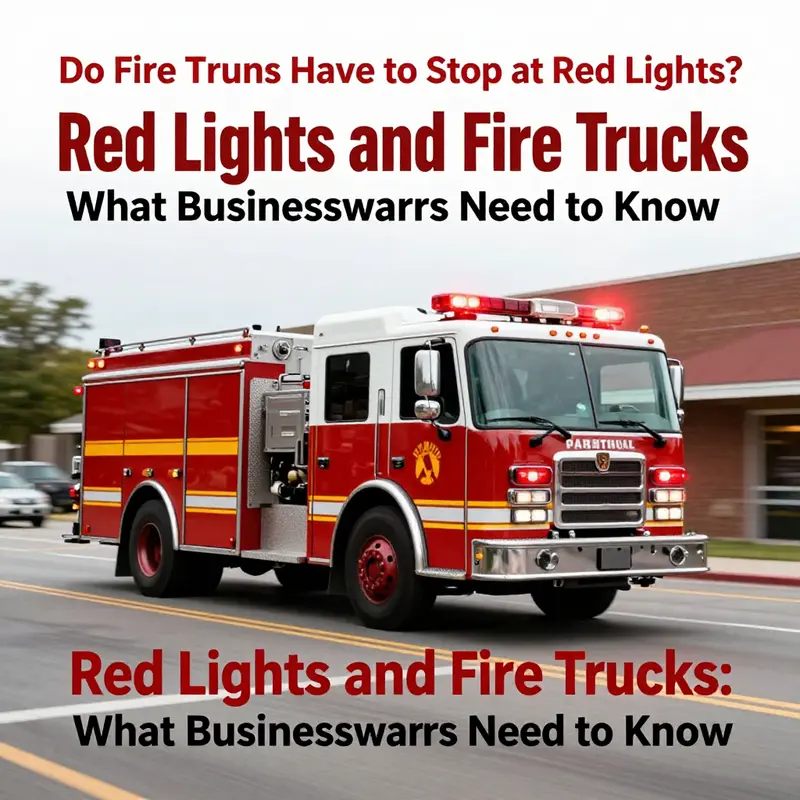
When the alarm crackles through a city block and a fire truck surges into the street with siren wail and a flood of blue-white light, the scene feels like a contradiction in motion: urgency without chaos, power that must still respect the human street it breaches. The drama is not only about speed; it is about a carefully calibrated balance between rapid response and the collective safety of everyone else on the road. Fire trucks, police cars, and ambulances are granted a special status in many places when they respond to emergencies. They can proceed through red lights and stop signs, but not with freedom or abandon. The exemptions are designed to shave seconds off a response time while maintaining a disciplined, safety-centered approach. This is the heart of the matter: the legal permission to break certain rules does not morph into a license to ignore risk. Instead, it marks a duty to move with due regard for broader safety considerations as the vehicle presses toward a scene where lives may depend on a timely arrival.
To understand how this works in practice, it helps to anchor the discussion in the recognized framework that governs emergency vehicle operation. In the United States and many other jurisdictions, emergency vehicles may pass through red lights or proceed through stop signs when responding to emergencies, provided they do so with due regard for safety. This phrase—due regard for safety—acts like a compass. It does not authorize reckless driving; it requires careful judgment, situational awareness, and a constant evaluation of risk. A red light is not an invitation to plow ahead; it is a permission to proceed when the risk of stopping would be greater than the risk of entering the intersection, and only after the driver has surveyed for oncoming traffic, pedestrians, and obstacles. The sirens and flashing lights serve as notice to others to yield and to clear a path, but they do not erase the responsibility to look twice before stepping into cross traffic or around a corner where a pedestrian may appear from behind a parked vehicle. This is a nuanced threshold, not a binary rule.
The National Highway Traffic Safety Administration (NHTSA) crystallizes the idea in its guidelines for emergency vehicle operation. The goal is to maximize speed to the incident while minimizing the chance of a collision. The guidance makes clear that the exemption is not a blanket freedom to ignore traffic laws; it is an exception to be exercised with restraint. The vehicle in emergency mode should move with appropriate speed for the situation, use the sirens and lights in a way that commands attention without startling other road users, and proceed only when the path is safe. If the path is not safe—if a cross street is suddenly occupied by a vehicle turning with limited visibility, or if a pedestrian begins an unanticipated crossing—the driver must adapt, slow, and even stop to reassess. The result is a dynamic balance: speed when it saves lives, patience when it protects lives in the moment. This adaptive approach is at the core of why the red light exemption exists in the first place.
The practical rhythm of a firefighting response illustrates the tension vividly. A fire truck racing toward a blaze is not guaranteed to encounter a single, clear path to the scene. Urban streets are crowded with buses, cars, cyclists, pedestrians, and temporary obstacles that can appear in seconds. The vehicle may pass through a red signal, but only after the operator confirms that the approach, the turning radius, and the cross-traffic situation permit safe passage. If crossing traffic has a protected turn, or if a pedestrian is waiting to cross but cannot be seen clearly due to glare or rain, the operator may opt to brake or wait, even in the midst of a siren chorus. In these moments, the exemption becomes a test of professionalism and prudence. It is not a carte blanche to gamble with public safety; it is a trained judgment that acknowledges the stakes and the limitations of high-speed navigation in a bustling city.
A central factor in that judgment is the role of the driver as a vigilant observer. Fire trucks, like other emergency vehicles, are built for visibility and control but rely on human judgment to interpret the field conditions. The operator screens for the potential arrival of a second emergency vehicle, which might require swift corridor adjustments or a change in lane positioning to avoid a bottleneck at an intersection. The process often involves a brief strategic pause at the perimeter of the intersection—enough to confirm that all lanes are clear, that a pedestrian cannot step into the path unexpectedly, and that the crossing traffic is indeed yielding. This pause is not a sign of hesitation in the face of urgency; it is a deliberate measure to prevent a preventable accident. The crew must constantly weigh the urgency of the call against the risk of harm to bystanders and responders alike. In this sense, speed becomes a responsibility, not a thrill.
The safety calculus extends beyond the intersection itself. It includes how the vehicle is driven in the approach to the scene, how the crew communicates with one another inside the cab, and how they coordinate with on-scene personnel. The sirens communicate with bystanders and other drivers, but the voice communications among the crew—what to expect at the next block, whether additional units are en route, whether a hydrant will be accessible—anchor the mission in continuous information flow. The equipment on the truck also shapes the approach. Heavier, more specialized trucks—whether they are aerial platforms, water tenders, or foam-equipped units—may require wider turns, longer stopping distances, or firmer, steadier throttle input to maintain control at higher speeds. The design implications of these vehicles are not incidental; they are central to how aggressively they can pursue a path through red lights while preserving safety for themselves and others.
The ethical dimension underpins every practical choice on the road. Communities place a high value on fast response in emergencies, and the public inherently trusts firefighters to act with both courage and restraint. That trust rests on predictable behavior. If drivers of emergency vehicles consistently pushed the boundaries of the red light exemption without clear justification, confidence in the system could deteriorate, and the very people the exemptions aim to protect could be placed at greater risk. Conversely, when firefighters demonstrate disciplined judgment—slowing, stopping, or re-routing as the situation evolves—the public sees a credible, reputable system at work. This perception matters because it influences how drivers and pedestrians respond when they hear a siren or see flashing lights. A well-calibrated system reduces the chance of sudden, panic-driven moves by other road users, which in turn lowers the chance of unpredictable outcomes at critical moments.
Within the broader ecosystem of emergency response, the rules about red lights intersect with a wider set of guidelines and standards. Law enforcement and medical services share many of the same operational principles: proceed with urgency, but with an unwavering commitment to safety. The training that firefighters receive emphasizes situational awareness, rapid hazard assessment, and the capacity to adjust to changing conditions on the ground. The result is a fleet of responders who are prepared not only to move quickly but to slow down at the right moments, recalibrate a plan in response to a new obstacle, and coordinate with other responders in a way that optimizes overall outcomes. The emphasis on due regard is not a vague ideal; it is a practical rule of thumb that gets tested in every intersection the fleet crosses.
For readers curious about how these principles translate into fleet choices and vehicle design, it helps to consider the broader context of emergency response capabilities. The vehicles that patrol our streets are more than transportation tools; they are coordinated components of a system designed to deliver critical services under pressure. The decision to deploy a heavy-duty platform or a nimble light truck is rarely about speed alone. It is about the mission profile, the terrain, the expected hazards, and the time required to bring specialized equipment to bear at the scene. Aerial fire trucks, for example, must navigate urban corridors with a precise combination of speed, stability, and reach. Water tenders require secure access to water sources and deliberate routing to avoid exhausting the supply chain on the way to a fire. Each vehicle type carries its own operational envelope, but all share the core principle: the red light exemption is a tool used within a framework of careful judgment and coordinated action.
As the chapter threads forward, it is important to acknowledge that legal specifics can differ by jurisdiction. Some places may require that traffic yield until the vehicle has cleared the intersection, others may grant a broader passage for red lights, and others still may impose more nuanced rules that depend on the type of intersection, time of day, or proximity to schools or hospitals. The common thread is that exemptions come with accountability. Agencies track response times, monitor near-misses, and continuously refine training to reduce risk while preserving speed where it matters most. The public, in turn, benefits from a system that embodies both urgency and restraint. When the two coexist, the chance of preventing a fatal crash while still delivering critical services increases. This balance is not static. It evolves with new data, new technology, and new understandings of how people and vehicles share space on busy streets.
In the end, the question of whether fire trucks have to stop at red lights is best understood not as a simple yes or no, but as a question about the kind of society we want to inhabit when seconds count. We want responders who can reach a scene quickly without surrendering safety to reckless speed. We want drivers, pedestrians, and other motorists to recognize and respect the signs of an emergency in progress, to yield when appropriate, and to stay vigilant for changing conditions. This collaborative choreography—driven by policy, trained by practice, and reinforced by community trust—creates a roadway environment in which red lights can still signify a barrier that responders may legally cross, but only after a careful, deliberate assessment of risk. It is a reminder that speed and safety are not mutually exclusive; when managed with discipline and leadership, they reinforce one another, enabling firefighters to arrive with the greatest possible impact while preserving the safety of the people they pass along the way.
For readers who want a closer look at the practical side of emergency response workflows, the emergency-rescue-vehicle category offer an immersive sense of how responders choose and deploy the right tools for the moment. You can explore the range of vehicles and configurations that teams deploy in the field to support their missions, and see how the design features align with the safety-first, response-second ethos that governs their work. οχήματα έκτακτης ανάγκης
As our understanding deepens, the bigger picture becomes clearer: red lights signal urgency, but they also signal responsibility. The exemption to stop signals is not a license to hurry carelessly; it is a solemn authorization to act with the public’s best interests in mind. The fire service, and emergency services more broadly, are built on that paradox—from the outside, a scene that seems like chaos in motion; from the inside, a highly disciplined operation that advances toward danger only when the path is safe. In that paradox lies the truth of modern emergency response: speed when it protects life, restraint when it protects lives. This is why the red-light rule is not simply a rule about traffic. It is a reflection of a public commitment to deliver decisive help during crises while honoring the everyday rights and safety of every road user who shares the road with responders. It is a balance written into policy, trained into crews, and observed by the public with a trust that remains essential to both effective emergency service and community safety.
External reference for official guidelines on emergency vehicle operation: https://www.nhtsa.gov
Running Red Lights for Rescue: How Fire Trucks Balance Speed, Law, and Safety
Why fire trucks can legally run red lights—and what that actually means
Fire trucks are allowed to pass red lights in many jurisdictions when responding to an emergency. That allowance is not a license to ignore caution. It is a narrowly defined legal exemption paired with strict operational rules. The exemption exists because minutes matter when lives and property are at risk. The practical challenge is reaching a scene quickly while avoiding new harm on the way there.
The legal framework behind this balance is straightforward in its principle and complex in its application. Traffic signals and signs govern ordinary road users to create predictable traffic flow. Lawmakers carve exceptions for emergency vehicles so responders can get to incidents without delay. Those exceptions typically require the use of audible and visual warnings, such as sirens and flashing lights, to alert others. They also require drivers of emergency vehicles to proceed with due regard for safety, meaning they may have to slow or stop even when traffic controls would normally allow them to go.
That last requirement—proceeding with due regard—matters more than the exemption itself. A fire truck operator must constantly assess the scene in front of the vehicle. When approaching an intersection under a red light, the operator looks for oncoming traffic, crosswalk users, bicyclists, and any unexpected obstacles. The presence of sirens and lights helps. But people sometimes do not hear or see an approaching truck. Pedestrians may be distracted. Drivers may have impaired hearing, reduced visibility, or may not immediately understand which direction the emergency vehicle is coming from. An experienced operator reads body language, vehicle movements, and gap times. When an intersection looks unsafe, the operator slows or stops, even though passage through the red light would be lawful.
Training underpins this judgment. Fire department drivers complete advanced instruction that covers vehicle dynamics, defensive driving, and intersection management. They learn to estimate closing speeds, to anticipate evasive moves by other road users, and to position the apparatus to protect crews and the public. Simulations and real-world drills teach restraint as much as speed. Many departments emphasize that arriving safely with a small delay is preferable to arriving first but causing a serious crash.
Operational protocols vary between departments and across regions, but the themes repeat. The apparatus must display lights and sound. The operator should reduce speed at intersections. If visibility is poor, the operator must take extra caution. The vehicle should not endanger crews already on the road or on-scene. And when multiple emergency vehicles respond, they coordinate to avoid creating chaotic traffic movements that increase risk. Those coordination practices include yielding to units closer to the incident or to a command vehicle that establishes control over the staging area. Many departments use a designated lead vehicle to set the pace and path through complex traffic.
Technology also plays a role in reducing the tension between speed and safety. Traffic signal preemption systems can change lights ahead of an approaching truck. When activated, these systems extend green lights or turn cross-street signals red to provide a safer passage. Preemption reduces the need to traverse a red light and lowers the chance of conflict with cross traffic. But preemption is not universal. It requires infrastructure, agreement with local traffic agencies, and compatible equipment on the apparatus. Where preemption is absent, the operator must rely on judgment and the awareness of other road users.
There are practical considerations beyond equipment and law. Size and weight matter. Fire trucks are large and heavy. They need more distance to stop than passenger cars. They have a taller center of gravity and can be less nimble at high speed. That reality forces conservative speed choices on narrow streets, in residential areas, or when road surfaces are wet. A red-light exemption does not change physics. The operator must account for braking distance and roll stability when deciding whether to enter an intersection.
Likewise, the human factor cannot be ignored. Sirens and lights are tools for alerting, but they also create stress and confusion. Drivers hearing a siren may instinctively brake, pull to the right, or make sudden lane changes. Some drivers freeze. Pedestrians may dart across streets thinking they can beat the vehicle. These reactions increase the risk at intersections. Fire truck drivers anticipate such responses and adjust their behavior accordingly. They may slow, flash lights more aggressively, or take a different route to avoid uncertain interactions.
When accidents do happen, liability and legal scrutiny follow. Exemptions do not eliminate responsibility. Courts and investigators look at whether the operator acted with reasonable care given the circumstances. They examine speed, lighting, siren use, prior warning, and whether the operator had an unobstructed view. Internal department reviews and external investigations both consider whether policy was followed. If an operator disregarded safety protocols, the legal and administrative consequences can be severe. Conversely, detailed documentation showing adherence to protocol and sound judgment can protect both the driver and the department.
Public education has an important role in reducing risk. Drivers often misunderstand the rules around emergency vehicles. Many believe they must come to a full stop whenever they see lights and siren, even when an emergency vehicle is approaching from a different direction. Others assume the emergency vehicle can pass through any situation without risk. Clear public messaging helps: move safely to the side, stop if required, and do not follow an emergency vehicle closely. Pedestrians should avoid making unpredictable moves when sirens sound. By improving public behavior, the probability of a safe, swift transit increases.
Inter-jurisdictional differences add layers of complexity. State and local laws define the exact scope of exemptions. Some places require a complete stop at a red light before proceeding, even for emergency vehicles, except where traffic preemption is active. Other places explicitly allow proceeding without stopping, provided due regard is exercised. Departments operating near municipal borders must train drivers on the variations they may encounter. Mutual aid responses—where crews cross jurisdictional boundaries to assist—require clear understanding of the host agency’s rules and any special agreements in place.
Coordination among multiple responding units is another practical necessity. When several fire trucks, ambulances, and police vehicles approach the same intersection, the risk multiplies. Standard operating procedures often designate a sequence or direction for entry. For example, the first-in unit may assume responsibility for establishing the scene and manage traffic control. Additional units may be instructed to stage nearby until the initial units secure entry paths. This reduces intersection congestion and prevents accidents caused by competing rushes.
Several routine scenarios illustrate the principles. A truck approaching an intersection with a green light that suddenly changes as traffic crosses will slow and verify the cross traffic is clear before accelerating. If an opposing vehicle blocks the intersection, the truck will come to a controlled stop until the path clears. At night, with reduced visibility and more pedestrians, drivers exercise added caution. When responding to structure fires where bystanders often gather, operators slow earlier to avoid striking people who step into the street to get a better look.
These operating choices affect response time. There is a trade-off between the fastest possible arrival and the lowest risk en route. Departments track both. Time-to-scene metrics matter, but so do safety records. A department with the fastest response times but repeated collisions achieves little if crews and civilians are injured in transit. Policies aim to reach an optimal balance where response times are acceptable and accidents are rare. Continuous training and after-action reviews help refine that balance.
Finally, the culture within a fire service shapes how the rule is applied. Some departments cultivate an aggressive driving style, believing speed is the paramount priority. Others promote a conservative ethic, valuing control and predictability. The safer approach combines urgency with caution. Leaders who emphasize accountability, training, and realistic risk assessment encourage operators to make prudent choices at red lights and elsewhere.
For anyone who shares the road with emergency vehicles, a simple mindset helps: expect the unexpected, yield promptly but safely, and avoid assuming the emergency vehicle can stop or swerve to avoid you. For emergency drivers, the guiding principle is similar: use available exemptions wisely and always assess intersection risk before proceeding. Where technology allows, use signal preemption to reduce conflict. Where it does not, let caution govern speed.
These practices reflect a shared civic responsibility. Laws provide the framework. Training gives responders tools. Technology improves options. Public cooperation reduces hazards. Together, these elements create a system where fire trucks can move with the speed necessary to save lives, while minimizing the risk of creating new emergencies along the way.
For department policies and technical standards on emergency vehicle operation, consult the National Fire Protection Association for detailed guidance and best practices: https://www.nfpa.org/
For information on specialized response vehicles, including command units that coordinate traffic and staging at incidents, see fire command vehicles.
Red Lights, Rapid Response: Navigating Intersections with Fire Trucks Under Legal Exceptions
When a fire engine screams down a city street, the world seems to tilt toward a different arithmetic of time. Each second is critical. The traffic signal that would consign a sedan to a halt becomes a negotiable threshold for a vehicle sprinting toward danger and rescue. The question that often surfaces in audits, debates among jurists, and public discussions is simple and deceptively easy to answer: do fire trucks have to stop at red lights? The instinctive answer for many drivers is no; the rules are bent when safety demands it. Yet the truth is more nuanced and much more consequential. The safety of the public and the people in the fire department depends on a carefully calibrated balance between privilege and responsibility. The law recognizes that when a professional fire unit answers a call, it gains certain exemptions that respect the imperative to save lives and protect property. At the same time, those exemptions are not carte blanche to do as one pleases. They come with a duty to exercise due regard for others, to plan a safe approach, and to be prepared to yield when the risk becomes unacceptable. In this sense, the red light at a cross street becomes less an invitation to ignore the signal and more a gate that must be negotiated with judgment.
The legal architecture behind this practice rests on a principle often summarized as the emergency response exception. In this frame, a fire truck may proceed through a red light when responding to an emergency, provided the sirens and flashing lights are active and the operation is conducted with the right of way in mind. It is a recognition that the alternative—waiting for a green signal in the midst of a fast-moving fire—could compromise the mission and cost lives. Yet the same architecture insists that the exception is not a license to abandon caution. It is a grant of speed, paired with heightened responsibility.
In practice, this means the driver of an emergency vehicle must treat the intersection as a space of potential danger where the usual rules are temporarily suspended, but not erased. The requirement is not merely to punch through a red light but to do so with due regard to safety. The phrase due regard is not cosmetic; it is the legal and ethical anchor for every maneuver. It requires visual and auditory awareness of the surroundings, an assessment of the speed and trajectory of cross-traffic, and a readiness to stop before entering the intersection if the conditions are unfavorable. The driver must weigh the urgency of the call against the presence of pedestrians, cyclists, patients in the vicinity, and other vehicles that may not realize the seriousness of the siren’s plea. In many jurisdictions, the rules anticipate this tension. They permit a red light to be treated as yield or as a stop-and-go decision rather than a unidirectional command. The vehicle may proceed when it is safe, with the understanding that if a safer alternative exists, it should be chosen. If the sight is blocked by a truck, or the cross-street is stacked with cars, or a pedestrian detector reveals someone stepping off the curb, the emergency vehicle may reinstate a stop. It is a perpetual negotiation between speed and safety.
The chain of accountability for such decisions runs through the training and protocols of the fire department and into the courtrooms where liability may be determined. This is not a world in which one can pretend that law and practice exist in silos. The driver is trained to plan ahead, to anticipate what other road users might do, and to adapt to the unpredictable rhythms of an urban arterial or a rural intersection. The duty of care is not suspended because the lights are bright or the siren screams louder. It remains the central test of competence. If an accident occurs while answering an emergency—say, a collision with another vehicle that fails to yield, or a pedestrian who steps into the path, or a cyclist who does not hear the warning—there can be serious consequences. The resulting liability in civil court can surpass the immediate harm of the situation, extending to damages or even charges if negligence is proven. The calculus becomes a public policy question as well: how to balance the imperative to respond rapidly with the obligation to protect the vulnerable populations that share the road.
To understand how the practice plays out in the day-to-day work of the fire service, consider the sequence of actions that typically unfolds as a fire engine nears an intersection with a red signal. The sirens begin to scream, and the lead driver communicates through radio and, where appropriate, through mounted signals that the unit is diverting toward the call. The crew members adjust their seating and prepare to move with precision, each member aware of the potential hazards beyond the brake lights. The vehicle slows, but not to the extent of a complete stop unless the conditions demand it. The driver scans the cross-street, paying particular attention to the timing of gaps in traffic. A safe crossing may hinge on a partial pause at the boundary line, a moment of caution in which the engine remains in motion but reduces speed to a crawl. In a dense urban setting, the approach itself can become a tactical operation: the engine may angle for a diagonal entry to reduce the width of the crossing or align with a lane that provides a clearer path through the intersection. These micro-decisions are not arbitrary. They are guided by standard operating procedures, measurement of risk, and the experience that comes from countless calls where the difference between proceeding and stopping is measured in breaths.
Public safety communications reinforce the practical side of these rules. The public expects that emergency responders will reach their destination with haste, but not at the expense of people in the street. To achieve this, departments emphasize the need for reliable coordination with other road users and robust situational awareness. In a city or a county where road networks are dense and multi-lane, the potential for conflicting movements around an intersection increases dramatically. A fire truck may have to cross an intersection where traffic signals are synchronized with a complex network of signals and turn restrictions. The driver must be mindful of the position of vehicles turning left across the path, of oncoming cars in the opposing lanes, and of pedestrians who may appear suddenly from between parked cars. Each of these factors shapes a split-second decision: when is it safer to push through, and when should the unit pause to allow a phalanx of vehicles to clear from the opposite approach before it proceeds? The safety protocols are designed not only to protect the crew but also to preserve the integrity of the response. A delay to ensure that the route is clear can prevent an entanglement whose consequences would ripple through the incident timeline, delaying fire suppression, medical aid, or rapid exit.
The internal architecture of fire service policy reflects the same emphasis on caution that governs the human decision-making at the wheel. A modern engine is not a purely mechanical device; it is a node in a broader system of response. Dispatch decisions, pre-arrival information, and the real-time feeds from traffic management systems all contribute to the ultimate choice at the intersection. When a unit is told to respond with lights and sirens, the dispatcher is establishing a priority that supersedes ordinary traffic flows. Yet the unit commander bears the responsibility of translating that priority into a safe and efficient path for the crew. The rules acknowledge this dual obligation by creating a framework in which speed does not replace safety, and safety does not erase speed. The end goal remains fixed: to bring those in need relief as quickly as possible while minimizing the risk to others.
This nuance matters for drivers who share the road with emergency vehicles. For the average driver, the law can seem opaque, and the behavior of emergency responders may appear inconsistent from one incident to the next. Some encounters at red lights end with a clean pass through, others with a full stop and a cautious crossing. The variance is not a sign of misbehavior but a reflection of real-time risk assessment. The best drivers learn to look for patterns in the emergency response culture of their local jurisdictions. They learn to anticipate that a red light might be treated as a yield, but only after the engine has confirmed that the path ahead is clear. They learn that when an oncoming vehicle approaches a cross-street with similar lights flashing, a moment of mutual courtesy and coordination becomes imperative. The law demands more than mere bravura; it demands professional discipline. The measure of success lies not in how loudly a siren sounds, but in how successfully the vehicle completes the mission with the least possible harm to bystanders and property.
To ground this discussion in the broader context of road safety and law, it helps to look at the guiding documents that shape emergency vehicle operation. National organizations have produced guidelines that translate the complex interplay of exemptions and responsibilities into practical steps. Among these, the principle of due regard stands out as a core tenet. It is a reminder that the privilege to violate typical traffic rules is bounded by the obligation to weigh harm, to seek the safest possible moment to cross, and to reassess continuously as the situation evolves. The guidance emphasizes predictable behavior. When a fire engine nears an intersection, the actions of the crew should be consistent enough that other drivers can learn to expect a response pattern. Predictability reduces the chances of a mistaken move by another road user who might otherwise react unpredictably. Jurisdictional differences do exist, but the thread that runs through most regulations is the insistence that emergency vehicle operation is a skilled, communicative, and safety-conscious enterprise.
In addition to the legal frame and the human factors at play, there is a practical dimension that concerns maintenance, equipment readiness, and training. A vehicle that responds with speed but without reliable brakes, or one whose siren system is not fully functional, poses a danger that defeats the purpose of the exemption. Fire departments invest in regular drills that simulate the precise dynamics of approaching and passing through red lights. These drills cover several variables: varying traffic densities, the presence of pedestrians, the coordination with other emergency units on the scene, and the interplay with the traffic signals themselves. A drill might test how the crew handles an upcoming intersection with a red light and a cross-traffic stream that includes a bus or a heavy truck. The aim is to build muscle memory that translates into safe judgment under stress. In a well-run operation, the crew will pass through an intersection by applying a controlled approach: slow down as needed, use the vehicle’s position to maximize sight lines, communicate with the cross-traffic through signals or eye contact, and proceed only when there is a clear window. After action reviews are standard practice. When a response ends, a formal review often looks at whether the intersection handling conformed to policy and whether any preventive steps could stop similar incidents from repeating.
The public-facing dimension of these policies is also worth noting. Local authorities often publish summaries that help ordinary citizens understand what to expect when emergency vehicles approach. People living near major roads may recall times when police or fire units glided through a red light, and they might wonder about the safety implications. Community education efforts aim to reassure residents that while the path may be cleared by the emergency vehicle, crossing pedestrians and drivers do not vanish simply because a siren is on. The fundamental message is that the system works best when everyone on the road understands the rules and behaves with civility. Yielding at the right moment to an emergency vehicle that is preparing to pass through an intersection is not only about following the law; it is about respecting the life-saving mission that is under way and recognizing that the consequences of hesitation may cascade beyond the moment.
In parallel with the legal and procedural aspects, one can reflect on the broader philosophical question that sometimes emerges in public discourse: should red lights be ignored at all costs by emergency responders, or should the traffic infrastructure be redesigned to accommodate faster and safer responses? The answer is not a simplistic either/or. It requires a system-level approach that includes better preemption technology, adaptive signal timing, and road layouts that minimize risk during high-speed responses. Many modern signal systems have features that can prioritize emergency vehicles in a controlled fashion, granting them a faster track through congested corridors without requiring drivers to guess whether a vehicle will bolt through a red. This is not a universal cure, and it raises its own set of challenges, from the reliability of sensors to the fairness of treatment for other road users, but it represents a direction in which policy and engineering can converge. It also underlines why the topic matters beyond the law: the safety metrics associated with emergency vehicle operations depend on how well the entire transport ecosystem harmonizes privilege with responsibility.
As readers consider the practical implications of these rules during a commute or a family trip, the underlying message should be clear. Fire trucks and other emergency vehicles do not simply replace the traffic signal with a louder engine and pursuing siren. They operate within a framework that explicitly acknowledges the unique urgency of their mission while demanding that they navigate with care. The red light, which for most drivers signals guaranteed stopping, becomes a negotiable boundary for those who answer calls of life and danger. And the public, in turn, plays a critical role by understanding when to yield and by expecting that responders who pass through a red signal do so with calculated caution rather than reckless bravado. The public expects speed, but it also expects safety, and the system is designed to deliver both in a balanced way.
For readers seeking a practical sense of how these rules translate into on-the-ground behavior for emergency teams, consider the broader family of vehicles that operate in this space. While the focus here has been on fire trucks, the same principles apply to other emergency units that use lights and sirens to navigate through traffic. The approach is consistent: prepare, proceed with caution, be aware of the environment, and function under the principle that risk is weighed against need. To explore contemporary examples and to see how departments tailor their procedures to fit local road networks, you may look at the Emergency Rescue Vehicle category on related professional and safety platforms. The content here remains anchored in the fundamental logic that the ability to respond quickly must be harmonized with the duty to protect the public. In the end, the intersection is a shared space that tests the crew’s discipline as much as the visibility of their lights.
Ultimately, the legal and practical nuances of red lights and emergency response are not abstractions; they shape everyday behavior in streets, highways, and neighborhoods. They influence how a family is protected when a nearby fire call requires a rapid response, how a commuter adjusts to an alert from a siren at a busy crossroad, and how a city plans its traffic infrastructure to support life-saving missions. The result is a mature, tested approach that recognizes emergency vehicles as essential to public safety, while insisting that their drivers—indeed, all drivers—practice disciplined judgment under potentially dangerous conditions. If a reader takes away one guiding idea, it should be this: privileges granted to emergency responders are backed by the responsibility to minimize risk and to protect life, not to maximize speed at any cost. The intersection thus becomes a shared space, a place where urgency and caution converge, where the clock on the wall tics for those inside the burning building or the injured awaiting care, and where every decision at the curb or the crosswalk carries consequences.
For authoritative information on traffic laws and emergency vehicle procedures, refer to official government guidelines on emergency vehicle operations: https://www.nhtsa.gov/emergency-vehicle-operations
community safety
Understanding whether fire trucks need to stop at red lights is more than just a matter of traffic laws; it is about being prepared for emergencies and fostering a culture of public safety among businesses. Emergency vehicle exemptions are designed to ensure that vital services can reach those in need swiftly. By familiarizing themselves with the legal landscape and safety protocols, business owners can play a significant role in maintaining community safety and facilitating smooth emergency responses. Remember, proactive measures today can save lives tomorrow.

