
















As business owners seek innovative ways to enhance their brand visibility or expand their operational capabilities, owning a fire truck may seem like an intriguing option. However, the process of owning such a unique vehicle involves navigating a complex landscape of legal regulations, operational requirements, and practical considerations. This article provides a detailed examination of these facets, ensuring that potential owners are well-informed and prepared for the responsibilities that come with fire truck ownership. Each chapter explores specific aspects: from understanding the legal framework guiding fire truck ownership, assessing the required operational protocols, to tackling practical considerations involving maintenance and cost—which altogether form a vital foundation for making a sound investment in this specialized vehicle.
Beyond Ownership: The Legal Labyrinth and Practical Realities of Owning a Fire Truck
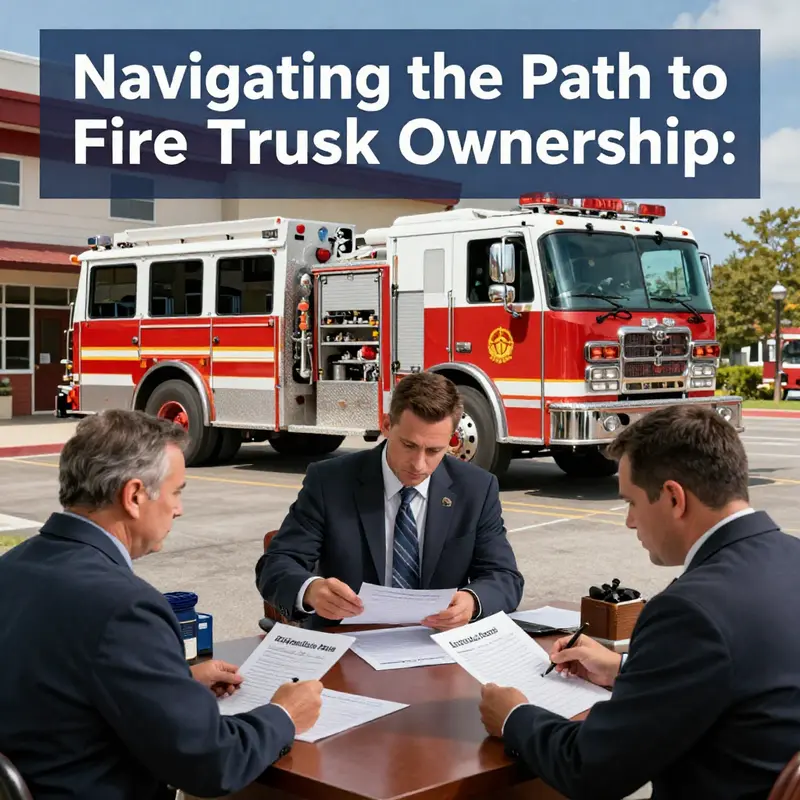
Owning a fire truck sits at the intersection of fascination and regulation. It invites a question that sits at the heart of this discussion: can you legally own such a vehicle, and what does ownership entail beyond the thrill of possession? The short answer is yes—ownership is possible in many jurisdictions—but it is never a simple private purchase. Fire apparatus are highly regulated assets with safety, liability, and public-interest considerations that shape every subsequent step.
Registration and licensing mark the entry point. A fire truck must be registered as a motor vehicle with the appropriate authority, typically a state motor vehicle department or a similar agency. Because these vehicles are large, heavy, and purpose-built, the paperwork often emphasizes title proof, vehicle weight classifications, and compliance documentation that may be more stringent than for ordinary trucks. The owner will usually need to present a plan for ongoing maintenance and operator training before registration is complete.
Safety and emission standards further constrain what is possible on the road. Fire apparatus must meet core federal safety requirements for brakes, lighting, tires, and structural integrity, and they can be subject to emissions rules that vary by engine type and jurisdiction. The rise of electric or hybrid fire trucks introduces new layers of safety protocols, battery management considerations, and charging infrastructure requirements that regulators and insurers are actively weighing. In practice, this means the vehicle may need modern safety upgrades or specialized inspections to pass muster before it can operate publicly.
Operating on public roads is a privilege that comes with licensing, insurance, and responsible driving. Owners may need a commercial driver’s license (CDL) or other endorsements, depending on the vehicle’s weight, configuration, and intended use. Insurance is essential and typically tailored to the vehicle’s size and risk profile, often including endorsements that reflect its equipment and potential liabilities. Even with a registered title and insurance, the right to drive a fire truck on public roads is conditioned on compliance with traffic laws and safe-operation standards.
Use and purpose clarify what is permissible. It is legal to own a fire truck for display, educational programs, or private collection, provided the vehicle complies with applicable rules. Using the truck to simulate an emergency response—activating lights and sirens in non-emergency situations or operating it in public spaces as if responding to a call—can be illegal and expose the owner to penalties. If the owner intends to operate on public roads beyond purely display events, formal pathways usually involve partnerships with fire departments, training organizations, and regulatory approvals.
Tax implications and ongoing costs add to the calculus. Large, heavy vehicles typically incur higher taxes and insurance costs, with some jurisdictions offering exemptions for historical, educational, or museum use. Even when exemptions apply, there are often strings attached—documentation, demonstrations, and use restrictions—that influence how ownership is structured and maintained. The lifetime cost of ownership extends far beyond the purchase price and includes fuel or energy, parts, routine maintenance, and periodic inspections.
Practical realities are the ultimate test. Fire trucks require specialized maintenance, access to spare parts, and trained technicians. They demand substantial storage space, secure and properly ventilated facilities, and a plan for routine testing of pumps, ladders, and communication systems. Budgeting realistically for ongoing upkeep helps ensure the vehicle remains a safe and capable asset rather than a museum piece.
A prudent path begins with concrete steps: contact the local DMV or equivalent to learn exact registration requirements and inspections; secure a title and proof of ownership; arrange appropriate insurance and any endorsements; and connect with credible training providers or a local fire department to establish a plan for operator training and ongoing compliance. Building partnerships with recognized fire-service entities often smooths the way toward more flexible use while maintaining safety and public trust.
Finally, trends toward electrification and advanced propulsion add new regulatory considerations. Battery safety, high-voltage systems, charging infrastructure, and the evolving standards for energy-efficient emergency vehicles require close collaboration with qualified technicians and regulators. The propulsion choice will influence the regulatory path, insurance, and maintenance architecture, but the overarching principle remains unchanged: ownership is possible, yet it demands discipline, accountability, and a commitment to public safety.
In short, owning a fire truck is a stewardship endeavor as much as a purchase. It requires planning, compliance, and a long-term perspective on how the asset serves education, public safety, and responsible display. If you pursue ownership, start by clarifying your objectives, understanding regulatory requirements, and seeking experienced partnerships that can bridge private ownership with safe, lawful operation.
Between Ownership and Operation: Navigating the Legal Runway for Fire Trucks
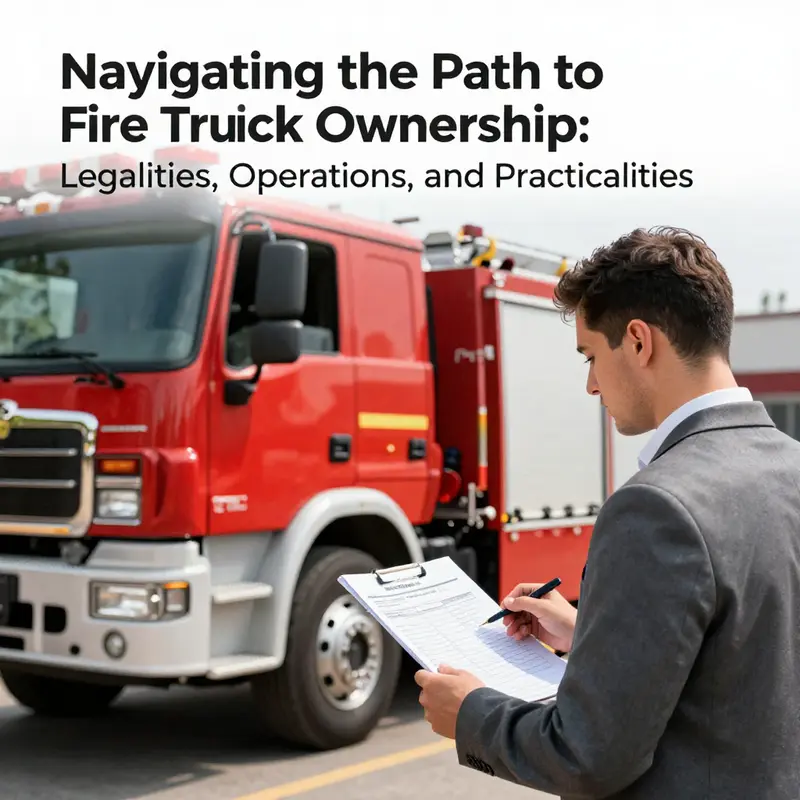
Owning a fire truck is a dream that sits at the intersection of public service, mechanical fascination, and legal complexity. It is more than a car with bigger tires and brighter lights; it is a purpose-built tool designed to save lives and protect property under extreme conditions. The allure of ownership can be strong enough to overlook the fact that a fire truck is also a heavily regulated asset that travels through a layered maze of federal standards, state and local rules, and practical realities. The journey from curiosity to ownership, therefore, begins not with a price tag but with a clear-eyed assessment of what it takes to register, insure, license, and legally operate such a vehicle on public roadways. It also requires an honest appraisal of what the vehicle will be used for, how often it will be driven, and who will maintain it. Without this groundwork, ownership risks becoming an expensive curiosity rather than a lawful, sustainable enterprise.
The first layer of this maze is the recognition that ownership is legal in the abstract, but operation on public roads is a privilege that comes with conditions. The vehicle’s fate is decided as much by regulatory compliance as by the initial purchase. A fire truck, even one that has served a municipal or industrial department, is not automatically a free-rolling permit to roam. Registration and title play the opening acts in this drama. In most states, you must register the truck as a motor vehicle, secure a valid title, prove ownership, and pay registration fees. The classification can vary; some jurisdictions label these extraordinary vehicles as commercial or special-purpose, which can influence how the vehicle is taxed, insured, and inspected. The path may feel bureaucratic, but these steps anchor the ownership in a framework designed to ensure safety and accountability for vehicles that operate in special circumstances and often under urgent conditions.
From there, the regulatory arc broadens into the safety and environmental regimes that govern any vehicle sharing the public space. Fire trucks, especially those originally built for emergency service, were designed to meet specific standards that may not align perfectly with standard passenger-car regulations. The federal dimension is anchored by vehicle safety and emissions standards, typically administered through agencies like the National Highway Traffic Safety Administration (NHTSA) and the Environmental Protection Agency (EPA). The challenge is not simply ticking boxes; it is ensuring that the apparatus, as configured for public operation, complies with safety features such as lighting, sirens, braking systems, tires, seat belts, and occupant protection, along with emissions controls and, increasingly, technologies that monitor exhaust and idle patterns. If a vehicle lacks a compliant configuration, the owner must pursue modifications, certifications, or retrofits that bring it into alignment with current federal standards. The result is not just a checkmark on a federal form but a set of practical adjustments that can reshape a vintage or imported unit into a roadworthy asset.
States and local jurisdictions layer on their own expectations for what counts as a roadworthy fire vehicle. This is where the operation on public roads transitions from a theoretical possibility to a practical reality. A crucial requirement is the driver’s qualification. A fire truck’s size and weight often exceed typical passenger vehicles, which means the operator may need a commercial driver’s license (CDL) or another specialized endorsement depending on the vehicle’s weight and configuration. Insurance then becomes a gateway decision: a vehicle intended for public road use must be insured, with coverage that reflects both the value of the machine and the risk profile of its operation. The coverage must extend to non-emergency use and, importantly, to the vehicle’s role on public roads, which differ from private use in terms of liability, liability limits, and any required umber of drivers. And then there are traffic regulations—oversized-vehicle permits, route restrictions, and local ordinances that govern the operation of vehicles with substantial dimensions. The owner’s responsibilities multiply when the intent is to operate along city streets, highways, or even rural lanes that were not designed with a fire apparatus in mind. In all cases, the compliance chain demands exacting attention to state and local statutes, and it often necessitates coordination with the DMV, the local police or sheriff’s office, and the fire department that originally used the vehicle.
A practical reality often forgotten in the dream is that ownership can be for purposes other than immediate active service. If the goal is to display, privately collect, or use the fire truck for educational events, the path to legal operation remains, but the emphasis shifts. Display and educational use are legitimate avenues, but they do not grant the freedom to ignore the rules that apply to road use. Even when not responding to real emergencies, the vehicle must be properly registered, insured, and maintained to pass roadworthiness inspections. The siren and lights, while perhaps decorative in a museum or educational context, still carry legal weight. The misstep that trips many would-be owners is to shout “emergency vehicle” without the proper authority or permitting framework. Using a fire truck to simulate an emergency response, complete with sirens and lights, can be illegal and expose the owner to fines, civil liability, or even criminal charges. The line between dramatic realism and unlawful impersonation is thin, and it is the owner’s duty to stay on the correct side of it.
Tax considerations complete the regulatory circle with a fiscal dimension that can surprise new owners. Large, heavy vehicles carry property tax implications that differ from standard passenger vehicles. Sales tax, use tax, and potentially other levies come into play, depending on the jurisdiction. Some states offer exemptions for historical or educational vehicles, which can be helpful if the fire truck is intended for a museum, a public safety education program, or a recognized educational purpose. Navigating these exemptions requires careful documentation, alignment with the vehicle’s intended use, and, often, cooperation with local tax authorities. The financial picture is not merely about the purchase price. It includes ongoing costs for fuel, routine maintenance, specialized parts, and the possibility of needing a crew or staff to operate and supervise the vehicle. For some owners, the annual cost of ownership can be a more meaningful consideration than the purchase price itself, especially when the unit sits unused for long stretches or requires frequent, costly repairs because it is a specialized machine.
This layered regulatory and financial framework is not meant to deter ownership but to encourage preparedness. The decision to own a fire truck is not simply a function of a capex budget; it is a governance proposition. It calls for a clear statement of purpose, a documented plan for compliance, and a lifecycle perspective that anticipates the vehicle’s evolving needs. The operational reality is that a fire truck has a finite life as a piece of emergency equipment and a longer life as a defensible asset for education, storytelling, and the public’s ongoing engagement with safety. The best owners treat ownership as a stewardship role: they prepare a maintenance regime that mirrors the department’s standards, ensure spare parts are accessible, and build a support network that can respond to breakdowns with the same agility that a fire department would expect in the field. This alignment of purpose, process, and people is what turns a legal possibility into a sustainable, responsible venture rather than a novelty purchase.
To get there, prudent owners begin with a candid assessment of technical compliance and readiness. NFPA 1901, the standard for structural fire apparatus, remains a guiding reference, as does ISO 9001 for quality management in manufacturing and service. These standards help ensure that a vehicle’s construction, equipment, and documentation meet recognized benchmarks of safety, reliability, and performance. It is not enough to own a fire truck; it must be demonstrably capable of performing as designed under the kind of demanding scenarios that it may face. The process of certification, testing, and inspection—whether at the factory, in transit, or after a transfer of ownership—becomes an ongoing part of the lifecycle. The maintenance burden follows closely. Fire trucks are intricate systems with complex hydraulic, pumping, electrical, and safety subsystems. Regular maintenance schedules, operator training, and dedicated technical support networks are not optional extras; they are the backbone of safe operation. Experience has shown that neglect in any of these areas multiplies risk, increases downtime, and inflates long-term costs, turning a promising project into a liability rather than a civic asset.
The procurement path—whether this involves a locally sourced unit or an imported model—adds another layer of diligence. In a world where specialized equipment can be sourced globally, the decision to pursue a particular configuration must account for post-sale service, spare parts availability, and access to technical expertise. The logistics of getting a complex vehicle from an overseas supplier into service near a city, a port, or a rural station can involve lead times, currency considerations, and the reliability of aftersales support. Proximity to ports such as Qingdao or Shanghai can influence delivery times, but the true test lies in the robustness of the ongoing support ecosystem. A responsible owner does not view delivery as the end of a transaction; it is the start of a long-term partnership that includes maintenance, parts availability, and access to skilled technicians who understand the unique demands of emergency apparatus.
Beyond the technical and regulatory scaffolding lies the essential question of mission alignment. The most effective ownership strategy begins with the department or the owner’s stated mission and deconstructs it into a small set of incident categories that will drive the vehicle’s configuration and utilization. Urban environments with high-rise challenges require different capabilities than rural wildland settings or industrial plants with distinct hazards. A pumper’s reliability to deliver water through hoses and pumps is a different proposition from an aerial ladder’s reach, or from a rescue truck’s extrication tools. Matching the vehicle’s primary function to anticipated incident types is a discipline that prevents overbuilding the fleet or underutilizing it. It also helps with budgeting and lifecycle planning because it translates abstract capabilities into tangible, measurable outcomes. Over-specifying for rare scenarios creates unnecessary costs and complicates maintenance, while under-specifying can leave a department unable to respond to the majority of calls effectively. The goal is a balanced, fit-for-purpose asset that remains practical over decades of service, with a clear plan for upgrades or replacements as technology and incident patterns evolve.
In practical terms, the ownership equation includes a steady, collaborative relationship with the local DMV and, often, with legal professionals who specialize in vehicle law and compliance. The DMV is not a gatekeeper to be tripped but a partner in ensuring that the vehicle, when used on public roads, respects the rights and safety of other road users. A careful owner will consult official DMV resources to verify title status, registration requirements, and any endorsements required for operation. Where necessary, it is essential to document the vehicle’s non-emergency status, its educational role, and its use if it participates in public demonstrations. This transparency helps avert questions about misuse and underscores a commitment to safety and accountability. The legal landscape is dynamic; rules change, standards update, and interpretations shift with new guidance. A thoughtful owner keeps abreast of these changes, regularly reviews compliance status, and adjusts practices as needed to maintain a lawful and safe operation.
The chapter’s closing frame returns to the practicalities of day-to-day ownership. The financial calculus, while important, is only part of the picture. Storage demands, for instance, are non-trivial. Fire trucks require substantial space for covered or secure outdoor storage, routine inspections, and access to maintenance bays with appropriate tools and equipment. The vehicle’s weight and dimensions influence site planning for parking, maneuvering, and fueling. The environmental footprint—fuel consumption, emissions, and idling practices—deserves consideration, especially in urban or sensitive environments. The social dimension cannot be ignored either. A fire truck on display or used for educational programs can become a neighborhood asset, a tangible symbol of public safety, and a platform for community engagement. That social value contributes to the justification for ownership beyond the utilitarian purpose of firefighting. Yet it also intensifies the responsibility to maintain the vehicle in ready-to-safely-operate condition, because the public’s trust and safety hinge on the vehicle’s reliability and appearance.
For readers seeking a deeper map of the options and considerations, consider exploring the broader sets of fire apparatus available on dedicated platforms that catalog the range of vehicles and their capabilities, including one widely used category that emphasizes fire-fighting trucks as a core offering. This resource provides a practical sense of how different configurations map to distinct mission profiles and incident demands, which can help inform a decision about whether ownership aligns with your goals and capabilities. If you’re exploring options, see the fire-fighting truck category here: The Striker’s electric-enabled variant further expands this architectural conversation. By integrating a battery-electric propulsion system and a modular pack strategy, the Volterra line shifts from a conventional diesel-dominant paradigm toward zero-emission operations during station maneuvers and standby periods. The chassis architecture adapts to underfloor battery packs, reducing the traditional metrology of a ladder-frame to what is effectively a modular, integrated powertrain envelope. In addition to the powertrain shift, Volterra leverages fast-charging and regenerative braking to recalibrate the aircraft-rescue workflow, delivering faster initial acceleration—reported as a meaningful performance delta against diesel-only configurations—and maintaining high discharge capability with electric pumps that can sustain robust water and foam delivery. The integration with AI-enabled platforms adds a data-guided layer to the suppression process, providing insights on flow, pressure, and nozzle performance, and enabling a connected suppression ecosystem that promises to shorten extinguishment times and conserve agents..
Ultimately, the question of whether you can own a fire truck is as much about stewardship as it is about legality. Ownership is feasible within the law, but it demands a disciplined approach to compliance, a clear sense of purpose, and a robust plan for maintenance, safety, and ongoing support. The path from curiosity to lawful operation is a careful trajectory: register, certify, license, insure, and operate within the bounds of the local and federal frameworks that govern large, specialized vehicles. It requires a long-term commitment to safety and reliability, a willingness to invest in specialized parts and expertise, and a readiness to navigate the administrative and fiscal realities that accompany a machine designed for high-stakes emergencies. The payoff, in return, is not simply owning a remarkable vehicle but securing a platform that can educate, inspire, and realistically support public safety objectives while remaining compliant with the rules that ensure everyone on the road stays safer.
As you contemplate this ownership journey, remember that the landscape can be instructive in its own right. The very act of diligently aligning a vehicle’s configuration, documentation, and operation with authoritative standards clarifies the responsibilities that come with handling high-performance emergency equipment. The end result is not a flashy novelty but a lawful, credible asset capable of contributing to safety education, civic pride, and, ultimately, the public good. If this is the course you choose, prepare for a structured process that begins with a clear mission, proceeds through a rigorous compliance pathway, and culminates in an ongoing partnership with suppliers, regulatory bodies, and a maintenance ecosystem that sustains the vehicle’s readiness for years to come. This is how ownership evolves from an idea into a responsible operation that respects both the law and the communities it serves.
External Resource
For a broader understanding of how fire truck models are chosen to meet diverse needs, see the Fire Engineering guide mentioned in the detailed results for the chapter. It provides a comprehensive framework for evaluating apparatus based on call data, incident profiles, and industry standards. External resource: Guide To Choosing The Best Fire Truck Model For Every Need.
Owning a Fire Truck: Navigating Legality, Responsibility, and Everyday Realities
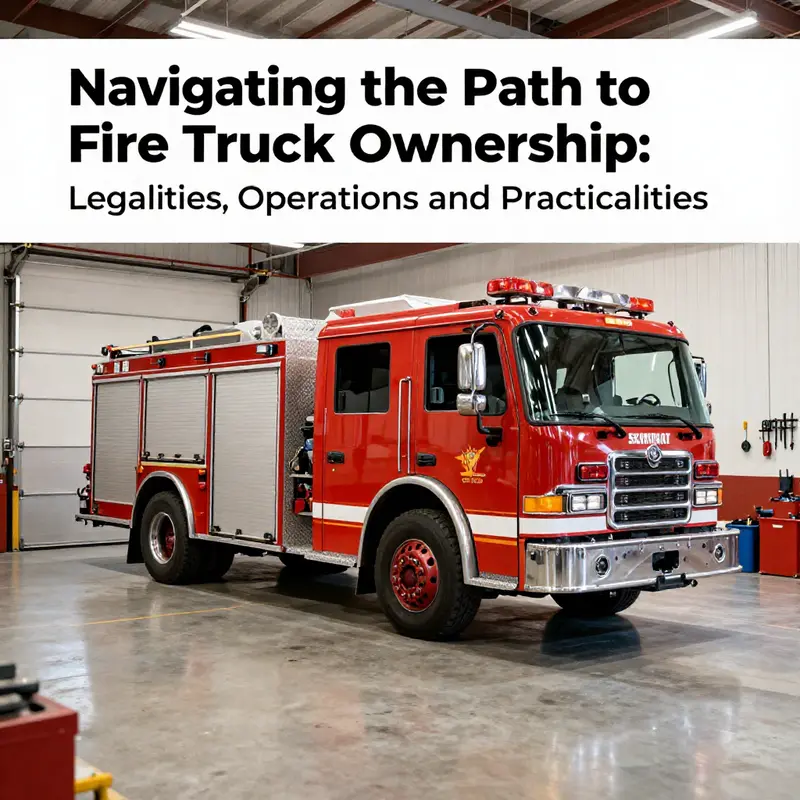
Owning a fire truck is rarely a straightforward transaction. The idea may spark curiosity or even a certain sense of awe, but the path from a spark of interest to a legally operable vehicle on public roads is paved with regulatory checkpoints, practical constraints, and ongoing commitments. The core question—can you legally own a fire truck—has a clear yes at its heart, but the conditions attached to that ownership determine whether the vehicle remains a decorative trophy, a museum piece, or a usable emergency tool. The practical narrative that follows is not merely about acquisition. It is about understanding the full spectrum of responsibilities that come with owning a fire truck, from the legal gatekeeping of titles and registrations to the daily realities of maintenance, staffing, storage, and lawful use. In many jurisdictions, the answer hinges less on ownership in itself and more on the capacity to meet standards that ensure safety, accountability, and reliability when the vehicle is needed most. This chapter threads together the regulatory framework with the lived realities of keeping a heavy, highly specialized machine in serviceable condition, while also acknowledging the nuanced ways ownership might play out for museums, educational groups, private collections, or specialized commercial ventures. The guiding thread is clear: legality opens doors, but it is practical discipline that keeps them open.
The legal starting line for ownership is surprisingly accommodating. You can possess a fire truck, but to bring it onto public roads you must follow a sequence of steps that align with the broader motor vehicle regime. Registration is the first hurdle. Fire trucks are large, heavy, and sometimes categorized as commercial or special-purpose vehicles, so the title and registration process may differ from standard passenger cars. You will typically need a valid title, proof of ownership, and payment of registration fees, and you may be placed into a category that reflects its unique use. This categorization matters because it informs which inspections, safety requirements, and maintenance records are expected by the state’s motor vehicle administration. The exact procedures vary by state, but the underlying logic remains consistent: verify ownership, certify the vehicle’s identity, and ensure a formal mechanism exists to track its disposition, use, and liability. The sense of formality is not punitive; it is a protective structure for operators and the public alike, reflecting the vehicle’s potential when called to action and its potential risk when misused.
Beyond registration, safety and emissions standards form a second critical barrier to lawful operation. The National Highway Traffic Safety Administration (NHTSA) sets federal safety standards for vehicles, including lights, sirens, brakes, tires, and occupant protection, while the Environmental Protection Agency (EPA) governs emissions. Fire trucks designed for emergency service often embody specialized configurations that may not align neatly with standard passenger-vehicle compliance, which means owners should anticipate inspection and, in some cases, modification work to pass regulatory checks. It is not unusual for a vehicle to require adjustments to lighting arrays, siren systems, or electronic controls so that they meet current codes and can be certified for on-road use. The practical takeaway is that ownership does not automatically confer on-road legitimacy; it requires a readiness to align a legacy or nonstandard build with contemporary standards. Consulting inspectors or a licensed technician with experience in emergency vehicles can help navigate the sometimes complex retrofit or retrofit-timing considerations, ensuring the truck remains compliant as standards evolve.
Operational on public roads is the third fulcrum of legal reality. Owning a fire truck does not grant by default the right to drive it on highways or through town streets. To operate legally, you must hold a valid driver’s license with appropriate endorsements, which often translates to a commercial driver’s license (CDL) given the vehicle’s size and configuration. Insurance is another nonnegotiable ingredient; public-road use requires coverage that reflects the vehicle’s weight, its potential liability, and the exposure to passengers, bystanders, and other road users. Even with the right license and insurance, compliance with traffic laws remains a constant. Vehicle length, height, and weight restrictions come into play, and certain jurisdictions impose additional route restrictions for oversized vehicles. The practical implication is straightforward: owning a fire truck and driving it are two linked but distinct activities, each governed by separate strands of regulation. If the vehicle is intended for nonemergency uses—display, private collection, or participation in events—there is often more flexibility, but even these paths require ongoing compliance with registration, insurance, and safety standards to avoid legal jeopardy.
Use and purpose add further nuance. It is entirely permissible to own a fire truck and to use it for nonemergency purposes. A truck might become a museum exhibit, an educational display, or a showpiece at events. Such uses are legitimate so long as the vehicle remains compliant with the standards mentioned above. The line is precise for operational emulation: driving with sirens and lights to simulate an emergency is illegal and can produce fines or criminal charges. Those who pursue private ownership often find themselves balancing ceremonial or educational uses with practical constraints. The vehicle may double as a unique ambassador for fire protection education, helping to illustrate fire safety lessons to students, community groups, and the curious public. This kind of use, while nonemergency, is still a high‑stakes enterprise requiring careful planning around maintenance cycles, insurance, and the legal constraints surrounding on-road operation. In short, ownership is not a ticket to perform emergency responses at will; it is a responsibility to demonstrate and sustain safe, legal operation whenever the vehicle is in public view or on public streets.
Tax implications are sometimes overlooked when the focus is on regulation and operation, but they matter for financial planning. Large, heavy vehicles carry different tax considerations than standard passenger cars. Depending on jurisdiction, there may be higher property taxes or sales taxes tied to the vehicle’s value and status. Some places provide exemptions for historical, educational, or museum-use vehicles, which can soften the tax burden if the fire truck is used for learning and outreach rather than private transportation. Understanding the tax landscape is not merely about minimizing bills; it is about ensuring long-term stewardship. Illegal avoidance or misclassification can lead to penalties or back taxes that undermine ownership plans. This is a practical reminder that the financial architecture around ownership—acquisition price, ongoing maintenance, insurance, licensing, storage, and taxes—must be evaluated with as much seriousness as the regulatory gatekeeping. The overarching message is that legality creates opportunity, but sustainable ownership depends on a well-planned economic framework that aligns to the vehicle’s intended role and duration of use.
From the perspective of practical management, ownership enlists a suite of ongoing considerations. Maintenance for a fire truck is not a casual maintenance routine; these vehicles are intricate machines with high‑pressure pumps, hydraulic systems, and sophisticated electronic controls. Regular servicing is essential, and it should be performed by technicians who understand the unique demands of emergency‑service equipment. The high level of reliability expected from a fire truck translates into a disciplined maintenance schedule, parts inventories, and access to specialized tools. Even where a truck is not used daily, components such as pumps, valves, and fire suppression systems require periodic testing to prevent corrosion, seal degradation, or electronic drift that could compromise performance. The materials used in the construction—such as corrosion‑resistant or protective coatings for rolling doors and exposed metal—are designed to extend life, but durability has practical limits. The point is not to discourage ownership but to acknowledge that long-term viability depends on proactive care, predictable budgeting for replacements, and a readiness to address failures before they become emergencies in training or demonstrations.
Storage and infrastructure form another essential layer of readiness. A fire truck requires secure, climate‑controlled housing capable of protecting sensitive systems from the elements while allowing for efficient access during maintenance checks. Adequate workspace for inspections, a maintenance bay, and nearby water or power connections can make the difference between a vehicle that sits idle and one that reliably supports community education, training programs, or occasional response scenarios in controlled settings. For vehicles equipped with advanced features like automated shutters or electronic monitoring, reliable IT support and power backups are not mere conveniences; they are prerequisites that help ensure the vehicle remains serviceable even when staff or vendors are not immediately available. The deeper takeaway is that the logistical footprint of ownership—garage space, environmental controls, and the associated utilities—should be factored into the decision as seriously as the purchase price. A well-planned facility becomes part of the mechanical integrity of the truck, a partner in keeping it ready when needed and preventing avoidable downtime.
Finally, the economics of ownership deserve careful attention. A used fire truck can appear attractively priced at first glance, but the total cost of ownership includes a spectrum of recurring expenses: insurance premiums that reflect the vehicle’s size and potential risk, fuel costs for high‑volume operations (and for demonstrations, which can still require meaningful mileage), ongoing parts replacement, and periodic inspections to maintain regulatory compliance. Even when the vehicle functions primarily as an educational asset, there are ongoing costs for maintenance, display, and liability coverage. For many private owners, the initial price is only a fraction of the lifetime investment. The decision to pursue ownership often hinges on a clear understanding of the intended use, a credible plan for funding ongoing care, and a strategy for ensuring the vehicle’s safety profile remains aligned with public expectations and legal requirements. When these factors are in balance, ownership becomes not just a possession but a commitment to a function that serves public safety and community learning.
In weaving together these strands—the legal gates, the on‑road restrictions, the intended uses, the fiscal realities, and the operational imperatives—the practical chapter of owning a fire truck emerges as an invitation to disciplined stewardship. If you are contemplating this path, the first step is not rushing to a purchase but engaging with your state’s Department of Motor Vehicles and, where appropriate, a legal professional who specializes in vehicle law. They can confirm the exact registration category, the required inspections, and any state‑specific considerations such as endorsements, weight classifications, or seasonal use restrictions. A trusted inspector or a specialized technician with emergency‑vehicle experience can guide you through tailored modifications that may be needed for compliance, while a clear insurance plan ensures protection for yourself, the vehicle, and the public. The overarching aim is straightforward: to honor the intent of ownership by ensuring the truck is a safe, reliable asset that can serve its declared purpose, whether that is education, demonstration, or controlled public service.
To further illustrate the landscape of vehicle configurations and the practical fit for various spaces, consider exploring the broad options in the heavy-duty fire truck category. A well-considered choice can align with a community’s needs, a private owner’s goals, and the realities of storage and maintenance, all while staying within a lawful framework. This approach helps ensure that the vehicle’s presence is informative and responsible rather than merely astonishing. As you assess your readiness, keep in mind that owning a fire truck is not simply about having a large vehicle with a loud siren. It is about committing to safety, accountability, and long-term stewardship that honors the function the vehicle is designed to perform when called upon by the community. The process is intricate, but the payoff can be meaningful—a tangible link to the craft of firefighting, a platform for public education, and a legitimate avenue for preserving a piece of essential public safety history.
If you pursue this path, a practical next step is to map out the regulatory requirements specific to your location and to identify the kinds of support you may need—maintenance expertise, storage capabilities, and a plan for ongoing compliance. It is equally important to build a realistic budget that anticipates both the upfront acquisition and the long arc of upkeep. While the destination may be legal ownership, the journey involves a partnership among the vehicle, the regulatory environment, and the community that will benefit from its presence. The result can be more than a curiosity; it can be a durable asset for education, inspiration, and, when necessary, emergency readiness that reflects a transparent commitment to public safety. For those who approach ownership with clarity, foresight, and respect for the responsibilities involved, a fire truck can become a compelling embodiment of the bond between equipment and service—and a reminder of the standards that keep communities safe.
External resource: For technical context on typical configurations and standards in fire-fighting vehicles, see https://www.hino.com/en/vehicles/fire-fighting
community safety
Legally owning a fire truck presents an exciting opportunity for business owners looking to enhance their operations or bolster their marketing strategies. However, it is vital to navigate the intricate landscape of legal regulations, operational requirements, and practical implications associated with such a significant investment. By understanding and adhering to the relevant guidelines, maintaining optimal operational standards, and considering practical maintenance aspects, potential owners can ensure a successful integration of a fire truck into their business framework. This pathway not only positions them for compliance with local laws but also enhances their brand’s engagement with the community and its safety protocols.

