
















As a business owner in the emergency services sector, understanding whether a Commercial Driver’s License (CDL) is required to drive fire trucks is crucial. This article delves into the regulations surrounding fire truck operations, focusing on the weight specifications that necessitate a CDL, the safety aspects associated with driving such vehicles, and how these rules vary from state to state. Through four detailed chapters, we will clarify why obtaining a CDL is often imperative, ensuring both compliance and the safety of your operations.
CDL Realities for Fire Trucks: When Regulations Bend Under Pressure
The question that often echoes through fire stations, training academies, and recruitment interviews is simple in theory: do you need a CDL to operate a fire engine? The practical answer is more nuanced. In emergencies, many firefighters operate under exemptions that align with the lifesaving mission. The urgency to reach a scene can override normal traffic rules, and a veteran driver may operate a large, heavy vehicle without standard CDL paperwork while responding to an incident. Yet this exemption is not unconditional and exists as a bounded provision that applies mainly to emergency operations. When the siren is off and the vehicle is moving through routine channels, the same heavy apparatus may fall under the general rulebook, and the driver is often expected to hold a valid CDL with the appropriate class and endorsements. The distinction is about readiness, training, and safety expectations that accompany every mile behind the wheel. The regulatory landscape is built on practical realities: fire trucks are not ordinary cars, and their weight, center of gravity, and duty cycle call for a robust framework of qualifications.
At the heart of that framework is the vehicle weight and configuration. A typical fire apparatus pushes the upper limits of what many people associate with everyday driving. When you consider the gross vehicle weight rating, or GVWR, the threshold is meaningful. If a vehicle weighs 26,001 pounds or more when fully loaded, the federal CDL program says that someone behind the wheel should hold a CDL with the appropriate class and endorsements. In many cases, fire departments operate trucks that exceed this threshold, especially when those trucks include heavy pumpers, aerial devices, or equipment compartments loaded with hoses, pumps, rescue gear, and protective systems. In non emergency contexts, that same weight profile triggers CDL compliance so that the operator has been vetted through the standard licensing process and has demonstrated the skills needed to handle a large, complex vehicle under a variety of conditions. It is not merely about the driver’s license; it is about the readiness to manage a machine that combines high mass, variable center of gravity, and sudden duty-cycle changes—factors that dramatically influence braking, acceleration, turning, and stability on the road.
Even when emergency exemptions exist, the practical picture is not uniformly painted across all jurisdictions. State laws differ in how they implement federal principles. Some states demand CDL credentials for any operator of a large fire apparatus, regardless of whether the vehicle is engaged in a response. Others carve out broader exemptions that apply solely to genuine emergencies, while requiring CDL certification for non emergency movements. This patchwork reflects historical practice, public safety philosophy, and the administrative realities of state motor vehicle agencies. In many departments, the default expectation has moved toward CDL ownership for all drivers of heavy fire apparatus, even during emergencies. This shift aligns with safety culture and operational readiness. When every driver on a shift is CDL certified, departments can more readily assign crews, coordinate cross jurisdictional responses, and ensure that everyone who touches a heavy vehicle understands its physics and blind spots. The upshot is that the public facing answer—do you need a CDL to drive a fire truck?—is not a blanket yes or no. It depends on the vehicle weight, the context of operation, and the specific state and department policy that governs the procedure of dispatch and movement.
In this sense, the question becomes less about a single rule and more about a spectrum of requirements. The GP tag on a ladder truck, a heavy pumper, or an aerial device often signals a need for more than just basic driving skill. A Class B CDL typically covers many fire apparatus categories, but additional endorsements can come into play. The air brake endorsement is commonly necessary because many heavy fire trucks rely on air brake systems. Tank vehicle endorsements are less common for fire engines but may be relevant if a unit is transporting large quantities of water or other liquids. The exact endorsements hinge on GVWR, vehicle design, and how it is used in daily operations. For firefighters pursuing a professional path across jurisdictions, CDL training can open routes to leadership roles, maintenance coordination, and cross department collaboration that a non CDL credential would not readily provide. That said, the decision to require a CDL is ultimately a policy choice grounded in local regulation and department doctrine. Some departments require every operator of large apparatus to hold a CDL, while others reserve the requirement for non emergency uses or certain vehicle configurations. The layered structure of exemptions and requirements means that individual firefighters, chiefs, and training officers must stay informed about the latest rules.
The practical implications for a budding firefighter or a veteran aiming to expand responsibilities are meaningful. Even if a department leverages emergency exemptions to permit CDL free operation during a response, the broader professional landscape often rewards or requires CDL certification for long term mobility and safety consciousness. Training programs within fire academies and fire departments increasingly integrate practical CDL preparation into a recruit’s pathway. The reason is straightforward: a posted regulation can change at the state level, and vehicles can be reconfigured or replaced with new assets that alter the tipping point for CDL necessity. A recruit who has already earned a CDL is better prepared to navigate non emergency movements, whether that means transporting a bulky apparatus to a maintenance facility, attending a regional drill, or moving equipment between stations. The capacity to drive a heavier vehicle with confidence translates not only into compliance but into fewer accidents and safer, more predictable operations for the team and the public. In the modern fire service, safety training and regulatory compliance are inseparable from mission readiness. The surgeon’s precision on the fireground is mirrored by the technician’s precision behind the wheel of a heavy vehicle, and both are essential to reducing risk and enhancing response times.
If you look closely at the real world dynamics of how departments manage CDL policy, you will find a blend of official policy and practical judgment. Firefighters who operate in non emergency modes are more likely to encounter the CDL requirement. For instance, when a truck is being transported between facilities or movements are part of a formal training exercise, the vehicle mass and configuration are measured against CDL criteria. And because state laws are not identical, a driver might be CDL certified in one state but not in another, depending on how the local agency interprets the weight limits and vehicle categories. This reality makes it essential for anyone pursuing a firefighting career to consult two reliable sources: the state DMV or equivalent licensing authority, and their fire department policy manual. In many departments, the policy manual is the definitive guide for what is required in daily practice, and it is updated frequently to stay in step with changes in state law, vehicle inventory, and liability considerations. The tension between emergency exemptions and strict licensing requirements is not a contradiction; it is a calibrated system designed to balance rapid response with predictable safety outcomes.
For those who want to see how these regulatory considerations play out in a practical sense, it helps to consider the kind of apparatus most often involved. The same heavy duty profile that demands careful handling on the road also demands a particular set of driving practices: wider turning radii, longer stopping distances, and a higher likelihood of equipment shifting during acceleration or deceleration. Fire departments routinely train their drivers to manage these dynamics, a process that often goes hand in hand with CDL instruction, even when an exemption would technically permit non CDL operation in emergencies. That synergy between training and licensing reflects the broader mission: to ensure the vehicle is ready to perform under pressure, and the operator is prepared to act with competence, regardless of whether the vehicle is moving toward a blaze or a drill. When you combine the weight considerations, the variation among states, the emergency exemptions, and the ongoing emphasis on safety training, the picture becomes clear: CDL status is not a simple yes or no label on a fire truck; it is a reflection of a vehicle’s weight class, the context of use, and the jurisdiction’s regulatory stance.
To connect the concepts with a concrete sense of the equipment involved, consider the types of apparatus that often influence CDL decisions. Heavy-duty fire trucks, including some of the most powerful pumping platforms, frequently sit near or above the 26,000-pound threshold when fully loaded. In non emergency driving, that weight category typically triggers CDL requirements, and the driver must hold a Class B CDL with the relevant endorsements. The fire service’s reality is to prepare for any scenario, from calm, non emergency transfers to chaotic, high-stakes responses. In many departments, this reality translates into a policy that favors CDL readiness as standard practice, aligning with safety standards, insurance expectations, and mutual-aid interoperability across jurisdictions. Even when rapid response is the primary objective, the underlying philosophy remains clear: a well-trained, CDL-certified driver is better equipped to manage complex vehicles, reduce risk on the road, and contribute to a smoother, safer operation during emergencies and non emergency movements alike. The result is a more consistent safety culture and, ultimately, a higher standard of public service.
3D models, airport fire truck, game development, simulation, aviation safety
3D models, airport fire truck, game development, simulation, aviation safety
CDL on the Front Line: Keeping Fire Trucks Safe, Swift, and Ready
When people imagine a fire team racing toward a blaze, the scene is often driven by instinct, speed, and courage. Yet behind every urgent siren and every split-second decision lies a machine that is far from ordinary. In most departments, driving a fire apparatus is not just about steering a large vehicle; it is about commanding a complex, heavy system that must perform reliably under pressure. That is why a Commercial Driver’s License (CDL) is a foundational credential for most fire truck operators. The requirement is not merely bureaucratic; it reflects a concerted commitment to public safety, training rigor, and the precise handling demanded by emergency work. The road to a fire station is paved not only with urgency but with a careful map of knowledge about weight, physics, and the choreography of a team moving through traffic with a purpose larger than any single mission. In other words, a CDL is more than a credential—it is a guarantee that the driver has demonstrated the competencies needed to manage a vehicle whose dynamic profile can turn a routine drive into a life-saving maneuver or, conversely, into a dangerous misstep that endangers civilians and responders alike.\n\nFire apparatus are among the heaviest vehicles on the road. They often exceed the mass thresholds that classify a vehicle as requiring a CDL. Under federal standards, if a vehicle’s empty weight tops 10,000 pounds or its gross vehicle weight rating—its weight including passengers and cargo—exceeds 26,000 pounds, the operator should hold a CDL. In practice, the vast majority of fire engines, pumpers, ladder trucks, and other specialized firefighting platforms fall well within or beyond these lines. This heavy profile is not a minor attribute; it shapes every aspect of how the vehicle accelerates, brakes, steers, and remains stable, especially when the clock is ticking and a lane of oncoming traffic must be navigated with precision. The physics of momentum and braking efficiency change when a fully loaded fire truck negotiates a crowded street, climbs an incline toward a blaze, or brakes suddenly to avoid an incident in progress. A certified driver with proper training is better equipped to anticipate these dynamics, reduce the risk of loss-of-control scenarios, and keep the crew and the public safe.\n\nBeyond the raw physics, the CDL framework anchors a broader culture of professional competence. In emergency driving, the margin for error is slimmer than it is for everyday commuting. The demands go beyond maneuvering; they encompass a disciplined approach to route selection, interagency communication, and the coordination of multiple responders with different roles and equipment. A dedicated CDL program trains drivers in defensive driving techniques designed to anticipate hazards long before they appear, a capability that becomes essential when responding through residential streets at speed or when navigating around pedestrians, cyclists, and parked vehicles. It also emphasizes rigorous pre-trip vehicle inspections. A fire truck must be inspected regularly: brakes, tires, lights, fluid levels, hydraulic systems, and the integrity of pumps and ladders all require systematic checks. A driver who has earned a CDL is trained to detect issues early and to communicate them clearly to the rest of the crew, thereby reducing the likelihood of breakdowns that could compromise a life-saving mission.\n\nThis is where the regulatory framework enters the narrative. In the United States, the Federal Motor Carrier Safety Administration (FMCSA) sets the standards that shape how commercial drivers are trained, tested, and held to consistent expectations, including those who operate emergency vehicles such as fire trucks. While there are exemptions or adaptations in some emergency service contexts, the prevailing practice across many departments is to require a valid CDL with the appropriate endorsements. Among the most relevant endorsements are the “P” endorsement for passenger transport, which covers the crew that rides in fire apparatus, and the “H” endorsement for hazardous materials in scenarios where a response might involve hazardous substances. The presence—and application—of these endorsements can vary by state and by department, reflecting a balance between standardized safety requirements and local workflows. Even where exemptions exist, the trend is toward maintaining a baseline of professional certification to ensure that every driver entering the cockpit of a fire apparatus has demonstrated core competencies that translate into safer operations.\n\nIt is important to acknowledge that state regulations can differ. Some jurisdictions may permit lighter or smaller fire vehicles to operate without a CDL, though this is increasingly uncommon as departments standardize equipment and response models to maximize safety and reliability. The general rule, reinforced by departmental practice, is that most fire departments require at least a CDL for drivers who operate any vehicle meeting those weight thresholds, along with appropriate endorsements if the mission ever touches passenger transport or hazardous materials. Those departmental policies reflect a practical response to local road conditions, traffic density, and the diverse environments in which firefighters operate—from crowded urban corridors to narrow suburban streets and rural roadways where maneuverability can be equally challenging. The bottom line is clear: CDL requirements exist because governing bodies understand that the responsibility of saving lives must be matched by an operator’s technical mastery, not merely by instinct or physical strength.\n\nThe training pathways that accompany the CDL are designed to build a durable foundation of skills that translate directly into daily embodied practice on the fire ground. CDL training emphasizes defensive driving—an approach that teaches drivers to project potential problems into the future, not just react to what appears in the windshield. This anticipatory skill is vital when a crew must weave through traffic, yield to other emergency responders, and position a truck so that hoses and ladders can extend without hindering bystanders or dispatchers. A robust program also foregrounds vehicle inspection procedures as a non-negotiable habit. Fire trucks must be technically ready before every response: brakes must be reliable, pumps properly primed, lights and sirens functioning, and all safety devices accessible to the crew. Regular, disciplined inspections reduce the chance that a mechanical fault becomes a barrier to an urgent mission, or, worse, becomes a contributing factor in an accident. Finally, emergency response protocols are woven into training, ensuring that the driver understands not only how to operate the vehicle but also how to harmonize movement with teammates performing water supply operations, roof access, or search-and-rescue tasks.\n\nThe practical implications extend beyond the cab. When a department hires a new driver, the expectation is that the individual will bring not only driving skill but also an understanding of how the vehicle’s size and weight interact with urban traffic, the direction of travel, and the dynamic needs of a team responding to a dynamic incident. This is why many departments require CDL holders to participate in ongoing refresher courses and recertification. Technology continues to evolve—the way anti-lock braking systems work, how electronic stability control can prevent rollover in steep turns, or how advanced braking systems are integrated with antilock features—and CDL holders are kept current with these developments. Ongoing education is not a luxury; it is a safeguarding measure, a recognition that the roadway changes, equipment improves, and the threats faced on scene are not static.\n\nIn terms of practical pathways for personnel entering this field, the journey often begins with awareness of weight classifications and the general CDL framework. Aspiring drivers typically pursue state-level CDL programs that culminate in written examinations and road skills tests. Depending on the vehicle type and department, candidates may need to demonstrate competence with air brakes, hydraulic braking systems, and the vehicle’s pump panel operation if those components are integral to the apparatus they will drive. Parallel to the licensing process, aspiring firefighters usually engage in departmental academy training, which not only equips them with firefighting tactics but also immerses them in the operational culture that surrounds vehicle handling, incident command, and crew coordination. In many departments, CDL acquisition is a shared journey—the driver gains certification, while the department ensures the vehicle and equipment are integrated into a coherent system that supports rapid, safe mission execution. This integrated approach reinforces a simple, enduring truth: the safety of the public and the safety of responders are inextricably linked to the driver’s certification and the department’s commitment to ongoing training.\n\nFrom a logistical perspective, a department will often designate a pathway that aligns with its existing fleet and response philosophy. The internal workflow may require drivers to hold a Class B or Class A CDL, depending on whether the fire apparatus is categorized as a single-vehicle unit or part of a larger, multi-vehicle combination. The endorsement choice follows the mission profile: a “P” endorsement becomes essential when the apparatus physically carries crew members, and “H” endorsements come into play if hazardous materials are a plausible component of the department’s response plan. While many responders may never encounter hazmats in the course of a routine call, preparedness matters, and the endorsement system exists to accommodate the range of contingencies a fire department may face.\n\nThe broader objective behind mandating CDL training for fire truck operators is straightforward: it is about reducing risk while preserving the effect of the mission. A well-trained driver can keep pace with a fast-moving incident, avoid unnecessary collisions, and position the apparatus with the kind of precision that frees up other responders to perform vital tasks. A driver who understands the vehicle’s braking capabilities, turning radius, and load distribution can prevent rollovers in sharp turns or on uneven pavement. They can also coordinate with the pump operator, the ladder crew, and the water supply team to create a seamless, effective assault plan. In this light, the CDL is not just a credential; it is a systematic approach to professional responsibility that sustains trust between the fire department and the community it serves.\n\nFor readers who may be curious about what this means in a concrete sense, consider the practical image of a department selecting a vehicle such as a heavy-duty fire truck. The choice of a proven, purpose-built platform—often a model designed to carry significant water loads, pumps, hoses, and rescue tools—signals a commitment to performance and reliability under pressure. Within that context, the driver’s CDL ensures that the operator has demonstrated not only basic driving competence but also the specialized capabilities appropriate for that platform. You can see this reflected in the way departments emphasize routine inspections, pre-incident planning, and careful positioning at a scene. The vehicle is a tool, and the driver is the operator who translates a complex combination of hydraulics, hydraulics, instrumentation, and human teamwork into a safe and rapid response. That translation—how a massive vehicle can move with confidence through crowded streets, relay its capabilities to the rest of the crew, and deliver water or rescue services where needed—depends on the driver’s certification and ongoing learning.\n\nIn overview, the CDL acts as a cornerstone of professional practice for fire truck operation. It embodies a rigorous standard that aligns with the high stakes of emergency response, a standard that is continually reinforced by training, inspection, and collaborative discipline within the team. While the specifics may vary by jurisdiction and department, the core idea endures: the safety, effectiveness, and credibility of a fire department’s response are intimately tied to the operator’s certification and commitment to growth. For readers seeking to delve deeper into the formal framework, the U.S. Department of Transportation’s FMCSA site offers guidance and official requirements that shape how emergency vehicle operators are trained and evaluated. As a practical takeaway, any reader aiming to understand or pursue this path should begin with the recognition that a CDL for fire apparatus is not an optional add-on but an essential investment in safety, capability, and public trust.\n\nInternal reference: When considering equipment choices and how a department builds its fleet around reliability and safety, many teams opt for purpose-built platforms that balance capacity with maneuverability. For a sense of how these vehicles are categorized and why their design matters to operator training, explore the category of heavy-duty fire trucks available in the department’s fleet catalog: heavy-duty fire trucks.\n\nFor readers who want to verify the official regulatory stance and the endorsements that commonly accompany emergency vehicle operation, the Federal Motor Carrier Safety Administration’s guidelines provide the foundational framework. They offer detailed descriptions of the licensing structure, endorsements, and the conditions under which exemptions may apply, alongside the broader context of how these standards support consistent safety performance across jurisdictions. Access the FMCSA’s information at the following resource: https://www.fmcsa.dot.gov.
Across the States, Across the Firelines: Navigating CDL Rules for Fire Trucks
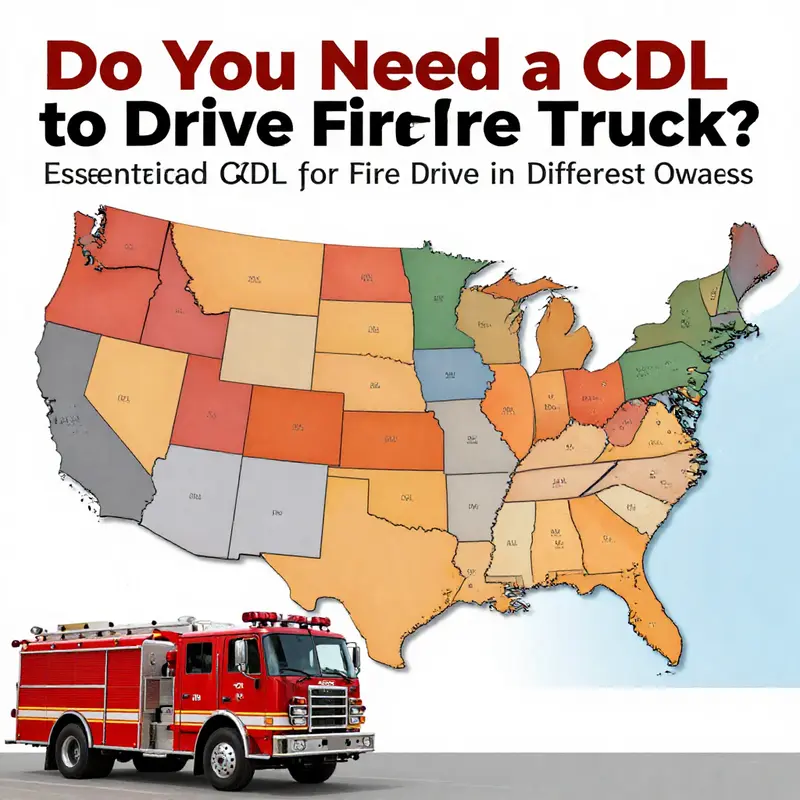
When the alarm sounds, every second counts and every wheel must respond with precision. A fire engine surging toward a blaze or a traffic collision carries not only water and ladders but a heavy responsibility to move quickly and safely through streets that were never designed for mass emergency responses. In conversations around what it takes to operate one of these vehicles, a question often emerges: do you need a Commercial Driver’s License, or CDL, to drive a fire truck? The honest, practical answer is both yes and no, depending on where you are and what you are doing behind the wheel. The landscape is shaped by a set of federal guidelines that set the baseline, then by state laws that interpret and apply those guidelines in ways that fit local realities. The result is a patchwork in which the same fire engine may be treated differently from one jurisdiction to the next, especially when the vehicle crosses the line between purposed-for-public-safety emergencies and what some agencies call non-emergency use, training, or transport.
At the heart of the discussion are two core considerations. First, the technical specifications of the vehicle—the fire truck’s weight, its gross vehicle weight rating, and its passenger capacity. The second is the public safety function it serves, which governs how regulators classify the act of driving. On the weight side, the rule of thumb is straightforward in principle: when a vehicle’s empty weight exceeds 10,000 pounds, or its total weight with passengers and cargo exceeds 26,000 pounds, the operation typically falls under CDL eligibility. In practice, most fire apparatus, with their large water tanks, pump units, and gear racks, exceed these thresholds even when empty, and far more so when fully loaded for an incident. The logic behind this threshold is protective: heavier vehicles demand more skill to maneuver, more braking force, and more disciplined handling under stress, all of which CDL training is designed to ensure.
But the actual regulatory picture is more nuanced. Federal rules provide a framework, but the day-to-day requirement for a CDL in the fire service is filtered through state regulations and the nature of the driving activity. In many states, driving a fire apparatus in an emergency, as part of the department’s official duties, is exempt from CDL requirements. This exemption recognizes the essential public safety mission and the specialized training that firefighters receive, including emergency vehicle operation courses that emphasize high-stakes decision making and controlled emergency response. The practical upshot is that a firefighter can legally pilot a fire truck to a scene without a CDL while responding to an official call. Yet that same driver could be required to hold a CDL if the vehicle is used for non-emergency purposes, such as training, long-distance transport, or administrative duties, and if the vehicle’s weight and passenger load meet the CDL thresholds.
Across states, the exemptions and thresholds look a bit different, which is why the same fire department can be viewed through different regulatory lenses depending on location. In California, for example, the official doctrine is that firefighters are exempt from the CDL requirement when driving fire trucks in the performance of their duties. If the vehicle is used for non-official purposes, or if its weight crosses the relevant thresholds and it is not performing an official duty, then a CDL of the appropriate class may be required. The California DMV’s guidance clearly distinguishes between on-duty, emergency operations and off-duty, non-emergency transportation, and it keeps the door open for CDL requirements when the context shifts away from public safety duties. In Texas, a similar pattern emerges. Firefighters do not need a CDL while on duty and responding to emergencies, but the same vehicle that exceeds certain weight limits or is used for non-emergency tasks can trigger CDL requirements. New York follows the same general principle: emergency response on duty is exempt, while non-emergency use or training that involves a vehicle meeting CDL criteria may necessitate the corresponding CDL class.
This state-to-state variation matters for several practical reasons. First, it affects who can legally operate a fire truck in a given situation. A volunteer or a rookie who has earned EVOC (emergency vehicle operation course) training and is acting in an on-duty capacity may be cleared to drive under exemptions in one state but could face different expectations in another, especially if the department plans mutual aid across state lines. Second, it shapes the training and credentialing path within a department. Even when a CDL is not strictly required for on-duty emergency driving, many departments opt to require a CDL for certain roles or for drivers who will routinely handle heavier apparatus during non-emergency activities. This approach aligns with a broader competency framework that stresses safe operation, professional responsibility, and the ability to transition between emergency and non-emergency contexts with clarity.
The interplay between federal baselines and state interpretations also reflects a practical tension: locomoting a large fire engine in dense urban traffic, through an intersection during a smoke-filled night, is not the same as transporting a fire truck to a maintenance yard for routine checks. In the first scenario, the public safety exemption typically applies, supported by rigorous departmental training and standard operating procedures designed to keep responders, bystanders, and other motorists safe. In the second scenario, it may be more appropriate to require a CDL, or at least a CDL-equivalent credential, to ensure that the operator can manage a heavy vehicle whose dynamic behavior changes with speed, load, weather, and road conditions. This is not a matter of jurisdictional pedantry; it is a matter of consistency and safety, especially when firefighting teams move across different terrains, from narrow city streets to long highway stretches during mutual-aid operations.
For firefighters and fire departments, the policy implications are nuanced. One practical implication is the need for clear internal guidelines about when a CDL is required and when it is not, depending on the vehicle type, its weight, and the nature of the mission. Departments often publish standard operating procedures that spell out the conditions under which a driver is considered permitted to operate a particular apparatus without a CDL, and those under which a CDL or a specific class is required. This clarity helps prevent last-minute personnel decisions at the edge of a fire scene, where hesitation or uncertainty could slow response times or create safety risks. It also informs mutual-aid coordination, where neighboring jurisdictions with different rules must harmonize their expectations so that responders can work together without confusion about tooling and credentials.
Beyond the internal policy framework, there is a broader professional expectation that even when a CDL is not legally mandatory for on-duty emergency driving, a driver’s familiarity with commercial vehicle operation can be a significant advantage. Heavy fire apparatus benefit from drivers who can anticipate how weight distribution shifts during emergency maneuvers, how to manage traction in slick or uneven pavement, and how to brake progressively while maintaining a controlled approach to a high-stakes incident. The training programs that departments implement—EVOC, defensive driving, incident-specific driving protocols, and heavy-vehicle handling—serve not just compliance but also the overarching goal of minimizing risks on the road while maximizing effectiveness at the scene. These programs often emphasize the same safety pillars that underpin CDL training: pre-trip inspections, route planning, load management, and a disciplined approach to risk assessment under pressure. In this sense, even where a CDL is not a formal requirement, the competencies associated with CDL-style training can be valuable assets for firefighters who drive heavy equipment.
For readers who are navigating career paths or mutual-aid capabilities, it is useful to view the CDL question as part of a larger ecosystem of fleet management and incident response. Fire departments may maintain a mix of vehicles that vary in weight and purpose: some are compact and suited for rapid response, while others are heavier, with specialized roles in water supply, aerial operations, or industrial settings. In practice, that mix means that a single department must balance the cost and logistics of training, licensing, and credentialing against the imperative to deliver timely, effective service. The more a department relies on cross-jurisdiction collaboration, the more important it becomes to align policies so that responders can operate smoothly regardless of where an incident occurs. For individuals entering the field, understanding the state-by-state landscape helps set expectations about potential credential requirements, the kinds of training to pursue, and how to position oneself for a role that may involve both emergency driving and routine vehicle operations.
If you are exploring the broader market for fire apparatus and the equipment that supports these operations, you may want to consider how fleets are designed around different regulatory contexts. For example, some departments emphasize lighter, highly maneuverable apparatus for urban responses, while others deploy heavier, high-capacity trucks for rural or industrial settings. This diversity in fleet composition complements the regulatory mosaic by ensuring that responders can adapt to a wide range of incidents without being overstretched by licensing barriers. The choice of vehicle type and the alignment with local regulations often reflect a practical mindset: equip the team to do the job when urgency demands it, while maintaining safety margins that protect responders and the public alike. To get a sense of how fleets are positioned in today’s market, you can explore examples of commercial fire trucks and the broader ecosystem that supports their operation and maintenance, which may be found at this resource: 상업용 소방차.
Looking ahead, the most reliable way to navigate the CDL question is to consult the local DMV or the fire department’s policy office. Because state regulations can shift with changes in law, and because a vehicle’s role within a department’s mission can alter its regulatory treatment, a direct check with the authoritative body that governs licensing is essential. The California DMV page on Fire Fighting Vehicles offers a model of how official guidance is structured: it distinguishes between on-duty and off-duty use, between official duties and training or non-official transport, and between different vehicle weights. While the specifics of each state’s code will vary, the principle remains consistent: the exemption for emergency public-safety driving is designed to empower responders to reach emergencies without unnecessary barriers, while the CDL pathway remains available for non-emergency scenarios or for operators who handle the most demanding equipment under conditions that elevate risk.
In this evolving regulatory environment, officers, recruits, and policy-makers alike benefit from a shared language about what each credential represents, what situations demand it, and how to prepare for the realities of fire service driving. The CDL conversation is not simply a matter of licensing; it is about resilience in the face of danger, about clear decision-making under pressure, and about the disciplined choreography that keeps a fire department’s response reliable across the streets, hills, and industrial corridors that communities rely on. The topic sits at the intersection of law, safety science, and every day firefighting practice, and it invites ongoing attention as new vehicle technologies, road environments, and cooperative response models continue to shape how we move when seconds matter.
For those who want to see a concrete example of how this topic can be framed within a department’s equipment choices and training programs, consider the broader category of fleet readiness and how commercial and emergency capabilities are integrated in modern fire services. A quick reference to the broader market can be found in the linked internal resource on commercial fire trucks, which illustrates how fleets balance weight, maneuverability, and mission profiles across different contexts. This perspective helps to ground the regulatory discussion in the practical realities responders face every shift. And for readers seeking official guidance on California’s approach to fire fighting vehicles, see the California DMV information at the end of this chapter.
External resource for further clarity: California DMV – Fire Fighting Vehicles. See official guidance here: https://www.dmv.ca.gov/portal/vehicle-licenses-and-registration/fire-fighting-vehicles/
brush fire trucks, wildland firefighting, fire safety equipment, off-road fire trucks, firefighting technology, business safety, emergency response vehicles
In conclusion, understanding the CDL requirements for driving fire trucks is vital for business owners involved in emergency services. The implications of weight specifications, safety training, and varying state regulations not only affect legal compliance but also play a significant role in ensuring public safety. By investing time in understanding these requirements, you can ensure that your operations meet the necessary standards while supporting the skilled personnel needed for such critical tasks.

