
















The invention of the first fire truck in 1518 marked a pivotal moment in firefighting history. Commissioned by the city of Augsburg, Germany, this pioneering vehicle laid the foundation for mechanized firefighting equipment. Understanding this landmark development is crucial for modern business owners who rely on efficient firefighting systems. In examining the historical context, technological innovations, industry impacts, and societal changes stemming from this invention, we can appreciate how far firefighting has come and its continuing significance in today’s business landscape.
Historical Context Reframed: From 1518 Cart-Pumped Pioneers to the Dawn of Motorized Fire Engines
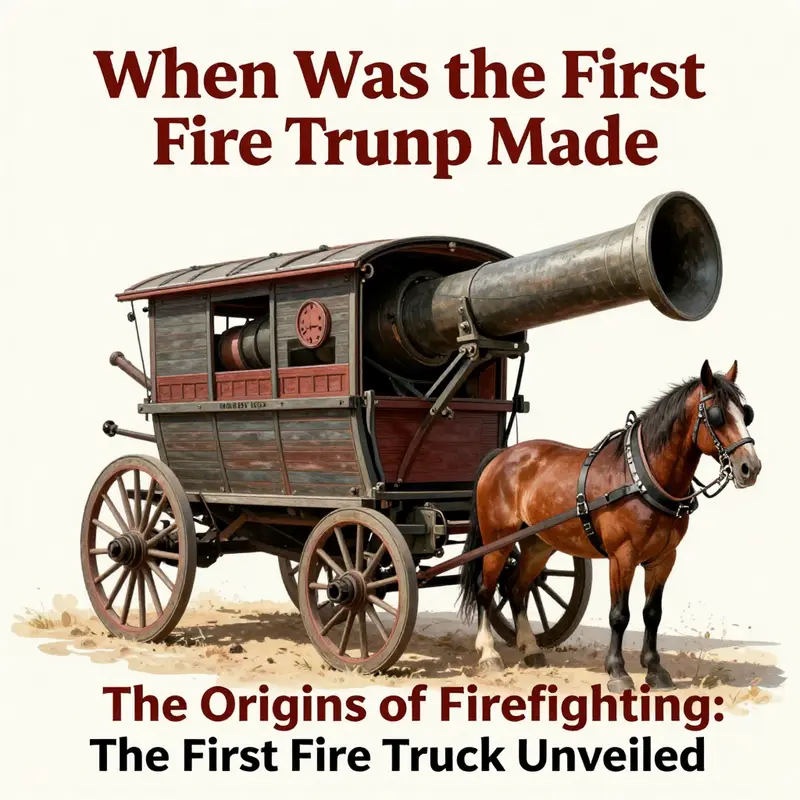
When we ask when the first fire truck was made, the answer unfolds as a conversation about definitions, technology, and the evolving needs of communities. If we define a fire truck by current standards—an integrated motorized vehicle with a powered pump, water supply, and hoses ready for rapid deployment—the historical trail takes us to the end of the nineteenth century. Yet if we widen the lens to include the earliest moves toward mechanization in firefighting, a much earlier landmark appears: in 1518 Augsburg, a metal craftsman named Antonius Brautner, who may also be found in records as Antenius Bratner, built a pioneering device that we can rightfully call a fire-related vehicle, or at least a water-pumping engine on wheels. This early invention featured a large pump mounted directly on a cart and was operated manually via levers, with horses pulling the contraption. Details about its internal mechanisms and hydraulics are scarce, but the basic concept is clear enough: a transportable, water-pressing unit that could extend the reach of a single hand-pump or bucket brigade beyond the firefighters’ immediate location. It was a tangible step in the long voyage from fixed pumps to mobile, mechanized response. The Augsburg cart did not resemble modern fire apparatus in form or function, yet it signaled a decisive shift: water-handling tools no longer had to be stationary or hand-driven alone. They could be deployed as a unit that moved toward a conflagration, bringing a powered means to pump and spray water closer to the seat of the fire. In that sense, Brautner’s lever-operated pump on a horse-drawn cart stands as an inception point for a lineage of vehicles whose purpose is singular and enduring: to harness mechanical power for rapid and directed water application in the fight against fire. It is tempting to recount the tale as a linear ascent, but the historical record shows a more measured ascent, with each era building upon the last by solving specific constraints. The volumes of water a hand pump could muster, the distance water could be moved, and the time required to assemble and deploy a brigade all shaped the design language of each subsequent generation. The Augsburg device thus anchors a narrative about early innovation: mobility plus hydraulic capability, combined with human and animal labor, creating a workflow that could be repeated and scaled as cities grew. As with many early engineering feats, the emphasis was on practicality and reliability in the face of urgent need. The visual language of firefighting—bright, conspicuous, and purposeful—began here in part because communities required a method to recognize and reach responders quickly, especially in dense urban environments where time translates to lives and property saved. The physical footprint of Brautner’s cart-pump was modest by later standards, but its implications were expansive. It allowed a firefighting team to start the fight from the road, rather than waiting for a water source to be brought to them, and it introduced a modularity that could be refined withiler gears, different pump sizes, and more efficient levers as technology permitted. Even in its limitations, the Augsburg machine foreshadowed a future in which fire apparatus would become a specialized fleet of tools designed not only to carry water but to generate power, maintain pressure, and deliver it to a nozzle with precision. The chapters that followed would see those ideas take on greater complexity and scale, particularly as steam and later internal combustion engines transformed how quickly and how forcefully water could be delivered to the source of a blaze. The late nineteenth century would heighten this transformation, turning a mechanical ambition into a motorized reality that redefined response times and firefighting strategy. In the broader arc of innovation, the move from horse-drawn or hand-pumped devices to motorized fire engines did more than speed up the arrival of water on the scene. It reshaped teams, workflows, and the very idea of what a firefighting fleet could look like. The introduction of motor power meant that pumps could operate at higher pressures for longer periods, enabling fire crews to attack flames more effectively and to reach taller structures or obstructed sites that were previously out of practical reach. These gains came with new engineering challenges—weight distribution, cooling, reliability, and the need for standardized controls that a crew could operate under stress. As these machines evolved, so did the perception and branding of firefighting itself. The color of fire apparatus emerged as a symbolic choice that would outlive early mechanical decisions and become an enduring convention. During the period of rapid innovation in the late nineteenth century, communities experimented with their own palettes, but red soon secured a dominant status. A common theory suggests that red was adopted because it stood out against the more subdued tones of the era’s road traffic, especially as automobiles became more prevalent. In a world of black carriages and gray trolleys, red announced “emergency ahead” with a bold immediacy. Yet color was not chosen by whim alone. It represented a visual language that helped shape public perception and situational awareness. Firefighters needed to be seen in the confusion of smoke, dust, and rapid movement. Red offered a striking contrast, and as fleets expanded, the color became a cultural signature, linking resilience, risk, and the urgent call of a response team. This aesthetic choice reinforced operational identity and civic pride, even as the machinery beneath the paint grew increasingly sophisticated. The transition from the late nineteenth century onward was not merely a craft evolution; it represented a shift in the social contract between urban life and its protectors. With motorized engines, the firefighting corps could respond more quickly, set up larger water lines, and station units more strategically across the city. The machinery required new training, new dollars, and new maintenance habits, yet it produced a more capable and scalable form of protection. The first motorized fire engine, built around 1899 by a prominent American manufacturer, crystallized this shift. It was not simply a faster pump on wheels; it was a self-contained platform capable of delivering water with a level of pressure and speed unattainable with hand pumps or horse-drawn units. The advent of true motorization marked a turning point: the era of the pump’s power being embedded in a vehicle, ready to roll to a scene and begin the work of suppression almost immediately. In many histories, this milestone is celebrated as the moment when firefighting entered the modern age. The implications went beyond speed. A motorized engine could carry more water, feature a more robust hose layout, and offer a reliability profile that allowed for longer deployments across a broader geographic area. Departments learned to optimize routes, station fleets near likely risk zones, and refine the logistics of water supply. The synergy between hydraulic capability and mobility created new operational paradigms. Fire responders could arrive with sufficient force to begin a decisive first attack, protecting lives and property at the earliest point of contact. As these mechanical strides took hold, the visual language of the fleet continued to align with practical needs. Red, again, became a marker of readiness and authority, a color-coded signal that could be recognized at a distance in smoke and glare. Yet even as color maintained its symbolic charge, the design conversation broadened to include safety, ergonomics, and compatibility with diverse environments. The modern fire engine did not appear overnight; it emerged from a sequence of refinements: more powerful pumps, larger water tanks, better hose lines, and improved chassis integration. Each advancement built upon the last, producing a vehicle that could perform under pressure, traverse urban insecurities, and support a crew in the most demanding conditions. The story of the first fire truck, in this sense, is a story of convergence. It is the convergence of mobility with hydraulics, of city planning with public safety, and of visual signaling with practical efficiency. It is a reminder that innovations in public service rarely arrive as a single invention; they arrive as a set of connected improvements that collectively raise the standard of capability. For readers tracing these threads, it helps to think about both the humble wagon and the ambitious machine that would come to symbolize a city’s commitment to protection and resilience. If Brautner’s 1518 cart demonstrates the essence of practical ingenuity—an attempt to bring water to the flames on a portable platform—the 1899 motorized engine demonstrates the power of design integration, where propulsion, pumping, water storage, and crew workflow are woven into a single operational tapestry. In contemporary terms, the chapter’s throughline is clear: the origins of the fire truck are rooted in necessity and experimentation, while its evolution is driven by a continuous quest for speed, reliability, and a clearer public message in moments of crisis. The combined forces of engineering refinement, urban growth, and the demands of rapid response coalesced into a fleet concept that could be deployed with confidence and speed. Today’s discussions of specialized fleets—whether they emphasize heavy-duty apparatus, aerial capabilities, or integrated rescue systems—reflect the same fundamental dynamic: to adapt a vehicle to the mission, to enhance the tools that accompany it, and to ensure that the sight of a red siren is both an omen and reassurance. For those exploring the arc from the first cart-mounted pump to the sophisticated engines of the modern era, the narrative offers a continuous thread: technology evolves to meet urgency, and the appearance of rescue vehicles is as much about perception as it is about hydraulics. The longing to reach a blaze swiftly, to pressurize and deliver water effectively, and to do so with a recognizably authoritative presence remains central to how we understand and value firefighting fleets today. As you move forward in this chapter to examine how these early compromises matured into standardized designs and diversified capabilities, consider how a single question—when was the first fire truck made?—unlocks a broader contemplation about the relationship between public safety, engineering, and the cities that rely on both. An ongoing thread of this discussion is the way fleets are categorized and presented to the public: the evolution from simple, movable pumps to well-organized, purpose-built platforms that can tackle a wide range of emergencies. For readers who want to explore current examples of fleet composition and the kinds of platforms designed for different operational needs, you can browse the broader collection of commercial fire trucks, a category that captures the ongoing diversification of firefighting equipment today. Commercial Fire Trucks
External resource: https://www.britannica.com/technology/fire-engine
From Cart to Catalyst: Tracing the Invention Timeline of the First Fire Truck
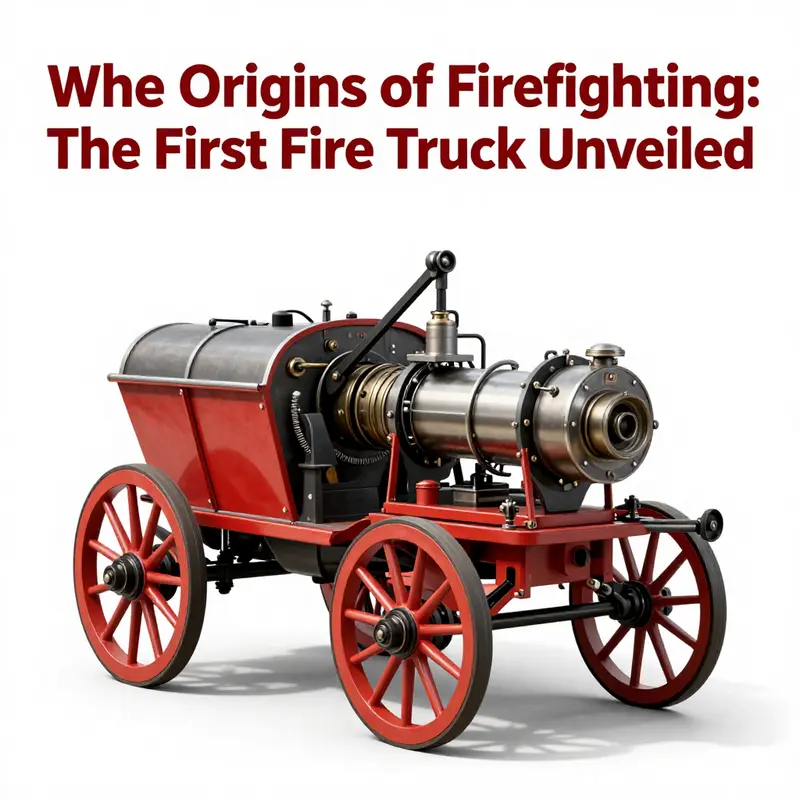
The history of the first fire truck unfolds as a layered evolution, not a single invention, and the story begins with a creature of necessity born in the early 16th century and then ripples forward through steam, motorization, and mass urban life. The commission to produce a firefighting vehicle in Augsburg in 1518 marks a pivotal moment, even if the surviving details are spare. Anticipating the demands of a growing city, a metal craftsman built a device with a large pump mounted directly on a cart, pulled by horses and operated by human effort through a system of levers. This was not a car designed for speed or comfort; it was a pump on wheels, a portable engine of water and force that could be brought to the scene rather than carted there piece by piece. It is tempting to see that early contraption as merely a curiosity, but it stands as a ceremonial stone in the long corridor of firefighting technology. It signals the first major shift— from hand pumps and foot-traveled gear to a machine-assisted approach that could multiply human strength and extend reach. In that sense, the Augsburg instrument embodies the concept of mechanized firefighting before the word was common.\n\nYet that first spark did not immediately ignite a parade of advancing machines. For more than two centuries, the fire service relied largely on manual effort and horse power, with improvised conveyances and hand-pumped engines that required firefighters to bring hoses, nozzles, and water supplies to the fire on foot or by basic horse-drawn carts. The transition from ritualized human labor to machine-assisted action grew in slow, incremental steps. The 18th and early 19th centuries witnessed a shifting understanding of how to marshal water at larger volumes and with greater pressure. Firefighters could see that speed and water flow were crucial, especially in dense urban settlements and later in buildings with more than one floor. The timeline thus tilts toward a technological hinge: the introduction of steam power as a propulsion and pumping force that would eventually redefine what a fire truck could be.\n\nIn the 1830s, steam-powered fire engines appeared on the scene, representing a quantum leap in capability. An early steam-driven model built around 1829—developed in a European workshop—signaled a leap forward in the capacity to push water with greater force and distance than any hand pump could achieve. It is important to note that this step was not immediately universally adopted or refined; the technology was ambitious and still imperfect. Still, the core principle—using steam pressure to drive the pump rather than relying on human or animal power—established a new trajectory. Steam engines could deliver a steadier, more powerful stream, which translated into faster water delivery and improved suppression in urban environments where fires often confronted firefighters with tight streets and multi-story structures. The steam era, in its early phase, was thus a proving ground for what a fire apparatus could accomplish when mechanical force was harnessed and directed by skilled operators.\n\nA few years later, a more practical and influential model began to take hold in firefighting lore. In the United States, a dedicated development in steam pumping made water move with substantially greater force and at longer reach. This era, more clearly in the 1840s, marks a turning point from novelty toward reliable deployment. While the exact corporate or individual identities behind every design can be elusive in the historical record, the essential effect is clear: steam pumping converted the fire wagon from a spectacle of potential to a repeatable, scalable tool of public safety. Fire brigades could respond with better timing and assemble a stronger stream of water. This change altered how urban spaces were protected, especially in cities rising with brick and stone and in neighborhoods where multi-story dwellings demanded greater reach from fire crews on the ground. The shift from hand pumps to steam-assisted pumps did not erase the labor and logistics of firefighting; it reoriented them. Pumping could now be accomplished with less reliance on ferocious physical strain, and it allowed firefighters to sustain water flow for longer periods while managing nozzles, lines, and other gear.\n\nThe narrative does not stop with steam alone. The late 19th century brought another revolution, one that would crystallize the modern form of the fire truck as a purpose-built vehicle rather than a retooled cart. The transition from steam to internal combustion engines began to reshape the economics, weight, and practicality of firefighting apparatus. Steam engines, though powerful, carried heavy boilers and required careful maintenance and fuel logistics. As technology advanced, lighter, more efficient engines offered easier operation and reduced upkeep. In this transformation, the fire apparatus evolved from a steam-driven pump mounted on a wagon to a purpose-designed vehicle that integrated pump systems, water supply, hoses, and the means to transport ladders and rescue gear. By the end of the 19th century, the consolidation of propulsion with pumping and water management was taking a definitive shape: the fire truck as a mobile, self-contained unit capable of rapid response and sustained service.\n\nThe turning point most often cited in firefighting histories is the moment when a motorized pumper—driven by an internal combustion engine—entered a major city’s fire department at the close of the 19th century. In 1899, a significant milestone occurred when a motorized pumper arrived in a large city, signaling the dawn of the modern era of firefighting vehicles. This event did more than replace a steam engine; it redefined the entire design philosophy of firefighting apparatus. A motorized chassis could bear the weight of a more compact, integrated system and could be maneuvered with greater agility through crowded streets. It also freed firefighters from the constant demands of hauling heavy steam equipment and coal or water supplies, allowing them to allocate more attention to tactical operations on the fire ground. The consequences were not instantaneous, but the trend was inexorable: engines that could move themselves accompanied the pump that sent water through hoses, and the vehicle itself became a multi-tool platform rather than a single-purpose piece of machinery.\n\nIn the broader arc, these developments—pulling the pump along as a mounted device, introducing steam power to intensify pumping, and eventually integrating internal combustion propulsion—converged to form the backbone of modern fire service mobility. Early carts and horse-drawn pumps were not discarded overnight; instead, they evolved into a spectrum of fire apparatus that could be tailored to the needs of a city, its climate, and its architectural profile. The result is a lineage that blends engineering ingenuity with public safety imperatives. The first fire truck, in this sense, was not a single thing but a sequence of improvements—a cart with a hand-pumped engine, a steam-powered pump wagon, and finally a motorized, purpose-built fire vehicle engineered to protect life and property with speed and reliability.\n\nThis evolution also highlights a critical dimension of firefighting history: the relationship between urban design and vehicle technology. As cities grew, the demand for faster response times and more robust water delivery intensified. The steam era raised expectations about what could be achieved on the ground, and the motor era extended that capability into the realm of everyday practicality. The modern fire truck, with its integrated pump, water tank, hoses, ladders, and rescue tools, emerged from these successive refinements. It is the culmination of nearly five centuries of experimentation and problem solving, a collective effort to translate muscle and will into mechanical advantage.\n\nFor readers seeking a practical anchor in the narrative, this chapter also connects to a continuing thread in the broader field of firefighting equipment. The story of the first fire truck is inseparably linked to the ongoing evolution of apparatus designed to deliver water quickly, pressurize streams, and support operations in complex urban environments. As the frontier of technology advances, contemporary vehicle categories continue to build on those historic milestones. The journey from an Augsburg cart to a modern, multi-functional fire vehicle illustrates how innovation travels through time, guided by a simple but enduring aim: to get water where it is needed, when it is needed, with the fewest possible delay and the greatest possible effect.\n\nExternal resource: https://www.firefightingnews.com/history-of-fire-trucks/\n
3D models, airport fire truck, game development, simulation, aviation safety
3D models, airport fire truck, game development, simulation, aviation safety
From Brautner’s Cart to Steam-Powered Engines: The Birth of the Modern Fire Engine
The question of when the first fire engine appeared invites us to read technology as a social project, not a single invention. The earliest documented attempt to move water to a blaze on the ground emerged in Augsburg in 1518, where a metal craftsman named Antonius Brautner built a cart mounted pump operated by hand levers and drawn by horses. This device was primitive by later standards, yet it carried the core idea of a mobile engine delivering water under pressure to a fire rather than relying on bucket brigades.
The story moves forward into the nineteenth century, when steam power began to reshape urban life. Steam engines in fire brigades provided greater water delivery and higher pressure, enabling crews to work more effectively at a distance from a water source. The shift from hand pumps to steam-driven machines did not happen in a single city or a single moment; it unfolded through experiments, investments, and the dedication of towns eager to protect dense urban cores.
Steam power did more than increase performance; it reframed public safety as a municipal responsibility. New apparatus required fuel, maintenance facilities, and trained operators, and cities accordingly built stations, hydrant networks, and dispatch systems. A more capable fleet changed expectations about response times and the scale of equipment needed to defend life and property. Over time, fire engines diversified: lighter motorized units for quick response, heavier steam and later motorized engines for larger incidents, and platforms designed to reach higher floors.
Thus, the first true fire trucks emerged not as a single machine but as a coherent system that linked mobility, water delivery, and adaptable design. The story also shows how public safety became a formal municipal service, integrating volunteers and paid staff, standardized procedures, and professional expertise. For readers seeking a concise overview, reference works on the history of fire engines connect these technical milestones to broader changes in urban governance and social reform.
You can explore these themes further in reputable sources on industrial fire apparatus and the evolution of urban emergency services.
brush fire trucks, wildland firefighting, fire safety equipment, off-road fire trucks, firefighting technology, business safety, emergency response vehicles
The first fire truck made in 1518 not only represents an essential milestone in firefighting technology but also catalyzed profound changes in societal safety perceptions and the evolution of the industry. For business owners, understanding this historical context is invaluable, recognizing that the roots of modern firefighting practices are grounded in these early innovations. As firefighting technology continues to advance, the legacy of the first fire truck serves as a reminder of the importance of resilient and effective fire safety measures in safeguarding lives and property.

