
















Wildfires pose a significant annual threat to California, challenging its emergency response capabilities. As these disasters escalate, myths about the state’s management of firefighting resources, particularly concerning outside assistance, often emerge. One prevalent question is whether California has ever turned away fire trucks from other states during its most critical firefighting moments. This article dives into the intricacies of California’s wildfire response, highlighting its collaborative framework with neighboring states, mechanisms of interstate support, and the pivotal role of the National Interagency Fire Center. Each chapter will systematically debunk myths, elucidate cooperation among states, and present recent instances where California has accepted critical aid, providing a comprehensive understanding for business owners and stakeholders.
3D models, airport fire truck, game development, simulation, aviation safety
3D models, airport fire truck, game development, simulation, aviation safety
3D models, airport fire truck, game development, simulation, aviation safety
3D models, airport fire truck, game development, simulation, aviation safety
Coordinating Fire Winds: How the National Interagency Fire Center Orchestrates California’s Mutual-Aid for Fire Trucks
When people ask whether California ever turned away fire trucks from other states, the blunt truth is often surprising to anyone who watches wildfires from afar: it did not. California has built, over decades, a mutual-aid framework that relies on rapid communication, clear authority, and a shared sense that no one’s fire fight should be held hostage by jurisdictional boundaries. At the center of that framework sits the National Interagency Fire Center (NIFC), a national hub whose job is to see the whole map—the weather patterns, the threat levels, and the available engines, crews, and aircraft—then move resources where they are most needed. The result is a steady, responsive flow of assistance that can swell or shrink with the season, but rarely, if ever, stall due to a refusal.
The NIFC’s work begins long before flames leap into the headlines. It is a central clearinghouse for fire threats across the country. It analyzes conditions, forecasts spread, and maintains a national pool of firefighting assets. This pool includes engines, air support, and personnel who are trained to operate under a unified incident management system. In practice, this means that when a region faces overwhelming fire danger, the NIFC can call on responders who operate under a common set of procedures, terminology, and safety standards. The goal is not merely to dispatch gear; it is to ensure that the right mix of capabilities reaches the right place at the right time. For California, with its expansive wildland interfaces and shifting climate-driven risk, that coordination is not an ideal but a necessity. The system works because every link in the chain—federal, state, and local agencies—recognizes that fire knows no borders, and neither should the response.
Within the NIFC, incident management is the guiding principle. When danger spikes, incident management teams spring into action. These teams bring a curated set of command, operations, planning, logistics, and finance capabilities, all integrated to manage complex wildfire incidents. Fire engines and their crews are not merely sent as individual units; they are deployed as part of a larger, integrative response that can include aerial supervision, support flights, and specialized equipment. The emphasis is on speed and compatibility. Engines rolling across state lines must be able to communicate with neighboring teams, align with incident objectives, and integrate with the local incident command structure. That is why the National Interagency Fire Center emphasizes a standardized approach, one that reduces the friction often created by jurisdictional differences.
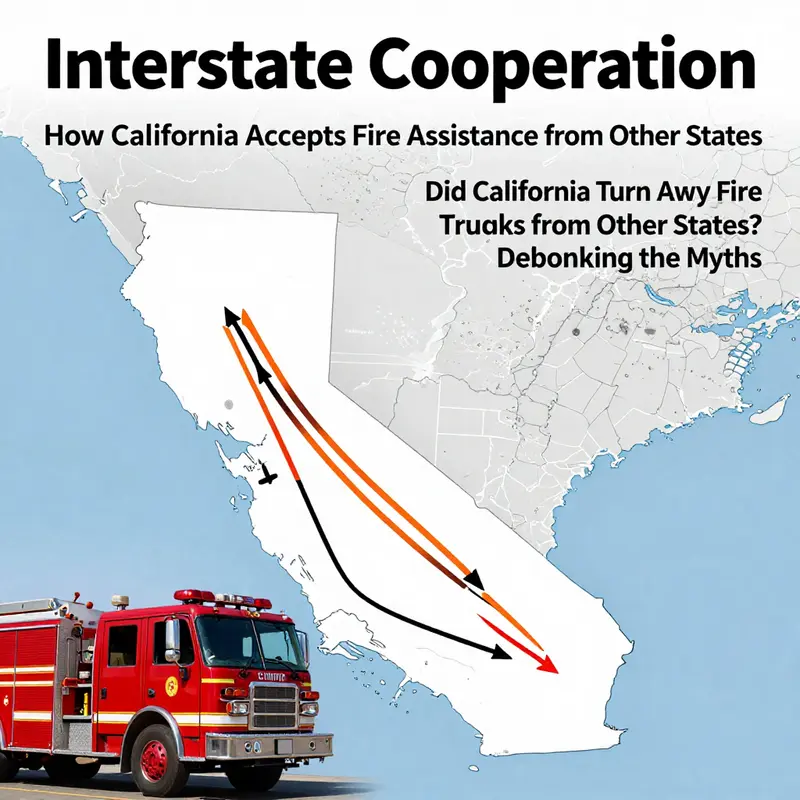
The relationship between California and its neighbors is reinforced through regional compacts and established mutual-aid agreements. In recent years, the state has expanded its cooperative framework with a dozen Northwest states, among others. These compacts are not ceremonial pledges but functional pipelines. They specify who can respond, what equipment they bring, how reimbursement works, and where staging areas will be located. The practical effect is to shorten the time between a resource request and a response. When California’s fire season intensifies, the NIFC monitors the entire theater of operations, not just the fires within any single boundary. It assesses risk, identifies resource gaps, and then activates the appropriate agencies to fill those gaps. Real-time situational awareness becomes the backbone of the response, ensuring that California can access a wide range of tools—from hoses and pumps to engines, crews, and aircraft—without delay.
The deployment process is as much about logistics as it is about fire science. The ICS, or incident management system, provides the framework that allows disparate agencies to work as a single unit. Under this system, fire trucks and crews from states far from the flames can be dispatched to California with a shared understanding of tactics, safety protocols, and command structure. The ability to move vast quantities of equipment across state lines depends on a highly coordinated logistics network: transportation routes, fuel supplies, maintenance and rehab cycles for equipment, and the readiness of crews to operate in unfamiliar terrain and under different command styles. The NIFC coordinates all of these moving parts, ensuring that a surge of support arrives where it’s most needed, not where it’s least inconvenient to send it. The outcome is a response that looks seamless from the outside but is the result of years of planning, drills, and interagency trust.
One practical testament to this system’s efficiency lies in recent wildfire seasons. California has routinely requested and received out-of-state assistance, and it has routinely accepted it. Engines and crews from neighboring states have joined California’s efforts, complementing local resources and extending the state’s capacity to fight fires that would otherwise overwhelm it. In 2023, for example, California actively accepted dozens of fire engines and crews from other states, with significant support from Arizona and Utah among others. This ongoing exchange is empowered by mutual-aid agreements that are kept current through ongoing collaboration and regular exercises. Such examples illustrate not only the generosity of neighboring states but the reliability of the national framework that makes such generosity possible. The mutual-aid lifeline is not a one-way street; California also contributes resources when other states face exceptional threats. It is this reciprocal readiness that underpins the credibility of the entire system and, more importantly, translates into lives saved and property protected on the ground.
To understand why the question of turning away out-of-state fire trucks never gains traction, it helps to look at the mechanics of deployment in real time. When the NIFC activates an incident management system, it does so with the explicit aim of matching needs with capabilities. If California signals a need for additional engines, the NIFC identifies available units from the national pool, prioritizing those with the right types of equipment and the right crew skill sets for the specific terrain and fire behavior expected. The decisions are not made in a vacuum. They emerge from the collaboration of federal agencies, state fire authorities, local incident command posts, and the tactical realities of the landscape. The result is a flow of resources that meets the moment’s demands while maintaining safety and effectiveness across the board. California does not face a binary choice between local pride and national aid; it has in practice a network that encircles the state with capacity and readiness.
This is not simply about the arrival of more engines. It is about the tempo and precision of the response. Real-time coordination means more than moving hardware; it means aligning strategy, weather intelligence, and suppression actions with every arrival. The NIFC’s role in providing situational awareness helps California allocate its own resources more intelligently in concert with incoming support. It also helps prevent potential misalignments that can slow operations, such as duplicative efforts in the same turf or gaps in coverage in other areas. In the end, the system’s purpose is to maximize effectiveness while maintaining safety for firefighters and the communities they serve. The mutual-aid model rests on the premise that a fire does not respect borders, and the response should not be hindered by them either.
For readers seeking a more granular sense of how these operations unfold, it helps to picture the network as a living organism—fueled by communication, sustained by planning, and animated by shared responsibility. The NIFC supplies the central heartbeat, but it is the interlocking arms of state and local agencies, incident command posts, and dispatch systems that carry the response to the ground. When a fire front grows, when wind shifts, or when terrain becomes more challenging, the system adapts. Resources shift, priorities adjust, and crews move in to joint operations with neighboring teams. The end result is a process that remains open to mutual aid, rather than closed off by territorial imperatives. The feedback loop—from the field back to the NIFC—refines future deployments, strengthens relationships, and reinforces the trust that makes cross-border cooperation possible year after year.
The broader takeaway is simple and essential: California does not turn away, nor does it hoard, fire-fighting capacity. It relies on a national framework designed to keep the lines of support open when fire seasons intensify. The NIFC’s leadership in assessment, resource management, and real-time dispatch creates a predictable, transparent continuum of aid. It turns what could be a chaotic scramble into a disciplined response, capable of expanding and contracting with the needs of the moment. For communities facing the uncertain stretches of a wildfire season, that is not a theoretical ideal but a practical, proven lifeline.
If readers want to explore how such frameworks are implemented in the field, they can look into the broader logistics and equipment compatible with these operations. The supply of fire-fighting engines, the coordination of aerial support, and the readiness of personnel all form part of the ecosystem that keeps California protected when danger escalates. And as the season changes, as weather patterns shift and new challenges emerge, the NIFC’s ongoing role remains clear: it is the central nerve that keeps mutual aid alive, connected, and responsive when every second counts. For further background on these operations, the official site provides the authoritative overview and up-to-date details on how such interagency coordination is executed in practice. [external link: https://www.nifc.gov]
Internal reference: In the narrative of equipment and capability, the broader market for fire-fighting vehicles and support gear plays a complementary part. For readers curious about the range of out-of-state equipment available and how it integrates into incident operations, a deeper look into the fire-fighting-vehicle category can be instructive. See the related resources here: wóz strażacki.
Across Borders, Into the Blaze: Interstate Fire-Truck Deployments and California’s Mutually Aided Wildfire Response
When people ask whether California turned away fire trucks from other states, the answer is not a simple yes or no. The state’s wildfire history reveals a different truth: California has long depended on a tightly woven system of mutual aid that stretches across state lines and even international borders. This chapter revisits a practical question by tracing the threads of cooperation that bind California’s emergency response to its neighbors. It is a story not of exclusion, but of rapid mobilization, shared resources, and a coordinated effort to keep communities safe when flames loom large and local fire crews are stretched thin. The backbone of that story is the National Interagency Fire Center and a web of agreements that predate each season, enabling a seamless transfer of engines, crews, aircraft, and equipment where they are needed most. In this framework, the question of whether California turned away out-of-state fire trucks becomes moot; what matters is how the system is activated, how quickly aid arrives, and how it reshapes the firefighting landscape during peak catastrophe periods.
The United States maintains a robust mutual aid infrastructure that couples state authorities with federal coordination to respond to large fires. Central to this is the National Interagency Fire Center (NIFC), which coordinates resource orders across jurisdictions under the Incident Command System. California participates in this national network, which statutes and operational conventions help to synchronize, so that when a county’s resources are overwhelmed by a fast-moving blaze, requests can be acknowledged, matched with available assets, and mobilized toward the scene with dispatch efficiency. This orchestration is not a sign of weakness in California’s own firefighting capacity; rather, it is a prudent system design that recognizes the impracticality of maintaining peak capacity for every scenario within state borders alone. Mutual aid allows California to pre-position assets in anticipation of a worsening season and to receive help from neighboring states as fires surge in multiple counties simultaneously.
The 2025 fire season offers a telling case study. As in years past, a sequence of large, fast-moving wildfires strained local departments and neighboring jurisdictions alike. In Tuolumne County, the 6-5 Fire grew rapidly, threatening critical communities and infrastructure while the county’s own resources were called away to other fires around the region. In response, California activated the Regional Cooperation Agreement (RCA), a long-standing compact that enables rapid deployment of emergency personnel and equipment across state and provincial borders. Under the RCA, a dozen Northwest states and several Canadian provinces agreed to share firefighting assets, including engines, crews, and aircraft, to address crises that exceeded regional capacity. The coordination was not about replacing local responders but about expanding the firefighting net so that containment lines could be established more quickly and evacuations could proceed with less delay.
During the peak of that crisis, fire trucks from Oregon, Washington, Idaho, Montana, and even British Columbia were deployed to California. This cross-border support was a practical extension of mutual aid principles: assets were dispatched through established channels, stationed at staging areas, and assigned to the Incident Command Post so they could integrate into local tactics and equipment pools. The effect was not ceremonial; it was measurable. In Tuolumne County, containment lines began to form where the 6-5 Fire had threatened structures and road corridors. There were moments when every minute counted, and the arrival of additional engines and crews allowed local units to maintain defensive lines, execute backburns under controlled conditions, and shift resources from suppression to protection of evacuations and critical infrastructure. In this sense, the RCA did what its designers intended: it escalated California’s capacity to respond without forcing it to suspend operations at the boundary of its own resources.
The mechanics of mutual aid are a blend of policy, logistics, and field adaptations. Pre-existing agreements establish the legal and administrative scaffolding for shared resources. Pre-identified response packages—ranging from single engines to multi-unit task forces, plus aviation and specialized equipment—are cataloged and ready for rapid deployment. When a county issues a request, regional incident management teams negotiate timelines, transport routes, and on-scene command arrangements, ensuring that arriving units can synchronize with the local Incident Command System. This is not merely about putting more trucks on a map; it is about integration—matching engine capacities, hydraulics, pump pressures, and water shuttle capabilities with the terrain and access routes at hand. The arrival of out-of-state units also prompts logistical considerations: additional fuel, maintenance crews, and liaison officers who facilitate communications across jurisdictions and language barriers that sometimes exist during cross-border deployments. The goal is to create a cohesive force that acts as a unified response, even when its members come from many different agencies with distinct procedures.
Beyond the tactical advantages, mutual aid shapes the strategic posture of California’s wildfire response. In burn seasons that overwhelm local resources, communities are protected not by a single department, but by a collective of agencies drawing on shared training, standardized equipment, and common operating procedures. One practical outcome is a more resilient regional system: as neighboring states experience their own fire pressures, they still participate in the same framework, which benefits everyone when fire seasons align and pressures build. The RCA’s cross-border dimension also highlights the importance of ongoing training and interoperability. Agencies practice joint drills, exchange incident command staff, and align communications protocols so that when a large incident arises, there is less friction in the initial stages of response. The result is a faster, more coordinated, and more scalable response that reduces the likelihood that a community will face a delay that could translate into lives or homes lost.
Some readers may wonder whether California’s open-door policy toward mutual aid could invite unintended consequences, such as over-reliance on external resources or the risk of chaos if units arrive without clear roles. In practice, the system’s checks and balances are designed to prevent such outcomes. The RCAs and NIFC-spearheaded coordination emphasize clear command-and-control structures. Deployments are governed by common high-level objectives and tactical priorities—protect lives, safeguard critical infrastructure, and allocate suppression resources where they are most needed. Even with the influx of engines and crews from across the region, local incident command teams determine the strategy, while incoming units adapt to those strategic aims and integrate into the established order. The result is a collaborative response that preserves accountability and maintains operational clarity on the ground.
This story of interjurisdictional deployment is also a reminder of the broader climate realities that shape firefighting at the turn of the decade. As drought conditions persist and fuel loads evolve with changing weather patterns, the frequency of multi-county and cross-border fires is likely to increase. In such a landscape, the value of mutual aid becomes not a nice-to-have but a foundational element of resilience. The RCA’s cross-border scope, including cross-national participation, illustrates how regional and international cooperation can fortify public safety in ways that individual departments cannot achieve alone. The ongoing evolution of these agreements will likely hinge on continued investment in training, interoperability, and rapid mobilization capabilities that are responsive to the pace and scale of 21st-century fires.
For readers seeking a concrete takeaway, it is clear that California did not shut its doors to out-of-state responders during the 2025 crisis. Instead, it leveraged a mature, legally grounded framework that makes cross-border deployments routine rather than exceptional. The evidence from this period points to a deliberate, well-executed sequence: a county recognizes its resource gap, a regional or state-based coordinating body activates mutual aid channels, and arriving units join the operational tempo under a unified command. In practice, that means more engines on the fire line, more personnel focused on protecting neighborhoods, and a greater probability that large fires are contained before they become unmanageable.
The conversation around inter-state cooperation in wildfire response should not be reduced to anecdotes or headlines. It demands attention to the systems that allow rapid, coordinated action across multiple jurisdictions. It requires continual attention to the readiness of fleets and the interoperability of equipment, so that when a call goes out, the response is not slowed by hesitation or mismatched capabilities. It demands recognition that California’s strength lies not only in its own firefighters but in the broader network of neighbors willing to stand with it when the flame stretches across counties and borders. In this sense, the RCA and related mutual-aid frameworks do more than move trucks; they move a collective commitment to public safety in a shared landscape of risk. As climate pressures intensify, that commitment will likely grow in visibility and significance, shaping how all western states—and their Canadian partners—prepare for, respond to, and recover from wildfire events. Engine by engine, the mutual-aid model translates concern into capability, fear into protection, and scattered resources into a coordinated frontline against destruction.
heavy-duty fire-truck category
External resource: California joins firefighting compact with a dozen Northwest states and Canadian provinces. https://www.california.gov/news/california-joins-firefighting-compact-with-a-dozen-northwest-states-and-canadian-provinces
brush fire trucks, wildland firefighting, fire safety equipment, off-road fire trucks, firefighting technology, business safety, emergency response vehicles
Understanding whether California turns away fire trucks from other states during wildfire seasons requires examining the state’s proactive approach to emergency management. The evidence clearly indicates that California welcomes and actively solicits assistance from neighboring states and federal agencies, especially during peak wildfire conditions. These collaborative efforts are built on systems of mutual aid and the coordination of the National Interagency Fire Center, ensuring resources are deployed where they are needed most. For business owners, recognizing this inter-state assistance framework can provide a clearer perspective on the resilience and adaptive strategies employed by California during natural disasters.

