















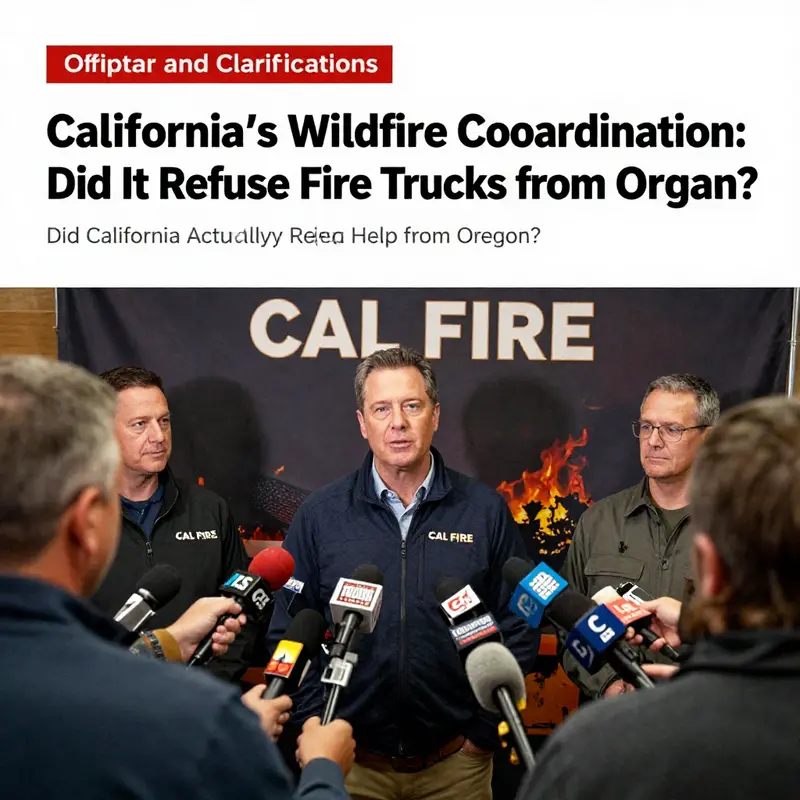
The 2023 wildfire season has sparked numerous conversations, particularly regarding California’s relationship with neighboring states like Oregon in emergency situations. As California faced several intense wildfires, speculation arose about whether it rejected assistance, including fire trucks from Oregon. This article delves into the intricate web of mutual aid agreements, the context of the 2023 fire season, and the official responses from both states. Each chapter aims to clarify this topic, reinforcing the collaborative spirit that defines inter-state firefighting efforts.
Mutual Aid in the Smoke: Debunking the Myth of California’s Refusal of Oregon’s Fire Trucks
When rumors travel faster than water in a drought, they often seize on dramatic phrases and dramatic moments. In the case of California and Oregon during the 2023 wildfire season, a misreading of events took root in some circles: the idea that California refused fire trucks from Oregon. The truth is more nuanced and far more constructive. In a region where wildfires test the limits of preparedness each year, the real story is a story of coordination, collaboration, and a system designed to move resources across state lines with speed and care. The National Interagency Fire Center (NIFC) sits at the center of this system, orchestrating a network that is supposed to function like a well-practiced relay team. When a blaze expands beyond a single jurisdiction, requests flow through established channels, and resources such as engines, aircraft, and personnel are dispatched to where they are needed most. The Emergency Management Assistance Compact (EMAC) provides the legal and operational framework that allows states to lend and borrow assistance during emergencies. It is within this framework that California, Oregon, and other Western states have learned to work with one another, not to compete or to deny, but to provide timely support that can save lives and property. The friction of firefighting, however intense, is not inherently about who says yes first. It is about the logistics of moving equipment, aligning shift schedules, and ensuring that crews can operate under a unified command when the landscape is both dangerous and rapidly changing. In this sense, misinterpretations about refusals often arise not from policy but from the whisper network of rumors that accompany any large-scale emergency. The practical reality is that mutual aid is a routine, expected part of how Western states respond to large fires, and the 2023 events in California demonstrated that continuity of operation rather than any single moment of arrival is what ultimately serves communities. The chapter that follows situates this reality within the specific events of the season, tracing how requests were made, how resources were moved, and how the public narrative sometimes diverged from the policy and practice that kept people safe on the ground.
To understand what happened—and what did not happen—it’s helpful to look at the structure that makes cross-border assistance possible. At the heart of the system is NIFC, a hub that coordinates interagency responses across jurisdictions and state lines. When wildfires threaten large swaths of land, the center helps allocate engines, crews, air support, and specialized teams in ways that are meant to balance urgent needs with available capacity. The EMAC framework then provides legal authority for deploying personnel and equipment, while individual state agencies—such as California’s CAL FIRE and Oregon’s Department of Forestry—work together to prepare, transport, and integrate incoming resources into the state’s incident management structure. In practice, this means that a Type 1 incident management team from Oregon might join a California incident commander with shared objectives, common communication protocols, and a common operating picture. The emphasis is on interoperability, not on competition or confrontation. The goal is rapid, reliable support that fits the scale of a given fire season, which for California in 2023 meant a demanding sequence of events across diverse terrains—from the Sierra Nevada foothills to the more arid expanses of Southern California.
The actual record from 2023 supports this understanding with concrete details that counter the rumor of refusal. California did not refuse Oregon’s fire trucks or its crews. Instead, California actively accepted mutual aid and integrated it into ongoing operations as part of the broader mutual-aid system. In Oregon’s case, multiple fire crews were mobilized along with a Type 1 incident management team to assist California crews in various theaters of operation. This collaboration reflects standard practice under EMAC and related interagency agreements, where requests travel through established channels and responses are sequenced to maximize effectiveness. In real terms, this meant careful staging, travel planning, and integration into the incident command structure so that resources could be deployed where they were most needed, when they were most needed, and with appropriate leadership and safety oversight. The assertion that there was an official refusal in any jurisdiction does not align with the documented communications from CAL FIRE, the Oregon Department of Forestry, or federal partners who noted the ongoing coordination rather than denial. The coordination was not without its challenges; decision-makers repeatedly spoke to the reality that a high volume of concurrent requests can slow deployments or require rerouting, but these delays related to scale and logistics rather than a veto of aid.
Where misunderstandings often arise is in the nuance between timely arrival and timely decision-making. In a wildfire season of unprecedented intensity, the tempo of requests can outpace initial estimates. Fireline realities—such as road access, fuel conditions, terrain, and aviation scheduling—shape when a resource can begin work and where it should be placed for maximum impact. These operational realities can be misread as refusals by observers who do not see the full cycle of a deployment: the moment a resource is requested, the time it takes to mobilize, the transit periods, and finally the on-site integration with local leadership. The truth, as reflected in official statements and the functioning of the mutual-aid system, is that Oregon’s resources did arrive and assist California, contributing to the broader effort to contain the fires across multiple fronts. CAL FIRE and the Oregon Department of Forestry have, over years of joint exercises and actual emergencies, consistently underscored the importance of cooperation, and the events of 2023 reinforced that stance even under severe pressure. This is not merely a matter of policy language but of on-the-ground practice that prioritizes lives and property over any narrative of exclusion.
The reasons this myth persists are instructive in their own right. Social media and rapid-fire news cycles can compress complex operational sequences into a single line, making a dramatic claim seem plausible even as the supporting details remain opaque to casual readers. When people hear that resources are “in transit” or that a request is “being coordinated,” they may infer that aid has been blocked or delayed deliberately. In truth, the Mutual Aid system works through layered checks and balances: request approval, resource matching, safety assessments, and adherence to incident command protocols. A high volume of simultaneous requests can create a backlog, particularly during peak fire season when many jurisdictions simultaneously require assistance and when resource inventories are stretched thin. Yet the absence of a formal refusal is a meaningful distinction that points to cooperative federalism in action rather than a tale of denial. In this sense, the California-Oregon experience in 2023 illustrates how the system is designed to absorb strain, reroute supply, and sustain a steady flow of support even as conditions deteriorate. That practical resilience—what emergency managers call system robustness—is the core takeaway for readers who want to understand how mutual aid functions under pressure.
This chapter also invites reflection on the broader climate and policy context that makes such cooperation not only possible but necessary. Western wildfires have grown in scale and frequency, challenging traditional firefighting paradigms and stretching the limits of state budgets and local capacity. Mutual aid is not a courtesy; it is a strategic necessity that helps maintain a baseline of protection for communities that would be overwhelmed by isolated firefighting efforts. The interagency network, with NIFC at its hub, provides the scaffolding for a coordinated regional response that can scale up quickly when fires explode across boundaries. In practice, this means that a state’s ability to request and receive help depends not only on the will to share but on the reliability of communications, the clarity of command structures, and the willingness of neighboring jurisdictions to stand in the breach when fires threaten large regions. The 2023 California fires thus became a case study in how mutual aid can function as a living system—one that adjusts to the pace of the crisis, remains open to incoming support, and preserves the safety of responders as the central operating impulse.
A final note on equipment and the material realities of mutual aid helps connect the abstract policy discussion with the day-to-day operations on the fireline. When resources arrive from other states, crews encounter a mix of apparatus, each with its own capabilities and limitations. Engines, aerial apparatus, and support vehicles may come in different configurations, and integration requires training, standard operating procedures, and a shared vocabulary for tactics and safety. For readers curious about the kinds of apparatus that can be part of these deployments, a representative overview is available in the fire-fighting-truck category, which showcases the different classes of vehicles typically deployed in coordinated responses. This reference is not meant to replace official briefings but to illuminate the practical dimension of mutual aid—the way communities become safer when equipment and skills cross the state line through a well-oiled system. For readers who want to explore this topic further, the resource linked here provides a window into the types of vehicles and specialized equipment that can be mobilized when mutual aid is invoked during a major wildfire.
Ultimately, the California-Oregon narrative from 2023 underscores a foundational principle of American emergency response: cooperation is not a polite gesture but a functional requirement. The mutual-aid framework thrives on trust built through joint exercises, shared standards, and a common commitment to public safety. The impression that aid could be blocked runs counter to the operational philosophy that has guided interagency cooperation for decades. In moments of extreme risk, when communities rely on fast, coordinated action, the system works best when every participant—state agencies, federal partners, and neighboring jurisdictions—approaches the mission with a clear sense of shared purpose. The responses observed during the 2023 fires reflect a system that remains resilient even under extraordinary strain, delivering support where it is most needed and ensuring that help does not arrive too late due to bureaucratic hesitation but arrives in time to save lives, protect homes, and preserve landscapes that are already precariously thin due to climate pressures.
External resource: For official details on interagency cooperation and mutual aid, see the National Interagency Fire Center (NIFC).
Open Doors and Shared Resources: California, Oregon, and the Mutual Aid Web Behind the 2023 Wildfires
Mutual aid is not a novelty in the western United States; it is the backbone of how communities survive when fire seasons burn beyond the limits of any single jurisdiction. In public conversations, myths can spread quickly—one persistent idea is that California somehow shut its doors to assistance from Oregon during the 2023 wildfire season. The reality is far more complex and far more hopeful. Across California’s forests, foothills, and urban-wedge landscapes, a carefully woven system invites help from neighboring states, not only as a courtesy but as a formal, recurring practice built on years of experience, interagency trust, and contingency planning. The story of 2023, when wildfires raged across the Sierra Nevada foothills and pressed into Southern California, illustrates a coordinated, efficient, and timely deployment of resources that would be unnecessary if a state were unwilling to accept aid. The corridors of mutual aid did not close; they opened wider, with Oregon among the states that answered the call when California’s capacity was stretched thin by fast-moving fires, shifting weather, and the sheer scale of the incident workload.
To understand why California did not refuse Oregon assistance, it helps to understand the architecture of mutual aid itself. The National Interagency Fire Center (NIFC) coordinates a federal-state-local collaboration that makes interjurisdictional firefighting possible at scale. When a wildfire expands beyond the capability of a local agency, a request can move through a well-established channel: county and state emergency managers identify gaps, activate mutual aid agreements, and request additional engines, crews, or aircraft from neighboring states. The system relies on standardized procedures, cost-sharing protocols, and unified command structures that allow cross-border cooperation to function without bureaucratic deadlock. This is not a one-time stopgap; it is a standing operating procedure, designed to scale up rapidly as fires threaten communities, natural resources, and critical infrastructure.
California’s own agencies—primarily CAL FIRE, in concert with county fire departments and OES (Office of Emergency Services)—have long maintained formal understandings with neighboring states. Oregon, with its own Department of Forestry and county fire authorities, is a natural partner within this framework. The mutual aid mechanism is designed to be reciprocal: when California needs help, Oregon can provide as much as it can, and when Oregon faces its own emergencies, California can respond in kind. The mutuality of the arrangement is intentional. It fosters a preparedness mindset that prioritizes lives and homes over jurisdictional pride and ensures that resources like engines, crews, and aircraft can move along established dispatch channels in days or even hours, not weeks.
The 2023 wildfire season demonstrates how this collaboration unfolds in real time. In California, the fires pressed into multiple regions with distinct challenges. The Sierra Nevada foothills demanded rapid structural protection, while Southern California contended with expansive wildland–urban interfaces and complex terrain. Across these scenes, Oregon contributed more than a token presence. Crews from Oregon joined strike teams in areas where lines needed reinforcing, engines extended the reach of ground crews, and aerial resources augmented reconnaissance, spotting, and suppression work from above. This is the essence of mutual aid: a shared pool of capabilities that can be mobilized when local resources become overwhelmed, ensuring that suppression efforts do not stall for lack of equipment or personnel.
What often gets misinterpreted is the timing and visibility of such aid. A resident in a hometown may see aircraft overhead and glimpse a foreign engine on a rural road, and the impression forms that help arrives from nowhere. In truth, state-to-state cooperation operates through a layered network of dispatch hubs, incident management teams, and pre-identified tasking leads. Requests flow through county EOC (Emergency Operations Centers) to the state level, where CAL FIRE or equivalent agencies evaluate needs, align them with available mutual aid, and coordinate with NIFC to balance assets across the region. The result is a synchronized response rather than a haphazard arrival of volunteers. The choreography matters as much as the fire lines themselves because it determines how quickly suppression actions can begin and how safely teams can operate in dynamic fire weather conditions.
Regional compacts play a central role in this orchestration. The Western Fire Chiefs Association Mutual Aid system is one such framework that translates the region’s overlap of jurisdictions into a scalable, flexible response network. It provides a formal mechanism for jurisdictions to request and receive emergency personnel, equipment, and other resources from neighboring states. When a fire grows beyond what one community can handle, this system helps ensure that a coordinated, layered response is available. In practice, it means that an Oregon engine company rolling toward a California fire line is not an extraordinary gesture but a routine extension of a shared, enduring system. The result is continuity in suppression actions, fewer delays in critical resource delivery, and cleaner interfaces between different agencies and levels of government.
The human dimension of mutual aid cannot be understated. The firefighters who cross borders to work side by side with colleagues from another state bring not only their skills but also a shared culture of safety, accountability, and professionalism. The travel from state lines to fire lines is rarely straightforward; it includes pre-mission briefings, familiarization with local terrain and tactics, and integration into a standing incident command structure. When Oregon crews arrive in California, they join a larger team that already includes CAL FIRE personnel, county units, and federal resources if necessary. The partners quickly align on incident objectives, risk management, and tactical priorities. In these moments, the mutual aid system reveals its true strength: it enables people to work together as though they had trained together for years, even if they come from different organizational cultures. The morale boost that comes from seeing familiar faces from neighboring states can be as valuable as the engines and boots on the ground.
Smaller, yet telling, details illuminate the functionality of mutual aid in practice. Dispatch centers prioritize interoperability; radio channels, incident action plans, and safety protocols are standardized to minimize miscommunication. Resource orders are backed by pre-negotiated cost-sharing arrangements so that the focus remains on suppression, not accounting. The consolidation of resources—crews, engines, and aircraft—acts like a force multiplier, allowing California to sustain suppression operations across multiple active fires without exhausting a single agency’s internal reserves. This balancing act is delicate, especially under the pressure of rapid-fire growth, shifting winds, and the evolving threat to communities, but the mutual aid framework is designed to absorb such shocks. The outcome is not a dramatic, singular act of aid but a steady, reliable flow of support that maintains momentum on the fire lines.
As with any large-scale emergency response, the public narrative occasionally devolves into simplifications or misperceptions. Reports or social media chatter may imply refusals or gatekeeping where none exist. In reality, the exchange is guided by formal channels, and the spirit of cooperation remains intact. California officials and their counterparts in Oregon have repeatedly stressed this cooperation. CAL FIRE and the Oregon Department of Forestry have publicly underscored that mutual aid is a well-established, ongoing practice. The 2023 fires provided another chapter in that history, underscoring how cross-border collaboration enhances resilience in both states and the surrounding region. Rather than a one-time gesture, it is a routine, essential part of how western states choose to operate in the face of extreme fire danger—together, with shared systems and shared responsibilities.
This collaborative approach carries broader implications beyond immediate suppression. It informs how communities recover and rebuild after fire, how insurance and liability are managed in cross-border deployments, and how training and equipment standards are harmonized to ensure compatibility. When Oregon crews join California teams, the result is more than a temporary addition of manpower. It is the transfer of tacit knowledge—tactics refined by years of experience on local fires, shared across state lines. It also leads to the cross-pollination of equipment and technique, with lessons learned in one terrain informing practices in another. The mutual aid ecosystem thus becomes a living body of practice that grows more robust the more it is used, audited, and refined.
For readers seeking the scaffolding behind these assurances, the National Interagency Fire Center remains the authoritative spine connecting local incidents with national support. Its public-facing materials outline how resources are requested, allocated, and tracked across state boundaries. The center’s guidance helps explain why the notion of a blanket refusal does not fit the operational realities on the ground. The system is designed to respond to the fire’s needs, not to enforce political lines or personal preferences. That distinction may seem subtle, but it is crucial for safeguarding lives and property when seconds can mean the difference between containment and escalation. As fires continue to pose a pervasive threat across the western United States, the mutual aid framework will remain a central instrument in the region’s fire-fighting toolbox.
In the end, the story of 2023 reinforces a simple but powerful truth: when fires threaten communities, neighboring states stand ready to help without hesitation or delay. The mutual aid web is not a convenience; it is a permission-based, obligation-grounded network that enables rapid, coordinated action across jurisdictions. California did not shut its doors; it opened them wider and welcomed Oregon’s resources as part of a larger, shared commitment to protect people, property, and ecosystems from escalating fire danger. The questions that linger in public discourse—whether resources could have arrived sooner, or whether more precise command structures might have shortened response times—are legitimate avenues for improvement. Yet they should be understood against the backdrop of a system that already operates under a framework designed for speed, safety, and interagency trust. As the next chapter turns to how equipment and logistics support suppression efforts on the ground, the current account of mutual aid serves as a reminder that cooperation, not hesitation, remains the region’s most reliable strategy in the face of wildfire.
Internal link for related resources: fire-fighting-truck
External resource: For a broader explanation of how interagency mutual aid works, see the National Interagency Fire Center at https://www.nifc.gov
Mutual Aid Across State Lines: California, Oregon, and the 2023 Fire Season’s Uneasy Truth
Rumors about how states respond to wildfires travel faster than flames, especially in an era of rapid information and dramatic headlines. The claim that California refused Oregon’s fire trucks during the 2023 fire season sits at odds with the formal structures that govern emergency response across the American West. The truth, grounded in interagency agreements, mutual-aid protocols, and years of shared practice, is that California did not reject help from its neighbor to the north. What did happen in 2023, as in years past and likely to happen again, is a complex choreography of requests, approvals, asset matching, regulatory compliance, and on-the-ground decisions made by incident commanders who must balance speed, safety, terrain, and the realities of climate-driven demand. Reading the season through that lens reveals a system designed to maximize collaboration, not to erect barriers when communities are in danger. The broader context—climate change amplifying fire activity, the presence of cross-border fires, and the ongoing need for a robust mutual-aid network—shows why this topic deserves careful, nuanced examination rather than a simplistic binary narrative about refusals.
To understand what happened and why, it helps to start with the architecture of mutual aid in the western United States. The National Interagency Fire Center (NIFC) serves as the central nerve center for coordinating fire resources across states. When a fire overwhelms a single jurisdiction, requests funnel through a system that includes the California Department of Forestry and Fire Protection (CAL FIRE), the Oregon Department of Forestry, Washington State agencies, and other partners. This is not a one-way donation; it is a dynamic exchange—an ecosystem where assets are drawn from neighboring states based on the incident’s scale, location, and the availability of equipment and personnel. Engines, aircraft, hand crews, and incident management teams are dispatched to the fire line where they can arrive quickly and operate safely. The goal is not to win a contest for scarce equipment but to stage a coordinated response that protects lives and property, minimizes further spread, and preserves the ability to respond to new incidents that emerge across the region. The mutual-aid doctrine rests on shared standards, interoperable communications, and a culture of readiness that transcends state borders. In practice, this means a dispatch plan that can pivot as weather changes, a staging area that teams from different states can access smoothly, and an incident command post that can integrate specialists from multiple agencies under a single, unified command structure.
In 2023, California faced a wildfire season of breadth and intensity that reinforced why cooperation across state lines is essential. The Sierra Nevada foothills, steep canyons, and the wildland-urban interfaces of Southern California created a landscape where fires could leap from steep slopes into communities in the blink of an eye. The mutual-aid network proved its value by enabling the rapid arrival of engines, aircraft, and crews from Oregon, Washington, Nevada, and beyond to assist with suppression efforts, construct breakout lines, and support air and ground operations. The pattern of resource sharing that year reflected the long-standing practice embedded in interagency agreements and the daily operations of dispatch centers that coordinate thousands of missions each season. While the public record does not always enumerate every engine that crossed the border, the ecosystem of cooperation is visible in the continuous stream of joint training, shared communications protocols, and cross-state deployments that occur whenever conditions demand it. The takeaway is not an absence of movement but the presence of a robust, flexible system designed to optimize available resources when lives and properties are at risk.
One important caveat from earlier fire seasons helps illuminate why some readers might misinterpret the 2023 record. In 2020, a West Coast fire season marked by widespread fires across California, Oregon, and Washington exposed some of the logistical and regulatory hurdles that can complicate cross-border assistance. In that year, environmental and emissions standards created friction for moving certain vehicles between states. A widely cited anecdote holds that 60 Oregon fire trucks were held back in California due to emissions regulations. That episode did not equate to a blanket refusal of Oregon equipment; rather, it highlighted the friction points that can arise when equipment—built to meet particular regulatory criteria—must be deployed in jurisdictions with different environmental rules. Since then, mutual-aid planning has increasingly incorporated strategies to minimize such barriers, including pre-incident agreements, waivers where appropriate, and the use of equipment that meets or can quickly be adapted to the host jurisdiction’s standards. The incident also underscored the importance of advance coordination, pre-positioned assets, and the shared responsibility of agencies to ensure that equipment can be turned to critical use as quickly as possible while remaining compliant with environmental and safety requirements. The lesson from 2020 remains central to 2023: cooperation is not a single moment of dispatch; it is a continuum of planning, adaptation, and alignment across agencies and state lines.
When we turn back to 2023, the absence of a publicly detailed, line-by-line ledger of Oregon engines entering California should not be read as evidence of refusal. Instead, it reflects the broader reality of emergency response in a busy wildfire season: high-volume incidents across multiple jurisdictions, each with its own escalation path, absorbs a great deal of information that is not always captured in a single, easily traceable document. The research notes that California officials consistently expressed willingness to accept mutual aid, and the interagency networks operated with the intent to match available engines, crews, and aerial resources with the fires where they were most needed. In that sense, the system functioned as designed: resources were allocated where they could be deployed most effectively, while still navigating regulatory and logistical realities. The climate context cannot be ignored here. A warming trend, longer fire seasons, and more extreme fire weather increase the frequency and complexity of incidents. In such a landscape, the mutual-aid system is not a luxury; it is a necessity, enabling a faster, more scalable response that can be adjusted on the ground as conditions shift. The 2023 season, with its mix of large fires and rapid shifts in weather and behavior, underscored this reality and reinforced why cross-border cooperation remains central to West Coast resilience.
A broader reflection on the regional pattern reveals that mutual aid is not merely a technical arrangement between agencies. It is a social contract built on trust, shared training, and a common language of response. Incident management teams train in joint exercises to ensure that when a multi-jurisdictional operation begins, there is less ambiguity about roles, reporting, and escalation. This alignment helps prevent miscommunication and delays that could cost precious minutes on the fireline. It also supports the practicalities that accompany cross-border deployments: radio interoperability, fueling arrangements, maintenance cycles, and the physical movement of apparatus through staging areas that may span more than one jurisdiction. The shared commitment to public safety—protecting lives, preserving homes, and maintaining critical infrastructure—provides a strong incentive for agencies to resolve regulatory hurdles ahead of time rather than during a crisis. The 2023 season’s lived reality suggests that this is not a theoretical ideal but a functioning practice that has grown more sophisticated with each year of experience.
Public narratives around wildfire response often reduce the story to a single dramatic moment—whether a truck was turned away or a line was held. Yet the broader story is about the resilience of the mutual-aid network under climate pressure and the ongoing work to strengthen that network. The seasonal surge in demand places a premium on pre-positioned resources, streamlined authorization processes, and interoperable communications. It also sharpens the focus on equipment inventory decisions. The devices and vehicles chosen by agencies to cross a state line must balance rugged wildland performance with the realities of cross-border operations—including the need to share hoses, pumps, radios, and maintenance practices. For readers who are curious about the equipment dimension of this shared mission, there is a wide spectrum of options that can play a critical role in cross-state deployments. The category of fire-fighting trucks encompasses a range of chassis, capacities, pump rates, and integrated features designed to meet diverse incident needs. See more in the fire-fighting truck product category: fire-fighting-truck product category.
Looking ahead, the 2023 season contributes to a clearer, more grounded understanding of how California and Oregon—along with their neighbors—operate under pressure. It reinforces the view that California did not refuse Oregon’s fire trucks in 2023; rather, it participated in a mutual-aid system that functions through continuous negotiation, compliance checks, and rapid logistical decision-making. It also demonstrates that the absence of a publicly cited, line-item transfer does not equal non-participation. In fact, it reflects the nature of emergency logistics: actions are often coordinated behind the scenes, with high degrees of coordination that are not always visible in headlines. The mutual-aid framework remains an indispensable asset as wildfires increasingly challenge communities along the Pacific coast and across adjacent landscapes. The real story is the steady, disciplined collaboration that makes it possible for a truck from one state to become a critical tool on the fireline in another, on a day when conditions demand every available resource be ready and able to perform.
For readers seeking a broader horizon beyond the domestic frame, it is useful to connect this discussion to the wider realities of North American wildfire dynamics. The Canadian wildfire season of 2023, widely reported as one of the most intense on record, helps illuminate how fire events can cross borders in both hazard and influence. Smoke that travels thousands of miles can affect air quality and trigger demand for firefighting assets even far from the epicenters of ignition. In a warming world, the interplay between domestic mutual-aid capacity and transnational fire activity grows ever more salient. This broader perspective underscores why interagency cooperation remains a central pillar of regional resilience. It also invites ongoing attention to how regulatory environments, funding, and training must evolve to keep pace with the changing behavior of fire, fuels, and weather across the continent.
External reference: https://www.cma.gov.cn/ztbd/2024zjbd/202410/t20241028_571624.html
3D models, airport fire truck, game development, simulation, aviation safety
3D models, airport fire truck, game development, simulation, aviation safety
brush fire trucks, wildland firefighting, fire safety equipment, off-road fire trucks, firefighting technology, business safety, emergency response vehicles
In summary, the narrative suggesting that California refused assistance from Oregon is a misconception. The robust framework of mutual aid agreements exemplifies the cooperation essential during crises like wildfires. The 2023 fire season highlighted the invaluable support received from neighboring states, including Oregon, demonstrating that in times of need, collaboration is key. As firefighters from different regions unite, the emphasis on teamwork fosters a more effective response, ultimately protecting communities across state lines.

