
















Understanding the complexities of driving a fire truck without a Commercial Driver’s License (CDL) is crucial for business owners involved in emergency services. Different fire truck types have varying requirements based on size and classification, which can influence operating decisions. Knowing when a CDL is necessary not only affects compliance but also impacts resource allocation and staff training. This article discusses the nuances of fire truck licensing, legal considerations, jurisdictional differences, and best practices for operating fire trucks without a CDL. Each chapter provides in-depth insights to help you navigate this essential aspect of fire service operations effectively.
Driving a Fire Truck Without a CDL: Rules, Exemptions, and Real-World Practice
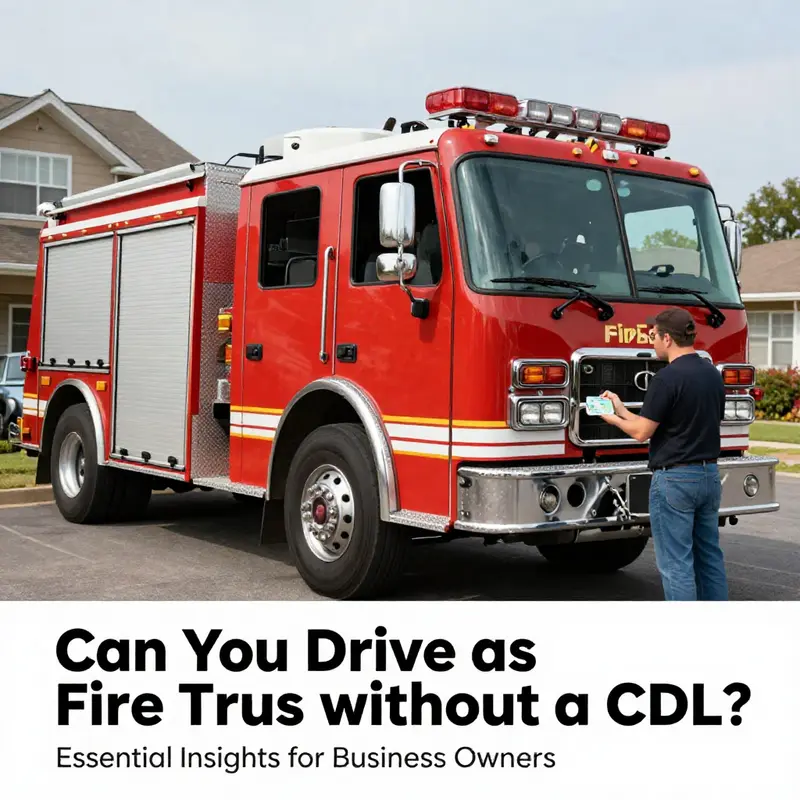
In most places, whether you can drive a fire truck without a CDL depends on GVWR, intended use, and local policy. Large fire engines often exceed the FMCSA 26,001 lb GVWR threshold and are treated as CMVs, which would normally require a CDL. There is a narrow fire department exemption that allows a trained firefighter to operate department apparatus during emergencies without a CDL, provided the duty involves firefighting or emergency response and not cargo or paid transport. This exemption does not permit routine non-emergency driving or personal use. State rules and local department policies vary, and some smaller, blue-plate or micro-vehicles may be operable with non-CDL training. For safety and compliance, many departments require CDL-level training for routine movements or non-emergency operations, and always verify the vehicle’s class and jurisdictional rules before operation.
Weight, Plates, and the Right License: Navigating CDL Rules for Fire Trucks
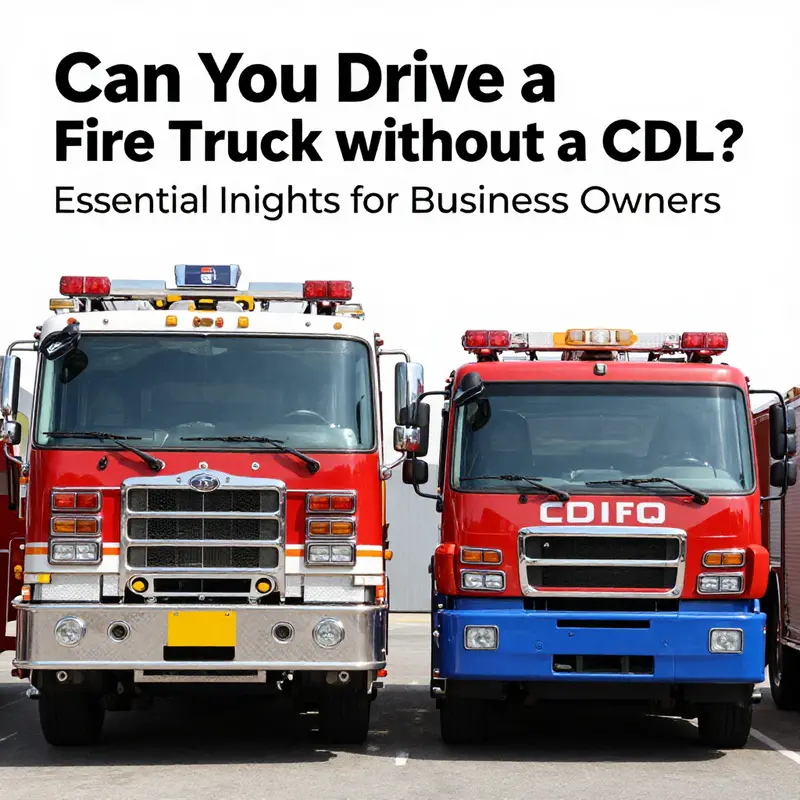
Fire trucks are built to do specific jobs, and the license to operate them follows the same logic as a tool’s size and weight. If you know what category a vehicle sits in, you can predict whether a CDL is required without having to memorize a long list of exceptions. The most reliable guide is the vehicle’s classification and its weight, not the driver’s ambitions or good intentions alone. In practice, the spectrum runs from small, blue-plate work vehicles to large, yellow-plate apparatus that can redefine what a driver is allowed to operate. The difference isn’t just about the color of a badge on a helmet; it’s about the physics of the machine, how it moves, and what it carries. This is why the question “can you drive a fire truck without a CDL?” isn’t answered with a universal yes or no. It hinges on the specific fire apparatus you have in mind and the jurisdiction that issues the license.
Fire service fleets are built around a set of core roles that determine how firefighters reach, fight, and sometimes rescue in a wide range of environments. At one end of the spectrum are the small, nimble vehicles designed for rapid response in tight urban spaces or in rural corridors where roads narrow or infrastructure can impede larger machines. At the other end are the behemoths: aerial platforms that can reach high-rise windows, tankers that ferry water to scenes with limited hydrants, and specialized rescue or foam-equipped units that carry heavy gear and hazardous materials. The classification system used by departments for training and procurement mirrors the licensing framework that governs who can legally operate each machine.
Within this framework, the most common cargo and firefighting configurations fall into a few broad categories. The pumper, or Type 1, is the workhorse designed to deliver water through hoses and nozzles and is the unit you most often see arriving first to structural fires. A typical pumper carries a pump capable of delivering a thousand to a couple thousand gallons per minute, depending on the vehicle’s size and the water supply available. Then there are aerial units: the ladder truck, or Type 2, and the aerial platform, Type 3. Both share the ability to reach elevated targets, but the latter replaces a straight ladder with a hydraulically controlled platform that firefighters can deploy to operate with stability and reach. Beyond these, there are water tenders or tankers, Type 4, designed not to fight a fire directly but to bring a reliable water source to the scene when hydrants are scarce. Foam tenders, Type 5, blend foam concentrate with water to tackle flammable liquid fires. Rescue trucks, Type 6, emphasize extrication and specialized toolsets for trapped victims. Wildland-focused brush trucks, Type 7, emphasize maneuverability and endurance on rugged terrain. Finally, Type 8 tankers or larger water carriers can move large volumes of water across longer distances, a critical capability in remote or drought-stricken areas.
The licensing line of sight to these vehicles is anchored in a predictable rule: GVWR, or gross vehicle weight rating, and the vehicle’s intended use. When the GVWR crosses the 26,001-pound threshold, the door to a commercial license generally opens. A common, practical rule in many jurisdictions is that standard pumper trucks tend to fall under the non-commercial category, partly because many of them are designed to be driven with a regular driver’s license. But as soon as you’re dealing with water tenders, large tankers, or other heavy-duty fire apparatus that push beyond that 26,001-pound mark, a CDL becomes the standard expectation. In concrete terms, a Class B CDL is the typical requirement for vehicles over that weight threshold, especially if the vehicle’s configuration involves towing a trailer or if it operates in a way that classifies it as a heavy vehicle under state or federal rules. If the apparatus is unusually large or specialized, such as very high-capacity aerial platforms or certain rescue vehicles, a higher class like Class A may come into play, particularly if the vehicle also tows a heavy trailer.
One of the more intuitive cues in the field is the plate color attached to the vehicle. Blue plates typically signal a smaller, light-duty platform—often a vehicle listed among “small, light, micro-specialized work vehicles.” In these cases, a standard non-CDL license, often paired with a Class C1 designation in some regions, is commonly sufficient. These are the kinds of trucks that sit under the 6-meter length range and carry nine or fewer passengers or crew, making them eligible for operation without a CDL in many jurisdictions. The opposite end of the spectrum is the bright yellow plate, which marks large, heavy or medium specialized work vehicles. For yellow-plate trucks, the licensing expectations align with Class B, and sometimes Class A, depending on the exact weight, wheel configuration, and whether the vehicle is towing a substantial trailer. The color cue is a practical shorthand, but it’s not a universal law. Local regulations can fine-tune the rules, add endorsements, or require additional training.
What does this mean for someone who wants to drive a fire truck without a CDL? The short, pragmatic answer is that yes, it is possible for certain types of fire trucks. If you are operating a small, blue-plate vehicle that remains under the GVWR threshold and meets the passenger capacity limits common to non-commercial classes, you may be able to drive it with a regular license. This is where the category of “small, light, micro-specialized work vehicles” applies, and it’s precisely why some departments assign volunteers or junior operators to these units. However, this allowance vanishes the moment you move into the realm of larger apparatus. Once a vehicle’s weight and configuration place it into the Class B category or above, the CDL becomes not just recommended but legally required, and any operation without it risks penalties and, more importantly, safety concerns. In practical terms, a department’s fleet mix will dictate the license path for its drivers. A brush truck or compact foam-equipped unit is very different from a ladder truck in a high-rise district, and the training to operate each reflects that difference.
The nuance extends beyond weight alone. Some vehicles carry hazardous materials, such as foam concentrates or other chemical agents, which can trigger endorsements on a CDL—most notably HazMat endorsements. The need for these endorsements is not optional; it reflects the hazardous nature of the substances being transported and the potential risk to the operator and the public. Even if a vehicle’s weight would otherwise place it in a non-CDL category, the presence of HazMat materials can shift licensing requirements. It’s a reminder that fire apparatus operation is not simply about moving from point A to point B; it also involves understanding what is being carried and the safety protocols that accompany those materials.
This is why, when planning or evaluating a career path or a department’s fleet, it’s essential to ground expectations in local rules as much as national tendencies. Weight, plate color, intended use, and the presence of any hazardous payloads combine to determine the actual license required. Fire departments, for their part, must ensure their personnel are properly licensed and trained to operate each vehicle safely. The procurement and deployment of these vehicles are as much about legal clearance as they are about firefighting capability. In practice, a firefighter or operator may begin with a smaller, non-CDL vehicle for training or rapid response in limited spaces, then transition to larger apparatus as they gain experience and as the department’s mission dictates. The careful choreography of training, licensing, and vehicle assignment is part of the broader discipline of emergency response readiness.
For readers navigating a real-world scenario, the practical takeaway is straightforward but deserves care. If you can safely stay within the brownline of a blue-plate, 6-meter-class vehicle with a modest crew, you might operate with a standard license after meeting any local non-CDL requirements. If you expect to drive anything larger, heavier, or more specialized, you should pursue the appropriate CDL class and any endorsements that apply. Always verify the latest local regulations, because jurisdictions vary in how they apply these rules in practice. The safest approach is to consult the department’s training officer or the state’s licensing authority to confirm the exact requirements for the specific vehicle your fleet uses.
Within this framework, it’s useful to visualize how an operator moves through the spectrum of fire apparatus as they gain experience and responsibility. A new driver may begin with smaller apparatus, such as a light rescue vehicle or a brush truck, gaining familiarity with vehicle handling, hose layouts, and critical safety procedures. As skills mature and the department’s needs evolve, the operator may be assigned to a pumper with a more robust water supply or to an aerial platform for complex rescues and high-rise incidents. Each step is a deliberate alignment of capability, safety, and regulatory compliance. In this sense, the question of whether you can drive a fire truck without a CDL becomes a reflection of the vehicle’s class, its weight, its plate color, and the governing rules that tie all of these elements together.
For readers who want a concise, external benchmark on CDL requirements, a reliable resource is the state-level licensing information that outlines the basics of CDL classes, weight thresholds, and endorsements. If you’re exploring this topic from a policy or training perspective, you may also explore the broader landscape of fire apparatus classifications and the corresponding licensing expectations through industry resources that categorize fire vehicles in ways that align with licensing frameworks. For those who want a direct, practical path to understanding the licensing specifics, the road map typically involves confirming the GVWR of the target vehicle, assessing its plate color as an initial indicator, and then confirming with local authorities whether any endorsements apply.
In short, yes, you can drive certain small fire trucks without a CDL in many jurisdictions, provided the vehicle remains within non-CDL limits and does not carry hazardous materials that require endorsements. For larger trucks, or for specialized equipment, a CDL is not optional—it’s a safety and legal necessity. The line between these two realities is drawn by weight, configuration, and the rules of the state or country in which you operate. By understanding the interplay of these factors, individuals can approach a career in fire service with clarity about what license they will need and when.
แหล่งข้อมูลภายนอก: DMV CDL Requirements
airport fire trucks, ARFF vehicles, emergency preparedness, firefighting equipment, used fire trucks
airport fire trucks, ARFF vehicles, emergency preparedness, firefighting equipment, used fire trucks
Jurisdictional Currents: How Licensing Shapes Driving a Fire Truck Without a CDL
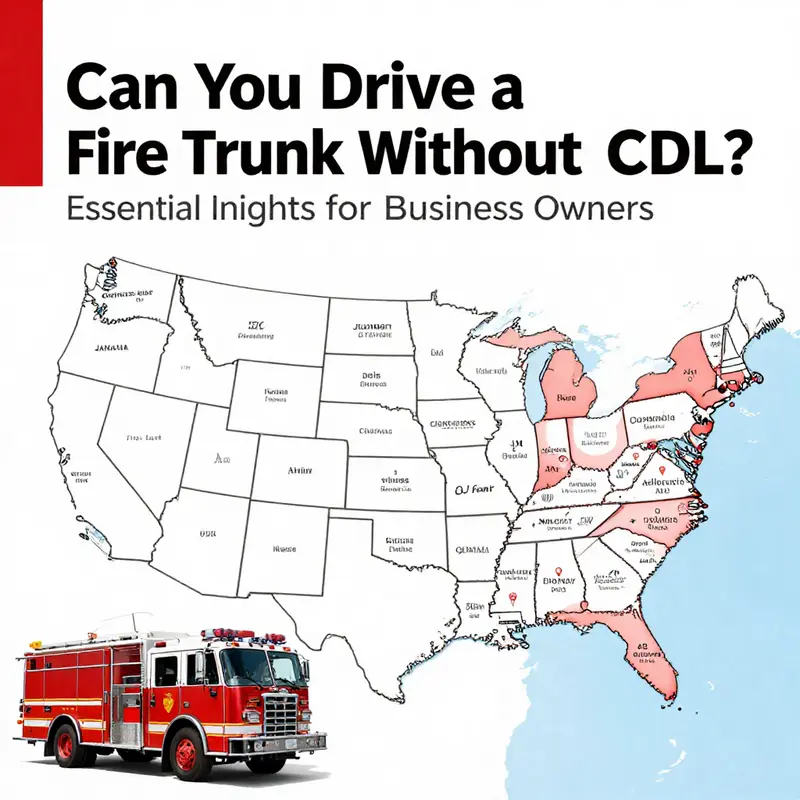
Licensing for driving a fire truck is less a single, uniform rule and more a tapestry of classifications, plate colors, and local interpretations. Across different jurisdictions, the same awe-inspiring vehicle can ride under very different legal rails, because the critical hinge is the vehicle’s physical characteristics and its official designation, not the driver’s ambition or even their firefighting credentials alone. When people ask whether you can drive a fire truck without a CDL, the answer emerges from the intersection of two truths: the size, weight, and configuration of the truck, and the specific regulatory framework that governs the jurisdiction in question. In practice, this means that the ability to operate a given apparatus without a Commercial Driver’s License is not a universal absolution but a conditional privilege tied to the vehicle’s class and its plate designation. For readers seeking to understand the landscape, the most reliable starting point is to map the ladder of vehicle classifications to the plate system used locally, then to connect those codes to the licensing requirements that govern operation on public roads and highways. The research to date suggests that the rules are not standardized across borders, and that accuracy depends on checking the exact code in force where the truck will be used. Large, heavy, or medium specialized fire trucks—often marked with yellow plates—tend to demand a CDL, typically Class B, because their size, weight, and duty cycle place them beyond the safe operating envelope of a standard license. These vehicles are not just bigger; they operate in contexts—rapid response across traffic, long routes to incident scenes, and complex braking and suspension demands—that require the skill set associated with heavy-truck operation. Some fleets that run very large or highly specialized platforms, such as high-reach ladder trucks or rescue vehicles, may require an even higher class, potentially Class A, depending on the vehicle’s exact weight, seating capacity, and the nature of the equipment carried. The logic is practical: as the heft and complexity of the machine increase, so does the potential risk of mishandling on public roads, and therefore the bar for entry to drive such a vehicle is raised. On the other end of the spectrum, smaller fire trucks—typically blue-plate vehicles—often fit within a more permissive licensing regime. In many places, a standard non-CDL license, such as a Class C1, suffices if the vehicle remains compact, light, and within particular length or seating thresholds. These vehicles are usually six meters or less in total length and carry nine or fewer passengers; their operating footprint on the road is closer to that of ordinary ambulances, light-duty service trucks, or small command vehicles. The pragmatic upshot is clear: yes, you can drive certain types of fire trucks without a CDL, but only if the vehicle is small and light enough to fall under a “micro-specialized work vehicle” category and is legally designated with a blue plate. The moment an apparatus grows beyond those thresholds, the CDL route becomes the standard path, and the risk of misclassification multiplies. The colors of plates and the lines of code behind them become silent, powerful signals about licensing. Yet, even this simplified map only hints at a much more nuanced reality. The current literature—limited in explicit cross-jurisdictional comparisons—tends to frame licensing discussions as a side effect of broader concerns: emergency response capability, vehicle safety, and compliance with performance standards. Standards documents like NFPA 1900 or NFPA 1910 primarily address how a vehicle should perform, how it should be tested, and how it should be maintained and inspected. They establish the expectations for reliability and safety but stop short of codifying the licensing framework that governs who may operate what on public roads. In short, licensing is driven by local or national regulatory bodies, not by NFPA standards. The gap this creates is not merely academic; it translates into real-world consequences for agencies that operate across jurisdictions or that consider interjurisdictional mutual aid. If a department shifts the mix of apparatus it deploys or expands its fleet to include more mid-sized or larger platforms, the licensing implications follow. And if a jurisdiction changes its classification thresholds—whether by reinterpreting plate colors, adjusting weight limits, or revising the thresholds for passenger capacity—it can suddenly alter which personnel require a CDL. The absence of a robust, comparative dataset across jurisdictions makes a definitive map elusive. What exists instead is a mosaic of anecdotal references, procurement histories, and safety inspection practices that hint at trends but do not establish a universal rulebook. A particularly important point from the limited results is that some vehicle types have stable, codified requirements across many regions, while others are more variable. For instance, the core variables—total weight, length, seating capacity, and power-to-weight ratio—are the most likely to drive licensing classifications. Where those variables push against regulatory thresholds, the likelihood of CDL requirement rises. Where they stay within the thresholds, the license rule may be more forgiving. This is why any comparative analysis must begin by cataloging the vehicle’s physical parameters precisely: its curb weight, gross vehicle weight rating, overall length, wheelbase, number of axles, and maximum payload. It should also record the vehicle’s official designation or classification within the jurisdiction, as that label often aligns with specific license types. Only then can departments begin to compare apples to apples—how a given jurisdiction interprets a six-meter vehicle versus a six-and-a-half-meter one, or a six-passenger chassis versus a nine-passenger one, or a ladder-equipped platform versus a roving rescue unit. The practical consequences of this framework reach deep into every layer of emergency response planning. For drivers, the question pivots on whether the license they hold is recognized for the specific truck they will operate and under what conditions. For management, it informs how training programs align with licensing, how recruitment is framed, and how certainty is created for on-call staff who may be deployed across jurisdictional lines. For regulatory officers, the issue centers on enforcement, safe operation, and the integrity of the licensing system itself. Given the heterogeneity of rules, many departments adopt a conservative posture: when in doubt, opt for the higher license class to ensure continuity of operation and to reduce risk to team members and the public. Some agencies might also pursue exemptions or permits tailored to emergency situations, though the scope and availability of such accommodations vary widely. The complexity is compounded when departments deal with mixed fleets. A single fleet may include small, blue-plate patrol or rescue vehicles alongside larger, yellow-plate ladder trucks. The drivers who operate these different machines may require different licensure, different training modules, and different endorsements within a single shift. This reality underscores the importance of clear fleet policies, proactive regulatory liaison work, and robust record-keeping. The limitations in the current research suggest that a comprehensive comparative analysis would benefit from closer engagement with local fire department regulations, legal texts on emergency vehicle operation, and official government or municipal codes. Such sources would illuminate how registration, exemptions, and licensing interact with field training, incident command, and mutual aid arrangements. In the absence of a universal standard, a practical approach to understanding licensing across jurisdictions is to view fire trucks as a spectrum of vehicle classes with a corresponding licensing ladder. Small, light-duty units belong on the lower rungs; mid-sized and large platforms require progressively higher licensing authority. The plate color and the published weight or length thresholds in a jurisdiction will usually reveal which rung applies. This approach helps illuminate both the constraints and opportunities for agencies planning fleet acquisitions, personnel development, and cross-border cooperation. It also clarifies for the public and policymakers why a one-size-fits-all answer cannot capture the true picture of fire truck licensing across jurisdictions. For readers who want to explore how vehicle families are categorized and marketed, a practical reference point is the broader market that clusters around commercial fire trucks. An accessible way to gauge how different units are positioned—and how those positions relate to licensing implications—can be found in the commercial fire truck category, which offers a sense of the diverse configurations that agencies may consider when planning their fleets. See the category here for context: รถดับเพลิงเชิงพาณิชย์. External standards and compliance remain essential guardrails in this conversation. While they do not determine licensing directly, they shape the safety and performance that licensing authorities expect from any vehicle operated on public roads. For a broader standards context, consult NFPA guidelines at https://www.nfpa.org/. The reality remains that until more jurisdictions publish and harmonize their licensing criteria, any analysis of fire truck licensing across locales will involve careful, jurisdiction-by-jurisdiction investigation, not a single global rule. Yet even without perfect uniformity, the pattern is discernible: the bigger, heavier, and more specialized the apparatus, the higher the likelihood that a CDL is required; the smaller, simpler, and more compact the vehicle, the more room there is for a standard license path to suffice. This is not a diminishment of the skill involved in driving a fire truck; instead, it is a recognition that the road-safety calculus shifts with the vehicle’s capabilities and the environment in which it operates. For departments, the prudent path is to build licensing and training programs that reflect the actual risk, confirm with local authorities, and document the decision framework used to classify each vehicle. In doing so, they not only ensure compliance but also support consistent, safe, and effective emergency response. As jurisdictions continue to evolve their rules, the priority remains clear: protect responders and the public by aligning licensing with vehicle performance, operator proficiency, and the realities of the streets where these machines must work. The journey toward clarity may be incremental, but each step toward harmonizing vehicle classifications with licensing expectations reduces ambiguity and helps keep fire teams prepared for whatever incident unfolds.
Steering Without a CDL: Best Practices for Small Fire Apparatus
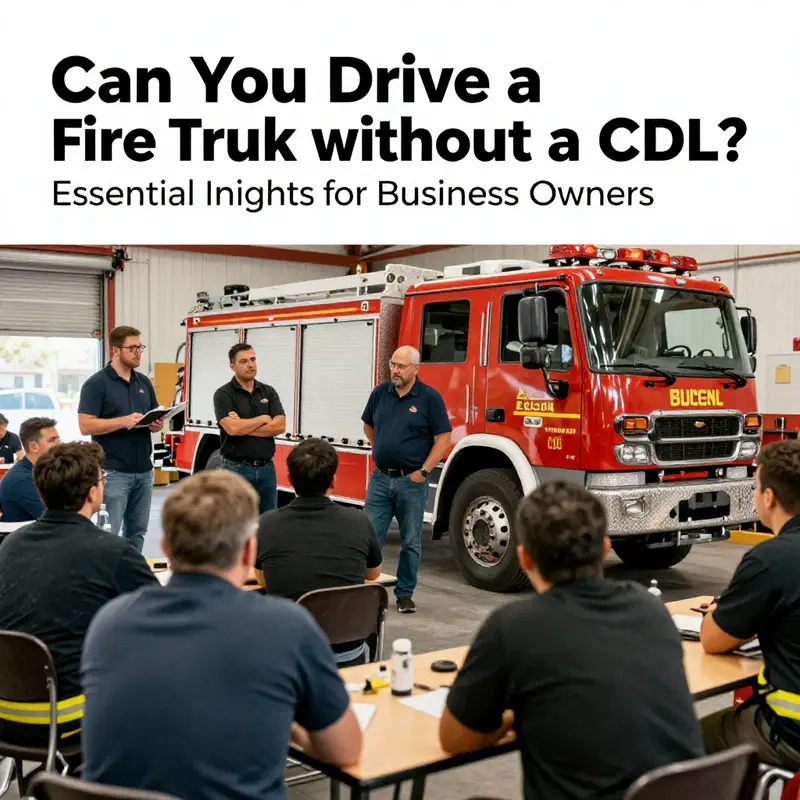
Licensing for fire apparatus is not a simple matter of a single credential, but a nuanced decision rooted in the vehicle’s size, weight, configuration, and the regulations of the jurisdiction in which the crew operates. When a department asks whether a fire truck can be driven without a Commercial Driver’s License, the answer hinges on the vehicle’s classification and its plate designation, not only on the driver’s certificate. In practical terms, many departments distinguish between large, heavy, or medium specialized units and smaller, light-duty rigs. Large and heavy trucks, commonly logged with yellow plates, generally demand a CDL because their gross vehicle weight ratings and mission profiles place them in the realm of commercial, highly regulated operation. A Class B CDL is typically the baseline for moving such vehicles, with some of the most specialized machines—such as high-reach aerial ladders or multi-vehicle rescue units—pulling the driver into higher classes or additional endorsements. But the landscape is more complex for smaller units. Blue plates often indicate lighter, non-commercial vehicles, and in those cases a standard non-CDL license, such as a Class C1 in certain jurisdictions, may suffice. These light-duty machines can be 6 meters in length or less and carry nine passengers or fewer, positioning them in a different regulatory tier altogether. Yet even among lighter trucks, the determining factors are the vehicle’s physical characteristics, its plate color, and the local laws that govern operation. It is essential to check state and municipal rules, because a blanket assumption about CDL necessity can lead to gaps in compliance when the vehicle is used in mixed environments or across jurisdictional lines.
The discourse around CDL requirements becomes even more practical when you consider the mission-driven realities of firefighting. A smaller apparatus that is designed for rapid response, neighborhood coverage, or training flights may travel through traffic without the burden of a CDL, but this does not absolve the operator from adhering to all safety, maintenance, and procedural standards. The operator must understand the vehicle’s limits, instill safe driving practices, and be prepared to handle the apparatus under the stress of an emergency scene. In many communities, the distinction between legal and safe is the difference between a quick, controlled response and a disorganized, risky maneuver through congested streets. The responsibility thus falls on the operator to internalize a clear framework for operation that integrates vehicle capability with the realities of road sharing and public safety.
A practical path through this landscape begins with a candid assessment of the apparatus in use. A small, light-duty fire truck—often designated under blue-plate classification—may be capable of fulfilling certain roles that previously required larger engines. This is not a call to casual driving, but a reminder that capability and licensing are separate questions. The guidance for the field is to align licensing with the vehicle’s weight and configuration, while ensuring that all involved personnel possess the appropriate training and certification for the specific truck they are operating. Training is the backbone of safe operation, and it must cover more than driving skills alone. Pre-incident inspections, familiarization with the truck’s pumps, foam systems, and onboard safety features, and a thorough understanding of the vehicle’s ladder or platform mechanics are essential. In this regard, the operator must be comfortable with the truck’s layout, including how to access controls, how to monitor system pressures, and how to respond if a component fails during transit or at the scene.
The training framework that supports non-CDL operation is anchored in both local practice and recognized standards. Comprehensive instruction should accompany every assignment to operating fire apparatus, regardless of license category. This includes pre-trip and post-trip inspections, safe driving techniques tailored to emergency response, and detailed procedures for entering and exiting roads with lights and sirens activated. The emphasis is on predictability and control rather than speed or risk-taking. The vehicle’s systems—pumps, water supply, stability controls, and any aerial devices—must be exercised under varied conditions so that the operator can anticipate how the machine behaves under load, on different pavement textures, and in adverse weather. The goal is to minimize surprises and to ensure that all crew members are secured by seatbelts and proper restraining devices during transit. These practices become even more critical when the vehicle is operating in mixed traffic, near pedestrians, or in urban corridors with frequent stops and starts.
Beyond training, adherence to maintenance and inspection routines is non-negotiable. Regular maintenance reduces the likelihood of mechanical failure when every second counts. A disciplined schedule of daily checks, coupled with periodic professional servicing, helps sustain reliability for non-CDL operations. Operators should be proficient in recognizing signs of wear that could impede performance—from brake fade and tire condition to hydraulic leaks and pump performance. A mechanically sound apparatus not only enhances safety but also improves response times by reducing the chance of a roadside breakdown that could delay a critical intervention. In the realm of safety, equipment usage matters as much as vehicle dynamics. Operators must consistently employ safety equipment, including seatbelts for all occupants, appropriate restraint for their crew, and clear, audible signaling through lights and sirens to alert other road users. The objective is not just to move the vehicle but to coordinate a safe passage through traffic, minimizing risk to civilians, responders, and the crew itself.
In an emergency, the operation of small fire apparatus without a CDL becomes a study in method and coordination. The driver must balance urgency with caution, navigate intersections with anticipation, and position the truck at the scene to stabilize access for incoming units while protecting the crew from hazards. Scene safety protocols require a clear plan for traffic control, lighting, and staging that accounts for the vehicle’s size and the equipment it carries. The operator must communicate effectively with dispatch, other responders, and any bystanders who might use the route in a crowded urban setting. The best practice is to treat every run as a controlled operation rather than a race against time, ensuring everything from wheel placement to water source connections is deliberate and rehearsed. Such an approach reduces risk and preserves capacity to respond to the next call with the same degree of readiness.
For departments exploring lighter, blue-plate options, the decision to pursue non-CDL operation should be accompanied by a thoughtful equipment strategy. In practice, that means selecting a vehicle that fits the department’s typical response profile while ensuring it remains within the legal framework of the local jurisdiction. A useful step is to study models and configurations that align with the department’s standard operating procedures, lifecycle costs, and training capacity. Operators and leaders alike benefit from considering the practical realities of daily use: maneuverability in narrow streets, fuel efficiency for extended standby, and the ease of maintenance for vehicles that might see frequent shifts between training drills and real incidents. When seeking a vehicle that can perform well within a non-CDL category, consider resources that categorize and describe light-duty fire apparatus. For instance, the รถดับเพลิงขนาดเล็ก category provides a sense of the types of machines commonly used in communities where the aim is rapid response with manageable licensing implications.
Ultimately, the question of whether a fire truck can be driven without a CDL is answered by a combination of weight, plate designation, and jurisdictional rules, all interpreted through the lens of safety, training, and readiness. Even when a vehicle can be operated without a CDL, the expectation remains that the operator will be highly competent, fully trained, and supported by a robust maintenance program. The aim is not only to meet the letter of the law but to honor the spirit of public safety by ensuring that every response is controlled, predictable, and capable of delivering reliable service when it matters most. As departments weigh their options, they should rely on established standards and continue to integrate best practices for training, familiarization, and ongoing assessment of both personnel and equipment. For those who want to dig deeper into the standards that guide operator qualifications and the broader design considerations of automotive firefighting apparatus, official guidelines such as NFPA 1917 provide a comprehensive framework to consult. See the external resource below for further detail: NFPA 1917: Standard for Automotive Fire Apparatus – Official NFPA Website.
External resource for standards and guidance: https://www.nfpa.org/codes-and-standards/all-codes-and-standards/list-of-codes-and-standards/detail?code=1917
community safety
For business owners, navigating the requirements for driving fire trucks without a CDL is more than just regulatory compliance; it directly impacts operational efficiency and safety. Understanding the nuances of fire truck classifications, staying updated with local regulations, and following best practices ensures both legal adherence and optimal performance. Ultimately, equipping your team with the right knowledge and skills regarding fire truck operations is essential in fostering a safe and compliant workplace.

