
















Effective emergency response is vital for urban safety, and the coordination between fire trucks and traffic lights plays a significant role in this system. While fire trucks do not directly control traffic lights, advancements in Smart Traffic Light Systems (STLS) enable them to communicate and influence traffic management during emergencies. This article explores the intricacies of how these systems work, the technological innovations that allow fire trucks to trigger traffic light changes, and the broader impact on urban response times. Each chapter unpacks the importance of these technologies, building a comprehensive understanding of their role in enhancing public safety.
Green Pathways and Rapid Response: How Smart Traffic Lights Shape Fire Truck Emergencies

When a fire call travels through the city, the street network becomes a living partner in the mission. Smart traffic light systems coordinate with approaching engines by listening for signals from the vehicle and the dispatch center, not by giving the vehicle a direct override. The result is a greener path that shortens travel time while preserving safety for all road users. In practice, signals extend green times at affected intersections, reduce red light delays, or create brief green corridors as a fire truck nears.
These systems rely on real time data from on board equipment, GPS routing, and central traffic management. Sensors at intersections monitor vehicle presence and traffic flow, while the governance layer sets how data is shared across agencies. The aim is reliable, scalable coordination that works across jurisdictions and preserves cybersecurity and safety.
Trials in several cities show measurable improvements in arrival times and smoother traffic for neighbors. Benefits include lower fuel use, less idling, and reduced emissions, along with safer speed profiles for crews. The concept of control shifts from a single vehicle to an intelligent network that can adjust multiple signals in concert while maintaining accountability.
To implement these systems, cities deploy robust hardware and software with redundancies and fail safes, standardize data formats, and establish cross agency agreements. The vehicle remains a participant in a data driven handshake, not the operator of a signal. The lights respond to urgency with rules that govern timing, producing a corridor that keeps the emergency mission on track while minimizing disruption to others.
In sum, smart traffic lights enable faster, safer emergency response by turning data into coordinated signal timing. They are not a manual override, but an orchestration that respects the complexity of urban life and strengthens resilience in public safety operations.
Sirens, Signals, and the Green Wave: How Fire Trucks Trigger Traffic Light Changes in Modern Cities
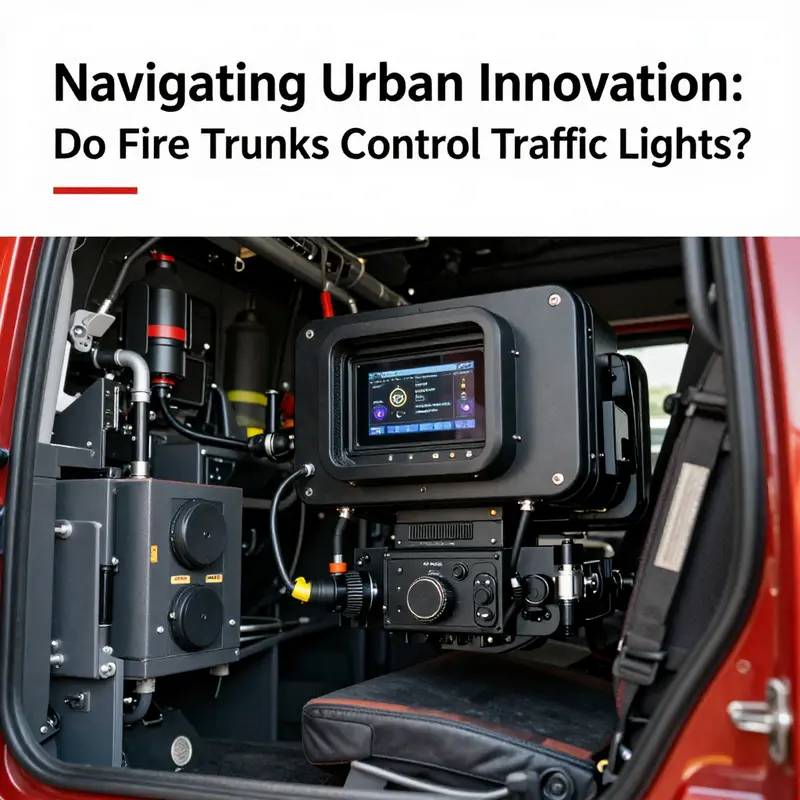
Across cities, emergency vehicle preemption relies on a layered, automated dialogue between moving responders and the signal network. Fire engines transmit a digital profile including position, speed, and route to nearby intersections. Controllers evaluate safety: is the cross-traffic clear? If so, they preempt the cycle to grant a green window for the approaching direction and may coordinate with adjacent signals to form a green progression. Technologies such as dedicated short-range communications (DSRC) and cellular networks (including 5G) carry these messages with low latency and high reliability, sometimes conveying speed and estimated arrival time to improve timing plans. The result is a green wave that lets the engine pass through corridor intersections with minimal delay, while preserving safety for pedestrians and other road users. Security, reliability, and maintenance are essential: authentication and encryption protect signals, redundancy and fail-safe logic keep operation safe if a link is disrupted, and operators retain oversight. The aim is not to override traffic laws but to create a controlled, temporary priority that adapts to traffic realities and then returns to normal operation once the emergency vehicle passes. In practice, cities pilot these systems at single intersections before scaling to corridors, with governance frameworks to ensure interoperability across agencies and vendors. Public safety benefits include faster response times and reduced wear on vehicles, while maintaining equity and safety for all road users. For those seeking deeper technical depth, the U.S. Department of Transportation provides detailed information on emergency vehicle preemption and standards: https://www.transportation.gov/technology/emergency-vehicle-preemption
Signals, Sirens, and the Street: Reframing Emergency Vehicle Traffic Light Control in the Urban Fabric
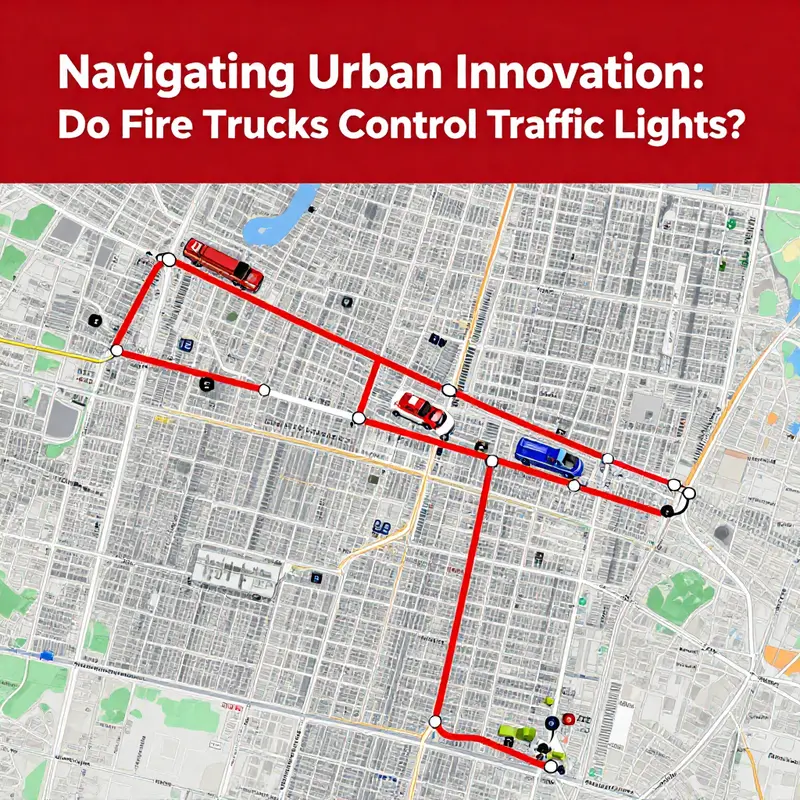
When a fire truck roars toward an intersection, the ordinary rhythm of city traffic shifts in a way that feels almost cinematic. The siren’s wail punctures the soundscape, the flashing lights paint the pavement with urgency, and the street itself seems to lean in to a tighter schedule. The question that often follows is simple, almost irresistible in its clarity: do fire trucks control traffic lights? The answer is layered and nuanced. They do not flip a switch, pull a lever, or press a pedal that directly commands a light to turn green. Yet they can trigger a web of automated responses within a city’s smart traffic ecosystem that makes the path ahead of them clearer, faster, and safer. In other words, they don’t control the signal in the old sense, but they can steer the signal system in ways that optimize a life-saving mission.
To understand how this works, one has to start with the architecture of modern urban traffic management. A city’s traffic signals, at their most advanced, operate not as isolated boxes but as nodes in a network. They talk to each other, share data, and respond to evolving conditions on the ground and in the air. At the heart of this network is a suite of technologies designed to interpret a moving emergency and translate it into signal behavior that favors our responders while preserving safety for everyone else on the road. The most talked-about of these technologies is priority signal pre-emption, where an approaching emergency vehicle can prompt a change in a signal’s phase. This can manifest as a direct green light for the vehicle’s path, a staged sequence that clears a corridor, or a more nuanced approach that reduces unnecessary stopping. The essence is not about the vehicle issuing a command from within its cab, but about the vehicle’s presence, trajectory, and predicted arrival time becoming a data point that the traffic system uses to adjust its choreography.
Several mechanisms enable this collaboration between fire trucks and traffic lights. In cities that have embraced cellular vehicle-to-everything (C-V2X) or similar wireless frameworks, the emergency vehicle broadcasts or shares identifiers and trajectory information with roadway devices and the traffic management center. The signals can then align to favor a green progression along a corridor that would otherwise require multiple lights to switch in sequence, creating what engineers call a green wave. In practice, this means fewer accelerations and decelerations, less idling, and an evacuation of delay that compounds quickly at dense urban intersections. The effect is not merely convenience; it translates into measurably faster response times, lower fuel consumption, and reduced emissions—outcomes that extend beyond the immediate needs of a fire crew to the broader city environment.
Theoretical discussions of signal pre-emption are mirrored in real-world experiments and simulations. A well-cited line of inquiry centers on the idea that emergency vehicles can trigger automated systems that adjust signals as they approach. A prototype and subsequent field tests have shown that when a system is properly tuned, the vehicle’s arrival time at an intersection can be shortened through a predictable sequence of signal changes. This approach, while technologically sophisticated, still asks for careful calibration. An overly aggressive green-wave policy risks compromising other road users or creating unsafe driver behaviors. That balance—accelerating an emergency path while maintaining safety for crossing pedestrians, other drivers, and cyclists—is the core challenge researchers and practitioners wrestle with when they design these systems.
If we look more closely at the technology stack, the logic behind emergency-light priority becomes clearer. The system must detect the vehicle’s approach with high reliability. It can rely on signals from the vehicle’s siren and flashing lights, GPS-based localization, or dedicated short-range communications. The choice of detection method affects latency, reliability, and coverage. A robust system can fuse multiple inputs to reduce false positives and maintain consistent behavior as traffic patterns shift throughout the day. Once detected, the traffic signal controller consults a set of policies that govern how the light should respond—whether to pre-empt a single intersection, create a rolling green corridor, or coordinate with adjacent signals to optimize downstream traffic flow. What looks like a single light changing is in fact part of a larger, cooperative sequence that unfolds across multiple nodes in a city’s transport matrix.
The mathematics of this orchestration is not merely an exercise in algorithmic elegance. It is grounded in the practical need to minimize door-to-life-saving interventions. The literatures that examine these systems emphasize that the gains come from reducing stops at red lights and smoothing the vehicle’s speed along its route. In many large urban environments, the combination of rapid signal pre-emption and intelligent routing can shave precious minutes, sometimes more. The impact grows when one considers the cumulative effect: fewer idling emissions, reduced congestion along alternate routes as drivers adapt to the changing signal choreography, and a more predictable response for dispatch centers that can nudge incoming units toward the most favorable corridors.
Within this landscape, the fire truck remains the initiator of urgency, not the sender of order. The vehicle’s crew relies on a suite of training, protocols, and radio communications that provide safety and situational awareness. The on-board crew still adheres to standard operating procedures that govern speed, lane discipline, and crossing behaviors. The traffic system, meanwhile, absorbs the vehicle’s potential impact and acts to optimize the intersection, balancing the urgency of the emergency with the safety of all road users. It is a partnership, not a command-and-control hierarchy. The result is a city that can respond more rapidly to life-threatening calls while preserving the broader integrity of its streets.
The research results driving this shift are compelling. Studies and reviews show that modern intelligent traffic-light systems, particularly those leveraging C-V2X and related VANET (vehicle-to-vehicle and vehicle-to-infrastructure) architectures, enable true priority signal pre-emption. These findings reinforce the practical claim that emergency vehicles can experience faster, smoother journeys through dense networks with fewer interruptions at intersections. The reporting also emphasizes that the benefit is not just a single-vehicle victory. By coordinating with a broad set of traffic participants and systems, the priority mechanism can improve network-wide efficiency, reducing queue lengths and smoothing travel times across multiple corridors. In essence, the system helps the city to anticipate and adapt to the unpredictable nature of an emergency, turning what could be a claustrophobic tangle of red lights into a navigable stream.
Simulation work adds a valuable layer of evidence. Platforms like OMNeT++, SUMO, and VEINS simulate the complex dance of moving vehicles, traffic signals, and wireless communication. These simulations, particularly when configured with 802.11p protocols, reveal that VANET-enabled traffic-light control can drastically reduce the average response time for emergency vehicles in large urban settings. But simulations also show the trade-offs. They quantify how changing a signal duration or the timing of a green phase can influence other traffic streams, fuel consumption, and even emissions. The most compelling outcomes come from policies that do not merely switch lights but reveal the expected red-light duration to approaching drivers. When drivers can see how long a red phase is likely to last, many behave more predictably. Some may slow down, others may reroute, and a portion may proceed with greater caution, all of which can simplify the dispatch path for the emergency unit and reduce the risk of secondary incidents.
This is where the discussion often enters the realm of policy and urban design. The deployment of such智慧 systems requires a careful framework that defines when and how a signal can be pre-empted, what backup measures exist if communication fails, and how pedestrians are protected during rapid signal transitions. It also demands thoughtful governance, ensuring that emergency responders retain priority access without eroding public trust in traffic safety. The ethical dimension is explicit: the goal is to save lives and minimize harm to all road users. In practice, that means robust testing, transparent performance metrics, and continual refinement of both hardware and software components.
In this context, the fire truck remains an instrument of life-saving mission planning, not a device that rewrites traffic physics on a whim. The drivers still must navigate intersections with care, obeying rules that do not disappear during emergencies. The traffic-control system, for its part, acts in concert, translating the urgency into a set of signal behaviors that clears a path forward while maintaining order for others on the road. The emerging consensus in the literature is clear: when implemented with caution and care, automated, vehicle-aware traffic-light control can deliver measurable reductions in emergency response times and improved safety outcomes. The system achieves this not by making every intersection yield to the nearest responder, but by orchestrating a broader, more intelligent flow that anticipates where a convoy of vehicles might travel and how other users will react to changing signals.
From the perspective of a city planner or a firefighter preparing for a shift, the picture is both technical and practical. The technical reality is a networked infrastructure that integrates sensors, wireless communication, and adaptive controllers. The practical reality is a training culture that emphasizes communication, situational awareness, and shared expectations about how the signal system will behave under different circumstances. It is about knowing when a green wave will help and when it might create unsafe conditions for pedestrians or cross-street traffic. It is about recognizing that the value of the system lies not in a single moment of green but in the reliability of the entire timing sequence across a corridor, the predictability of driver responses, and the capacity to recover gracefully if any link in the chain fails.
The broader implications extend beyond response times. Reducing idle time at intersections lowers fuel consumption and emissions, contributing to a healthier urban environment. It also has a ripple effect on traffic management strategies, enabling more efficient routing algorithms that can adapt to real-time conditions. When a city develops a responsive, data-driven approach to emergency signal control, it creates a platform for further advances. For instance, traffic managers can share live corridor performance data with dispatch centers, allowing for dynamic decision-making about routing, staging, and resource deployment. In a well-integrated system, the street becomes a living organism that senses, communicates, and adjusts in near real time to support critical events.
To illustrate the practical aspect, consider the human dimension of such systems. A firefighter team is trained to interpret scene dynamics rapidly: the location of the fire, the hazards near the intersection, the likely spread of flames, and the best route to the building. The traffic-light system, in turn, interprets this data through its own sensors, predicting where a block or two ahead the vehicle will emerge and how long a red phase might hold at the critical turns. The collaboration is designed to reduce the cognitive load on responders. They focus on the task at hand—getting stationary equipment, hoses, and personnel to the scene—while the city’s digital network handles the low-level timing of green phases. The rider on this brave, efficient protocol is safety: the changes in signal behavior must be reversible, transparent, and verifiable, so that pedestrians and drivers understand why a light changes and how long they have to react.
In a broader sense, this evolution represents a shift in how cities conceive of mobility and emergency service delivery. The relationship between fire trucks and traffic lights mirrors a deeper trend: the move from isolated, mechanical systems to integrated, data-enabled networks that share purpose across agencies and technologies. The city becomes less a collection of separate components and more a collaborative ecosystem where public safety, transportation efficiency, and environmental stewardship converge. The science behind this shift—advanced simulations, vehicle-to-infrastructure communication, and adaptive signal controls—bears fruit when it is translated into governance, budgeting, and everyday practice on the street. The result is not a city that yields to emergency services but a city that can respond to crises with greater speed, precision, and accountability.
For readers who want to see a tangible emblem of this shift, consider the way the emergency-rescue-vehicle category frames the broad spectrum of equipment and capabilities that support such missions. Within this category, one can explore the kinds of vehicles and support systems that are designed to operate in concert with smart infrastructure. The synergy between the hardware that moves responders and the software that governs street signals is part of a larger conversation about how urban systems can become more resilient and more humane in their design. Although the category itself is a catalog of tools, the underlying principle remains constant: technology should extend human capability without eroding safety or agency on the ground. In practice, this means continually testing, validating, and refining how signals respond to emergency presence and how drivers perceive the evolving landscape as a convoy of responders passes through.
The evidence and logic outlined here converge on a practical takeaway for city residents and policy-makers alike. Fire trucks do not control traffic lights in the sense of issuing direct commands from within the cab. Yet, through carefully engineered, data-driven, and safety-centered systems, they benefit from a form of indirect control that optimizes the corridor ahead. The traffic signal network uses the arrival information to adjust its phases, creating safer, faster passages for emergency vehicles while preserving orderly traffic flows on cross streets. This is not a simplification of complexity but a sophisticated rebalancing of competing priorities: life-safety, efficiency, and safety for all who share the street.
As cities continue to invest in smarter infrastructure, the future promises even more seamless integration. Redesigns of intersection layouts, the deployment of more capable sensors, and the expansion of vehicle-to-infrastructure communications will likely broaden the reach of priority signal strategies. The next generation of emergency response, in effect, may be defined less by the power of a single siren and more by the intelligence of a whole network that negotiates time and space in concert with responders. When done right, this evolution preserves the essential purpose of public service: to protect life, safeguard property, and move communities toward safety with dignity and speed. The chapter of urban mobility that begins with a siren ends with a city that moves wiser, not merely faster, and that is perhaps the most compelling kind of progress.
For readers seeking a direct portal into the practical, You can explore further how such coordination is cataloged and contemplated within the broader ecosystem of emergency-response infrastructure through the emergency-rescue-vehicle category. This resource highlights the breadth of equipment that supports fast, safe, and coordinated movements through urban landscapes. acil-kurtarma-aracı kategorisi
External resources that illuminate the broader scholarly conversation about intelligent traffic-light control for emergency vehicles provide a scientific backbone to these practical discussions. The body of evidence suggests that when implemented with careful attention to reliability, safety, and equity, smart, vehicle-aware traffic-light control yields meaningful improvements in response times and traffic operation. See the 2025 study published in Transportation Research Part C for a rigorous examination of these systems and a compelling argument for their value in modern cities. Intelligent Traffic Light Control System for Emergency Vehicles
community safety
The integration of Smart Traffic Light Systems and the technological advancements that allow fire trucks to influence traffic signals are crucial in improving emergency response times. While the fire trucks do not directly control traffic lights, their ability to communicate with these systems enhances safety and efficiency in urban settings. As technology continues to evolve, the coordination between emergency vehicles and traffic management will play an increasingly important role in safeguarding communities and improving the effectiveness of first responders.

