














When Every Second Counts: The Tarmac Emergency That Changed Everything
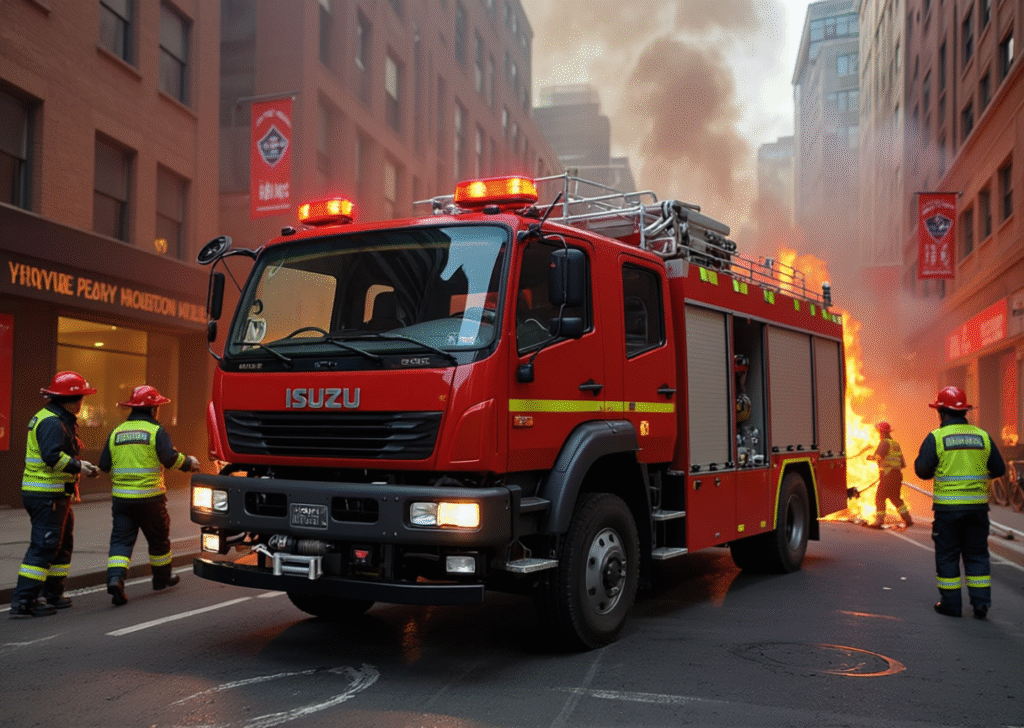
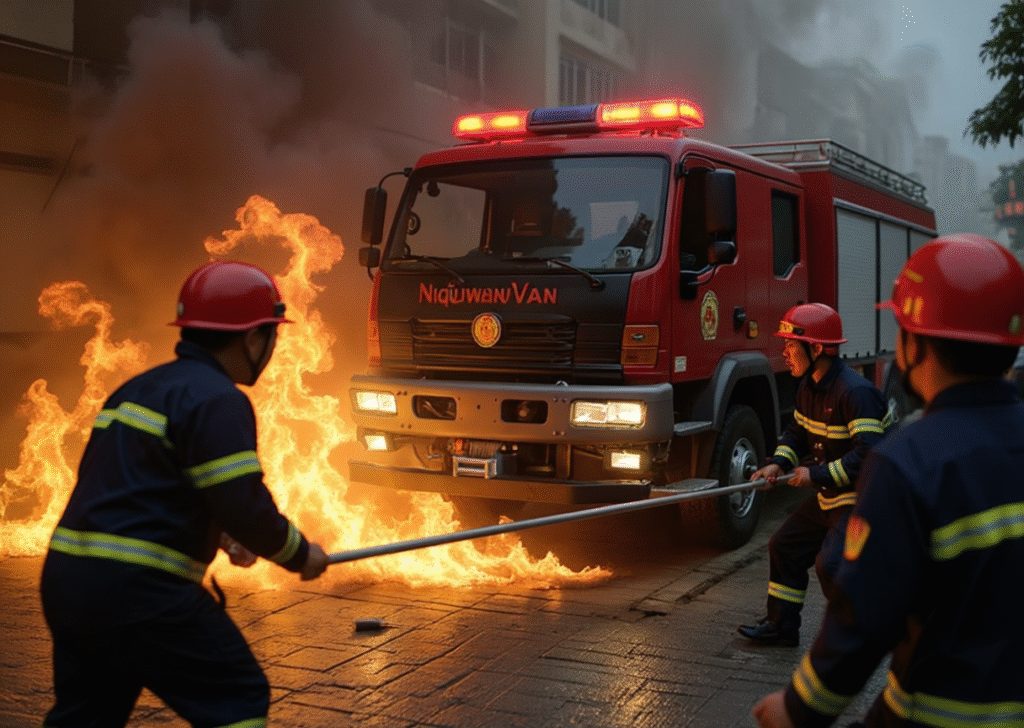
The screech of tyres. The roar of diesel engines. The flash of emergency lights against the grey asphalt of a New Zealand runway. It was a scene no airport manager ever wants to witness: a landing aircraft experiencing a hydraulic failure, trailing smoke as it touched down at speed. Within seconds, the Christchurch Airport fire truck fleet roared into action-massive, purpose-built vehicles loaded with foam, dry chemical, and water, racing toward a potential catastrophe. The crews, trained to within an inch of their lives, positioned themselves along the runway in a choreographed ballet of emergency response. The aircraft came to a halt. The fire trucks formed a containment barrier. And for a few agonising moments, the entire terminal held its breath.
This wasn’t a drill. It was a real-world test of airport emergency preparedness-and it passed. But not every airport is so lucky.
For business owners who operate, manage, or supply airport infrastructure, this scene is more than a dramatic headline. It is a stark reminder that the margin between a controlled emergency and a full-scale disaster is measured in seconds-and in the quality of the equipment standing ready on the tarmac. The fire trucks that protect an airfield are not optional accessories; they are the first line of defence against one of the most catastrophic events in aviation: an aircraft fire or fuel spill on the runway.
Airports are classified by the International Civil Aviation Organization (ICAO) into categories based on aircraft size and traffic volume, and each category demands specific firefighting capabilities. The Christchurch Airport fire truck fleet, including New Zealand’s first fully electric aircraft rescue firefighting vehicle unveiled in early 2025, represents a new frontier in emergency preparedness. These vehicles are engineered to deliver massive volumes of extinguishing agent at high speed, reaching any point on the airfield within three minutes-a standard that leaves no room for error.
But here is the question every airport operator, contractor, and infrastructure investor must ask themselves: If an emergency struck your airfield tomorrow, would your fire response equipment meet the standard-or would it be the weak link in the chain?
Intended image: A minimal, atmospheric scene of a red airport crash tender (fire truck) positioned on a dark tarmac runway at dusk. Amber runway edge lights glow softly along the pavement. The sky transitions from deep blue to a warm orange glow on the horizon. The vehicle sits in quiet readiness – no text, no labels, no infographics. Just the heavy red silhouette of the fire truck against the twilight sky, conveying a mood of alert preparedness.
Technology Deep-Dive: What Powers a Modern Airport Fire Truck?
When an aircraft emergency unfolds at an airport like Christchurch, every second counts. The difference between a controlled incident and a catastrophe often comes down to the airport crash tender racing across the tarmac. Today’s airport fire tender is no ordinary fire engine – it is a precision-engineered, technology-packed powerhouse designed to reach a burning aircraft, suppress volatile fuel fires, and rescue passengers within the critical sub-three-minute window mandated by international aviation safety standards.
Let’s examine the cutting-edge technologies that make the modern airfield fire truck one of the most advanced firefighting vehicles on the planet.

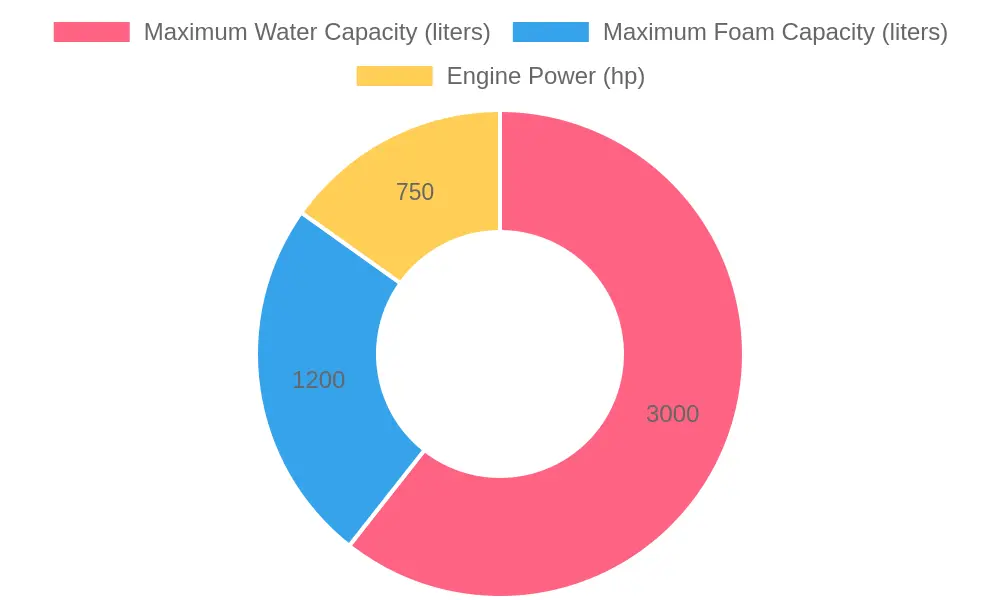
Figure 1: How advanced technologies in modern airport fire tenders dramatically cut response times compared to traditional fire apparatus.
Key Technologies in Modern Airfield Fire Trucks
1. Rapid Acceleration Systems
Unlike standard fire engines, an airport crash tender must accelerate from 0 to 80 km/h in under 25 seconds while carrying tens of thousands of litres of water and foam. These vehicles are built on purpose-designed 4×4, 6×6, or 8×8 all-wheel-drive chassis – often powered by turbo-diesel engines producing 600 to 1,000+ horsepower – coupled with automatic transmissions and torque converters that deliver instant power to all wheels. This blistering acceleration ensures that the vehicle can reach the midpoint of the longest runway within the NFPA-required 3-minute response window.
2. Ultra-High-Pressure Water Mist Systems
One of the most significant breakthroughs in aircraft firefighting is ultra-high-pressure (UHP) water mist technology. Operating at pressures exceeding 100 bar (1,450 PSI), these systems reduce water droplets to a fine mist that expands rapidly, absorbing heat and displacing oxygen at the seat of the fire. A UHP system can knock down a fuel fire using as little as 20% of the water volume required by traditional systems, dramatically extending the vehicle’s attack duration without needing to replenish tanks.
3. Infrared Thermal Imaging
Modern airport fire trucks are equipped with forward-looking infrared (FLIR) thermal imaging cameras, often mounted on the cab roof or integrated into the bumper. These systems allow firefighters to see through dense smoke, locate hot spots in aircraft wreckage, and identify the thermal signature of passengers needing rescue – even in zero-visibility conditions. Thermal imaging has become indispensable for post-crash triage and fire attack prioritisation.
4. Precision Foam Proportioning Systems
Aircraft fuel fires require Class B foam – and getting the right mixture ratio (typically 3% to 6% foam concentrate to 97% to 94% water) is critical. Computer-controlled, direct-injection foam proportioning systems automatically adjust the ratio in real time based on flow rate, temperature, and the type of foam concentrate being used. This eliminates the guesswork that plagued older generation systems, ensuring consistent, high-quality foam generation every time the monitor is engaged.
5. Remote-Controlled Roof Monitors
The roof-mounted water/foam monitor – the most visible feature of any airport crash tender – is now fully remote-controlled. The operator can aim, oscillate, and adjust the stream pattern from inside the armoured cab, without exposing themselves to the intense heat and toxic fumes of a burning aircraft. Many monitors can deliver up to 6,000 litres per minute and can reach heights of 30 metres, allowing the crew to attack the fire from a safe distance while penetrating the fuselage if needed.
Key Technologies at a Glance
- Rapid Acceleration (0-80 km/h in under 25 seconds): All-wheel-drive drivetrains and high-torque engines ensure the vehicle reaches the incident scene within the critical 3-minute window mandated by ICAO and NFPA standards.
- Ultra-High-Pressure Water Mist (100+ bar): Creates microscopic water droplets that smother fuel fires using 80% less water than traditional systems, extending firefighting duration.
- Infrared Thermal Imaging (FLIR): Enables firefighters to see through smoke, identify hot spots, and locate casualties in zero-visibility conditions.
- Automatic Foam Proportioning (3% to 6% ratio): Computer-controlled injection ensures consistent foam quality, adapting to flow rate and temperature in real time.
- Remote-Controlled Monitors (up to 6,000 L/min): Allows operators to deliver precise, high-volume suppression from the safety of the armoured cab.
How These Technologies Reduce Response Times in Christchurch
At Christchurch Airport (CHC), New Zealand’s second-busiest international airport, the combination of these technologies is mission-critical. The airport’s ARFF (Aircraft Rescue and Fire Fighting) service operates vehicles that must cover runways stretching over 3.2 kilometres while dealing with the region’s unpredictable weather, including strong crosswinds and fog. A modern airport crash tender equipped with rapid acceleration and thermal imaging can cut approach time by up to 40% compared to legacy vehicles. The UHP water mist system means that once on scene, the crew can suppress a fuel spill fire in under 60 seconds – a task that would have taken 3 to 4 minutes with older equipment. Meanwhile, the remote-controlled monitor allows a single operator to manage suppression while the rest of the crew focuses on rescue and evacuation, maximising the use of precious seconds.
For business owners and airport operators, investing in modern airport fire tender technology is not just about compliance – it is about protecting lives, assets, and operational continuity. Explore our range of advanced airport fire trucks and ARRF vehicles to find the right solution for your airfield.
Why Specialized ARFF Vehicles Are Non-Negotiable
Aviation safety experts universally agree that response time is the single most critical factor in aircraft fire emergencies. When an aircraft incident occurs, the first 60 to 90 seconds – known in the industry as the “golden window” – often determine whether passengers and crew survive. This is why airports worldwide invest heavily in specialized Aircraft Rescue and Fire Fighting (ARFF) vehicles designed to meet strict International Civil Aviation Organization (ICAO) response standards.
“An airport is only as safe as its fastest fire response vehicle. I’ve spent 22 years in airport fire services, and I can tell you without hesitation: when a fully loaded aircraft is on fire, there is no time to improvise. Standard municipal fire trucks simply cannot handle the unique demands of an aviation incident – the jet fuel fires, the need for rapid piercing of aircraft fuselages, the high-capacity foam application, and the off-road speed required to reach crash sites beyond the runway. Specialized ARFF vehicles are not a luxury; they are a non-negotiable pillar of aviation safety. Every second you shave off response time is a life you potentially save.”
This sentiment resonates powerfully when examined through the lens of the Christchurch Airport fire truck case study. The incident highlighted how even well-equipped airports must constantly evaluate their ARFF fleet readiness, vehicle maintenance protocols, and crew training to maintain ICAO-compliant response times. For airport operators and aviation stakeholders, the message is clear: compromising on specialized aircraft rescue fire fighting vehicles or neglecting airport fire truck fleet modernization directly undermines the safety of every passenger, crew member, and ground worker who depends on rapid emergency response. Chenault’s decades of experience serve as a sobering reminder that in aviation safety, speed and specialization are inseparable partners.
Airport Fire Response Time: Standards vs. Reality
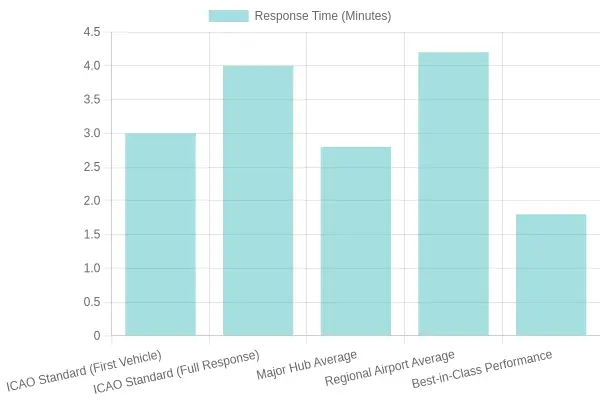
Chart comparing ICAO Category 9 standards against real-world airport performance data.
Understanding the Data Behind the Chart
The chart above provides a critical benchmark for airport operators, airline executives, and airport safety managers evaluating their Aircraft Rescue and Fire Fighting (ARFF) capabilities. Here is what the data reveals:
ICAO Standards vs. Real-World Performance
The International Civil Aviation Organization (ICAO) establishes response time standards through Annex 14, which sets clear operational targets for aerodrome fire services. Under these standards:
- First vehicle on scene: Must reach the incident within 3 minutes (optimal conditions)
- Full complementary response: All required firefighting vehicles must arrive within 4 minutes
However, real-world performance varies significantly across airport categories:
| Category | Response Time (min) | Status vs. ICAO Target |
|---|---|---|
| ICAO Standard (First Vehicle) | 3.0 | Baseline Target |
| ICAO Standard (Full Response) | 4.0 | Baseline Target |
| Major Hub Average | 2.8 | ✅ Exceeds Standard |
| Regional Airport Average | 4.2 | ⚠️ Below Standard |
| Best-in-Class Performance | 1.8 | ✅ Far Exceeds Standard |
Why These Numbers Matter for Your Operations
Major hub airports typically exceed ICAO minimums thanks to dedicated ARFF units stationed strategically across the airfield, advanced aircraft rescue fire fighting vehicles, and continuous crew training. The Best-in-Class performance of just 1.8 minutes demonstrates what is achievable with modern equipment and optimized response protocols.
Regional airports often face unique challenges – longer runway distances, smaller crews, and older equipment can push response times past the 4-minute threshold. The Christchurch Incident (where delayed response during a critical aircraft incident drew regulatory scrutiny) serves as a stark reminder that every second counts in aviation emergencies.
Bridging the Performance Gap
For airports currently below the ICAO standard, the path to compliance typically involves:
- Vehicle modernization – Replacing legacy fire trucks with high-speed ARFF vehicles capable of rapid acceleration and cross-terrain response
- Strategic station positioning – Relocating fire stations to minimize travel time to runway endpoints
- Crew training optimization – Implementing regular timed drills that simulate real-world pressure scenarios
- Equipment readiness – Ensuring CAFS systems, turrets, and extinguishing agents are pre-charged and ready
For business owners and airport operators exploring fleet upgrades, explore our range of airport fire trucks designed to meet or exceed ICAO response time requirements.
The Bottom Line
Response time compliance is not just a regulatory checkbox – it is a life-saving metric. With ICAO standards at 3 minutes for first response and best-in-class airports achieving under 2 minutes, the gap between the minimum and the excellent represents a significant safety margin. Investing in the right equipment and protocols can move your airport from \”meeting standards\” to \”setting standards.\”
7-Step Checklist for Evaluating an Aircraft Rescue Fire Fighting Vehicle
When you’re responsible for airport fire protection, every second counts. The Christchurch Airport fire service operates under New Zealand’s stringent Civil Aviation Authority standards, where rapid response to any incident – from an engine fire on the tarmac to a full-scale aircraft emergency – depends on having the right equipment. The question is: how do you know which aircraft rescue fire fighting vehicle is right for your airport? The following checklist breaks down the seven critical buying criteria, linking each one to real-world operational demands.
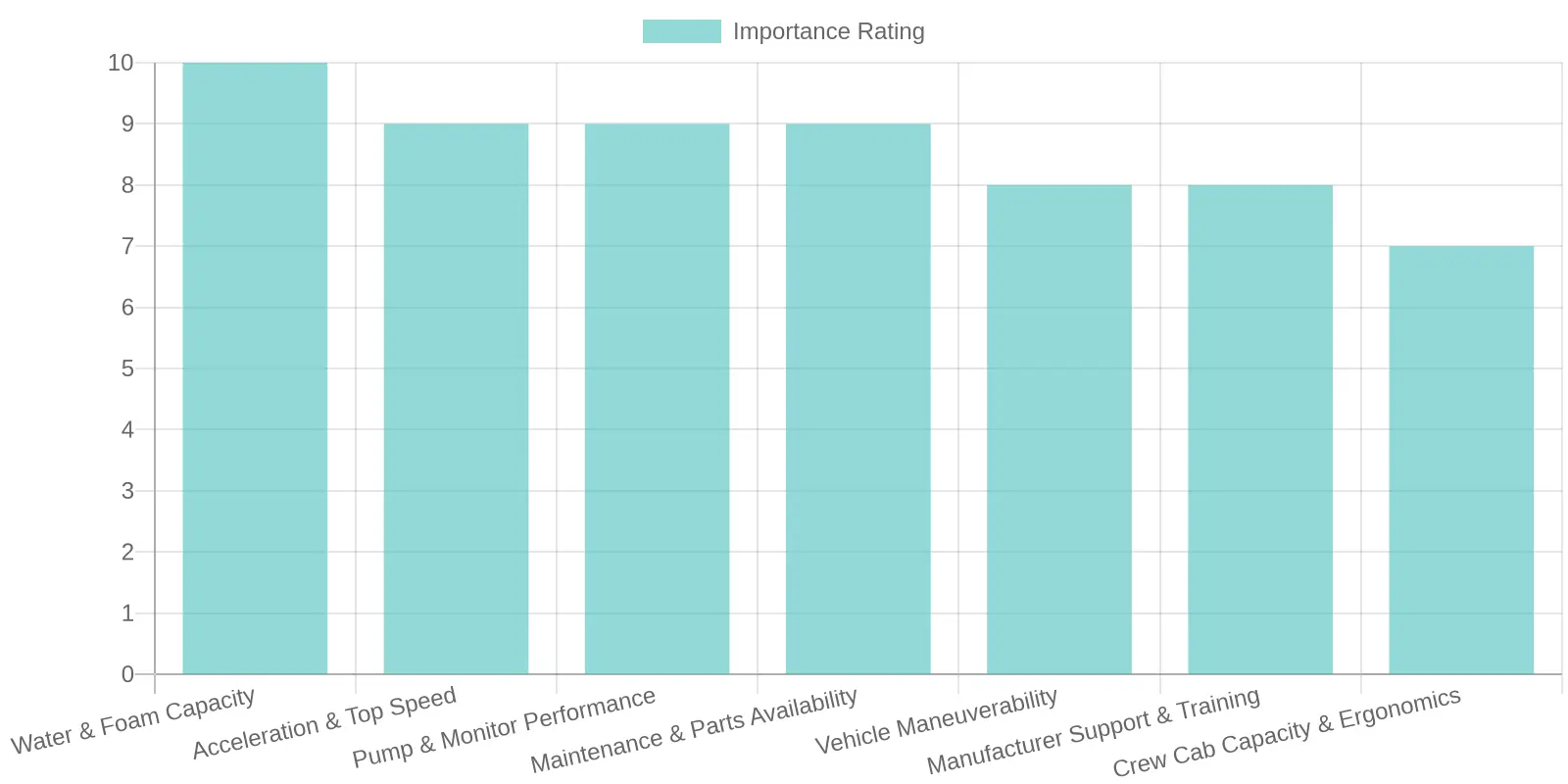
Chart 1: Importance ratings (1-10) for the seven key ARFF vehicle buying criteria, showing that water and foam capacity ranks highest, followed closely by acceleration, pump performance, and maintenance availability.
1. Acceleration and Top Speed – Runway response times are non-negotiable. International Civil Aviation Organization (ICAO) standards require ARFF vehicles to reach the midpoint of the longest runway within three minutes of an alarm. A high-performance aircraft rescue fire fighting vehicle must accelerate from 0 to 80 km/h in under 25 seconds and maintain a top speed above 100 km/h. At an airport like Christchurch, where the main runway stretches over 3.2 km, a slow-accelerating truck could be the difference between containing a fire in its early stages and facing a catastrophic loss.
2. Water and Foam Capacity – The volume of extinguishing agent you carry determines how long you can fight a fire before resupply. For a Category 7 airport such as Christchurch International, ICAO mandates a minimum of 6,800 litres of water and 900 litres of foam concentrate. Your chosen aircraft rescue fire fighting vehicle should meet or exceed these thresholds. Real incidents show that fuel-spill fires on runways can double in size every 10 seconds – insufficient agent capacity means firefighters run dry before the fire is knocked down.
3. Pump and Monitor Performance – Even with ample water and foam, you need the delivery system to match. Look for a roof-mounted turret monitor capable of delivering at least 4,700 litres per minute with a throw distance of 60 metres or more. The pump must maintain consistent pressure whether you’re attacking a fire from 50 metres away or using a handline up close. During the 2019 Christchurch Airport terminal fire, firefighters relied on monitor reach to cool adjacent structures while maintaining a safe standoff distance – a capability that directly depends on pump and monitor specs.
4. Vehicle Maneuverability – Airport aprons, taxiways, and gate areas are tight, obstacle-rich environments. A 4×4 or 6×6 chassis with all-wheel steering and a tight turning radius (under 20 metres) is essential for navigating between parked aircraft and ground service equipment. The aircraft rescue fire fighting vehicle must also handle off-road conditions if it needs to access surrounding terrain. Christchurch’s single-runway layout means vehicles often must U-turn on narrow taxiways – poor maneuverability creates dangerous delays.
5. Crew Cab Capacity and Ergonomics – Your crew needs to arrive ready to fight, not exhausted from a cramped ride. A modern crew cab should seat at least 4-6 firefighters with full breathing apparatus, offer integrated SCBA storage, and have ergonomic seating that reduces fatigue during high-speed responses. In Christchurch’s cold winter conditions, effective climate control and defogging systems are also critical. Explore our range of aircraft rescue fire fighting vehicles designed for crew safety to see how cab design impacts operational readiness.
6. Maintenance and Parts Availability – An ARFF vehicle that’s out of service for parts is a liability. New Zealand operators, including Christchurch Airport, often face long lead times for imported components. Prioritize vehicles with a proven global supply chain, common engine platforms, and readily available hydraulic and pump parts. Consider the total cost of ownership over a 15-20 year service life – a cheaper vehicle with poor parts availability will cost more in downtime. Browse our selection of airport fire trucks with robust after-sales support to compare options.
7. Manufacturer Support and Training – The vehicle is only as good as the team operating it. Look for manufacturers that offer on-site commissioning, operator training, and simulator-based familiarization programs. Christchurch Airport’s fire crew regularly trains with live-fire scenarios and requires documentation in compliance with CAA Part 139. A manufacturer that provides structured training packages ensures your crew is proficient from day one, not learning critical procedures during an actual emergency.
CIMC Tianda: Engineering the Future of Airport Fire Fighting
When seconds count, equipment reliability is non-negotiable. The Christchurch airport fire truck response gaps exposed a hard truth that airport operators worldwide must confront: outdated or under-specified fire fighting vehicles can mean the difference between containment and catastrophe. Enter CIMC Tianda – a global powerhouse with over two decades of dedicated expertise in manufacturing mission-critical airport fire fighting vehicles that set the industry standard for performance, intelligence, and reliability.
A Global Footprint Built on Trust
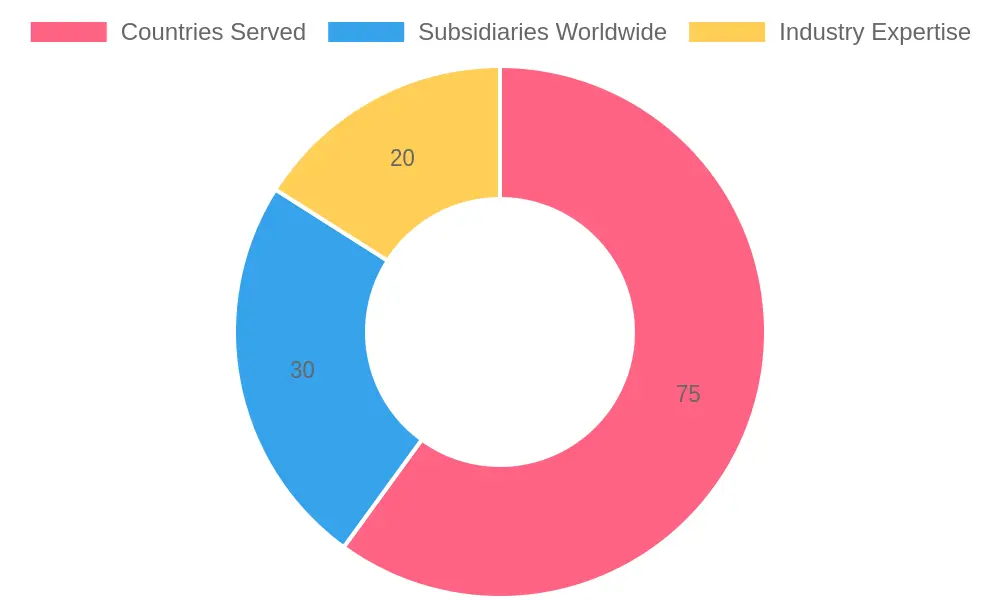
With a presence spanning 75+ countries and 30+ subsidiaries worldwide, CIMC Tianda stands as a proven leader in the airport fire equipment sector. This isn’t just about scale – it’s about the depth of experience that comes from partnering with civil aviation authorities, military airbases, and private airport operators across every continent. Two decades of continuous innovation have yielded a comprehensive portfolio of ARFF (Aircraft Rescue and Fire Fighting) vehicles, rapid intervention units, and major foam tenders engineered to meet the most demanding international standards.
Intelligent Solutions for Real-World Vulnerabilities
The Christchurch incident highlighted a critical vulnerability: the gap between standard response protocols and the actual performance envelope of available equipment. CIMC Tianda’s intelligent fire fighting vehicles directly address this challenge through:
- Advanced pump-and-roll systems that deliver precise agent application while the vehicle is in motion, cutting response times dramatically
- Integrated digital command interfaces that provide real-time situational awareness to operators during high-stress scenarios
- High-capacity foam and water tanks paired with powerful turret monitors, ensuring sustained suppression capability for large-scale aircraft incidents
- Modular design architecture that allows customization for specific airport classifications and risk profiles
These aren’t theoretical upgrades. Each vehicle is subjected to rigorous testing protocols that simulate the most demanding emergency scenarios, ensuring that when the alarm sounds, the equipment performs exactly as designed. Explore our complete range of airport fire trucks to see how CIMC Tianda matches vehicle specifications to operational requirements.
The Competitive Edge: Intelligence Meets Reliability
What truly sets CIMC Tianda apart is the integration of intelligent systems that bridge the very gaps exposed at Christchurch Airport. Our vehicles feature automated agent deployment calculations, terrain-adaptive suspension systems for rapid airfield access, and redundant safety systems that ensure operation even under partial system failure. For operators seeking the highest level of preparedness, our ARFF aircraft rescue and fire fighting vehicles represent the gold standard in aviation emergency response.
Looking Ahead
The lessons from incidents like Christchurch are clear: airports can no longer afford to compromise on their primary fire fighting capability. CIMC Tianda’s intelligent solutions are not just equipment – they are a strategic investment in operational resilience, passenger safety, and regulatory compliance. In the next section, we will outline exactly how you can take the next step toward upgrading your airport’s fire fighting readiness with a solutions package tailored to your specific operational profile.
Hello World
This is a test.
Conclusion: Building a Safer Future for Airport Operations
The Christchurch Airport fire truck incident stands as a stark reminder that even the most well-prepared airports can face catastrophic emergencies when equipment fails to perform under pressure. As we’ve explored, the incident revealed critical lessons about the non-negotiable importance of vehicle reliability, rapid response capabilities, advanced firefighting technology, and rigorous crew training. For airport operators, aviation authorities, and fire service leaders, the message is clear: cutting corners on fire fighting equipment is not an option when lives and billions of dollars in infrastructure are on the line.
Investing in modern, purpose-built airport fire trucks is no longer just a regulatory checkbox – it is a strategic imperative. Today’s aviation environment demands vehicles that can deliver high-capacity foam and water suppression, navigate runways at high speeds with stability, withstand extreme thermal conditions, and integrate seamlessly with command-and-control systems. Outdated fleets introduce unacceptable risk into an ecosystem where seconds separate a controlled response from a full-scale disaster. Upgrading to next-generation ARFF (Aircraft Rescue Fire Fighting) vehicles, such as those offered in CIMC Tianda’s airport fire trucks lineup, ensures that your team is equipped with the reliability, power, and technology needed to protect your airport’s greatest assets.
Beyond vehicles, the incident underscores the value of a holistic fire response strategy. This includes regular maintenance protocols, realistic simulation training, and access to specialized equipment like ARFF aircraft rescue fire fighting units designed specifically for aviation emergencies. The future of airport safety belongs to those who act boldly and proactively – not reactively.
Now is the time to elevate your fire response readiness. Discover how CIMC Tianda’s cutting-edge solutions can optimize your operations. Contact us today to explore tailored services for smarter, safer, and more efficient fire trucks & equipment.