Airport Fire Trucks

Airport Fire Trucks

Airport Fire Trucks From RIV to 13,000 L Crash Tender

An airport fire truck is sized by the aircraft and the runway, not the road. The range covers 4×4 rapid intervention vehicles, 6×6 crash tenders, 10,000–13,000 L water tanks, 1,000–2,000 L foam and 100 L/s monitors. For regional airports, international hubs, heliports and military airfields that need a crash tender matched to the aerodrome category.

The range is delivered through CIMC Firetruck, with core manufacturing at Sichuan Chuanxiao in Chengdu. Every enquiry is tied to a written specification, a chassis or component availability date and a documentation pack for tender, registration or customs review.

13,000 LWater capacity
100 L/sMonitor flow
115 km/hTop speed
6×6Crash chassis
Why the specification matters

Why Airport Trucks Are Specified by the Aerodrome Category

A regional airport and an international hub do not need the same crash tender. The aircraft size, the runway length and the rescue category decide the agent load and the acceleration.

An airport fire truck must reach the runway, cross the grass and apply foam to an aircraft fire within the rescue and firefighting response time. The chassis, tyres, agent load and monitor configuration follow the aerodrome category, not a generic fire truck specification.

The commercial case is decided by four things: agent load, acceleration, off-runway mobility and monitor reach; the usable capacity, 4,000–13,000 L of water and 1,000–2,000 L of foam; crew and equipment fit; and the documentation needed for registration or tender. A lower purchase price that ignores one of those numbers is usually paid back in downtime.

Specification control

The agent load, acceleration, off-runway mobility and monitor reach are fixed in one drawing package before production. The customer approves the interface, the performance figures and the equipment list as a set, not as separate purchase orders.
One system, one supplier

The body, tank, pump, control logic and equipment mounting are engineered together. The interface risk sits with one build team, not between an importer, a body builder and a component supplier.

Capacity with margin

The specification is built around 4,000–13,000 L of water and 1,000–2,000 L of foam, then checked against the chassis axle rating, the stability envelope and the duty cycle. The advertised maximum is not used as the design point.

A layout for the crew and the task

The body is laid out around a 2–6 person cab, a roof monitor, a bumper monitor and a rescue tool set, with the controls, hose bed, lockers and equipment reachable from the ground. The crew should not have to climb on the roof to start the attack.

Service and parts

Each airport fire truck is delivered with a model-specific parts list, a first-year consumable recommendation and a documented service schedule. Wear parts are identified before delivery, not after the first failure.

Documentation before dispatch

Dimensional drawings, test records, operation manuals and the inspection file are prepared before shipment. The tender or registration package is reviewed against the destination requirements.

Practical use cases

Where Airport Fire Trucks Are Used

Start with the incident, the access and the water or power source. The configuration follows.

01

Regional airport RIV

A 4×4 rapid intervention vehicle with 4,000–6,000 L for a small airport or the first response at a larger one.

02

International hub crash tender

A 6×6 13,000 L crash tender with 2,000 L foam and a 100 L/s monitor for a wide-body aircraft.

03

Heliport and offshore

A compact 4×4 with a foam monitor for a helipad, a rooftop or an offshore platform.

04

Military airfield

A 6×6 crash tender with blackout lighting and a convoy configuration.

05

Cargo and terminal

A structural response truck for a cargo shed, a terminal or a fuel farm.

06

Airport support

A rescue tools, equipment or command vehicle that supports the crash tenders.

Certification and documentation

Certified, Tested and Documented for Tender Review

The certificate and the test record are part of the product, not paperwork added after the order.

ISO 9001 · 14001 · 45001

Management systems audited

Quality, environmental and occupational health and safety management systems certified to GB/T 19001, GB/T 24001 and GB/T 45001. Certificates are available for pre-qualification.

GB 7956.10

Airport fire truck standard

The airport range is engineered around GB 7956.10-2025 for airport fire trucks, covering acceleration, agent load and foam performance.

ICAO and NFPA

Aerodrome compliance review

For export, the technical file is reviewed against ICAO Doc 9137, NFPA 414 and the aerodrome category. The applicable clauses are confirmed per project.

Export file

Market-specific documentation

For markets outside China, the technical file is built around the standard named in the tender. Applicability and third-party certification are confirmed in writing before contract.

Product line

Compare Representative Models

Representative configurations from the current range. Final tank, body, equipment and chassis are fixed in the signed technical specification.

Model or platformKey specificationBest for
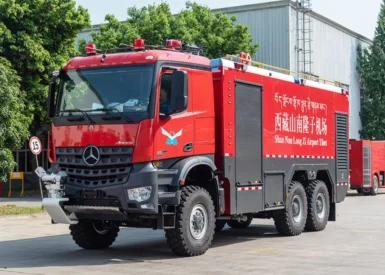
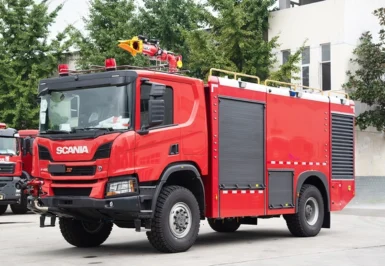
SXF5192GXFJX55Scania 4X4 Airport Fire Fighting Truck Arfff Rapid Intervention Vehicle 4×4 chassis; foam monitor; airport rescue 4×4 rapid intervention View model →
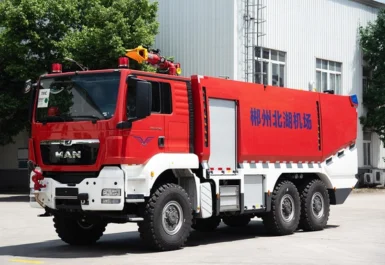
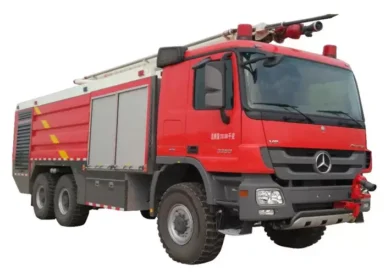
SXF5271GXFJX1106×6 MAN Airport Rescue Fire Truck Aircraft Rescue and Firefighting Vehicles 6×6 chassis; foam monitor; airport rescue 6×6 crash tender View model →
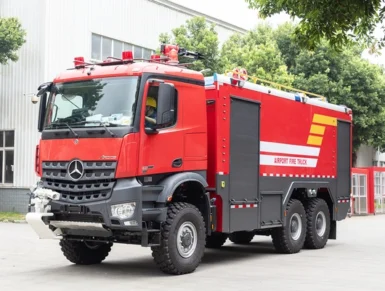
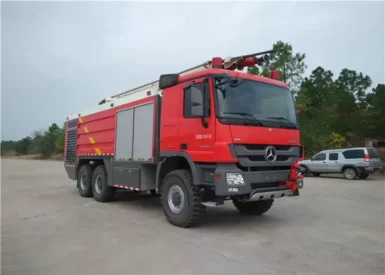
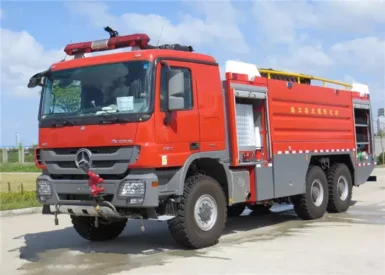
SXF5282GXFJX110Mercedes-Benz Airport Fire Fighting Truck Arfff Vehicle foam monitor; airport rescue 6×6 crash tender View model →
Gross Weight 29000 KG Six Seats ARFFCIMC airport fire truck foam monitor; airport rescue 6×6 crash tender View model →
Engine Power 440kw RIV Rapid InterventionCIMC airport fire truck 440 kW 4×4 rapid intervention View model →

Specifications are representative and vary by model, chassis and destination. Confirm the final configuration, axle load and performance figures in the signed technical agreement.

Manufacturer

Built by a Factory That Also Builds the Rest of the Fleet

The airport range is built around the aerodrome category: agent load, acceleration and off-runway mobility matched to the aircraft and the runway. The core manufacturing base is in Chengdu, with tank fabrication, subframe and body welding, pump assembly, electrical harnesses, painting and full-load testing under one management system.

Sichuan Chuanxiao Fire Trucks Manufacturing Co., Ltd. is a member of CIMC Tianda Holdings and traces its line to the Sichuan Fire Machinery Factory, founded in 1963. The company operates a 200,000 m² plant with more than 500 employees and a range of more than 300 fire truck variants.

Products are distributed in more than 60 countries, with service to more than 2,000 fire departments and rescue organizations. Factory-direct supply covers the appliance, the fire pump and monitor, the body and the parts list, rather than a broker assembling unrelated components.

1963Origin of the fire factory
200,000 m²Chengdu manufacturing base
300+Fire truck variants
60+Export markets

Diario Libre reported the January 2019 delivery of 40 fire trucks to the Dominican Republic as the first Chinese aid project since the two countries established diplomatic relations. The trucks were built by Sichuan Chuanxiao and handed over to the national 9-1-1 system.

Source: Diario Libre

What factory-direct support includes

The handover is the start of the service record, not the end of the order.

  • Pre-delivery inspection — dimensional, performance, electrical and task-specific checks against the approved specification.
  • Commissioning support — on-site or remote, covering start-up, calibration and the first operational drill.
  • Crew training — operation, daily checks, task-specific procedures and shutdown.
  • Spare parts — model-specific parts list, first-year consumables and wear-part recommendations.
  • Documentation — operation and maintenance manuals, inspection forms, material certificates and test records.
Records on file

Airport Fire Trucks: Orders and Fleet Records

Published orders, handovers and platform records with buyer, date, quantity and source. Figures are as reported, not estimates.

Multiple airports2025

50 airport fire trucks ordered in four months

Buyer
Airport operators; individual clients not disclosed
Order
50 airport fire trucks, about ¥200 million
Date
Orders received January to May 2025
Value
About ¥200 million

The report describes the order intake for the new airport model, including 39 t units with a 13,000 L water tank and 2,000 L foam tank.

Source: The Paper, citing JinwenjiangRecord
Chengdu, China2020

One rescue tools truck for Tianfu Airport

Buyer
Chengdu Tianfu International Airport construction headquarters
Order
1 × rescue and breaching equipment truck
Date
Contract award 19 September 2020
Value
Value not published

A dedicated airport rescue support vehicle, tendered separately from the airport’s main crash tenders.

Source: EbnewRecord
Sichuan, China2021

First electric airport fire truck developed

Buyer
Development program; launch customer not disclosed
Order
Electric 6×6 ARFF platform
Date
First generation developed in 2021
Value
Program value not published

The company describes this as the world’s first pure-electric airport fire truck, later followed by a 39 t production model.

Source: JinwenjiangRecord

Verification note: each record is linked to its published source. Where a source did not publish a value or quantity, the card says so.

Procurement questions

Airport Fire Trucks FAQs

The questions that decide the configuration, the chassis and the documentation package.

What is the difference between airport fire trucks and ARFF?

ARFF is the task: aircraft rescue and firefighting. An airport fire truck is the vehicle. The two terms are often used interchangeably, but an airport may also need structural, command and equipment trucks that are not ARFF crash tenders.

What size airport needs a full-size crash tender?

It depends on the aerodrome category and the largest aircraft. A regional airport may use a 4×4 RIV; an international hub with wide-body aircraft needs a 6×6 crash tender with 10,000 L or more of water and 1,000 L or more of foam.

What foam capacity is required?

The foam capacity follows the aerodrome category and the aircraft fuel load. A 13,000 L water and 2,000 L foam crash tender is a common configuration for a large hub. The application rate and the foam quality must be tested.

Can airport trucks be used for structural response?

Yes, but they are optimized for aircraft fires. A structural response truck may have a different body, a larger hose bed and a pump configured for hydrants. Many airports need both.

What certification applies?

For Airport Fire Trucks, the documentation package includes the ISO 9001, ISO 14001 and ISO 45001 management system certificates, the applicable GB 7956 test basis and the material and pressure test records. Market-specific certification is quoted separately.

What is the delivery lead time?

A standard configuration on an available chassis is typically 90–180 days after drawing approval. Imported chassis, aerial appliances, custom bodies and specialized equipment can take 6–10 months. The contract should state the chassis, drawing approval and delivery dates separately.

Can the specification be customized?

Yes. The airport fire truck can be configured around the tank, pump, body, equipment and destination requirements. The limit is the chassis rating, the stability calculation and the applicable standard, not the catalogue.

How is the unit shipped and handed over?

Large vehicles usually move by RoRo; smaller equipment can ship by container or air freight. A factory acceptance test can be arranged before shipment, and commissioning or training can be provided on site or remotely.

What training and spare parts are included?

Training covers operation, daily inspection and the task-specific drill. Each airport fire truck is supplied with a model-specific spare parts list, and a first-year consumables kit can be quoted.

What warranty is offered?

Warranty terms are set in the contract and typically cover the chassis per the chassis manufacturer’s terms and the fire body or equipment for 12–24 months. Extended coverage and a service-level agreement can be quoted.

How do I compare two quotations?

Compare the drawing, the bill of materials, the pump or system curve, the tank material, the axle-load calculation and the test plan. A lower price with a smaller tank, a generic pump or missing test records is not the same product.

What should I send for a quotation?

Send the task, the required capacity or flow, the chassis preference, the destination market and the equipment list. For a airport fire truck, a site plan, a photo of the access or the existing installation is also useful.

Request a quotation

Send the aerodrome category and the aircraft

Tell us the aerodrome category, the largest aircraft, the runway length and the response time. We will match the crash tender, RIV and support fleet to the airport.

Quotations are based on a frozen technical specification. Final capacity, flow, height and equipment are confirmed in the signed agreement.

Showing all 13 results