
All products and categories

The Complete Fire Truck and Rescue Vehicle Catalogue

Twenty-seven product categories, from 300 L rapid-attack ATVs to 25 t foam tankers, 18–70 m aerials and 6×6 airport crash tenders. The catalogue is organised by the incident the appliance has to solve, not by chassis size alone, so a buyer can move from the duty to the specification without comparing unrelated machines.

Every category page carries the same structure: applications, standards, representative models and published delivery records. Core manufacturing sits in Chengdu with Sichuan Chuanxiao, a CIMC Tianda company, and the range is supported by one documentation and spare-parts system.

27Product categories
300+Fire truck variants
60+Export markets
2,000+Fire departments served
How the catalogue works

Why a Catalogue Should Be Organised by Duty, Not by Chassis

Two trucks can share a chassis and still solve different problems. The category should follow the incident, the access and the water or power source.

A 6×4 chassis can carry a water tanker, a foam tender, a water tower or a rescue body. The differences are in the tank, pump, monitor, body and control system, not the badge on the cab. Comparing those trucks by chassis alone hides the numbers that decide the outcome.

The catalogue is grouped by the job the appliance performs. That makes the first comparison honest: a pumper against a pumper, a water tower against a water tower, an airport crash tender against another crash tender. The 27 categories are the shortest route from the incident to the right specification.

27 categories, one specification language

Every category page uses the same decision fields: capacity, flow or reach, crew and chassis, applicable standard and the documentation package. That makes a pumper, a water tower and an airport tender comparable on the points that matter.
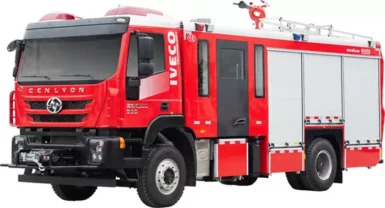

Category pages, not brochure pages

Each page carries the applications, representative models, standards and published delivery records for that category. The buyer can move from the duty to the shortlist without jumping between unrelated product sheets.

One manufacturer across the fleet

Tank, pump, monitor, foam system, body and control logic are engineered together at the Chengdu base. The interface risk sits with one build team, not between an importer, a body builder and a component supplier.

Delivery records with names and dates

The catalogue is backed by published orders: 40 trucks for the Dominican Republic, 10 foam trucks for Tibet, a five-vehicle chemical park package and 50 airport trucks. Each record is linked to its source.

Tender-ready documentation

Dimensional drawings, pump curves, axle-load calculations, material certificates and model-specific parts lists are prepared before shipment. A compliance matrix can be built against the tender clauses.

Parts and service after handover

Every category is supported by a model-specific spare-parts list, a first-year consumable recommendation and a training package. The handover is the start of the service record, not the end of the order.

Where the catalogue fits

Six Duties, Twenty-Seven Categories

Start with the duty. The category and the specification follow.

01

Municipal fire and rescue

Pumpers, tankers, aerials and small rapid-attack trucks for structure fires, vehicle fires, hydrant supply and high-rise response.

02

Industrial and petrochemical

Foam tenders, CAFS pumpers, water towers, robots and gas supply trucks for tank farms, terminals, refineries and chemical plants.

03

Airports and ARFF

4×4 rapid intervention vehicles and 6×6 crash tenders with 10,000–13,000 L water, 1,000–2,000 L foam and 100 L/s monitors.

04

High-rise and elevated attack

Aerial ladders, platforms and water towers from 18 m to 70 m, with 300–450 kg cages and monitors rated for elevated attack.

05

Forest, wildland and narrow access

4×4 ATVs, compact pumpers and water-mist vehicles that can reach tracks, villages and vegetation where a full-size pumper cannot turn.

06

Special operations and support

Command, equipment, lighting, rescue, remote water supply, drone and robot categories that complete the fleet around the pumpers.

Certification and documentation

Certified, Tested and Documented for Tender Review

A fire truck is a regulated asset. The certificate, the test record and the compliance matrix are part of the product.

ISO 9001 · 14001 · 45001

Management systems audited

Quality, environmental and occupational health and safety management systems certified to GB/T 19001, GB/T 24001 and GB/T 45001. Certificates are available for pre-qualification.

CCC

China fire truck certification

China-market fire trucks are CCC certified and type-tested under the GB 7956 series. Export configurations are documented against the destination standard.

GB 7956

The Chinese fire truck standard series

The catalogue covers water tankers, foam trucks, CAFS, airport crash tenders, aerial appliances, rescue vehicles and chemical rescue vehicles under the relevant GB 7956 parts.

Export file

Market-specific compliance

For markets outside China, the technical file is built around EN 1846, NFPA 1901, NFPA 414, ICAO Doc 9137 or the local code named in the tender. Applicability is confirmed in writing before contract.

All product categories

Browse All 27 Fire Truck and Rescue Categories

One table for the full catalogue. Each row links to the category page with models, specifications and applications.

CategorySize and configurationBest for
Fire Fighting TruckGeneral-purpose pumpers3–25 t water or foam; 30–170 L/s; 4×2, 6×4 and 8×4Municipal and industrial pumpers View category →
ARFF Aircraft Rescue and Fire FightingAirport crash tenders6×6; 10,000–13,000 L water; 1,000–2,000 L foam; 100 L/sRunway and aircraft incidents View category →
Industrial Fire TruckPlant and terminal duty12–25 t; water, foam or CAFS; 80–170 L/sRefineries, tank farms, chemical plants View category →
Small Fire TruckRapid intervention0.3–6 t; 4×2 or 4×4; 500–3,000 LNarrow streets, villages, first response View category →
Heavy Duty Fire TruckHigh-capacity tenders16–25 t; 6×4 or 8×4; 100–170 L/sLong-duration supply and high fire load View category →
Aerial Fire TruckPlatforms and booms18–70 m; platform or boom; 300–450 kg cageHigh-rise rescue and elevated attack View category →
Special Fire TruckSmoke, rescue, air, powderSmoke exhaust, rescue, air supply or dry powder bodyTunnels, chemicals and rescue support View category →
Fire Fighting ATVOff-road rapid attack65–500 L; 4×4; water mist or CAFSForest tracks, alleys and fast attack View category →
Fire Truck PartsOEM componentsPumps, monitors, CAFS, doors, cabins and seatsFleet repair, refurbishment and local assembly View category →
Portable Fire Fighting EquipmentCrew-carried equipmentPumps, SCBA, protective suits and gas detectorsFirst attack and firefighter safety View category →
Fire Fighting DroneAirborne attack and survey25 kg payload; 200–300 m working height; 5 km linkHigh-rise, forest and aerial survey View category →
Fire Extinguishing RobotRemote firefighting80 L/s monitor; 1 km remote control; explosion-proof optionsPetrochemical and toxic environments View category →
Light Fire TruckScene lighting8×2 kW LED; 50–80 kW generator; 12 m mastNight operations and scene illumination View category →
Water Tower Fire TruckElevated monitor18–60 m; 3–12 t; 3,000–6,000 L/min monitorTank farms, warehouses, elevated attack View category →
Water Tanker Fire TruckWater supply2–25 t; 30–100 L/s; 4×2, 6×4 and 8×4Water supply and shuttle operations View category →
Foam Fire TruckClass B suppression6–27 t; 3–6% proportioning; 80–170 L/sFlammable liquids and fuel fires View category →
Emergency Rescue VehicleRescue and salvage98–168 tools; crane, winch and lighting optionsRoad crashes, collapse and rescue View category →
Aerial Ladder Fire TruckLadder rescue18–44 m common, up to 70 m; 300–450 kg cageWindow rescue and roof access View category →
Fire Equipment TruckEquipment transport98–168 sets; 16–18 t; custom rackingStation equipment and task-force support View category →
CAFS Fire TruckCompressed air foam3,600–55,000 L/min foam output; 4–18 tWater-limited and high-expansion attack View category →
Fire Command VehiclesCommand and communications7 seats; 100–1,000 W communications; 13 setsCommand, control and communications View category →
Remote Water Supply System Fire TruckLong-distance supply2 km relay; 400–35,000 L; up to 750 hpRemote water supply and flood drainage View category →
Hydraulic Truck CraneLifting support8–70 t; 7–40 m boom; truck-mountedLifting, recovery and logistics support View category →
Special VehiclesCustom bodiesCustom chassis, body and equipment integrationNon-standard rescue and support roles View category →
Gas Supply Fire TruckBreathing air support50 kW; 570 L/min; 10 t chassisBreathing air and gas support at long incidents View category →
Commercial Fire TrucksCommercial chassis10–20 t; sprinkler or pumper body; 95 km/hMunicipal services and commercial sites View category →
Airport Fire TrucksAirside response6×6 RIV to 13,000 L; 100 L/s; 115 km/hAirport fire and rescue operations View category →

Capacities and heights are category ranges, not a single model. Final tank volume, pump curve, axle load and equipment list are fixed in the signed technical specification.

Manufacturer

One Factory, Twenty-Seven Categories, One Documentation Standard

The catalogue is delivered through CIMC Firetruck, with core manufacturing at Sichuan Chuanxiao Fire Trucks Manufacturing Co., Ltd., a member of CIMC Tianda Holdings. The company traces its line to the Sichuan Fire Machinery Factory, founded in 1963, and today operates a 200,000 m² plant in Chengdu with more than 500 employees and a range of more than 300 fire truck variants.

Production covers tank fabrication, subframe and body welding, pump assembly, electrical harnesses, painting and full-load testing. Key components, including fire pumps, monitors and CAFS modules, are designed in-house, so a replacement part is traced to the same drawing as the original.

Products are distributed in more than 60 countries, with service to more than 2,000 fire departments and rescue organizations. Factory-direct supply covers the appliance, the fire pump and monitor, the body and the parts list, rather than a broker assembling unrelated components.

1963Origin of the fire factory
200,000 m²Chengdu manufacturing base
300+Fire truck variants
60+Export markets

Diario Libre reported the January 2019 delivery of 40 fire trucks to the Dominican Republic as the first Chinese aid project since the two countries established diplomatic relations. The trucks were built by Sichuan Chuanxiao and handed over to the national 9-1-1 system.

Source: Diario Libre

What catalogue support includes

The handover is the start of the service record, not the end of the order.

  • Category selection — match the duty, access and water or power source to the right product family.
  • Specification review — tank, pump, monitor, body, chassis and axle load checked as one package.
  • Tender file — drawings, curves, certificates and a compliance matrix for evaluation.
  • Spare parts — model-specific parts list, first-year consumables and wear-part recommendations.
  • Training — operation, daily checks and the task-specific drill at the factory or on site.
Orders on the record

Delivered and Contracted Across the Catalogue

Three published records with buyer, date, quantity and, where published, value. Figures are as reported by the source, not estimates.

Dominican Republic2019

40 fire trucks for the national 9-1-1 system

Buyer
Dominican Republic national 9-1-1 emergency system
Order
40 fire trucks and support equipment
Date
Delivered January 2019
Value
Aid project; value not published

Reported as the first Chinese aid project after diplomatic relations. The trucks were built by Sichuan Chuanxiao.

Source: Diario LibreRecord
Yunnan, China2026

Five vehicles for a chemical park fire station

Buyer
Yundian Chemical Park fire station, Chuxiong High-Tech Zone
Order
Heavy foam truck, 25 m water tower, rescue truck, chemical rescue truck and gas supply truck
Date
Final acceptance 13 May 2026
Value
¥5.49 million for five vehicles

A single station package spanning five catalogue categories, configured for chemical-park rescue and accepted together.

Source: Chuxiong High-Tech ZoneRecord
Multiple airports2025

50 airport fire trucks ordered in four months

Buyer
Airport operators; individual clients not disclosed
Order
50 airport fire trucks, about ¥200 million
Date
Orders received January to May 2025
Value
About ¥200 million

The report describes the order intake for the new airport model, including 39 t units with a 13,000 L water tank and 2,000 L foam tank.

Source: The Paper, citing JinwenjiangRecord

Verification note: each record links to its published source. Where a source did not publish a value or quantity, the card says so.

Procurement questions

All Products and Categories FAQs

The questions that decide the category, the chassis and the documentation package.

How do I choose the right product category?

Start with the incident, the access and the water or power source. A structure fire in a hydranted district points to a pumper; a tank farm points to foam or CAFS; an aircraft fire points to ARFF; a high-rise points to an aerial appliance. The category pages then narrow the chassis and capacity.

Are all 27 categories manufactured by the same company?

The core fire truck range is engineered and built at the Chengdu base of Sichuan Chuanxiao, a CIMC Tianda company. Some specialised equipment and partner-built models are integrated into the same specification and documentation process. The page for each category states the relevant build basis.

What information do you need to quote?

Send the task, the required capacity, flow or height, the chassis preference, the destination market and the equipment list. For a vehicle, add the station bay dimensions and the road or site access. For a tender, send the specification and the compliance clauses.

Can I mix categories in one order?

Yes. Fleet orders commonly combine pumpers, tankers, foam trucks, aerials and support vehicles in one programme. The vehicles can share a documentation set, a spare-parts philosophy and a training package, while each chassis and body is specified for its own duty.

What certifications apply across the catalogue?

The management system is certified to ISO 9001, ISO 14001 and ISO 45001. China-market fire trucks are CCC certified and type-tested under the GB 7956 series. Category-specific standards such as GB 7956.10 for airport trucks or GB 7956.12 for aerial appliances are listed on the relevant page.

Which standards apply to export orders?

The tender usually names the standard: EN 1846, NFPA 1901, NFPA 414, ICAO Doc 9137 or a national code. The technical file is built around that standard, and third-party inspection can be arranged. The applicable clauses and exclusions are confirmed in the signed specification.

What is the lead time?

A standard configuration on an available chassis is typically 90–180 days after drawing approval. Imported chassis, aerial appliances, airport crash tenders and custom bodies can take 6–10 months. The contract should separate the chassis availability, drawing approval and delivery dates.

Can specifications be customized?

Yes. Tank volume, pump flow, monitor type, foam proportioning, body layout, lighting, winch, crane and equipment racks are specified per order. The limit is the chassis axle rating, the stability calculation and the applicable standard, not the catalogue.

Do you supply spare parts and training?

Every vehicle is supplied with a model-specific spare-parts list and a first-year consumable recommendation. Training covers operation, daily inspection, pump or system checks and the task-specific drill. It can be delivered at the factory, a regional point or the customer station.

How are vehicles shipped?

Large vehicles usually move by RoRo; smaller equipment can ship by container or air freight. A factory acceptance test can be arranged before shipment. On arrival, commissioning and crew training can be provided on site or remotely.

What warranty is offered?

Warranty terms are set in the contract and typically cover the chassis per the chassis manufacturer's terms and the fire body or equipment for 12–24 months. Extended coverage and a service-level agreement can be quoted.

Can you help with tender documents?

Yes. The documentation package can include dimensional drawings, chassis data, axle-load calculations, pump curves, monitor flow and throw, foam proportioning data, electrical schematics, material certificates and a compliance matrix against the tender clauses.

What is the difference between a category page and a product page?

A category page explains the duty, the selection criteria, the standards and the representative models for a type of appliance. A product page lists the specification of one model. Start with the category, then compare the models within it.

Do you supply complete station packages?

Yes, for fleets and new stations. A package can combine pumpers, tankers, aerials, command, equipment, lighting, breathing air and rescue vehicles, with a shared training and spare-parts plan. The scope is defined in the tender or the station brief.

How do I verify a case?

Each case card links to the published award, handover or delivery report. The buyer, date, quantity and value are shown as reported. Where the source did not publish a value or quantity, the card says so; no estimated figures are presented as facts.

Request a catalogue review

Send the duty, the site and the fleet plan

Tell us the incidents you cover, the water source, the access, the station bay and the number of vehicles. We will map the requirement to the right categories, propose a fleet mix and return a specification with the axle-load and performance checks attached.

Quotations are based on a frozen technical specification. Final capacity, flow, height and equipment are confirmed in the signed agreement.