
















Understanding the size of fire trucks is crucial for business owners, especially those in industries requiring safety and emergency preparedness. This article delves into the dimensions and specifications of fire trucks, the variety of types and their respective sizes, and how these sizes influence firefighting efficiency. Each chapter presents vital information that interconnects these aspects, enabling better decision-making regarding fire safety and equipment investments.
Sizing Up the Shield: How Fire Trucks Span Streets, Sizes, and Capabilities

Size is not a single number when we talk about fire trucks. It is a spectrum shaped by purpose, terrain, and the choreography of a team in motion. The vehicle that rolls to a blazing building must balance a trio of demands: reach, capacity, and maneuverability. As a result, manufacturers design a family of machines where the geometry—length, width, height, and the spaces inside the chassis—reads like a map of firefighting strategy. In this chapter, we move through that map: how dimensions are defined, what they enable or restrict in the field, and why a truck’s size matters more than the color of its siren. The discussion is not a catalog of models but a narrative about how form follows function in the crucial work of saving lives and protecting property. It is a story that anchors numbers in reality, showing how a fire engine’s body shape translates into everyday outcomes: faster responses, steadier water supply, safer ladders, and fewer compromises when space is tight and time is scarce. And while the specifics can vary by region and standard, the underlying logic travels across borders, guided by universal needs and shared safety frameworks that harmonize firefighting practice around the world.
Begin with the simplest truth: fire trucks come in a spectrum of lengths. Some urban-primed units run compact, designed to slip through narrow streets and side alleys where every centimeter counts. Others stretch the horizon, built to haul big water tanks, heavy pumps, and sprawling tool loads for industrial sites or rural frontiers. In practical terms, typical urban-response trucks may cluster around the six- to seven-meter mark, while larger, purpose-built apparatus can exceed ten meters. A concrete sense of scale emerges when we put a few figures on the page. A representative range shows total lengths around six thousand to nearly ten thousand millimeters, with a handful of configurations lingering near the lower end of the spectrum and a larger subset stretching well beyond the nine-meter threshold. The width of these machines standardizes a bit more, commonly around 2.5 meters, a footprint that translates to the corridor the truck must navigate when doors swing open and personnel rush to deploy hoses and equipment.
Height presents another axis of variation, though it remains bound by practical limits. Many trucks hover around three and a half meters in height, a ceiling determined not just by garage doors and clearance under bridges, but by the need to carry tall ladders, elevated platforms, or outriggers. The height figure matters beyond the ceiling clearance; it interacts with payload distribution, center of gravity, and the mechanical geometry of stabilizing legs and ladders. The result is a vehicle that looks, in the best cases, like a carefully engineered balance between profile and purpose rather than a simple block on wheels. When height grows, so too does the potential for wind resistance and the necessary clearance for urban canyons and rural tree lines, which in turn shapes the design choices around chassis stiffness, suspension travel, and tire selection. In a sense, height constraints push designers to optimize every other dimension so the truck remains agile and reliable under duress.
The weight story is inseparable from size. The permissible total weight gives a ceiling for everything the crew and machine carry into service. A representative heavy-duty chassis can be rated around 28,000 kilograms, which translates to about 61,729 pounds. That total is not merely a gravity problem; it is a blueprint for how much water a truck can hold, how many extinguishing agents it can mix, and how many personnel or pieces of equipment can be stowed while maintaining a safe margin for braking, acceleration, and safe maneuvering. The payload and the water volume are tightly linked to the mission profile. Water is the lifeblood of firefighting, and on many fronts, it is the central constraint that determines the truck’s size. Tanks come in a spectrum from several thousand liters to twenty thousand liters, depending on whether the vehicle is designed for rapid response with a smaller water load or for sustained operations where refilling points are scarce and every drop must be accounted for. A common family of configurations nests foam tanks alongside water tanks, typically in the neighborhood of five thousand to seven thousand liters for foam. The foam is not an ornament; it changes the mathematics of the pump and the dynamics of flow, allowing teams to blanket flammable liquids or certain surfaces with a barrier that suppresses ignition while water continues to cool and cool and cool. The interplay between water and foam storage is essential because it shapes the geometry of the chassis: longer frames to accommodate the tanks, thicker cross-members to bear the weight, and more spacious compartments to house hoses, nozzles, and portable equipment.
The engine and its powertrain anchor the truck’s capability to perform under load. Engine power ranges in practical fire-truck configurations from the mid-two hundreds of horsepower to the low four hundreds. In numeric terms, that spectrum translates roughly from 260 HP up to about 420 HP, with some high-end variants delivering around 400 horsepower or more when measured in kilowatts. That power is not a badge of speed alone; it is the fuel that propels pumps, drives hydraulic systems, and maintains performance when the vehicle is loaded with water, foam concentrate, ladders, and a full crew. Transmission choices reinforce the same principle: multiple gears, often in the neighborhood of a 16-speed configuration, provide both torque and finesse as the vehicle negotiates gradients, obstacles, and tight streets. Pneumatic braking systems—air brakes—are standard in large fire trucks, a choice born from the need for reliable, scalable stopping power that remains effective even when the vehicle’s mass climbs under heavy load.
But size is not just about raw mass or bottle-neck geometry; it is also about the dynamics of water delivery—the pump and the nozzle being the heart of the firefighting system after the driver takes the wheel. The pump’s discharge capacity is measured in liters per second, and the numbers one typically encounters range from about 20 L/s up to 40 L/s, with higher-output pumps used in larger, more capable rigs. This is where the relationship between tank size and pump capacity becomes more than a simple arithmetic problem. A bigger water tank buys more time between refills, but only if the pump can deliver water at rates that meet the demand of a growing fire scene. Heavier trucks can carry more water and have more robust pumps, but they also demand more from road infrastructure and the crew’s operating space. In practice, the design challenge is to harmonize pump performance with the truck’s weight, frame stiffness, and axle configuration so that high-volume discharge is sustainable during an active incident.
Axle configuration and tire choice also illuminate how size plays into capability. Fire trucks employ a range of drive configurations, from 4×2 to 6×4 and even 4×4 for certain off-road or rugged-terrain applications. The number of driven axles, combined with tire size and tread, governs weight distribution, traction, and the ability to maintain control when the vehicle is heavily loaded. Common tire sizes—such as 10.00-20, 11.00-20, and 10.00R20—reflect a balance between load-bearing capacity, road contact area, and the need for stability when the apparatus is in motion or stationary on uneven ground. The choice of tires is not cosmetic; it is a direct line to performance in rain, snow, mud, or heat, and to resilience when the truck must hold a stubborn line against a slope or compensate for a soft shoulder during a critical shift in the incident scene.
The presence of aerial and specialized equipment adds a further layer of geometric complexity. Aerial ladder trucks, for example, require extended ladders that can reach heights of 30 meters or more. The ladder not only increases the truck’s height but also consumes space along the chassis length and subtly shifts the center of gravity. The ladder’s reach becomes a design constraint as engineers must ensure that the vehicle’s overall footprint remains compatible with typical urban geometry such as bridge heights, parking clearances, and traffic lanes. In the field, this translates into decisions about where the vehicle can stage and how the crew can maneuver around it to deploy ground operations and elevated access with the minimum loss of time. The end result is a family of vehicles whose most dramatic feature—the ladder—imposes both a spatial obligation and an operational advantage, enabling firefighting from above and creating new lines of defense against the spread of fire.
All of these dimensions combine with safety and quality standards that guide what is acceptable in production and what performance must be demonstrated in the field. Reputable manufacturers design to international safety and quality frameworks such as the general principles codified in recognized standards. Those standards establish expectations for braking efficiency, stability, and crashworthiness; for the reliability of pumping systems under repeated cycles of use; and for the durability of structural components under the harsh conditions of daily operation. The standards influence every dimension in the sense that they define the thresholds that a given vehicle must meet in order to be deemed roadworthy and mission-ready. This ensures that a larger machine, as formidable as it may be, does not become unwieldy in the real world, where every second counts and every turn must be navigated with care. The interplay between standardization and customization is a constant dialectic: while standards validate core capabilities, manufacturers tailor vehicles to fit the climates, urban forms, and industrial profiles of their customers. In practice, this means that two trucks of the same general class may differ in subtle ways—internal layout, door locations, equipment compartments, and the precise routing of hoses and cables—yet still comply with the same overarching safety criteria.
To keep these varied dimensions coherent with real-world operation, many fire trucks are designed with a clear mission-based logic embedded in their configuration. A light-duty, urban-oriented 4×2 chassis will emphasize compact length and nimble handling, with enough water capacity to handle initial suppression and a rapid return to service. A heavy-duty, high-capacity unit prioritizes water and foam storage, long-range pumping capability, and robust stability across uneven terrain, with a chassis that can tolerate the added mass and still deliver dependable braking and steering performance. An aerial unit balances the need for reach with the practicalities of roadway geometry, ensuring the ladder can extend and retract without colliding with obstacles while still preserving the ability to move quickly when needed. In all cases, the objective remains the same: to convert a set of measurements into a reliable, responsive tool for the crew and the incident commander, a tool that becomes more effective the more its geometry aligns with the scene at hand.
The design conversation does not exist in a vacuum. It is deeply connected to the environments in which fire services operate—urban cores with sharp corners and limited turnaround space; rural districts with longer distances to hydrants or water sources; industrial sites with high fire load and complex access; or highway incidents that demand rapid staging and high-speed response. In urban cores, the narrow streets favor compact lengths and tight turning radii, but they demand enough water and foam capacity to address the onset of a fire before a more capable off-road or longer-range unit can arrive. In contrast, rural or industrial settings may justify longer trucks with larger water tanks and more robust pumping capacity, where the ability to operate for an extended period without immediate refilling can dramatically affect outcomes. The highway environment introduces another layer of constraint: height and length become critical when negotiating overpasses and lane closures, and where swift, predictable maneuvering is essential to keep traffic moving safely around an incident.
An important thread running through all of this is the practical reality of space, load, and crew. The crew area must be designed to accommodate a typical team while providing space for a range of tools—hoses, nozzles, adapters, power tools, rescue equipment, and medical supplies. The compartments must be arranged so that responders can access critical items rapidly, with a layout that minimizes the time spent searching in the cab or the belly of the vehicle. This is not merely a convenience; it directly affects the ability to stage and deploy in the critical minutes when people are at immediate risk. The geometry of the cab and the body, the way doors swing, the height and reach of shelves and compartments, all influence how quickly a team can transition from drive to deploy. The end-to-end system—from the moment the call comes in to the first water reaching the fire—depends on this structural choreography. Sizes are chosen with this choreography in mind, ensuring the vehicle can reach the scene, deliver water, and support rescue operations without becoming a hindrance to the mission.
As with any complex engineering problem, a balance is struck between specificity and flexibility. Some fire services require a standardized fleet with a common footprint to simplify maintenance, training, and interchangeability of parts. Others opt for a diverse portfolio because diverse missions demand diverse tools. In both cases, the underlying principle remains: the size, weight, and capability set of a fire truck are not arbitrary; they are tuned to the group’s operational doctrine, the terrain they serve, and the critical standard they must meet. This shared logic ensures that even as truck lines differ from one department to another, the intent remains consistent: to bring the most effective, reliable tool to the fire scene, regardless of the geometry of the street that holds it in place or the ladder that reaches toward smoke and flame. For readers seeking a catalog-like overview of heavy-duty configurations and their characteristics, the following category page offers a focused glimpse into how these machines are grouped and described in practical terms: heavy-duty-fire-truck category.
In closing, size is a language that communicates capability in firefighting. It tells responders what a vehicle can do before it starts moving, and it tells commanders what to expect once it arrives. The numbers—meters of length, kilograms of weight, liters of water and foam, horsepower and pumps—are not ends in themselves but units of meaning: they describe the fire truck’s operational envelope. A well-chosen size profile can shorten the distance from the first squirt of water to a controlled, safe outcome. It can shorten the cycle from alarm to action, and it can expand the crew’s ability to stabilize a scene, protect bystanders, and preserve what they aim to save. In this sense, the truck’s dimensions are not merely technical specs; they are a strategic instrument, a portable workshop of safety, designed to be intimate with the places it serves and agile enough to adapt as the fire grows or shifts shape across the urban or rural map. This is the essence of sizing up the shield: to know where it fits, how it operates, and what it enables when every second counts.
For further context on the range of heavy-duty configurations and the kinds of bodies and tanks that constitute this category, see the heavy-duty-fire-truck category page.
External resource: For an industry-standard reference on fire apparatus specifications and testing practices, see NFPA resources on fire apparatus standards at NFPA.org.
Sizing the Siren: Understanding the Size Spectrum of Fire Trucks Across Types

The question of how big a fire truck is invites more than simple curiosity. Size matters because a fire engine must negotiate crowded streets, reach distant points of a blaze, carry enough water or foam, and still fit inside fire stations and on the limited real estate of a driveway or a bay. Size, then, is a language of capability. It signals what the vehicle can do, where it can go, and how quickly it can respond. Across the firefighting world, there is no single standard footprint. Instead, the width, height, length, and the weight a truck carries are tuned to the mission it must fulfill. A compact urban responder that zips through narrow lanes looks very different from a heavy-duty unit designed for industrial sites or wide-open rural terrain. The result is a spectrum of proportions that reflects the environments served, the kinds of emergencies anticipated, and the regulatory frameworks that shape vehicle design and operation.
Begin with the basics: most common frontline pumper trucks, the workhorses of many departments, sit somewhere in the midrange of the size scale. In practical terms, these pumpers tend to stretch from roughly six to nine meters in length. They are long enough to accommodate a pump, hoses, and a robust water supply, but not so long that they become unwieldy on tight city streets. Their width typically hovers near two meters, a dimension that balances stability on the road with the ability to navigate narrow passages or crowded urban corridors. Heights for these vehicles usually fall around three meters, give or take a few tens of centimeters depending on the equipment mounted on the chassis and the cab configuration. This combination of length, width, and height creates a footprint that makes pumpers versatile, responsive, and capable of carrying essential tools while remaining practical for daily operations.
Yet the firefighting fleet does not stop at the pumpers. When the mission shifts toward elevated access and rescue operations in tall buildings, the vehicle profile expands in conspicuous ways. Aerial trucks, or ladder trucks, are built to reach higher than ground access allows. Their length commonly surpasses the three-meter mark by a considerable margin, and many extend well beyond nine meters in total, with some configurations pushing past twelve meters. Aerial platforms and the hydraulics that extend the ladders add substantial length and height to the vehicle, reflecting the need to deploy a stable, fully supported working area at height. Aerials also demand more space to house their ladder sections, stabilizing outriggers, and related control systems. In practice, you can expect these machines to present a longer wheelbase and a taller silhouette, especially when the ladder assembly is fully deployed. The payoff is the ability to reach upper floors, execute rescues, and conduct advanced firefighting operations from above, capabilities that are crucial in urban cores where high-rise structures are common.
Beyond the pumpers and aerials, the size spectrum includes water tankers and tenders. These vehicles are designed to move large volumes of water to locations where hydrants are scarce or unavailable. The tank itself becomes a major factor in overall size. Tank capacities can vary widely, from a few thousand liters to many thousands, a scale that directly influences the vehicle’s length and the space it requires to house pumps, filtration systems, and control equipment. For instance, a 15,000-liter water and foam tender will typically present a longer chassis than a light-duty pumper, and its height may be modestly higher to accommodate the tank and related hardware. In some configurations, the overall length can exceed ten meters, and the height will adjust to preserve stability and weight distribution as water loads shift during travel and pumping operations. The width often expands to two point seven or two point eight meters given the broader tank profile, while the turning geometry must still be considered to maintain accessibility in tight quarters. These tenders occupy a different strategic niche: they extend the reach of a fire department’s water supply, enabling lengthy operations in environments where water sources are remote or distant from municipal networks.
Rescue units occupy yet another segment of the size spectrum. Built for urban flexibility, these vehicles prioritize maneuverability and rapid deployment over maximum payload. Their design often results in compact profiles—typical lengths in the range of roughly four and a half to six meters. A smaller footprint does not imply reduced capability; instead, rescue units emphasize tools and systems that help crews perform rapid extrications, stabilize scenes, and deliver essential safety equipment to people in need. The balance between compact form and full-function capability is delicate, but it is precisely what allows rescue units to thread through congested streets, alleyways, and residential blocks while still carrying enough gear to support immediate life-saving actions.
The story of size, however, does not end with a simple sum of measurements. A truck’s footprint is the result of several interacting design decisions. Drivetrain configuration—such as whether a vehicle uses a two-axle four-by-two layout or a four-by-six or six-by-four arrangement—directly affects not only weight distribution but also the range of maneuverability and the capacity to carry heavier loads. Cab design matters as well: a single-row cab tends to keep length down, while a double-row cab can elongate the overall footprint to accommodate more crew or equipment storage inside the cab, which is often a trade-off against rear storage space and the overall wheelbase. The question of suspension, steering geometry, and the vehicle’s center of gravity is not merely academic; it translates into how safely a vehicle can operate at speed, in rain, on uneven pavement, or on a slope while carrying a heavy water tank or a long ladder. In short, the size of a fire truck is a practical function of the mission profile, not a mere measurement to be recorded for curiosity’s sake.
Another critical dimension is how a vehicle’s height interacts with infrastructure. Buildings, bridges, tunnel clearances, and even parking structures can limit which trucks can operate in a given area. Taller units with long ladders may not fit through certain tunnel passages or under bridges whose clearance is marginal. In many urban settings, this can mean a deliberate decision to stock multiple classes of apparatus, each tailored for a specific route or risk profile. The optimal mix might include compact, fast-response units for initial attack and access, mid-sized pumpers for standard evolutions, and larger, specialized vehicles for fixed risk scenarios, such as industrial plants, airports, or seismically active zones where longer booms or greater water capacity become essential. This distribution is not arbitrary; it reflects a strategic understanding of where a department will operate and what kinds of emergencies it is most likely to face.
The practical reality is that size also interacts with regulatory and safety standards that define what is permissible on public roads and in public facilities. Across different regions, standards govern how a fire truck is designed, how much weight it can safely carry, what the permissible noise and emissions levels are, and how the vehicle must perform under load in various conditions. In the United States, the National Fire Protection Association’s 1901 standard outlines essential performance and equipment criteria for on-road fire apparatus. In Europe, the EN 1846 standard plays a similar role, while in China, GB 7956 governs other aspects of design and operation. These norms do more than set a ceiling for cluttered garages and awkward roadways; they shape the geometry of the vehicles themselves. The result is a world where a seven-meter-long urban pumper can be certified and deployed with confidence in one country, while a similar unit might be tuned differently for another location’s roads, climates, and firefighting practices. The net effect is a spectrum with guardrails rather than a single line, allowing manufacturers to tailor size and weight to mission-specific performance without compromising safety or reliability.
As one contemplates the relationship between size and capability, the role of equipment carried on board becomes central. Aerial ladders, pumps, foam systems, rescue tools, and stabilization apparatus all contribute to the overall dimensions. The ladder sections that extend from the chassis, the height reach they provide, and the support hardware that stabilizes the vehicle during operation contribute to both length and height. Water tanks and foam tanks occupy space that would otherwise be available for equipment and crew; larger tanks mean fewer compartments for extrication gear or rescue tools, which in turn influences how a department allocates its resources and trains its personnel. The same logic applies to smaller, more specialized units that carry a compact but carefully curated set of tools. Each choice—how much water to carry, how long a ladder to mount, whether to add a foam system, which pumps to install—feeds back into the vehicle’s weight, balance, and path through the urban fabric.
Choosing a truck’s size is also about operational tempo. A department that emphasizes rapid response in dense city blocks benefits from vehicles that can accelerate quickly, turn sharply, and occupy modest space in a crowded fire station. In contrast, a department tasked with protecting large industrial facilities or rural pipelines may prioritize endurance, extended range, and a heavier water load, even if that means accepting a longer, taller, or heavier vehicle with a longer wheelbase. In both cases, the decision is not merely about how big a truck looks; it is a calculated approximation of how much damage a department expects to face, how many personnel will be on the scene, and how long they expect to operate before the next resupply. The interdependence of size, weight, and capability creates a practical choreography, a balance between reach and reachability, between carrying capacity and maneuverability, and between the immediacy of a response and the stability of a multi-hour operation.
This nuanced balance is a reminder that the size of a fire truck is not just a matter of physics and weight figures. It is a reflection of a city’s or a region’s geography, its built environment, and the everyday realities of moving through space that a firefighter must contend with. The same city that requires a compact, nimble unit for quick access to tight courtyards may also rely on a long-range tender that can shuttle tens of thousands of liters of water to an inland or remote site. A district with a skyline of glass towers will demand aerial platforms with substantial reach, while a coastal area with frequent storms might benefit from specialized units that can cope with high winds and challenging conditions. In short, the size of a fire truck is a practical, situational statement of how a community imagines safety, how it plans for risk, and how it prepares its responders to protect lives and property when seconds count.
For readers who want to connect the general discussion of size to concrete design choices, a useful link is the aerial fire truck category, which showcases how ladder length, platform height, and overall footprint scale up in those distinctive machines. aerial fire-truck category. This category highlights how the ladder, the stabilizing outriggers, and the working platform influence not only reach but also the vehicle’s length, height, and balance during elevated operations. It is a reminder that a single piece of equipment can cascade into a cascade of size considerations that ripple through the truck’s entire design and how it is used on scene. At the same time, it illustrates why many departments maintain a diversified fleet—each vehicle type sized to fit a snapshot of the hazards they anticipate and the spaces they must navigate every day.
Beyond the physical measurements and regulatory wrap, there is the human factor to consider. The crews who operate these machines must work in harmony with the vehicle’s size. A larger, taller truck demands different entry and exit practices, a different cadence of movement around the scene, and distinct coordination with other responders and with onlookers. Training becomes as crucial as engineering: drivers and pump operators must know precisely how to handle weight distribution when the vehicle is loaded with water and equipment, how to deploy the ladder without compromising stability, and how to maneuver through a complex urban scene with pedestrians and other vehicles nearby. Even seemingly small choices, such as the door swing, the placement of compartments, or the angle of a side mirror, can influence the time and success of a response. In this sense, size is not only about length and height; it is about the choreography of a team bringing a complex set of tools to bear in a rapidly evolving situation.
Ultimately, the size of a fire truck is a practical compromise built from decades of firefighting experience, engineering innovation, and the realities of the built environment. It represents a careful calibration of what must be carried, how it will be used, and where the vehicle must go. While the numbers may seem abstract—meters, liters, kilograms—their implications are concrete: faster access, safer rescues, more effective suppression, and the ability to sustain operations when faced with the unpredictable challenges that fires and emergencies throw at responders. As communities grow and change, so too will the vehicles they rely on, each new generation balancing an evolving mix of size, weight, and capability to meet tomorrow’s risks with the same essential commitment to saving lives and protecting property.
For readers seeking a broader synthesis of size and its practical implications across different environments, external resources provide additional context on how fire truck types and sizes align with regional needs and safety expectations. https://www.firesafety.com.au/fire-truck-types-and-sizes/.
Size as Strategy: How Fire Truck Dimensions Shape Firefighting Effectiveness
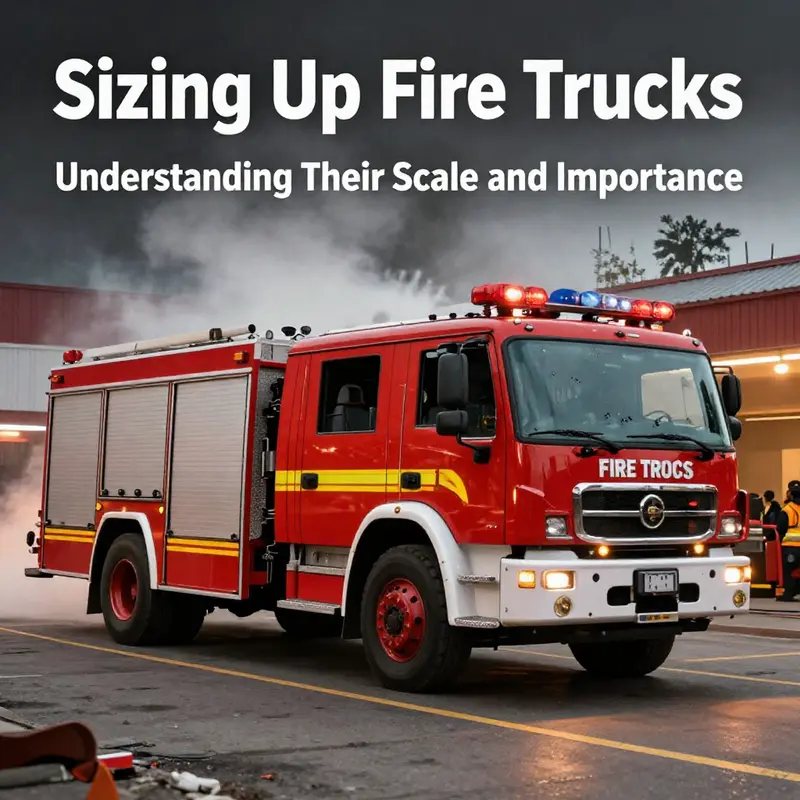
The question “how big is a fire truck?” invites a straightforward measurement, yet the answer is more nuanced than a tape measure can reveal. Size is not a vanity metric; it is a strategic choice that shapes every step of an emergency response. Firefighting demands vary widely—from congested urban streets crowded with vehicles to wide-open rural landscapes where access is limited and water supplies are sparse. In each scenario, the vehicle that rolls to the scene is a carefully selected tool, sized not for elegance but for mission success. The result is a spectrum of sizes, each with its own strengths and blind spots, designed to meet the conditions that responders are most likely to encounter. In practice, this means that a fleet will typically include a mix of light-duty, compact trucks and heavier, higher-capacity apparatus. Such diversity reflects the reality that there is no single universal size that fits every fire scenario. Mobility, water on board, pumping capacity, and rescue capabilities all hinge on dimensions—from the overall length and width to the height of the chassis and the reach of the hoses and ladders. Even the choice of configuration, such as a four-wheel-drive urban model versus a longer, multi-axle platform, is driven by where the truck must operate and how quickly it must perform under pressure. In short, size becomes part of the firefighting plan itself, a pre-emptive decision that determines how fast a crew can reach the fire, how long it can stay sustained at the scene, and what kind of threats it can confront head-on.
Size and capacity sit at the core of this calculus. On the lower end of the spectrum, lighter, compact urban models are typically around six to seven meters in length. They are designed to thread through tight streets and to appear where access is constrained by parked cars, narrow lanes, or the geometry of a city block. These vehicles prioritize agility and rapid deployment. They may carry modest water reserves and a compact array of tools, enabling a quick knockdown of smaller fires or initial attack until larger support units arrive. Yet even these smaller trucks are more than merely scaled-down versions of their bigger cousins. They integrate essential features—technologies for rapid water delivery, efficient pump systems, and compact foam or dry chemical capabilities—that allow them to make a meaningful difference in the earliest moments of a fire.
As the incident grows in scale, so does the need for water and propulsion power. Larger, heavier-duty models—often configured as six-wheel or eight-wheel platforms—bring substantial increases in both water capacity and pumping potential. In generic terms, many of these robust trucks operate with onboard water tanks ranging from several thousand liters up to about 16,000 liters, a volume that translates to roughly 5 to 16 cubic meters. This onboard reservoir fundamentally changes the tempo of an operation. When hydrants are nearby, the primary goal may still be rapid knockdown and containment; but in environments where municipal water supplies are intermittent or nonexistent, the ability to sustain a stream of water without frequent refills becomes a decisive advantage. In practice, the right balance between tank size, pump capacity, and the weight that the chassis can safely bear is a product of careful engineering and field feedback. An engine in the mid to high hundreds of horsepower—often in the 266 to 440 horsepower range—provides the momentum needed to haul heavy payloads across varied terrain and to push water through long distances or up to elevated targets. This power margin matters not only for surge capacity but also for maneuvering with full equipment in tow, where weight shifts can influence handling and stability.
Beyond water, modern fire trucks increasingly integrate advanced extinguishing agents that extend the reach of a single apparatus. Foam systems, for instance, have become essential when the nature of the fire involves fuels or large-scale industrial hazards. Foam can blanket a burning surface more effectively than water alone, limit vapors, and help prevent reignition by creating a barrier between the fuel and the air. The capacity to deliver foam in addition to water adds another layer to the size equation because tanks and pumps must be sized to accommodate this dual-pressurization demand. In many configurations, the most capable units include dedicated foam tanks or integrated foam delivery systems that ensure responders can switch or blend agents rapidly. This functionality is particularly important in large industrial fires or in wildland-urban interfaces where access to consistent hydrant water is unreliable and long-duration attack is required.
An important factor in this discussion is the role of specialized equipment that comes with larger trucks. Aerial ladders, for example, are not optional accessories; they are integral components that dictate additional length and height. The presence of an extendable ladder dramatically shifts the geometry of the vehicle. When a truck carries a ladder capable of reaching thirty meters or more, the chassis must accommodate not only the stowed height but the mechanics of extension and retraction, the counterweights necessary for balance, and the routing of hydraulic lines that feed the ladder’s movement. The result is a unit that is visibly taller and longer than a basic wheeled platform. While this capability opens new avenues of access for rescuing individuals from elevated locations and for rapid roof work, it also demands broader turning radii, more careful navigation through constrained urban spaces, and more complex on-scene coordination to manage ladder operations in tandem with ground-based attacks.
The advantages of larger trucks are tangible and significant. Greater water and foam capacity means less downtime spent refilling; sustained operations can proceed with fewer interruptions, which is crucial when facing a fast-developing blaze or a fire in a rural setting where water sources are remote from the scene. In incidents involving large structures, industrial facilities, or wildfires where steady progress and long attack lines are required, a high-capacity unit acts as a mobile reservoir. It brings both the means of application and the means of transport under one roof, simplifying logistics and enabling crews to prioritize critical tasks—like fire line advancement, exposure protection, and rapid secondary search and rescue—without constantly breaking to rehydrate their water supply. The foam component further enhances this capability by enabling effective knockdown and extension in environments where water alone would be less efficient or would require impractically large water flows.
From a safety and standardization perspective, larger apparatuses must align with rigorous international benchmarks. Standards such as NFPA 1901 in the United States, EN 1846 in Europe, and GB 7956 in China set guidelines for vehicle construction, equipment placement, and performance. These frameworks ensure that a high-capacity unit not only delivers more water or more foam but does so with predictable reliability and resilience under demanding conditions. The emphasis on safety is not a bureaucratic exercise; it reflects the heavy responsibilities placed on frontline crews. A larger vehicle, with more powerful pumps, heavier water loads, and extended ladders, must perform in environments that test braking systems, steering stability, and fatigue resistance. The adherence to standards helps guarantee that the added size translates into real-world uptime and consistent performance in the middle of a crisis.
Yet size comes with trade-offs that cannot be ignored. The most obvious is maneuverability. A longer, taller, and heavier vehicle has a smaller margin for error in tight urban streets, alleyways, or parking-laden corridors. Navigating a narrow boulevard with a 16,000-liter tank and a 30-meter ladder requires precise handling, wider turning circles, and sometimes the recruitment of additional spotters. This is not a flaw in design so much as a reminder that capability is a function of context. A large, high-capacity truck excels where space is available and threats are severe; in dense urban cores, it can struggle to position itself for optimal attack angles or to place hoses where they are most effective. Operators must be trained to compensate for these constraints, with careful route planning, weight distribution awareness, and coordinated communication with incident commanders and other units.
Maintenance and lifecycle costs form another facet of the size equation. Heavier, more capable trucks carry heavier maintenance demands. The more water on board, the more frequent the inspections for hoses, fittings, and tank integrity. High-capacity pumps require regular testing, and the interior of a large apparatus often includes more complex electrical and hydraulic systems that demand specialized technicians. The large size also translates to higher initial procurement costs and greater recurring expenses for fuel, tires, and spare parts. These are practical realities that fleet managers weigh when building a response apparatus roster. The payoff, however, is clear when a high-capacity vehicle can sustain operations at a level that a smaller unit would have to abandon long before the emergency is resolved.
An effective response strategy hinges on choosing the right tool for the right job. Large foam-capable, water-rich trucks deliver unmatched impact for certain scenarios but may be less suited for others. In highly congested urban environments, a fleet still benefits from smaller, more agile platforms that can reach the edge of a fire quickly, set up initial lines, and establish early containment while larger units maneuver into position. For rural districts with limited hydrants and long smoke plumes, a heavy-duty truck with substantial water reserves becomes a lifeline, extending its reach to maintain a steady stream and to protect exposures while tanker shuttles or ground crews work to secure a more permanent water source. The optimal mix depends on risk assessment, geography, and the operational philosophy of a fire department or incident command structure.
The narrative around size must also acknowledge how equipment configuration evolves with mission profiles. A high-capacity unit may be designed not only to deliver more water and foam but to serve as a platform for additional tools. An elevated potential for rescue operations, incident command support, or specialized interventions means the truck can function as a nodal backbone of the incident scene. In this sense, size becomes a platform for capability, enabling a broader spectrum of actions at a single location rather than dispersing functions across multiple, smaller vehicles. This integrated approach reduces the fragmentation of resources and can shorten critical decision cycles when the scene is dynamic and time is a decisive factor.
The discussion of size would be incomplete without returning to the core truth: the most effective fire service is one that matches the truck’s dimensions and capabilities to the anticipated mission. A 16,000-liter foam-capable unit is not inherently better than a nimble urban 4×2; each serves different needs, and both can be indispensable when deployed thoughtfully. The aim is not to chase the largest possible vehicle but to curate a balanced fleet that optimizes response time, attack effectiveness, and on-scene sustainment under a wide range of conditions. This balance is achieved through careful planning, continual training, and a disciplined approach to fleet development that respects geography, urban morphology, industrial risk, and the evolving threat landscape.
For readers who want to explore the practical implications of heavy-duty configurations and to compare how different sizes align with specific operational environments, our catalog provides a spectrum of options. You can browse our heavy-duty fire trucks collection to see how such vehicles are positioned within a broader fleet strategy, including payload, wheelbase choices, and integrated firefighting systems that support both water and foam delivery. heavy-duty fire trucks catalog.
As the discussion turns to real-world deployment, one practical takeaway emerges with clarity: the size of a fire truck is not an advertisement for bravado. It is a calculated instrument of capability. The right size, chosen with an eye toward the most probable threats and the realities of the terrain, converts potential into performance. Large apparatuses bring the power to sustain an attack, the endurance to manage long incidents, and the flexibility to support complex rescue operations. Smaller, agile units bring the speed to reach the scene, the precision to deploy initial lines quickly, and the agility to navigate dense street grids. The best fleets blend these characteristics, layering capability across vehicles so that, collectively, they can adapt to whatever fire presents itself.
This alignment of size and purpose is reinforced by standards and professional practice. Fire departments routinely evaluate vehicle dimensions in the context of the urban fabric they serve, the industrial risks they face, and the water infrastructure they depend on. The decision to invest in a larger or smaller unit is not made in isolation. It is part of a broader planning process that weighs response times, maneuverability, maintenance costs, and the evolving demands of the community. In this framework, size becomes a strategic asset—a way to tailor the fleet to the realities on the ground rather than a relic of an aspirational ideal.
External reference: https://www.alibaba.com/product-detail/HOWO-4X2-6X4-16000-Liters-Foam-Water_1600037978145.html?spm=a2700.galleryofferlist.normal.1.2f8a4d2bNqFvJU&productId=1600037978145
Final thoughts
Understanding the size and type of fire trucks can significantly impact your business’s emergency preparedness and effectiveness. As we’ve explored, fire trucks vary widely in dimensions based on their types and roles in firefighting. Choosing the right fire truck is a strategic decision that can enhance safety and response efficiency in critical situations. Always consider not only the size but also the specific requirements of your operational environment.

