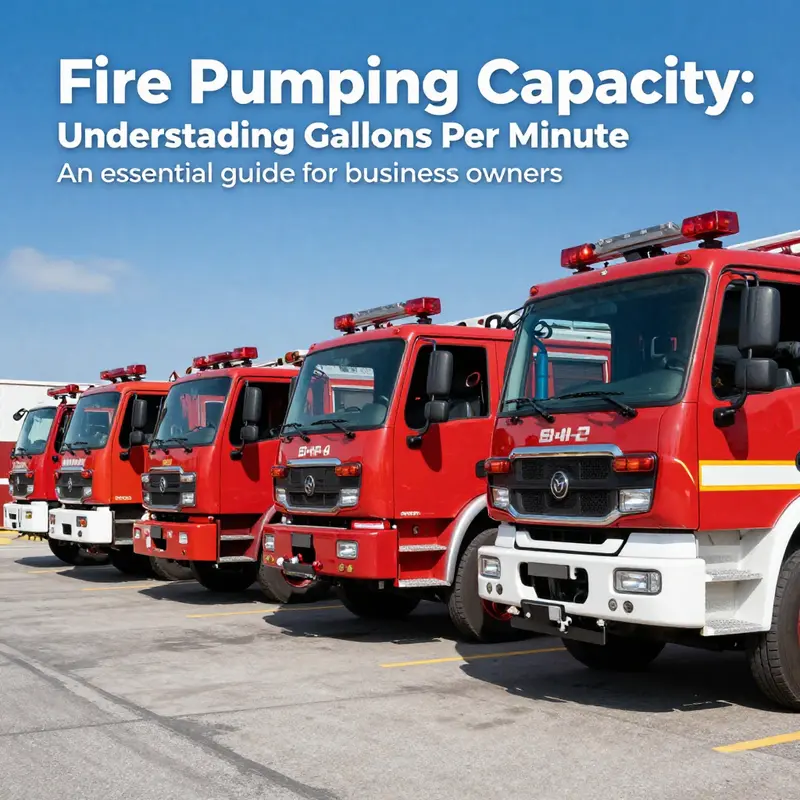
Fire trucks don’t come in one size. A standard pumper, an aerial ladder truck, and an airport crash tender serve different missions, and their dimensions follow from what they carry and where they operate. Understanding the range helps anyone who has to plan space for these vehicles — fire departments, but also logistics and construction firms that need to think about clearances and access.
Standard Pumpers

The standard pumper is the workhorse of most urban fleets. It’s long enough to carry substantial water and equipment, short enough to maneuver through tight streets and fit in fire bays. A typical pumper runs about 8.4 to 10 meters long (27 to 33 feet), around 2.5 meters wide (8.2 feet), and 3.2 to 3.6 meters tall (10.5 to 11.8 feet). A commonly cited 4×2 configuration measures 8.4 meters long, 2.5 meters wide, and 3.54 meters tall. Exact numbers vary by manufacturer, model, and regional rules, but the general envelope stays recognizable.
Capacity is the other half. Standard trucks typically carry 5,000 to 8,000 liters of water, with 8,000 liters (an 8-ton load) a common benchmark for vehicles that pair rapid response with sustained water application. Many also carry foam concentrate for mixed scenarios. Engines range from about 266 horsepower to over 500, the lower end for reliable city response and the higher end for expressways, steep grades, and demanding pump loads.
The bodywork has to hold the pump, hoses, ladder fittings, rescue tools, and medical gear in accessible compartments. A longer body means more storage but also a larger turning radius and more weight to maneuver. Designers balance the water tank’s position, hose routing, and access doors so crews can deploy an attack line quickly without sacrificing agility.
Ladder Trucks

Aerial ladder trucks trade compactness for height. They typically run 11 to 13 meters long, noticeably longer than most pumpers, because the chassis has to carry the ladder’s hydraulic machinery, stabilizers, water and foam supplies, and the crew’s working space. Fully extended, the ladder can reach 100 to 135 feet (30 to 41 meters) — enough to reach the upper floors of most urban and suburban buildings.
Maximum reach isn’t the same as usable height. The ladder is angled to balance reach and stability, commonly around 70 degrees, and safety protocols keep a buffer between the ladder and the building. Soft ground, outrigger spread, and the distance from the base all constrain how high a crew can actually work. A ladder capable of 135 feet of extension may not be deployed to its full vertical potential if the footing is poor. That interplay between maximum reach and safe operation is central to ladder truck design: the base chassis, hydraulic system, stabilizers, and counterweights all work together to keep the platform stable as the ladder climbs.
Heavy-Duty and Airport Trucks

At the far end of the spectrum are the specialized heavy-duty trucks built for airports, industrial complexes, and petrochemical sites. These operate at scale: the largest airport units run about 13.6 meters long, 3.1 meters wide, and 3.5 meters tall, and can weigh over 50 tons. They carry massive tanks — around 17,000 liters of water and 2,400 liters of foam — to sustain a long attack across a wide apron or runway network.
Within the heavy-duty class, configurations vary. A 4×2 unit runs about 8.405 meters long, 2.5 meters wide, and 3.54 meters tall; a comparable 4×4 rescue-oriented model sits at roughly 8.41 meters long with the same width and a slightly shorter 3.50-meter height. Full-load weight can approach 15,000 kilograms, which shapes acceleration, braking, steering stability, and tire load. Water and foam tanks often range from 5 to 10 cubic meters (5,000 to 10,000 liters), with engines in the 266 to 420 horsepower range. Drive layouts — 4×2, 4×4, or 6×4 — trade maneuverability against traction and load distribution for rough terrain or remote sites.
Construction follows international standards such as ASME and ISO, with compliance checks from bodies like SGS, BV, CCC, and SONCAP. Materials favor corrosion resistance, since the trucks are constantly exposed to water and foam, and manufacturers build in modular subassemblies so pumps, electrical systems, or foam delivery can be upgraded without replacing the whole chassis.
What Size Means in Practice
Size drives cost and logistics. A longer, heavier truck needs a stronger chassis, braking system, and suspension, plus larger maintenance bays and specialized technicians. Departments weigh extra water and foam capacity against operator training, fuel consumption, and turning radius. The fleet is usually a mix: compact pumpers for tight urban streets, mid-size responders, and a few large mission-specific platforms for airports and industrial sites.
The fleet is also changing. Hybrid propulsion and cleaner engines are finding their way into heavy-duty units, and lightweight composites could free up payload for larger tanks. Smart pumps, precision pressure control, and real-time telemetry are making crews more efficient. But the core dimensions — the 8.4 to 8.5-meter length range for standard heavy-duty chassis, the 5–10 cubic meter water tanks — remain central to design.
For more on the heavier end of the market, see the heavy-duty fire truck category. For broader truck specifications and configurations, an official manufacturer reference is available at https://www.sinotruk.com/en/. A vendor example of a high-capacity unit can be found at https://www.alibaba.com/product-detail/10000-Liters-Brand-New-Fire-Truck_1600489579454.html.