Evaluating a Tiller Truck for Sale: Where Buyers Lose Money
A tiller truck is among the most specialized pieces of apparatus a fire department can buy. The trailer-mounted rear steering axle that gives these trucks their tight turning radius also brings maintenance and inspection problems that an aerial or an engine does not have. For fleet managers and municipal procurement officers, those problems usually show up in the repair budget months after the title changes hands.
Three things decide whether a used tiller truck represents value or a liability, and all three need checking before you finalize an offer.
Rear steering play. The tiller operator steers the trailer axle through a linkage, and wear anywhere in that chain shows up as vague tracking, uneven tire wear, and poor brake balance. Lash you can measure at the steering box, or worn kingpins, mean money.
Inspection blind spots. Routine pre-purchase reviews skip the rear steering station, the trailer frame, and the mid-ship connections, which is exactly where corrosion and cracks start.
Repair budget. Tiller-specific steering and axle parts are low-volume and expensive, so reserve planning matters. Buyers who understand these three factors, and the underlying rear axle steering and turning radius trade-offs, avoid the mistakes that cost the most.
How Rear Steering Play Develops in Tiller Trucks
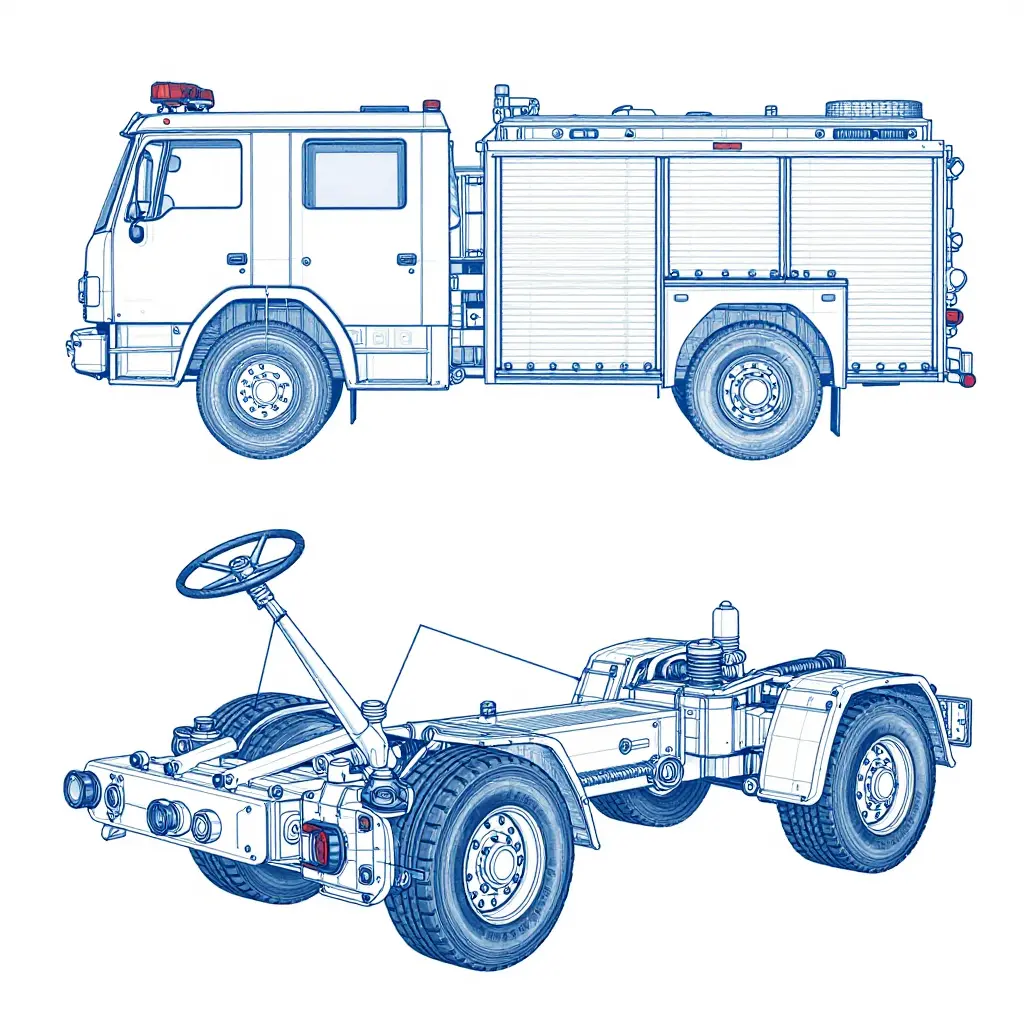
On a tiller truck, rear axle steering is a system separate from the front end and operated from the tiller cab. The firefighter riding the tail steers the rear wheels directly, and that is what lets a long aerial turn so tightly. Diagnosing rear steering play starts with knowing the parts between the tiller wheel and the rear wheels.
The mechanical chain, front to back
- Tiller cab steering wheel and column – The operator’s input point. Rotation travels down the column into a steering gear or control unit.
- Mechanical or hydraulic linkage – Legacy apparatus use rod-and-bell-crank mechanical linkage; newer units use hydraulic or electro-hydraulic systems with a steering control valve and actuator cylinder.
- Drag links – Transmit motion from the gear output to the steering knuckle arm.
- Tie rod ends – Ball-and-socket joints that carry motion across to the opposite wheel while allowing suspension travel.
- Kingpins – Pivot bushings that let each wheel steer; worn kingpins introduce both lateral and vertical slop.
- Rear-steering gear – The gearbox converting input rotation into lateral steering force; sector shaft end-play and gear tooth wear both add lash.
What ‘play’ or ‘lash’ actually means
Play is the total free travel in the chain before the rear wheels respond to the steering wheel. Every joint adds a little, and the amounts stack up.
- Designed lash – A small, intentional clearance that absorbs thermal expansion and holds lubricant film. It is normal and appears on the build specification.
- Wear-induced play – Excess free travel caused by component degradation, out-of-spec clearances, or loose fasteners. It grows over time and cannot be adjusted back to factory feel once metal is gone.
What accelerates the wear
- Mileage and operating hours – Every steering cycle wears gear teeth, bushings, and pins. A high-hour tiller has been through thousands of steering reversals.
- Road vibration – Constant chassis vibration loosens fasteners, frets mating surfaces, and enlarges clearances.
- Abrasive environments – Dust, grit, and road salt attack kingpins, tie rod ends, and exposed linkage seals, speeding up clearance growth.
On a used unit, the rear steering gear and kingpins deserve the same attention as the front end. Our overview of T-line fire apparatus maintenance and inspection points covers related service considerations for tiller fleets.
Rear Steering Play Diagnostic Reference
Use the table below as a first-pass benchmark when you walk a used tiller truck or send one through a shop inspection. The figures are general reference points for heavy-duty steering, not the manufacturer’s tolerances for a specific chassis, so use them to sort minor wear from a go/no-go condition and confirm final limits against the OEM specification.
| Component | Acceptable Free Play | Action Threshold |
|---|---|---|
| Tiller steering wheel free play | 10-25 mm (approx. 0.4-1.0 in) at the rim before resistance engages | Over 30 mm (1.2 in) or lost motion beyond the wheel’s free-travel band – inspect column, universal joints, and gearbox |
| Drag link play | Up to 1.5 mm (0.060 in) radial movement at each end fitting | Over 3.0 mm (0.120 in) or audible clunk under reverse load – replace worn ball socket or rebuild joint |
| Tie rod end play | 0-1.0 mm (0-0.040 in) axial and radial at the taper seat | Over 1.5 mm (0.060 in) or any stud rotation in the taper – replace the tie rod end |
| Kingpin vertical movement | Less than 0.13 mm (0.005 in) measured with a dial indicator under a pry bar | Over 0.25 mm (0.010 in) – rebuild or replace the kingpin and bushings |
| Steering gearbox backlash | Under 5 degrees of lash at the sector shaft with wheels centered | Over 10 degrees, or lash that cannot be adjusted out – rebuild or replace the rear steering gearbox |
| Hydraulic assist response lag | Under 0.5 seconds from input to measurable assist pressure | Over 1.0 second, or erratic assist under load – check pump output, relief valve, and cylinder seals |
Any measurement past the action threshold in two or more rows usually signals end-of-life rear steering hardware, which is a strong negotiating point on price or a mandatory repair line in the budget.
For context on how these rear-steer tolerances shape overall truck maneuverability, see our guide to tiller fire truck selection and rear axle steering turning radius.
Inspection Blind Spots When Buying a Tiller Truck
The parts that decide whether a used tiller truck stays reliable are usually the ones you cannot see. Buyers check the cab, the pump, and the tire tread. The rear-steering mechanism, the tiller trailer, and the trailer-to-tractor articulation area get far less attention. Those are the true inspection blind spots, and they are where expensive surprises wait.
A standard walkaround misses hidden wear for structural reasons: the linkage sits behind panels, hydraulic lines run out of sight, and pivot joints collect grease and grime that mask cracks and play. Steering tested only on smooth pavement will not reveal wobble, binding, or a loose tie rod that appears under load. Start in these five places.
Blind Spot 1: The Trailer Underside
Lie down and look up. Crossmembers, mounting hardware, and the rear steering subframe are under there, and that is where rust and fatigue cracks take root, well out of sight of a casual glance.
Blind Spot 2: The Articulation Pivot
The articulation pivot is central to how a tiller handles. Worn bushings and cracked housings hide under grime, and the joint is packed tightly enough that you have to clean it before you can see anything.
Blind Spot 3: The Rear Steering Hydraulic Circuit
Hydraulic lines feeding the tiller axle run where you cannot watch them, and fittings can weep unseen. Pressure-test the circuit rather than judging it by the reservoir level alone.
Blind Spot 4: Wiring Harness Chafing Points
Wiring harnesses around the articulation and rear axle rub against brackets and frame edges. Chafed insulation and exposed conductors produce the intermittent tiller faults that are hard to trace later.
Blind Spot 5: Frame Stress Near the Rear Axle
Cracks and spreading bolt holes frequently appear near the rear axle mounts, so probe the area and check torque specs before committing.
For a deeper chassis-oriented checklist, see this used fire apparatus chassis inspection guide to compare hidden-wear standards.
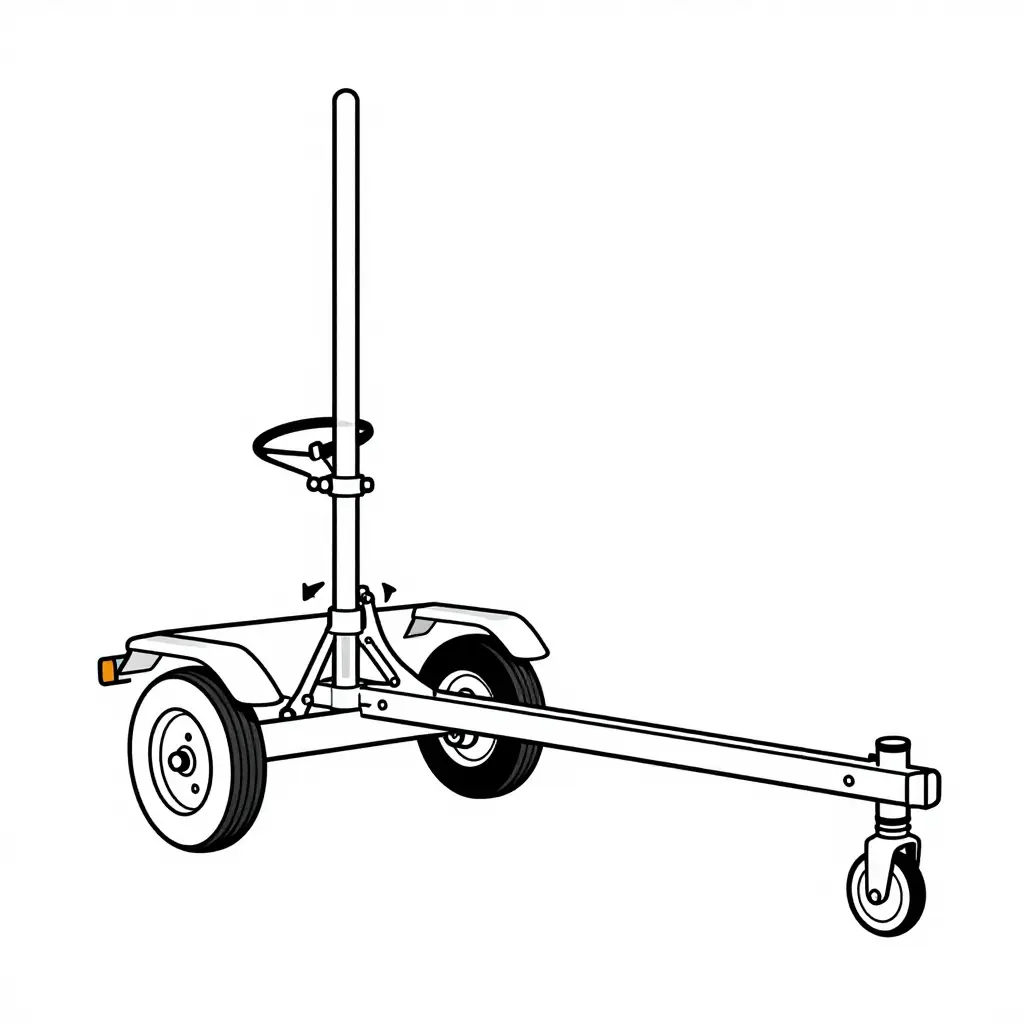
This schematic traces the rear steering linkage path from the tiller cab back to the rear axle, the exact chain where play accumulates over time.
Tiller Truck Rear Steering Inspection Checklist
The rear-steering assembly is where wear hides best on a tiller truck, so work through this list in order and document every finding. For deeper context on the rear axle and how it shapes turning performance, read up on tiller fire truck selection, rear axle steering, and turning radius before you negotiate.
- Measure steering wheel free play at the rim with the engine idling, then compare the reading against OEM tolerance limits.
- Check tie rod and drag link play by rocking the linkage while a helper holds the wheel steady.
- Inspect kingpin and pivot joints for vertical lift, binding, or grease purge that signals internal wear.
- Verify hydraulic line condition for chafing, weeping fittings, and brittle hoses that conceal leaks.
- Test steering response on both smooth pavement and loose gravel to expose vague or delayed rear steering play.
- Examine the articulation area for cracked welds, elongated bolt holes, and fresh paint over old damage.
- Check wiring harness routing near pivot points to confirm there is no abrasion, pinching, or exposed conductor.
- Review maintenance records for steering gear service, fluid changes, and any repeat alignment complaints.
- Confirm parts availability for the steering gear, kingpins, and linkage before you commit to purchase.
- Re-measure rear steering play after a loaded road test to catch wear that only appears under stress.
- Photograph every joint, hose, and fitting so hidden wear is easy to track during the repair budget phase.
Building a Realistic Repair Budget Before You Buy
An inspection report tells you what is worn, not what the fix will cost. Turning findings into a repair budget means pricing each defect in parts, labor hours, and downtime before you sign anything. Skip that step and a bargain-priced truck becomes the most expensive rig in your fleet.
Start with the findings, not the asking price
- List every flagged item and tag it: safety-critical, functional, or cosmetic.
- Anything related to rear steering play belongs in the safety-critical column before anything else.
- Price the truck twice: once as it sits today, and once as a roadworthy unit.
Break the estimate into real cost categories
- Parts: tie rods, drag links, kingpins, seals, hoses, hydraulic valves, and steering gearbox internals.
- Labor hours: multiply realistic shop time by your local fire apparatus labor rate.
- Machining or rebuilding: steering components often need reaming, boring, or full rebuilds rather than simple replacement.
- Hydraulic system repair: pumps, cylinders, lines, and fluid flushes on the rear-steer circuit.
- Alignment: a multi-axle alignment is mandatory after any steering work.
- Contingency: a reserve for the rust, cracks, and worn bushings nobody sees until the truck is on a lift.
Parts availability drives both lead time and cost
Older tiller trucks often depend on discontinued or low-volume components. A single obsolete hydraulic valve can add weeks of lead time and a premium price, because specialty suppliers know how scarce the part is. Understanding how fire apparatus dealers handle spare parts and warranty claims helps buyers spot which repairs will drag on for months. When sourcing a tiller truck for sale, ask about parts lead time, not just parts price.
Why a low sticker price can mislead
A truck priced thousands below market is usually discounted for a reason. Steering and hydraulic work in particular can erase the savings on the first shop visit. Budget for the worst realistic case, then compare that total against residual value and remaining service life.
Set a contingency reserve and weigh it against residual value
- Reserve 15-25% of the projected repair total for undiscovered wear.
- If repairs plus purchase price exceed realistic residual value, walk away or renegotiate.
- Use a structured planning approach, similar to budgeting a new fire truck customization and its lead-time and service costs, to frame the trade-offs.
A disciplined repair budget turns a hopeful purchase into a procurement decision you can defend.
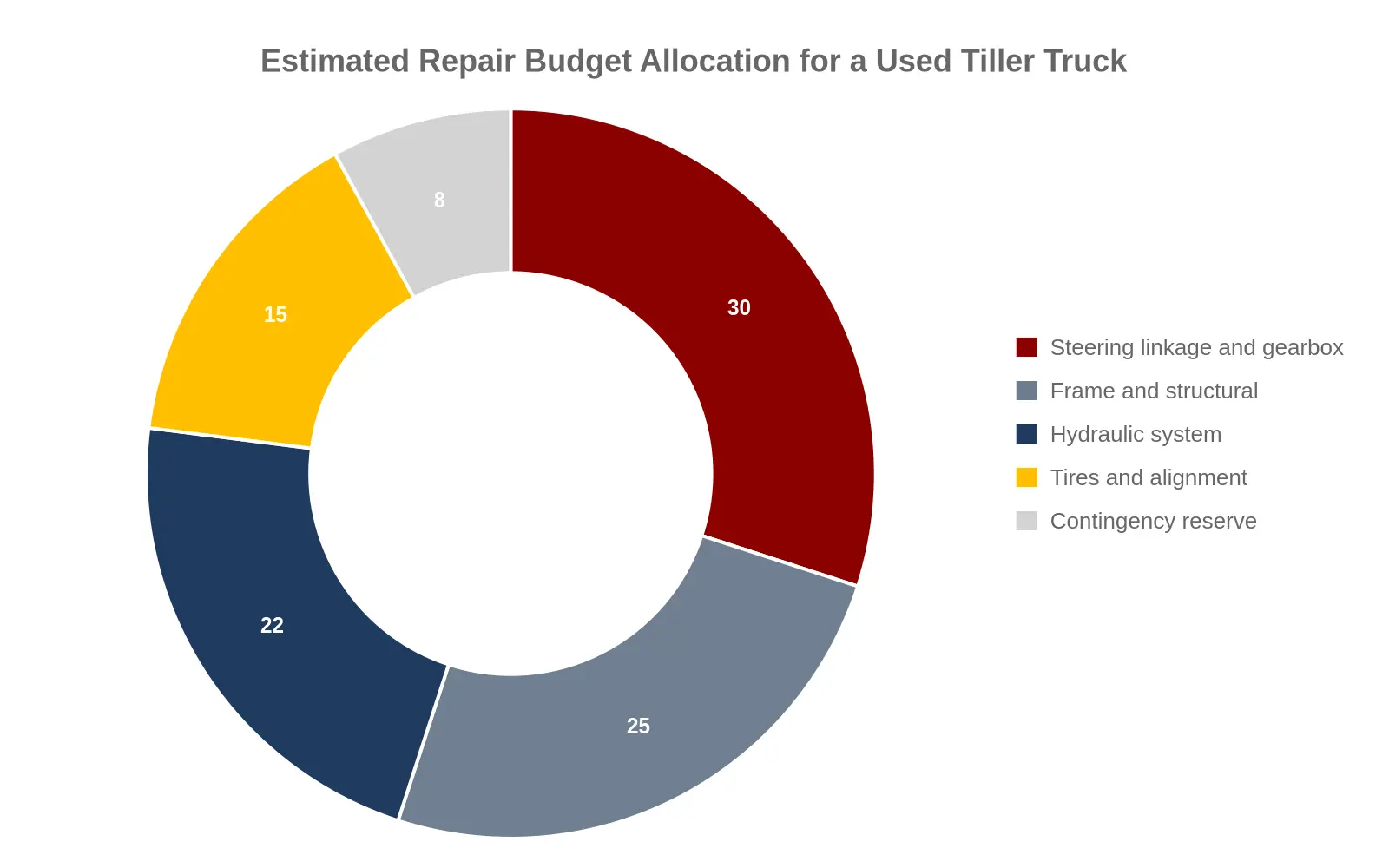
Estimated allocation: steering linkage and gearbox lead at 30%, followed by frame and structural at 25%, hydraulic system at 22%, tires and alignment at 15%, with a contingency reserve covering the remaining 8% of the budget.
Frequently Asked Questions About Tiller Truck Rear Steering and Repair Costs
How much rear steering play is acceptable?
As a rule, up to about one inch of free play at the steering wheel rim is tolerable, and anything beyond that points to wear in the linkage. The steering should feel firm and return smoothly. Anything loose, vague, or clunking warrants an inspection before you commit to a purchase.
Can rear steering play be adjusted instead of replaced?
Sometimes, yes. Many tiller systems use adjustable tie rods, drag links, or shims that let a technician take up minor slack. Once internal gearbox, kingpin, or bearing wear sets in, adjustment only masks the problem. A qualified shop should measure tolerance first, then tell you whether a refresh or a full replacement is the smarter long-term call.
How often should rear steering systems be inspected?
Annual inspections are the baseline, but high-mileage or high-call-volume tillers benefit from semi-annual checks. Rear steering play, hydraulic lines, and linkage should be tested every time the truck is serviced. Watch for the blind spots that routine walkarounds miss, such as hidden pivot joints and mounting brackets.
What drives the highest repair costs on tiller rear steering?
The single largest driver is replacing the rear steering gearbox or hydraulic control unit, which can run several thousand dollars in parts alone. Labor to access rear-axle components adds significant hours. Corroded linkage and damaged kingpins also inflate the repair budget quickly, especially on older apparatus with limited parts availability.
Is a used tiller truck with play still worth buying?
It can be, if the price reflects the work ahead. Budget for a professional steering evaluation and set aside a realistic repair budget before bidding. A tiller truck for sale with minor, adjustable play is often a bargain; one with deep gearbox damage usually is not. When in doubt, consult our tiller fire truck selection guide before you commit.
Making a Confident Purchase Decision
A tiller truck is a ten-year decision. Three things should anchor any serious evaluation: knowing how rear steering play develops, checking the places routine inspections skip, and pricing the repairs before you sign. Miss one and a bargain becomes a liability.
Confirm that the rear steering linkage moves within spec, not just that it moves. Look where others do not look closely enough, from steering gear mounts to frame stress near the rear axle. Put a real number against future work before you ever talk price.
Use a practical framework to compare a tiller truck for sale against its true total cost:
| Decision Check | What to Verify | Red Flag |
|---|---|---|
| Rear steering play | Linkage tolerance and gear condition | Binding or excess free play |
| Inspection coverage | Full underside, mounts, and frame | Access blocked or rushed |
| Repair budget | Parts, labor, and downtime estimate | No documented figures |
| Total cost | Purchase price plus 5-year upkeep | Price-only comparison |
A structured checklist and a documented repair budget are your best safeguards. They turn a gut-feel negotiation into an evidence-based one. The same discipline that applies to outrigger fault diagnostics and slope checks applies here: inspect the system, quantify the risk, then commit.
For fleet managers, dealers, and procurement officers, confidence comes from preparation. Document the condition, price the repairs, and calculate the true total cost. Do that, and the right tiller truck for sale stops being a gamble and becomes a sound investment.