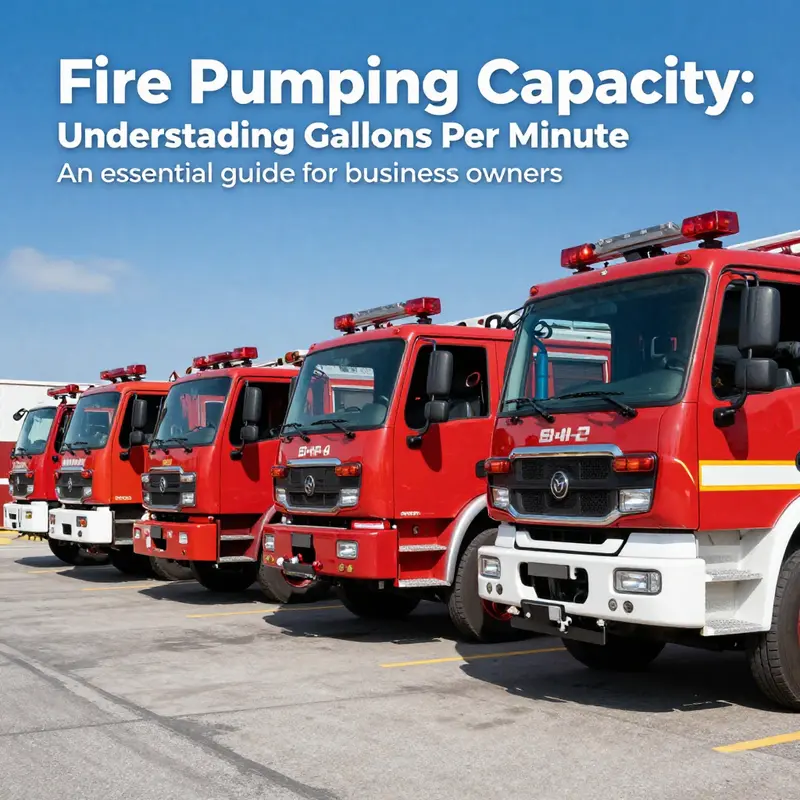
Budgeting a New Fire Truck: Customization Lead Time and Lifetime Service Cost
Two numbers in a fire truck budget tend to catch procurement committees off guard: how long the build takes, and what the truck costs to run. The first decides when the apparatus reaches the station. The second decides what you spend on it every year after that. Both belong in the plan from the start, not in a revision six months in.
A quote covers only what you pay on delivery. A fire truck is built to order, and spec’ing, engineering, and delivering it can take anywhere from a few months to more than a year. After that, fuel, scheduled maintenance, parts, tires, and staffing keep drawing on the budget for as long as the truck is in service.
Budget for build time and ownership cost together, not just the invoice. Departments that do tend to avoid the two failures that show up most often: a truck that arrives after the coverage gap it was meant to close, and a maintenance reserve that runs dry halfway through the truck’s life. A comparison of costs by chassis class and pump rating is a reasonable place to start.
What Drives the Price of a New Fire Truck
A new fire truck is dozens of configuration decisions stacked into one invoice, and each decision moves both the purchase price and the cost of running the truck later. These fire truck cost drivers account for most of the difference between a lean spec and an expensive one.
Chassis Class
Everything else bolts to the chassis, so it sets the floor for cost. A commercial chassis built on a production truck frame costs far less than a custom chassis engineered from scratch, but it also caps body size, pump size, and axle weight. Step up to a heavier custom chassis and you can carry more equipment and keep the truck in service longer, at the price of more fuel and faster wear on tires, brakes, and suspension. Chassis, pump, and agent choices interact; this guide to what a new fire truck actually costs walks through the combinations.
Pump Rating
An engine’s pump rating, measured in gallons per minute (GPM), moves the price directly. Going from 1,250 GPM to 1,500 or 2,000 GPM means larger impellers, a heavier driveline, and bigger plumbing, all of which cost more up front. Those larger pumps also carry more seals and packing to maintain over the truck’s life. For how ratings are matched to community risk, see fire truck pump capacity.
Tank and Agent Capacity
Water and foam are heavy, and weight is expensive. A 500-gallon tank is cheap next to a 1,000- or 2,000-gallon tank, because each added gallon demands a stronger chassis, a larger baffled tank, and heavier axles. Add foam or dry chemical and the price climbs again. The same weight shows up later as higher fuel use, plus periodic agent replacement and system recertification.
Aerial or Ladder Configuration
Aerials are where the price line jumps most. A 75-foot aerial costs far less than a 100-foot platform or a 107-foot quint, because steel, hydraulics, outriggers, and stability engineering all grow with reach. Ownership costs are steeper too: annual inspections, hydraulic service, outrigger maintenance, and more insurance and operator training.
Specialty Equipment
Specialty equipment fits the truck to a mission and raises both numbers. CAFS, onboard air, winches, generators, scene lighting, thermal imaging, and rescue tools all add purchase cost, and each one lands on the maintenance schedule. Every system you add also adds a part to stock and a way for the truck to sit in the shop.
At a Glance
| Cost Driver | Purchase Price Impact | Ownership Cost Impact |
|---|---|---|
| Chassis class | Commercial vs. custom; heavier GVWR costs more | Fuel, tires, brakes, suspension wear |
| Pump rating | Higher GPM adds impeller and driveline cost | Annual testing, seals, and servicing |
| Tank / agent capacity | Larger tanks need stronger chassis and axles | Fuel use, agent refill, recertification |
| Aerial / ladder | Largest single jump; scales with reach | Inspections, hydraulics, outriggers, training |
| Specialty equipment | Each system adds sticker price | More parts, more maintenance, more downtime |
How Customization Lead Time Accumulates
The clock starts when the contract is awarded, not when steel is cut. Every week between signing and delivery is part of your customization lead time, and it stretches as your specification moves further from a stock build. The invoice is not the whole cost. The fire truck build timeline also stretches across interim leases and months of deferred deployment.
The Build Sequence, Stage by Stage
- Specification sign-off. The committee settles features, tank size, and pump rating. Specs written from scratch invite revisions that push out everything downstream.
- Engineering and design review. The builder turns the spec into fabrication drawings. Custom bodies and one-off compartments mean more review cycles.
- Chassis procurement. Commercial chassis are often backordered, and a rare or specialized one can add months before the body shop starts.
- Body fabrication. The crew welds and assembles the body. Here the choice between modular construction and a fully custom build, such as the T-Line fire apparatus approach, has the largest effect on the schedule.
- Pump and system installation. Plumbing, foam, and electronics go in. Complex pump and foam systems take more labor hours.
- Paint and finishing. Several coats, graphics, and cure time.
- Inspection. Pre-delivery inspection catches defects before you sign for the truck.
- Acceptance testing. Your crew verifies pump performance, ladder operation, and safety systems on site.
Lead Time by Stage
| Stage | Typical Lead Time | Main Budget Impact |
|---|---|---|
| Specification sign-off | 2-6 weeks | Longer committee cycles delay the whole chain |
| Engineering and design review | 4-12 weeks | Custom drawings raise design and revision fees |
| Chassis procurement | 8-16 weeks | Interim lease of a borrowed or rental rig |
| Body fabrication | 8-14 weeks | One-off compartments add labor and materials |
| Pump and system installation | 4-8 weeks | Specialty pump and foam work raises unit cost |
| Paint and finishing | 2-4 weeks | Extended bay occupancy |
| Inspection | 1-3 weeks | Rework can trigger change orders |
| Acceptance testing | 1-2 weeks | Deployment slips, coverage gap persists |
Why More Customization Means More Weeks
The stages do not run in neat parallel; they stack. A bespoke spec forces extra engineering, which pushes chassis ordering, which delays fabrication. Because each stage feeds the next, the customization lead time compounds rather than adding up linearly. A fully custom aerial can take 12 to 18 months longer to arrive than a stock pumper.
The Budget Trap: Interim Costs and Lost Days
Every extra week costs something. While the truck is on the line, you may be leasing a loaner, paying to store interim equipment, or running an aging rig past its replacement date. A late truck also means a coverage gap that no line item captures cleanly.
Lock Your Footprint Before Design Review
Finalizing the spec also freezes the truck’s dimensions. Measure your station bays, apron turning radii, and wash-bay clearances before you sign off, and check how big fire trucks really are first. If a truck does not fit, the redesign adds months quietly. Budget time the way you budget money.
Before committing budget, benchmark phase-by-phase timelines. The degree of customization and the chassis class drive most of the schedule, so weigh those against the ranges below.
Table 1. Typical Customization Lead Time Ranges by Configuration and Build Phase
| Configuration Type | Engineering Phase | Fabrication Phase | Install & Commissioning Phase | Total Estimated Lead Time (months) |
|---|---|---|---|---|
| Standard commercial-chassis pumper | 1-2 months | 5-7 months | 1-2 months | 8-11 months |
| Custom-chassis pumper | 2-3 months | 9-12 months | 2-3 months | 13-18 months |
| Tanker / tender | 2-3 months | 8-11 months | 2-3 months | 12-17 months |
| Aerial ladder or platform unit | 3-4 months | 12-18 months | 3-4 months | 18-26 months |
Caption: Representative ranges only; actual lead times shift with order backlog, spec complexity, and manufacturer capacity.
Understanding Lifetime Service Cost
The truck is delivered, the purchase order is filed, and the spending continues. Lifetime service cost is every recurring expense the apparatus generates between the day it enters service and the day it is retired. Over a typical 15- to 20-year life it can match or exceed the purchase price. The real fire truck operating cost is a two-decade commitment, not a one-time invoice.
Preventive Maintenance
Preventive maintenance is the most predictable expense and the one most often underfunded. Oil and filter service, brake and tire inspections, chassis lubrication, and annual pump checks come due on fixed intervals no matter how busy the station is. Skipping them does not save money. It moves the cost to an emergency repair later.
Wear-Part Replacement
Wear parts fail on their own schedule. Hoses, gaskets, seals, brake pads, suspension bushings, and pump packing all wear out through normal use and get replaced again and again. No single part costs much; over twenty years, the steady stream of them adds up.
Pump and System Service
The pump is the apparatus’s most expensive source of surprises. Priming systems, impellers, relief valves, and foam proportioners need specialized service, and they tend to fail at the worst possible moment. Knowing how these parts degrade, from priming failures during high-rise rescue to proportioner drift, lets planners budget for rebuilds instead of reacting to them.
Fluid and Fuel Consumption
Diesel, engine oil, coolant, hydraulic fluid, and DEF are consumed continuously, and a heavy apparatus burns far more fuel than a passenger vehicle. Fuel is usually the largest single annual operating expense, and it tracks call volume and idle time.
Certification and Testing
Certification and testing are not optional. Annual pump service tests, aerial ladder inspections, and emissions or safety checks carry recurring fees and occasional repair orders. Let them lapse and you put both insurance coverage and liability at risk.
Insurance
Premiums reflect the truck’s replacement value, your liability limits, and the fleet’s safety record. They rise year over year, and they belong in the budget as a fixed annual cost.
Expected Downtime
Downtime is a cost measured in readiness. Every hour a truck spends in the shop is an hour it cannot answer a call, which pushes work onto reserve apparatus and overtime. Planned maintenance downtime is far cheaper than a failure during peak demand.
Why Model These Costs at Purchase
Modeling service cost at the point of purchase turns the budget from a guess into a plan. A cheaper truck with expensive, failure-prone systems can cost more over twenty years than a slightly pricier one with a documented service history. Project maintenance, parts, fuel, certification, insurance, and downtime before signing, and you can compare total cost of ownership, set aside a realistic reserve, and avoid the mid-life budget crisis that catches unprepared departments.
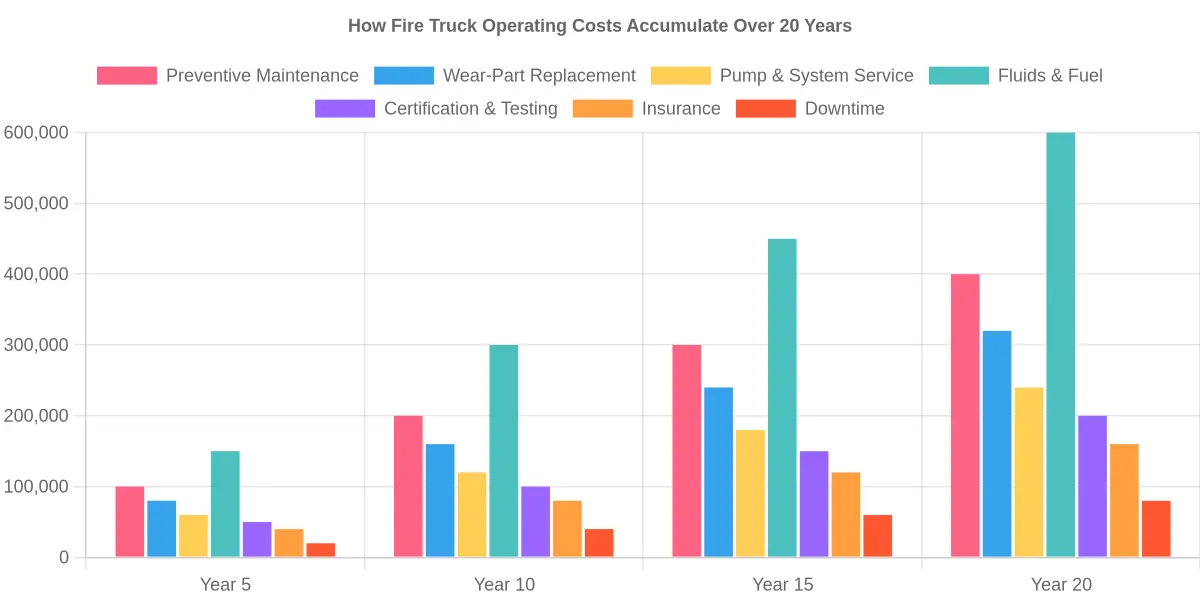
The table below shows how those categories accumulate over twenty years. The ranges are illustrative; real figures move with call volume, climate, and apparatus class.
| Cost Category | Typical Annual Range (USD) | 20-Year Cumulative Estimate (USD) |
|---|---|---|
| Preventive maintenance | 8,000 – 12,000 | 160,000 – 240,000 |
| Wear-part replacement | 10,000 – 18,000 | 200,000 – 360,000 |
| Pump and system service | 8,000 – 15,000 | 160,000 – 300,000 |
| Fluids and fuel | 15,000 – 30,000 | 300,000 – 600,000 |
| Certification and testing | 5,000 – 9,000 | 100,000 – 180,000 |
| Insurance | 6,000 – 12,000 | 120,000 – 240,000 |
| Expected downtime | 5,000 – 12,000 | 100,000 – 240,000 |
Taken together, these line items show why a truck’s true cost is visible only when recurring expenses are modeled alongside customization lead time, before the contract is signed. Departments that do it protect both the fleet and the budget for the whole service life.
Cumulative Lifetime Service Cost Over 15 Years
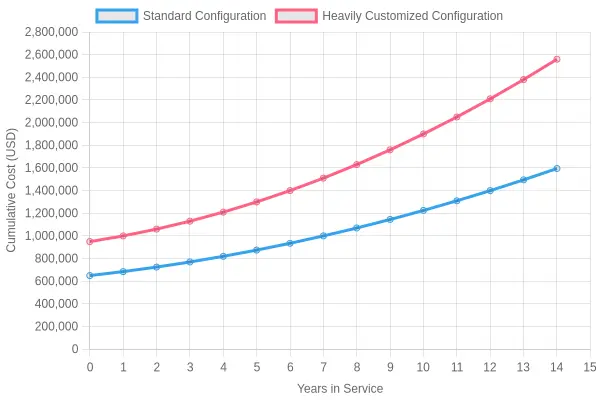
A heavily customized configuration starts with a higher acquisition cost and pulls further away from the standard build each year, ending year 15 at roughly $2.56M against $1.60M for the standard configuration.
Budget Line Items to Plan For
A procurement budget works only if it covers the whole lifecycle. Use these line items as a checklist before you solicit bids.
- Purchase or financing cost – base chassis, body, and pump package, plus interest if you finance the rig.
- Customization and engineering change orders – department-specific features, plus any change orders issued after the design is frozen.
- Warranty period coverage – staff time to document and pursue claims so covered repairs stay cost-neutral.
- Annual preventive maintenance – inspections, fluid changes, and pump testing.
- Wear-part reserves – a sinking fund for brakes, hoses, seals, tires, and other parts that wear with heavy use.
- Fuel and fluid budgets – diesel, DEF, oil, and coolant, estimated from call volume and road hours.
- Certification and testing – pump certification, aerial testing, and safety inspections required to keep the truck in service.
- Insurance – premiums set by vehicle value, replacement cost, and the department’s claims history.
- End-of-life replacement reserve – a planned annual set-aside so a 20-year replacement cycle does not land on one budget year.
Built on a realistic read of how much a new fire truck costs, these categories turn a one-time purchase into a funding plan you can defend.
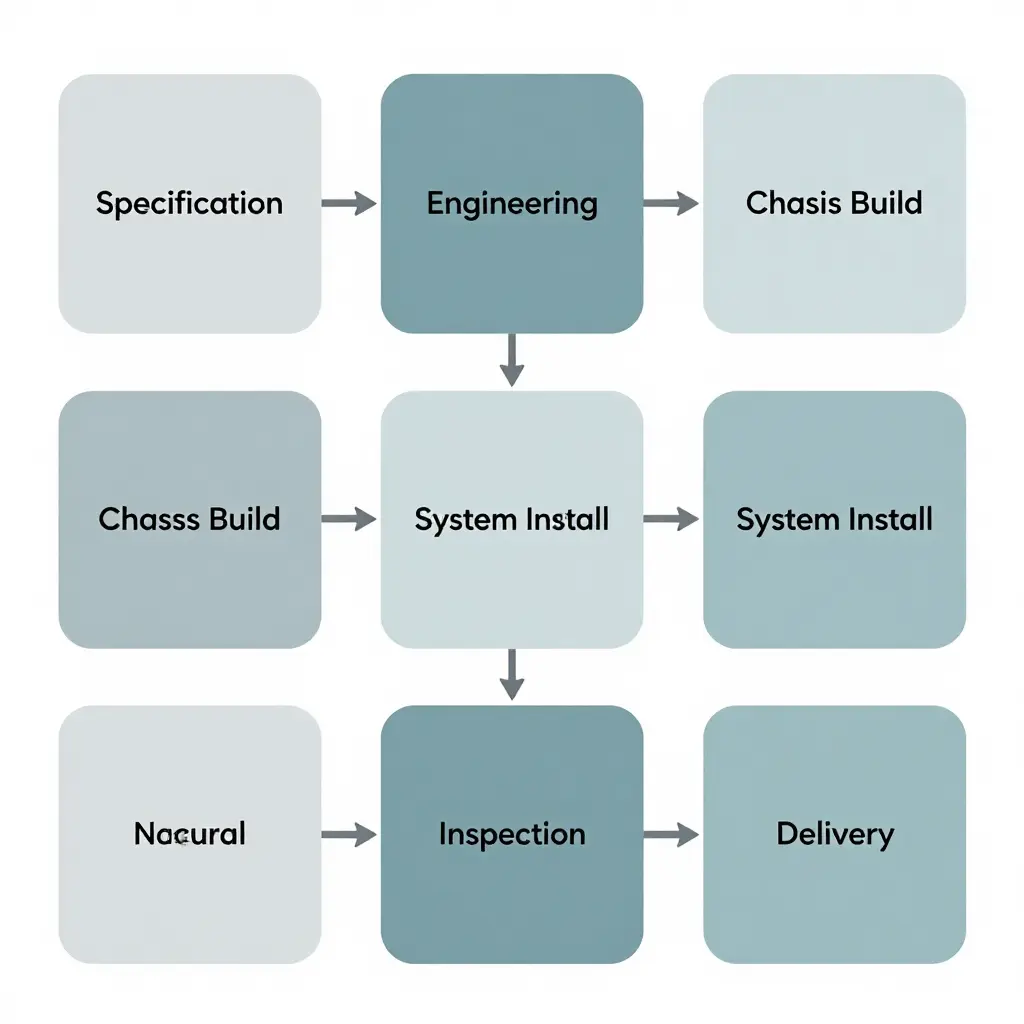
The diagram maps the customization timeline from order specification through to delivery.
From Purchase Price to Total Cost of Ownership
The invoice you sign on delivery day is the beginning of the spending, not the end of it. A fire truck’s real cost is its total cost of ownership (TCO): the purchase price, the drag of lead time, and every dollar of service and downtime over a 15- to 20-year career. Budget only to the invoice and you will be asking the council for an emergency appropriation long before the truck is paid off.
Why TCO beats a line-item comparison
When two bids look close on paper, the cheaper truck often costs more over time. To compare them fairly, fold four streams into one number:
| Cost Stream | What It Captures | Share of TCO |
|---|---|---|
| Initial purchase cost | Chassis, body, pump or aerial, customization options | 30-45% |
| Interim lead-time costs | Loaner or rental apparatus, delayed-response exposure, price escalation during the build | 5-15% |
| Projected lifetime service cost | Preventive maintenance, parts, fuel, recertification, scheduled downtime | 30-50% |
| Residual / resale value | Trade-in or resale credit at end of service life (a deduction) | -10 to -25% |
Add the first three, subtract the fourth, and divide by expected service years. That annual figure, not the sticker price, is what your budget has to carry. It also turns fire truck replacement planning into a rolling forecast rather than a crisis.
Weighing residual value honestly
Residual value is where optimism inflates a budget without anyone noticing. Rare, specialized configurations sell poorly; standard rigs with complete service records sell well. A truck kept on schedule and backed by strong parts and field support brings more at retirement, which makes manufacturer selection a financial decision as much as a mechanical one. When you start choosing your ARFF truck manufacturers, look for builders with proven long-term parts availability and field service.
Build contingency into every number
Change orders arrive mid-build, and downtime arrives without warning. Set aside a contingency of 8-12% to cover both, and keep a separate reserve for parts surprises. A TCO model with no contingency line fails the first time a pump seal or aerial cylinder goes soft.
The bottom line for planners
Treat the purchase price as one input, not the answer. Model lead-time cost, project lifetime service, credit residual value honestly, and keep a contingency. Then compare every bid on total cost of ownership. Departments that do this retire trucks on schedule instead of explaining a budget surprise to taxpayers.
Frequently Asked Questions
How long does customization typically add to delivery?
Customization generally adds six to fifteen months on top of a standard build, depending on scope. A truck ordered close to a production line with minimal changes can ship in eight to twelve months. A fully custom pumper often takes thirteen to eighteen months, and an aerial eighteen to twenty-six. Vague specifications and late design revisions cause most of the delay.
What is a realistic annual service cost as a percentage of purchase price?
Plan on service cost of roughly two to four percent of the original purchase price each year. A $750,000 pumper carries about $15,000 to $30,000 a year in maintenance, inspections, and consumables. Pump testing, aerial certification, and foam system service push high-use units toward the top of that range. Chassis class and pump rating drive pricing, so check them before committing to years of projections.
Should departments budget for change orders?
Yes. Change orders are common and typically run three to eight percent of contract value. A contingency of eight to twelve percent covers them, along with the downtime and parts surprises that follow. Whatever is left over can go toward the next apparatus in the fleet plan.
How does configuration choice affect resale value?
Configuration can matter more than age. Standard chassis, common pump sizes, and popular compartment layouts hold value best. Heavily specialized or unusual builds attract fewer buyers and sell for noticeably less. Mainstream specifications let a department recover more of its original investment.
Building a Durable Fire Truck Budget
A fire apparatus is not a single purchase; it is a commitment that runs for a decade or more. Lead time and service cost belong in the same plan as the sticker price, because a lower purchase number can become the most expensive truck in the fleet once delays and maintenance bills arrive. Chassis class, pump rating, and agent capacity set the capital cost. Customization lead time and lifetime service cost set the operating cost. They all affect one another, so they belong in one spreadsheet.
A workable sequence:
- Model total cost of ownership (TCO). Acquisition, financing, fuel, maintenance, and residual value over the full service life, not just year one.
- Reserve for change orders. A contingency line for the specification changes that come up during a custom build.
- Schedule for lead time. Put realistic delivery windows in the replacement calendar so coverage gaps do not appear.
- Plan for service and replacement. Budget recurring maintenance and a sinking fund for the replacement date.
Handled this way, budgeting a new fire truck becomes a procurement process rather than a reaction to a broken truck. Departments that treat lead time and service life as budget variables get longer service from their apparatus and can account for every dollar when the council asks.