Selecting a Tiller Fire Truck: The Three Variables That Decide the Purchase
A tiller fire truck is a tractor pulling a separate rear-steering trailer. Three engineering variables decide whether a department can maneuver and house the apparatus it is about to buy: rear axle steering, turning radius, and station bay length. Get those wrong and the truck will not fit the streets or the station, however it looks on a specification sheet.
Rear axle steering is what makes a tiller a tiller. A trained tillerman steers the trailer’s rear wheels independently of the tractor, so the trailer tracks tighter and pivots more precisely than a rigid aerial. That changes the vehicle’s effective turning radius, which is what lets it work narrow urban streets, tight intersections, and congested response routes without multi-point turns. Station bay length settles the other end of the call: because a tiller platform splits into tractor and trailer, it often fits shallow or irregular bays that cannot take a comparable single-body quint or ladder truck, which avoids a costly station renovation.
For fire chiefs, specification managers, and municipal planners, those three numbers tie apparatus performance to infrastructure and budget. Tiller platform configurations show how tractor-trailer geometry turns into operational reach and station compatibility.
What follows covers how to evaluate rear axle steering systems, estimate realistic turning radii, and match tiller geometry to the bays you actually have.
Tiller Fire Truck Role and Operational Advantages
A tiller fire truck is a tractor-drawn aerial whose rear trailer section steers on its own, from a dedicated tillerman position. On a rigid straight-frame aerial one driver controls every axle; on a tiller, a second trained firefighter sits in a forward-facing cab at the tail and steers the trailer. The tillerman works a rear steering wheel and hydraulic linkage and coordinates with the tractor driver by radio or intercom, so the trailer can follow a path of its own.
While maneuvering, the tillerman counter-steers the trailer against the tractor’s input, keeping the long rear body inside the turn. That coordinated steering shortens the functional turning radius of a rig that may run over 55 feet in overall length, so a long aerial can thread intersections and alleys that would stop a rigid truck of the same size.
In dense corridors and tight quarters, the advantages are:
- Turning in tight intersections: the trailer tracks inside the tractor’s path, so the rig clears corners a rigid aerial cannot.
- Spotting and docking: the tillerman lines the turntable and outriggers up with curbs, hydrants, and building setback lines.
- Fewer multi-point maneuvers: one controlled approach replaces repeated backing, which shortens arrival time in congested districts.
- Obstacle clearance: the rear operator can swing the trailer clear of parked vehicles, scaffolding, and overhead hazards.
Because tiller aerials are long, their dimensions drive bay length, door width, and floor planning. Reviewing how big fire trucks are before procurement helps a department match the specification to the building it already owns.
Rear Axle Steering Engineering on a Tiller Fire Truck
On a tiller fire truck, the trailing axle is not a passive tag axle. It is a purpose-built steering assembly with its own operator. The tillerman sits at a rear control position and turns a second steering wheel that moves the rear axle independently of the tractor’s front wheels. Two people drive the truck: the driver steers the front axle, the tillerman steers the rear, and each input reaches its wheel set through its own hydraulic or mechanical linkage.
[Diagram: blueprint-style side and top view of a tiller fire truck showing the front steering axle and independent rear steering axle, with the front wheels steering left while the rear wheels counter-steer right, plus a tight turning circle, wheelbase dimension lines, and labeled tillerman control position.]
Steering Angle Geometry and Counter-Steering
Steering angle is the variable that governs maneuverability. Rear axle steering systems usually deliver 15 to 25 degrees of articulation, and modern designs let the tillerman counter-steer, turning the rear wheels opposite the front. Steer left up front and the tillerman steers the rear wheels right, which forces the trailer to rotate around a tighter instantaneous center. The effective turning radius shrinks, so a 100-foot ladder can take intersections, cul-de-sacs, and narrow station aprons that a rigid-wheelbase unit would need a multi-point turn to clear.
A tiller carries an unusually long wheelbase to support an extended aerial, and rear axle steering is what keeps that length from becoming a liability. It does not settle everything. Overall length still has to be reconciled with aerial reach, bay dimensions, and the station envelope, so specification teams should model the turning envelope against aerial reach versus apparatus length trade-offs before committing to a chassis. Every additional degree of rear articulation buys maneuverability that offsets part of the penalty of a longer body, which is why steering angle, wheelbase, and station bay length belong in the specification as one package rather than as separate line items.
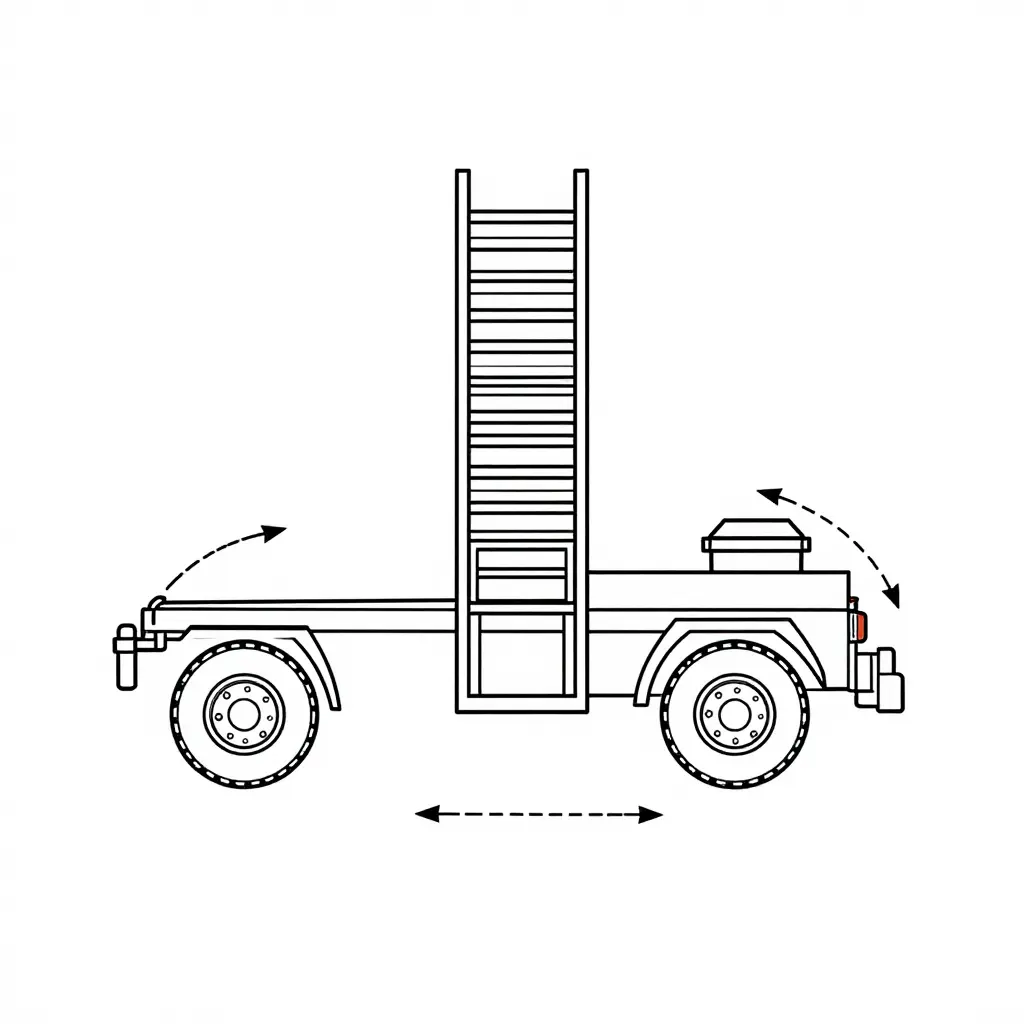
Schematic overview of tiller rear axle steering geometry: the chassis frame spans the front (steer) axle and the rear steering axle, where independent pivot arcs show how the rear wheels turn separately from the front wheels.
Turning Radius Metrics: Curb-to-Curb and Wall-to-Wall
Turning radius is the smallest circle a vehicle traces through a full 180-degree change of direction. On a tiller it constrains both route selection and station design, so it matters which figure a manufacturer is quoting. Curb-to-curb measures the path of the outer front tire, with the curb line as the only obstruction. Wall-to-wall measures the outermost envelope of the whole rig, front bumper through mid-body step to trailer tail, and is always larger. A specification that lists only the curb-to-curb figure understates the swept area a tiller occupies at a tight intersection.
| Metric | What it measures | Typical relevance |
|---|---|---|
| Curb-to-curb | Outer front-tire path, curb line as sole obstruction | Intersection and arterial corridor clearance |
| Wall-to-wall | Outermost apparatus envelope (bumper to trailer tail) | Station apron, bay egress, aggressive turns |
How Rear Axle Steering Moves the Pivot Point
A single-body apparatus pivots around a nominal point between its front and rear axles. A tiller does not. Its tillerman counter-steers the rear wheels against the tractor’s input, which moves the effective pivot point rearward and makes the trailer track inside the front’s path instead of swinging outward. The swept path shrinks measurably, and a long articulated rig clears corners and alley approaches that would stall a straight-frame engine of comparable length.
Turning Radius as a Route and Egress Constraint
Turning radius governs response routes and station egress at the same time. A tighter figure holds cornering speed and removes multi-point turns, which feeds directly into the factors that shape fire apparatus response times. At the station it sets apron width, driveway flare, and bay door alignment: if the wall-to-wall radius is wider than the apron arc, every departure becomes a controlled maneuver instead of a clean pull-out. Specify both radii, confirm the tiller’s counter-steer range, and check trailer-tail clearance against the tightest turn on the district’s primary response route before the build is finalized.
Turning Radius Comparison: Why Rear Axle Steering Wins in Tight Urban Corridors
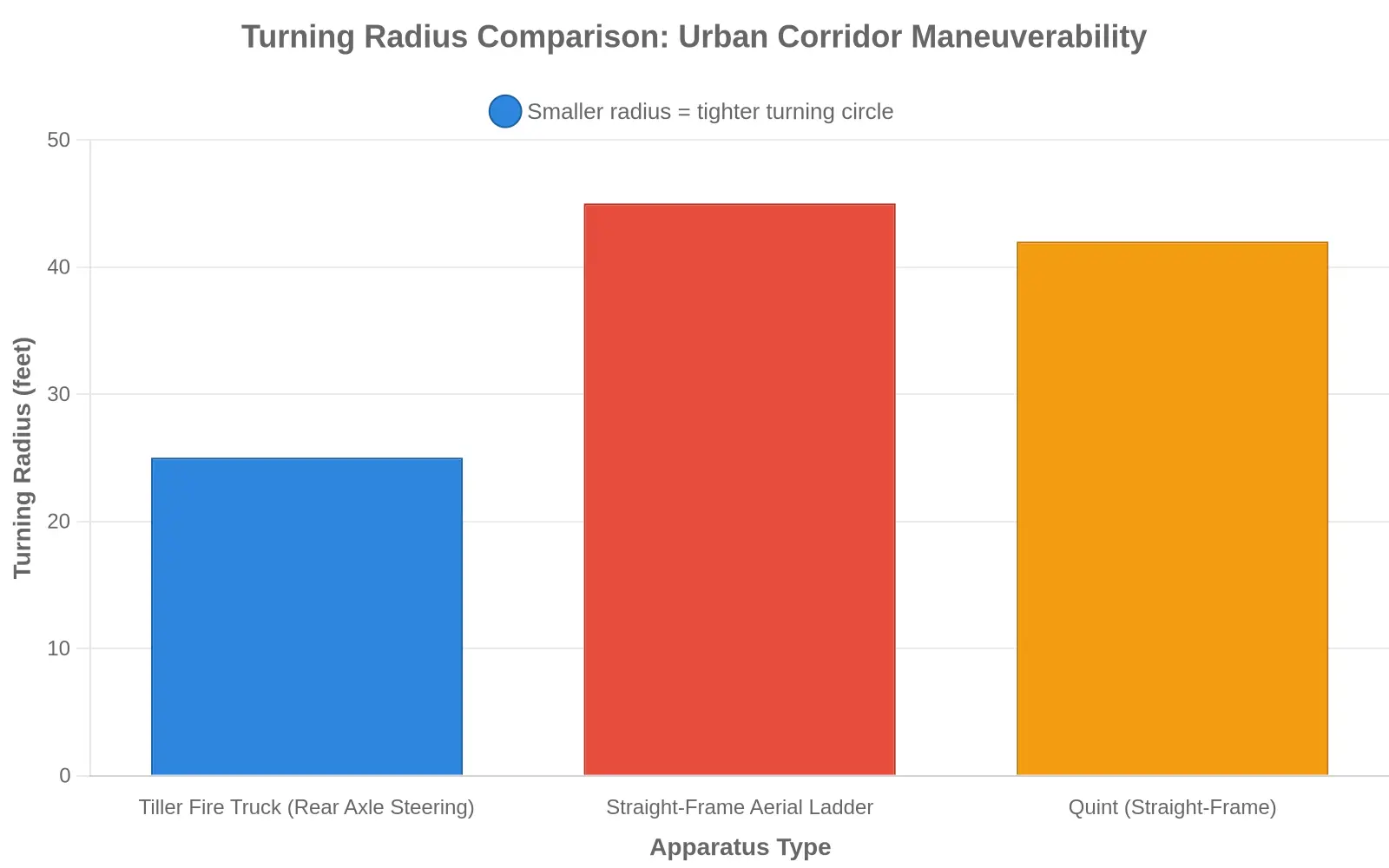
For a chief weighing a tiller against a conventional straight-frame rig, turning radius is usually the number that settles the argument. The chart compares three configurations on the same urban route.
What the Numbers Tell You
| Apparatus Type | Turning Radius (ft) | Turning Radius (m) | Urban Corridor Fit |
|---|---|---|---|
| Tiller Fire Truck (Rear Axle Steering) | 25 | 7.6 | Excellent |
| Quint (Straight-Frame) | 42 | 12.8 | Marginal |
| Straight-Frame Aerial Ladder | 45 | 13.7 | Poor |
The tiller with rear axle steering carves a turning circle roughly 20 feet tighter than either straight-frame rig, a 44% reduction against the aerial ladder and 40% against the quint. That is the margin between taking a tight intersection in one smooth arc and working through a reversing maneuver with a structure burning.
Why Rear Axle Steering Changes the Geometry
In a tiller design, a certified operator steers the rear axle independently of the tractor. That “crab” capability shortens the swept path of the effective wheelbase, letting the rear of the apparatus follow a tighter, controlled line through a confined corridor. Straight-frame aerial ladders and standard quints steer only from the front axle, so their turning radius grows with the wheelbase.
Practical Takeaway for Tight Corridors
If your first-due district includes narrow historic streets, cul-de-sacs, or angled inner-city intersections, the bar chart above makes the maneuverability case. Weigh that turning advantage against the apparatus footprint when you evaluate how big fire trucks really are, and confirm the station bay can take the overall length, not just the turning radius, before you finalize a specification.
Planning Station Bay Length for a Tiller Fire Truck
Bay planning starts with overall length, and a tiller fire truck is one of the longest vehicles a department owns. A tractor-drawn aerial typically measures 55 to 65 feet from the tractor’s front bumper to the trailer’s tail. Unlike a rigid straight-frame ladder, the trailer steers on its own rear axle, so the combination articulates in motion but occupies its full published length when parked. Bay length has to hold that static footprint plus operating clearance at both ends.
Overall Length and Rear Overhang Clearance
Size the bay to its door-to-door interior dimension, not the nominal building shell. The tiller trailer rear overhang, typically 8 to 10 feet behind the rearmost trailer axle, pivots during backing and swings laterally. Leave a minimum of 3 feet of clear space behind the trailer tail for walk-around access, wheel chocks, and the door’s closing swing. Check ceiling height before committing to a bay, since tractor and trailer heights differ and the trailer cab may need additional headroom. For a full breakdown of how apparatus height governs clearance above the unit, review our guidance on how high a fire truck stands.
Doors, Aprons, and Apparatus Floor
- Door opening: 14 feet wide minimum and tall enough to clear the highest cab with margin.
- Apron: Keep the slope no steeper than about 2 percent so the tiller trailer does not scrape.
- Apparatus floor: Provide a level, sealed slab able to support the concentrated axle loads of both the tractor and the loaded trailer.
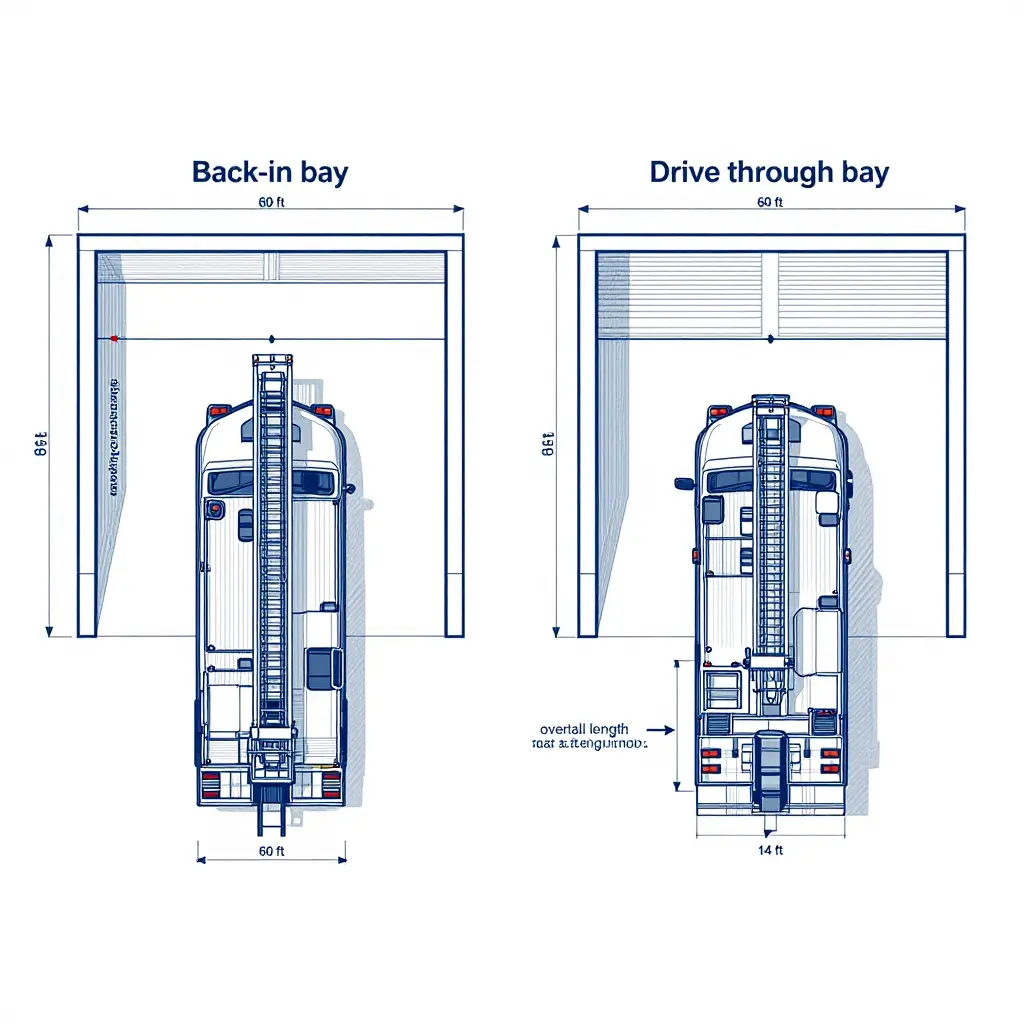
Drive-Through vs. Back-In Layouts
| Layout | Bay Length Demand | Key Advantage |
|---|---|---|
| Back-in | Shell length plus rear overhang maneuvering clearance | Lower construction cost; requires skilled reversing |
| Drive-through | Two doors, plus exit apron beyond the far door | No reversing; fastest turnout and safer egress |
Drive-through bays remove the reverse maneuvering that stresses the rear axle steering geometry, but they need land on both sides of the building.
Tiller vs. Straight-Frame Aerial: Key Specification Comparison
When a department weighs a tiller fire truck against a conventional straight-frame aerial ladder, the decision usually hinges on three interlocking variables: turning radius, overall length, and the station bay the rig has to live in. The table collects the specifications procurement managers ask about most, organized around the tiller’s defining feature, a steered rear axle.
| Apparatus Configuration | Turning Radius (Curb-to-Curb) | Overall Length | Rear Axle Steering | Tillerman Position | Min. Station Bay Length | Urban Maneuverability Rating |
|---|---|---|---|---|---|---|
| Tiller Aerial – 100 ft | ~28 ft | ~62 ft | Standard (tiller axle) | Dedicated rear cab, facing forward | ~68 ft | Excellent |
| Tiller Aerial – 107 ft (heavy-duty) | ~30 ft | ~65 ft | Standard (tiller axle) | Dedicated rear cab, facing forward | ~72 ft | Excellent |
| Tiller Quint – 75 ft | ~26 ft | ~58 ft | Standard (tiller axle) | Dedicated rear cab, facing forward | ~62 ft | Excellent |
| Straight-Frame Aerial – 100 ft | ~40 ft | ~50 ft | Not available | None | ~58 ft | Good |
| Straight-Frame Aerial – 107 ft | ~42 ft | ~52 ft | Not available | None | ~60 ft | Moderate |
| Straight-Frame Quint – 75 ft | ~34 ft | ~42 ft | Not available | None | ~50 ft | Good |
Turning radius is measured curb-to-curb at the front outside tire. Rear axle steering is what cuts that figure by roughly 25 to 30 percent against a straight-frame rig of comparable ladder length, even though the tiller is the longer vehicle overall. That trade-off explains why tillers need deeper bays, which is covered in the discussion of how big fire trucks actually are.
- Rear axle steering: on a tiller the rear axle is steered, not dragged. It is integral to the design, not an add-on. Straight-frame aerials steer with the front axle only, so the rear wheels simply track the front.
- Overall length: tiller aerials run longer because of the separate rear cab and tiller box, so confirm apron space and door geometry before committing.
- Minimum station bay length: add 3-5 ft of clearance beyond overall length for ladders, hose, and walking room around the apparatus.
- Urban maneuverability: reflects real-world tight-street, cul-de-sac, and alley performance, which is the tiller’s core procurement advantage.
For a station retrofit, the tiller’s ~65-72 ft bay requirement is often the deciding cost factor; for a department with narrow streets and short blocks, the ~28 ft turning radius frequently justifies it.
Station Bay Planning Checklist for Tiller Fire Truck Deployment
Before you sign the purchase order, walk the bay. A tiller fire truck is a long, articulated machine, and a few inches of miscalculation can turn a routine response into a driveway problem. Use this checklist as the starting point for your station specifications.
- Door opening – at least 14 ft (4.3 m) wide. Measure the height from the finished floor to the lowest obstruction, whether that is a door header, sprinkler main, or exhaust fan. A tiller trailer cab sits higher than a standard tractor cab, so confirm the tallest vertical point on the trailer rather than the tractor.
- Station bay length – plan for the full trailer plus maneuvering margin. Overall length typically runs 55 to 65 ft, so allow roughly 70 to 75 ft of straight, obstruction-free depth. For a wider look at how apparatus footprints compare, see our guide on how big fire trucks really are.
- Apron slope – cap it at 2 percent (about 1 inch per 4 ft). Excessive grade transfers weight unevenly onto the rear-steering axle and loads the articulation joint as the tiller wheels transition from apron to roadway. Grade away from the door, never toward it.
- Turning clearance – reserve a 90 ft unobstructed radius at the apron. The rear tiller steers independently, but the trailer still sweeps a wide, prescribed arc. Keep curbs, hydrants, signage, and visitor parking outside the swept path.
- Rear overhang swing – verify 8 to 10 ft of tail sweep. The rear-steering axle pivots opposite the tractor, so the module tail kicks out in either direction. Mark a painted no-park zone behind the apparatus bay and keep personnel clear during backing moves.
- Apparatus floor loading – design for an 80,000 lb GVW concentrated point load. Specify a minimum 8 in reinforced slab at 4,000 psi, and confirm the slab cures fully before delivery. Include separate check plates for jack stands or outrigger pads used during maintenance and pump testing.
A top-down line-art schematic of a tiller fire truck parked inside a station bay, with overall bay length, front and rear clearance margins, and the rear overhang swing arc shown as simple geometric shapes and dimension lines.
Procurement and Specification Decision Guidance
Specifying a tiller fire truck begins with the operational problem, not the apparatus. Chiefs and specification managers should rank their priorities in a fixed order: reach the target response area, fit the station, then control lifecycle cost. A tiller exists to put a long aerial or heavy ground ladder set into tight, historic, or congested districts where a straight-frame quint cannot maneuver. If your district has none of those constraints, the added trailer complexity rarely pays for itself.
The defining trade-off is rear axle steering. Passive self-steer axles articulate automatically and ask little of the driver, while active command-steer systems give the tiller operator direct control and a tighter turning radius in dense alleys and cul-de-sacs. Active systems cost more, add a training burden, and introduce electronics that require robust diagnostics.
| Rear-steer option | Turning radius | Driver skill | Lifecycle impact |
|---|---|---|---|
| Passive (self-steer) | Moderate | Low | Lower purchase, simpler service |
| Active (command-steer) | Tightest | High | Higher cost, more electronics |
| Fixed rear axle | Widest | Low | Least capability, not tiller-grade |
Station bay length is the hard constraint that often decides the entire specification. Measure the deepest bay wall-to-door, accounting for overhead doors, ventilation, and personnel clearance; a tiller typically runs far longer than a standard engine. If the bay cannot be modified, rear-steer geometry and trailer overhang become the only levers left.
Lifecycle cost reaches well past the purchase price. Factor in training, tire and articulation wear, and parts lead time when you review how to approach budgeting a new fire truck around customization, lead time, and service cost. Confirm who stocks trailer-specific components and how quickly warranty claims resolve, since downtime on a single tiller can strand an entire station; those are exactly the terms worth clarifying through apparatus dealer spare-parts and warranty-claim practices.
Put these questions to manufacturers: What is the demonstrated turning radius at your specific wheelbase and rear-steer mode? What is the confirmed station bay length and clearance envelope? How is the tiller cab rated for occupant protection and rescue access? Who provides operator certification and recertification? What is the documented parts availability and warranty response time for rear-steer components? Anchor every answer in measured data, not marketing estimates.
Frequently Asked Questions: Tiller Fire Truck Selection
How does rear axle steering affect a tiller fire truck’s turning radius?
Rear axle steering lets the trailing wheels follow a tighter path than the tractor, which sharply reduces the turning radius on narrow urban streets and tight intersections. Because the tiller operator steers the rear axle independently, the apparatus can take corners that a rigid straight-frame truck of comparable length cannot clear. That maneuverability is the primary reason departments invest in a tiller for dense districts.
How much station bay length is required for a tiller fire truck?
A tiller fire truck typically needs roughly 65 to 75 feet of usable bay depth, depending on the aerial’s overall length, plus clearance for the tiller cab and walking access around the apparatus. Departments should add depth beyond the apparatus itself for bumper-to-door tolerances and overhead door tracks. Confirming the available bay length early prevents costly structural modifications later.
Will a tiller fire truck fit an existing station bay?
It fits only when the bay’s usable length, width, and door height exceed the apparatus envelope with margin to spare, since the tiller cab sits at the rear and adds both height and length. Planners should measure door opening height, turning clearance into the bay, and apron geometry rather than relying on aisle measurements alone. When a bay falls short, relocating or extending it is often more economical than compromising the tiller fire truck’s specification.
How do procurement decisions differ from straight-frame apparatus?
A tiller fire truck procurement introduces a second steering position, which adds driver-training requirements, dual-cab ergonomics, and rear-axle steering maintenance considerations that straight-frame apparatus does not have. Specification teams must also weigh tiller crew staffing against the tighter turning radius that rear axle steering delivers. These variables change lifecycle cost, staffing models, and fleet deployment compared with a standard rigid aerial.
| Selection Factor | Tiller Fire Truck | Straight-Frame Apparatus |
|---|---|---|
| Turning radius | Smallest (rear axle steering) | Larger, fixed rear axle |
| Station bay length | ~62-72 ft typical | ~50-60 ft typical |
| Staffing | Adds tiller operator | Single driver |
| Best application | Dense urban streets | Wide-access suburban districts |
What training and staffing does a tiller fire truck require?
Operating a tiller fire truck requires a dedicated tiller operator trained in coordinated rear axle steering, plus a driver in the tractor cab. Departments should budget for recurring proficiency training, because the tiller position’s turning radius advantages depend entirely on skill. Reviewing how big fire trucks are helps planners align staffing and bay requirements early.
Is a tiller fire truck the right choice over a quint or straight-frame ladder?
A tiller fire truck is preferable when narrow streets, tight turning radius demands, and long aerial reach outweigh the simplicity of a straight-frame unit. If your response area offers wide, open access and limited staffing, a quint may deliver comparable performance with lower complexity. Matching apparatus architecture to the actual street network, not to tradition, drives the best long-term outcome.
Conclusion: Turning Specifications Into a Procurement Decision
Selecting a tiller fire truck is ultimately an exercise in balancing three interdependent variables. Rear axle steering determines how tightly the trailer tracks behind the tractor. Turning radius defines which intersections, cul-de-sacs, and narrow streets the apparatus can actually navigate. Station bay length decides whether the vehicle fits through the door and parks without blocking neighboring units. Change one and the other two shift. A tighter turning radius achieved through rear axle steering may still fail if the bay is too short to house the longer trailer, and a generous bay does nothing for a crew facing a 90-degree turn in a dense historic district.
For procurement managers, the practical sequence is straightforward:
- Measure and document actual response-route geometry, not just posted street widths.
- Confirm bay length, door height, apron depth, and backing clearance against the manufacturer’s published dimensions before finalizing the spec.
- Verify how the rear axle steering system behaves at low speed, in reverse, and during pump operations.
- Model the full fleet mix, since a tiller’s role changes depending on what else sits in the bay, and national fleet composition data offers useful benchmarking on how many fire trucks operate across U.S. departments.
Next Evaluation Steps
Move from paper to pavement: schedule a demonstration with a comparable tiller apparatus on your own streets, conduct a bay-fit and apron test, and request documented turning radius figures at both axle-steer modes. Pair those results with lifecycle cost inputs, then reconcile them against the station modifications any given configuration would require. When the geometry, the building, and the budget all agree, the specification is ready for bid.