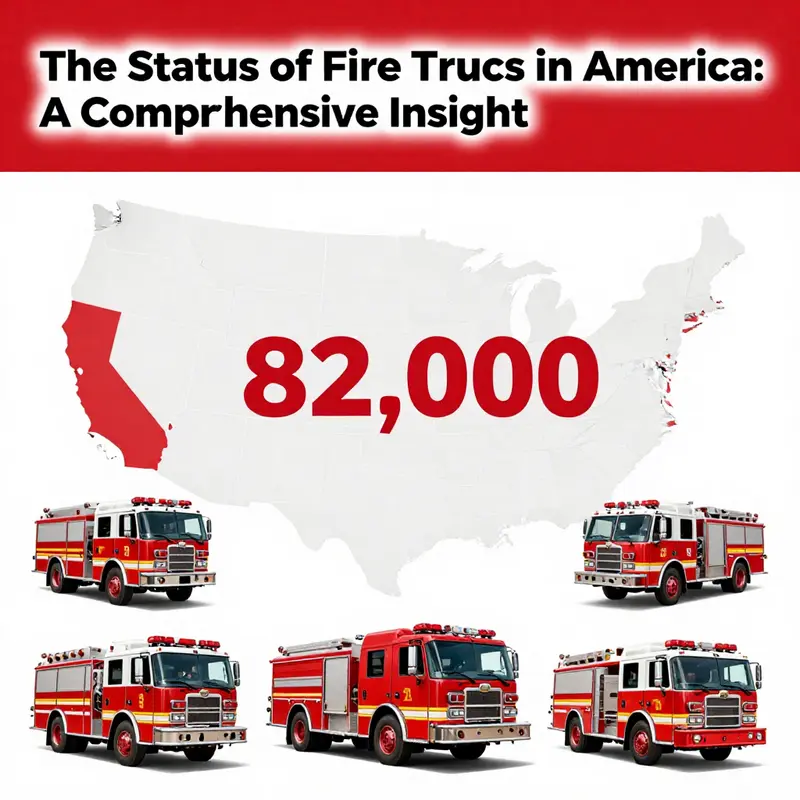
The short answer: about 82,000. That’s the count the National Fire Protection Association (NFPA) reported for 2023, covering fire apparatus in active service across the country. The fleet operates through more than 30,000 fire departments and over 50,000 fire stations, which works out to roughly three apparatus per department.
The 82,000 figure is specific about what it counts. It covers dedicated firefighting vehicles — structural engines, aerial ladders, rescue units, hazmat rigs, command vehicles, and support units like wildland engines and water tenders. Broader tallies that push toward 100,000 mix in ambulances and utility vehicles, which have different missions. For measuring firefighting capacity, the NFPA’s 82,000 is the cleaner number.

The fleet isn’t spread evenly. Urban departments carry a larger share of aerials, big pumpers, and specialty units because they face dense housing, high-rise fires, and heavy call volumes. Rural and small-town departments lean on smaller, more versatile rigs and water tenders to cover long distances where hydrants are scarce. The Midwest — Illinois, Ohio, Michigan — anchors the used-truck market, since its industrial base sits close to manufacturers and refurbishers. That secondary market matters for departments that can’t afford new builds: a well-maintained used truck can extend a fleet’s life without a full replacement. North America is expected to account for 32.0% of global fire truck market revenue by 2025, a share driven largely by U.S. demand.

The infrastructure behind the trucks is as important as the count. Stations run maintenance bays and keep spare parts on hand. Mutual-aid agreements let neighboring departments share apparatus during large incidents, which stretches the effective fleet well beyond the raw headcount. Dispatch systems — E911 and computer-aided dispatch — route alarms to the nearest ready station, weighing traffic and vehicle availability in real time. A truck’s status, pump pressure, and diagnostics flow back through the same network, so the 82,000 vehicles operate as a connected system rather than a static inventory.
The fleet is also changing. New builds emphasize safety features, fuel efficiency, and digital integration. Electric and hybrid drivetrains are in early pilots, driven by fuel costs and emissions goals. And departments increasingly retrofit older trucks with new sensors and communications gear instead of replacing them outright, which stretches budgets while keeping proven platforms in service. For departments weighing upgrades, heavy-duty fire trucks are one option that keeps capability in line with municipal budgets.

The number itself will keep moving as departments modernize and as risk shifts with urban growth and wildfire. But the 82,000 baseline is what the U.S. actually maintains today, and the story behind it is about how those vehicles are distributed, maintained, and deployed — not just how many there are.
Industry analysis points to continued growth in the North American fire truck market through the early 2030s. For market context and forecasts, see the Fire Truck Market Size, Share, Trends and Forecast 2034 report, the Fire Truck Market Report, and the North America Fire Truck Market forecast to 2033.