
















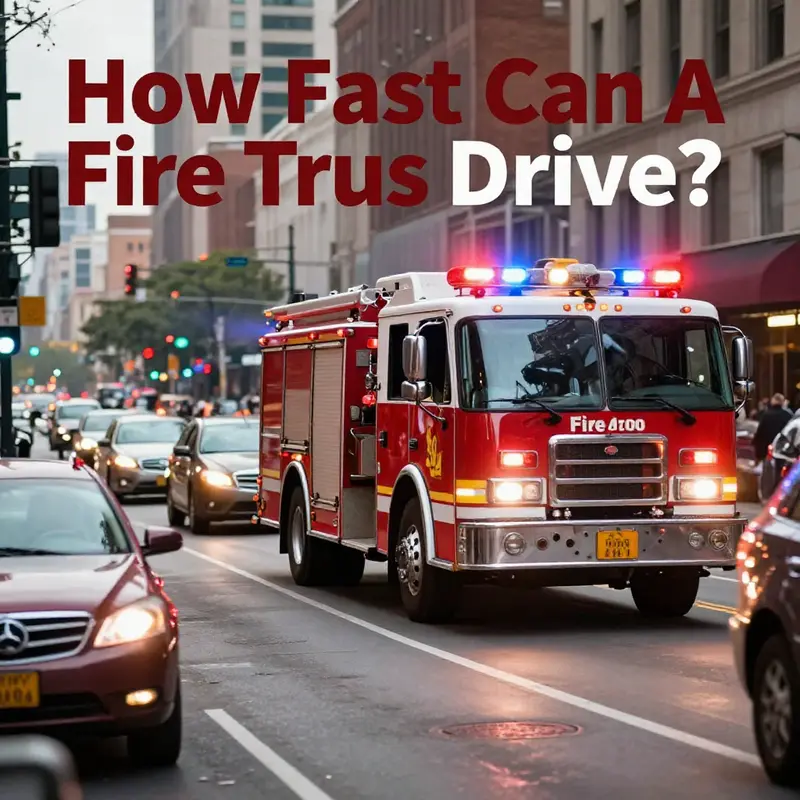
Fire trucks play a critical role in emergency response, yet their speed capabilities are often misunderstood. Beyond the sirens and flashing lights, the speed limits for fire trucks and the laws governing their operation are crucial for both safety and efficiency. This article delves into how fast a fire truck can drive, anchored by legal regulations, technical specifications, comparisons with other emergency vehicles, safety considerations, and the impact on urban traffic. Each chapter contributes to a holistic understanding of fire truck speed and operational protocols, vital for business owners navigating safety and logistical compliance in urban environments.
null
null
Beyond the Siren: Speed, Weight, and Terrain in the Real-World Dash of a Fire Truck
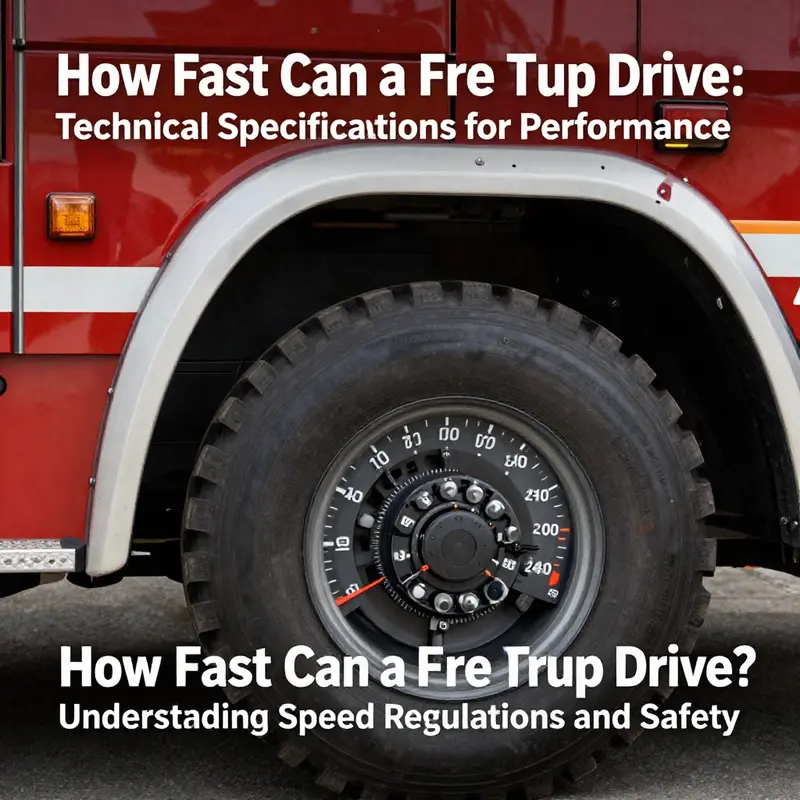
When a fire alarm sounds, speed becomes only one part of a complex equation. A fire truck is never a race car; its mission is to arrive quickly while preserving stability, control, and the safety of the crew and the public. The science of how fast these vehicles can move is shaped by physics, vehicle design, road conditions, and the ethical obligation to drive with due regard for safety. What emerges from the real world is a spectrum rather than a single number: a spectrum that shifts with where the call is coming from, what is loaded on the rig, and what the driver can see and anticipate in a few critical seconds.
In urban streets, speed is constrained not only by speed limits but by turns, cross streets, pedestrians, and the need to clear signals and hydrants without creating new hazards. In open highways, there is more room to stretch the legs of the engine and chassis, but there are still limits—the weight of water, hoses, ladders, and equipment multiplies the consequences of a miscalculation. In forested or rough terrain, maneuverability and traction become the dominant constraints, and the engine slows in deliberate fashion to ensure that the apparatus does not slip, tip, or become stranded on uneven ground. Across these scenarios, the question of how fast can a fire truck drive resolves into a nuanced understanding: there is a practical ceiling, a typical operating range, and a safety margin that governs every turn and acceleration.
The operating range that responders experience is not arbitrary. It reflects both legal allowances and departmental policies that prioritize rapid arrival with disciplined driving. In many places, responders are legally permitted to exceed posted speed limits when lights and sirens are activated, but this privilege comes with obligations. The vehicle must be driven with due regard for safety, which translates to minimizing aggressive acceleration, maintaining a safe following distance, and preparing to brake early for intersections, pedestrians, or stalled traffic. When this balance is struck, speeds commonly fall into recognizable bands that reflect the environment. Urban roads, congested with vehicles and pedestrians, often see average travel around 30–40 km/h (about 20–25 mph) as crews weave through traffic signals, school zones, and narrow lanes. The same geography, if cleared, can allow much faster movement on a highway or open road, where averages climb into the range of 60–80 km/h (roughly 37–50 mph) or more, provided the route remains safely navigable and free of obstructions. The contrast is stark enough that even within a single city, an engine may sprint down a broad arterial only to decelerate sharply as it approaches residential streets with parked cars and curbside hydrants.
The upper end of speed capability, described in many technical discussions, is often framed as a theoretical ceiling rather than a practical target. In favorable conditions—an empty, straight highway, good weather, and minimal traffic—top speeds for fire apparatus may be cited around 90–100 km/h (about 56–62 mph). In other words, the physics of a heavy, water-filled vehicle with a long wheelbase does not invite the effortless, blistering acceleration of a sporting car. The mass of the apparatus, the inertia of a full water tank, the complexity of steering and braking under load, and the potential for tire slip all work against aggressive speed. Even when a department documents higher theoretical limits, day-to-day practice favors controlled acceleration, steady cruising, and careful deceleration long before a hazard is encountered. In some jurisdictions, officials recognize that speed must be balanced with accountability; enforcement actions can follow if response driving endangers the public or disrupts traffic flow in unsafe ways. The goal is to arrive with the crew intact and the equipment ready to perform, not to post the fastest possible time by any measure.
Different fire apparatus types also shape speed expectations, though the overarching principle remains consistent: heavier, more equipment-laden trucks demand more careful handling than lighter, specialized or aerial units. A conventional pumper, stocked with hoses, couplings, hydrant tools, and a water tank, sacrifices some nimbleness for capacity and reach. A wildland or airport rescue engine—designed for a specific mission—will optimize for stability and command presence in its operating environment, but this specialization does not erase the fundamental limits imposed by weight and terrain. Even among electric powertrains, designed to deliver instant torque, the control systems must manage traction and braking with precision, especially on uneven surfaces or in environments that require stealth or minimal vibration near sensitive ecosystems. In all cases, the trajectory from a standstill to top speed is a carefully managed arc, with the driver and the apparatus harmonizing throttle, braking, and steering to preserve control and safety.
The practical question then extends beyond maximum speed to the realities of road and weather conditions, road surfaces, and the interplay between the vehicle and the driver’s decision-making process. A well-trained crew benefits from standard operating procedures that emphasize situational awareness: anticipating intersections, pre-planning routes around bottlenecks, and using turnout lanes to allow faster traffic to pass when possible. The vehicle’s handling characteristics—brake fade, tire grip, suspension response, and steering feedback—become a choreography rather than a simple punch of throttle. Even on a clear day, a slight shift in weight as doors open, water tanks slosh, or equipment shifts can alter stability and require mid-course adjustments. The result is a driving environment in which speed is a meaningful metric only when it serves the mission and does not threaten safety. To that end, departments increasingly train for dynamic decision-making: when to push slightly for time, when to hold the line, and how to orchestrate a rapid, controlled approach that reduces risk to others on the road.
For those seeking a closer look at the kinds of gear that influence speed through weight and handling, the broader apparatus ecosystem offers essential context. Equipment categories—ranging from pumps and hoses to specialized hardware—shape the dynamic load the vehicle carries. A detailed look at the available fire-truck parts can provide useful perspective on how a rig’s balance is achieved and maintained during a rapid, life-critical response. This perspective helps explain why the sleekest, fastest theoretical performance rarely translates into a routine response. It also underscores why the best performance is not the fastest but the most reliable, with speed measured alongside stability, predictability, and crew safety. See https://cimcfiretruck.com/product-category/fire-truck-parts/ for more detail.
Thus, the question of how fast can a fire truck drive sits at the intersection of physics and policy, strategy and safety. It is not simply a matter of horsepower or top speed; it is a matter of engineering ethics and operational prudence. The vehicle must be capable of controlled acceleration and deceleration, robust braking, and stable cornering under load. It must also be capable of predictable behavior when negotiating urban grids, rural byways, or rugged fire lanes. In practice, fire departments rely on these principles to calibrate their expectations about speed. They recognize that the fastest possible arrival is a function of many elements aligning in a split second: the driver’s judgment, the vehicle’s mechanical state, road geometry, and the surrounding traffic. The siren and lights are not a license to abandon caution; they are a signaling system that prompts other road users to yield while the responders maintain caution and order.
Ultimately, the best measure of speed is not the raw top figure but the ability to reach the scene equipped to perform. The system that governs response is a balance of capability and restraint, designed to protect people and property without inviting unintended harm. When these factors are balanced, the science of speed becomes a narrative of disciplined urgency—a reminder that the most vital metric on every run is not the loudest or the fastest, but the safest, most efficient arrival with control and readiness. For anyone curious about the higher-level standards that govern performance, visit professional guidelines that codify these practices and help ensure that every mile covered by a fire truck translates into a safer, swifter rescue. As departments continue to refine training, vehicle design, and road management, the relationship between speed and safety remains a dynamic, evolving conversation. External resources on these standards provide further depth into how communities define and measure emergency response performance: https://www.nfpa.org/codes-and-standards/detailed-content?code=1917
Racing with Responsibility: The Real Speeds of Fire Trucks and the Trade-Offs Behind Emergency Velocity
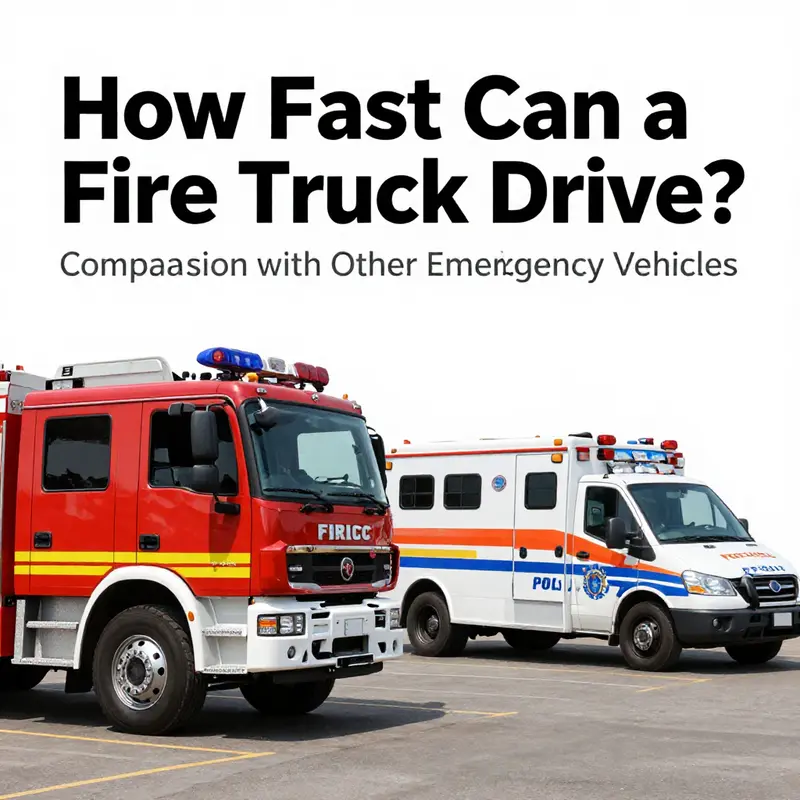
Racing to the scene is a core part of what a fire department does, but speed is never pursued in a vacuum. A fire truck’s tempo on the road is a careful negotiation among urgency, safety, and the practical realities of carrying tools, water, and crew. The question of how fast a fire truck can drive touches on law, engineering, and mission discipline. It invites us to look beyond a single number and toward the broader idea that speed in firefighting is a function of context as much as it is of horsepower. Fire apparatus are engineered to deliver life-saving capability, and that means prioritizing stability, reliable handling, and predictable performance over sheer velocity. The pace at which a truck moves toward a blaze depends on where it is, what it is carrying, and how the incident has been prioritized by the incident commander and responding units. The urban grid, rural byways, and highway corridors each present a different set of constraints, all of which shape the speed profile of a response.\n\nIn dense city environments, the baseline speed of a fire engine during routine travel is modest. In many urban areas, fire trucks tend to move at roughly 22–28 mph (35–45 km/h) under normal traffic and signalization conditions. That figure is not a ceiling; it is a practical operating range, reflecting the pressures of pedestrians, crosswalks, turn restrictions, and the need to thread a long, heavy vehicle through congested streets. The design tradeoffs are stark: weight distribution, the mass of water on board, ladders, hoses, and all the other gear mean that acceleration must be smooth, braking effective, and steering controlled. Even when the sirens waft through the air and traffic yields, the vehicle’s handling remains a critical determinant of how fast it can travel safely.\n\nThere are moments, however, when conditions align more favorably. In ideal, open-road situations—clear lanes, light traffic, dry pavement—modern fire apparatus can reach higher speeds. In those moments, speeds climb toward 60–70 km/h (37–43 mph). These are not everyday city runs but specialized responses, such as alerts for major structural fires or hazardous materials incidents where rapid miles on the clock can meaningfully shorten the time to arrival. The same logic translates when crews move to highways or arterial routes designed for higher speeds, provided the route is safe for an emergent, heavier vehicle. In some jurisdictions, there is latitude to push toward the upper end of the allowable range on suitable roads, though the precise limits vary with local regulations and road design. California, for example, has provisions that can permit fire apparatus to travel up to about 65 mph (105 km/h) in urban settings and even faster on highways when it is deemed necessary and safe. It’s a reminder that the line between urgent travel and reckless speed is a real one—one that responders must constantly navigate.\n\nThe opposite end of the spectrum is equally instructive. In rural or forested areas, where road quality deteriorates, shoulders narrow, and rescue routes may be less direct, fire trucks often operate at lower speeds, around 25–35 km/h (15–22 mph). The terrain, the road surface, and the distance to water sources all contribute to this slower pace. A truck’s capacity to pump, draft, or shuttle equipment over uneven ground becomes a more limiting factor than in urban centers, and the speed with which a vehicle can maneuver becomes a question of stability and safe progression rather than raw velocity. Across this spectrum—from the staccato tempo of a city response to the steadier clip of rural travel—speed is a function of the road, the load, and the mission.\n\nThose numbers, while informative, only illuminate part of the picture. When we place fire trucks side by side with other emergency responders, the contrast sharpens. Ambulances, designed to minimize patient transport time, generally move faster than fire trucks in many urban contexts—roughly 50–60 km/h (31–37 mph) on city streets and able to reach higher speeds, up to about 80 km/h (50 mph), on highways to prioritize rapid patient handoff and care. Police cars, operating under the broad umbrella of urgent law enforcement and public safety, can exceed 100 km/h (62 mph) on open roads during pursuits or urgent deployments. Then there are the airborne responders—emergency medical helicopters that carve through the sky at around 200–250 km/h (124–155 mph)—a reminder that velocity, in the broad emergency-services ecosystem, spans a wide range. Yet the distinctive strength of a fire truck is not its top speed but its capacity to deliver water, equipment, and personnel where they are needed most, in a coordinated, controlled, and safe manner. The heavy, water-filled chassis, coupled with ladders, pump gear, and hoses, reduces agility compared to lighter vehicles even when the engines are strong. The emphasis on stability helps prevent rollovers and compromised control on turns, wet pavement, or slippery surfaces, situations that can arise quickly in critical incidents.\n\nContext matters, too, when we consider how the vehicle’s speed interacts with traffic management, dispatch strategies, and the route chosen by firefighters. The due regard for safety standard—required in many jurisdictions—means that responders must balance the need for speed with the duty to protect the public. Sirens and lights play a crucial role in clearing paths, but they do not guarantee instantaneous clearances or absolute freedom to punch through every obstacle. Route planning, traffic signal preemption, and real-time updates from dispatchers all influence how far speed can be translated into actual arrival time. The incident’s priority level, the type of hazard, and the location of the fire or emergency all inform decision-makers about whether pushing a truck to higher speeds is warranted. These considerations become more acute in urban cores where pedestrian activity, street furniture, and congested lanes create a complex tapestry of risk if a heavy vehicle moves too quickly or unpredictably.\n\nFor readers seeking a broader perspective on how speed stacks up against the overall demands of emergency response, it helps to look at the broader data on apparatus performance. The field studies conducted by fire service researchers emphasize that speed is only one piece of a larger system, where response time is shaped by dispatch accuracy, route optimization, water supply logistics, and crew readiness. This is not to say speed is unimportant; rather, it functions within a framework that prizes reliability, controlled handling, and effective on-scene operations. In practice, a rapid arrival helps secure a more favorable incident arc, but it must be achieved without sacrificing the ability to perform critical tasks once the team arrives. A successful response weaves together rapid transit, careful driving, and decisive action on the ground.\n\nAs you explore the practical side of fire truck velocity, you may notice how the vehicles themselves and the people inside them contribute to the numbers. The engine’s power, the transmission, the braking system, tire grip, and suspension all shape acceleration and deceleration. The water tank load, hoses, and equipment generate a constant dynamic of weight that can shift with every maneuver. Even the best-performing apparatus must respect the physics of motion when moving through urban traffic, negotiating intersections, or traversing hilly terrain. This is why speed is generally described in ranges rather than precise figures: it reflects not a single moment of acceleration but a composite of conditions, loads, and decisions that together determine how fast a fire unit can, and should, travel toward its target.\n\nFor readers who want to dive deeper into comparative data and performance studies, the National Fire Protection Association’s Fire Department Apparatus Performance Study offers a comprehensive resource that contextualizes speed within broader performance metrics. It provides real-world measurements and analysis that help explain why a truck’s speed in practice often diverges from its theoretical maximum. If you want to explore more about the equipment and capabilities that underlie these speed figures, you can browse the broader catalog of fire fighting equipment and trucks that inform modern response logistics at the fire fighting truck category page. This kind of information helps connect the numbers to the everyday realities of firefighting—how crews plan routes, how officers weigh risk versus urgency, and how communities balance faster response with public safety. https://www.nfpa.org
null
null
Speed, Streets, and Seconds: How Fast a Fire Truck Can Move in Urban Traffic and Why It Really Matters
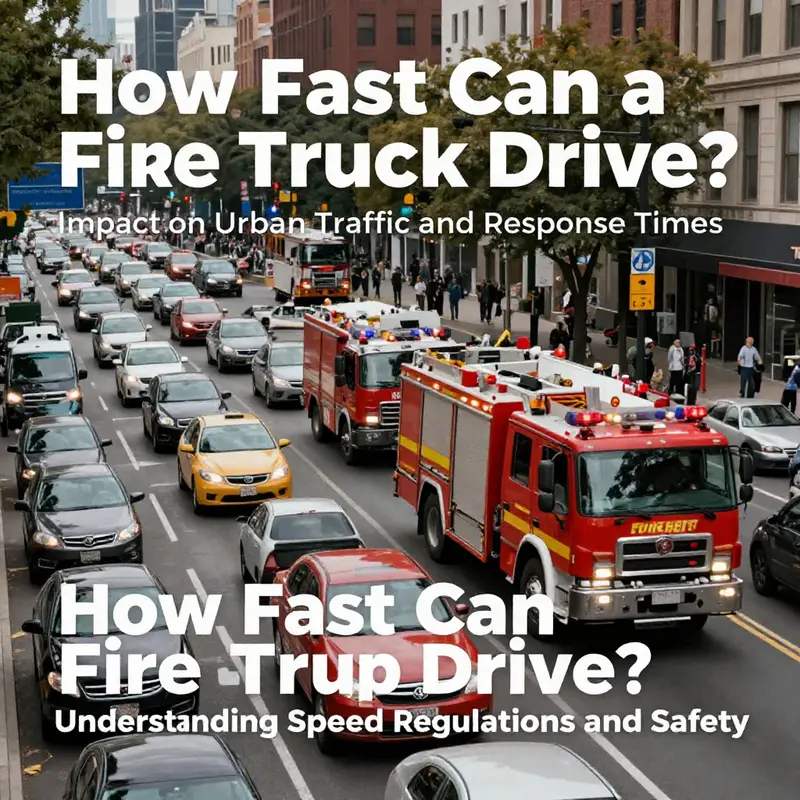
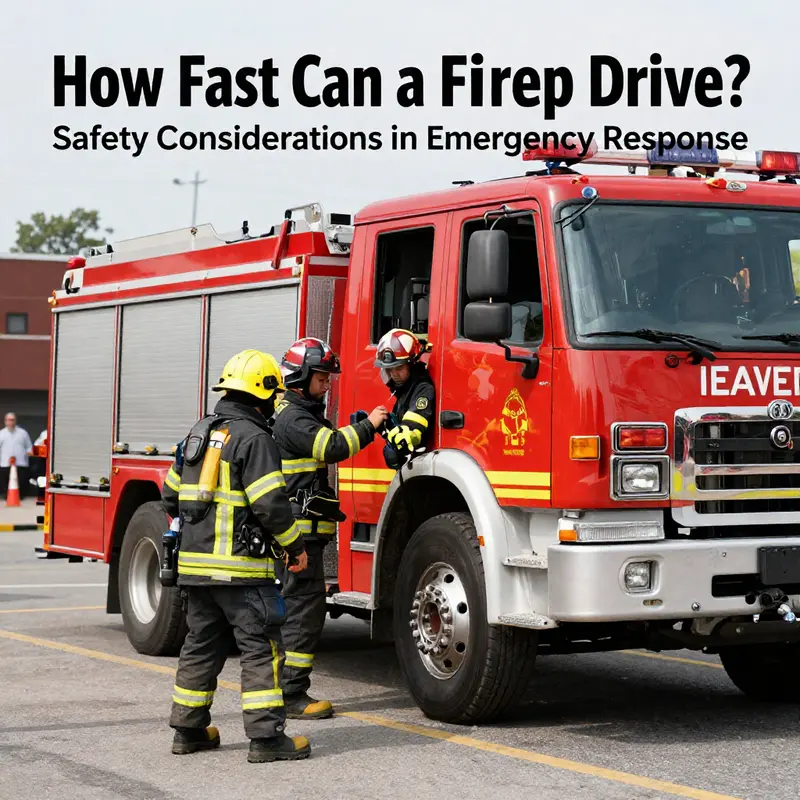
When a fire call comes in, every passing second carries weight. The urgency is real, but so is the need to keep the public and the crew safe as the vehicle hurtles toward a blaze or a rescue. Fire trucks are built for rapid response, yet their speed on busy city streets is a careful balance of momentum and restraint. They depart with lights and sirens, but they cannot abandon governance of the road entirely. The result is a nuanced picture: on open roads, a fire apparatus can reach speeds that surprise casual observers; in the heart of dense urban grids, the same apparatus slows to a crawl, navigating traffic, pedestrians, and the very potholes that threaten stability for a laden, equipment-heavy vehicle. Understanding how fast a fire truck can drive in practice means tracing not just the limits of engineering but also the realities of city infrastructure, driver training, and evolving traffic management strategies that seek to keep those seconds moving in the right direction rather than squander them in delay.
The upper bound of a fire truck’s speed, when conditions are favorable and the emergency demands it, is set by a combination of design, load, and road quality. On open, highway-like stretches away from dense centers, these vehicles can reach around 80 kilometers per hour, which translates to roughly 50 miles per hour. That figure reflects what a modern, purpose-built apparatus can sustain when there is no need to brake for congestion, and when the pavement is smooth and well-marked. It is not a universal speed cap across all scenarios, but it establishes a benchmark for what the machines are capable of under optimal circumstances. The more revealing part of the picture appears when we move into urban or suburban arteries where the real traffic choreography unfolds.
In cities, the same vehicles rarely sustain those peak numbers for long. Urban environments introduce a suite of obstacles: dense vehicle networks, unpredictable pedestrian movement, frequent intersections, bus lanes, and construction zones. The equipment on board—hoses, ladders, rescue tools, and spare gear—adds weight and raises the center of gravity, demanding careful acceleration, braking, and cornering to preserve control. The net effect is a more modest pace, even when the siren wails. Jurisdictions differ, but a common thread runs through the practice: in urban settings, speeds typically fall into the range where visibility, reaction time, and the ability to negotiate turning radii safely take priority over raw velocity. California illustrates this balance with a practical cap on urban driving that can stretch toward higher speeds on highways when deemed necessary and safe; by contrast, in a dense, congested city like New York, the same logic translates into more restrained speeds, often in the mid- to high-40s miles per hour, depending on traffic and time of day. These numbers reflect both policy and real-world constraint, not a contradiction between urgency and safety.
Yet even these urban limits are not arbitrary. They are shaped by the physics of a heavy vehicle, the road surface beneath it, and the dynamic demands of emergency operations. A fire truck is not a passenger car; it carries a full load of water, equipment, personnel, and sometimes a large aerial apparatus. The combination of mass and wind resistance, especially when doors are open or equipment is deployed, changes the handling characteristics. Traction varies with weather and pavement condition, and the vehicle must remain steerable and controllable at all times. The aim is not merely to arrive first, but to arrive alive, with equipment intact and ready for immediate deployment at the scene. In practical terms, this means that even when the lights and sirens are active, drivers exercise disciplined acceleration, cautious lane changes, and deliberate approach speeds through intersections. The idea is to minimize risk while preserving the ability to reach the incident with the apparatus in good order and the crew prepared for action.
An important design consideration often discussed by engineers and fleet operators is the alignment of vehicle configuration with local traffic laws and road layouts. Right-hand drive (RHD) configurations, for example, can offer improved driver visibility in regions where traffic flows on the left side of the road or where sightlines into narrow, busy street sections are critical. The choice of configuration, alongside the chassis, suspension, and braking systems, reflects a broader commitment to ensuring that the truck can respond effectively without compromising safety. When planning or procuring fire apparatus for a city, departments weigh such design features against the anticipated operating environment, the kinds of incidents most frequently encountered, and the need to integrate smoothly with urban traffic management strategies.
That integration is increasingly about managing delay as much as it is about maximizing speed. A growing corpus of research shows that traffic congestion can significantly affect response times for emergency vehicles. In a 2026 study published in Transportation Research Part A: Policy and Practice, researchers found that every minute of delay in emergency response correlates with a measurable uptick in property damage. While the figure is context-dependent, the direction is clear: even small reductions in travel time through smarter traffic coordination can meaningfully influence incident outcomes. This is where urban planning meets on-the-ground practice. Cities are experimenting with smart traffic management systems that offer priority signaling for emergencies and real-time data integration. When a fire truck approaches an intersection, GPS-enabled coordination can prompt signals to alter timing or path trajectories in ways that reduce waiting at red lights and improve predictability for crews and neighboring drivers. In some metropolitan areas, these technologies have begun to yield tangible improvements in travel times by enabling faster, more predictable passage through critical bottlenecks.
The practical implications extend beyond the moment of driving. A faster arrival saves valuable seconds that multiply across the duration of a firefighting operation—affecting not just the speed of knockdown, but the duration of exposure for residents, the extent of property preservation, and the overall safety margins surrounding the incident. The hardware’s raw speed is only part of the story; the orchestration of movement through traffic, the anticipation of green phases at signals, and the coordination with other emergency units all contribute to the bottom line: how quickly help can be on scene and how effectively it can function once there. This is why many fire departments increasingly rely on integrated systems that couple vehicle telemetry with traffic signal control, route optimization, and even public information campaigns that help bystanders understand how to yield to emergency vehicles. The synergy of speed and safety thus becomes a living process, not a single metric.
To appreciate the full scope of what governs speed in practice, it helps to look at how these vehicles are framed within their local ecosystems. The speed ceiling in open-road conditions, while real, is frequently eclipsed by urban risk management concerns. Road hazards such as potholes, uneven pavement, and construction zones demand a cautious, stabilized cadence. The vehicle’s ballast, the need to maintain tire integrity, and the imperative to preserve steering control in corners all constrain acceleration and top speed during routine responses. In addition, when a fire engine carries personnel and a large toolkit, the extra mass translates into longer stopping distances and more nuanced brake modulation, especially on contaminated or slick surfaces. These realities collectively explain why the same fire apparatus can travel at 50 mph in certain contexts and slow to below 40 mph in others, even within the same city block sequence.
For readers seeking a tangible sense of scope, consider the pathway from dispatch to action. The initial leg may move through a corridor of signals that are optimized for emergency travel, but that corridor is only as good as the traffic environment around it. If the route traverses a maze of parked cars, bicycles, and pedestrians, the driver must adjust in real time, balancing speed with situational awareness. It is this dynamic that shapes the actual travel speed and, ultimately, the time to the call’s focal point. In this sense, speed is a function of both vehicle capability and urban choreography. The most effective responses arise when the design and the policy converge: the hardware is capable of rapid movement, the streets are managed to clear a path, and the crew operates with disciplined judgment to keep the operation on a safe, predictable trajectory.
For those curious about the practical details behind where to look for information on fire-truck specifications and how they relate to urban performance, it helps to consider the broader landscape of vehicle design and procurement. A deeper dive into the characteristics of heavy-duty fire trucks reveals how manufacturers tailor weight distribution, braking force, and suspension tuning to meet the demands of dense urban operation. See the category of heavy-duty fire trucks for an illustrative sense of how these vehicles are positioned in modern fleets and what that means for their speed envelope in city streets. heavy-duty fire trucks
Ultimately, velocity on city streets is less about a single number and more about the choreography of motion under pressure. Masters of the moment know that every response blends the science of speed with the art of safe driving, the constraints of the road, and the strategic use of technology to keep the path clear. The urban landscape is not a straight line, and neither is the clock when a fire truck is en route. The most effective chapters in a city’s emergency response narrative are written not only in the yards of the apparatus but in the intersections of policy, infrastructure, and practice, where the goal is to shorten the time to impact without inviting risk to the public or to the crew. For researchers and practitioners alike, that balance remains the central challenge: moving faster where it matters most, while maintaining the discipline that protects everyone on the road.
For readers seeking a broader, technically grounded perspective, a recent technical guide on right-hand-drive fire trucks offers detailed considerations about how configuration choices align with local traffic dynamics and safety requirements. It provides a framework for understanding how operators reconcile speed with control, especially in regions with particular traffic patterns and regulatory environments. https://www.fireengineering.com/technical-guide-rhd-fire-truck-grades-specifications-applications/
Final thoughts
Understanding the speed capabilities of fire trucks allows business owners to better navigate the complexities of urban safety and emergency services. As fire trucks are integral to community safety, acknowledging their speed regulations and operational restrictions is crucial for effective planning and coordination. By promoting a culture of respect for emergency services, businesses contribute to a safer environment and ensure smoother interactions with these vital services. Always prioritize communication and compliance with local regulations to support emergency responders effectively.

