
















The speed at which fire trucks operate is a delicate balance between urgency and safety. Understanding these regulations is crucial for business owners who may find themselves in the vicinity of emergency response efforts. The following chapters will delve into the legal regulations governing fire truck speeds, outline how they operate during emergencies, and explore the public safety considerations connected with their operations. By comprehending these aspects, business owners can better support emergency services while maintaining a safe environment for customers and employees alike.
Racing the Clock Within the Law: The Real Boundaries Fire Trucks Navigate When Responding to Emergencies
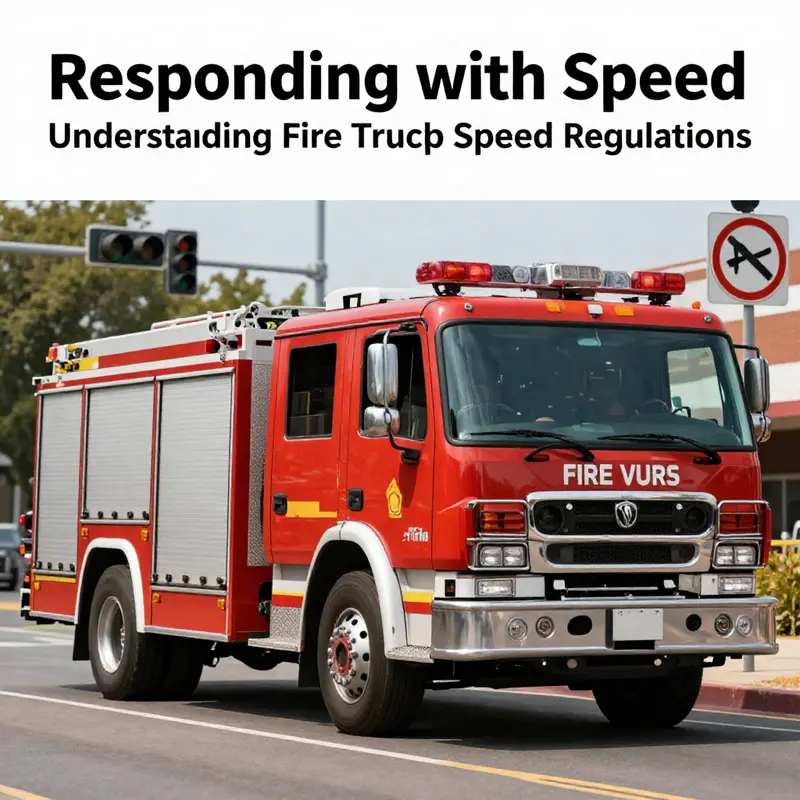
When sirens slice through the city and engines surge forward, the question that first rises is simple in form but complex in practice: how fast are fire trucks allowed to go? The easy answer would be, as with most rules of the road, there is a number—a maximum speed within which every driver must operate. But like many emergency measures, the truth isn’t a single figure; it’s a dynamic balance between speed, safety, and the specific conditions on the ground. Fire trucks are not exempt from the law, even as they command the road in moments of crisis. Their speed is governed by the same fundamental mandate that governs every other vehicle with a mission to save lives and protect property: act fast, but act safely. The speed at which they travel is a product of the immediate hazard, the geometry of the route, the density of traffic, visibility, weather, road surfaces, and the capabilities and training of the crew behind the wheel. In other words, there is no universal maximum speed that can be slapped onto all emergencies. There is, instead, a framework—an operating standard—that guides decision making in real time, and that is the backbone of how fast a fire truck may move from station to scene.
To understand why this question is so layered, it helps to look at how speed is interpreted in different places and under different rules. In the United States, speed is typically governed by state and local traffic laws, with exceptions carved out for emergency response. These exemptions are not licenses to abandon caution; they are conditions under which the driver must continuously weigh risk against urgency. In many jurisdictions, fire apparatus may proceed through intersections with caution after confirming that their approach makes sense given the traffic configuration, the presence of pedestrians, and the outcome of coordinating signals from traffic control or incident command. Some places have explicit provisions about certain maneuvers during an emergency response. For example, a local regulation might restrict a fire engine traveling in opposing traffic lanes or attempting to race through a congested intersection to a markedly lower speed, such as 20 mph, precisely to reduce the chance of a collision with oncoming vehicles or pedestrians. That specific limit—twenty miles per hour when the apparatus enters opposing lanes or crosses an intersection—becomes a concrete constraint in those environments, a reminder that speed cannot trump safety when the public is present and vulnerable.
Even with such constraints, the core principle remains the same across landscapes: the faster you go in an emergency, the higher the stakes. The speed threshold is not a target to be reached; it is a boundary to be respected whenever the environment or the mission makes a fastest possible approach more dangerous than the hazard you’re racing to resolve. In practical terms, this means that a fire truck’s speed is calibrated to a condition where the risk of harming bystanders, creating new hazards, or compromising the crew’s ability to operate safely is kept to a minimum while still advancing the mission. The sirens, the flashing lights, the preprogrammed routes, and the coordination with dispatch and on-scene leaders all work in concert to negotiate that delicate balance. In many districts, this balance is codified in a patchwork of statutes, department policies, and training standards designed to harmonize rapid response with broad public safety.
Across the Atlantic and beyond, the picture shifts in its specifics yet keeps to the same essential logic. In places like portions of the United States, the law may explicitly allow certain speed deviations from posted limits during emergencies, but with notable constraints—red signals are not a suggestion to roll through; pedestrians and cross traffic still demand caution; stopping at a red light remains a possibility under the right conditions and with the appropriate contingencies in place. In other jurisdictions, such as parts of Asia, the legal framework emphasizes priority passage for emergency vehicles but does not fix a universal maximum speed for all emergencies. The emphasis in these frameworks is safety first, followed by efficiency, with a clear emphasis on using warning devices and following the direction of traffic police when present. The common thread is not the speed at which a given fire truck must travel, but rather the discipline with which its crew operates at any speed they choose to implement.
This is not a paradox but a principle: speed is a means to an end, not an end in itself. The faster a crew can reach a scene, the more the door to saving lives and preserving property can open. Yet speed is not the sole measure of effectiveness. The layout of a city, the density of traffic, the pattern of pedestrian movement, and the complexity of the scene all shape how fast responders can safely and effectively move. Consider a corridor of city streets at dawn: vehicles breathe and shift in the pulse of traffic, lights flicker, and the risk of a misread turn or an impatient driver becomes significant. In such conditions, drivers are trained to modulate speed, not merely accelerate. The discipline of rapid response rests on the crew’s shared understanding of how far they can push their vehicle without compromising control. The engine’s torque, the tire grip, the weight distribution when fully loaded with water or equipment, even the crew’s seating and interface with the steering wheel—all of these physical factors translate into a practical ceiling on speed. And when road conditions deteriorate—wet pavement, snow, ice, a slick shoulder—the ceiling lowers, not because the law dictates it, but because physics and safety demand it.
The Chinese legal framework, as described in the detailed results, adds another layer to this tapestry. The Traffic Safety Law of the People’s Republic of China acknowledges the priority status of emergency vehicles carrying out their duties, including fire trucks. It explicitly requires other vehicles and pedestrians to yield the right of way, which sets the scene for dangerous interactions to be mitigated by a clear duty of care on the part of the public. Crucially, the Chinese provision does not fix a concrete maximum speed for fire trucks during emergencies. Instead, it foregrounds three principles: safety first, activation of warning devices, and adherence to directions from traffic police when available. In practice, this translates into a flexible approach to speed, where fire trucks may exceed normal limits when necessary for the mission, but such deviations are always predicated on safety and necessity as absolute prerequisites. The law thus prioritizes the ethical calculus of life-saving action over a mechanical aim for speed. The operational takeaway is that speed is conditional, contingent on a mosaic of factors including traffic, road geometry, weather, visibility, and the presence of bystanders. It is a reminder that a nation’s respect for life can be expressed not only in the speed with which it moves toward danger but also in the restraint it exercises to protect the vulnerable along the route.
This tension—speed as a tool and speed as a risk—shapes the way departments design and train their response programs. In modern fire services, there is a robust emphasis on contextual decision making. Dispatch systems, pre-incident planning, and on-scene command structures work to optimize not only the route but the speed of arrival. The crew may be guided by a route that avoids high-traffic corridors or uses preemption-based signals to reduce delays. In many districts, traffic signal preemption devices grant fire apparatus a path with fewer red lights, or at least with seconds shaved off dangerous cycles, to shorten travel time without forcing the crew into reckless behavior. Yet preemption is not a universal feature; it’s a capability that depends on local infrastructure and policy, and its deployment is weighed against other safety considerations as the mission unfolds. The practical upshot is that speed is a moving target even within a single incident: as the fire grows and the scene evolves, so too does the decision about how fast to push the vehicle toward the hazard.
To speak plainly, there is a spectrum rather than a fixed limit. On one end lies a scenario where a crew must reach a burning structure as quickly as possible. In such cases, the driver might be authorized to operate at higher speeds, but still within the boundaries of safe driving. The driver’s awareness, reaction time, and ability to manage complex traffic conditions become the limiters, not a number printed on a statute. On the other end lies a routine call where flames are contained, or a medical response where minutes are critical but not life-threatening in the same dramatic way. In these cases, the speed may be markedly lower, but the urgency remains. The difference is less about the absolute velocity and more about the control and precision with which the velocity is managed.
This nuanced reality places a premium on training, communication, and culture within fire departments. A driver’s competence in rapid response driving is not simply about how fast they can go, but how well they can anticipate hazards, adjust to a shifting environment, and coordinate with the rest of the crew and with other road users. It involves not just steering and throttle but also situational awareness, risk assessment, and the ethical responsibility to protect life while moving quickly. The forward motion of a fire engine is a live narrative—the siren’s wail, the intersection’s geometry, the pedestrian’s step, the cyclist’s glance, the other driver’s hesitation. Every moment demands judgment, and every decision to accelerate or ease off is a calculated risk.
The real-world implication for communities is that speed is best understood as a function of context. People often ask, “How fast can they go?” The truthful answer is: as fast as the situation allows, without creating new hazards in the process of addressing the old one. This means that speed limits are not simply numbers to be obeyed or ignored; they are thresholds that public safety professionals negotiate with each dispatch, each route, and each on-scene command decision. For residents and pedestrians, this translates into a call for predictable behavior from responders. Sirens and lights are meant to break through the cacophony of traffic, but drivers, cyclists, and pedestrians also carry a responsibility to respond safely—to yield, to stop, to move aside calmly when it is safe to do so. The public’s understanding of this shared responsibility can reduce the risk of secondary crashes, which can compound the danger and delay the ultimate goal of saving lives and securing properties.
In this broader conversation, one practical signal emerges clearly: the fastest possible arrival is achieved not by chasing an abstract speed limit, but by optimizing the entire system of emergency response. This includes the efficiency of dispatch, the reliability of communication between units, the availability of preplanned routes, and the capacity of crews to execute synchronized actions once the apparatus reaches the scene. It also includes a critical public-facing component—education about how to respond when a fire engine or other emergency vehicle approaches. Public education and driver awareness contribute to a smoother path for the vehicle, reducing the need for reckless speed and, therefore, reducing the risk to bystanders and responders alike. When communities understand the why behind the rules and the trade-offs involved in speed, they can participate more effectively in the chain of safety that begins on the road and ends at the hazard’s remediation.
From a fleet perspective, the actual speed a fire truck travels on an emergency response is influenced by the type of vehicle and its equipment. A small, agile apparatus designed for rapid response may accelerate quickly and navigate tight urban streets with relative ease, but it carries a smaller payload and water tank. In contrast, a larger, heavier truck with a substantial water supply and a bulkier load requires more time to accelerate, more room to maneuver, and greater room for error in tight spaces. The different vehicle profiles in a department’s fleet interplay with the conditions at the scene to determine the feasible speed at any given moment. This is why many departments emphasize a holistic approach to emergency response that integrates vehicle dynamics, driver training, route optimization, and real-time decision making—so that what looks like a simple question on a dashboard can be answered with a network of safeguards, protocols, and rehearsed procedures rather than with a singular number.
The topic of speed also invites reflection on the tools and practices that support safer rapid responses. The integration of modern technology—real-time mapping, traffic surveillance feeds, and preincident data—allows crews to anticipate road conditions, identify alternate routes, and adjust their approach before they reach the hazard. The role of communication cannot be overstated: a well-coordinated incident command system ensures that all responding units are aware of changing conditions and can adapt their speed accordingly. In this sense, “how fast” becomes a question of “how fast with the greatest assurance of safety.” The crew’s ability to modulate speed in response to unfolding circumstances—whether the structure’s position, the trajectory of a vehicle through an intersection, or the speed and density of oncoming traffic—becomes the practical measure of effective emergency driving.
For readers seeking a concrete sense of the broader ecosystem that shapes emergency speed, an understanding of how a department views its own fleet is instructive. A typical fire apparatus is part of a larger ecosystem that includes non-emergency vehicles, other agencies, and the public. The interplay of this ecosystem means that the fastest path to a scene is often a negotiated outcome rather than an automated equation. Departments may designate anticipated routes based on the type of incident, the time of day, and historical patterns. They may employ pre-emptive traffic control measures or request support from law enforcement to facilitate a safe corridor. The ultimate objective remains clear: minimize the time to life-saving intervention while minimizing exposure to danger for all involved.
Within this framework, it is worth circling back to a practical takeaway that blends policy with everyday reality. If you are driving or walking near an emergency scene, your best chance to contribute to safety is to stay alert and predictable. Yield to the vehicle when appropriate, avoid sudden movements, and do not block the path of the responding unit. Remember that even when a fire truck is allowed to exceed normal speed in pursuit of the mission, the officers and firefighters behind the wheel will be making split-second judgments designed to preserve life and property. In its simplest form, the question of how fast a fire truck can go is answered by a parallel question: how fast can it go safely, given the conditions at hand? The answer depends on a constellation of factors, all aimed at ensuring that urgent action does not become urgent danger.
For a reader who wants to explore a practical example of the kind of equipment that supports rapid response, consider the broader fleet category that includes emergency rescue vehicles. These platforms, designed with specialized capabilities, illustrate how speed, safety, and capability co-exist in a well-structured response strategy. Emergency Rescue Vehicle page.
As the chapter closes on this topic, the guiding thread remains intact: there is no single maximum speed for fire trucks that applies universally. The speed at which a fire truck is allowed to go is defined by the mission’s demands, the road network, and the safety margins required by the crew and bystanders. In the end, the fastest path to safety is not a number on a speedometer alone. It is the deployment of a disciplined response, a careful orchestration of warning devices, traffic coordination, and on-scene leadership that ensures the success of a rescue without compromising the safety of the public. The speed limit—the functional limit—exists to protect life and property; the real measure of effectiveness is the degree to which responders can reach, assess, and mitigate danger with precision, care, and accountability.
External perspective can provide a broader lens to this topic. For a broader international perspective on emergency vehicle priority and operating procedures, see this resource: https://www.nhtsa.gov/road-safety/emergency-vehicles
null
null
Fast, Fearless, and Safe: The Public Safety Balancing Act Behind Fire Truck Speeds
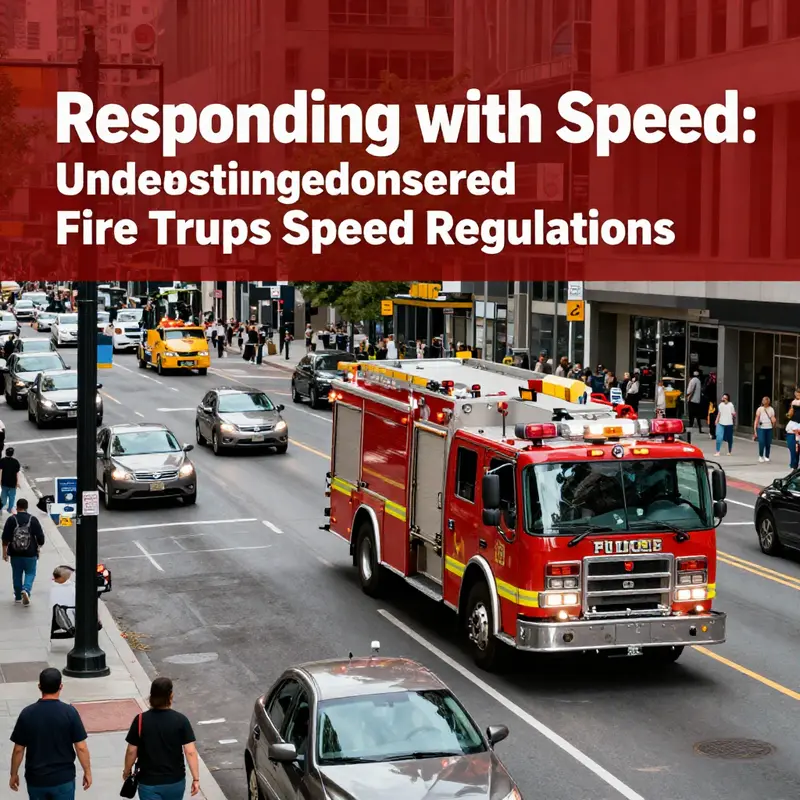
When people picture a fire engine roaring through a city street, the image is often of urgency and purpose. Sirens wail, lights flash, and the vehicle seems to defy the ordinary rhythms of traffic as it races toward a crisis. Yet the reality behind how fast fire trucks are allowed to go is not a simple yes-or-no proposition about maximum velocity. It is a careful, continuously updated calculus that weighs the potential gain in response time against the inevitable risks to the public, the crew, and the surrounding environment. The guiding principle is not speed for speed’s sake, but speed in service of safety and life safety. This principle shapes every decision a fire department makes about when to push the limits and when to pull back, and it sits at the center of how cities, departments, and communities think about emergency mobility.
At first glance, the law seems clear: traffic regulations apply to all vehicles, and fire apparatus are not exempt from the rules that govern the road. The practical truth, however, is more nuanced. Fire departments are empowered to operate with a sense of urgency that mirrors the gravity of the situations they face, but this empowerment is bounded by controls designed to reduce risk. In many places, including large metropolitan areas, there are explicit restrictions that temper the impulse to speed through intersections or in opposing lanes. For example, in certain jurisdictions associated with Los Angeles, operators are restricted to a maximum of about 20 mph when driving into opposing traffic lanes or when traversing intersections in a way that could threaten crossing traffic. These rules acknowledge a fundamental fact: an emergency response can be compromised just as readily by an abrupt crash at a high speed as by a delayed arrival on scene. The policy intention is not to extinguish the fire of urgency but to temper it with a shield of predictability and protective discipline.
Still, it would be naive to portray such limits as a universal brake on action. Firefighters and their officers routinely assess whether a higher speed is both feasible and safe given the circumstances. When conditions align—clear roads, good visibility, light traffic, and favorable weather—the margin for rapid movement widens. Conversely, dense urban cores, narrow streets, heavy pedestrians and cyclists, adverse weather, or obstructed sightlines shrink that margin quickly. In those moments, the priority moves from rapid arrival to safer arrival: slower speeds, more cautious acceleration, and a heightened emphasis on coordination with other road users. The operative phrase remains safety first, speed second, with the public interest a constant reference point. The same logic governs decision-making whether a fire truck is responding to a residential blaze, a hazardous materials incident, or a medical emergency where every second counts but every misstep could have consequences far beyond the immediate call.
What does this look like in practice? It begins with the explicit instruction that sirens and lights are not a license to ignore traffic signals or common-sense caution. When a fire truck is responding, it uses the siren and the warning lights to alert others and to create a path. Yet the crew remains bound by the same fundamental rules of the road that apply to all operators. They yield to pedestrians and cross-traffic as required by law, and they must stop at red lights when necessary to ensure a safe crossing or a controlled merge. The interplay between the urgency of the mission and the safety of the public creates a continuous tension that drivers train to manage with precision. The training emphasizes reducing risk through predictable, cooperative maneuvers: establishing a clear plan for intersections, maintaining a controlled and steady tempo, and executing lane changes and turns with deliberate, scalable decisions rather than abrupt, last-minute actions. In other words, speed is a tool, not an autonomous objective.
A crucial dimension of this balancing act lies in the way emergency response is framed by broader public safety infrastructure. Across many cities, speed limits or operational caps reflect not only legal compliance but also the realities of urban design, traffic patterns, and the unpredictable human element on the street. The visibility of emergency vehicles—driven by bright lights, sirens, and conspicuous signaling—plays a protective role by guiding other motorists to yield and by creating a safer corridor for the responding unit. Yet visibility does not guarantee safety; it must be paired with disciplined driving, clear radio communication, and intact vehicle systems that can sustain higher speeds without compromising control. Vehicle dynamics matter as much as legal allowances. Modern fire apparatus are engineered to manage the stresses of higher-speed driving: they feature robust braking systems, enhanced stability control, reinforced frames, and tires designed to handle abrupt decelerations and heavy loads. The more capable a vehicle is at stopping smoothly and maintaining stability, the more confidently a driver can press the accelerator when an oncoming path is truly clear.
The public safety lens requires a continuous, data-informed view of risk. The National Fire Protection Association, among others, collects data that illuminate how fast trucks travel in different contexts. According to NFPA profiles and related research, the speeds that fire vehicles maintain vary widely with the environment. On open highways with good visibility and light traffic, it is not unusual for a fire unit to operate at higher speeds, approaching 50 mph (about 80 km/h) if circumstances permit. In contrast, urban environments with dense traffic, frequent crosswalks, and more pedestrians often see speeds in the range of 25–30 mph (roughly 40–50 km/h). These figures are not arbitrary; they reflect operational standards designed to optimize the chance of reaching the scene quickly while preserving the life and safety of the public as well as the responders themselves. The logic is empirical as much as it is procedural—absent the ability to navigate a corridor safely, any speed advantage is moot, and risking a crash that blocks the route or harms bystanders would defeat the purpose of a rapid response.
To be sure, speed in an emergency is dynamic. It shifts with weather, road construction, time of day, and the tactics a particular incident demands. In poor weather—rain, snow, fog—stopping distances lengthen, reaction times increase, and the likelihood of hydroplaning or skidding rises. In those conditions, even a unit with high performance brakes and well-tuned stability controls will naturally reduce its speed, not out of reluctance, but out of necessity. The same applies to roads with slick surfaces or uneven pavement. The objective is not to press through the most challenging stretch at all costs but to pass through it with control and minimal exposure to danger. In this sense, the speed limit is not a static figure; it is a flexible, context-driven parameter that operators adjust in real time as risk assessments evolve.
An important element in this calculus is the human factor. Training for emergency driving emphasizes hazard anticipation, orderly traffic negotiation, and the ability to foresee and forestall dangerous scenarios before they arise. Fire department drivers are taught to anticipate hazards such as stalled vehicles mid-block, pedestrians stepping into crosswalks, or a sudden shift in traffic flow from a side street. They learn to read the road as a living system, understanding where conflicts are likely to occur and how to stage a response that minimizes disruption to others while still preserving critical seconds. This training also includes the discipline of using warnings and signals to create a predictable path for others on the road. Predictability reduces the chance that a compliant driver, uncertain and stressed by the siren, will misread a maneuver or accelerate into a dangerous position. It is a subtle, often underappreciated, but crucial form of safety engineering: the public learns what to expect from emergency vehicles, and responders learn how to shape that expectation through disciplined behavior.
Beyond the human element, the performance characteristics of the vehicles themselves shape permissible speeds. A modern fire apparatus is designed with dual priorities in mind: rapid acceleration when conditions allow and stable, reliable braking when conditions demand a halt. Brake systems, including advanced anti-lock braking and electronic stability control, are tuned to maintain steering control and to prevent rollover or jackknife events when the vehicle is carrying heavy loads or turning at speed. Aerodynamics, weight distribution, suspension tuning, and tire selection all contribute to how a truck handles at higher velocities and how quickly it can decelerate into a safe stop. Engineers and fleet managers conduct ongoing analyses of braking distances, cornering limits, and stop-start cycles across a range of typical routes. The goal is to know the envelope within which higher-speed responses remain safe and not to stretch that envelope beyond safe boundaries. When the road geometry is simple and the traffic environment is controlled, higher speeds may be within the envelope. When that geometry becomes complex—think multi-lane intersections, rotarys, or narrow streets—the envelope contracts, and so does the allowable speed.
The public safety calculus also encompasses decision-making about interagency coordination and pre-activation planning. Dispatch centers and incident commanders play critical roles in shaping how fast a unit should move. They weigh the knowns and unknowns of each call, assess the probable residence or location of a fire, and determine the risk of delaying the response versus the risk of proceeding at a higher speed through traffic. In practice, the decision often hinges on the clarity of information available at the moment of dispatch and on the ability of the responding crew to confirm a safe path en route. Route selection is another decisive factor. Even with the same call, a dispatcher might choose one route over another based on current traffic conditions, road work, or reported obstacles. The chosen route can determine whether a truck can maintain a brisk pace or must decelerate to negotiate curves, cross streets, or congested corridors. This dynamic underscores why a fixed speed limit cannot capture the full reality of emergency mobility. The system is designed to be adaptive, emphasizing a controlled, efficient, and safe passage rather than a single uniform velocity.
Public safety, then, emerges not from a single policy or a singular percentile of speed but from an integrated ecosystem. It includes clear signaling that makes the emergency vehicle’s intentions obvious to other road users, formed by trained drivers who interpret and react to the flow of traffic in real time, and supported by vehicles and equipment designed to be controllable, predictable, and resilient under stress. The public’s experience of this system is shaped by how well these pieces work together. When they do, the results are a smoother, safer alerting of other drivers, fewer abrupt maneuvers, and a greater probability that the fastest legal path to the incident becomes the safest path to save lives. As with many aspects of public safety, the numbers alone—say, 20 mph in certain restricted circumstances, 50 mph on an open highway—do not tell the full story. The full story is in the choreography: the timing of the siren, the control of the wheel, the spacing of vehicles, the road geometry, and the crew’s discipline to stay within the limits of what the street and people can tolerate.
Of course, the data from national sources provide a macro view that helps policymakers, departments, and the public understand the larger pattern. The NFPA data show notable variability by road type, weather, and urban density. On open highways with clear visibility and minimal traffic, fire trucks may travel at higher speeds, potentially approaching 50 mph. In contrast, urban environments with heavy traffic or adverse weather conditions typically see lower speeds, often in the 25–30 mph range. These patterns reflect operational priorities that aim to keep response times as short as possible while preserving the safety of everyone on the road. The result is a nuanced, evidence-based framework for thinking about emergency mobility that aligns with both the science of vehicle dynamics and the art of traffic etiquette. For those who want to explore the data more deeply, authoritative sources provide detailed breakdowns and methodology that can illuminate how these averages are derived and how they vary by city, road type, and incident type.
As this chapter tracks toward a close, it is useful to reflect on the broader implications for communities and the future of emergency response. The speed at which fire trucks travel is not just a matter of equipment or regulation; it is a reflection of how a city organizes itself to protect life and property under pressure. Infrastructure investments that improve traffic signal preemption, enable better route planning, and support safer high-speed traversals through dense areas can meaningfully expand the safe envelope for rapid response. Training and culture matter as much as technology. When responders consistently practice disciplined, transparent operations, the public gains confidence that dramatic speeds will be exercised with restraint and care. The design and maintenance of the vehicles, from braking systems to chassis stability, are part of the safety ecosystem that makes faster responses possible without sacrificing safety. In every call, the aim remains the same: to arrive quickly, to act decisively, and to do so in a way that minimizes risk to the people who share the road with these moving lifelines.
For those who want a practical sense of how this translates into everyday operations, consider how an intersection is treated during emergency travel. A driver approaching a red light at speed might face a choice: commit to a risky cross or slow down and re-time the approach. The decision is rarely a simple binary; it is a multiplication of factors—how far away the light is, the position of other vehicles, the potential for a safe turn, and the predicted behavior of pedestrians. Dispatch and on-scene leadership help coordinate these elements so that the route chosen minimizes exposure to danger while preserving the speed needed to reach the scene in time. This collaborative approach extends beyond the engine and its crew. It includes nearby drivers who respond to the emergency with courtesy and compliance, pedestrians who stay alert and away from the path, and the broader urban design that makes rapid, safe movement possible. In many ways, speed is a social contract as much as a mechanical issue.
Ultimately, the question of how fast fire trucks are allowed to go cannot be answered with a single numeric threshold. It requires a living synthesis of law, engineering, physiology, urban design, and human judgment. The numbers cited by NFPA and municipal codes describe typical ranges and boundaries, but the real story is how those ranges are managed in real time. When a fire truck moves through a city, it does so within a system designed to maximize life safety while limiting the chance of new injuries or property damage. The speed within that system is the product of a deliberate process: preincident planning, route optimization, driver training, vehicle engineering, traffic integration, and public cooperation. It is a speed that is fast enough to make a meaningful difference when seconds count, but slow enough to avoid turning urgency into disaster. For communities, the ultimate measure is not simply how quickly a truck can travel from station to scene, but how effectively that speed translates into saved lives and minimized harm.
To dive deeper into the practical implications and to explore related equipment categories and training resources, see the Emergency Rescue Vehicle category. This internal reference highlights the kind of versatile platforms that safety professionals consider when designing, staging, and deploying rapid-response capabilities in diverse environments. The overarching goal remains constant: keep the road safer, even as the road itself becomes a conduit for lifesaving action. For a broader, data-oriented perspective on fire department operations and the factors that shape emergency mobility, the NFPA Fire Department Profile Data offers comprehensive context and analysis that can inform policy and practice across jurisdictions. Access to this external resource provides a foundation for understanding how national trends intersect with local realities, helping communities calibrate their expectations and their investments in public safety infrastructure.
External reference: NFPA Fire Department Profile Data. https://www.nfpa.org/News-and-Research/Data-research/NCES/Fire-Department-Profile-Data
Internal reference: Emergency Rescue Vehicle category. Emergency Rescue Vehicle category
Final thoughts
In summary, understanding the speed regulations governing fire trucks is essential for business owners interacting with their communities. These regulations foster a balance between swift emergency responses and the safety of the general public. Awareness of how fire trucks operate not only helps in anticipating their movements during emergencies but also promotes cooperation between businesses and emergency services, ensuring safety for all involved. By embracing this knowledge, business owners can contribute positively to their community’s emergency preparedness.

