













During wildfire crises, the question of resource allocation between states often arises, particularly regarding the assistance provided by California to its neighboring states. As California and Oregon confront severe wildfire threats, understanding the dynamics of their mutual aid agreements becomes critical for business owners, especially those whose operations may be affected by these disasters. In this article, we will explore California’s emergency protocols, the coordination challenges during wildfire responses, and a detailed analysis of the mutual aid agreements that allow for fire truck support. By examining these aspects, we aim to clarify the misconceptions surrounding California’s commitment to supporting Oregon during emergency situations.
No Denial, Only Duty: California–Oregon Mutual Aid in Wildfire Response
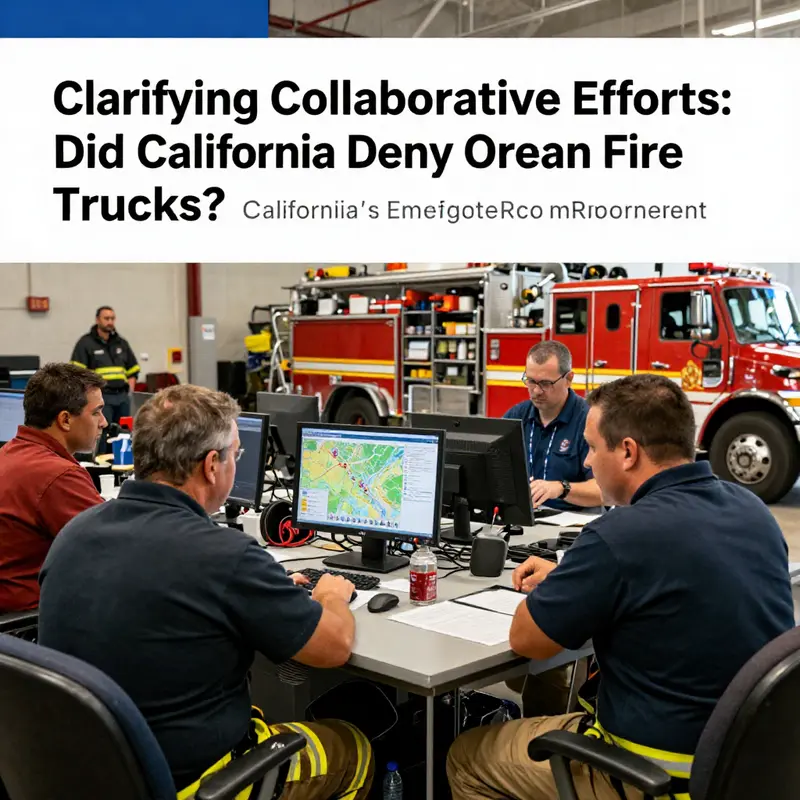
Mutual aid in wildfire response is less about a single decision and more about a sustained framework that crosses state lines. California’s emergency protocols are designed to mobilize resources quickly through regional networks, not to gatekeep assistance from neighboring states. The National Interagency Fire Center and state emergency management agencies coordinate requests, ensuring that engines, water tenders, crews, and aerial support can be allocated where the threat is greatest. The result is a system of shared capability that treats fire as a common adversary and resources as shareable assets.
To understand how Oregon fire trucks integrate into California’s suppression efforts, it helps to follow the operational spine of mutual aid: formal agreements, standardized training, interoperable communications, and a common incident command structure. When demands exceed local capacity, Oregon units can be dispatched to California, with safety, credentialing, and integration into the host command post governed by pre-negotiated protocols. The goal is rapid, safe, and coordinated action that protects lives and property while maintaining accountability across jurisdictions.
From Oregon’s perspective, participation is both obligation and opportunity. Deployments reduce local coverage temporarily, but they also strengthen regional resilience by exposing crews to different tactics, terrain, and equipment. Interagency rules ensure compatibility, while joint exercises and shared standards help crews operate as a cohesive team. Reimbursement and funding mechanisms support these cross-border movements and reinforce a long-term capacity to weather future fire seasons.
The broader takeaway is that California did not deny Oregon fire trucks; rather, the mutual aid system is designed to move resources where they are needed most. Cross-border cooperation yields a more agile, interoperable, and resilient regional firefighting capability. Readers seeking more detail can consult CAL FIRE’s Mutual Aid program and related interagency guidelines for field practice and governance.
Cross-Border Firefighting Under Pressure: How Coordination, Not Denial, Shapes California–Oregon Mutual Aid
When wildfires scorch vast areas, the resilience tested is not just within a single department but in the choreography of mutual aid across borders. The question of whether California denied Oregon fire trucks is a simplification; the more important inquiry asks how neighboring states coordinate, triage, and deploy scarce resources when every hour counts and fire lines shift with the wind. The answer, supported by official practice and field reporting, is that California did not deny Oregon’s firefighting assets. What happened instead is a high stakes dance of interagency collaboration, mutual obligations, and logistical constraints that emerge whenever multiple jurisdictions lean on the same finite resources. To understand why there is no simple yes or no, one must trace the architecture of intergovernmental fire response, the human calculus of risk and priority, and the cascading effects of time, distance, and information flow that shape every decision at the edge of a growing flame.
The backbone of cross border response is the mutual aid framework that binds state agencies, federal partners, and local incident commanders into a single, if sometimes asynchronous, system. In wildfire emergencies, California routinely taps into resources drawn from neighboring states through established lines of authority and interagency agreements. The National Interagency Fire Center serves as a central hub where federal and state agencies converge to coordinate the allocation of engines, aerial assets, and personnel. This arrangement is not a one size fits all dispatch but a dynamic mapping of need against availability. The process requires a shared language about equipment compatibility, crewing, and mission readiness, plus a clear understanding of who is in the lead on a given incident and who has the authority to commit assets across borders. Those elements—operational command, equipment standards, and real time situational awareness—are the core friction points that determine whether a convoy is delayed at the border or welcomed onto a fire line with open gates of the mutual aid network.
Within this framework, California’s approach to Oregon’s fire trucks is not a matter of preference but of jurisdictional responsibility and risk management. When an urgent fire front advances toward the California line, the question becomes which assets can be spared without compromising the state’s own incident management. California does not operate in a vacuum; its own air tankers, ground engines, and incident command teams are deployed to protect communities, water supplies, and critical infrastructure. The decision to deploy or accept out of state resources is anchored in formal approval pipelines, often requiring in state prioritization and, crucially, a shared understanding of the incident commander’s intent and the resource’s readiness status. It is here that the myth of denial often takes root: a delay or a perceived hesitation to release a vehicle from the Oregon roster can be misread as denial, when in fact it may be a decision born of triage logic, cross border sovereignty, and the logistical realities of moving hardware and crews across a moving front.
Consider the practicalities that underlie these high stakes choices. Fire trucks are more than metal tools; they embody a bundle of capabilities, compatibility needs, and crew competencies. A pumper designed for Oregon’s terrain and climate might be fully aligned with Oregon’s manpower protocols and maintenance cycles, yet it must still be integrated into California’s incident command system, radio frequencies, and standard operating procedures. A vehicle that arrives on the California border must be able to operate alongside California engines, share the same communications channels, and be ready to deploy under the same safety margins that govern a state’s own fleet. When the green lights are flashing, any mismatch—be it a different pump size, water handling capacity, or hose lay standards—can create delays while crews learn to plug into a new system of operations. The interplay between equipment compatibility and crew readiness is a subtle but powerful source of friction, one that can look like hesitation when viewed from the outside but is, in fact, a necessary precaution for maintaining safety on the line.
Another layer of complexity is the coordination of timing, routes, and access. The geography of wildfire response often means that resources must traverse road networks that are compromised by fire, smoke, road closures, or heavy traffic from evacuation flows. The moment a request from Oregon arrives, the path to California may involve crossing controlled access points, border checks, or staging areas that are themselves under evolving threats. The timing of a dispatch matters as much as the dispatch itself. If a crew arrives too early, it may disrupt an ongoing operation; if it arrives too late, a line of fire may have grown beyond the reach of available assets. These timing considerations are not about intent but about maintaining cohesion across jurisdictions with different risk tolerances, standard operating procedures, and thresholds for escalation. The result can be a transient perception of delay, even when the movement is sanctioned and appropriate within the broader strategy of incident management.
The literature and field discussions from recent years reveal a recurring theme: coordination challenges are not born of malice or a policy of denial but from the granular realities of interagency governance. A study of governance after large fires in other states emphasizes administrative and coordination challenges that persist within federal systems designed to share resources. In the California–Oregon context, those challenges manifest as information gaps, lagging situational awareness, and jurisdictional boundaries that blur during rapidly evolving incidents. When resources originate in another state, the receiving agency must confirm not only availability but also compliance with in-state safety requirements, PPE standards, and the practicalities of medical accountability for personnel. Each verification step protects responders but also contributes to the perception of a slow process. The irony is that these checks are intended to prevent harm; they can, however, be read as gatekeeping just when the fire needs it most.
What emerges from the cross border experience is a narrative focused on centralized decision making pressures of a shared threat. The National Interagency Fire Center and state emergency management agencies operate within a framework that emphasizes control, responsibility, and public safety. In moments of peak activity—such as during the busiest wildfire seasons—agency leaders publicly emphasize that mutual aid is designed to absorb shocks, even if imperfectly. The record is clear that inter state support remained active and there are no credible accounts of a formal, policy-driven refusal by California to accept Oregon’s firefighting resources during that period. Yet the operational stories that emerge from the field describe choreography that can feel slow and methodical as responders align resources with the most urgent hotspots and ensure that every asset is ready for immediate deployment under state command.
Media reporting has occasionally highlighted delays or bottlenecks at the border—instances where out of state crews faced delays at entry points, or where California leadership needed to reallocate internal fleets to cover in state priorities before committing cross border assets. Taken individually, these episodes may appear as counterexamples to a seamless mutual aid system, but when viewed across seasons they reveal a robust pattern of coordination under pressure rather than outright denial. In this sense, the California–Oregon mutual aid relationship is emblematic of modern emergency management: a living, learning system that must balance rapid response with rigorous safety, legal accountability, and jurisdictional integrity. The friction points—information sharing lags, variable equipment standards, and the pace of decision making under threat—are not unique to these states; they echo across the West where mutual aid is a lifeline and a logistical puzzle at once.
For readers seeking a tangible sense of how this plays out in practice, consider the broader lesson about resource mobility and the role of standardization. When fire seasons overlap in neighboring states, the need to mobilize and deploy across a porous border becomes a case study in interoperability. Agencies invest in common incident command protocols, shared training for crews, and communications ecosystems that enable cross border teams to work together without paralysis. The aim is to minimize the time between a request for assistance and the arrival of capable units at the right location, with crews already familiar with California’s safety expectations and California, in turn, ready to receive and integrate resources that come from Oregon or elsewhere. The spectrum of equipment involved ranges from the familiar heavy engines to specialized apparatus that may include aerial devices, water tenders, or remote supply systems. Each category carries its own maintenance, readiness, and deployment considerations, which must be understood and reconciled on the fly if a response is to stay coherent and effective.
This is where the public conversation about mutual aid intersects with the lived experience of responders and the communities they protect. The ultimate objective is not to prove who wields the strongest truck but to ensure that life-saving capabilities—egress routes for civilians, protection of critical infrastructure, and containment of the fire’s advance—are preserved through timely, coordinated action. When people hear about delayed entries or staged equipment, it is a call to examine structural improvements that reduce friction: clearer pre-identified staging areas, standardized interagency radio channels, and more transparent prioritization criteria for cross-border resource allocation. The path forward, in other words, lies in refining the playbook so that the most critical decisions can be made with the speed of a well rehearsed team, not a cautious, ad hoc assembly.
In reflecting on the California–Oregon dynamic, it is helpful to connect the dots between anecdotal field experiences and the broader governance literature. A recent study on governance after wildfire highlights that complexities within federal and interagency operations persist even as systems mature. Its central insight that administrative hurdles and coordination frictions endure under the stress of major incidents resonates with field personnel who describe mutual aid as a functioning system that requires ongoing negotiation, real time clarifications, and unwavering commitment to safety and accountability. The takeaway for practitioners, policymakers, and observers is not a simplification but a call to invest in interoperability, in clearer authority lines, and in rapid, trustworthy information exchange. This is the trench warfare of modern wildfire response, where success hinges on how well teams translate policy into action when the ground beneath their feet shifts with the flames above them.
Readers who want to see how this translates into practice can look at practical measures for equipment readiness and cross border logistics. The readiness question is not merely about having enough engines in reserve; it is about guaranteeing that those engines can be brought to the scene in hours, navigated through road systems that may be compromised, and integrated into a unified command structure without delay. In this sense, mutual aid is a continuous learning enterprise that balances state sovereignty with shared responsibility. While no formal denial has been conclusively documented in the California–Oregon context, the pattern of reported delays and the operational realities described by frontline responders point to a need for ongoing reforms that reduce friction and shorten the time from request to arrival. The work is not complete, and the outcome is not automatically assured, yet the trajectory remains one of closer, more reliable cooperation rather than unilateral restraint.
To bring this argument home for readers curious about the real world shape of mutual aid, consider the broader ecosystem that supports cross border exchanges. The conversation about cross border responses is inseparable from how communities prepare for wildfire season, how agencies train their personnel, and how at the end of the day a fire line becomes a shared responsibility. As long lived drought conditions persist and climate variability intensifies, the demand for interagency ingenuity will only grow. The question is not whether California will deny Oregon’s resources; it is how the mutual aid network can function with greater speed, clarity, and confidence so that every asset arrives with maximum effectiveness and minimum friction. In that sense, the discipline of coordination becomes the true measure of readiness, and it is this discipline that holds steady even when the flames rise higher than anyone anticipated.
Internal note: The conversation about preparedness and equipment interoperability can be enriched by exploring how fleets and apparatus are categorized and deployed in practice. For readers seeking a practical sense of the kinds of hardware that support cross border firefighting operations, a broader catalog of firefighting trucks and related gear offers useful context. You can explore a wide range of options here: fire fighting trucks catalog
External resource: For a more analytical look at how federal and state agencies navigate coordination challenges during wildfire responses, the following report provides a comprehensive lens on governance and incident management across jurisdictions. External resource: https://www.npr.org/2025/01/15/1067984207/wildfire-response-coordination-challenges-federal-agencies
Across Borders, Shared Resources: A Thorough Look at California–Oregon Mutual Aid for Fire Trucks
When people ask whether California denied Oregon fire trucks during a major wildfire, the quick truth is simple: it did not happen in any systematic or planned way. California’s emergency response system is built to lean on a network of mutual aid agreements that span state lines, agencies, and incident command structures. In practice, California and Oregon have 続ed an intricate, well-rehearsed choreography of requests, deployments, and reimbursements that expands suppression capacity when every engine, crew, and asset matters. The question, though it may appear straightforward, invites a broader examination of how mutual aid actually works in the western United States, where geography, climate, and resource strain can compress what would otherwise be slow, deliberate processes into rapid, coordinated action. The real story is not about refusals but about the mechanism behind rapid support, the protocols that ensure compatibility among diverse fleets, and the shared recognition that fire seasons increasingly operate on a regional scale rather than within one state’s borders alone.
At the heart of this arrangement lies mutual aid: formal, pre-authorized agreements that empower one state to request help from another when fires overwhelm local capabilities. California and Oregon have built these arrangements upon a framework of compacts, intergovernmental coordination bodies, and federal coordination channels that collectively reduce response times and expand suppression options. The mechanisms are not ad hoc improvisations. They are codified in law and practice, designed to withstand the pressure of simultaneous outbreaks across the West. The Western States Fire Commission, for example, functions as a coordinating backbone for resource sharing among western states. Under such structures, a fire incident that threatens to outstrip local resources in California can trigger a streamlined process to draw on Oregon’s fire trucks, personnel, and equipment—without waiting for a license to operate or a new shipment of approvals. The system anticipates the moment when a single large fire becomes a regional issue and ensures that cross-border support can be mobilized quickly and efficiently.
To appreciate why denials are not an element of this arrangement, it helps to map the flow of a typical mutual aid request. When California experiences a major wildfire event that stretches its own resources thin, the incident management team or the state’s emergency management agency can issue a formal request through established channels. These channels, standardized training, and common communication protocols allow Oregon to respond within a tightly defined framework. The agreements cover more than simply the arrival of additional engines. They encompass the deployment of crews, support personnel, and the equipment that makes a difference in the field. Reimbursement for fuel, labor, and maintenance costs is expressly incorporated into the arrangements, ensuring that burden sharing remains equitable and transparent. In short, the process is designed to be optically clear: no state is being told “no” when help is available; rather, both sides execute a pre-agreed sequence that aligns needs with availability.
The practical reality is further clarified by the shared climate narrative that links California and Oregon. They occupy adjacent forests, foothills, and basins that are similarly vulnerable to climate-driven fire behavior. This geographic and climatic adjacency means that the resource needs during a bad season can echo across state lines. The mutual aid system is, therefore, not simply a generosity incentive; it is a pragmatic response to a common risk profile. When a California fire grows beyond the capacity of local engines, California can call upon Oregon’s fleet of engines, along with crews and equipment, to help stem the spread and protect communities. The reciprocal mechanism works in the opposite direction as well: Oregon can access California’s forest-protection assets during its own wildfires. The shared objective is resilience through redundancy and cooperation, not unilateral sovereignty over scarce resources.
Operationally, the framework is constructed on three pillars: preparedness, interoperability, and financial accountability. Preparedness means that the two states invest in standardized training and equipment compatibility so that a unit from Oregon can slot into a California incident command post with minimal adaptation. Interoperability extends beyond hardware to include radio frequencies, incident command structures, and standard operating procedures. This ensures that a shared operation, whether in the Sierra Nevada foothills or farther south along the coast, can function as a unified force rather than a patchwork of competing systems. Financial accountability, meanwhile, guarantees that response costs are allocated fairly. The Californian side reimburses for fuel, labor, and maintenance when engines are dispatched to Oregon, and vice versa, creating a transparent formula that underpins ongoing collaboration. By codifying these practices, both states reduce the risk that confusion or financial ambiguity could derail a critical moment of mutual aid.
The practical impact of these arrangements became particularly evident in the recent years when fire seasons extended their reach and intensity. In 2023, for example, Oregon-based engines were deployed to assist California’s suppression efforts, reinforcing capacity in the Sierra Nevada foothills and in Southern California where communities faced simultaneous pressure from multiple fronts. The deployment of more than 150 fire engines from Oregon illustrates how these agreements translate into real, measurable support on the ground. This isn’t a narrative about idle goodwill; it is about a robust, scalable response system that can escalate quickly when fires threaten large populations and valuable landscapes. It is also a testament to the value of early, proactive planning, rather than late-stage improvisation, in wildfire management.
This level of coordination would not be possible without formal statements and organizational anchors. CAL FIRE, along with state emergency management agencies, has repeatedly underscored the cooperative ethos of mutual aid. The official communications emphasize that the system’s strength lies in pre-existing protocols, standardized training, and the capability to mobilize resources that have been vetted for interoperability. In addition to the internal mechanics, the system benefits from federal coordination channels, particularly through the National Interagency Fire Center (NIFC), which provides situational awareness, resource tracking, and broader visibility into cross-border needs. While the day-to-day decisions about which specific engine or crew is dispatched may involve several agencies and call centers, the overarching principle remains consistent: when a larger fire event triggers a demand for more engines, mutual aid is activated, not contested. The public narrative often reduces the conversation to a single question—whether a denial occurred—but in practice the operational reality reflects a seamless, collaborative response that aims to maximize suppression capacity in a region where fire danger is both persistent and interconnected.
The assurances from these arrangements are reinforced by formal statements and public-facing resources that outline the legal and practical basis for mutual aid. The California Governor’s Office of Emergency Services (Cal OES), for instance, provides detailed information about how cross-border cooperation is structured, how resource sharing is coordinated, and how deployments are integrated into ongoing emergency response operations. This documentation is not merely ceremonial; it documents the real-time logistics of cross-state support, including the steps involved in requesting, mobilizing, and reimbursing mutual aid assets. Readers who want to understand the precise mechanics can consult official resources that describe the structure, legal basis, and deployment practices behind these arrangements. The value of such official channels is that they anchor the broader narrative in verifiable procedures, reducing the chance that rumors or misinterpretations take root in communities seeking quick answers during a crisis.
Yet, even a robust, well-organized mutual aid system faces challenges. When multiple states are concurrently fighting fires, the scheduling of engines and crews becomes a logistical puzzle rather than a simple ledger entry. Availability windows, maintenance cycles, travel distances, and road conditions can introduce delays or require prioritization. In such cases, there might be moments when a requested unit is not immediately available or when a particular class of equipment must be substituted to fit the mission at hand. These realities are not denials; they are the unavoidable constraints of operating a high-stakes, time-sensitive rescue operation that spans thousands of square miles. The distinction matters for public comprehension, especially when people fear that a denial signifies political or bureaucratic obstinacy. In truth, the system is designed to absorb those constraints without compromising the overarching commitment to rapid, effective suppression.
Behind the scenes, the mutual aid network has built-in redundancy and contingency planning. Standards for training and equipment compatibility ensure that a fire engine from one state can operate safely within the mission parameters of another state’s incident command. Clear communication protocols and shared terminology align teams from diverse agencies, reducing the risk of miscommunication during critical moments. The emphasis on interoperability is not an abstract ideal; it is a practical necessity, born from decades of joint exercises, real incidents, and continual refinement of procedures in a region where fires move quickly and the landscape demands coordinated action. This is precisely why denials never become the refrain of the narrative. What occurs, instead, is a choreography of resources that can be called upon when and where they are most needed, guided by pre-established agreements and a shared sense of urgency.
As readers consider the deeper implications, it is worth noting that the mutual aid framework extends beyond equipment to knowledge-sharing and operational learning. Standardized training not only ensures that a line of engines can be integrated into an incident command post smoothly but also enables crews to adapt to different firefighting tactics, weather conditions, and terrain. Cross-border cooperation creates an environment in which lessons learned in one state can inform practices in the other, bolstering the overall resilience of the region. The outcome is a more capable, more responsive system that can scale up when the threat grows, while remaining disciplined about safety, accountability, and resource stewardship. This is not a story of one state acting in isolation; it is a narrative of two states, linked by climate, geography, and a shared commitment to protecting communities and landscapes from wildfire.
For readers who want a tangible sense of how this operates in practice, consider the equipment and asset mix central to mutual aid deployments. fire trucks and related apparatus are a pivotal piece, but they sit within a larger ecosystem that includes crews, fuel, maintenance support, and command-and-control resources. If the discussion ever drifted toward a simplistic notion of “more trucks equals better outcomes,” the real takeaway must be that the value arises from the integrated system: the right mix of engines, the right teams, the right fuel logistics, and the right, compatible communications frameworks that allow a cross-state operation to function as a single, cohesive unit. In this sense, the mutual aid relationship is a model of collaborative preparedness that other regions facing comparable wildfire risks could study and adapt. It demonstrates how formal agreements, practical interoperability, and shared financial arrangements can yield a more robust defense against a threat that respects no state boundary.
For readers who wish to see how these principles translate into user-friendly exploration of equipment categories, consider the broader context of equipment types and categories, which can be explored through a dedicated online resource. The linked fire truck category page provides a catalog of equipment classes and configurations commonly employed in multi-agency responses. This resource helps connect the discussion of mutual aid to the tangible tools that responders rely on in the field, while maintaining a neutral, non-commercial framing that focuses on public safety and interagency cooperation. Fire fighting truck category
In sum, the California–Oregon mutual aid framework for fire trucks and associated resources is a carefully engineered system built to avoid the notion of denial and to embrace rapid, cooperative action. It rests on pre-existing compacts, standardized training, and interoperable communications. It is anchored in a climate and landscape that demand a regional response capability rather than a piecemeal, state-by-state approach. It is reinforced by reimbursement structures that sustain ongoing collaboration rather than create friction. And it is proven by real-world deployments, from the increased activity of the 2020 season to the notable cross-border engine deployments that characterized the 2023 firefighting efforts. The conversation about whether one state “denies” another’s assets thus centers on a misunderstanding of how mutual aid functions in practice. The truth is more nuanced and, ultimately, more reassuring: California and Oregon work together through a shared framework that expands each state’s fire-suppression capacity when it is needed most, and that is the kind of cooperation that keeps communities safer, even as fires become more unpredictable and widespread.
External resources offer additional context for readers seeking formal grounding in these arrangements. For a comprehensive overview of the legal basis and deployment statistics behind California’s mutual aid framework, consult the state’s emergency services portal. This official resource provides up-to-date information on how cross-border requests are initiated, tracked, and reimbursed, helping to illuminate the mechanics that underlie the practical narratives described above: https://oem.ca.gov
Final thoughts
Understanding the cooperative framework of mutual aid agreements shed light on the effective firefighting strategies deployed between California and Oregon. It showcases the commitment to handling wildfire threats collaboratively, ensuring that resources such as fire trucks are shared as needed. As business owners, recognizing the significance of these agreements and the logistical challenges involved can better prepare your operations for the implications of wildfires, reinforcing the importance of a united front in emergency management. The focus should remain on enhancing collaboration to tackle future challenges effectively.

