
















For business owners, understanding the protocols surrounding emergency vehicles, especially fire trucks, is crucial for both safety and legal compliance. Emergency responders need swift access to operate effectively, and as such, maintaining a safe distance behind a fire truck is not just a recommendation but a responsibility. This article explores the concept of safe distance, special situations that require greater caution, the legal implications of ignoring these guidelines, and how adherence to safety compliance is essential for public and organizational safety. Each chapter aims to provide insights that enhance the understanding of this important topic.
Behind the Siren: Navigating Safe Distance When Following a Fire Truck
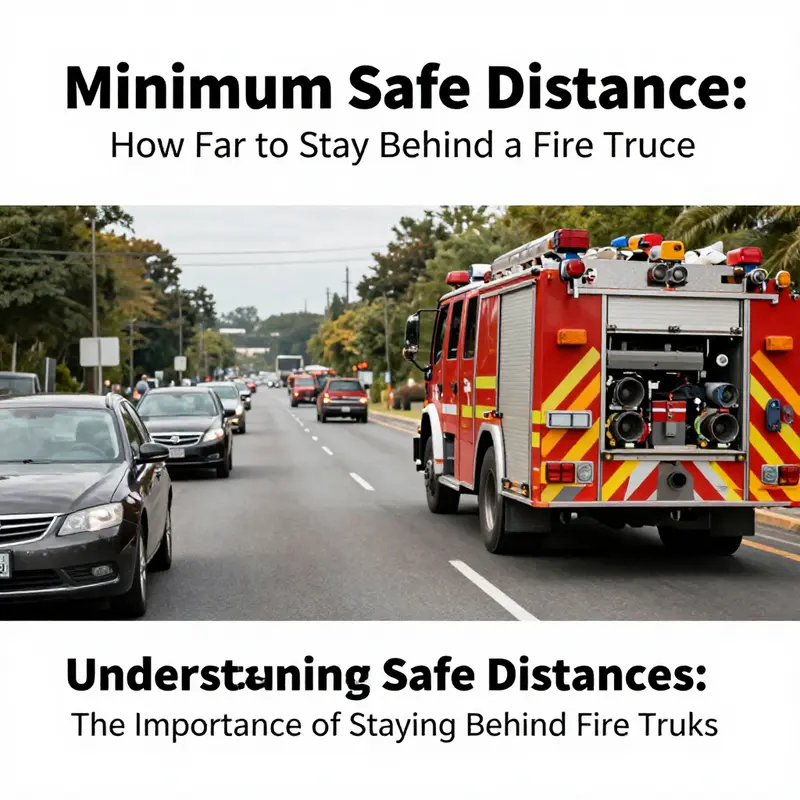
In the heat of an emergency, the space you give a fire truck becomes a quiet measure of safety rather than a mere courtesy. A vehicle equipped with flashing lights and a blaring siren is moving through traffic with a clear purpose: to reach the scene, protect lives, and prevent further harm. The people in the street are relying on that mission, and the way we position ourselves behind the truck can either help or hinder the responders. The guidance is practical and grounded in real-world outcomes. It is not about slow driving for its own sake; it is about preserving a corridor that allows the crew to maneuver, brake, and steer around obstacles as swiftly and safely as possible. When you follow a fire truck, you are not simply a spectator on the road. You are part of a dynamic, high-stakes operation, and your behavior matters.
Baseline safety starts with distance. Official safety guidelines generally call for a minimum following distance of about 50 meters, roughly 164 feet, behind a fire truck on both urban and rural roads. This rule is designed to accommodate sudden stops, abrupt changes in direction, or evasive maneuvers that the truck may need to make to navigate traffic or to reach a critical point in the incident. At first glance, that 50-meter figure may seem modest, a simple buffer. In practice, it is a deliberate buffer that keeps you from crowding the vehicle, reduces the risk of a rear-end collision, and gives drivers behind you time to react as well. The value is consistent across multiple safety and traffic management guidelines, and it aligns with the core principle that emergency responders must have a clear, unobstructed path to their destination.
Yet the real world of an active emergency adds a crucial nuance. When the fire truck is actively responding to an incident, with its lights flashing and siren sounding, the space you need increases substantially. Detailed research results emphasize a minimum safe distance of at least 500 feet in this scenario. That distance, about 152 meters, creates a wide safety margin: it accounts for the vehicle’s momentum, unpredictable road surfaces, the potential for other vehicles to react slowly, and the possibility that the truck might brake suddenly or change lanes to avoid a hazard. The difference between 50 meters and 152 meters is not just a number. It reflects the shift from routine driving to a controlled, hazard-rich operation where every foot of space translates into time for reaction, observation, and safe maneuvering.
Legal and safety frameworks underpin these guidelines. Public safety organizations, alongside transportation departments, emphasize the necessity of yielding to emergency vehicles and adjusting one’s driving to ensure the crew can operate without obstruction. This includes not only maintaining distance but also giving way when the truck approaches intersections, lanes merge, or the signal changes to indicate an imminent turn or stop. In practical terms, the safer you keep the space behind the truck, the less likely you are to cause a rear-end collision that could imperil both the responders and other road users. The 50-meter baseline remains a reliable standard for everyday driving, while the 500-foot rule serves as a heightened precaution during active responses. Both are consistent with best practices for avoiding disruptions and ensuring efficient, safe operations at the scene.
Context matters. Poor visibility conditions—such as sweeping curves, blind intersections, or zones under construction—can drastically reduce reaction time. In those settings, the distance should be increased even beyond the 50-meter baseline. The same logic applies to weather effects like rain, fog, or ice, where stopping distances extend and the likelihood of sliding or skidding compounds the risk. In high-traffic environments, where vehicles cluster around the truck or where pedestrians and cyclists fill the margins, drivers should slow down more and keep even more space. The aim is not to chase the fire truck or crowd its wake, but to form a safe, predictable ribbon of space that enables the responders to do their job without pressure or hurry from behind.
Beyond distance, situational awareness is essential. The driver should monitor the traffic flow, not just the trucks ahead. You should avoid aggressive lane changes to squeeze past, since sudden movements near an emergency vehicle create new hazards for everyone. If you find yourself too close to the vehicle, the prudent choice is to slow further and fall back gradually to the prescribed distances. It may feel counterintuitive during a busy moment, but ample space reduces the chance of a rear-end collision and allows the truck to operate without needing to adjust for a close follower. Your attentiveness should extend to the road ahead, the traffic behind you, and the evolving status of the emergency response. Moving over when required by law, yielding to the siren, and maintaining a calm, controlled pace are all part of a disciplined driving approach that protects the crew and the public alike.
Special situations call for even greater caution. In urban canyons where buildings channel noise and wind, or at intersections where sightlines are limited, the distance should be increased to provide time for the truck’s signals to be perceived and respected. If you are approaching a construction zone, an accident scene, or a roadway where maintenance work is ongoing, slow down more than usual and maintain a generous buffer. The same logic holds in rural settings where winding roads and hedges can hide the truck from view until the last moment. In all these contexts, your adherence to distance becomes a practical safeguard. It is not about slowing down for its own sake but about ensuring that every maneuver the truck makes is predictable and controllable from your position behind it.
Operational safety is reinforced by the general duty to yield and to stop or move to the side when necessary. The act of yielding to an emergency vehicle is a legal obligation in many jurisdictions and a core safety practice that reflects the recognition that responders may need to change their path rapidly. When you do yield, your timing matters as well. If the truck is approaching a cross street, you should be prepared to stop cleanly and to re-enter your lane only when the path is clear and the truck has passed. If the situation requires you to stop, do so at a safe distance on the shoulder or as directed by law enforcement. The goal is to create and preserve a corridor that allows the engine to reach the incident without interference, while also preserving the safety of people on foot and in other vehicles. This is a collaborative moment on the road, and the road rules governing it are designed to coordinate millions of individual decisions into a single, safer outcome.
For drivers who want to explore the broader context of emergency-vehicle operations and the kinds of specialized vehicles that support those responses, there is value in looking at the wider ecosystem of rescue and incident-management equipment. As you read about the various specialized vehicles and how they are deployed, you may notice how the same principles of space and timing apply across different scales and configurations. If you are curious about the kinds of emergency-response platforms that crews rely on—beyond the standard fire engine—you can explore an internal resource that catalogues emergency-rescue vehicles. Emergency Rescue Vehicle category offers a window into the broader spectrum of equipment and how it fits into modern response strategies. This is not a sales pitch but a reminder that safety norms extend into the design and deployment of the tools responders use, reinforcing that distance and respect for the response path are universal across scenarios.
In practice, the message for everyday drivers is straightforward: respect the space around a fire truck. If you are driving behind one, maintain at least the 50-meter baseline as a starting point. When the truck is actively responding, extend that distance to about 500 feet if the situation allows. In adverse conditions or near hazards, err on the side of more space rather than less. And always yield, slow, and move over when required by law and safety considerations. The discipline of distance protects not only the responders who are racing toward a critical incident but also the people awaiting help, the other motorists sharing the road, and the pedestrians who may be near the edge. This is a practical, humane standard rooted in concrete safety outcomes.
External resource for broader guidance on driving near emergency vehicles can deepen understanding of these practices and their public-safety rationale: https://www.safemotorist.org/driving-near-school-buses-and-emergency-vehicles
Beyond the 50-Meter Rule: Adapting Safe Distance Behind an Emergency Fire Truck
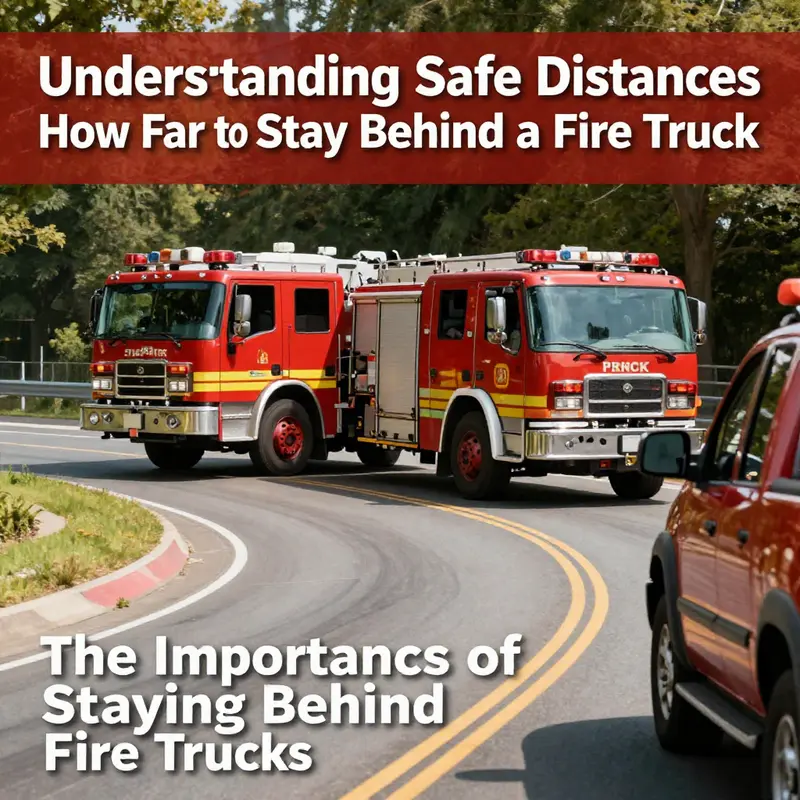
The standard guideline of keeping about 50 meters behind an active fire truck provides a reliable baseline, but real-world driving rarely fits a single number. In practice, drivers must assess conditions and adjust the gap to preserve safety for responders and other road users. This chapter explains how to translate that baseline into flexible, situation-aware behavior.
Active responses demand extra space. Fire apparatus accelerate and brake with urgency, and the truck may swerve or brake hard to avoid pedestrians, debris, or other vehicles. Maintaining a larger buffer in these moments reduces rear-end collisions and gives the operator room to react.
Visibility and road geometry further reshape safe following distance. In rain, fog, smoke, or at night, reaction times lengthen and sightlines narrow. Curves, hills, and construction zones may require extending the gap beyond the standard 50 meters to accommodate slower perception and longer stopping distances.
When multiple emergency vehicles are present, the lead vehicle sets the pace, and following drivers must watch for changes in lane patterns, speed differentials, and sudden moves by adjacent units. The core idea remains: yield to the lead vehicle and keep a clear buffer, adjusting as the convoy evolves.
In urban environments, space can be tight. Yield early, slow smoothly, and use signaling to help other drivers create a safe corridor without provoking confusion. Patience and consistent deceleration help maintain safety without blocking the scene.
After the truck reaches the incident, the risk profile shifts from following to proximity around the apparatus. Maintain awareness of crews moving around the vehicle, and stay clear from hose lines, ladders, and equipment. The 50-meter baseline still helps, but responders and bystanders may require you to move farther back to avoid heat, water spray, or shifting debris.
The message is practical, not prescriptive: keep a clear, predictable gap that you can adjust for weather, traffic, and the scale of the operation. By prioritizing safety, yielding when appropriate, and staying aware of the evolving scene, drivers support emergency responders while protecting themselves and others on the road.
Beyond the 50-Meter Rule: Legal Duty, Practical Distance, and the Real Space Needed Behind a Fire Truck
When an emergency vehicle screams past with sirens wailing and lights flashing, the road becomes a delicate, high-stakes space. The public’s safety hinges on how well everyone yields, not merely on how far they think they should stay behind. The question “how far to stay behind a fire truck” seems straightforward at first glance, but the answer unfolds as a lattice of law, habit, and physics. A practical baseline—about 50 meters, or roughly 164 feet—often gets cited as the rule of thumb for following distance on both urban and rural roads. Yet the distance itself is a feature of a broader obligation: to create enough room for the emergency vehicle to control its path, avoid collisions, and reach the scene without delay. The distance is not simply a number to memorize; it is a visible expression of how traffic must flow to accommodate life-saving work under pressure. In this light, the conversation moves from a fixed measurement to a broader, more nuanced understanding of safety, responsibility, and the legal commitments that bind every driver when the siren sounds.
The practical logic behind the 50-meter figure rests on several interlocking realities. Fire trucks accelerate rapidly, maneuver with a high center of gravity, and sometimes travel at speeds that outpace surrounding traffic. They rely on immediate lane control, rapid deceleration, or sudden turns to respond to unfolding incidents. A vehicle that follows too closely can complicate a driver’s ability to brake smoothly or to steer away from hazards. In dense traffic, a tight line behind an emergency unit can escalate the risk of rear-end collisions, hamper the truck’s ability to weave through lanes, and trap other drivers in a bottleneck just when space is most needed. The distance also protects bystanders and the crew themselves: a clear buffer reduces the chance that a startled driver will veer into the scene or into a rescue operation. In this sense, the 50-meter rule serves as a pragmatic, safety-oriented standard that translates the abstract duty to yield into a measurable, actionable practice.
Yet law and practice do not hinge on meters alone. The most fundamental legal duty driving into any emergency scenario is yielding the right of way to the responding vehicle. Across jurisdictions, the core principle remains consistent: drivers must do what is necessary to allow emergency vehicles to pass safely. In many places this is framed not as a fixed following distance but as a behavioral standard—move over to the right lane if possible, slow down, and stop if required, clearing a path for the responders. The emphasis is on making space and preserving the efficacy of the response. This is why a uniform, nationwide image of safety instruction emphasizes yielding, not merely counting meters. The absence of a universal distance in some codes does not weaken the obligation; it underscores the point that safety hinges on a driver’s act of giving space and the ability to adapt to the specific conditions of the moment.
In practice, the distance several drivers choose to maintain can be interpreted as a discipline of anticipation. A buffer of 200 to 300 feet—roughly 60 to 90 meters—has emerged as a widely accepted anchor in many driver education programs and emergency services guidelines. This broader buffer recognizes that real-world driving is rarely a straight line. Roads bend, visibility may be compromised, and other drivers do not always react in unison. A larger buffer affords the fire crew more room to react to sudden stops, to avoid obstacles, or to negotiate curves and intersections with less risk of a tailback that leaves the emergency vehicle boxed in. The city-block comparison—about 200 to 300 feet—offers a tangible, human-scale sense of the space needed to accommodate big, maneuverable vehicles that nevertheless have to bend the world around them in real time. In this sense, the distance becomes a practical expression of the larger mission: to safeguard both responders and the public as the response unfolds under time pressure.
Acknowledging that the legal landscape does not enforce a single distance, it is essential to translate this into concrete, repeatable behavior. When a fire truck approaches with its sirens and lights activated, the driver’s instincts should reflect the dual aims of safety and efficiency. First, yield by reducing speed and moving to a clearly defined space if it is safe to do so. If you can do so without endangering yourself or others, move to the far right lane or pull over entirely to allow the emergency vehicle to pass. If you cannot change lanes because of heavy traffic, maintain a significant and steady gap while continuing to slow and provide room for the turn if the truck intends to pull into an intersection or exit. Do not attempt to merge in front of or alongside the emergency vehicle; that would jeopardize the crew’s control. Second, be mindful of multiple units. Fire responses often involve more than one unit traveling in convoy or in staggered formations. Gaps widen, and lanes can close without warning as trucks maneuver, re-route, or position themselves for the next step of the operation. Third, once the truck has passed, re-enter traffic only when it is safe, with clear sight lines and ample space between you and the vehicle you just yielded to. The return to normal driving should be deliberate, not abrupt, to avoid creating another hazard as the scene develops behind you.
The legal and safety message, then, is not simply about the distance behind a fire truck. It is about cultivating a mode of driving that respects the urgency of the moment and the unpredictability of the road ahead. A driver who adheres to the spirit of yielding—who understands that a fixed distance is insufficient by itself—will be more likely to keep themselves and others safe. The distance serves as a guide to help you align with this responsibility, but the core expectation remains the same: give space, slow down, and let the responders do their job without impediment.
Special situations heighten the stakes and demand even more careful judgment. Where visibility is compromised—around sharp curves, at blind intersections, or in construction zones—the reaction time available to both you and the fire crew shrinks. In these contexts, the prudent move is to extend the following distance beyond the standard baseline. If the road narrows or lanes pinch down, an extra buffer can prevent a cascade of braking and swerving that might otherwise send debris, signal heads, or road signs into the path of responders. When your line of sight is obstructed or when the roadway is uneven or broken, maintaining a larger gap reduces the chance of a late-braking incident that could trigger a chain reaction on crowded streets. Construction zones introduce additional hazards: workers, equipment, and altered traffic patterns can appear suddenly as a truck negotiates a tight path through a work zone. In such moments, patience becomes a form of protection, and the distance you keep becomes a lever for the safety of everyone on the road.
The consequences of failing to yield are not theoretical. They carry real legal and personal risk. A driver who fails to yield to an emergency vehicle may face substantial fines and license points, which can translate into higher insurance costs and the possibility of suspension in severe cases. In the most unfortunate outcomes, obstructing or delaying a life-saving mission could lead to criminal charges or civil liability. Even when a collision does not occur, the failure to yield can complicate or slow the response, potentially costing precious seconds that matter to someone in danger. These penalties and outcomes reflect society’s judgment that emergency responders must move with priority and protection, and that drivers have a moral and legal obligation to create the space necessary for those acts of rescue to be carried out—unhindered and unimpeded.
All of this converges on a practical, everyday practice: when you encounter an approaching fire truck, ease off the accelerator, scan the surroundings, and adjust your position with the goal of creating a generous, clear corridor for the responders. If you can switch lanes safely, do so and allow the truck to pass in the open space the road provides. If you must stop, do so in a safe, clearly marked area off the travel lane, ensuring you do not block intersections or driveways where the truck may need to turn or screen off other hazards. After the vehicle has passed, resume driving with caution, staying mindful of other vehicles that may react to the emergency maneuver in front of you. This approach does not require heroic restraint; it requires disciplined attention to the realities of emergency response, the physics of large vehicles, and the legal duty many jurisdictions codify as yielding the right of way.
For readers seeking a tangible linkage to broader resources, consider exploring the Emergency Rescue Vehicle category as a reference point for the kinds of equipment and operations that shape these responses. This internal resource helps anchor the real-world context of how emergency services move and how the space behind them is managed in practice. The principle remains the same: space, time, and predictable behavior are the triad that makes a dangerous moment safer for everyone on the road. As you reflect on your own driving habits, hold the distance not as a rigid limit but as a flexible, safety-first approach that aligns with the spirit of the law and the realities of the road.
In sum, while a fixed distance like 50 meters provides a useful baseline for following behind a fire truck, the responsible, law-abiding driver acts with a broader understanding. Yielding, creating space, and remaining patient are the core duties that ensure emergency crews can operate effectively and safely. The distance you maintain is the visible sign of your commitment to that duty. When seconds count, the right distance—amenable to the moment’s conditions—helps ensure that those seconds are not wasted, but rather used to protect life and property when every second matters. For jurisdictional nuance, see the relevant statutes that describe how yielding and safe passage are mandated in your area, such as California’s Vehicle Code §21055.
Further context on this topic can be found in authoritative legal references: https://leginfo.legislature.ca.gov/faces/codes_displaySection.xhtml?sectionNum=21055&lawCode=VRC
Trailing Safely in the Wake: Understanding the Crucial Distance Behind Fire Trucks During an Emergency
When a fire truck races toward a scene with lights blazing and a siren slicing through traffic, drivers instinctively ask: how far should I stay behind? The question is simple in form but complex in practice. The answer sits at the crossroads of safety, law, and the logistics of an active emergency. The space between you and the lead vehicle is not a static number so much as a dynamic buffer that protects the people in both vehicles and the pedestrians and other road users who populate the street. In essence, the distance you maintain serves two intertwined purposes. It keeps emergency crews unimpeded so they can maneuver around obstacles, make rapid lane shifts, or stop suddenly without fearing a collision. It also protects you and others from a potential chain-reaction crash if the lead vehicle brakes or swerves in response to a developing situation. The rule you choose to follow, or that your jurisdiction prescribes, should always be loyal to that dual aim: give space so responders can work, and preserve space so your own travel through the moment remains safe.
Public-safety authorities in many places describe a minimum safe following distance behind moving emergency vehicles as about 50 meters, which is roughly 164 feet. This distance is chosen to accommodate sudden stops, evasive actions, or detours that the lead vehicle may take as it advances toward an incident. It is a rule that acknowledges the tempo and risk of an emergency scene, and it translates into a practical habit for everyday driving: when you hear a siren and see flashing lights, you begin to create a wider cushion between you and the vehicle ahead and you stay mindful of the road’s edge, your mirrors, and the behavior of other road users. To convert and compare, 50 meters is also a standard many drivers recognize as a baton in the hand of safety officials—a distance that, in ideal conditions, gives you enough time to react, slow smoothly, and avoid the abrupt consequence of a rear-end collision.
But there is another strand of guidance that rides alongside the 50-meter rule, one that shifts with the context of the road and the setting. Some safety resources advocate a larger buffer, up to 500 feet behind a moving emergency vehicle. That distance, about 152 meters, emphasizes the same principles—reaction time, clear sightlines, and unimpeded access for the responders—but it reflects a different calculus of risk. Keep in mind that 500 feet is not universally mandated; it appears in certain driving-education materials and public-safety guidelines as a cautious maximum buffer, particularly in high-speed zones or areas with constrained visibility. The presence of these two benchmarks does not undermine safety. It reveals a spectrum of best practices designed to adapt to real-world conditions. The central message remains unchanged: do not tailgate, do not crowd the lead vehicle, and always prioritize safety over speed.
Special conditions demand even more careful attention. When roads narrow, curves along hills, intersections with limited sightlines, or construction zones with shifting lanes and uneven surfaces come into play, the practical space you should give can and should grow larger than the baseline numbers. Visibility is a critical factor: the better you can see the path ahead and the lead vehicle’s path, the more accurately you can anticipate braking, lane changes, or detours. In curves, where the lead vehicle may brake earlier or take an adaptive turn to avoid an obstacle, increasing your following distance reduces the risk of a last-second collision if your sightline deteriorates. In construction zones, where workers, equipment, and detours create unpredictable hazards, the buffer becomes a crucial margin for error. In adverse weather— rain, fog, or snow—reaction times lengthen, road grip decreases, and the stopping distance grows. The disciplined driver adjusts the distance accordingly, decelerates earlier, and keeps attention fixed on the evolving sequence of events in front of and around the emergency vehicle.
The practical essence of these guidelines is not merely to check a box or to meet a numerical quota. It is to embed a practiced, anticipatory caution into your driving. When you hear the siren or see the flashing lights, you should be mentally preparing to yield, slow down, and maneuver out of the way with deliberate, smooth action. This means choosing a lane position that leaves a clear path for the responding unit, avoiding weaving or aggressive speeds that can confuse other drivers, and signaling clearly before any lane changes. It also means recognizing that your responsibility extends beyond your own vehicle. If you are approaching a cluster of cars, you may need to influence the flow by maintaining steady spacing rather than attempting to resume full speed as soon as the sirens pass your vicinity. The goal is not to accelerate away from the scene, but to support the mission of the emergency responders by eliminating impediments and keeping the corridor of travel open.
In discussing distance, it is also important to acknowledge how rules translate into behavior on busy streets and quiet rural roads alike. In urban environments, a 50-meter baseline can seem challenging given dense traffic and frequent stop-and-go patterns. Drivers must be especially vigilant about pedestrians stepping off curbs, cyclists weaving through lanes, and the frequent need to merge or diverge around stalled vehicles. In rural or highway settings, higher speeds can reduce the time you have to react, and the same 50-meter rule may demand even more space. The cardinal rule—yield to emergency vehicles and be prepared to stop or move over when necessary—remains consistent. The law in many regions expects drivers to facilitate the movement of emergency services by pulling over to the edge of the road if safe, or by adjusting their lane position to allow the responders a clear path. This behavior protects responders and reduces the likelihood of secondary crashes that can complicate an already tense incident.
Those who want to explore the broader landscape of emergency-vehicle operations can gain insight into the equipment and capabilities used on scene. For readers curious about the kinds of apparatus that respond to emergencies, consider exploring the range of options involved in fire-fighting trucks. This category reflects the diverse roles and specialized configurations designed to reach, access, and manipulate fire scenes—from compact urban units to long-range, heavy-duty platforms—demonstrating why space around the lead vehicle matters so deeply. The principle holds across all such vehicles: give them room to operate and create a safe corridor for personnel and equipment to function effectively. fire-fighting trucks
As a final note, the average driver’s confidence in maintaining a safe distance grows with practice and consistent adherence to the core idea: safety first, speed second. The distances cited in guidelines are not arbitrary numbers but carefully reasoned baselines that reflect typical reaction times, vehicle dynamics, and the realities of road design. If you are ever unsure about the appropriate distance in a given setting, err on the side of more space rather than less. A little extra room now can prevent a collision later, protect the emergency crew as they perform critical work, and keep routine travel from becoming part of the incident scene. Always yield to emergency vehicles and be prepared to stop or move over when necessary, even in situations that test your patience or your sense of urgency. In the end, a steady, respectful, and planned response contributes to safer roads for everyone.
External resource: https://www.safemotorist.com/driving-near-school-buses-and-emergency-vehicles
Final thoughts
In conclusion, maintaining a safe distance from fire trucks is essential for public safety and compliance with legal standards. Business owners, in particular, must recognize the importance of adhering to these guidelines to ensure effective emergency responses and avoid potential legal repercussions. By remaining informed and observant, you can contribute to a safer environment for everyone on the road.

