Fire Equipment For Sale: Certification Gaps, Shelf Life and Delivery Lead Time
Why Fire Equipment Procurement Is a Compliance Decision
When you buy a fire truck or a portable extinguisher, you are not furnishing an office. Every listing you approve becomes part of your facility’s safety system, and if the equipment fails, the paperwork lands on your desk rather than the seller’s.
For facility managers, safety and compliance officers, and procurement staff, the stakes are unforgiving: a single gap in certification, an expired shelf-life component, or a delivery that arrives after your compliance deadline turns a routine purchase into a liability event. Compliance gets tested in audits, insurance reviews and, after a fire, incident investigations. Every line item you buy is evidence.
That is why fire apparatus procurement deserves the same rigor you apply to any regulated asset. The difficulty is that suppliers look identical on a quote sheet while differing in three areas that decide the outcome:
- Certification gaps – which standards the equipment truly meets, which certifications are current, and where documentation quietly falls short.
- Equipment shelf life – how long extinguishing agents, seals, hoses, and pressure components remain reliable before service dates expire.
- Delivery lead time – how quickly equipment can be sourced, configured, and delivered without compromising on quality or compliance.
Together these decide whether your inventory holds up at inspection and whether you carry avoidable legal exposure.
CIMC Tianda has manufactured and supplied firefighting and rescue equipment for more than 20 years, across international procurement, engineering, and compliance. The sections below draw on that work, from spotting a certification gap to specifying certified apparatus for real operating conditions.
Certification is where most of the risk sits.
What Are Certification Gaps in Fire Equipment?
A certification gap is the distance between the approval you assume a product carries and the approval it actually carries. It rarely shows up on a spec sheet, a brochure, or a listing photo, yet it is often the biggest single source of compliance and liability exposure a buyer faces. A pump, extinguisher, hose assembly, or complete apparatus can look identical to a fully certified unit while missing the approvals your jurisdiction, insurer, or inspector requires.
Outright fraud is uncommon. Gaps usually come from ambiguous wording and mismatched paperwork, or from a seller who lets buyers fill in the blanks with optimistic assumptions. Closing them starts with knowing which certifications matter and how they fail.
The Certifications That Actually Matter
Certification works in layers, and each layer proves something different:
- NFPA standards – The National Fire Protection Association publishes the design, testing, and performance benchmarks (such as NFPA 1901 for fire apparatus and NFPA 10 for portable extinguishers) that most North American buyers rely on. “NFPA certified fire equipment” should mean the finished product was tested to the relevant standard, not merely that it was designed with those standards in mind.
- EN standards – European norms (for example, EN 3 for extinguishers or EN 1846 for firefighting vehicles) govern products sold into EU and many export markets. A unit built to EN specs may not satisfy NFPA expectations, and vice versa.
- ISO certifications – ISO 9001 and similar marks certify a manufacturer’s quality management system, not the performance of an individual product. A factory can be ISO certified and still ship a non-compliant unit.
- Third-party testing and listings – Independent labs (UL, FM, LPCB, VdS, and others) verify performance against a standard. Their listing marks carry real weight because someone other than the seller confirmed the result.
- National fire code approvals – Local authorities, fire marshals, and building codes may impose their own acceptance requirements on top of international standards.
How Mismatches Create Risk
A gap between assumed and actual certification rarely stays theoretical. It surfaces at the worst possible moment:
- Regional certification mismatches – Equipment certified for one market arriving in another where the approval is not recognized, forcing rejection at inspection or a costly retrofit.
- Expired or missing certificates – Certificates that lapsed, were never issued, or cannot be produced on request, leaving you unable to prove compliance.
- Self-declared compliance – Vendors claiming “meets NFPA” or “EN compliant” without independent testing, which is a statement of intent rather than verified proof.
- Documentation gaps – Test reports, nameplate data, and traceability records that do not match the delivered unit.
The Downstream Consequences
These gaps hit three pressure points at once. Insurance: underwriters can reduce, dispute, or deny a claim if covered equipment was not certified to the standard your policy assumes. Inspections: fire marshals and code officials can fail an inspection or require removal of non-compliant assets, disrupting operations. Legal liability: in the event of a fire, inadequate or misrepresented certification can expose owners and procurement staff to negligence claims and regulatory penalties.
Before comparing products, ask for the certification evidence directly instead of accepting it at face value. You can review a range of fire equipment for sale options, but request the certificate, confirm who issued it, and match the standard to your jurisdiction. In fire safety, a certification gap is not a paperwork detail; it is risk you carry until someone else proves otherwise.
Decoding Certification Claims: A Buyer’s Comparison Table
Suppliers use certification labels as sales shorthand, and “certified” means very different things depending on the standard behind it. The table below turns the most common claims you will meet when sourcing fire fighting trucks for sale into concrete verification steps, so you can separate compliance evidence from marketing decoration.
| Certification / Standard | Typical Region | What It Verifies | Buyer Checkpoint |
|---|---|---|---|
| NFPA 1901 / 1906 | North America | Design, performance and safety requirements for automotive fire apparatus and their components (pumps, ladders, tanks, lighting). | Request the third-party test report and confirm the apparatus model/year matches the NFPA edition cited in the listing. Verify the agency that tested it is accredited. |
| EN 1846 (Parts 1-3) | European Union / EEA | Classification, performance and safety of firefighting and rescue service vehicles, including categories, pump output and crew protection. | Ask for the exact EN 1846 part and category (e.g., Category 1/2/3) and cross-check it against your intended duty cycle and terrain. |
| ISO 9001 | Global | The manufacturer’s quality management system, not the product itself. Confirms documented processes, traceability and consistent production. | Verify the certificate is current, issued by an accredited body, and lists the specific manufacturing site and product scope on the scope statement. |
| CE Marking | European Union | Declares conformity with applicable EU directives/regulations (e.g., Machinery, EMC). It is a manufacturer’s self-declaration unless a notified body is involved. | Ask for the signed Declaration of Conformity and the specific directives applied. Treat CE as a baseline, not proof of fire-performance capability. |
| National Fire-Approval Schemes (UL, FM, BSI Kitemark, VdS, CCCF) | Region-specific (US, UK, Germany, China, etc.) | Independent testing and ongoing factory surveillance for listed components or complete products against published standards. | Confirm the listing is active and searchable in the approval body’s public database, and that the scope covers the exact component or vehicle you are buying. |
| TUV / Third-Party Type Approval | Europe / Global | Independent verification of product type against specified technical standards and safety criteria. | Match the type-approval reference number to the specific model variant on the invoice, not just the brand name. |
How to Use This Table
Treat each row as a question to send the supplier before you sign. A credible vendor answers all of them without hesitation and supplies the underlying documents: certificates, test reports, and listings you can verify independently. When a claim cannot be traced to a named standard, an issuing body, and a document number, it belongs in the marketing column, not your procurement file.
In practice, most professional buyers stack several of these checks together: a quality-system certificate (ISO 9001) for the manufacturer, a product standard (NFPA or EN 1846) for the vehicle, and a component listing (UL, FM or equivalent) for critical safety items such as pumps and valves. Evidence at one level rarely covers another, which is exactly where certification gaps between competing offers tend to hide.
Understanding Fire Equipment Shelf Life Before You Buy
When you browse fire equipment for sale, the price tag tells you little about how much usable life is left inside each component. A truck or a piece of portable gear is not a single unit with one expiry date: it is a collection of parts, each aging at its own pace. Those differences shape both your budget and your compliance record.
Shelf Life Varies by Component
Fire equipment shelf life depends on the component. Foam concentrate degrades as its surfactants separate, which is why manufacturers typically assign it a defined storage period before re-testing is required. Dry chemical extinguishing agents can cake and lose flow, while clean agents are more stable but still subject to pressure and seal integrity. Hoses crack and delaminate with UV exposure, and pressure cylinders must be hydrostatically tested at set intervals. Seals and gaskets harden, electronic boards and sensors drift out of calibration, and vehicle drivetrain components wear according to hours and mileage rather than calendar age alone.
Storage Shelf Life vs. Service Life vs. Replacement Interval
The three terms are not interchangeable. Storage shelf life is the period an unused item stays within specification before it is first placed in service. Service life begins once the item is installed and operating, and it is shaped by heat, chemicals, and duty cycles. Recommended replacement intervals are the manufacturer or authority-defined limits that may be shorter than either. A hose can sit in a warehouse for years, then fail quickly once exposed to real fireground conditions.
How Age Affects Reliability and Certification
Age is not just a wear question; it is also a certification question. Testing bodies and insurers tie validity to documented dates and inspection history. An expired cylinder or an out-of-date foam batch can void a warranty, fail an audit, or be rejected during incident review, even if the item looks new.
What to Request Before You Buy
Ask suppliers for manufacturing or batch dates, hydrostatic test records, and full maintenance logs. A trustworthy seller provides them without hesitation. If components need refreshing, sourcing genuine replacement parts is far safer than improvising.
Age is a specification, not a footnote. The checklist below shows exactly what to verify.
Shelf Life and Service-Life Intervals: What Buyers Should Expect
The clock starts ticking the moment fire equipment leaves the factory, and it is one of the most overlooked items in any procurement budget. Agents, hoses, cylinders, seals, and electronics age at very different rates, and each carries its own inspection, testing, and replacement interval. The chart below compares typical service-life figures for six common components, giving you a quick sense of which items you will be replacing soon and which you can plan around for the long haul.
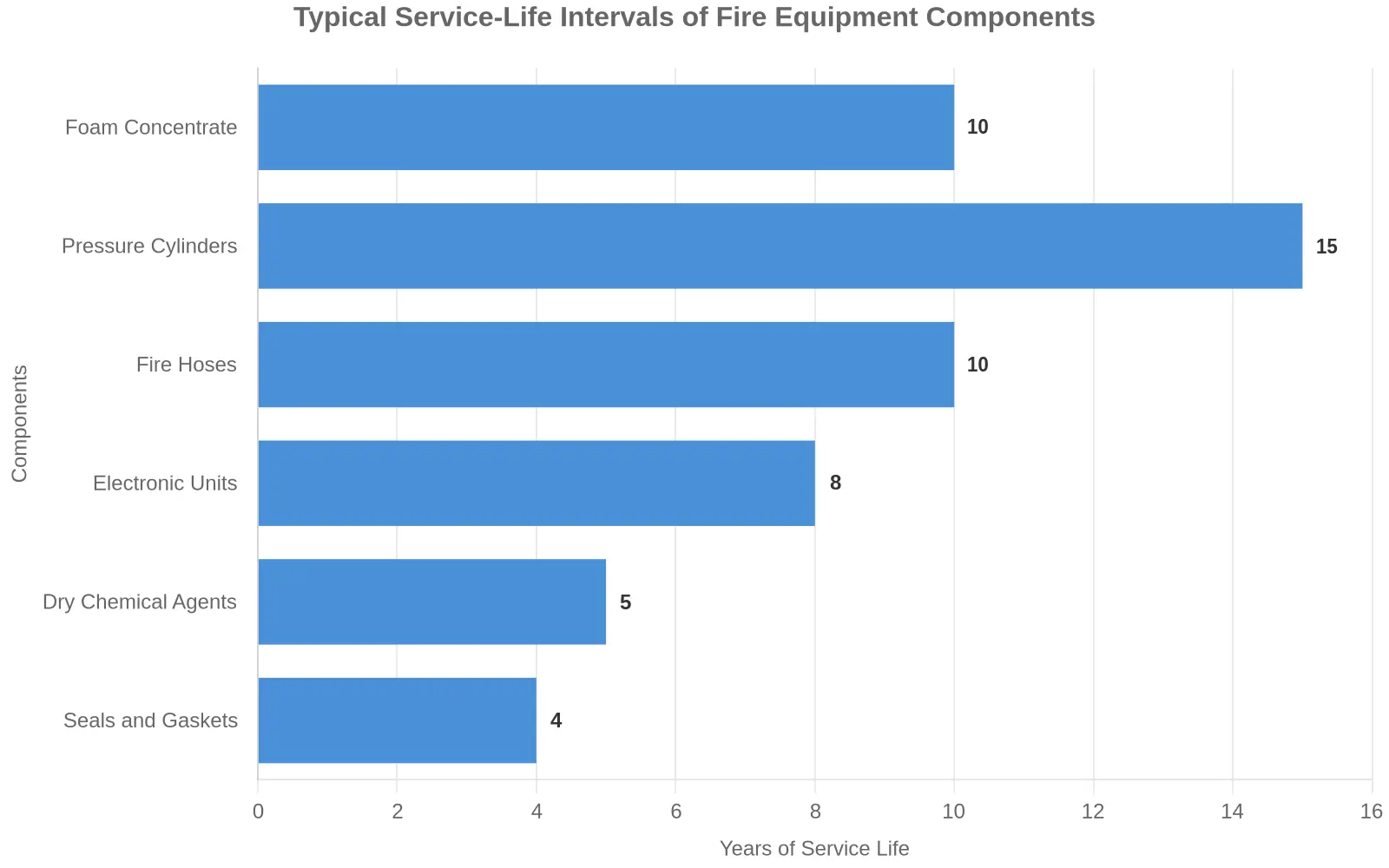
Chart: Typical service-life intervals of fire equipment components, in years.
Reading the Chart
Pressure cylinders anchor the long end of the scale, often reaching about 15 years before hydrostatic testing cycles or corrosion force retirement. Foam concentrate and fire hoses sit in the middle at roughly a decade, though both depend heavily on storage conditions and how frequently they are deployed. Electronic units follow at around 8 years, a reminder that circuit boards, sensors, and control modules age in ways that are invisible until they fail. At the shorter end, dry chemical agents and seals and gaskets land near 4 to 5 years, the tightest intervals in the group.
Why the Spread Matters
- Short-cycle items drive recurring cost. Seals, gaskets, and dry chemical agents must be inspected and refreshed far more often, so budget for them as ongoing expenses rather than one-time purchases.
- Long-cycle items still need vigilance. A cylinder rated for 15 years is not maintenance-free; visual inspections, hydrostatic tests, and pressure checks keep it compliant.
- Storage and environment change everything. Heat, humidity, and sunlight can shorten shelf life dramatically, so documented storage conditions are as important as the dates on the label.
- Certification is separate from lifespan. A valid certificate on delivery does not tell you how much life a component has left; those are two distinct checks.
Treat these intervals as planning benchmarks, not universal guarantees. Manufacturer specifications, local codes, and the conditions of actual use will always refine the numbers. For teams managing fleets and replacing consumables, sourcing the right fire truck parts on a predictable schedule can prevent both overstocking and the compliance gaps that come from expired agents or brittle seals.
Understanding Delivery Lead Time for Fire Equipment
Price is only part of the comparison. Fire truck delivery lead time is the interval between placing an order and taking physical possession of a fully certified, road-ready vehicle. For a simple piece of equipment this may be measured in weeks; for a purpose-built fire apparatus it can stretch to many months. Knowing what drives that timeline is the difference between a compliant fleet and a missed deadline.
What Actually Drives the Timeline
Several factors stack together to determine how long you will wait:
- Manufacturing capacity. Chassis availability, production-line scheduling, and order backlog all set the baseline. Peak demand seasons can push standard builds further out.
- Customization. Anything beyond a catalog configuration – pump sizing, tank capacity, compartment layouts, livery – adds engineering and fabrication time.
- Certification testing. Units must pass performance, safety, and emissions testing before release. Third-party certification adds a defined but non-negotiable window.
- Shipping and customs clearance. International transport and border documentation can add weeks, and clearance delays are among the most common surprises.
- Spare-part sourcing. Specialized components, including pumps and electronics, depend on supplier availability, which is why a well-stocked fire truck parts network matters.
Standard vs. Custom-Built Units
A standard unit is built to an existing specification and can often be delivered from stock or a rolling production line. A bespoke apparatus is engineered around your site, mission profile, and local regulations. Because bespoke units require design review, one-off fabrication, and unit-specific testing, they generally carry noticeably longer lead times. Plan for that difference from day one.
Planning Fire Apparatus Procurement
Smart fire apparatus procurement treats lead time as a scheduling problem, not a surprise. Start by mapping your compliance or replacement deadline backward, then negotiate delivery milestones into the contract rather than accepting a vague “estimated” date. Build in buffer time of 15-25% for testing and shipping contingencies. Suppliers with genuine global reach, such as CIMC Tianda across 75 countries and 30+ subsidiaries, can often shorten or de-risk these windows through regional logistics and local support. Order early, verify the schedule in writing, and leave yourself room to breathe.
Supplier Evaluation and Verification: How to Vet Sellers Before You Buy
A pump that fails, a ladder that underperforms, or a certification that turns out to be a photocopy of a photocopy can put lives and licences at risk. Before you sign a purchase order, treat the seller as part of your safety chain and verify them as carefully as you would verify the equipment itself.
Start With the Right Questions
A credible supplier welcomes scrutiny. Ask directly:
- Can you send a complete, valid copy of the certification for this specific model, not a generic brochure claim?
- What is the batch number and the manufacturing date of the units you are quoting?
- Do you have third-party or factory test reports for this production run?
- What exactly does the warranty cover, and for how long?
- How quickly can you ship spare parts, and where are they stocked?
- Who in your organisation is responsible for after-sales service in my region?
A vague answer to any of these is a warning sign. Precision signals competence.
The Documents You Should Demand
Request documentation before payment, not after delivery. Insist on valid certification copies that match the model and batch you are buying, and check the expiry dates. Ask for batch and manufacturing dates so you can track shelf life and stored life on consumables such as extinguishing agents and seals. Test reports should be traceable to a recognised laboratory or the manufacturer’s own controlled testing. Warranty terms should be written, specific and clear about labour versus parts. Finally, confirm spare-part availability with part numbers and lead times, so you are not stranded mid-season.
That is where fire safety compliance stops being paperwork and becomes operational readiness.
Why Manufacturing Pedigree Reduces Risk
A supplier’s manufacturing heritage tells you how they behave when a problem appears. A builder with decades of engineering discipline, in-house production and a documented quality system is far less likely to ship non-conforming units than an assembler who rebrands other people’s stock. Strong pedigree also reduces certification risk: reputable makers already hold the approvals buyers need and can supply the matching evidence on request.
The Value of a Global Support Network
Delivery risk is not only about shipping dates. It is about what happens six months later when a seal fails or a controller needs replacing. A supplier with a genuine global footprint can source parts, dispatch technicians and honour warranty terms across borders. When evaluating sellers, ask where their subsidiaries, service centres and stocked warehouses sit relative to your operations.
Where CIMC Tianda Fits
CIMC Tianda belongs to that reliable category. The company holds a world-leading position in passenger boarding bridges and a top-tier standing in firefighting and rescue equipment, backed by more than 30 subsidiaries across 75 countries. That reach is not a marketing slogan; it is the infrastructure that keeps certification and delivery risk low. If you need spare parts, see the fire truck parts range to understand how availability is structured across the fleet.
Your Verification Checklist
- Certification copies: valid, model-specific and dated
- Batch and manufacturing dates recorded on the invoice
- Test reports traceable to a recognised laboratory or factory
- Written warranty with clear coverage and duration
- Spare-part list with part numbers and quoted lead times
- Named regional service contact and escalation path
- References from comparable buyers in your sector
Run through this list every time you source fire equipment for sale. Ten minutes of verification protects years of operational readiness.
Frequently Asked Questions
How do I verify that a fire equipment certification is valid?
A valid fire equipment certification should always be traceable back to an accredited testing body, such as UL, FM, or an equivalent national authority. Request the original certificate number and confirm it directly through the issuing organization’s database rather than trusting a scanned copy alone. A genuine certificate lists a specific model, a defined scope of approval, and a review or expiry date that can be independently checked. Buyers who skip this step risk acquiring equipment that fails inspection.
How long does fire equipment typically last?
Service life depends on the equipment type, storage conditions, and maintenance discipline. Fire trucks are generally engineered for 15 to 25 years of dependable service, while portable extinguishers and hoses carry much shorter inspection and replacement cycles. Documented servicing is what actually extends usable life and preserves resale value.
Why do fire truck delivery lead times vary so much?
Fire truck delivery lead time varies because of chassis availability, the scope of customization, and manufacturer production capacity. Highly specialized units, such as aerial or ARFF vehicles, require longer build and testing phases than standard commercial models. Locking specifications early and ordering ahead reduces the risk of costly delays.
What happens if equipment is used past its shelf life?
Using equipment past its shelf life, especially extinguishing agents or rubber seals, can cause failed activation or reduced performance during a real emergency. Expired items may also void insurance coverage and breach safety regulations. Always follow the manufacturer’s replacement schedule and record every inspection.
How should I compare fire equipment suppliers?
Compare suppliers on certification transparency, lead time reliability, after-sales support, and spare parts availability. A trustworthy supplier provides verifiable documentation and firm timelines, not vague promises. You can review our range of fire equipment trucks to gauge the build quality and configurations available before you commit.
Conclusion and Key Takeaways: Buying Fire Equipment with Confidence
Procuring fire equipment is never just a transaction. It is a long-term commitment to protecting people, assets and operational continuity, and three criteria shape the decision:
- Certification gaps are the first filter. Verify that every unit carries recognized, traceable approvals before payment, because unverified compliance exposes your organization to failed inspections, voided insurance and serious legal liability.
- Shelf life determines true value. Ageing agents, seals, hoses and suppression media can quietly expire, so demand documented production dates, service intervals and replacement timelines rather than assuming new-looking hardware performs as new.
- Delivery lead time protects readiness. A truck that arrives late leaves your facility temporarily unprotected, so weigh realistic production and shipping schedules against your risk calendar, not just the sticker price.
Hold the three together and the picture is clear: informed procurement is the most reliable safeguard for your operations, your budget and your legal standing. Buying on price alone may look efficient on paper, but it is the buyer who absorbs the cost of a gap.
At the center of that assurance stands CIMC Tianda, a dependable global partner for firefighting and rescue equipment. With deep engineering expertise and a broad portfolio, the company supports buyers across industries and regions, from specification through to delivery.
To move from criteria to configuration, explore robust industrial fire trucks engineered for demanding plant and warehouse environments, or step up to heavy-duty fire trucks built for sustained, high-capacity response. For procurement teams that insist on verified quality and dependable timelines, the next step is a conversation.