Airport Fire Truck Price: How Specification Drives the Final Number
The final airport fire truck price comes out of the specification, not the sales sheet. Every ARFF vehicle cost quote is really a price for meeting a defined performance standard: acceleration, discharge rate, agent capacity, off-road mobility. For a procurement team, that makes the useful comparison quote-against-specification rather than headline figure against headline figure. Our airport fire trucks page shows how these specification tiers turn into distinct vehicle classes.
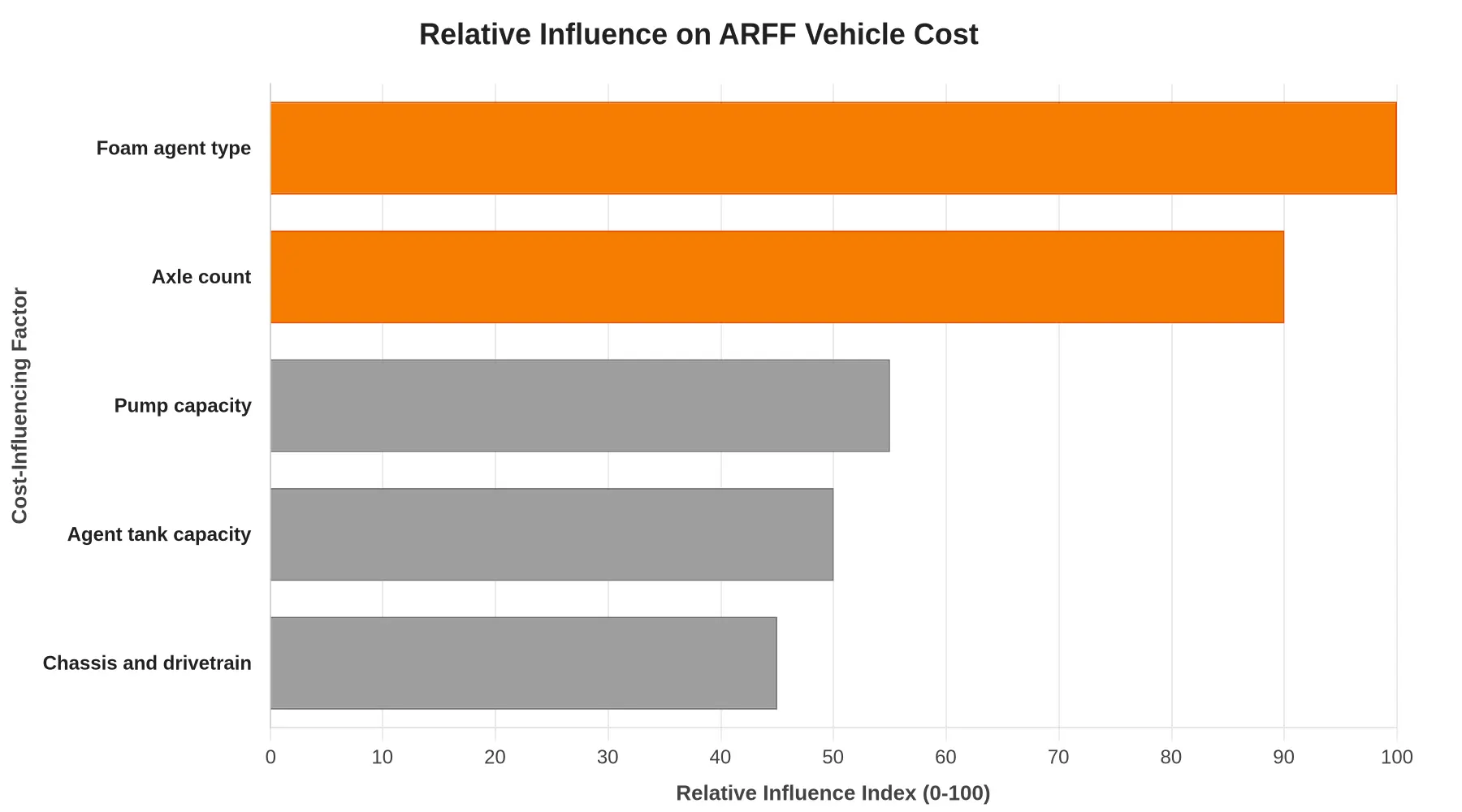
Across an ARFF fleet, two variables account for most of the price spread. Both are engineering decisions, not cosmetic options.
The Two Dominant Price Movers
Foam agent type governs the firefighting system. AFFF, fluorine-free foam, and dry chemical each dictate tank materials, pump rating, proportioning accuracy, and corrosion protection. Change the agent and you change the system architecture, and the ARFF vehicle cost with it.
Axle count governs the chassis and drivetrain. A 4×4, 6×6, or 8×8 configuration sets how much agent weight the truck can legally and safely carry, and each added axle brings more structure, components, and complexity.
What This Guide Covers
This buyer’s guide works through the two levers in order: foam agent type and its system-level cost effects, then axle count and its effect on chassis and payload, and finally how to compare total cost of ownership across configurations.
How Foam Agent Type Moves ARFF Vehicle Price
Foam agent type touches almost every cost line on an aircraft rescue firefighting (ARFF) vehicle: raw materials, proportioning hardware, tank and plumbing metallurgy, and the compliance risk built into the total airport fire truck price. Choosing the agent is effectively choosing the vehicle architecture.
AFFF: high-performance chemistry, high regulatory exposure
Aqueous film forming foam (AFFF) relies on fluorosurfactants that spread a fast-sealing film across hydrocarbon fuel. The chemistry is expensive, and proportioning has to hold tight 3% or 6% induction ratios, which means corrosion-resistant wetted parts, stainless or coated tanks, and carefully balanced pumps. The bigger pressure now is regulatory: PFAS restrictions are pushing buyers to plan for agent replacement and system retrofits, adding lifecycle cost on top of the purchase price.
Fluorine-free foam (F3): cleaner compliance, larger volumes
Fluorine-free foam removes the PFAS liability but changes the engineering math. Hydrocarbon surfactant blends generally need higher application rates, often at 3% concentration, so the truck carries larger agent tanks and needs more frequent resupply. Most proportioning systems handle F3 after recalibration; some pump and induction packages have to be upsized. The net effect is lower compliance risk and higher fluid and tankage cost.
Protein and fluoroprotein foams: legacy economics
Protein foam uses hydrolyzed protein as its base. The raw material is cheap, but the foam spreads slowly and has little tolerance for fuel contamination. Fluoroprotein adds fluorochemicals to improve fuel tolerance. Both need aggressive proportioning and both are now largely legacy ARFF choices, so a low agent price is often offset by limited supplier availability and by difficulty meeting current performance specifications.
CAFS: higher hardware cost, lower agent consumption
Compressed air foam systems (CAFS) inject air into the foam solution to produce a dry, long-throw stream with a controlled expansion ratio. The system adds a dedicated air compressor, air-injection plumbing, and control logic, a real uplift on the vehicle base. In return you get much lower water and agent consumption per fire, smaller tanks, and lighter resupply logistics. A CAFS foam fire truck therefore tends to cost more up front while cutting agent-related operating cost. For reference configurations, compare foam fire truck builds and CAFS fire truck builds side by side.
| Foam agent type | Raw material cost | Proportioning & pump demand | Tank & plumbing | Regulatory pressure |
|---|---|---|---|---|
| AFFF | High (fluorosurfactants) | Tight 3%/6% ratio, precision pumps | Corrosion-resistant, lined tanks | High – PFAS phase-out |
| Fluorine-free (F3) | Moderate-high, higher use rate | Recalibration, sometimes upsized | Larger tanks for volume | Low – no PFAS |
| Protein / fluoroprotein | Low raw material | Aggressive induction | Standard steel, foam-compatible | Low but legacy-limited |
| CAFS | Lower agent per fire | Air compressor + injection | Smaller tanks, air plumbing | Depends on agent used |
Every agent choice is a total-cost decision. A cheap foam chemistry can raise tank, pump, compliance, and resupply costs; a pricier agent or CAFS hardware can lower them. Judge foam agent type against the full lifecycle cost behind the airport fire truck price, not the sticker alone.
Foam agent types and their impact on airport fire truck price
| Foam agent type | Typical proportioning system | Relative agent cost | Tank and plumbing requirements | Compliance considerations | Relative impact on ARFF vehicle cost |
|---|---|---|---|---|---|
| AFFF (aqueous film-forming foam), 3% / 6% | Balanced-pressure or around-the-pump proportioner with fixed induction rate | Low to moderate (cost baseline) | Standard stainless-steel or FRP foam tank; conventional piping manifold; routine flush | Fluorine-based; being phased down under PFAS restrictions (EU, several US states) | Baseline (1.0x) |
| Fluorine-free foam (F3) | Precision volumetric or mass-flow proportioner, typically at 3% concentration | High (roughly 2x to 3x AFFF per liter) | Larger tank volume for equal discharge duration; corrosion-resistant wetted parts; more frequent flushing | PFAS-free; aligns with emerging green procurement and environmental specs | Moderate to high (+10% to +15%) |
| Protein / fluoroprotein foam | Inline inductor or line proportioner, 3% to 6% | Moderate | Oversized tank; high-viscosity handling and agitation to prevent settling | Legacy specifications; generally unsuitable for polar-solvent (alcohol) fires | Baseline to moderate |
| CAFS (compressed air foam system) | Direct-injection proportioner paired with an onboard air compressor and controlled expansion | Low agent consumption per unit volume (controlled expansion) | Dedicated air compressor, foam manifold and special nozzles; heavier, more complex chassis | Must satisfy NFPA 414 and applicable ICAO provisions; accepted for many Class B scenarios | High (+15% to +30%) |
For CAFS-equipped airframes, procurement teams can compare ready-built platforms in our CAFS fire truck range to benchmark installed-system cost against tank-and-plumbing requirements.
Key factors that move the final airport fire truck price
Before comparing quotes, it helps to know which specifications push the number up. These are the cost drivers that matter most on an ARFF platform, and each one links the foam agent choices above to the axle and chassis decisions below.
Foam agent type and volume. Whether a fire-fighting truck carries AFFF, fluorine-free foam, or a dual-agent system, and how many liters it stores, sets a large share of the ARFF vehicle cost: premium concentrates and larger tanks raise both material and containment expense.
Foam proportioning and pump configuration. Balanced-pressure, around-the-pump, and direct-injection proportioners carry different hardware and calibration costs, and the choice affects how precisely foam reaches every discharge.
Axle count and chassis class. Moving from a 4×4 to a 6×6 or 8×8 chassis adds driveline components, weight, and engineering, making axle count one of the strongest single levers on the airport fire truck price. You can compare configurations across our ARFF airport fire trucks.
Water and foam tank capacity. Every extra liter of water or foam needs stronger tanks, baffling, and load support, so capacity scales cost steadily.
Aerial or monitor reach. Roof monitors, extending booms, and aerial ladders add structure and hydraulics, and cost rises with reach.
Pump flow rate (L/min or GPM). Higher-rated pumps and their larger impellers, drives, and piping deliver more extinguishing power but cost noticeably more.
Braking and suspension upgrades for high axle loads. Heavy ARFF platforms need reinforced brakes, ABS, and air or spring suspension to stay safe and legal; these parts are priced by duty rating.
Certification and compliance testing. NFPA 414, ICAO, and other approvals require documented testing and verification, and that work is an unavoidable line item on the final quote.
How Axle Count Changes the Airport Fire Truck Price
Axle count is the most direct structural lever on the final airport fire truck price. ARFF drivetrains are defined by wheel configuration, 4×4, 6×6, or 8×8, and that one figure reshapes the chassis, the payload ceiling, and the compliance work behind every quotation.
The three core ARFF configurations
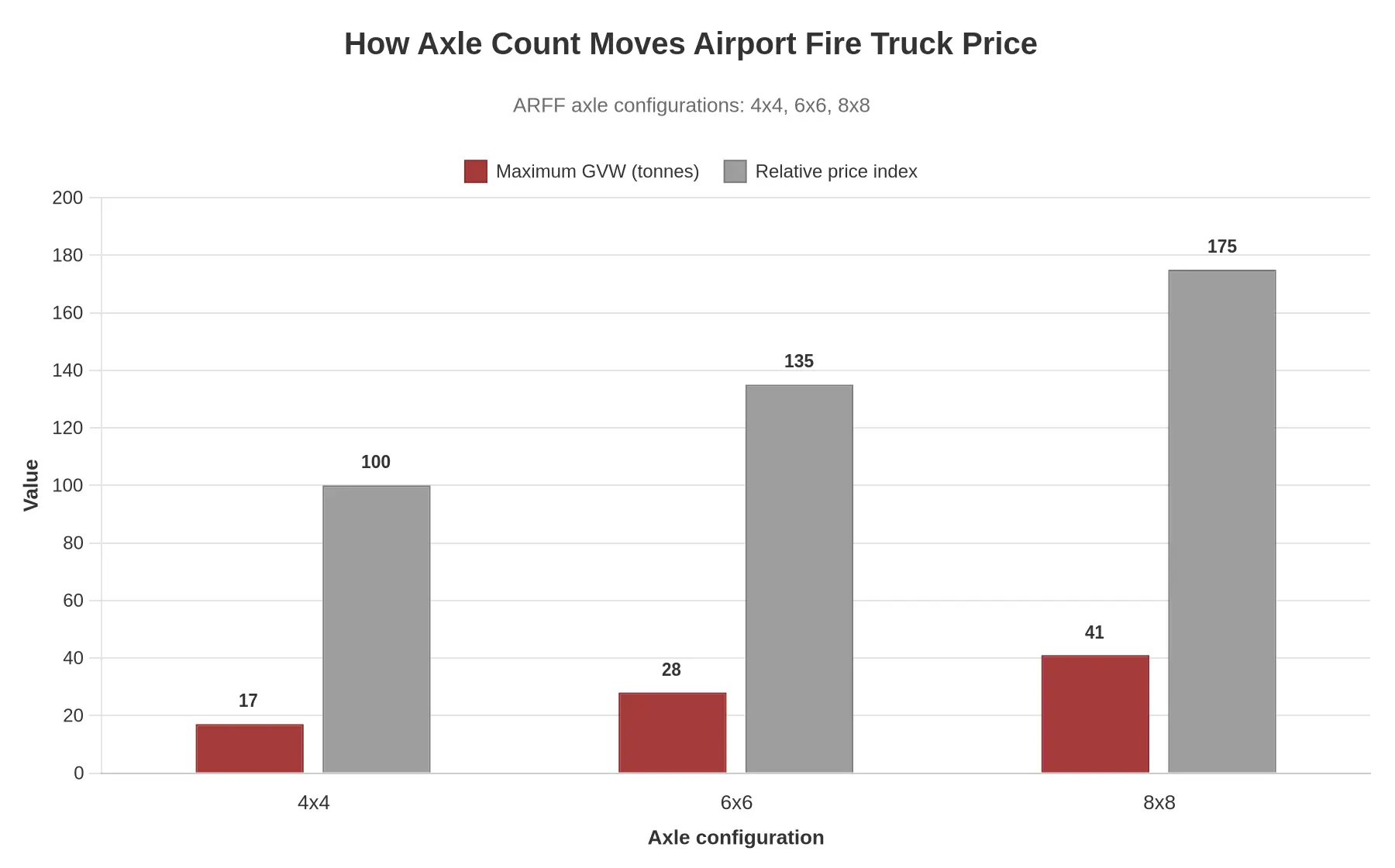
- 4×4 – Two axles (four wheels), all driven. Typical GVW around 16-18 t. Suited to small regional airfields and fast first-response roles.
- 6×6 – Three axles (six wheels), all driven. The mainstream ARFF platform, GVW around 26-30 t, with volume for large water and foam loads.
- 8×8 – Four axles (eight wheels), all driven. A true heavy-duty fire truck class built for ICAO Category 9/10 airfields, GVW from 38 t and beyond.
Why more axles buy more capability
Each added axle spreads gross vehicle weight across more contact patches, keeping axle loads inside legal and tire limits. That headroom goes straight into larger water and foam tanks, longer ladder or boom reach, and better traction on the soft, uneven ground around runway shoulders and grass strips.
The table below maps the three configurations onto payload and cost.
| Configuration | Axle count | Typical GVW | Water / foam capacity | Relative cost index |
|---|---|---|---|---|
| 4×4 | 2 | 16-18 t | 3,000-4,500 L | 100 |
| 6×6 | 3 | 26-30 t | 6,000-9,000 L | 148 |
| 8×8 | 4 | 38-45 t | 12,000-14,000 L | 205 |
The cost layers each axle adds
- Chassis complexity – Longer, stiffer frames, extra cross-members, and revised mounting geometry.
- Engine and drivetrain sizing – Higher GVW demands more horsepower, larger transmissions, and additional driven axles, transfer cases, and inter-axle differentials.
- Heavy-duty suspension and braking – Multi-axle air suspension, higher-capacity springs, and more air-brake circuits with ABS/ESP.
- Tires and wheels – Two or four extra wheels plus matching rims, scaling roughly with axle count.
- Compliance and testing – More axles means more braking, stability, and axle-load certification work, raising engineering and test cost.
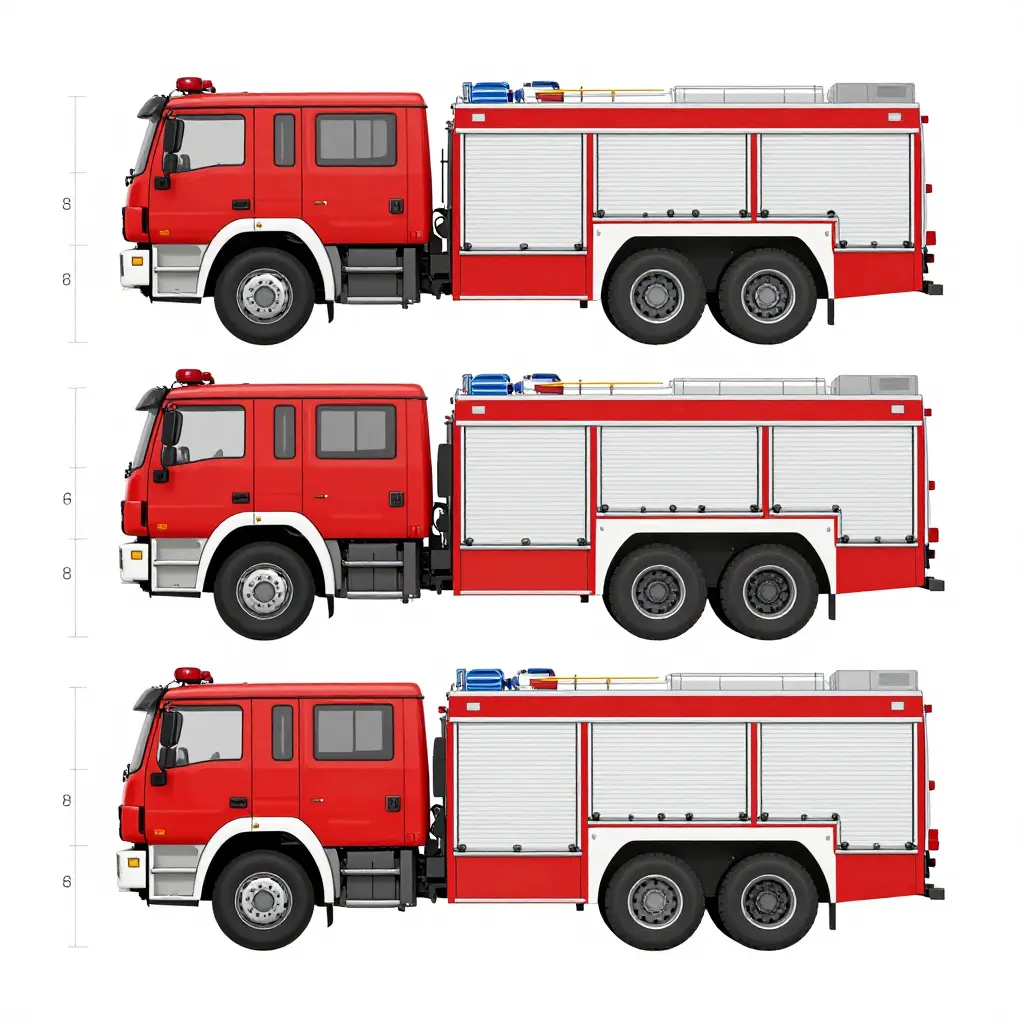
Because these layers stack, the airport fire truck price climbs faster than axle count alone suggests. A 6×6 typically indexes about 45-50% above a comparable 4×4, and an 8×8 adds roughly another 35-40% on top.
Matching axle count to the mission
Tie axle count to airfield category, runway length, and the foam output required rather than buying capacity speculatively. Review our heavy-duty fire truck chassis for multi-axle drivetrains, or compare the full airport fire truck lineup to match configuration to your cost and response targets.
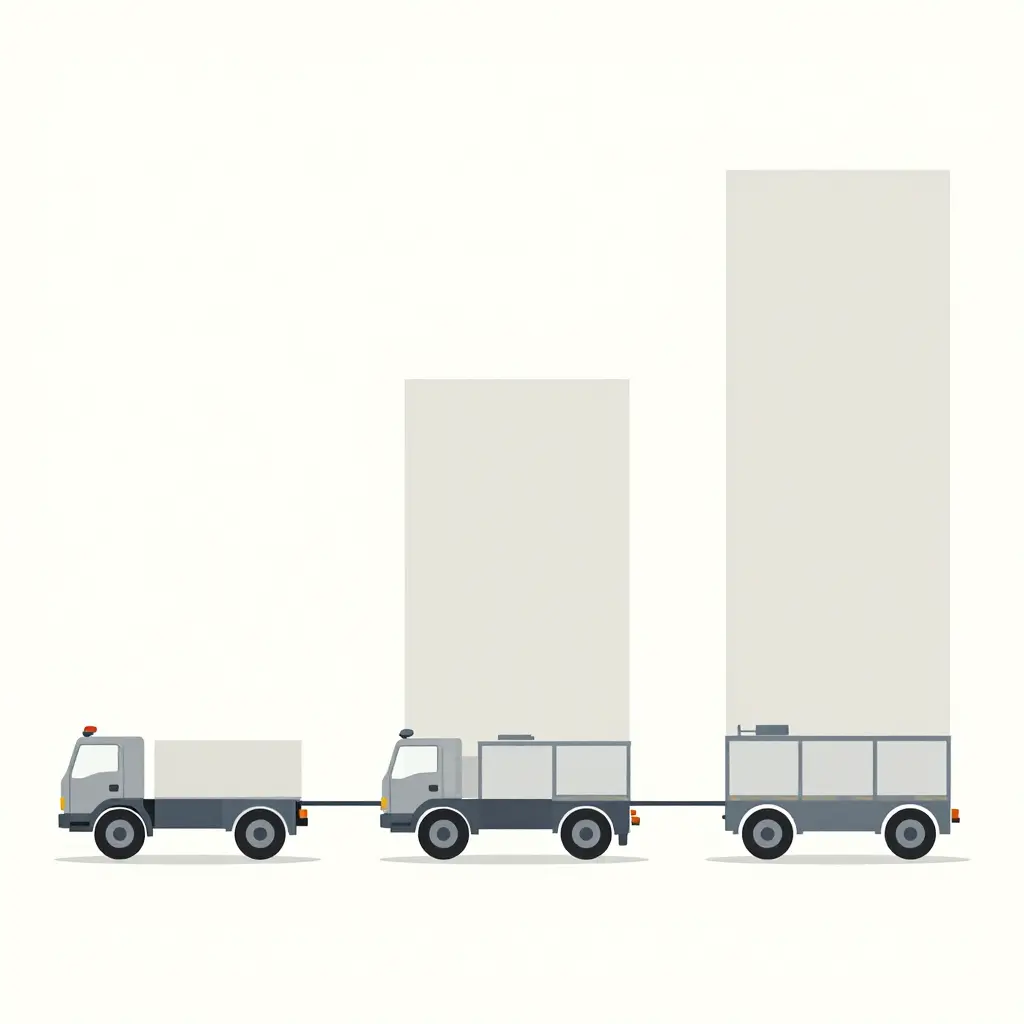
How Foam Agent Type and Axle Count Interact
Foam agent type and axle count are not independent line items. They pull on the same design string, and that string ends at the final airport fire truck price.
One direction: bigger tanks force a bigger chassis
Fluorine-free chemical agents, now required in many jurisdictions, generally need a higher application rate than AFFF on Class B fuel fires and can be more sensitive to foam quality. Engineers often compensate with a larger tank volume and a wider foam concentrate proportioning range. A bigger tank means more liquid mass, more structure, and a heavier gross vehicle weight (GVW). Once GVW passes a practical threshold, the chassis has to move from a compact 4×4 up to a 6×6 or 8×8. That jump adds an axle count, a second drive line, larger brakes, and heavier suspension, escalating ARFF vehicle cost well beyond the price of the tank itself.
The reverse: a small chassis limits the chemistry
Reverse the logic and it still holds. A compact 4×4 chassis puts a hard ceiling on water and foam capacity. With limited tank volume, the practical choice of foam agent type narrows: agents that need high application rates are hard to justify, and some fluorine-free blends cannot be carried in useful quantity. The chassis ends up dictating the chemistry.
Why the two cannot be priced separately
Tank volume, GVW, axle count, and agent selection constrain each other, so no procurement team can price them separately. Pricing agent type in isolation understates airport fire truck price; pricing axle count in isolation ignores why the larger chassis was required at all. Start with the mission profile, then review complete ARFF aircraft rescue and fire fighting vehicles configured as an integrated system rather than a parts list.
Reading the Chart
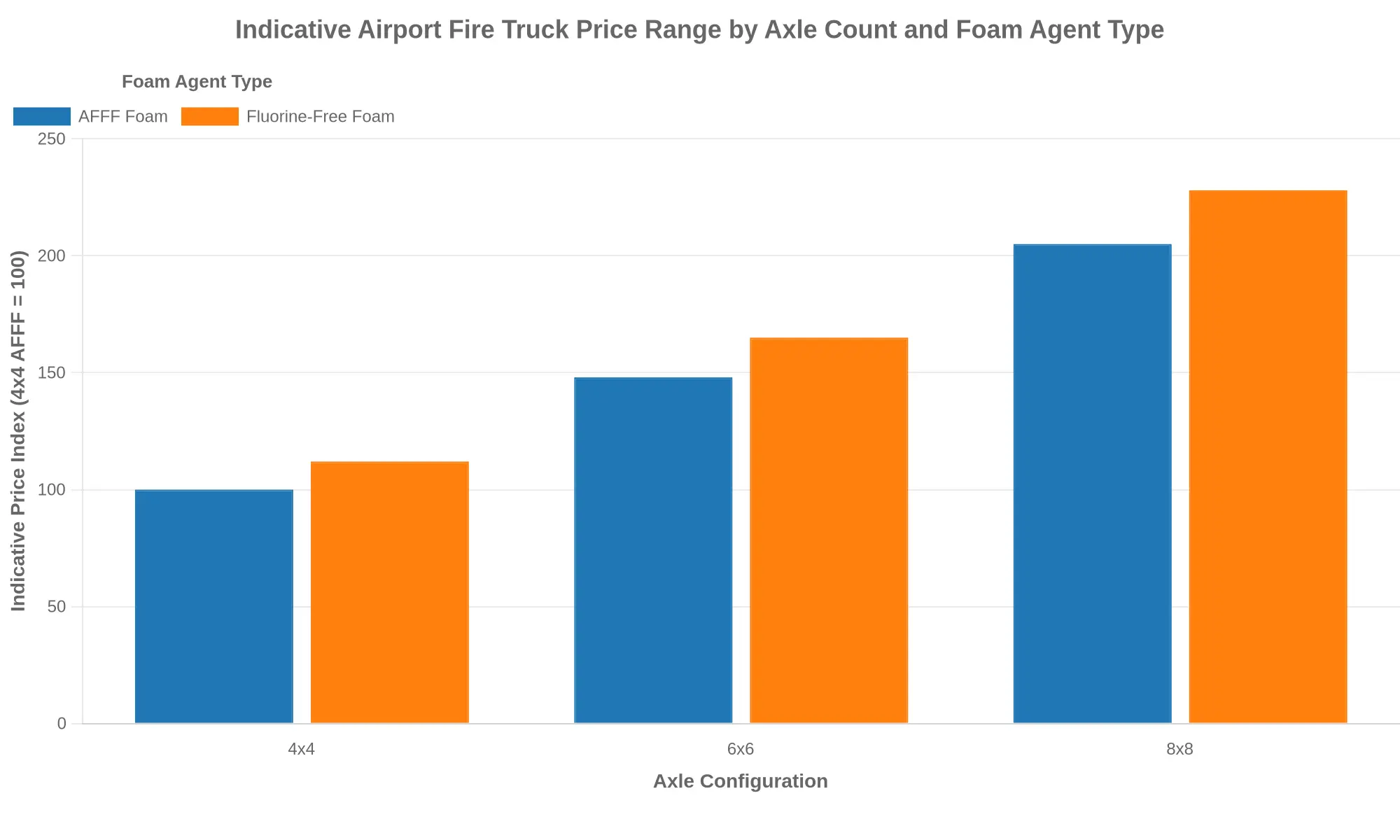
The chart isolates the two variables that reshape most ARFF budgets: axle count and foam agent type. Values are an indicative, specification-driven price index, anchored so that a 4×4 truck running AFFF equals a baseline of 100. Treat it as a directional map of cost relationships, not a quote; real numbers move with chassis brand, pump capacity, water/foam tank size, and tendering terms.
Two patterns stand out:
- Axle count is the stronger lever. Moving from a 4×4 to an 8×8 roughly doubles the index. Larger axle configurations mean more drivetrain hardware, bigger torque capacity, heavier tanks, and reinforced chassis, costs that compound rather than simply add up.
- Foam agent type is the subtler lever. Switching from AFFF to fluorine-free foam adds a steady premium of roughly 10-15% at every axle level. It is a consistent markup, not a step change, so it scales with the size of the truck’s foam system rather than acting as a one-time surcharge.
Why the Gap Between Foam Types Stays Proportionate
Fluorine-free foam (F3) costs more per litre than legacy AFFF, and the agent price is only part of the story. Because these modern formulations often need stainless-steel or specially coated tank internals, different proportioning hardware, and updated crew training, the premium grows with a truck’s total foam capacity. That is why the two bars in each axle group stay closely bracketed instead of diverging: the difference tracks system size, not axle complexity.
For a procurement team weighing a fluorinated-to-fluorine-free transition, budget the foam premium as a percentage uplift on the foam system, then treat axle configuration as the dominant cost driver on top.
Turning the Index Into a Budget Conversation
The index is most useful next to a real specification. A 6×6 truck built to a moderate water/foam spec sits well below a fully loaded 8×8 with an oversized tank and a high-flow monitor, even when both share the same foam agent. To see how these configurations map onto actual product lines, browse the available airport fire trucks for sale and compare how OEMs configure tanks, pumps, and foam systems across each class.
A quick planning heuristic for buyers:
| Axle Configuration | Relative Price Index (AFFF baseline) | Primary Cost Drivers |
|---|---|---|
| 4×4 | 100 – 112 | Entry chassis, compact tanks, two-axle drivetrain |
| 6×6 | 148 – 165 | Larger tanks, higher pump capacity, reinforced frame |
| 8×8 | 205 – 228 | Heavy-duty drivetrain, maximum foam/water capacity |
Use these bands to sanity-check a tender, not to replace it. If the specification calls for a larger foam system, longer monitor reach, or a specific fluorine-free certification, expect the final number to move within, and occasionally beyond, the ranges above.
Figures are indicative, specification-driven estimates for comparative planning only and do not constitute a fixed quote.
Lifecycle and Total Cost of Ownership
The airport fire truck price on the purchase order is only the entry point. Over a service life of 15 to 20 years, what matters for an aircraft rescue and firefighting (ARFF) unit is ARFF vehicle cost viewed as a whole. Acquisition is usually the single largest line, but it is rarely the majority of what an operator actually spends.
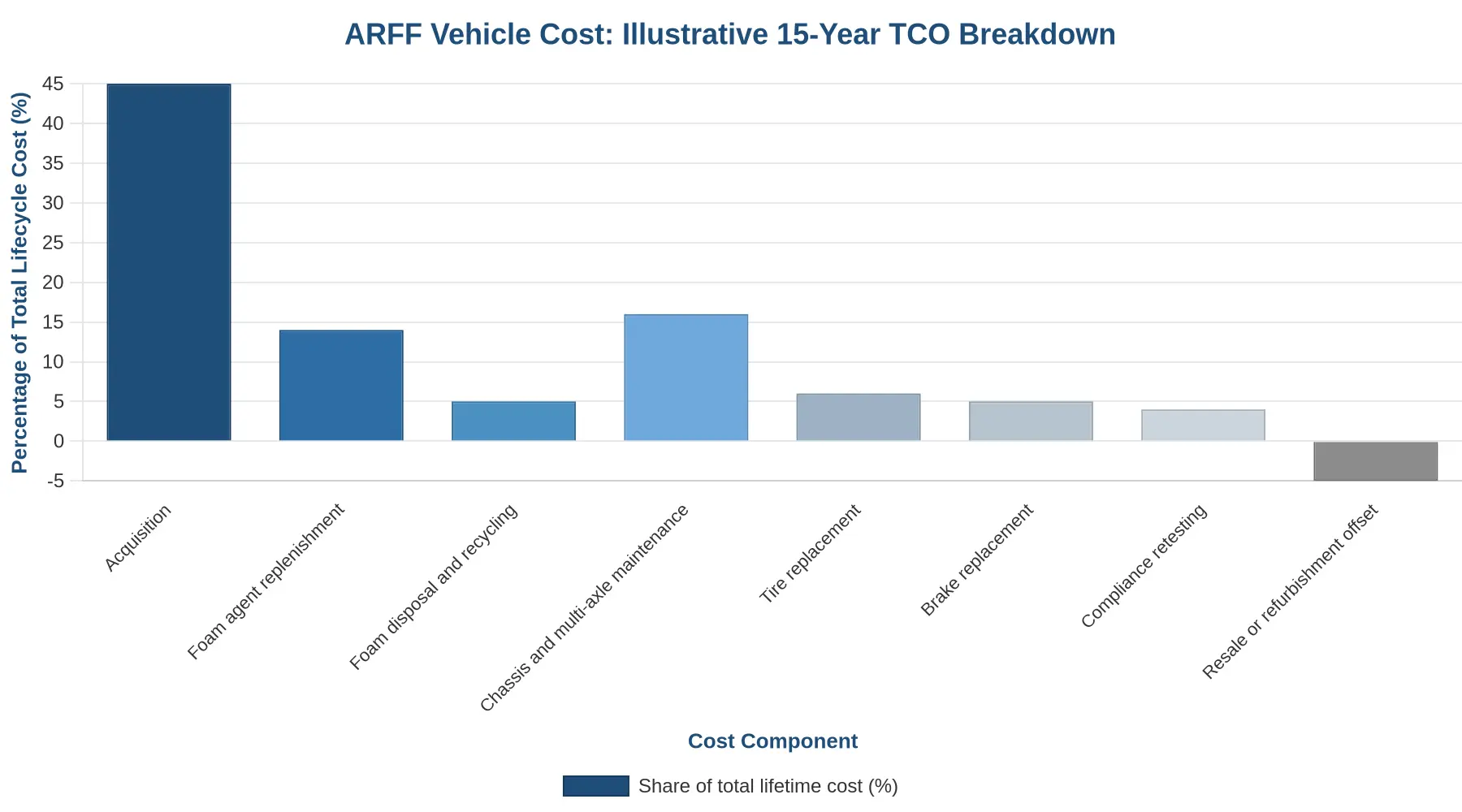
The chart above shows how a typical foam fire truck spreads its lifetime cost. Much of it sits outside the initial invoice: foam agent, chassis upkeep, tires, brakes, compliance work, and the credit recovered at disposal all reshape the real number.
Foam Agent: Replenishment and Disposal
Foam is a consumable, and its chemistry drives recurring spend. AFFF and other fluorinated agents face tightening regulation, and many airports are moving to fluorine-free foam (F3). Each transition means draining, disposing of, and recharging the tank, a cost that recurs with every regulatory cycle. Some agents also carry shelf-life limits, so even unused inventory has to be turned over and disposed of as controlled waste.
The agent you specify at purchase compounds over the vehicle’s life. A premium, longer-lasting concentrate can cost more up front but need fewer recharges; a cheap agent can mean more frequent replacement and pricier disposal.
Chassis Maintenance, Tires, and Brakes
Higher axle counts raise payload capacity and braking performance, but they also multiply wear items: more tires, more brake sets, more suspension components, more maintenance hours. A 6×6 or 8×8 foam fire truck carries a heavier chassis and a broader parts inventory than a lighter configuration, and the gap widens every year.
Sourcing consumables and replacement parts efficiently is central to controlling that drift. Airport operators can review genuine and compatible components through the fire truck parts catalog to keep scheduled maintenance predictable and downtime short.
| Cost Component | How It Scales | Relative Weight |
|---|---|---|
| Acquisition | Axle count, foam system, body spec | Largest single line |
| Foam replenishment | Agent type, tank size, training volume | High and recurring |
| Foam disposal | Regulation changes, shelf life | Moderate, cyclical |
| Chassis / multi-axle upkeep | Number of axles, duty cycle | High over lifetime |
| Tires | Axle count, load rating | Moderate |
| Brakes | Axle count, stopping demands | Moderate |
| Compliance retesting | Evolving foam and safety rules | Low but mandatory |
| Resale / refurbishment | Hours, condition, market demand | Offsets total cost |
Compliance Retesting and Residual Value
As foam regulations evolve, vehicles may need re-certification, system recalibration, or documentation updates. The cost is modest in any single year but non-negotiable, and it can spike when standards change.
At the end of the cycle, resale or refurbishment recovers some value. A well-maintained ARFF unit with documented service history and a rebuildable chassis can return a meaningful share of its original price, which is why the lowest sticker price is not automatically the lowest total cost. When comparing quotes, model the full ownership picture, not just the acquisition figure.
Frequently Asked Questions About Airport Fire Truck Pricing
What is the typical airport fire truck price range?
A new aircraft rescue and firefighting (ARFF) vehicle generally runs from roughly USD 500,000 for a compact 4×4 rapid-intervention unit to more than USD 1.2 million for a large 6×6 or 8×8 truck with a 12,000 L water tank and a full foam system. Water and foam capacity, pump output, axle count, and NFPA 414 compliance level drive the number. Military and Category 10 airfields usually sit at the upper end. Representative configurations are listed on our airport fire trucks category page.
How much does foam agent type add to the cost?
Foam agent type affects both the onboard proportioning hardware and the consumable cost. AFFF and AR-AFFF proportioning systems are the baseline, while fluorine-free foam (F3) can add roughly 10-15% to the vehicle price through different proportioner calibration, material compatibility, and larger agent tanks. The agent itself often costs two to three times as much per litre as legacy AFFF.
Why does axle count increase the price?
Axle count raises both chassis cost and engineering complexity. Moving from 4×4 to 6×6 or 8×8 adds driven axles, larger brakes, heavier suspension, multi-stage transfer cases, and reinforced frames, and it raises gross vehicle weight, which in turn requires higher-rated tires and wheels. Each added axle typically adds tens of thousands of dollars, and it is what supports the larger water and foam loads needed for a higher ARFF index.
Do fluorine-free foam requirements raise ARFF vehicle cost?
Yes. Fluorine-free foam mandates often raise ARFF vehicle cost through modified proportioning systems, stainless-steel or specific elastomer plumbing, extra tank capacity, and recertification testing. Because F3 foams need different expansion ratios and higher application rates, some departments have to upsize pumps and tanks as well.
Should buyers prioritize foam agent type or axle count first?
Prioritize axle count. It fixes the vehicle’s GVW, payload ceiling, and ARFF index capability, while foam agent type is easier to adjust later through proportioner settings or agent selection. Define the required index and water/foam volume, choose the axle configuration that supports it, then confirm the foam agent and build the budget around both. That keeps airport fire truck price tied to response requirements rather than optional features.
What Really Drives the Final Price
Two decisions drive the final airport fire truck price more than any others: foam agent type and axle count.
Foam agent type sets the cost of the extinguishing system and its agent load. AFFF, AR-AFFF, and fluorine-free concentrates differ in chemistry, proportioning complexity, and refill economics, so specialized concentrates push the specification, and the price, upward.
Axle count governs the chassis, GVW, suspension, and maneuverability envelope. A 4×4, 6×6, or 8×8 configuration changes the drivetrain, tire, and braking package, and every additional axle adds material, engineering, and compliance cost.
Procurement Comparison Checklist
When comparing ARFF vehicle quotes, work through these items:
- Confirm the foam agent type, concentrate volume, and proportioning system.
- Verify axle count, drivetrain configuration (4×4/6×6/8×8), and GVW class.
- Check pump capacity, water/foam tank volumes, and discharge rates.
- Review acceleration and top-speed performance against NFPA 414 and ICAO requirements.
- Compare chassis OEM, braking, and tire specifications.
- Request lifetime agent refill and maintenance cost projections.
- Validate warranty terms, crew training, and parts availability.
For deeper specification detail, procurement teams can review the airport fire trucks category and the foam fire truck category at CIMC Tianda.
Airport fire truck pricing is specification-driven. Foam agent type and axle count remain the primary levers, and a requirement-based comparison is the surest route to a defensible procurement decision.