Apron Drive vs Fixed Ramp Boarding Bridge: The Decision That Defines a Stand
Choosing between an apron drive and a fixed ramp boarding bridge shapes how a stand is laid out, which aircraft it can accept, and how quickly it turns. Both move passengers from the terminal to the aircraft door; the difference is in the machinery, and that difference shows up in the stand.
Apron drive bridges use powered drive columns and bogies to travel across the apron along multiple axes. They can extend, retract, raise, lower, and slew, so a single unit can serve a wide range of aircraft types and door sill heights. Fixed ramp bridges are anchored to the terminal structure and hold a largely fixed elevation and geometry, with only limited articulation at the rotunda or ramp. They carry less mechanical complexity, but they also constrain how a stand can be used.
The first thing the choice affects is boarding bridge clearance. Service roads, ground support equipment parking, fuel hydrant pits, and aircraft wingtip paths all have to be checked against the bridge envelope. Apron drive units sweep more apron; fixed ramps use less, but they leave far less room to absorb a change in fleet mix or door height over the life of the terminal.
Retrofit feasibility is the second constraint. Bolting a fixed ramp onto an existing stand may need only a compact foundation and a short tunnel section, while converting to apron drive can force drainage redesign, pavement strengthening, and utility relocation. Operators weighing that trade-off often study how docking faults, stand tolerance, and downtime costs behave over time before committing capital.
Gate turnaround time is where the choice finally shows. Bridge travel speed, docking precision, and the number of repositioning moves per turn all affect how fast an aircraft is released, and each of those comes back to the bridge type selected years earlier.
Apron Drive Boarding Bridge Mechanics and Clearance Profile
An apron drive boarding bridge earns its place at high-traffic gates because it moves. Unlike a fixed ramp bolted to one stand position, a driving bridge carries its own propulsion, so one gate can serve several aircraft types without a second structure. For operations managers working with mixed fleets, that flexibility is the point, but it comes with a clearance obligation a fixed ramp does not have.
Powered drive, steering, and the telescoping tunnel
At the base sits a drive bogie with powered wheels, usually driven by electric or hydraulic motors that let the bridge crawl across the apron under its own control. Steering comes from pivoting the bogie, and many units offer crab steering so the structure can translate sideways rather than only rotate. The telescoping tunnel, built from two or three nesting sections, extends and retracts to match different door sill heights and fuselage positions, while the rotunda at the terminal end absorbs the articulation. The cabin then seals against the aircraft door.
The clearance profile that governs siting
On a driving bridge, clearance usually decides whether a stand is usable, not drive power. A clearance problem shows up either as a tunnel that cannot swing far enough or as a chassis that blocks service roads.
- Stand footprint – the ground area the bridge chassis occupies, including its parked rest position during aircraft movement.
- Maneuvering space – the turning and crab-steering room needed to reposition between aircraft types.
- Free travel envelope – the arc swept by the tunnel and cabin as it extends, retracts, and rotates.
- Vertical clearance range – the door sill height band the tunnel must reach across the fleet.
- Safety clearances – the minimum gaps kept clear of the fuselage, engines, and ground service equipment.
These zones overlap with GSE traffic, so docking performance often depends on stand tolerance and wear as much as on mechanical force. Teams that track docking faults and stand tolerance see how quickly a small clearance shortfall turns into a turnaround delay.
An apron drive bridge delivers that flexibility only when the full clearance profile, from stand footprint to free travel envelope, is designed into the stand from the start.
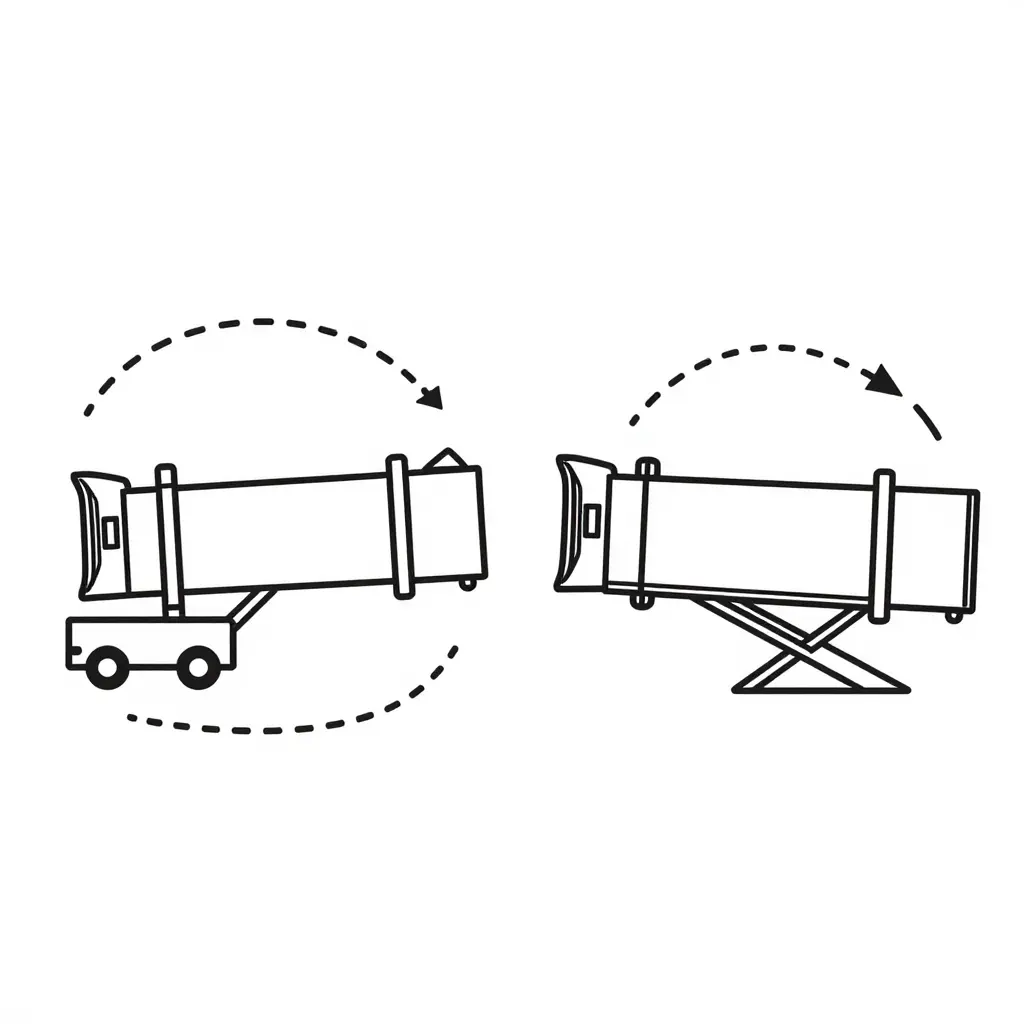
A simple line-drawing schematic of the two bridge types: the apron drive concept (left) shows the wide rotational travel envelope created by its wheeled base, while the fixed ramp concept (right) pivots from a single fixed point, producing a much narrower swing arc.
What separates the two systems at the gate is how much clearance and flexibility each one actually buys. The table compares their clearance and specification envelopes, which is the practical basis for weighing stand tolerance against retrofit constraints and turnaround time.
| Bridge Type | Travel/Motion Type | Typical Stand Offset Range | Maneuvering Space Requirement | Door Sill Height Tolerance | Docking Envelope Flexibility | Typical Aircraft Compatibility |
|---|---|---|---|---|---|---|
| Apron drive (self-propelled) | Powered drive wheels, telescoping tunnel, +/- 90 deg slew | 3-8 m terminal-to-stand offset | Wide: 15-20 m clear apron sweep | Adjustable 2.4-5.8 m, +/- 0.5 m fine trim | High: full lateral, vertical and rotational travel | Code C/D/E – A220, 737, A320, 787, A350 |
| Fixed ramp (stationary) | No travel; fixed tunnel with built-in ramp | Fixed, preset 0-2 m | Minimal: 3-5 m | Fixed gradient, limited +/- 0.1 m | Low: fixed geometry, single docking path | Single family / Code C – 737 or A320 class |
These figures are illustrative engineering values; actual limits depend on the specific OEM model, stand layout and apron geometry.
Retrofit Limits: Why Converting Between Apron Drive and Fixed Ramp Bridges Is Rarely Simple
Swapping a fixed ramp for an apron drive unit, or the reverse, looks straightforward on paper. In practice, boarding bridge retrofit limits appear quickly, because almost every interface the new bridge touches was designed around the old one. The terminal, the paving, the pivot, and the utilities all become constraints.
Structural Foundations at the Terminal
A bridge does not simply bolt onto a wall. Its weight, wind loading, and dynamic docking forces transfer into the terminal structure through dedicated foundation points. A fixed ramp loads the building very differently from an apron drive bridge that carries much of its mass on a wheeled bogie. Retrofitting often means cutting into an existing slab or footing to add anchorage, and that work escalates once load paths and passenger areas are involved.
Apron Paving and Load Bearing
Apron drive bridges roll on tires, concentrating heavy point loads where they park and pivot. If the apron was built for a fixed ramp with only a static base, the paving may not carry those dynamic wheel loads. Upgrading the sub-base, drainage, and markings turns a bridge project into a civil works project.
Rotation Pivot Constraints
The pivot sets the geometry of the docking envelope. Existing pivot positions, cabin heights, and stand lead-in lines rarely match the new unit, so a gate retrofit boarding bridge must either relocate the pivot or accept a reduced docking range. Inherited pivot geometry makes alignment problems compound, which is why it helps to review passenger boarding bridge docking faults and stand-tolerance wear before redesigning it.
Available Apron Real Estate
Apron drive bridges need room to maneuver, park, and service. Fixed ramps need far less. Adding a drive unit to a tight stand can eat into service roads, painted clearances, and aircraft turning envelopes, space that is usually already committed elsewhere.
Utility Routing: Power, Data, and Hydraulics
Every bridge depends on routed power, control data, and often hydraulic lines. An existing terminal may have only a modest feed sized for a fixed ramp. New drives, sensors, and hydraulics need larger conduits, updated panels, and safe cable paths, all of which must thread through occupied buildings and active aprons.
Why Retrofit Is More Constrained Than New Build
A new build starts with a blank sheet: foundations, paving, geometry, and utilities are designed together. A retrofit inherits decisions someone else already made. That is why schedules stretch and costs grow even when the bridge itself is off the shelf.
Before committing, weigh the true cost of retrofit against replacement. The bridge is rarely the hard part; the surrounding infrastructure usually is.
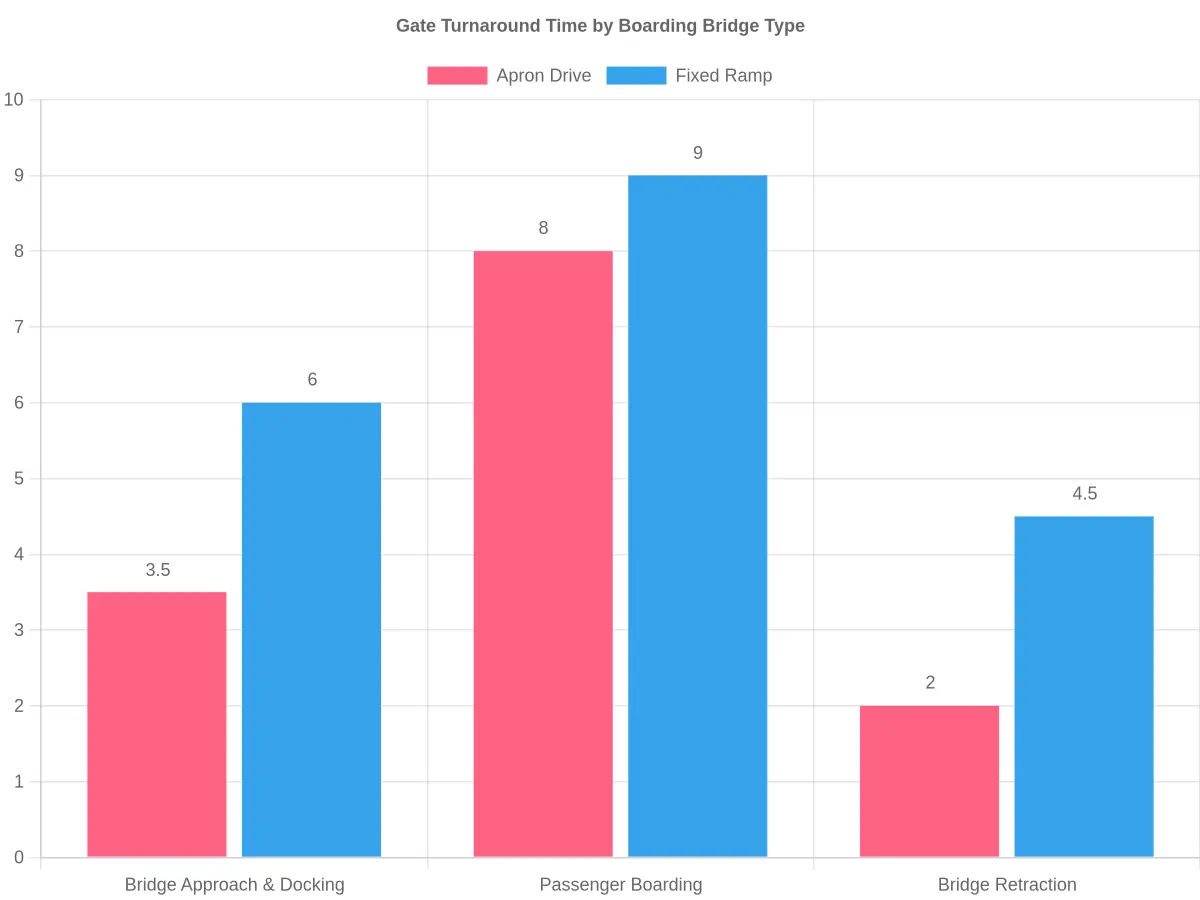
The chart below breaks estimated gate turnaround time, in minutes, into phases, contrasting apron drive and fixed ramp boarding bridges to show where each design spends its time.
Gate Turnaround Time: How Apron Drive and Fixed Ramp Bridges Compare
The bridge type a gate uses shapes gate turnaround time, because docking speed, repositioning ease, and tolerance for aircraft parking accuracy all feed into how fast a turnaround closes. Apron drive and fixed ramp bridges trade flexibility against predictability, and that trade-off shows up most clearly in boarding bridge turnaround efficiency.
Apron drive bridges carry their own drive column, so they can telescope, pivot, and rise to meet an aircraft after it has parked. That range means they usually dock faster when the aircraft sits off its nominal stop mark, and they reposition easily between fleet types sharing a stand. Operators commonly see shorter docking windows on apron drive gates because the bridge absorbs parking error instead of pushing it back onto the marshaller or pilot. A fixed ramp bridge presents a fixed interface at a fixed stand, so it demands tighter aircraft parking accuracy because the bridge cannot chase the door. When alignment is good, though, its simpler kinematics give a steadier passenger flow rate: the cabin-to-terminal path is constant, so dwell, deplaning, and boarding curves repeat shift after shift.
| Factor | Apron drive | Fixed ramp |
|---|---|---|
| Docking speed | Faster when aircraft is off the stop mark | Fast only with precise parking |
| Repositioning ease | High – handles mixed fleet types | Low – tied to one stand position |
| Passenger flow rate | Variable, adjusts to aircraft | Consistent, fixed cabin-to-terminal path |
| Parking accuracy dependency | Lower – bridge absorbs error | Higher – needs disciplined alignment |
| Turnaround predictability | Moderate | High on dedicated stands |
The trade-off also shows up in maintenance. Docking problems and worn parts erode stand availability over time, and it is worth understanding common boarding bridge docking faults and how stand tolerance and downtime costs accumulate.
In practice, apron drive bridges typically save time on mixed-fleet, high-mix gates where parking accuracy varies, while fixed ramp bridges give more predictable turnarounds on dedicated stands with disciplined parking. Flexible docking buys turnaround resilience but adds mechanical complexity; a fixed interface buys repeatability at the cost of tolerance. Which one is right depends on fleet mix, stand layout, and how much variance a schedule can absorb.
Choosing Between Apron Drive and Fixed Ramp Boarding Bridges
Selecting between an apron drive (self-propelled) boarding bridge and a fixed ramp bridge is rarely a pure cost decision. It depends on the aircraft you actually handle, the physical limits of each stand, and the tempo your gates must sustain. The framework below is meant to get infrastructure planners and operations managers to a defensible, stand-by-stand decision.
The boarding bridge selection criteria that matter most
- Fleet mix and door sill range: An apron drive unit travels vertically and horizontally to serve several aircraft types and door heights, so it is the safer default for mixed narrow-body fleets. A fixed ramp bridge is locked to one sill height range, which limits it to a consistent aircraft family.
- Stand geometry and clearance availability: Apron drive bridges need a clear apron sweep and enough depth for their travel path. If apron clearance is tight or the stand sits against a fixed obstacle, a fixed ramp bridge avoids blocking movement areas.
- Retrofit feasibility: Existing structures, pavement bearing capacity and hydrant positioning determine how much civil work is needed. Retrofitting a powered apron drive bridge usually demands heavier foundations and power/data runs, while fixed ramps often integrate with less structural disruption.
- Capital and lifecycle cost: Compare more than purchase price: maintenance of drives, wheels and hydraulic systems, plus downtime cost. Docking wear and unplanned stand downtime can outweigh the initial savings of a cheaper unit.
- Turnaround time goals: Faster docking and undocking protect tight gate schedules in high-frequency operations, which favors powered apron drive bridges where turnaround discipline is critical.
| Factor | Apron Drive | Fixed Ramp |
|---|---|---|
| Fleet flexibility | High, multi-type | Low, single family |
| Clearance demand | Higher apron sweep | Compact footprint |
| Retrofit burden | Heavier foundations | Lighter integration |
| Turnaround speed | Fast docking | Slower to reposition |
| Best fit | Mixed, high-tempo gates | Fixed, space-constrained stands |
Recommended direction
Treat apron drive bridges as the default for mixed fleets and high-turnaround gates, and reserve fixed ramp bridges for stands with hard clearance limits or a stable, single-aircraft mission. Score each stand against these criteria before committing capital, and let turnaround targets and retrofit reality, not catalogue price, break the tie.
Frequently Asked Questions: Apron Drive vs Fixed Ramp Boarding Bridges
These are the questions operations managers and infrastructure planners ask most often about the two bridge types, covering mobility, clearances, retrofit limits, and turnaround impact.
1. What is the main difference between apron drive and fixed ramp boarding bridges?
Apron drive bridges are mobile: a wheeled drive column powers telescoping tunnels across the apron to reach the aircraft. Fixed ramp bridges are stationary structures anchored to the terminal, with a set elevation and no powered travel. That trade-off between mobility and structural simplicity shapes how each type handles docking, flexibility, and daily operations.
2. How do clearances differ between the two types?
Apron drive units need a clear apron footprint for their drive path and docking envelope, so they demand wider stand clearances and obstacle-free pavement. Fixed ramp bridges occupy a defined, smaller footprint, but their fixed height and reach limit which aircraft they can serve, which tightens vertical and lateral tolerances.
3. What limits boarding bridge retrofits?
Retrofit limits usually come from slab load-bearing capacity, available apron space, and terminal structural interfaces. Fixed ramp bridges require rigid foundations and fixed geometry, while apron drive retrofits need drive-path clearance and electrical power. Local codes, stand layout, and fleet mix usually decide whether a retrofit is feasible or cost-effective.
4. How does each type affect gate turnaround time?
Apron drive bridges often dock faster across varied aircraft and can adjust to last-minute stand changes, which supports tighter turnarounds. Fixed ramp bridges are reliable but slower to reposition and less flexible, so they suit stable, single-type operations. Either way, docking faults and stand-tolerance wear can erode turnaround gains.
5. Which type is better for multi-aircraft stands?
For multi-aircraft stands, apron drive bridges generally win. Their mobile drive columns and telescoping tunnels let one bridge serve several parking positions and aircraft sizes. Fixed ramp bridges suit dedicated, single-position gates but struggle to reposition across multiple aircraft footprints, which makes them less efficient where stands host mixed fleets.
6. How do maintenance needs and downtime compare?
Apron drive bridges contain more moving parts (drive wheels, motors, and controls), so they need more frequent routine inspection. Fixed ramp bridges have fewer mechanical components, though their structure and stairs require periodic structural checks. For both, wear parts and docking faults are the leading drivers of unscheduled downtime and repair cost.
The Bottom Line on Apron Drive vs Fixed Ramp Boarding Bridges
The decision between apron drive and fixed ramp boarding bridges rarely comes down to which one is “better.” It comes down to which one fits the airport in front of you.
Clearances set the hard boundaries. An apron drive bridge needs enough maneuvering room and structural tolerance to reach the aircraft without overloading the terminal or the stand. A fixed ramp bridge needs stand geometry that keeps passengers close to the building, which limits how much aircraft size variation it can absorb.
Retrofit limits matter just as much. Older piers were not designed for the heavier loads, longer reaches, or tighter docking tolerances that current bridges require, and that reality shapes the docking faults and wear issues operators run into. What looks like a simple upgrade often turns into a structural project.
Gate turnaround time ties the two together: the bridge that clears and docks fastest for your actual fleet mix is the one that protects the schedule during the busiest hours.
The honest answer is that the best choice depends on stand geometry, fleet mix, and retrofit feasibility. No single rule applies everywhere.