What Stand Tolerance Means in Boarding Bridge Docking
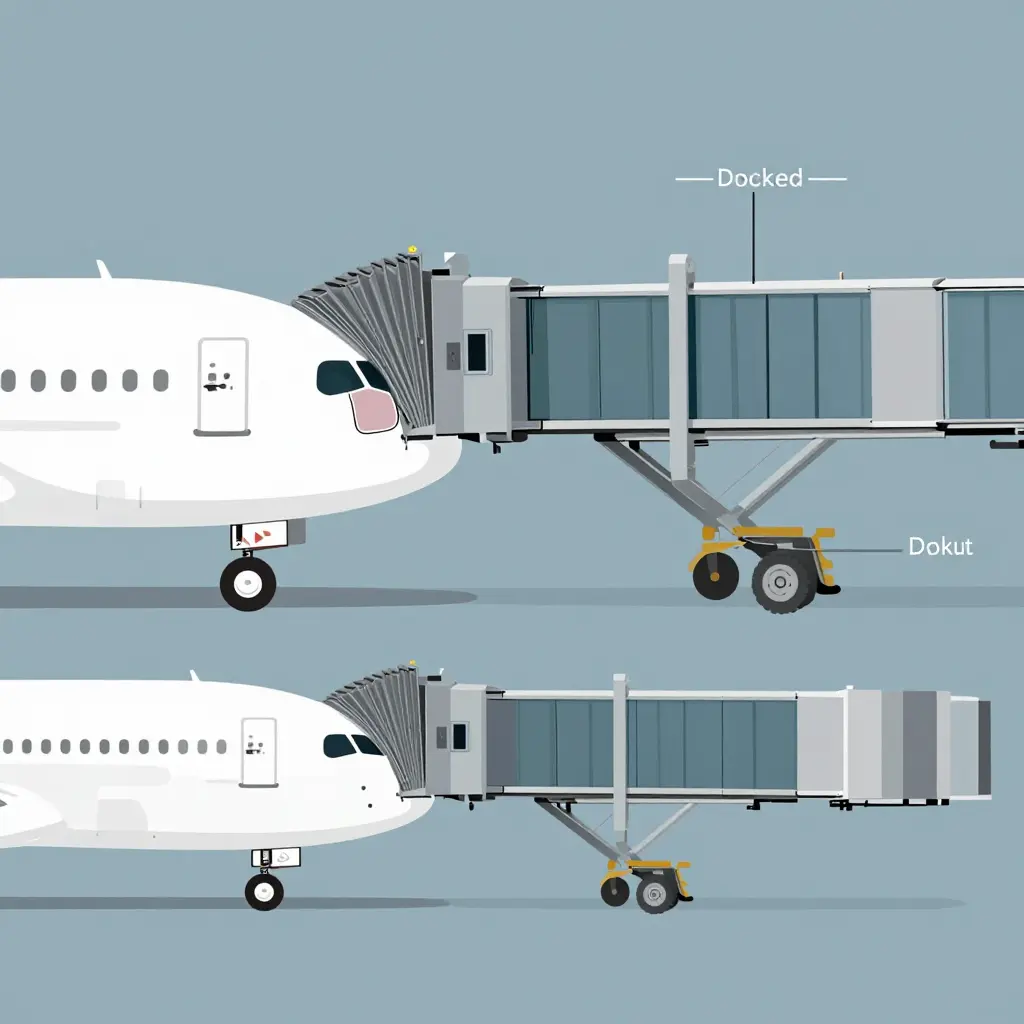
Stand tolerance is how far a passenger boarding bridge and an aircraft door can be offset — horizontally and vertically — and still dock. It sets the acceptable gap between where the cab should sit and where it actually arrives. Keep docking alignment inside that window and the sequence finishes on its own: the bridge connects, the canopy seals, passengers board.
Push past stand tolerance and the docking cycle fails. Sensors flag the mismatch, the automatic sequence stops, and the bridge pulls back to a safe position. An operator then lines it up by hand, which costs turnaround time and puts extra wear on every moving part involved.
Five physical factors set and limit stand tolerance:
- Aircraft type fixes door sill height, fuselage curvature, and approach angle, so a wide-body and a narrow-body need different bridge settings.
- Apron markings put the nose wheel in position. Let them fade or drift, and the door ends up somewhere other than where the bridge expects it, shrinking the usable window.
- Stand geometry — stand dimensions, stop-bar location, surrounding clearance — decides how precisely an aircraft can park.
- Bridge travel range is how far the tunnel can extend, retract, and rotate to reach the door.
- Jetway alignment is how closely the bridge axis matches the door; a small drift here alone can push docking alignment out of range.
These factors interact, so stand tolerance is never a fixed number. It shifts with the aircraft, the pavement, and the condition of the bridge itself, which is why inspecting wear parts on a schedule is what actually keeps docking reliable.
| Aircraft Category | Typical Door Sill Height Range | Recommended Horizontal Tolerance | Vertical Tolerance | Common Fault Triggered When Exceeded |
|---|---|---|---|---|
| Regional turboprop (e.g., Q400, ATR 72) | 1.2 – 1.8 m | +/- 50 mm | +/- 25 mm | Sill contact and premature bumper wear |
| Regional jet (e.g., CRJ, E175) | 1.8 – 2.5 m | +/- 75 mm | +/- 30 mm | Bridging plate misalignment |
| Narrow-body (e.g., A320, 737) | 2.4 – 3.7 m | +/- 100 mm | +/- 40 mm | Auto-level fault and excessive bumper load |
| Wide-body (e.g., 777, A350) | 4.5 – 5.5 m | +/- 150 mm | +/- 50 mm | Drive overload and telescopic jamming |
| Freighter / combi wide-body | 4.8 – 5.8 m | +/- 150 mm | +/- 50 mm | Cabin height sensor drift |
The Role of Wear Parts in Boarding Bridge Reliability
A boarding bridge depends on a handful of moving parts that take constant mechanical stress. Those wear parts decide whether an aircraft docks cleanly or drifts out of tolerance, and knowing which ones matter lets maintenance teams catch a fault while it is still cheap to fix.
Drive wheels and tyres turn motor torque into horizontal travel. As tread thins, traction drops and the bridge creeps or hesitates on final approach. Bogie and pivot bearings let the tunnel rotate and follow the aircraft; once they wear, the cab picks up play and stops tracking a straight line to the door.
Hydraulic cylinders and seals raise, lower, and extend the bridge. A leaking seal turns smooth motion jerky, and fine positioning gets harder. Telescopic rail wear pads hold the tunnel sections in line; when they thin, the sections sag and the cab tilts. Canopy and bumper components take the impact against the fuselage, and a worn bumper passes that shock into the frame, where it disturbs alignment.
Limit-switch actuators tell the control system when travel has reached its limit. A sticky one sends false signals and triggers abrupt stops or over-travel. These parts work as a chain: wear one and the load moves to its neighbour.
That chain explains most docking faults. Wear accumulates, the bridge loses the precision it needs to meet the door, and the cab arrives offset, low, or at the wrong angle. When several parts degrade at once, the error compounds and each approach is less repeatable than the last. Regular inspection and on-time replacement are what break the pattern.
The same discipline applies to other airport ground-safety equipment, where scheduled servicing keeps failures from turning costly.
How Wear Translates into Docking Faults and Downtime
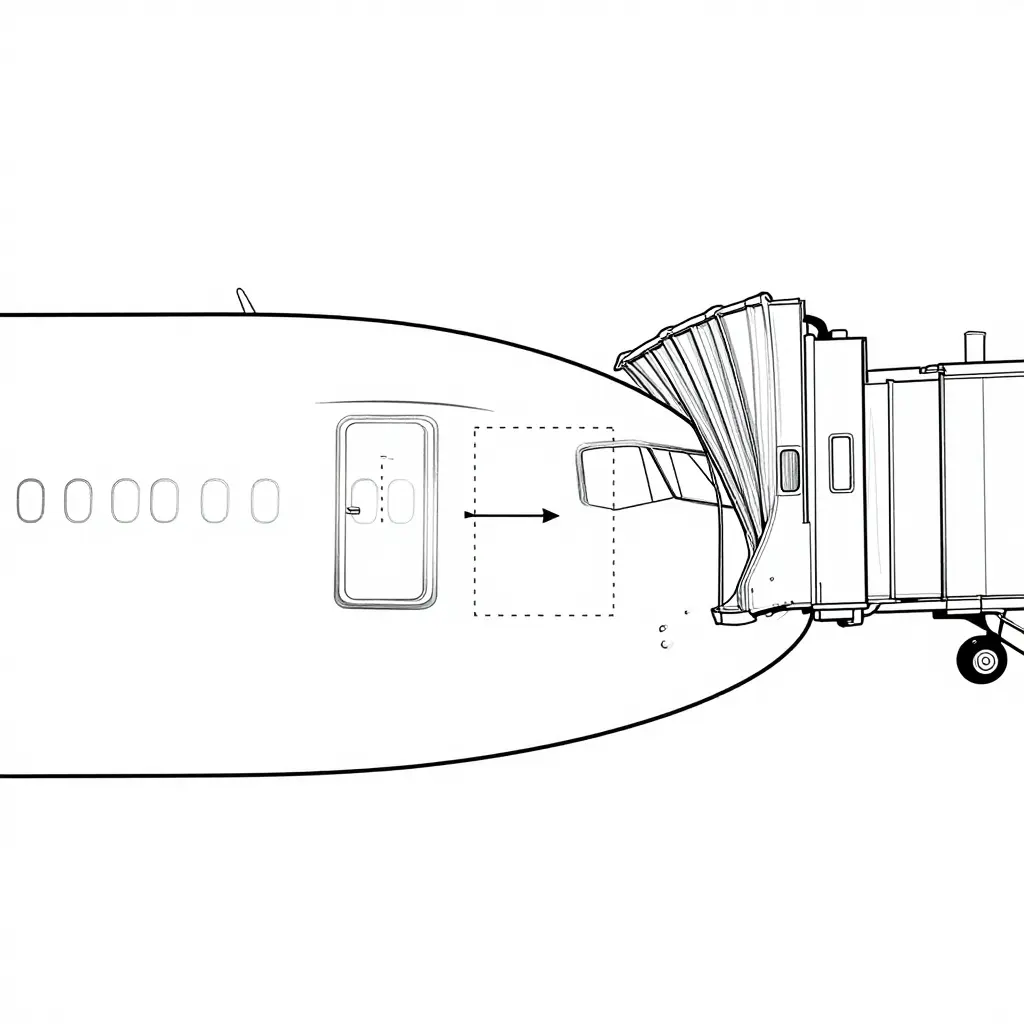
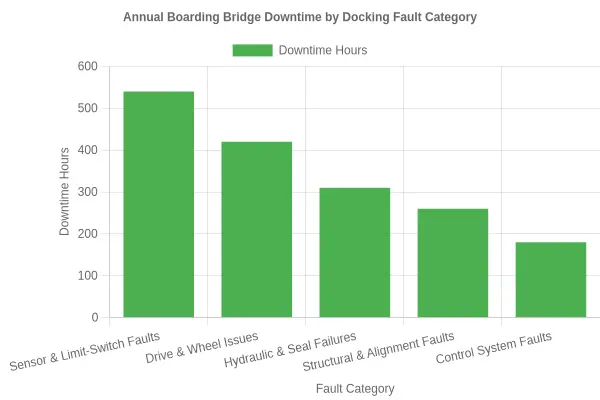
Worn drive components cause docking faults more directly than anything else. As drive motors, gearboxes, and wheel assemblies degrade, the apron-drive system loses the positioning precision it needs to meet a stand tolerance. A guide wheel with flattened bearings, or a drive chain with stretched links, cannot hold the cab level against the door, and the bridge drifts off-axis. The control system sees the misalignment, stops the approach, and makes the operator restart. Every stop costs minutes; across a busy gate they add up to real downtime.
Sensors go the same way. Proximity and limit sensors that confirm cab height, door contact, and travel limits drift out of calibration long before they fail outright. An ambiguous signal leaves the safety logic one option: abort the docking rather than risk a collision. The abort is correct by design. But when the cause is a degraded sensor and not a real obstruction, a routine arrival turns into an unplanned maintenance call.
Hydraulic leakage slows the cycle instead of stopping it. Seals and hoses that weep fluid lose pressure, and the telescoping and elevation functions turn sluggish. The bridge still docks, but every motion takes longer, gate occupancy stretches, and the crew waits. The case for catching small failures early holds across airport ground equipment too, from bridges to the vehicles that support airside emergency response.
Wear does not announce itself. It shows up as stops, aborts, and slow cycles, and only root-cause analysis ties those symptoms back to the parts that caused them. Track the failure mode rather than the symptom and the downtime stops being a surprise.
Calculating the Downtime Cost of Boarding Bridge Faults
A bridge that will not dock cleanly is more than a maintenance ticket. The cost spreads across the whole turnaround, and you cannot control it until you can see where it lands.
The four cost components
A docking fault bills the operation in four places:
- Delayed boarding and turnaround penalties. Each blocked minute delays pushback and the aircraft’s next rotation, and it holds up fueling and catering too. When a gate goes out of service, airlines often pass turnaround penalties and missed-slot charges back to the airport operator.
- Personnel and maintenance labor. On-call technicians, supervisors, and often a second crew for lift or electrical support bill at premium rates, especially outside core hours.
- Parts replacement. Worn rollers, cables, hydraulic units, and control sensors have to be sourced, shipped, and fitted. If the part is not a stocked wear item, aircraft-on-ground urgency drives the price up fast.
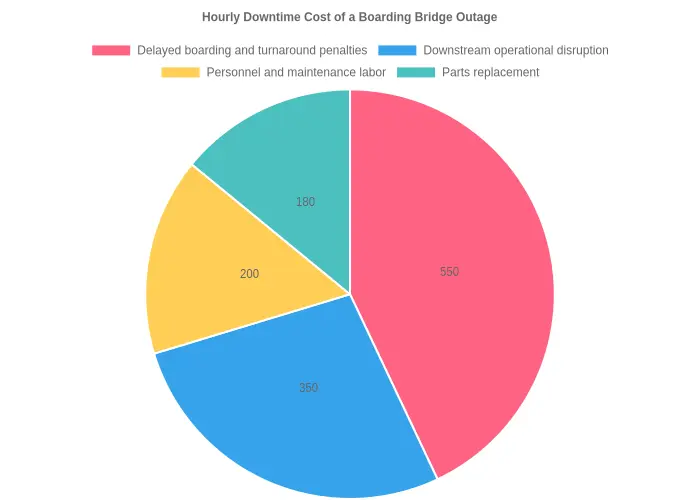
- Downstream operational disruption. Rebooked passengers, gate reassignments, extra fuel burn on late departures, and knock-on delays to later flights rarely appear on the maintenance invoice at all.
The chart below shows how they stack up per hour of unplanned downtime.
A simple way to estimate cost per hour
Start with the direct hourly rates and add them up:
| Cost component | Typical driver | Illustrative hourly impact |
|---|---|---|
| Delayed boarding and turnaround penalties | Missed slot, crew overtime | $300 – $600 |
| Downstream operational disruption | Rebooking, gate reassignment | $250 – $500 |
| Personnel and maintenance labor | On-call technicians, supervision | $150 – $250 |
| Parts replacement | Wear parts, actuators, control units | $100 – $300 |
For a medium-hub stand, the total lands roughly between $800 and $1,650 per hour of downtime — a usable figure for a business case. Faults like these also strain ground access for emergency response, a problem covered in fire trucks on bridges during emergency response.
Why prevention lowers total cost
Monitoring stand tolerance catches alignment drift before it stops boarding, and a fixed wear-parts schedule keeps components within specification. Both cut how often a bridge goes out and how long it stays out, and that is where the savings are. A roller swapped on schedule costs far less than hours of downtime.
A modest spend on monitoring and scheduled parts swaps protects a much larger daily exposure. Skip it and the stand, the passengers, and the schedule all pay.
Conclusion
Boarding-bridge reliability comes down to three things: stand tolerance, wear parts, and downtime cost. Get them right and an aircraft docks on schedule; get them wrong and a single gate fault spreads through the whole turnaround.
Stand tolerance is the precision with which the bridge meets the door. Measure it routinely, document the specifications, and calibrate the same way on every stand, and small misalignments get corrected before they turn into a passenger boarding bridge docking fault.
Wear parts — rollers, bearings, hydraulic seals, sensor assemblies — degrade slowly enough to go unnoticed until performance drops. A replacement schedule turns that unpredictable failure into a planned maintenance window, which protects the equipment and the schedule at the same time.
Downtime cost is the most visible of the three. Every minute a bridge sits out of service means delayed boarding, idle staff, and gate conflicts that ripple to later flights. Hold stand tolerance and replace wear parts on time, and that bill drops.
Monitoring and data-driven maintenance keep getting easier to run. CIMC Tianda, which builds boarding bridges and other airport ground equipment, is one of the manufacturers pushing that technology forward. For operators who invest in precision and prevention, fewer boarding bridge faults and smoother turnarounds follow — and the wider field of airport ground safety equipment is moving in the same direction.