What the sticker price is made of
A fire truck quotation is rarely one number. An equipped unit is built from separately priced blocks, and each block carries its own engineering, material and labour cost. Read only the total and you cannot tell where the money went; compare totals between two suppliers and you are comparing packages, not prices.
The first block is the chassis and cab: engine, driveline, axle ratings, braking and crew cab configuration, frequently built on heavy-duty fire truck chassis platforms. The second is the body and superstructure: subframe, compartment layout, roll-up doors, walkways, hose beds, and any ladder or aerial structure. The third covers pump and foam hardware, from the fire pump and plumbing through proportioning, valves, gauges and controls. Together these three account for most of the visible fire truck price breakdown a business owner receives.
The remaining two blocks are allowances rather than components, and they are the two buyers most often misjudge. The loose equipment allowance funds the hose, nozzles, hand tools, ladders, extrication gear and rescue or medical kit that has to ride on the vehicle. The payload margin is the weight capacity deliberately left unused after the build, so equipment, water, foam concentrate and crew can be added without overloading an axle.
Both are easy to understate in a budget and expensive to correct later. A fire apparatus specification sent out for quotation should name the equipment list and state the remaining payload figure, so the five blocks can be compared side by side.
Loose Equipment Allowance: A Line Item That Grows Quietly
Every fire truck quotation carries at least one number that nobody argues about at the signing table and everybody argues about eight months later. That number is the loose equipment allowance: the budget and the payload weight reserved for everything not bolted, welded or plumbed to the chassis. Hoses, nozzles, branch pipes, suction hoses, ladders, rescue tools, breathing apparatus, hand tools, foam concentrate and portable extinguishing units all live inside it. None of them appear on the chassis drawing. All of them show up at the loading dock.
Why it must be written as two numbers
Specify the allowance twice, once in currency and once in kilograms, because cash buys the gear and kilograms carry it. A buyer who negotiates only the money can end up with a truck that is legally overweight before a single firefighter climbs aboard.
The usual failure is a generous cash allowance sitting next to a tight weight allowance. The specification promises money for gear, the payload margin permits only so much mass, and the purchasing team spends the money on dense items: foam concentrate, suction hose, heavy rescue tools. The builder finds the problem during the weight study, and someone has to remove a locker, cut tank capacity or re-rate an axle. Any of those fixes costs more than funding the allowance properly in the first place.
Insist on itemization by category
Ask for the allowance to be itemised by category in the quotation, so both the money and the mass are visible. Sourcing fire truck parts against a fixed, published line item is far easier than arguing over a lump sum eight months later. A credible quotation breaks it down like this:
- Hose and nozzles: attack lines, suction hoses and branch pipes, which are lighter than they look but bulky in a locker
- Ladders: roof and extension ladders, mounted outside the body yet still counted in the payload calculation
- Rescue and hand tools: cutters, spreaders, hand tools and cribbing, the densest weight per cubic metre on the list
- Breathing apparatus: cylinders and spare bottles, where the full weight is non-negotiable
- Foam concentrate and portable units: drums and wheeled extinguishers, which take budget and payload at the same time
Treat the allowance as a design input and the cost estimate holds together from signature to delivery. Buyers who want to price the gear themselves can review portable fire fighting equipment separately, then hand the supplier a list instead of a hopeful number.
Loose Equipment Allowance: Budget Share and Weight Share to Verify
Loose equipment is the part of a fire truck quote where numbers get vague fastest. The table below splits the allowance into recognisable buckets and shows, side by side, how much of the money each bucket usually absorbs and how much payload it takes with it. Every figure is a range, because a light quick-attack unit and a heavy pumper do not carry the same kit. Use the ranges as a sanity check, not as a price list.
| Equipment Category | Typical Items | Budget Share of the Allowance (%) | Weight Share to Check (kg) |
|---|---|---|---|
| Hose and nozzles | Attack and supply hose, nozzles, adapters – the everyday working kit, so treat it as non-negotiable | 10-15% | 250-600 (higher with longer runs and larger diameters) |
| Suction and water supply fittings | Suction hose, strainers, hydrant and relay fittings – heavier on pumpers and tankers that draft from open water | 5-10% | 150-450 |
| Ladders and access equipment | Ground and roof ladders, hand tools – weight sits high on the body, so check the mounting point, not just the total | 5-10% | 120-350 |
| Rescue and cutting tools | Cutters, spreaders, rams, saws, cribbing – often the biggest surprise cost after hose | 10-20% | 200-700 |
| Breathing apparatus and PPE | SCBA sets, spare cylinders, turnout gear, helmets – counts against seat capacity as well as payload | 15-25% | 250-600 |
| Foam concentrate or extinguishing agents | Foam concentrate, dry powder, CO2 – weight follows tank size, and liquids shift while driving | 5-15% | 200-1,500 |
| Unallocated reserve | Deliberately left open for site-specific kit and late changes – an honest line item, not padding | 5-10% | 150-400 |
Ranges are intentional. The split moves with apparatus class: a small urban unit skews toward hose and PPE, an industrial or foam unit toward agent weight. Present each figure with the class it assumes.
Read the weight column down rather than treating every maximum as typical. Taking the bottom of each row gives about 1,300 kg; taking the top of each row gives about 4,600 kg, which describes no apparatus anyone builds. A light quick-attack unit sits near the low figure, a fully equipped pumper lands around 2,350 kg, and the seven maxima do not occur together. That is why the erosion figures further down this article top out at 2,350 kg.
How to read this against a supplier quotation
Ask the supplier to mark every quotation line against one of these categories and to state weight in kilograms rather than “complete with standard equipment”. A blank category, or a lump-sum “loose equipment” figure with no breakdown, is where you should slow down and ask what is actually included – you can compare real kit options in the portable fire fighting equipment range before signing. Keep the unallocated reserve in the budget on purpose as well: it absorbs the items nobody remembered on day one, and it is easier to defend than a mid-build variation order.
Payload Margin: The Engineering Buffer You Pay For
Payload margin is the gap between the permitted gross vehicle weight stamped on the chassis plate and the sum of everything bolted, tanked or strapped onto it: chassis, body, water, foam and loose equipment. On paper it looks like leftover arithmetic. In practice it is the cheapest capacity in the deal, because you have already paid for it and can still put it to work.
When the buffer runs out, the first casualties are water and foam. A builder protecting a number on the scale will trim tank volume by a few hundred litres, and those litres are what decide whether your crew knocks down a compartment fire on arrival or waits for a second appliance. Fire truck payload capacity is fixed by regulation rather than by goodwill, so the tank and the margin compete for the same kilograms. Something has to give, and it is usually the water.
Thin margin also arrives with paperwork. Dropping equipment onto a truck after delivery can push individual axles past their ratings, which means re-certification, fresh documentation and sometimes a suspension rebuild. It redraws your map too: posted bridges, weight-limited industrial roads and older site access routes become off-limits once the vehicle edges past its original design envelope.
And it caps every future upgrade. Radios, thermal cameras, cutters, extra hose and a larger foam proportioner all arrive with weight attached. Owners who bought margin fit them without a second thought; owners who bought a fully loaded specification end up removing water to make room for a winch.
The trap is that the loose equipment allowance spends this margin directly. Every extinguisher, nozzle and set of irons you specify eats into the buffer. The two line items therefore belong at the same negotiating table, preferably before you start comparing foam fire truck platforms. Lock the equipment list, then ask the builder for the resulting weight sheet with the balance stated. Unused margin is not capacity sitting idle; it covers wet hose, full fuel tanks, a heavier crew than expected and the equipment nobody has thought of yet.
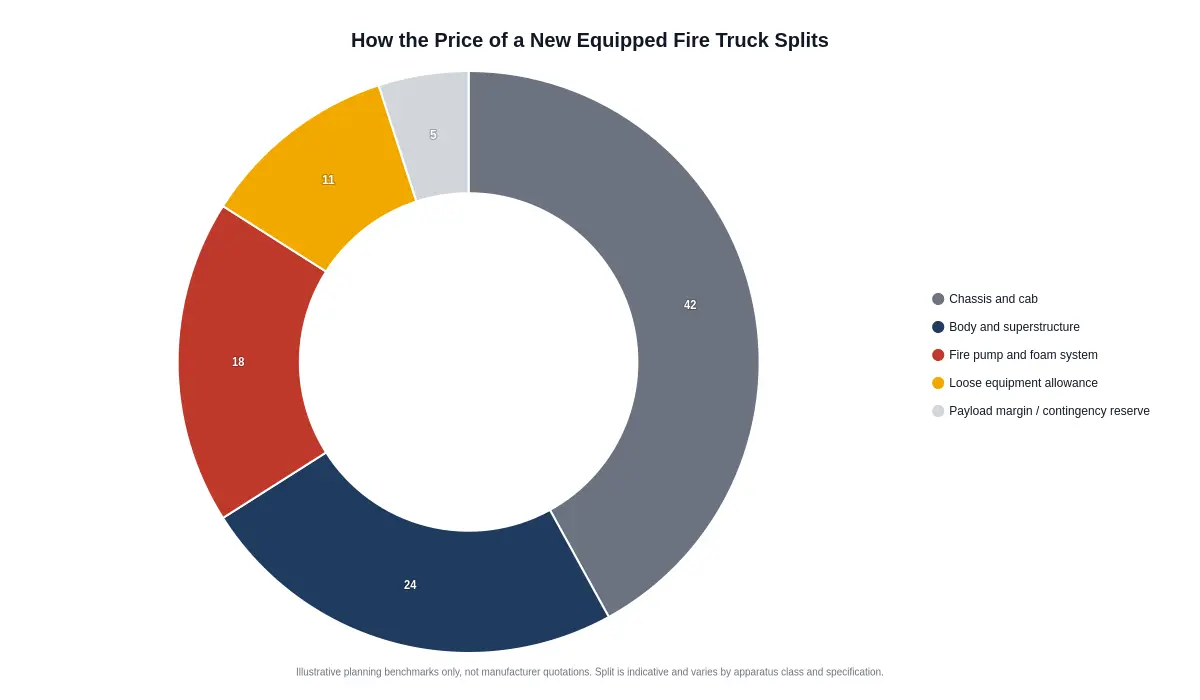
On a typical build the split runs 42% chassis and cab, 24% body and superstructure, 18% fire pump and foam system, 11% loose equipment allowance, and 5% payload margin or contingency reserve. The last two are the lines buyers most often under-budget. Treat the shares as planning benchmarks for your own business case, not as manufacturer quotations.
Note: the split is indicative only and shifts with apparatus class and specification.
Quotation Review Checklist for Business Owners
A quotation protects you only if the numbers are written into it. Work through these eight points before signing.
- Payload margin in kilograms. Ask for the figure remaining after full equipping, as one number, and check that the same number appears on the signed specification sheet.
- Loose equipment allowance, split in two. The quotation should carry it twice, once as a cash amount and once as a kilogram figure, on two separate lines.
- Tank capacity at full load. Every tank, foam concentrate included, with working volumes in a table you can cross-check against the foam fire truck configurations you are buying.
- Axle loads after equipping. Front and rear, calculated with all equipment fitted and tanks full, and shown against the chassis manufacturer’s rating.
- Agent density tolerance. Foam concentrates vary in density; ask how the quotation handles the difference and get the accepted tolerance band in writing.
- Reserve for later additions. Whatever weight is held back for equipment you may add later should be published as a figure separate from the loose equipment allowance.
- A written exclusion list. Ladders, hose, winches and crew gear: if they sit outside the allowance, the list should be an annex to the contract.
- Weighing method before delivery. Who attends, which certified weighbridge is used, and whether the weighbridge ticket counts as a delivery document.
Eight written confirmations are the difference between a friendly quotation and a number you can hold a supplier to. Skip them and the margin absorbs whatever arrives late: optional extras, denser foam than budgeted, equipment that turned out to be excluded.
Payload Margin Is Not Leftover Space
A new fire truck quote usually looks tidy on the page: chassis, cab, body, pump, tank, foam system, one total at the bottom. Those are the money blocks described at the top of this article. What almost never appears as its own line is the distance between what the truck is legally allowed to weigh and what your equipment list actually weighs.
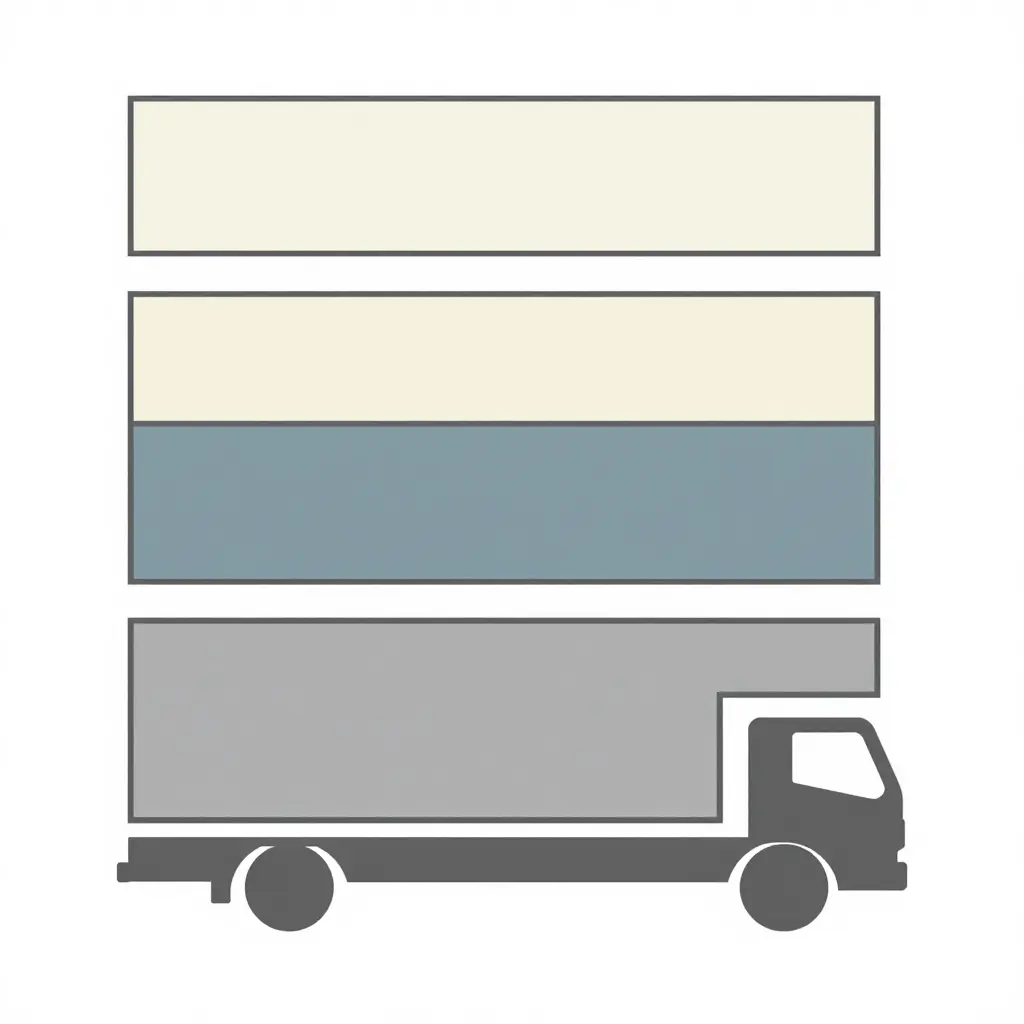
That gap is the payload margin, and it is where late builds get expensive. The blocks are easy to picture: chassis and cab at the bottom, body and superstructure above it, then water and foam payload, then the loose equipment allowance – hoses, tools, ladders, extrication gear, the small items that arrive in boxes and never stop accumulating – and finally a band at the top that is deliberately held back. That band is your margin, and it is the only part of the stack you have not already committed.
This stack is a weight model, not the price split. On the weight side the pump and its plumbing sit inside the body and superstructure block; on the price side they are quoted as their own 18% line. The two models answer different questions and should not be read across each other.
The margin needs its own line because the block directly beneath it is the one that moves. A loose equipment allowance is an estimate, not a fixed quantity. Every increase in that estimate shrinks the reserve, and once the reserve is gone you are not buying a lighter truck, you are buying a truck that has to be re-specified.
Reading the Stack From Bottom to Top
Once the stack is on the table the negotiation changes. Instead of arguing about tank size in isolation, you can ask which block a change is being taken out of. The layers behave like this on a commercial or custom build.
| Stack layer | What it represents | Who usually owns the number |
|---|---|---|
| Payload margin band | Reserve capacity held back after all other blocks are counted | Dealer and upfitter, agreed with you |
| Loose equipment allowance | Estimated weight of hoses, tools, ladders and loose gear | You, informed by the upfitter |
| Water and foam payload | Tank volume and agent weight, including foam concentrate | Your response requirements |
| Body and superstructure | Compartmentation, pump module, tank cradle, walkways | Body builder |
| Chassis and cab | Bare chassis, cab, fuel and driver | Chassis manufacturer and dealer |
Four things worth settling before you sign off a specification.
- The allowance should be a number. Kilograms or pounds on the specification sheet; “Plenty of room” is not a specification.
- If the reserve is a percentage, find the baseline. Five percent of gross vehicle weight and five percent of payload capacity are very different commitments.
- Foam systems add weight that never shows on the body drawing. Proportioning hardware, concentrate tanks and plumbing all draw from the same stack, which is why matching the specification to the right foam fire truck configuration early avoids re-plating later.
- The band is also retrofit space. Radios, cameras, scene lighting, drone docks and battery systems arrive after delivery, and a truck built with zero margin has nowhere to put them.
What the Reserve Band Actually Buys
Optionality, mostly. A truck with real payload margin can take a heavier hose load, a larger concentrate tank or a new piece of equipment three years from now without a trip to an engineering office. It also protects resale, because the next owner inherits the headroom instead of a specification that is already maxed out.
One habit is worth building. Before approving a build sheet, find the top band on the diagram and point to it. If you cannot, ask where it went. A quote that states the margin explicitly was usually put together by someone who expects the truck to still be working in year ten.
Chassis, Body Build and Integration: Where the Remaining Budget Sits
Most buyers start with tank size and pump rating, then treat everything else as a shopping list of accessories. It works the other way round. The fixed portion of an equipped fire truck’s price is set by structural choices made before a single nozzle is loaded, and that fixed portion decides how much budget survives for loose equipment and how much margin is left over.
Chassis class and configuration
A commercial chassis keeps cost predictable. Step up to a custom cab on a heavy-duty fire truck and the numbers move in ways that do not reverse: heavier frame rails, higher gross axle ratings, longer wheelbases, air brake systems and reinforced mounting points all carry fixed engineering and certification cost. Add an aerial device and the chassis has to absorb stabiliser loads and outrigger reinforcement, which is why an aerial fire truck sits in a different cost band altogether. Trimming lockers does not give that money back.
Body material, compartment layout and pump drive
Body build decisions set your payload ceiling. Aluminium, stainless steel and composite bodies differ in tare weight, repair philosophy and price, and compartment layout determines how much of the advertised body volume becomes usable storage. Pump drive – PTO, split-shaft or midship – then reshapes the packaging envelope around the pump, plumbing and driveline. A body that looks generous on paper can consume several hundred kilos of payload before you load a single length of hose, so a tank capacity that reads fine in the brochure may leave little room for rescue tools or extra water supply equipment.
Integration hours and compliance load
Every system added after the chassis and body are set is billed in skilled labour hours plus test time: foam proportioning and CAFS plumbing, scene lighting, radios, pump panel instrumentation. Heavier apparatus carries proportionally higher integration and compliance cost, because there are more circuits, more plumbing runs, more weight distribution calculations, more braking and stability verification and more documentation. Chassis, body and integration are the decisions that set the budget, not the finishing touches. What your fire apparatus specification leaves for loose equipment is whatever survives them.
Where Loose Equipment Allowance Quietly Eats Your Payload Margin
Every specification starts with a comfortable number: gross vehicle weight rating minus curb weight leaves a payload figure that looks generous. Then the quotations start stacking up. Hose, nozzles, ladders, extrication tools, SCBA cylinders, foam concentrate, scene lighting, winches, cribbing, and the mounting hardware that holds it all in place. None of it is heavy on its own. Together it consumes the margin you were counting on for water, foam and crew.
Reading the trade-off in the chart
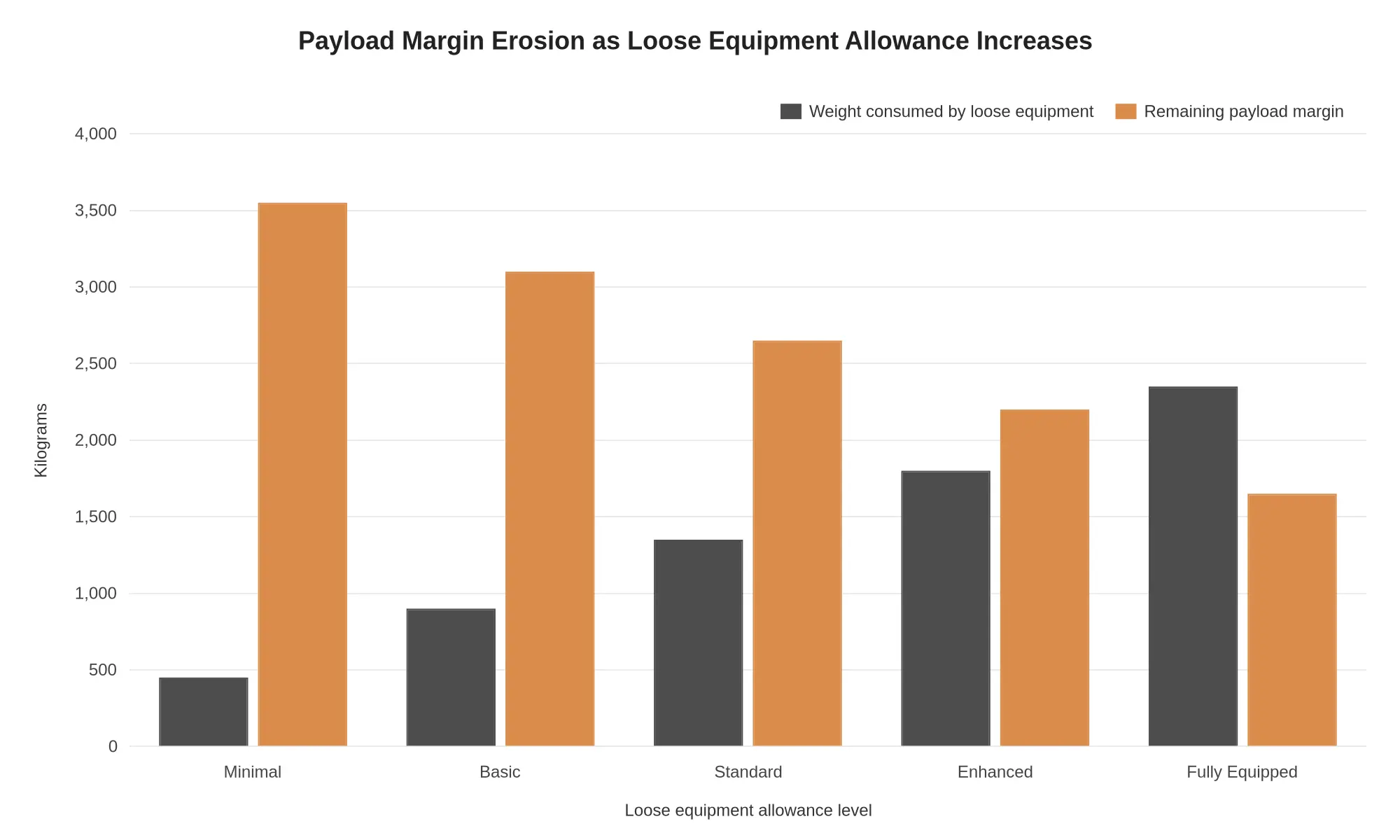
Each allowance level carries two bars, from a minimal kit through to a fully equipped configuration:
- Grey bars show the kilograms claimed by loose equipment and its mounting.
- Orange bars show what is left as usable payload margin once that equipment is accounted for.
- The two series add up to the same working envelope at every level, which is the whole point: a kilogram added on one side is a kilogram removed from the other.
At the minimal end, roughly 450 kg of loose equipment leaves 3,550 kg of margin for water and crew. At the fully equipped end, equipment rises to 2,350 kg and the remaining margin falls to 1,650 kg, a drop of more than half. No single step looks dramatic, which is why the cumulative slide catches buyers out.
Turning the chart into a purchasing decision
Before you sign, ask for the allowance in writing and ask where it sits relative to tank capacity. A 2,000 litre water tank weighs in around 2,000 kg before you add foam, plumbing and the pump. On a lighter chassis, a generous equipment allowance can push the build into a heavier class, which changes axle ratings, braking, tyre specification and eventually the price.
If your department genuinely needs a full complement of tools on board, plan for the weight from day one rather than discovering it at the weighbridge. Selecting a chassis with headroom, such as a heavy-duty fire truck platform, usually costs less than retrofitting capacity later. For smaller budgets and tighter streets, the smarter move is often to trim the allowance and keep the margin.
Note: the values shown are illustrative and depend on chassis class, tank capacity, pump configuration, and local equipment standards. Use them as a conversation starter with your builder, not as a specification.
Quick reference: allowance versus remaining margin
| Allowance level | Loose equipment (kg) | Remaining payload margin (kg) |
|---|---|---|
| Minimal | 450 | 3,550 |
| Basic | 900 | 3,100 |
| Standard | 1,350 | 2,650 |
| Enhanced | 1,800 | 2,200 |
| Fully equipped | 2,350 | 1,650 |
Beyond the Purchase Order: Cost of Ownership Discipline
The purchase order is signed, the keys are handed over, and the spending starts. Two line items that looked like minor spreadsheet details at the quotation stage govern what you pay every month for the next decade: the loose equipment allowance and the payload margin.
Start with weight. Every kilogram you carry burns fuel and wears rubber. A truck that arrives over-specified – oversized tanks, extra tools, a heavier body than the duty cycle requires – pays for that excess at every fill-up and every tyre change. Over a service life measured in hundreds of thousands of kilometres, a modest weight penalty compounds into a serious operating cost, and it never appears on the original invoice.
The allowance behaves the same way when it is set too low: the shortfall does not disappear, it moves. Hose, nozzles, ladders, rescue tools and PPE that belonged in the capital purchase become unbudgeted purchases in year two or three – bought at retail, delivered late, and often at a specification that does not quite match the truck.
A thin payload margin leaves no room for the upgrades every fleet eventually wants: a larger monitor, additional foam capacity, a new communications package. Adding weight after delivery can also push the vehicle outside its rated configuration and trigger re-certification, re-testing and axle re-rating that nobody planned for. For an industrial fire truck working a fixed annual budget, those surprises land hard.
A well-structured equipped fire truck cost structure does the opposite. Allowance, payload margin, fuel, tyres and maintenance are all sized at specification, so cost lands predictably across the service life instead of arriving as a retrofit.
Takeaway: the cheapest bid is rarely the lowest fire truck total cost of ownership – buy the margin up front, or pay for it later.
Frequently Asked Questions
What is a loose equipment allowance on a new equipped fire truck?
It is the budget and the weight set aside for tools, hose, nozzles and gear delivered with a new fire fighting truck. It covers items that are not permanently mounted, so the vehicle arrives service-ready without exceeding chassis limits.
How much payload margin should be reserved?
A workable target is 10 to 15 percent of rated payload left after loose equipment is loaded. State the baseline alongside the figure, because 15 percent of payload and 15 percent of gross vehicle weight are quite different amounts of weight. The buffer covers added tools, extra water, foam and crew weight over the service life, and it keeps axle loads legal and braking performance inside rated limits.
Can the loose equipment allowance be increased after the order is placed?
Usually yes, but only within the remaining payload margin and only before the body build is locked. Later changes tend to trigger re-engineering, re-weighing and a price adjustment, so request any increase in writing during the pre-build review stage.
Why does tank capacity reduce payload margin?
Water is heavy. Every 1,000 litres weighs roughly one tonne, and that mass counts against gross vehicle weight. A larger tank leaves less payload margin for loose equipment, so suppression duration is traded against tool, hose and crew capacity.
Should the allowance be quoted in currency, weight, or both?
Both. Weight confirms the load stays inside legal axle limits; currency defines what the budget actually buys. A supplier who lists kilograms next to cost makes the allowance plannable and puts two competing quotes on the same footing.
Structuring the Budget Before the Specification Is Fixed
Everything above comes down to sequencing: settle the money and the mass before the hardware list hardens. A loose equipment allowance is not a rounding cushion tacked onto the end of a quotation. It is an itemised budget line, carried twice – once as cash that survives into the purchase order, once as weight that survives into the axle and payload calculation. Payload margin needs the same discipline: sized deliberately, priced into the chassis and body from the outset, and defended against the slow erosion of late additions. Margin that is simply whatever remains after everything else has been chosen is not margin at all; it has already been spent.
Three things worth doing on a first equipped purchase:
- Build the allowance as a list, not a lump sum. Name each item with its cost and its weight, then hold that schedule through negotiations so every substitution is compared on weight as well as price.
- Fix the payload reserve before the body is designed. Decide the share of gross vehicle weight that must stay uncommitted and write it into the specification as a requirement with a price attached, not as an outcome to be discovered later.
- Re-quote when either figure moves. A change in the allowance changes the cash total and the weight total, and both should trigger a documented revision, not a verbal adjustment.
Apparatus class belongs at the end of that sequence, not the beginning. The payload and allowance figures decide whether a fire fighting truck on a commercial chassis can carry the intended tool load, or whether the mission profile points toward ARFF aircraft rescue fire fighting apparatus with entirely different weight and space characteristics. Choose the class first and the allowance ends up absorbing decisions it never informed.
An equipped fire truck cost structure is only reliable when the cash budget and the weight budget are written down, itemised and defended before the specification is fixed.