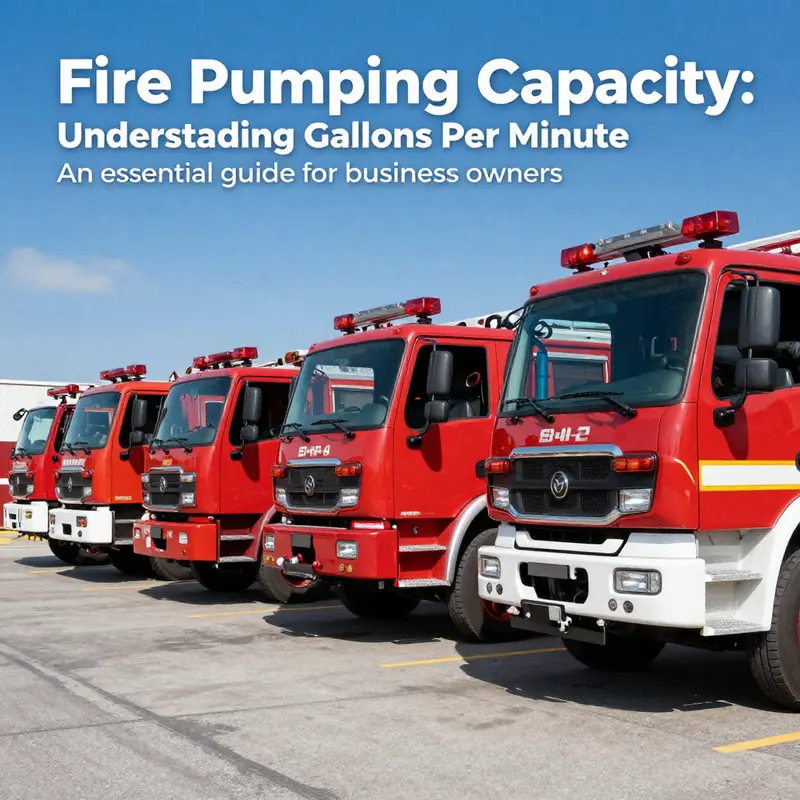
Shopping for fire trucks for sale in Canada means committing capital, not flipping through a catalogue. The budget has to carry fleet readiness, insurance exposure and whatever rules the province where the truck will run actually enforces.
Two items decide whether the purchase performs: provincial inspection rules and cold-start commissioning. Get either wrong and a delivered unit sits idle while permits stall and the first January start fails.
Treat both as purchase criteria, the same way you treat parts availability and a realistic lifecycle budget. Our commercial fire trucks range shows the configurations built for Canadian conditions. The sections below cover how to verify compliance, plan commissioning, and price the whole life of the unit before you sign.
- Compliance: find out which provincial inspections apply to your unit before you sign, so permits do not hold up delivery.
- Commissioning: run a cold-weather start protocol that protects engines, pumps and seals through a February freeze.
- Lifecycle cost: model ten years of ownership, including parts lead times, technician rates and resale value.
How Provincial Inspection Authority Works in Canada
If you have moved apparatus across a provincial border, or bought a used pumper from photographs, you already know the paperwork never looks the same twice. Canada has no national fire apparatus inspectorate. Each province and territory sets its own rules, and those rules, not federal ones, decide whether a truck can be plated, insured and placed in service.

Why the Authority Rests With Provinces and Territories
Under the Constitution Act, 1867, property and civil rights, municipalities and the regulation of road vehicles fall to the provinces. Fire service delivery is organized provincially and municipally. Ottawa’s interest is narrow: interprovincial transport, federal workplaces, aviation, dangerous goods in transit. The general safety condition of a fire engine is not a federal file.
So each jurisdiction writes its own act and regulation, then treats national model codes and consensus standards as accepted references. The labels change, the thresholds shift, the forms differ, but the structure underneath is consistent enough to plan around.
The Building Blocks Every Regime Shares
Pre-Purchase and In-Service Inspection
Before a unit is transferred or first registered, a qualified third party inspects the chassis, brakes, tires, electrical system, warning devices, pump, tank and body. Some jurisdictions insist the work be done at a designated facility; others accept a detailed report from a certified technician. Either way, the seller’s documentation package matters as much as the wrench work.
Annual or Periodic Re-Inspection
Once commissioned, most regimes impose a fixed interval: annually for the fleet at large, more often for certain classes. Inspections are documented and retained, and a failed unit comes off the run until it is corrected. That paper trail follows the apparatus for its working life.
Pump and Aerial Testing
Pump performance is verified against rated capacity and pressure, including relief valve function and priming. Aerial devices get structural and operational tests at defined intervals, sometimes with non-destructive examination of critical welds. Owners of aerial fire truck platforms should carry this cost as its own line, separate from routine mechanical service.
Documentation of the Data Plate
The data plate carries the truck’s identity: manufacturer, model, serial number, pump rating, tank capacity, gross vehicle weight, build date. Inspectors check it against build records, and a mismatch stops registration. Keep it legible. A heavy repaint can make a plate unreadable and cost you weeks.
Acceptance of Out-of-Province Units
Units from elsewhere are usually welcome, rarely accepted automatically. Another jurisdiction’s inspection may be recognized as-is, accepted with conditions, or refused in favour of a fresh inspection by a locally accredited body. Local expectations get layered on top: markings, warning lights, hose threads, registered weight class.
What This Means for a Buyer
Build the inspection file before money changes hands, treat the data plate as its spine, and get written confirmation of which authority will certify the unit after delivery. Handled early, that is a line item. Handled late, it is a delay.
The table below sets these building blocks side by side, including the places where provincial rules converge and the places where they differ.
Typical Provincial Fire Apparatus Inspection Requirements to Verify Before Purchase
Provincial rules differ, yet most buyers are asked for the same core documents before a sale closes. The comparison shows what inspectors typically want, how it is proven, and where timelines tend to stretch.
| Requirement Category | What Buyers Usually Must Provide | Typical Evidence Format | Effect on Sale Timeline |
|---|---|---|---|
| In-service inspection certificate | Current certificate from recognized inspection facility | Signed certificate with date and inspector ID | Fast if valid; 1-3 weeks if expired |
| Pump performance test record | Recent pump flow and pressure test results | Printed test sheet with certified gauges | Adds 1-2 weeks if retest needed |
| Aerial or ladder load test | Structural load test within validity window | NDT report plus load test certificate | 2-4 weeks for recertification |
| Apparatus weight and axle compliance | Scale ticket and axle load calculation | Weight slip and manufacturer rating sheet | Minor delay; often same-day verification |
| Electrical and lighting check | Working lights, siren response, battery health | Inspection checklist signed by technician | 1 week for repairs if faults found |
| Foam system verification | Proportioning accuracy and tank integrity proof | Foam calibration test data and service log | 1-3 weeks if recalibration required |
| Out-of-province transfer inspection | Provincial safety inspection after import | Transfer safety certificate issued locally | 2-6 weeks depending on province |
| Annual re-inspection scheduling | Confirmed renewal date and service provider | Booking confirmation and compliance calendar | No delay if booked before delivery |
| Cold-weather start and operation test | Verified cold start, heater, and brake performance | Test log with ambient temperature recorded | 1 week in winter months |
| Brake and tire certification | Minimum tread depth and brake adjustment proof | Technician measurement report | Same-day unless parts required |
Aerial equipment moves budgets and timelines the most, so review aerial ladder fire truck specifications early in your planning.
Inspection scopes, expiry windows and test intervals are set provincially and they change. Confirm current requirements, forms and accepted test providers with your local authority having jurisdiction before you sign or book transport.
Documentation Checklist Before You Commit
A used apparatus can be good value or a money pit, and the difference usually shows up in the paperwork rather than the paint. When you are shopping used fire trucks for sale in Canada, the seller’s word is no substitute for a signed, dated record that a third party can verify. Give the file the same attention you give the pump, the frame and the mileage.
Start collecting before you discuss price, not after. Every item below should be a copy you keep, cross-checked against the VIN, the pump serial number, the aerial or ladder serial number and the build plate. If a document exists but the seller cannot produce it, treat it as missing until proven otherwise.
- Inspection certificates: current provincial or third-party safety inspection paperwork confirming the truck legally passes as built, with the inspection date and the inspector’s licence number visible.
- Pump test reports: a dated performance test showing rated flow at pressure, so you can check that the pump still delivers what the spec sheet promises at 150 psi and at maximum volume.
- Ladder or aerial certification: non-destructive and load test records for any aerial device, including the certification body, test date and next due date.
- Weight and axle documentation: scale tickets and axle rating plates, so you can confirm the truck is legal for Canadian highway weights and will not need re-plating or re-certification on delivery.
- Service and maintenance history: work orders, oil analysis and pump packing or seal changes that show how the truck was cared for between calls.
- Cold-weather package specification: written details on block heaters, battery warmers, heated pump compartments and glycol systems. This is the item that decides how cold-start commissioning goes in a Canadian winter.
- Warranty transfer terms: the original warranty documents plus a written statement of what transfers to you, for how long, and whether the transfer fee is included.
- Delivery acceptance forms: a signed checklist covering fuel and fluid levels, key and equipment inventory, hour meter readings and cosmetic condition at handover.
- Ownership and lien clearance: title or registration plus a lien search confirming no financing claim follows the truck into your yard.
- Build and modification records: factory build sheets and any documented body, chassis or equipment changes, useful when you weigh chassis and body selection against your own response requirements.
When documents are missing, the cost and the delay land on you. A missing pump test means paying for a re-test and losing weeks of availability while the truck sits. Gaps in inspection paperwork can force a re-inspection, a re-plating or an unexpected repair before the vehicle is insurable and road-legal. Thin service history raises the odds that your insurer or lender demands a mechanical assessment at your expense. And without delivery acceptance forms it is nearly impossible to prove what was included, so shorted equipment becomes your purchase rather than the seller’s problem. Insist on the full file, in writing, before you sign.
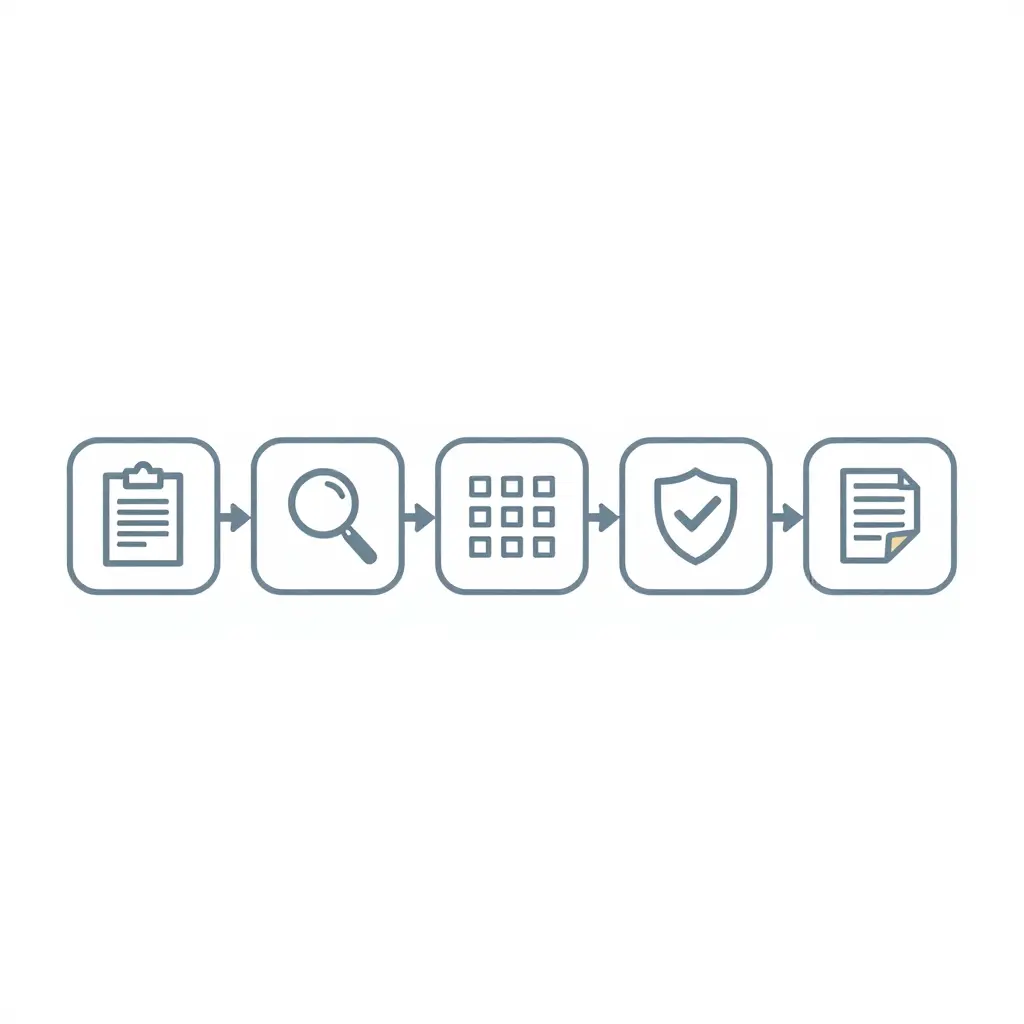
Inquiry, documentation, physical inspection, approval, acceptance: five steps, in that order.
Cold-Start Commissioning: A Fixed Sequence Worth Following
On a winterized apparatus going into service, cold-start commissioning follows one order: verify the battery and charging system, confirm coolant and block heater function, guard against fuel gelling, check the air system and brakes at low temperature, prime the pump and exercise every valve, calibrate the foam proportioner, and only then run a staged warm-up ahead of load testing. Skip to flow tests on a frozen drivetrain and the numbers tell you nothing, while a pump, a seal or a season goes with them.

Battery and charging system verification
Load-test each battery instead of reading voltage. Check alternator output at idle and under load, terminal torque and corrosion, and that the battery blanket or heater pad cycles. Then confirm the on-board charger brings the bank to full overnight, and that the boost stud is clean and working.
Coolant and block heater function
A refractometer reading tells you the freeze point suits your region’s design low. From there, check that the block heater, thermostat and cab heater core deliver real heat within a reasonable window. Look for weeping hoses, and check level at both the cold and hot marks.
Fuel gelling precautions
Confirm the fuel in the tanks suits the season, treat or blend as required, and verify the fuel heater and water separator work. Cold-filter plugging is the most common reason a winterized truck fails to start on the first call.
Air system and brake checks at low temperature
Watch compressor build-up time, governor cut-out and air dryer purge. Drain tanks for moisture, confirm the dryer is actually drying, then check brake stroke, slack adjuster travel and spring brake hold on a cold, unheated unit.
Pump priming and valve operation
Test the priming system for vacuum retention, then cycle every valve, drain, relief valve and tank-to-pump line. Packing and seals that sat cold tend to weep or seize. Better to find that in the bay than at a call.
Foam proportioner calibration
Calibrate the proportioner across its full flow range with cold concentrate, which is noticeably thicker than the drum label assumes. Check injection rates against manufacturer targets and confirm the foam-capable apparatus plumbing holds pressure without leaks.
Staged warm-up before load testing
Bring the truck up through idle, then moderate load, then full operating temperature before any performance test. Metal, seals and lubricants need to reach their designed clearances first. A pump tested cold can score its wear rings or seize a shaft, and whatever it reads says nothing about real capacity. A staged warm-up also shows whether coolant temperature, transmission fluid and hydraulic circuits settle before the pump is asked to work.
Work through it in order and log each step. The log is what proves the truck was commissioned, rather than merely delivered.
How Long Should a Cold Truck Warm Up Before Load Testing?
When a fire truck is commissioned in a Canadian winter, the pump test is where patience runs out. Cold hydraulic oil, stiff grease and thick coolant all need time before you ask for rated performance. The chart below splits a staged warm-up by system group, so you can sequence the work instead of idling for an hour and hoping.
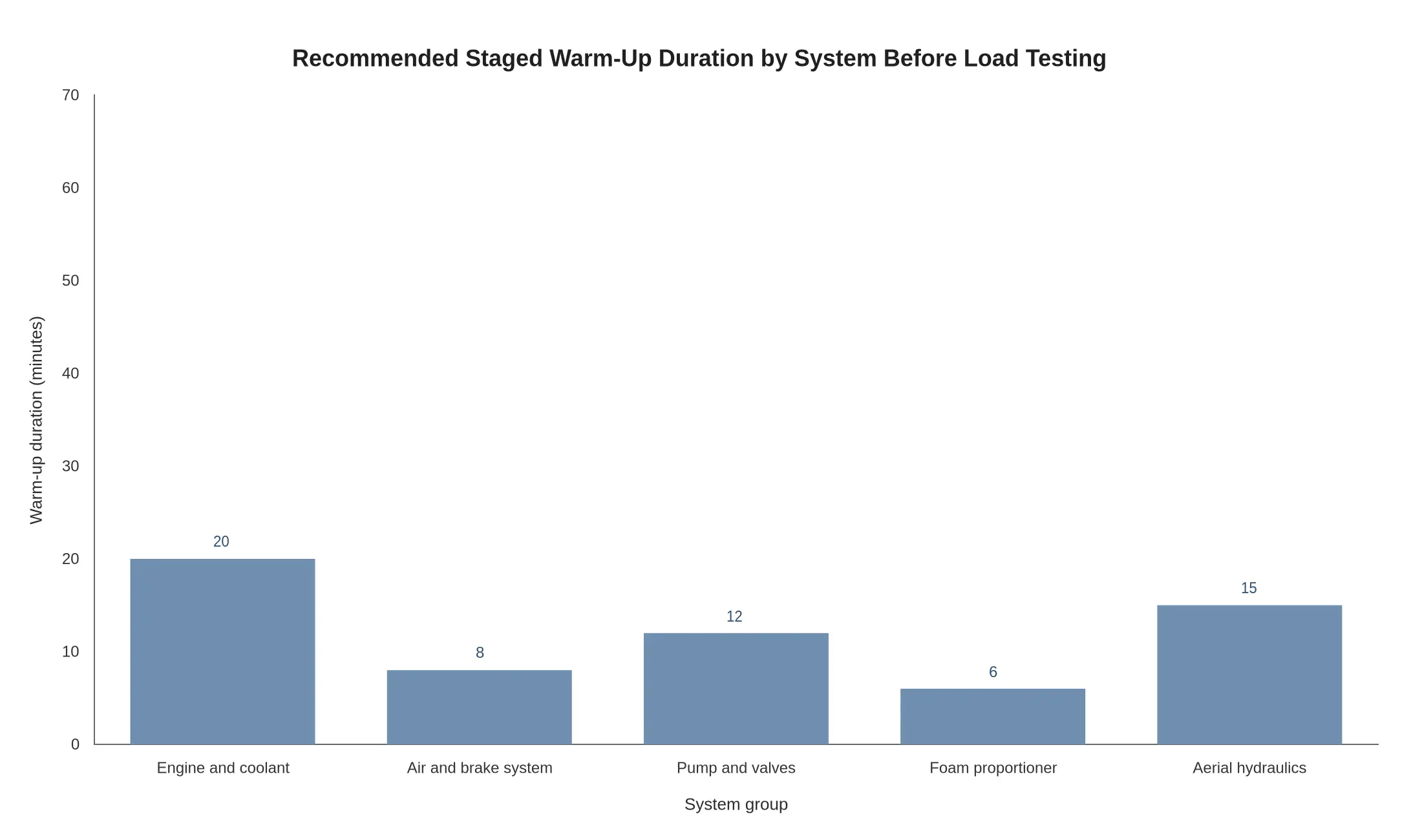
Reading the Bars
| System Group | Warm-Up (min) | What You Are Waiting For |
|---|---|---|
| Engine and coolant | 20 | Coolant above 60 C so the block and turbo are stable under load |
| Air and brake system | 8 | Air dryer cycling, tanks at full pressure, no moisture slug |
| Pump and valves | 12 | Gearbox oil thinned, suction and discharge valves cycling freely |
| Foam proportioner | 6 | Foam concentrate flowing evenly, no cavitation in the pump |
| Aerial hydraulics | 15 | Oil at operating viscosity before boom movement |
| Staged total | 61 | Minimum baseline before any rated load test |
Read the numbers as a floor, not a target. On a -20 C morning the engine stage can double, and a truck with an aerial fire truck boom circuit deserves more patience before the first raise. These are planning figures drawn from typical commissioning practice, not a manufacturer’s bulletin, so adjust them to the unit and the forecast.
Budget about an hour of staged warm-up, 61 minutes across the five groups, before a cold truck goes through its rated load test. The engine and coolant stage alone accounts for a third of it, and it is the stage crews skip.
Winterization Specifications to Confirm in the Purchase Agreement
A truck that ran clean in September can still refuse to turn over in Yellowknife in January, and the parts that fail are usually the ones nobody wrote down. Before you sign, every winterization item below should appear as a specific line in the purchase agreement with a measurable acceptance criterion, not as an assurance that the unit will arrive as “fully winterized fire apparatus.” Buyers ordering a heavy-duty fire truck chassis for prolonged sub-zero duty should treat these clauses as non-negotiable.
- Block and coolant heaters: the heater wattage and thermostat set point, plus confirmation that the cord or plug is mounted where a gloved crew member can reach it without climbing onto the apparatus.
- Battery blankets: thermostatically controlled wraps on every starting battery, with a maintainer, so cold cranking capacity survives an overnight soak at -30 C.
- Heated pump compartments: a thermostatically controlled heater or engine coolant loop inside the pump house, with the sensor placed away from the heater so the reading reflects the compartment rather than the element.
- Drain and freeze protection: a documented list of drain points for the pump, primer, gauges and low spots in the plumbing, plus written air-blowout instructions for post-call shutdown.
- Cold-weather lubricants and fluids: the exact grades of engine oil, hydraulic fluid and pump gearbox oil shipping in the unit, named on the build sheet rather than left “as required”.
- Insulated water tanks: insulation thickness, and the tank sitting inside a heated enclosure rather than exposed to the frame rails. This matters most on industrial fire truck packages for plant and terminal sites that may sit idle for weeks.
- Operator training on cold-start procedure: a documented walkthrough at delivery covering preheat time, correct ether or intake heater use, air dryer behaviour, and the order in which systems come online.
Every item here is cheap to specify at quotation and expensive to retrofit, so tie each one to the acceptance inspection. Ask the dealer to sign off on a cold-soak demonstration, confirm which items carry warranty coverage, and keep the signed specification with the bill of sale. That page is what your fleet has to lean on at the first hard freeze.

Reading the chain left to right: power check, temperature check, fluid and valve check, mechanical systems check, final gauge verification.
Lifecycle Cost and Compliance Risk: The Number Nobody Quotes You
Every apparatus purchase starts with a quote sheet, and that sheet is rarely the real number. Total cost of ownership plays out over 15 to 25 years and includes commissioning, inspections, downtime, component wear, resale and insurability. Under-plan the compliance side and the other lines grow.
Delayed in-service dates drain the budget
A truck that fails its provincial inspection in week three earns nothing in week four. While paperwork and re-testing are sorted out, you are paying for interim coverage, rented apparatus or standby contracts, and your crew trains on equipment it cannot deploy. On a unit budgeted for 500 calls a year, two months of delay is real money.
Repeat inspections cost more than the retest fee
A failed pump, foam proportioning or aerial load test brings travel, crew hours, inspector scheduling and a second round of documentation. That bill rarely lands on the province or the inspector; the owner absorbs it. Build the inspection sequence into commissioning from day one and you book one visit instead of three.
Cold-start commissioning and premature component wear
An apparatus started cold, idled briefly and shut down again during setup wears differently from one commissioned to a proper warm-up and load protocol. Seals weep, batteries sulfate, DEF lines crystallize, aftertreatment clogs, pump packing dries and brakes glaze. Those failures surface at year four rather than year one, which is exactly why they get blamed on the manufacturer instead of the commissioning plan.
Incomplete records hit resale value directly
When a buyer looks at fire trucks for sale in Canada and the maintenance binder has gaps, the offer reflects it. Missing inspection certificates, unexplained service intervals and absent cold-start logs turn a well-kept truck into a discounted one, and a few percent off a six-figure asset outweighs every fee discussed above.
Insurance and contract eligibility
Insurers price risk, and municipal or industrial contracts commonly require current compliance documentation before a unit is allowed to respond. A truck with an incomplete file can drop out of tender eligibility, mutual aid rosters or preferred rate programs. If you are considering specialty apparatus built to a documented commissioning scope, confirm upfront which records you will receive and who signs off on the provincial inspection.
What to put in the plan
| Cost bucket | What drives it |
|---|---|
| Delayed in-service | Re-testing, paperwork gaps, interim coverage |
| Repeat inspections | Failed pump, foam or aerial tests plus crew time |
| Premature wear | Cold starts, shallow warm-ups, dry seals |
| Resale discount | Incomplete service and inspection records |
| Eligibility loss | Lapsed certificates, insurer conditions, tender rules |
Treat apparatus compliance cost as a line you budget and verify before delivery, not something discovered after the keys change hands. A truck that enters service on schedule with a complete file is the cheapest one you will own, because the saving repeats with every year of use.
Where Pre-Service Budget Typically Goes
A truck can pass every mechanical check and still cost far more than the quote before it answers a call. Most buyers budget for the sticker and forget the spending that decides whether the unit passes provincial inspection on the first attempt. Here is how that money typically splits.
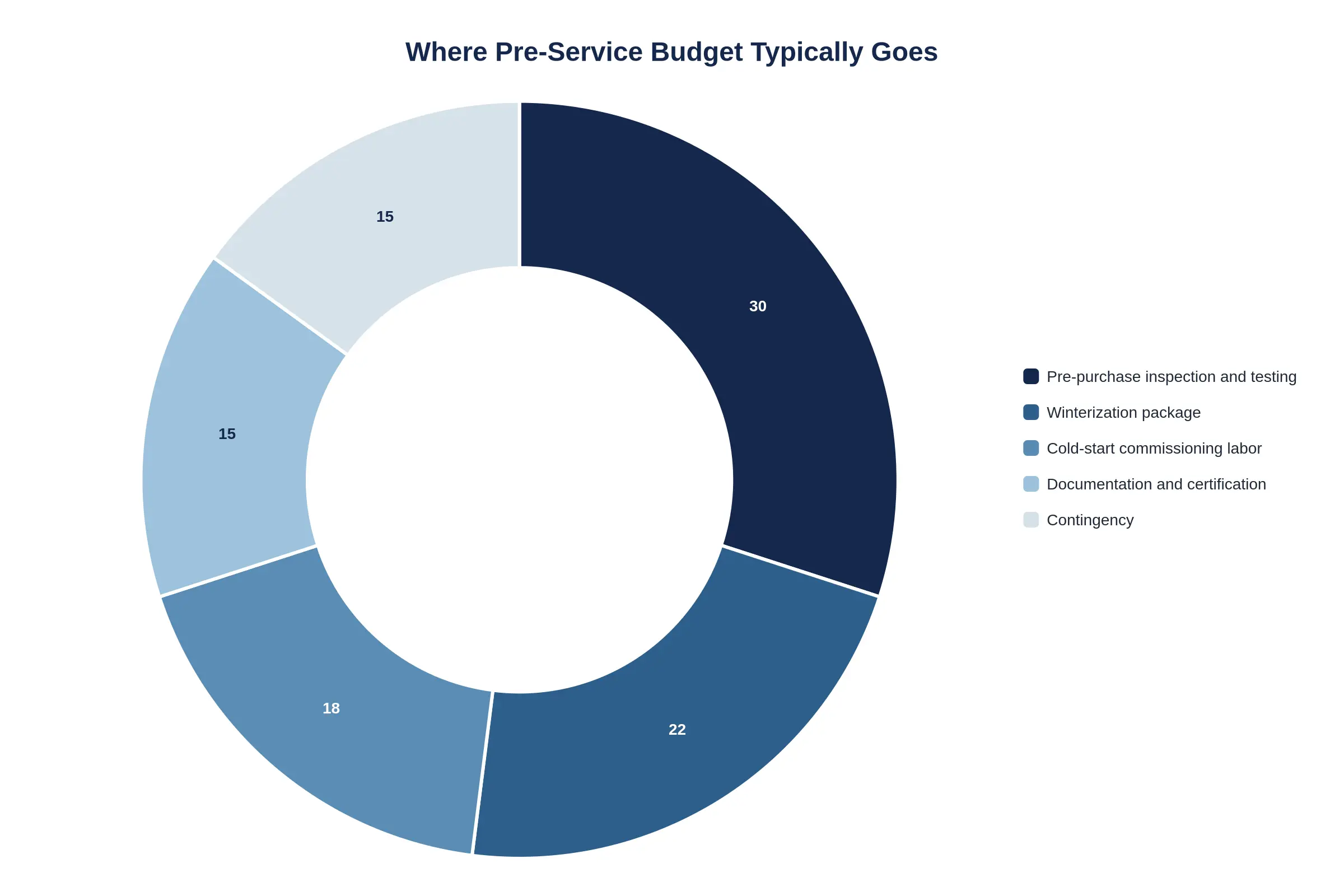
Pre-purchase inspection and testing is the single largest cost driver at about 30 percent, because a failed provincial inspection resets every downstream task.
The shares below fit a typical mid-range apparatus, and the shape holds up reasonably well whether you are buying a pumper for a small municipality or something heavier. A few things worth noticing:
- Inspection and testing leads at 30 percent. Pump flow tests, foam proportioning verification, brake and air system checks and third-party documentation all sit here. Where the annual or initial inspection regime is stricter, this share grows rather than shrinks.
- Winterization at 22 percent covers immersion heaters, battery blankets, heated pump compartments and glycol charge. In Prairie and Northern postings this is not optional equipment but the difference between a truck that starts at -35 C and one that does not.
- Cold-start commissioning labor at 18 percent is the hands-on time: priming systems, verifying that the block heater circuit cycles, testing the air dryer in sub-zero air, and training the crew.
- Documentation and certification at 15 percent is unglamorous and non-negotiable. Weight certificates, ULC or equivalent markings, inspection sign-offs, and the paperwork your insurer will ask for.
- Contingency at 15 percent is what saves you when the inspection turns up a hose reel that fails pressure or a pump packing that will not seal.
Two winter-related lines add up to 40 percent of the budget. In a cold climate, treat that as a fixed cost rather than a negotiating chip. If you want to see how the load changes across chassis classes, browse the heavy-duty fire truck range and compare how spec levels shift the winterization and commissioning work.
Budget the pre-service money up front, in writing, with the contingency line intact, and the truck that arrives in November will be ready for January.
Frequently Asked Questions
Is an out-of-province inspection required before I register a used fire truck in Canada?
In most provinces, yes. A used apparatus bought outside your province generally needs a safety or mechanical inspection before registration, and the checklist varies by jurisdiction. Confirm the local requirements with your motor vehicle office, then shop fire trucks for sale in Canada with a clear picture of what has to pass.
How long does an in-service inspection certificate typically remain valid?
Commonly 6 to 12 months, but the province sets the actual expiry date and renewal interval. Check the certificate date before dispatch and book renewal early, because an expired certificate can take the apparatus out of service.
Does a new fire apparatus need cold-start commissioning?
Yes. Before acceptance, a new apparatus should get cold-start commissioning covering battery condition, fluid levels, engine starting, pump priming and heater operation. In cold regions the commissioning report should also confirm antifreeze strength and that the block heater and air dryer work correctly.
What records should a buyer retain for resale?
Keep the bill of sale, registration or title documents, inspection certificate, maintenance and pump-test logs, warranty paperwork and the cold-start commissioning report. A complete file makes the apparatus easier to sell and lets the next buyer verify its service history.
How does winterization affect pump testing?
Residual water can freeze in the pump, valves and piping and cause costly damage. Test before winterizing, or use a heated bay with approved freeze protection, then drain and document the result. A successful test is no reason to skip the drain-down.
Two Checkpoints Worth Building Into the Buying Process
Provincial inspection compliance is the first checkpoint. Every unit has to satisfy the regime of the province where it will actually operate, and confirming that early stops a compliant chassis from turning into an expensive argument later. Cold-start commissioning is the second. A truck that cannot pump reliably at -30 C is not ready for a Canadian winter, so commissioning belongs on the schedule as a documented, signed-off milestone before the vehicle joins the roster, not something squeezed into the first busy week.
Before inspection terms are negotiated, match apparatus category to duty cycle. An airport response unit, a structural pumper and a wildland interface truck each carry different inspection expectations and different seasonal loads. Business buyers can review aircraft rescue and fire fighting vehicles to see how a specialized category lines up with a specialized duty cycle. Purchase, inspection and commissioning work best in that order, and keeping the sequence straight is what puts a service-ready truck in the bay on day one.