China ARFF Truck for Sale: Runway Length and Foam Tank Sizing Tradeoffs
Runway length and foam tank size are not independent choices on an ARFF truck. More water and concentrate mean a heavier chassis, higher axle loads, slower acceleration and a higher price. Buyers who lock one figure early usually have to reopen the other.
Three figures decide the specification: the discharge rate your aerodrome category requires, the distance from the station to the farthest runway point, and the payload your chassis and pavement can carry. A longer runway raises the response distance, so discharge rate and tank size go up, weight goes up, and the chassis list gets shorter.
A China ARFF truck for sale is the working example here, but the same logic applies to any fire fighting truck ordered for airport duty. The figures are planning ranges; your regulator’s standard sets the minimums.
How Runway Length Sets the ARFF Baseline
Runway length matters because it changes the distance a truck has to cover. A 4,000 m runway puts the station farther from the thresholds than a 1,200 m regional strip, so the same response-time target demands more speed and acceleration. That usually means a larger engine, a heavier chassis and a higher price.
Runway length does not set the aerodrome category by itself. The category follows the largest aircraft that actually uses the airport, measured by fuselage length and width. Long runways tend to attract larger aircraft, so length and category often rise together, but a long runway served only by turboprops can remain a low category.
Once the category is fixed, the standard sets minimum agent quantities and discharge rates for the aerodrome. The fleet has to meet those totals; a single truck does not have to carry them alone.
Payload then decides the chassis. Light airports often run 4×4, mid-size fields 6×6, and long-haul hubs 8×8, sometimes with twin engines and a bumper turret. Two trucks with the same tank volume can still differ in acceleration and axle load, so compare full-load performance rather than tank size alone.
Vendor figures are a starting point. Ask for test data at full load and check it against the category requirement. The airport rescue fire fighting range shows the formats available.
The table pairs runway length bands with the categories and truck sizes that usually go with them. Start with the band closest to your site, then look at the chassis and GVW columns, where the real constraints appear when you shortlist airport fire trucks from different suppliers.
| Runway length band | Airport category level (I-X style grouping) | Indicative water capacity per vehicle (L) | Indicative foam concentrate capacity per vehicle (L) | Typical chassis/drive config | Approximate GVW band | Key constraint to watch |
|---|---|---|---|---|---|---|
| 900-1,500 m (short regional / general aviation) | Category 1-3 | 1,200-3,000 | 150-400 | 4×4 light to medium commercial chassis | 8-14 t | Turning circle and wheelbase on small aprons; axle limits on secondary access roads |
| 1,500-2,000 m (regional turboprop and narrow-body) | Category 3-5 | 2,500-5,500 | 300-700 | 4×4 or 6×4 medium chassis | 12-20 t | Pump-and-roll performance versus bridge and pavement weight limits |
| 2,000-2,700 m (domestic narrow-body hub) | Category 5-7 | 5,000-9,000 | 600-1,200 | 6×4 or 6×6 heavy chassis | 20-28 t | Acceleration and top speed needed to meet the response-time target with a full tank |
| 2,700-3,200 m (wide-body capable international) | Category 7-9 | 8,000-13,000 | 1,000-1,800 | 6×6 or 8×8 heavy chassis | 28-36 t | Axle and tyre loading on taxiway shoulders; foam proportioning accuracy at high flow rates |
| 3,200-3,700 m (long-haul international) | Category 9-10 | 12,000-16,000 | 1,500-2,300 | 8×8 heavy chassis with twin rear axles | 34-44 t | Manoeuvring envelope around the fuselage; access to runway-end and overrun areas |
| 3,700-4,000+ m (ultra-long-haul and high-altitude) | Category 10 (top band) | 14,000-18,000+ | 1,800-2,800+ | 8×8 or custom multi-axle ARFF chassis | 40-52 t | Refill logistics and water supply on site; sustained foam output rather than tank size alone |
Caption: capacities, GVW bands and category pairings are indicative planning ranges for early-stage comparison, not compliance figures. ICAO and NFPA set minimum quantities for the aerodrome as a whole, normally met by several vehicles. Confirm final numbers against the standard that applies to your airport (for example ICAO Annex 14, NFPA 403, or China’s MH 5001 aerodrome standard) and against your own site risk assessment, runway geometry and fleet response plan.
Foam Tank Sizing Tradeoffs: Weight, Speed and Cost
Every litre of water and concentrate has to be carried, accelerated, steered and stopped. A larger tank raises gross vehicle weight, and the weight shows up in acceleration, top speed, axle and tyre loads, braking distance and, eventually, chassis class. Once the truck crosses a certain weight, the specification moves into heavy duty fire truck territory, with a steeper price and fewer chassis options. On a short runway a heavy truck that cannot reach the threshold in time is a liability regardless of how much agent it carries.
On a foam fire truck, the trade works in the other direction too. More agent means a longer discharge before the truck has to refill, which matters when the nearest water source is kilometres from the runway and a water tender needs time to reach the scene.
Concentrate and water tanks need to be sized together. At 1% proportioning a litre of concentrate makes about 100 litres of foam solution; at 3% it makes about 33. A concentrate tank that is generous at 3% looks oversized at 1%, and the other way round.
The tank itself is usually much larger than one load requires. Many builders size it at roughly 10-15% of water capacity so the truck can make several discharges before refilling. A 12,000 L water tank with 1,200 L of concentrate is normal, and it does not mean the foam is proportioned at 10%.
- Payload budget: tank volume is the quickest way to exceed payload and axle ratings.
- Chassis class: once gross vehicle weight crosses a class threshold, the price step is steep.
- Proportioning ratio: moving from 3% to 1% cuts concentrate use by about two thirds at the same water flow.
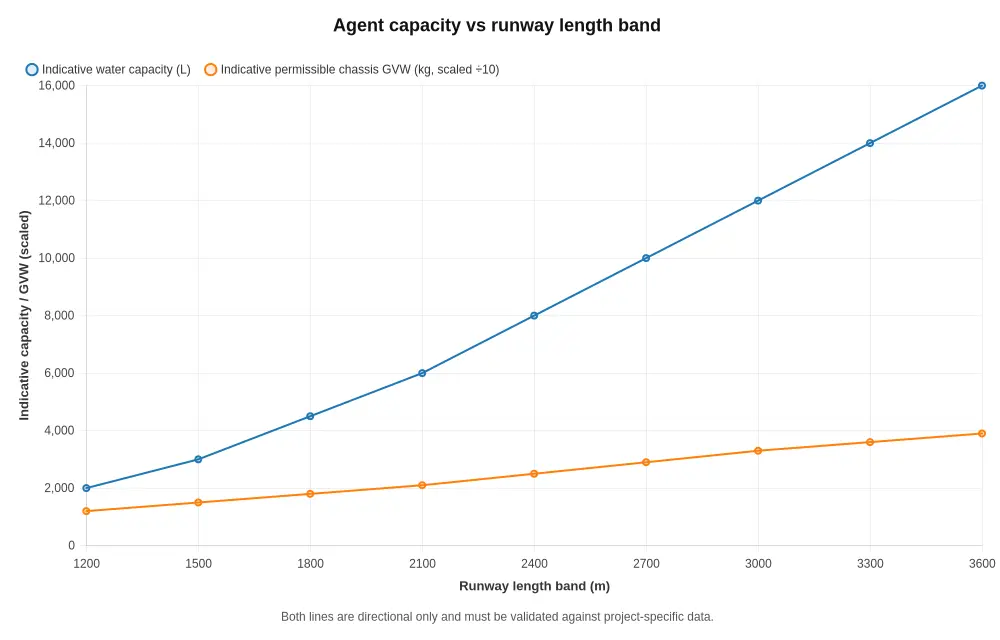
Both lines are directional only and must be validated against project-specific data.
Evaluation Checklist Before You Order
Work through these steps before you commit to a China ARFF truck for sale. Each one produces a number you can put in the specification.
- Confirm the largest aircraft that will use the airport and the category it sets. That fixes the minimum discharge rate and agent quantity for any firefighting truck you shortlist.
- Measure the actual distance from the station to each runway end, not the midpoint. Published response distances often assume a station position that does not match your layout.
- Turn those distances and the confirmed category into a required discharge rate and discharge duration.
- Convert duration into water and concentrate volumes using the proportioning ratio you will actually run.
- Check the resulting gross vehicle weight against axle ratings, bridge limits and pavement strength, especially on older aprons.
- Test acceleration and braking with full tanks. Part-loaded demonstrations flatter the truck.
- Match certificates and third-party test reports to the exact model and configuration offered.
- Get spare parts lists, training and warranty response times in writing, with named contacts and deadlines.
Write the category, discharge rate, tank volumes and full-load performance into the contract, so the delivery inspection has something to measure against.

The Cost of Getting Foam Tank Sizing Wrong
An oversized tank is paid for every day the truck is in service. It raises the purchase price, burns more fuel, wears tyres faster, adds to pavement loading and makes the truck harder to place on a crowded apron. Undersizing is less visible at handover: discharge duration falls, crews start planning around distant water sources, and the fleet may not meet the category the airport is licensed under. That is a compliance failure, not a specification compromise.
Work out the capacity the operation needs before looking at what the chassis can carry. Check tank size against runway length, expected call volume and the water supply on site, then compare total cost of ownership over the service life rather than purchase price alone. Buyers sourcing a China ARFF truck for sale should settle this line early in the specification. A water tanker fire truck can cover refill and support duties alongside the ARFF fleet.
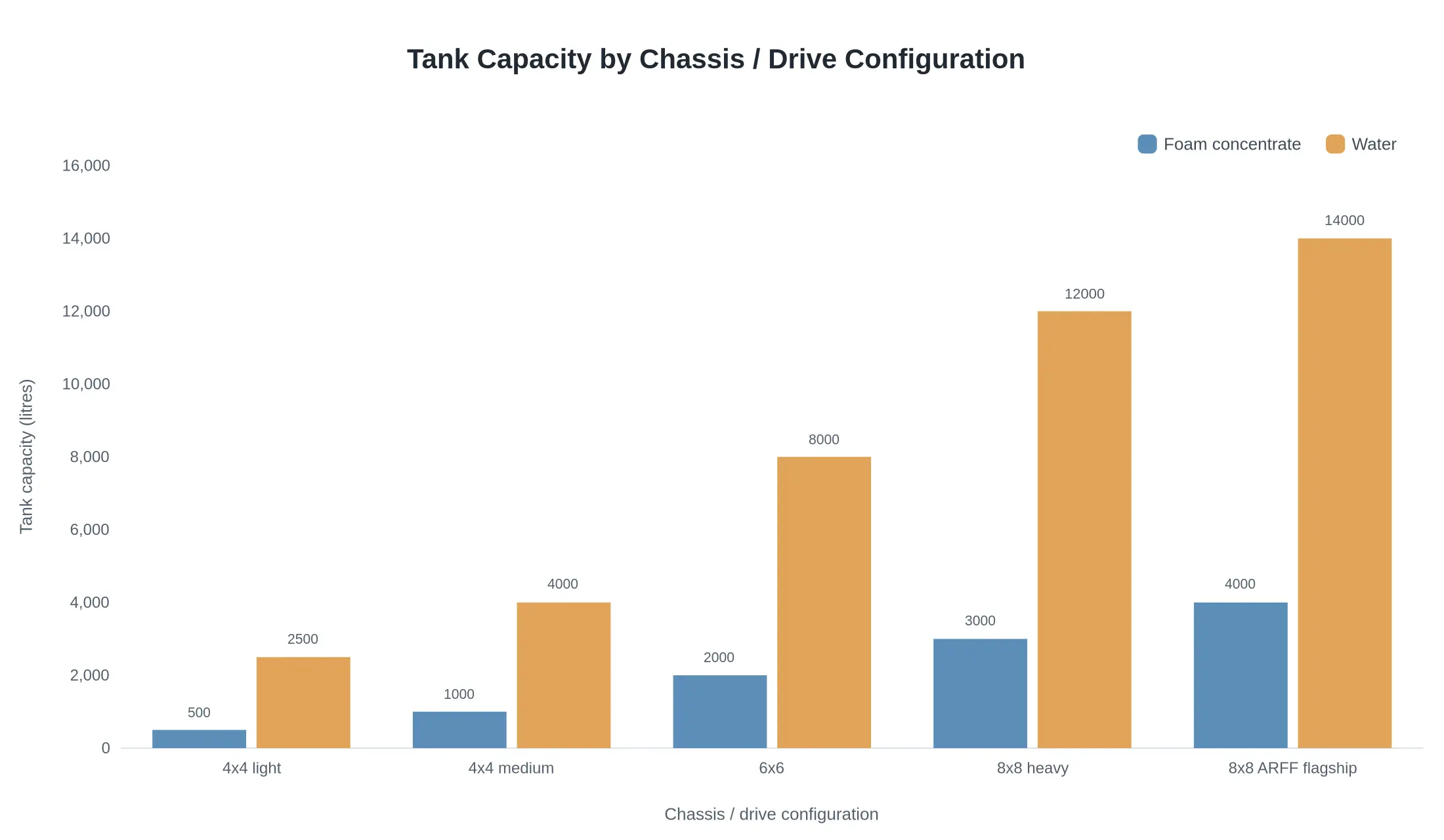
Figure: indicative foam concentrate and water tank capacities by chassis and drive configuration – the values shown are typical ranges rather than fixed specifications, and actual water-to-foam ratios vary with the proportioning system installed.
Sourcing a China ARFF Truck: What to Verify Before Ordering
Before you commit to a China ARFF truck for sale, check the paperwork against the rules your airport operates under. That means chassis certification, foam proportioning test reports, pump performance curves and compliance with NFPA 414 or ICAO Doc 9137. In China, MH 5001 is the aerodrome technical standard most buyers will be measured against; confirm with the regulator which edition applies before comparing offers.
A witnessed factory acceptance test is worth the trip. Run the pump at rated flow, measure proportioning accuracy at more than one setting, and check turret reach and foam throw against the specification. A third-party inspector can add an independent record before the truck is shipped.
ARFF trucks are often over-width and over-weight for normal road transport. Confirm deck dimensions and port clearances early, and appoint an agent who handles abnormal-load permits at both ends.
Ask for a spare parts list with lead times for the items that actually fail, and budget for operator and technician training on site. Put after-sales response times in the contract; a promise made in a sales meeting is not a service level.
CIMC Tianda, the supplier behind this range, says it has more than 20 years in airport fire trucks and firefighting equipment, with operations in 75 countries and 30+ subsidiaries. Its catalogue also covers every special fire truck category.
Figure: Foam tank sizing decision flow. Legend, in order from top to bottom: (A) served aircraft type + airport category; (B) response distance + response time target; (C) required discharge rate; (D) required discharge duration; (E) resulting water and foam concentrate volumes, branching into chassis selection.
Frequently Asked Questions
How does runway length affect the ARFF truck I should buy?
Runway length sets the distance the truck must cover, and the largest aircraft using the runway sets the category, which fixes minimum water capacity, foam output and discharge rate. The response-time target then drives acceleration. Longer runways usually mean larger aircraft and a higher category, so the trucks grow with them; a short regional strip can often be served by smaller airport rescue fire fighting vehicles on a 4×4 chassis.
What foam concentrate tank size is typical for a medium-category airport?
For a category 4-6 airport, a single truck usually carries several hundred litres of concentrate, in the region of 400-1,000 L. How much of that can be used in one discharge depends on the water tank and the proportioning setting. Size the concentrate tank from water capacity, discharge rate and the number of applications you need to sustain.
Can a larger foam tank replace the need for a nearby water source?
No. Concentrate is proportioned into water at roughly 1 to 6 percent, so water remains the volume that limits discharge time. A bigger foam tank buys more foam batches, but the truck still needs refill access, hydrants or a water tender support plan.
Is a 4×4 ARFF truck sufficient for a short regional runway?
Often it is, particularly where the aerodrome category is low and the surface is gravel or grass. Check axle loads, ramp width and the foam output the category requires before ordering; a 4×4 that meets the category on paper may still be too slow over a long taxi route.
What should be verified in the purchase contract for a China ARFF truck for sale?
The stated category, pump and proportioning performance, chassis and engine model, warranty terms, spare parts list, delivery schedule and inspection rights. Name the certificates and third-party test reports that must be handed over with the vehicle, and set the acceptance test criteria in advance.
Matching Runway Length and Foam Tank Sizing to Your Operation
Start with the largest aircraft that will use the airport. Its fuselage length and width set the aerodrome category, and the category sets minimum discharge rate and agent quantity. Measure the response distance to the farthest runway point, convert category and distance into discharge rate and duration, then turn duration into water and concentrate volumes. The full-load weight that results decides the chassis and axle configuration.
- A sizing sheet that lists inputs, assumptions and the agent volumes they produce
- Verified performance data measured at full load, not at a nominal rating
- Written compliance documentation against the standard you are specifying to
CIMC Tianda says it supplies airport and aircraft rescue fire fighting equipment in 75 countries. Send runway and category data with the enquiry; tank size follows from them.