Buying a Fire Truck as a Shared Fleet
Several business owners can buy one fire truck together and run it as a shared fleet. Shared here means co-ownership, or contracted pooling, of one or more firefighting vehicles among site owners, so no single business carries the whole capital cost.
Whether the arrangement holds up depends on three decisions: how far the truck ranges, who keeps it maintained, and how the invoice gets divided.
Get those three right and a group of mid-sized sites can field apparatus that none of them would buy alone. The vehicles involved are usually in the class covered by commercial fire trucks.
The sections below take them in order, then list the contract terms that need to be signed off before the first call-out.
What a Dispatch Radius Actually Measures
A dispatch radius is a coverage distance: the straight-line reach from the station, adjusted for the roads and access the truck actually has to use.
The distance is only useful next to a response time you can hit. Gates, traffic and gravel lanes consume minutes that never show up on a map.
Payload is a separate limit, and the two get confused. A radius assumes the truck arrives with enough water or agent to begin work before the first resupply run, so tank size and pump capacity decide how wide the ring can honestly be drawn.

How to Size a Dispatch Radius
Work back from a target response time instead of picking a round number of kilometres. Ten minutes on your roads becomes a measured distance, then a risk-adjusted one.
Hazard tightens or loosens the ring: fuel storage and process heat warrant short radii, open yards tolerate long ones. Tank size and pump capacity cap the result, so compare water tanker fire trucks before you fix the boundary.
In practice a shared fleet gives each vehicle a fixed primary coverage zone plus a mutual-aid overlap zone. The overlap is what covers the week a partner’s truck sits in the workshop.
An undersized pump or tank shrinks the usable radius quickly, whatever the map says.

The station sits at the center. Each ring is a coverage tier, the small blocks are the stops a shared rig has to reach, and the overlapping ring on the right is the mutual-aid zone — ground two neighboring stations can both cover, which is usually where pooling gains the most.
Maintenance Pool: Keeping Shared Fire Trucks Ready to Roll
Co-owned apparatus only earns its keep while it is available to answer calls. The maintenance pool is the written arrangement that keeps it available.
What a Maintenance Pool Covers
A pool usually folds the following into one shared budget:
- Shared workshop bays or a contracted service partner. One service point, with lifts and tools, handles every unit in the group, so each job is done to the same standard.
- Joint spare-parts stock. Filters, seals, pump kits, valves, couplings and hoses are bought once and drawn by all partners, which cuts emergency purchases at retail markup.
- One service calendar. Intervals are unified and the dates staggered, so no two partners lose cover in the same week.
- Certified technicians. Pumps, foam systems and aerial devices are serviced by qualified staff, including aerial fire truck platforms that need documented inspection.
- Shared inspection and compliance records. Test certificates, pump flow results and ladder or boom checks sit in one file every partner can audit.
- Annual pump and foam testing. Flow tests with paperwork an insurer will accept.
- Digital service logs. Cloud entries tracking repairs, parts and defects.
- A cost ledger and an uptime target. One record splits invoices by usage share, and a stated availability figure turns goodwill into an obligation.
A single-owner truck sits idle while it waits for service; a pooled fleet rotates units, so one rig is in the workshop while another answers calls. That rotation protects maintenance schedules and keeps availability steady through the year, and no partner is left without a vehicle during a scheduled repair.
The two curves below start in the same place — a new chassis under warranty — and then separate. The pooled line flattens from year three as shared parts stock and fewer emergency purchases take effect, while the single-owner line keeps climbing as wear parts, tyres, pumps and brakes all fall due.
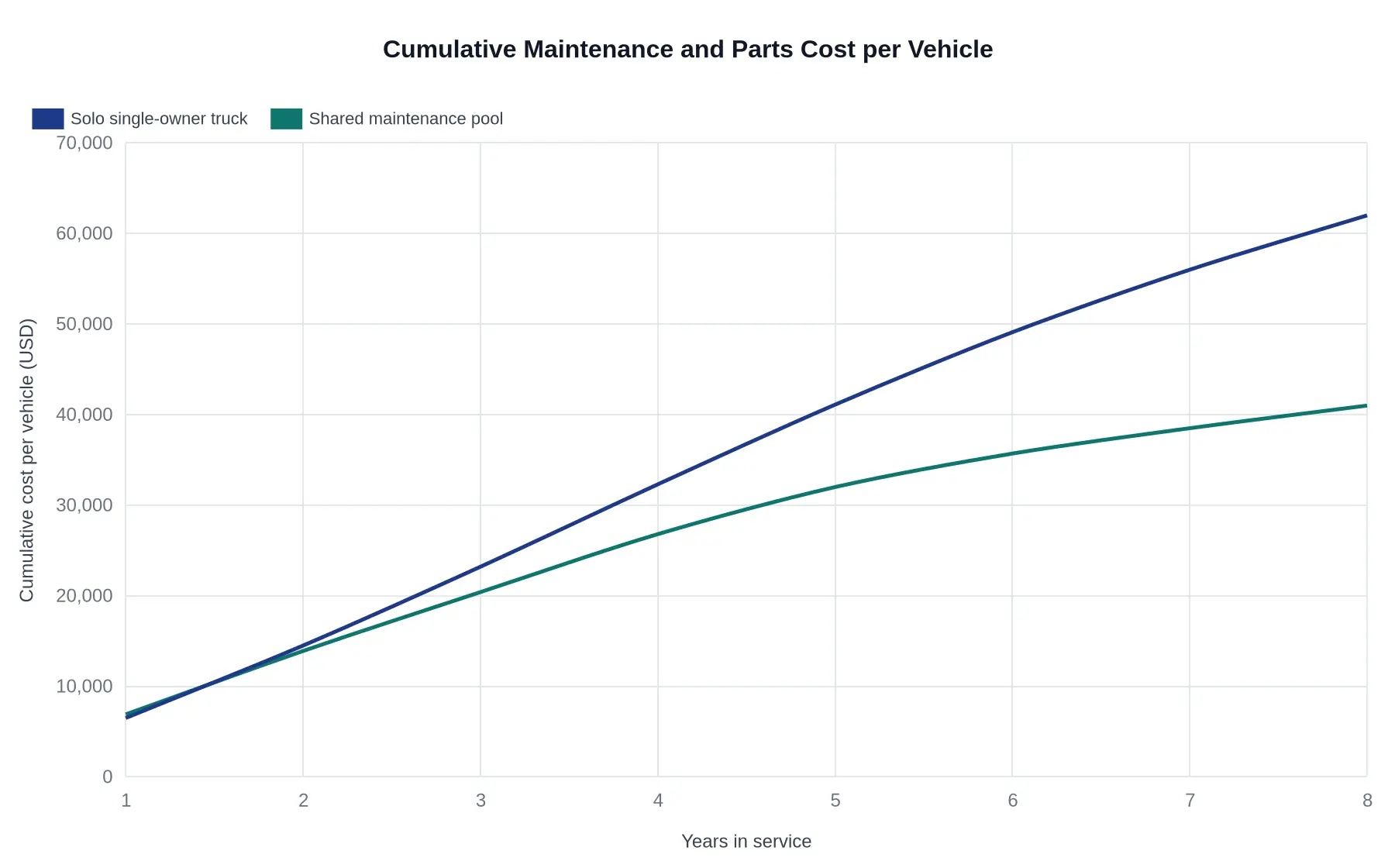
By year eight the chart puts the pooled vehicle roughly a third lower on cumulative cost. Shared parts stock and fewer days parked waiting on a delivery account for most of that gap.
Cost Split: Structure the Deal Before You Sign
Buying the truck is rarely where shared fleets come apart. Disagreement over who pays which share of it, year after year, is.
Four Common Cost Split Formulas
- Equal shares. Every partner pays the same capital contribution and the same running cost. Fast to administer, and it works best where sites are similar in size, risk profile and call frequency.
- Usage-based allocation. Costs follow call volume or operating hours. The partner that rolls the truck most often pays the most, which keeps dispatch discipline honest and makes idle standby visible.
- Risk-weighted tiers. Each site’s share reflects its hazard exposure: fuel loads, chemical storage, process heat, distance from a water source. Higher-risk operations carry a larger percentage.
- Hybrid: capital shares plus an operating levy. The purchase price is split by agreed ownership percentages, while a flat annual levy funds fuel, servicing and crew training no matter who drove last month.
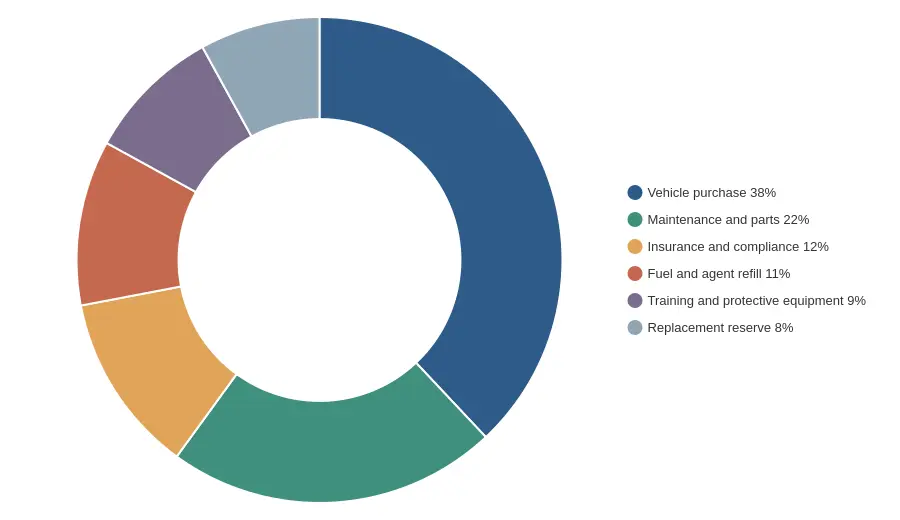
Under any of them, reserves for tyres, agent refill, major repairs and eventual replacement have to be funded from year one, not after the first failure. Put the formula in writing inside the shared ownership agreement before purchase, then review it annually against logged usage so the numbers keep matching reality. Chassis size should follow the partners’ real duty cycles; the fire fighting trucks range is where you compare them.
Cost Split Models for a Shared Fire Truck Fleet
Compare each model against your partner count and call volume, then pick a chassis from the commercial fire trucks range.
| Model | How Costs Are Divided | Best Fit | Watch-Outs |
|---|---|---|---|
| Equal share | Each partner pays the same fixed monthly contribution. | Similar-sized departments with steady, comparable call volumes. | High-volume partners may feel overcharged for light use. |
| Usage-based | Billing follows each partner’s logged runs, hours and mileage. | Mixed fleets where one partner responds far more often. | Needs disciplined dispatch logs and a clear dispute process. |
| Risk-weighted tier | Partners pay tiers set by hazard exposure and building density. | Industrial parks paired with lower-risk commercial districts. | Tier reviews can stall when risk profiles shift quickly. |
| Capital-plus-operating hybrid | Capital costs split equally, operating costs divided by actual usage. | Groups that want shared ownership without shared maintenance bills. | Two ledgers mean more administration and stricter audit habits. |
| Third-party managed lease pool | A manager holds the lease and bills partners per use. | Partners testing shared ownership before buying outright. | Less asset control, and exit terms need careful review. |
Choosing the Right Trucks to Share
Start with the coverage zone rather than the catalogue. Where partners’ sites sit close together, a compact fire fighting truck with a modest tank and a strong pump often covers more ground than a large unit that spends half its day refilling. Where distances stretch out, a water tanker fire truck that can shuttle water and resupply crews on scene earns its cost.
Standardising across partners keeps the maintenance pool small: one set of spares, one training standard, one cab layout whichever crew climbs in. Buy one versatile unit first and let it prove the model before adding a foam fire truck or an industrial fire truck for a coverage gap you have actually documented.
Check that a service point can reach your zone, and carry delivery lead time in the launch plan instead of discovering it late. Warranty and crew training terms are easier to negotiate at purchase than after delivery. CIMC Tianda builds water tankers, foam trucks, aerial ladders and airport rescue vehicles, so the specification conversation can start before anything is ordered.
Terms to Fix in Writing
Seven terms belong in the agreement itself, signed before the first call-out, so every member knows its rights and obligations:
- Ownership shares and title holder – record each member’s percentage interest and name the entity that holds the vehicle title and registration.
- Dispatch priority – define fire truck dispatch order for simultaneous incidents by incident severity, site risk and distance, not by who paid most.
- Insurance and liability – set policy limits, name additional insureds and allocate liability for damage, injuries and third-party claims.
- Operator certification – require drivers and pump operators to hold current licences and complete documented familiarisation on the commercial fire trucks in service.
- Service records – grant every member access to inspection, maintenance and repair logs, ideally through a shared digital file.
- Reserve fund – fix a per-member contribution schedule and the release threshold for major repairs or tyre and pump rebuilds.
- Exit and buy-out – state notice periods, the valuation method and how remaining members absorb the departing share, plus a dispute route such as mediation before arbitration.
Review all seven at renewal, so costs, coverage and dispatch rules keep tracking actual use.
Frequently Asked Questions
Can businesses legally co-own a fire truck?
Yes. Two or more companies can hold joint title through a limited liability company, a cooperative agreement or a written partnership. Vehicle registration, insurance and fire-code requirements vary by jurisdiction, so confirm the local rules for commercial apparatus; what causes trouble later is vague paperwork. Spell out ownership percentages, cost obligations and exit terms before the chassis is ordered.
How many partners does a shared fleet realistically need?
Three to five partners is the range that usually works. Fewer than three rarely spreads capital and maintenance costs far enough to justify the coordination effort, and beyond five, scheduling and dispatch decisions slow down. Two companies can operate together, but that pairing generally runs more smoothly as a rental or service agreement than as joint ownership.
Who should hold insurance and title?
Title belongs with the owning entity, not with an individual partner, so no single business can sell or pledge the apparatus alone. The policy should be issued in that same entity’s name, with every partner listed as an additional insured and loss payee. Review it annually as vehicle values and partner shares change.
Does shared operation affect manufacturer warranty or service support?
Not on its own. Coverage attaches to the chassis and apparatus rather than to the number of operators, but warranty terms generally assume trained operators and maintenance done to schedule, so thin records are what complicate a claim. Log every inspection and repair, and register each authorized operator with the dealer so service calls are not held up by identity checks. Read the OEM terms for any condition on shared or fleet use.
Can one shared fleet mix vehicle types, such as water tankers, foam trucks and aerial units?
Yes. Groups routinely pair a large water tanker or foam unit with smaller apparatus under one agreement, provided dispatch rules and cost splits are set per vehicle class. Many also add light fire trucks built for tight urban routes to cover more call types without duplicating spend. Mixing classes only needs a clear rule on who pays for what.
Closing Decision Summary
Before you commit capital, settle the three items in this order:
- Dispatch radius first. Map every site the truck has to protect and set a maximum response distance; that number sizes both the fleet and the apparatus.
- Maintenance pool second. Decide where routine service, hose testing and pump certification happen, and who holds the spare-parts budget.
- Cost split last. Turn the first two decisions into a written formula covering capital, insurance, crew time and a reserve fund.
Yes, a business can buy a fire truck for a shared fleet, provided the coverage zone, the service model and the cost formula are fixed in writing first.
CIMC Tianda’s firefighting and rescue portfolio spans water tankers, foam trucks, aerial ladders and airport rescue vehicles, all listed in the fire fighting truck range.