Why a Mixed ARFF Fleet Is a Procurement Decision, Not Just a Purchasing History
Few airport operators decide to buy from three or four ARFF fire truck manufacturers. It happens a vehicle at a time: a terminal expansion adds two rigs, a replacement cycle lands in a different budget year, a tender goes to whoever answered that specification best. Ten years on, one station holds trucks from three or four builders and nobody remembers choosing that fleet. The mix itself is rarely the problem.
The bill arrives after delivery, in two places: parts commonality and crew handover.
Parts commonality sets how much capital sits on your shelves and how long a truck stays out of service. When every chassis, pump end and nozzle assembly belongs to one builder, stockholding multiplies, lead times stretch, and a single failed component can park a rig for weeks while a replacement is built to order. A fleet planned around shared components carries less stock and keeps more of its response coverage available.
Crew handover sets how fast a responding crew can use the truck in front of them. Pump panel layouts, gauge positions, joystick logic and master switch sequences differ between brands. Firefighters who rotate across mixed vehicles relearn controls at every shift change, and that friction shows up in checklists, drill time and the first minutes of a call.
What follows covers both: how to audit the fleet you already run, how to write new purchases so components overlap where it counts, and how to standardize handover across dissimilar vehicles. It also covers what to look for in the ARFF product range when you add capacity, and how the broader fire fighting truck range supports the rest of the airside and station fleet.
Why Mixed Fleets Create Parts and Training Friction
A fleet assembled from several ARFF fire truck manufacturers is really several engineering ecosystems parked side by side. Component specification is the first pressure point. Pumps, foam proportioning systems, valves, seals and electrical relays that do the same job are often built to different dimensions, pressure ratings and thread standards. Two trucks that look comparable on the apron may share almost nothing interchangeable, so the spares inventory duplicates line by line instead of consolidating behind one part number. That duplication ties up capital in slow-moving stock and multiplies the number of suppliers a workshop has to manage.
Service intervals add a second layer. Each manufacturer sets its own inspection cycles, lubricant grades, filter change points and calibration routines. Maintenance cannot be batched into one workshop window, and consumables have to be stocked in several variants. Lead times lengthen as a result: a part that is a shelf item for one brand becomes a special order for the other, and safety stock gets repeated for every platform. Purchasing also loses the volume leverage that standardization would otherwise deliver when sourcing fire truck spare parts.
Control layouts are the third driver, and the one crews feel most. Switch positions, gauge clusters, pump engagement sequences and foam control logic vary between manufacturers, so an operator has to remember a different procedure for each vehicle. At handover that inconsistency slows familiarization and raises the chance of hesitation, or of reaching for the wrong switch, under pressure. Training fragments into vehicle-specific modules instead of one shared operating standard.
The trade is simple: mixed fleets buy upfront variety with permanently higher operating complexity, and the only way to design that complexity out is to buy from fewer builders on purpose.

Read the rings from the inside out: platform-specific parts at the core, serviceable components in the middle, fleet-wide consumables on the outer ring. The markers stand in for part families, and the radiating lines show every tier feeding one shared inventory – the same logic that lets a mixed fleet run off a single fire truck parts pipeline.
Where Parts Standardization Actually Pays Off
No two ARFF fleets look the same. One bay might hold a 2015 6×6 on a commercial chassis; the station down the road runs a newer 8×8 with a rear-engine layout. Full vehicle standardization is a fantasy in that setting, and usually the wrong target. Parts standardization is a decision you can make on the next order: not forcing every rig onto one spec sheet, but finding the families where component interchangeability already exists and buying inside those families on purpose.
Why bother? Downtime, not the spare, is the expensive part of a fire truck. A rig parked over a clogged filter or a burnt relay costs far more than the component, and every hour of that sits against your response coverage. Hold one hose coupling instead of four and the store room shrinks, the training shortens, and nobody is hunting shelves at 2 a.m.
Practical mixed fleet parts commonality starts with an audit rather than a brochure. Walk the bays. List what actually breaks, then group those failures by family. Even on heavy-duty fire truck platforms built a decade apart, most consumables come from a shared supplier base, and that overlap is the leverage a sensible fire truck parts program is built on.
These are the families worth standardizing first:
- Filters and lubricants – Engine, hydraulic and air-dryer filters follow the component maker’s specification rather than the chassis brand, which often collapses several variants into one SKU.
- Brake and suspension wear items – Pads, discs, bushings and shocks often share suppliers across weight classes, and they wear on a schedule you can predict.
- Pump seals and valves – Suction and discharge flanges, hose threads and valve bodies follow common dimensional standards even where the pump end itself is model-specific. Plumbing and fittings pool easily; internals do not.
- Hose couplings and adapters – Storz and instantaneous couplings are set by national standards rather than truck brands, so a coupling fits the next chassis as long as both were specified to the same standard.
- Electrical relays and fuses – Blade fuses, mini relays and breaker types are close to universal, which makes bay-side and roadside swaps fast and cheap.
- Lighting and warning components – Beacons, scene lights and work lamps follow common voltages and mounting patterns, so spares fit almost any rig.
- Cabin-mounted breathing apparatus interfaces – Seat brackets, air-line quick connects and regulator fittings follow the SCBA maker’s standard, not the truck builder’s, so they survive a chassis change.
- Fasteners, clamps and body hardware – Bolts, U-clamps and panel latches are commodity items, and consolidating them cuts catalog clutter quickly.
Start with two or three families. Track how often each part leaves the shelf for a quarter, and add the next family only when the data says it earns the space.
Parts commonality across ARFF truck classes
Read across a row to see how one component family behaves when it is shared across airport fire trucks and other ARFF classes. Standardization potential says how far parts can be pooled; lead time and handover risk say what crews gain or lose. The easy wins sit where high potential meets a short lead time and a low handover burden, which shows up most clearly at a station running foam fire trucks and special fire trucks beside its rescue rigs.
| Component family | Typical standardization potential (High / Medium / Low) | Typical replacement lead time without commonality | Handover risk if the family differs |
|---|---|---|---|
| Pump and drivetrain | Medium | 4-8 weeks, build to order | Low – familiar throttle and pump logic |
| Foam system, turret and nozzles | Medium | 6-10 weeks, supplier specific | Medium – different ratio and aim controls |
| Electrical, CAN bus and controls | High | 3-6 weeks, mixed part numbers | High – a different control layout to learn |
| Braking, axles and suspension | High | 2-5 weeks, catalog items | Low – same checks and same failure cues |
| Hose, couplings and fittings | High | 1-3 weeks, stock dependent | Low – interchangeable at the pump panel |
| Cab, crew protection and body panels | Low | 8-16 weeks, jig built | High – seating, exits and stowage differ |
| Water tank and dump valve assembly | Medium | 5-9 weeks, fabricated per chassis | Medium – similar dump steps, different capacity |
The lead-time ranges are planning estimates of the kind you find on supplier schedules, not measured benchmarks – check them against current quotations. Take the table into a specification review and ask each manufacturer to declare, family by family, whether a shared part number applies. That converts commonality from a sales claim into a line item you can hold someone to.
Auditing a Manufacturer’s Commonality Claims
Commonality is easy to claim and hard to verify, so treat it as a documentation exercise rather than a sales conversation. Ask every shortlisted manufacturer for the same evidence package, in writing, and score the answers side by side. The point is not to catch anyone out. It is to find out whether the shared-parts story survives the night a vehicle goes out of service and a component has to move from one truck to another within hours.
Four checks cover most of it:
- Parts numbering and catalog transparency. Request the parts catalog for each vehicle class and compare numbers line by line. Real commonality shows identical numbers for identical items. Different numbers with no cross-reference table usually mean the parts are similar, not interchangeable.
- Published service intervals. Ask for intervals per component in writing rather than a verbal summary. Intervals that shift between vehicle classes with no engineering reason behind the shift suggest the maintenance plan was written per model instead of per platform.
- Single-supplier coverage across vehicle classes. Get it in writing which classes one supplier can actually support, and whether the same source covers both fire fighting trucks and industrial fire trucks in your fleet mix.
- One format for technical documentation. Sample a wiring diagram and a torque table from each class. If format, units or revision conventions differ, crews spend handover translating paperwork instead of checking equipment.
A spot check is a reasonable way in: pick ten to fifteen fast-moving items – filters, lamps, brake chambers, hose couplings – and ask the supplier to show where each appears in every relevant catalog. Keep the written responses and revision dates on file, then repeat the exercise each time you add a vehicle class. Two or three procurement cycles of that gives you a documented picture of how much genuinely carries across the fleet, which is worth more at budget time than any brochure claim.
Reading the Scores: Where Commonality Pays Off First
An audit only pays if it changes what you order next. The six families below re-cut the seven rows above: cab systems and body panels scored apart, the water tank folded into the pump and water system. Each family gets a 1-10 score, where 10 means “nearly plug-and-play across your whole mixed fleet” and 1 means “treat it as bespoke every time.” Two ratings move against the coarser High/Medium/Low table, and both moves are worth understanding. The pump row above bundles pump ends with drivetrains, which are built to order; scored on its own, the pump end climbs to the top. Electrical controls rate High above but 7 here, because a common multiplex platform is achievable with a manufacturer who commits to one, not automatic.
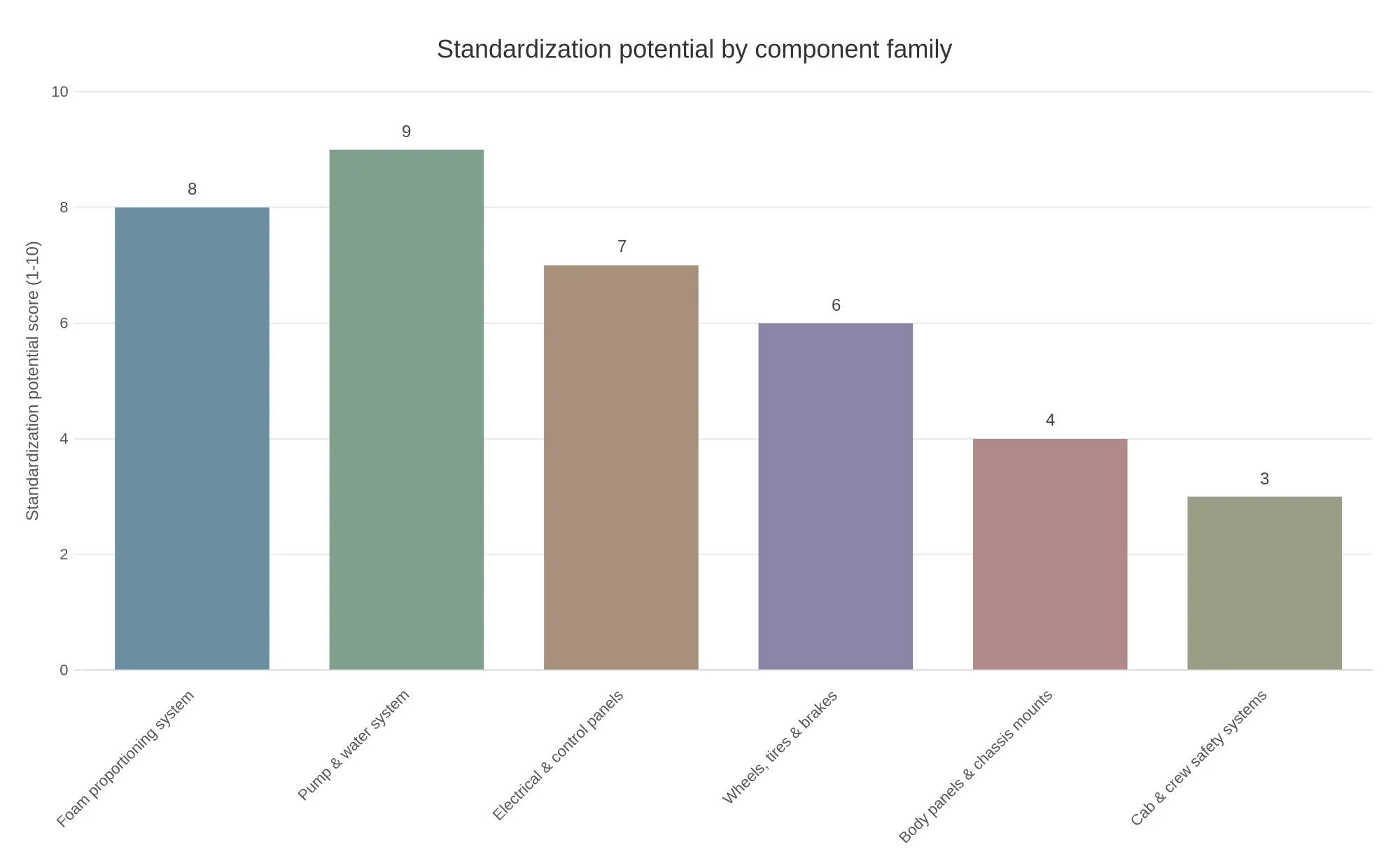
Component family scores at a glance
| Component family | Standardization potential (1-10) | Practical read |
|---|---|---|
| Pump & water system | 9 | Highest payoff: shared pump ends, valves and plumbing kits |
| Foam proportioning system | 8 | Standardize the proportioner type and calibration routine |
| Electrical & control panels | 7 | Achievable with a common multiplex platform |
| Wheels, tires & brakes | 6 | Quick win on consumables, slower on hubs and ABS logic |
| Body panels & chassis mounts | 4 | Cosmetic gain mostly; tooling rarely transfers |
| Cab & crew safety systems | 3 | Keep per-OEM; focus training on differences instead |
What the shape of the chart tells you
The scores stair-step rather than cluster, and that pattern is more useful than any single number. Hydraulic and fluid-handling systems sit at the top because they are assembled from catalogd components that tolerances and thread standards already govern. Anything touching the cab or the chassis mounting geometry sits at the bottom, because it is built, validated and certified against one specific OEM platform.
That points to three first moves: pump end kits, foam proportioner calibration kits, and a shared electrical connector standard. Between them they account for most of the duplication a mixed fleet carries, and they are the parts crews touch on shift. For the consumable and wear-item sourcing that supports that plan, one consolidated fire truck parts range is easier to manage than a pile of individual OEM numbers.
The two low scores are not failures. They mark the edge of what standardization can deliver, and knowing where that edge sits is what stops a standardization plan from turning into a promise you cannot keep.
Crew Handover and Cross-Fleet Switching Risk
Handover quality rests on one premise: the incoming shift should be able to sit down, read the panel and confirm readiness in the same sequence the outgoing shift used. That predictability erodes quickly in a mixed fleet. One truck routes pump engagement through a rotary selector and analog gauges; the next wants an electronic controller and a layered touchscreen menu. Monitor and turret controls differ in joystick response, travel limits and dead-man handling. Display logic differs in what appears first and what sits two screens down. Pre-connect arrangements differ in valve position, hose routing and the point at which pressure is actually available.
Each difference is a second mental model a crew has to carry, and every additional model adds time to the handover.
Parts commonality works on this problem indirectly, which is why it rarely gets the credit. Standardize pumps, valves, control modules and hose fittings, and new deliveries converge on the configuration already in service, because the shared components dictate both the physical layout and the logic underneath it. Trucks stay comparable across buying cycles instead of drifting into one-off designs. The crew’s mental model stays valid longer, checklists stay reusable, and cross-training between shifts stops restarting from zero. The same logic applies to specialized units: a station running a CAFS fire truck beside a water tower fire truck gains most when the interfaces match, so a crew can switch vehicles on a short briefing rather than a fresh qualification.
The five-step handover below runs in a fixed order: status readout, equipment and inventory confirmation, fluid and pressure check, defect and fault logging, then transfer of responsibility.
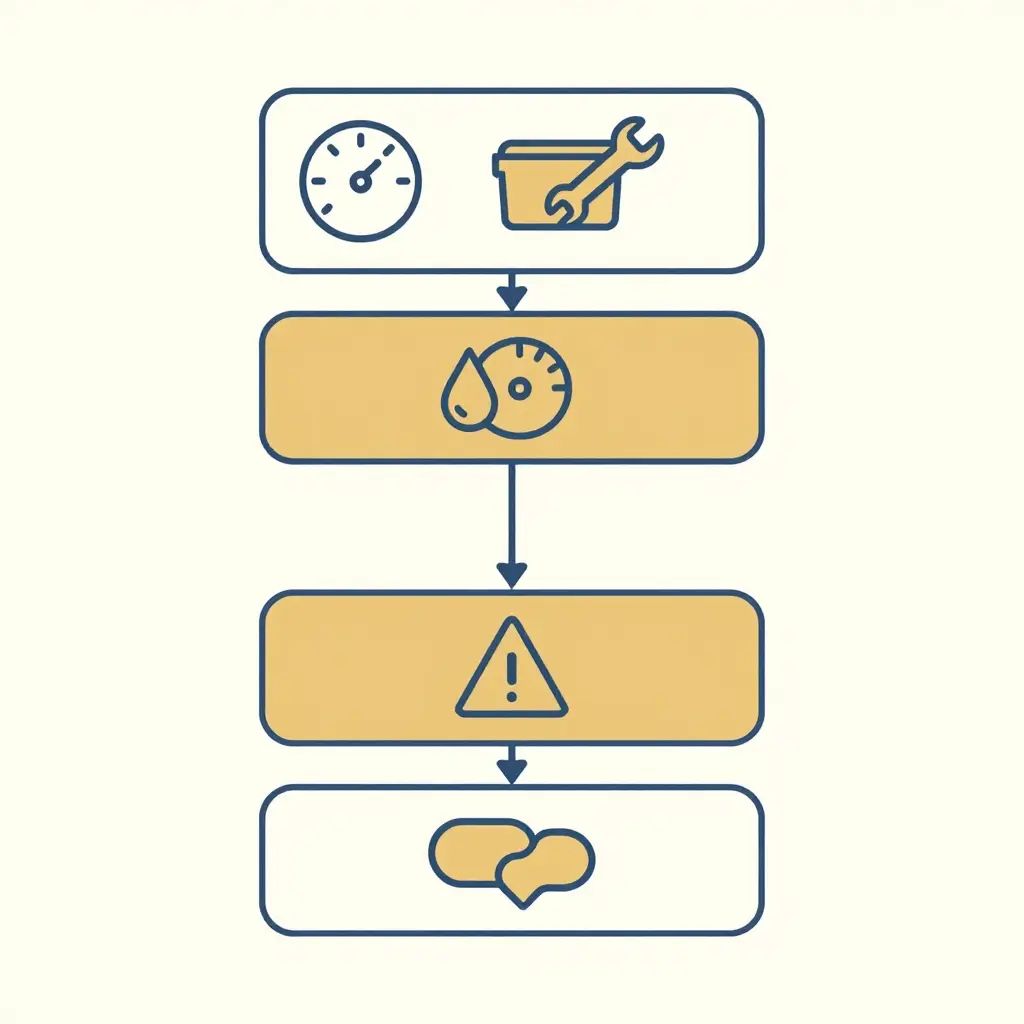
Keep that order every shift, on every truck. Where pump panels, foam systems and gauge layouts differ from bay to bay, the fixed rhythm is what stops a small discrepancy from becoming a surprise on the way to an incident.
The Crew Handover Checklist, Step by Step
Shift change at an airport fire station is rarely a quiet moment. Trucks come back hot, foam tanks are half empty, a hydraulic spreader is sitting on the wrong shelf, and the incoming crew has about fifteen minutes to absorb everything the outgoing crew knows. On a single-model fleet that transfer is rough but survivable. Put a European-built ARFF fire truck in the same bay as a domestically produced unit, a water tender and a command vehicle, and the conversation collapses into personal shorthand. One driver says “topped up,” another writes “OK,” and a third waves at the gauges. Three weeks later nobody can explain why a foam proportioner failed inspection. A written checklist turns that chat into a signed record that follows the truck rather than the person.
Run the steps in the same order at every shift change, on every truck, without exception:
- Confirm vehicle status. Declare the unit operational, restricted or out of service; record odometer and engine hours, fuel level, active warning lights, tire pressures and brake system pressure. Anything unrecorded is assumed to be the outgoing crew’s problem, which is exactly how gaps begin.
- Read water and foam agent levels. Note the actual tank percentages and the foam type, concentration and batch where relevant. Write down gauge readings instead of the word “full”: a half tank recorded as full is a safety failure, not a rounding error.
- Verify pump and monitor function. Engage the pump briefly in tank or draft mode, confirm pressures hold, and test the roof and bumper monitors through their full travel. Listen for cavitation, watch for weeping seals, and flag any valve that moves slowly.
- Inventory breathing apparatus and rescue tools. Count SCBA cylinders by pressure, check mask seals and spare air, and confirm cutters, spreaders, rams and their power units are present and charged. Cross-check the loose gear against your portable fire fighting equipment manifest, so nothing leaves the station in a private vehicle.
- Log every defect against a shared template. Use identical fields across the fleet: item, location, severity code, photo and a single defect ID. The same template should serve a 6×6 and a 4×4 alike, so trends stay visible instead of dissolving into free-text notes.
- Sign off the documentation. Both crew leaders sign, work order numbers are attached, and refill or incident records are closed out. Crews running an incident command setup can log acceptance directly in the fire command vehicles, so the record travels with the response rather than the shift.
- Confirm handover timing and acceptance. Timestamp the handover, have the incoming crew leader formally accept the vehicle, and assign any outstanding defects to a named person with a deadline. An unaccepted handover is a handover that never happened.
The steps are not the part worth copying. The template is. Document a Panther, an Oshkosh and a locally built pumper with the same fields, the same severity language and the same defect IDs, and you can finally compare them: defect rates by model, recurring failures by component, downtime by crew. Without one template, each crew invents its own dialect, and you are left with four good trucks and no way to tell which one is quietly failing.
Handover time distribution by phase
The proportions below are illustrative, drawn from the five-step checklist above, and they show where a shift change actually spends its minutes. Verification work – counting gear, reading pressures, reconciling a shared spare-parts tally – takes about 70% of the window, and the largest single block within it is the fluid and pressure check at 28%. Responsibility transfer looks quick at 12% only because the earlier steps did the work. On a mixed-brand fleet, expect the inventory slice to creep up, since one shared parts inventory has to be reconciled against several different layouts.
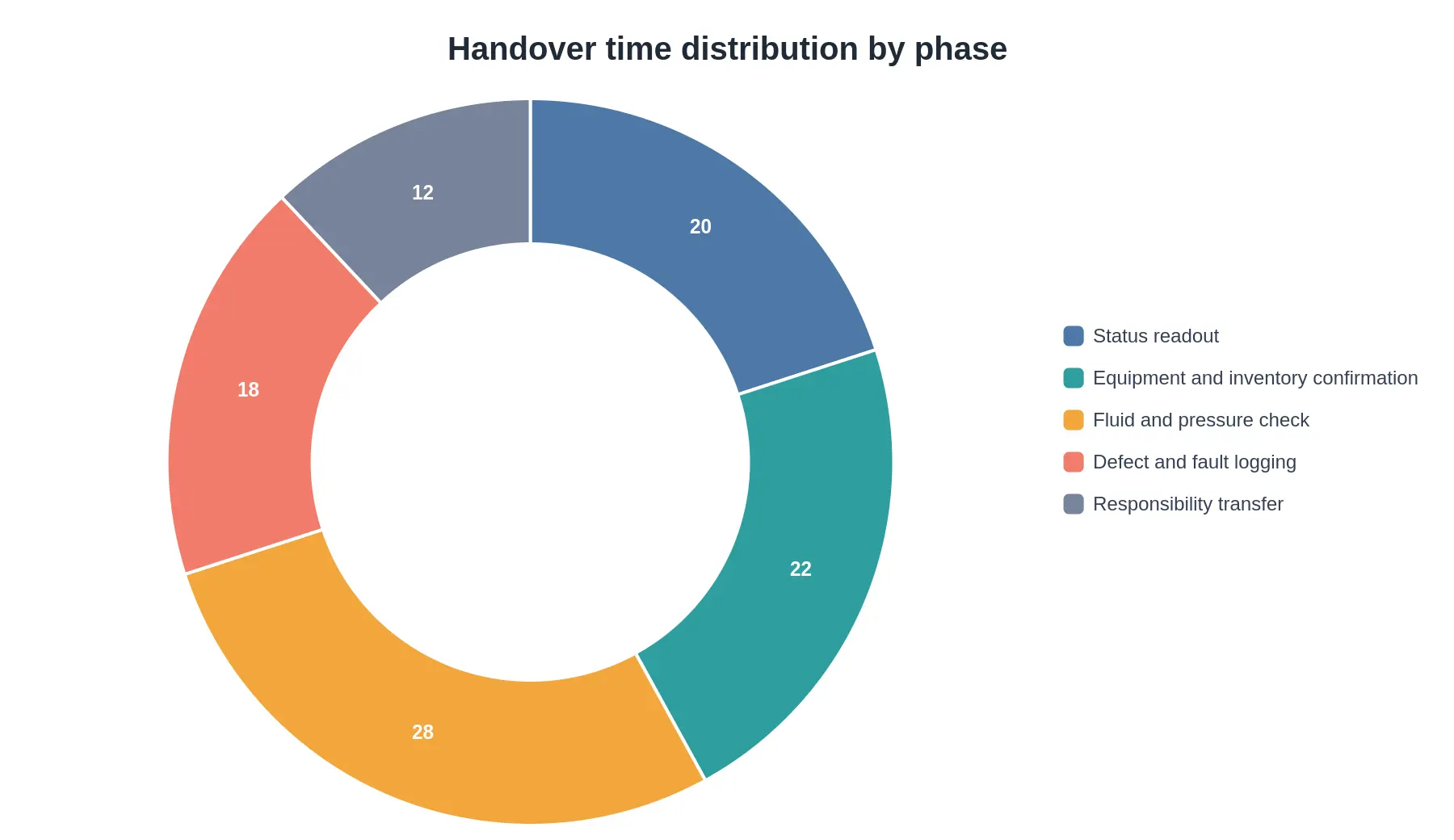
What the slice sizes tell you: the fluid and pressure check is the biggest block, so a shortcut taken there is where risk accumulates fastest. Responsibility transfer should stay the smallest slice – a signature and a verbal acknowledgment, not a second inspection. Treat the percentages as planning proportions for crew rotations, not measured benchmarks from any particular department.
Frequently Asked Questions
Is parts commonality achievable when trucks come from different manufacturers?
Yes, within limits. Standardize the interfaces – pump ends, valves, hose couplings, electrical connectors – across brands, then consolidate cross-reference numbers into a single approved catalog. Bodies and cabs stay with their OEM, and that is fine; they are the part of the truck that was never going to be pooled anyway.
How many shared component families should a business owner target first?
Two or three, and no more than five at once. Pumps, valves, hose and nozzles, filtration and braking are the usual first set. Prioritise high-failure, high-cost items, then expand once stocking data confirms real savings.
Can a single supplier serve multiple vehicle classes such as ARFF and industrial units?
Many ARFF fire truck manufacturers also build industrial, commercial and light-duty lines. One supplier can serve both classes when hydraulics, foam systems and controls share a common design platform. Review the ARFF and aircraft rescue fire fighting range before shortlisting vendors.
How can crew handover quality be measured objectively?
Score crew handover against a fixed checklist: fluids, foam ratio, pump hours, fault-log closure and equipment inventory. Track completion rate and repeat defects per shift, then review monthly against a set threshold.
How should a business phase fleet standardization within an existing budget?
Phase it by procurement cycle. Retrofit shared couplings and connectors on existing units first, then specify common platforms on replacement purchases, spreading spend across three to five budget years. Standardising through fire truck parts keeps early retrofits inexpensive.
Procurement Next Steps
For a business owner, the procurement decision is to narrow the fleet to a manageable set of families that repeat across vehicles: pumps, foam proportioning systems, valves, nozzles, brake consumables, electrical relays and body hardware. With that list in hand, request catalog transparency from each manufacturer – part numbers, interchange data, lead times, revision history. Commonality then becomes measurable instead of assumed, and maintenance gets a defensible basis for stock levels and supplier negotiation. Relevant fire-fighting truck platforms can be reviewed here.
The operational half is one handover checklist for the entire fleet: the same order of checks, the same terminology, the same sign-off fields, so a crew moving between different ARFF vehicles records the same critical information. Use the airport fire trucks overview to align vehicle categories before the checklist is finalized. Then review the configuration annually, because pump packages, foam systems and electronics change, and an annual review keeps both the part families and the handover steps current.
Standardized parts, transparent catalogs, one handover checklist and an annual review. Those four things decide whether a mixed fleet is an accident of purchasing history or a procurement position someone actually chose.