Three Specification Decisions That Determine a Tanker’s Real Cost
Three questions decide what a tanker truck costs to own: what the tank shell is made of, how the pump is driven, and how quickly the depot can refill it. Together they set the payload the chassis can legally carry, the hours the truck spends delivering water rather than waiting for it, and the cost per litre over its service life.
In most procurement reviews, those same three items account for the bulk of the gap between a low purchase price and a low cost of ownership. A shell built to save weight, a pump drive sized for the wrong duty cycle, a refill loop that outruns depot throughput: each one moves money off the invoice and into the operating budget.
The sections below take each decision in turn and give the comparison points worth writing into a specification – payload, service life, maintenance interval, turnaround time – so a shortlist of water tanker fire trucks can be judged line by line rather than on adjectives.
Tank Body Material Fixes Corrosion Life and Legal Payload
Tank body material is not a finish choice; it is a payload decision. Corrosion resistance and tare weight are both fixed the moment the shell grade is signed off, and every kilogram of shell is a litre of water the same chassis can no longer legally carry.
Carbon steel pressed from QS or BS plate and given an internal coating is the cheapest route, and any local welder can repair it. Its life is set by the coating rather than the steel, so plan on re-coating every 8 to 12 years, and on 12 to 15 years from the shell if the lining is kept intact. Stainless 304 handles potable water and most foam duties at 3 to 4 mm wall; 316L adds chloride and chemical resistance at a higher cost per tonne. Neither grade needs a coating, which removes one maintenance item from the depot schedule.
Aluminium alloy brings shell weight per unit volume down to roughly a third of steel, but the plate has to be thicker to recover stiffness, and baffles need full-penetration welds with pulse MIG control because the heat-affected zone loses strength. Composite or GRP shells sidestep corrosion and carry the lowest tare, usually with a quoted 15 to 20 year life, but baffle plates are bonded rather than welded, field repair is limited, and impact damage is unforgiving.
Match material to duty: carbon steel for depot-bound water only, 304 or 316L for potable water and foam, aluminium where payload on long hauls matters most, GRP for many aggressive chemicals. Comparing a water tanker fire truck build against another tanker truck for sale? Put plate grade, wall thickness, coating system, baffle spacing and weld procedure in the specification and score both offers against them.
Tank body material comparison for tanker trucks
The five materials that come up most often when buyers shortlist water tanker fire trucks, compared on the points that matter in a tender review:
| Material | Typical wall thickness | Corrosion resistance | Effect on tare weight and payload | Typical service life | Best-fit duty profile | Relative acquisition cost | Maintenance considerations |
|---|---|---|---|---|---|---|---|
| Carbon steel with internal coating | 4-6 mm shell | Moderate if lining stays intact | Heavier tare, reduced payload | 12-15 years when lined | General water hauling | Lowest relative cost | Lining inspection, patch repairs |
| Stainless steel 304 | 3-5 mm shell | Good in potable water | Moderate tare penalty | 15-20 years | Potable and process water | Mid-range relative cost | Passivation, chloride awareness |
| Stainless steel 316L | 3-5 mm shell | Excellent, chloride tolerant | Moderate tare, robust shell | 20 years plus | Chemical and coastal duties | Highest stainless cost | Weld care, chloride monitoring |
| Aluminium alloy | 5-6 mm shell | Fresh water only; chlorides attack it | Lightest tare, best payload | 12-18 years | Long-haul high-payload routes | Higher than carbon steel | Galvanic isolation, alloy welds |
| Composite/GRP | 6-10 mm shell | Excellent, non-corroding | Very light tare weight | 15-20 years | Corrosive and potable loads | High relative cost | Impact repair, UV protection |
Use the table to build a shortlist, not to settle it. The duty profile, together with the payload and axle-load rules of your operating region, still decides the final specification.
Pump Drive Layout
The pump drive decides how fast water reaches the scene and how much engine power is left for the road. Five layouts cover almost every tanker in service.
Transmission PTO-driven pump
A PTO-driven pump takes power straight off the gearbox, which makes it compact and cheap to specify. Flow and pressure rise and fall with engine speed, and fuel burn while pumping follows the same curve.
Rear-mounted pump with split-shaft drive
A split-shaft drive feeds a rear-mounted pump through the driveline. Flow and pressure are strong and drafting from open water is straightforward; the driveline runs longer, but rear access for service stays simple.
Midship pump
A midship pump sits behind the cab on a split shaft, which spreads weight and shortens hose runs. It costs more and uses chassis length the tank body would otherwise take.
Dedicated engine-driven pump set
An independent engine decouples pump output from road speed, so the truck can move while it discharges. The price is extra weight, a second cooling system and fuel burned at a steady rate even with the nozzle shut.
Hydraulic drive system
Hydraulic drive puts the pump where the layout needs it and allows fine speed control. Pumping efficiency is lower, and the circuit needs disciplined maintenance.
Match the layout to how the truck will actually be used. If most runs are short shuttles feeding a fixed dump point, a PTO-driven pump on a compact water tanker fire truck is usually the cheapest way to buy a tanker that still performs.
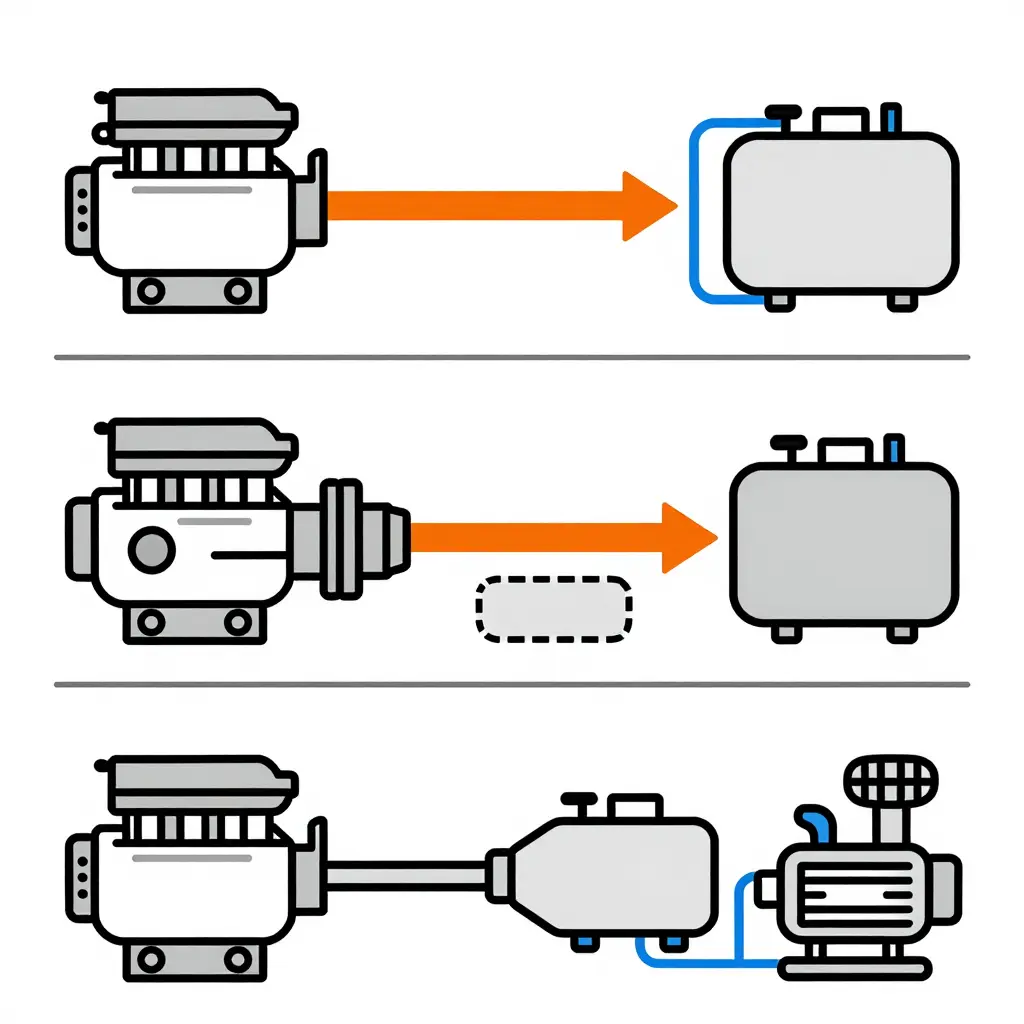
Caption: orange marks the power path from engine through driveline to the dashed pump in each panel; blue marks water moving between pump and tank.
Refill Turnaround Drives the Shift, Not Tank Size
The number that limits a tanker is usually the depot bay, not the tank. A large body served by a slow fill point delivers less water in a day than a mid-size body at a fast one.
Breaking the Cycle Into Its Parts
Refill turnaround is the sum of small delays: arriving and positioning at the bay, opening the fill port and coupling the hose, the fill itself, changing over when a queue forms, and the departure checks before the truck rolls.
Each specification moves one of those segments. Tank capacity sets fill duration. Port diameter and the number of fill points set how much water moves at once. Bay scheduling decides whether a changeover costs ten minutes or nothing.
Size refill capacity against the delivery leg rather than the tank alone, and ask what the depot can sustain per hour before committing to any tanker truck for sale. A water tanker fire truck is only as productive as its refill loop, so the bay deserves as much of the budget as the body.
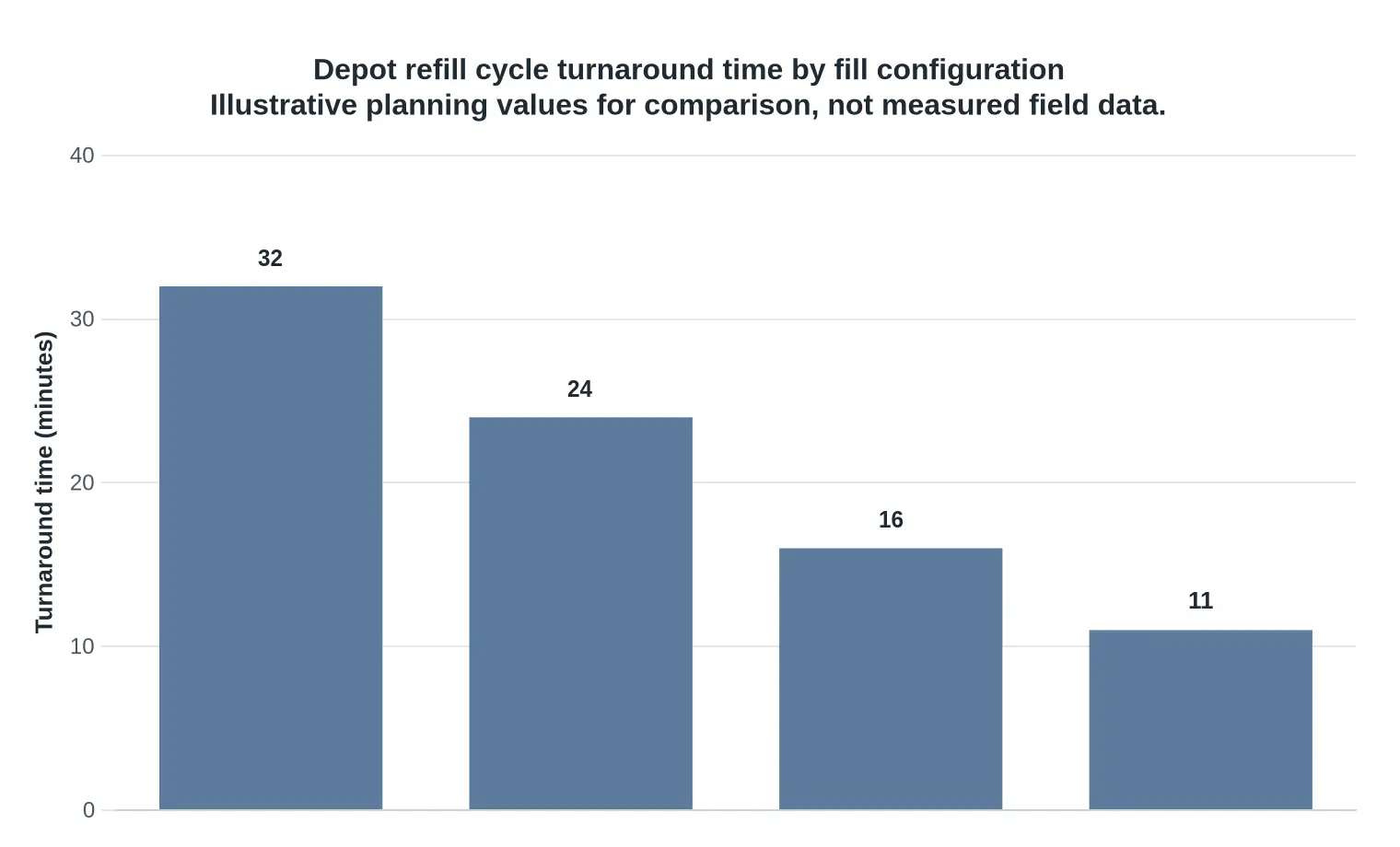
That chart is the argument in numbers. Gravity fill, a single transfer pump, dual-port parallel filling and bottom loading with pre-staged hoses all move the same volume at very different speeds, and the spread is wide enough to decide whether a truck fits one more load into a shift. Faster configurations also let a depot serve the same number of trucks from a smaller footprint, or absorb a seasonal peak without adding a bay – worth weighing against pump and hose cost when you shortlist water tanker fire trucks.
Measures that shorten the depot refill cycle
Where a fleet controls its own fill point for a water tanker fire truck, a few changes cut non-revenue time at the standpipe:
- Match the fill port diameter to the depot hose so flow is not throttled at the coupling.
- Add a second fill point for parallel filling; it roughly halves standing time per load.
- Pre-stage hoses, strainers and couplings at the bay so the crew connects as the truck parks.
- Move refills outside peak delivery windows so trucks do not queue behind each other at the hydrant.
- Specify a transfer pump rated above the hydrant supply, so the tank limits fill time rather than the pump.
- Record turnaround per load and review it with the crew monthly.
Verifying a tanker truck for sale against your own duty profile
A specification sheet only becomes comparable once every line is tied to a measurable duty requirement. Until then you are comparing adjectives, not capability.
Verification points to confirm
- Tank capacity and usable volume after baffling
- Declared tare weight and axle load distribution
- Tank body material grade certificate
- Pump flow at rated pressure and rated speed
- Pump drive layout and PTO rating
- Fill port size
- Acceptance test procedure referencing recognised standards
Ask for the certificate, not the brochure. Pair the material certificate with a scale ticket: an unproven shell grade, or a pump drive that loses flow away from rated speed, shrinks the volume you actually deliver on every refill. Our water tanker fire truck range shows how these figures are declared in practice.
What goes unverified at tender stage is what generates cost after delivery: downtime, re-rating, rework.
Frequently asked questions
Which tank body material gives the lowest lifetime cost?
Over a 15 to 20 year service life, stainless usually wins on total cost despite the higher purchase price. It resists potable water and mild chemicals without a lining, so the relining and patch repairs carbon steel needs do not arise. You can compare builds directly in our water tanker fire truck catalogue.
Does pump drive layout change fuel consumption while pumping?
Yes. A PTO-driven pump draws less than a separate engine drive because it uses the chassis engine instead of adding a second one to run and cool. The penalty for an independent engine is usually quoted at roughly 15 to 20 percent more fuel per pumping hour, paid in exchange for steady output through long stationary shifts.
How is the depot refill cycle measured?
From arrival at the fill point to the moment the truck is full and ready to move. Track it in minutes per 1,000 gallons, counting hose connection, filling and disconnection, so depots can be compared on equal terms.
Can a tanker be specified for both potable and non-potable duties?
A tanker can be dual-rated only with separate compartments, or with a documented washout and certification protocol. Most buyers order two dedicated units instead, because shared tanks fail health inspections once residue builds up.
What documentation should accompany a tanker truck for sale?
Every tanker truck for sale should arrive with the tank material certificate, pump performance curve, hydrostatic pressure test report and axle weight distribution sheet. Request the as-built drawing and the written warranty terms before releasing final payment.
Fleet Fit: Where the Tanker Sits in Your Line-Up
A water tanker rarely works alone, and refill logistics are easier to plan across the whole line-up than to bolt on after the tank body has been chosen.
Water tanker fire trucks carry the depot’s reserve water. Heavy-duty fire trucks take the long runs and sustained pumping. Industrial fire trucks cover fixed high-risk sites where mains access is thin. Behind them sits the support layer: fire truck parts for wear items, portable fire fighting equipment for crews working away from the vehicle.
Keeping tank materials, pump drive conventions and refill fittings consistent across a fleet cuts training time and spares cost together. CIMC Tianda builds fire-fighting equipment and brings international project experience to that specification work.
Conclusion: Let the Decision Order Do the Work
Tank body material, pump drive layout and depot refill cycle set payload, uptime and lifetime cost, and no single specification sheet shows them in relation to one another. Fix the order and the comparison becomes usable: define the duty profile, choose the material to match it, settle the drive arrangement, then size the refill hardware around the cycle depot staff can actually sustain – the same sequence visible in water tanker fire truck configurations. A tanker truck for sale evaluated in that order becomes a line-by-line comparison against competing offers, with every claim traced to a decision already made and measured, and every gap visible before signature.