How Fire Pump Priming Actually Works
Pumps move water, not air. That stubborn fact is the whole reason priming exists. Fire pump priming clears air out of the pump casing and suction hose so atmospheric pressure can push water up into the pump. Leave air trapped inside and the impeller just spins through vapor, moving nothing.
Atmospheric pressure does the lifting. At sea level, the atmosphere bears down on the surface of a water source – a cistern, a static pool, a drafting pond – at roughly 14.7 psi. That pressure can only push water into a space that is nearly empty, so the pump has to evacuate air first and create a low-pressure zone; only then does atmospheric pressure send water up the suction hose. A pump set above the water line gets no gravity feed at all. It depends entirely on that pressure difference.
How high the water can climb is capped. At sea level, atmospheric pressure theoretically holds up a column of water about 33.9 feet tall, but friction loss, altitude, and imperfect seals cut into that fast, and most crews keep drafting lift to roughly 10 to 25 feet. Because lift height and hose friction both eat into performance, understanding how lift height reduces effective pump capacity explains why a marginal prime burns critical minutes on a high-rise response.
Vacuum Prime vs. Dry Prime
Priming systems come in two broad types, and they clear the air in different ways.
- Vacuum prime: A venturi or rotary vane pump pulls air out of the pump casing, creating the negative pressure that lets atmospheric pressure push water in. It is common on many midship and rear-mount pumps.
- Dry prime: A positive-displacement system physically scoops and pushes air out of the pump until water arrives. It is often favored where a strong, reliable prime is needed from a completely dry start.
Why the Air-Tight Seal Matters
Every priming method rests on the same condition: the system has to be sealed. A leaky suction hose gasket, a worn intake valve, or a loose strainer connection lets outside air rush back in as fast as the primer pulls it out. The pump then never drops below atmospheric pressure, water never rises, and the prime fails. The air-tight seal is not a detail. Without it, priming does not happen at all.
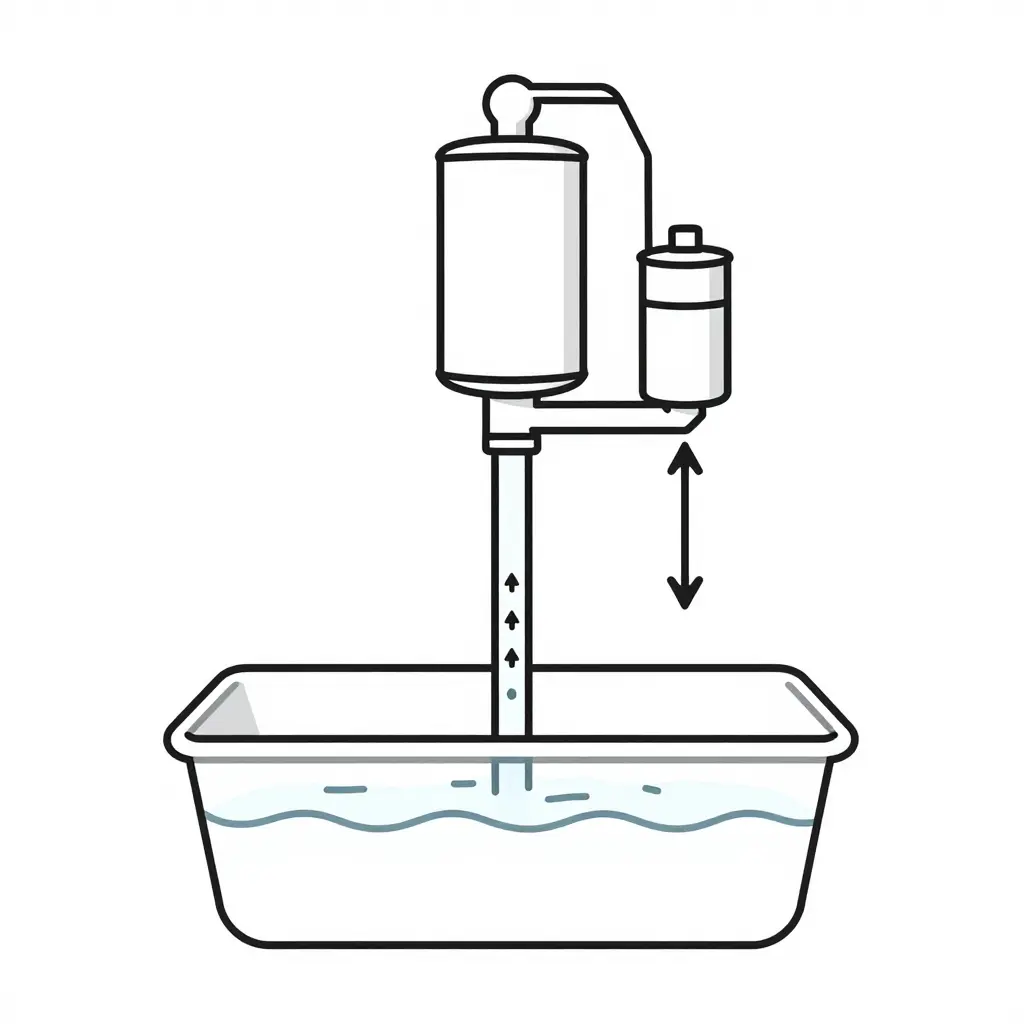
The schematic walks through the principle in a single frame. Water sits in a source at the bottom, the vertical lift line runs up to the pump body, and the evacuation path draws air out of the pump and suction line. With the trapped air gone, atmospheric pressure pushes water up the lift line and into the pump for discharge. The arrows mark the two opposing flows: water rising, air being pulled out.
Lift Height and the Physics of Priming
Lift height is the vertical distance between the surface of a water source and the center of a fire pump’s impeller. Vertical lift is that same rise expressed purely as elevation – the total climb a pump must overcome, no matter how long the horizontal run is. Both numbers decide how hard a pump works just to pull water in before it can push any out.
Priming clears air from the suction line so atmospheric pressure can drive water up into the pump, and that pressure has a ceiling. At sea level, a perfect vacuum can lift a column of water only about 33.9 feet, or roughly 10.3 metres. No priming system, however powerful, gets past that barometric limit.
Why Real Limits Are Lower
Crews never get close to that theoretical maximum. Friction inside the suction hose, turbulence, tiny air leaks at couplings, and the pump’s own inefficiency all consume pressure. Most fire service guidance keeps practical lift under about 15 to 20 feet (5 to 6 metres), and many manuals warn that deeper suction invites priming failure.
Every extra foot of lift slows the water down. Each foot of rise costs roughly 0.43 psi of the available pressure, so a tall lift leaves less force to move water quickly. The pump may still prime, but the delay stretches from a heartbeat into several seconds – which matters when a fire is growing upstairs.
Deep Drafts and Low Water Levels
Deep drafts and low static water levels make fire pump priming harder because air has farther to travel down the suction hose, and more of the pump’s limited pressure is spent just lifting water. When the source sits far below the apparatus, the suction line may also be longer, and hose length directly shapes how far a truck can draft. In high-rise operations that feed a standpipe, crews also weigh how far ladder and mast equipment can reach upward, because the pump at ground level must overcome both lift and vertical head.
Priming is a fight against gravity and the atmosphere. Ignore lift height, and gravity usually wins.
How Water Source Type Changes the Priming Job
The pump casing, impeller, and priming device behave according to the same physics no matter where the water comes from. What changes is the water source: it sets how much work priming has to do, how tight the seals need to be, and how easily air gets pulled in. A hydrant arrives pressurized; a pond does not. That one difference rearranges the whole task.
Pressurized hydrants
A hydrant already holds water under pressure, so the incoming flow does most of the priming. Priming load is low, and the risk of air entrainment is minimal as long as the connection is tight. The main failure point becomes a poor coupling or a dry hydrant rather than the priming system itself.
Static sources such as ponds or tanks
Static sources force the pump to lift water through suction hose. That raises the priming load, because the system has to create a vacuum strong enough to pull water up and displace the air. Seal integrity on the suction side becomes critical, and any small leak invites air entrainment that can defeat fire pump priming.
Below-grade cisterns
Cisterns add a vertical lift component that many crews underestimate. Deeper lift means a longer priming cycle and greater sensitivity to worn gaskets. If the suction strainer draws close to the surface, vortexing can pull air down and stall the lift entirely.
Relay and drafting setups
Relay and drafting operations divide priming work across multiple apparatus. A weak seal anywhere along the chain can introduce air that interrupts the whole supply. These setups carry the highest entrainment risk because there are more connection points to leak.
A quick comparison
| Source type | Priming load | Seal demand | Air entrainment risk |
|---|---|---|---|
| Pressurized hydrant | Low | Moderate | Low |
| Pond or tank | High | High | High |
| Below-grade cistern | High (lift) | High | Moderate to high |
| Relay or drafting | Variable | Very high | Highest |
How this connects to time lost
Most priming failures are not random. They come from a mismatch between the source and the setup. A truck that primes instantly at a hydrant may hesitate at a cistern, because the same seal cannot hold a deeper vacuum. Once crews see that, they can predict where the delay will land. Related faults in supporting systems follow the same load-versus-capacity pattern; proportioning drift and slow refill timing are covered in this article on foam system faults and refill timing.
Not every water source primes the same way, and the conditions at each type of supply point shape how long your pump sits there pulling a prime while a high-rise fire keeps burning.
| Water Source Type | Typical Lifting Requirement | Priming Difficulty | Common Failure Mode | Approximate Time to Prime |
|---|---|---|---|---|
| Pressurized Hydrant | None (positive pressure feed) | Low | Air lock from a dry hydrant or an open drain valve | 5-15 seconds |
| Static Pond/River | 10-25 ft (3-7.5 m) | High | Loss of prime from suction air leaks or vortexing at the strainer | 30-60 seconds |
| Below-Grade Cistern | 15-30 ft (4.5-9 m) | High | Air entrainment or a collapsed suction hose under vacuum | 45-90 seconds |
| Portable Tank Draft | 5-15 ft (1.5-4.5 m) | Medium | Vortexing and poor sealing at the hard-suction connection | 20-45 seconds |
| Relay Pumping | Varies with source; discharge-side lift only | Medium | Pressure surge or trapped air in the supply line | 15-40 seconds |
The higher the lift and the softer the source, the more seconds you lose, so even a strong fire truck pump capacity cannot rescue a suction line that never fully primes.
The Time Lost When Priming Fails
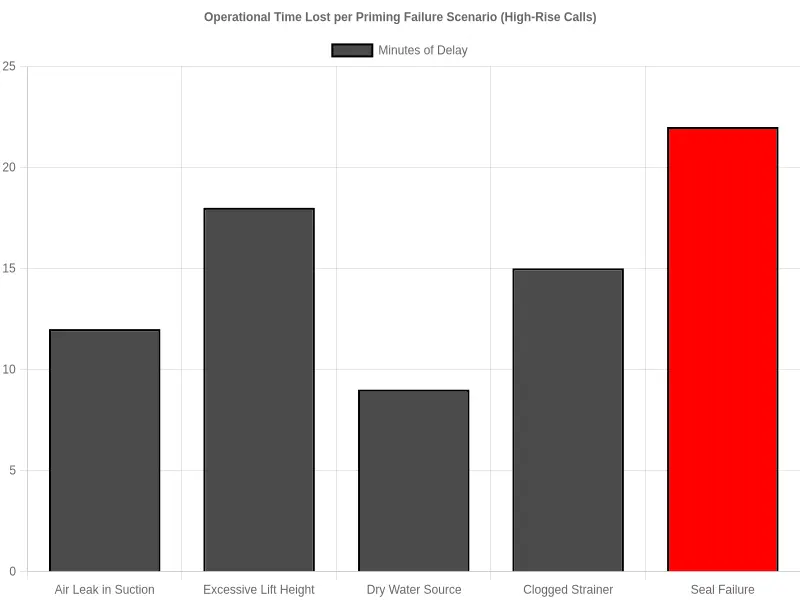
A priming failure rarely announces itself. The pump just spins without moving water, and every second spent troubleshooting is time lost the incident never gets back.
At a ground-level fire, a brief delay is an inconvenience. In a high-rise rescue, it changes the operation. Water has to climb standpipes and attack lines against gravity, so the gap between “water available” and “water at the fire floor” is already measured in minutes. A failed prime stretches it further.
One failed attempt costs roughly 30 to 60 seconds. A second and third attempt, plus checks of the priming valve, throttle setting, and suction hose, can eat three to five minutes before a crew confirms the pump is actually moving water.
Other problems pile on top. A leaking suction seal lets air in, the prime drops, and the crew starts over. Switching sources, from hydrant to draft or draft to tender, resets the whole sequence and adds setup time of its own.
That lost time lands on occupants and crews alike. Trapped residents above the fire floor and search teams working upper levels take on smoke and heat for every extra minute the line stays dry.
The search-and-rescue window narrows, the fire grows, and the risk to everyone inside climbs with them. How quickly a pump is expected to reach capacity shows what a stalled prime really costs; see this breakdown of fire truck pump capacity for reference. In high-rise work, priming is the clock.
Preventing and Managing Fire Pump Priming Failures
Use this checklist before and during high-rise rescue calls, when every second of lost pressure counts.
- Verify that every suction hose coupling gasket is seated, uncracked, and free of debris, because one damaged seal lets air into the line and stalls fire pump priming before water ever reaches the pump.
- Inspect the suction strainer for mud, grit, and debris, then clear any blockage so the pump can draw a full, unobstructed column of water from the source.
- Confirm that the water source is deep enough and far enough from the bank to avoid drawing in air or forming a vortex, since shallow draft is one of the most common causes of priming failures.
- Keep the lift height within the pump’s rated vertical lift limit, because drafting from more than roughly 10 feet above the water surface sharply reduces available vacuum, flow, and usable fire truck pump capacity.
- Run pre-priming checks on the pump panel before arrival, verifying that all discharge, drain, and relief valves are closed and the primer is actually functioning.
- Watch the vacuum and pressure gauges throughout priming, and troubleshoot immediately if the needle fails to climb within the expected time.
- Practice drafting and relay setups regularly, and map backup water sources and hose layouts in advance for the target buildings.
- Assign a dedicated pump operator on every high-rise response, and confirm radio contact with the crew so priming problems are reported the moment they appear.
Run these steps often enough and priming stops being a guess. Crews reach the fire floor with steady pressure instead of a preventable delay.
Frequently Asked Questions About Fire Pump Priming
What is fire pump priming?
Fire pump priming is the process of removing air from the pump casing and suction hose so that atmospheric pressure can push water into the pump. A centrifugal fire pump cannot move water until that air is displaced, because it does not create suction on its own. Priming is complete once the pump is full of water and begins to discharge at the expected pressure.
Why does lift height affect priming time?
Lift height is the vertical distance between the water surface and the pump intake, and it directly changes how much work the priming system must perform. As lift height increases, the vacuum required to raise water grows, and a pump can only lift water roughly 25 to 29 feet at sea level under ideal conditions. Higher lift therefore means longer priming times, more air to evacuate, and a greater chance the pump will not prime at all, which is why rated pump capacity must always be matched to the lift the scene demands.
Can a pump prime from a below-grade cistern?
Yes, a pump can prime from a below-grade cistern, provided the total lift height stays within the pump’s rated capability and the suction hose remains airtight. Cisterns located one or two stories below grade are common in high-rise buildings and usually fall within a workable lift range. A dirty or poorly maintained cistern can clog the strainer and stall priming, though, so verify the water source before connecting.
How can crews reduce priming failures on high-rise calls?
Crews reduce priming failures by checking suction hose couplings, gaskets, and strainers before charging lines, since most priming problems come from air leaks. They also keep lift height as low as possible and confirm that the water source is actually supplying water. A well-maintained pump with a functional primer is far more reliable, so routine inspections matter on every shift.
What role does the water source play in time lost?
The water source has a direct impact on time lost during a high-rise rescue, because a marginal source such as a shallow pond or a low static level forces the pump to work harder to prime. Departments that pre-plan usable water sources near target buildings shave minutes off their setup time. When the water source fails or runs dry, crews must relocate and re-prime, which can delay a high-rise rescue by several critical minutes.
Conclusion and Key Takeaways
Three things decide whether water reaches a high-rise fire in time: lift height, water source, and time lost. Lift height sets the demand on the pump; every extra floor of vertical rise cuts the pressure and flow available at the nozzle. The water source decides what the pump has to work with, whether that is a hydrant on the street, a static supply, or a relay from a distant engine. Time lost is the gap between the two, measured in minutes spent re-establishing suction or chasing a prime while the fire keeps growing.
Priming is what holds those three in check. A pump that primes quickly and holds its seal turns a difficult lift height into routine work and lets crews draw from whatever water source is closest to the scene. When priming is unreliable, the same call becomes a waiting game that no amount of ladder work can fix.
A few points worth carrying forward:
- Lift height is a hard limit, not a suggestion. Priming performance has to be verified against the heights your district actually presents, not just the ones in the manual.
- The water source is only useful if the pump can reach it. Drafting from static supplies depends entirely on a sealed, well-maintained priming system.
- Lost time compounds. Every minute without water at a high-rise rescue adds to fire growth, occupant risk, and structural damage.
- Preparation beats improvisation. Routine priming checks, clean strainers, and tight suction connections turn unpredictable failures into known, manageable steps.
Reliable priming is easy to take for granted until it fails. Departments that treat priming readiness as routine maintenance rather than an afterthought keep their lift within limits, their water source secure, and their lost time short. For a wider look at the equipment behind this work, see this overview of top ARFF fire trucks.