Introduction: Uptime Is the Only Metric That Matters
Three variables decide how often a fire apparatus is ready to roll: spare parts lead time, warranty claims handling, and service coverage. For dealers and fire department fleet managers, those three set the ceiling on vehicle uptime. Let one slip and a frontline engine, ladder, or rescue sits out of service while the district covers the gap with less.
Spare parts lead time is the order-to-delivery interval for a fire truck component: the time from placing an order with a distributor or original equipment manufacturer (OEM) to the correct part arriving and being ready to install. That interval covers order entry, OEM production or warehouse picking, and inbound freight. Dealers and fleet managers measure it in days of downtime. It grows with configuration complexity, which is why it helps to understand what drives customization lead time and service cost before a part is ever needed.
Warranty claims are the process for documenting a defect, premature failure, or non-conformance, submitting it to the manufacturer, and resolving it through repair, replacement, or credit. Warranty administration for a fleet covers parts tracking, labor documentation, claim submission, and reimbursement recovery.
Service coverage is where, when, and how fast qualified technicians and mobile support can reach an apparatus. It includes dealer service networks, authorized mobile mechanics, on-site diagnostics, and preventive maintenance programs.
The sections below take each pillar in turn: shortening spare parts lead time, running a warranty claims workflow that gets paid, and judging whether service coverage can keep a rig on the road.
Spare Parts Lead Time: The Metric That Decides Operational Readiness
For fire apparatus dealers, price is rarely the constraint that keeps a rig down. Lead time is. The gap between diagnosing a failed component and having the right fire truck parts on the bay floor ready to install decides how many days the apparatus stays out of service. A department does not get those days back, and fewer available rigs means thinner response coverage across the district.
The Five Variables That Drive Spare Parts Lead Time
Component type sets the floor. Pads, rotors, and air valves ship from regional depots in days. Pumps and aerial components are built to order, tested, and released against specific ratings, so they take weeks or months. Dealers who know fire truck pump capacity can match a replacement pump or impeller to the original spec and skip the failed-fit cycle. Hose assemblies restock faster because fixed lengths and thread patterns make ordering simple – see how long a fire truck hose is.
OEM sourcing adds structural delay. When one manufacturer controls a proprietary electronics or control module, there is no generic substitute. Lead time then follows the OEM’s production calendar rather than local demand, and a single-sourced controller can hold up an entire rig.
Stocking strategy is the variable dealers control most directly. A disciplined plan keeps fast-moving foam system components, brake parts, and filters on the shelf, and treats body panels, cab panels, and aerials as order-by-exception. The trade-off is capital tied up in inventory against a rig parked for weeks.
Order verification prevents the quietest downtime. The worst outcome is the wrong part arriving after a long wait. VIN-level validation, supersession checks, and alerts on revision changes keep the first shipment correct.
Logistics closes the loop. A correct part in a warehouse does nothing until it reaches the bay. Freight consolidation, expedited carriers, and depot-to-dealer routing compress lead time for critical spares.
The practical rule for fire apparatus dealers is to treat lead time as a service-level commitment rather than a shipping detail. Forecast by component category, validate every order, and stock the right mix of fire truck parts. That turns unpredictable downtime into planned maintenance, which is what protects operational readiness when the next alarm sounds.
For related planning considerations, see our guide to budgeting a new fire truck’s customization lead time and service cost.
| Component Category | Typical Order-to-Delivery Lead Time | Primary Lead Time Driver | Impact on Uptime | Recommended Stocking Strategy |
|---|---|---|---|---|
| Pumps (impellers, seals, wear rings) | 4-12 weeks | OEM build-to-order and cast-part machining | Critical – a pump failure sidelines the entire apparatus | Stock seals, gaskets and wear rings; keep impellers on standing order |
| Aerial/Ladder Components (hydraulics, cables, turntable) | 6-16 weeks | Custom fabrication and hydraulic certification | Severe – ladder or platform goes out of service | Stock hydraulic hoses and seals; pre-order cables before season |
| Electronics & Control Modules (pump panels, ECUs) | 2-8 weeks | Semiconductor supply and firmware versioning | High – disables monitoring and operator controls | Hold critical modules on shelf and set firm min/max levels |
| Chassis & Braking Parts (pads, rotors, air valves) | 3-10 days | Aftermarket availability and OEM markups | Moderate – safety and compliance exposure | Stock common wear items and source from local distributors |
| Foam System Parts (proportioners, pumps, nozzles) | 3-8 weeks | Specialty components and flow calibration | High – proportioning drift threatens ARFF performance | Stock proportioner parts and nozzles; keep calibrated spares ready |
| Body/Cab Panels (doors, compartments, trim) | 5-14 weeks | Custom paint matching and metal fabrication | Low-moderate – cosmetic to functional disruption | Order as needed; keep latches, hinges and hardware in stock |
Warranty Claims Administration: Protecting Dealer Margins and Fleet Uptime
A warranty process that runs well protects dealer margins and fleet uptime at the same time. Get a claim right the first time and the dealer recovers the parts and labor it is owed, and the department gets a working fire truck back sooner. Get it wrong and reimbursement slips away while the rig sits idle.
Warranty administration deserves the same rigor as any other service line. Treated as back-office paperwork, it costs money and time.
The mechanics of a clean warranty claim
Documentation comes first. Every file needs the VIN, component serial numbers, a clear failure description, fault codes, the repair order, parts used, and dated photo or video evidence. Omit one item and the claim stalls.
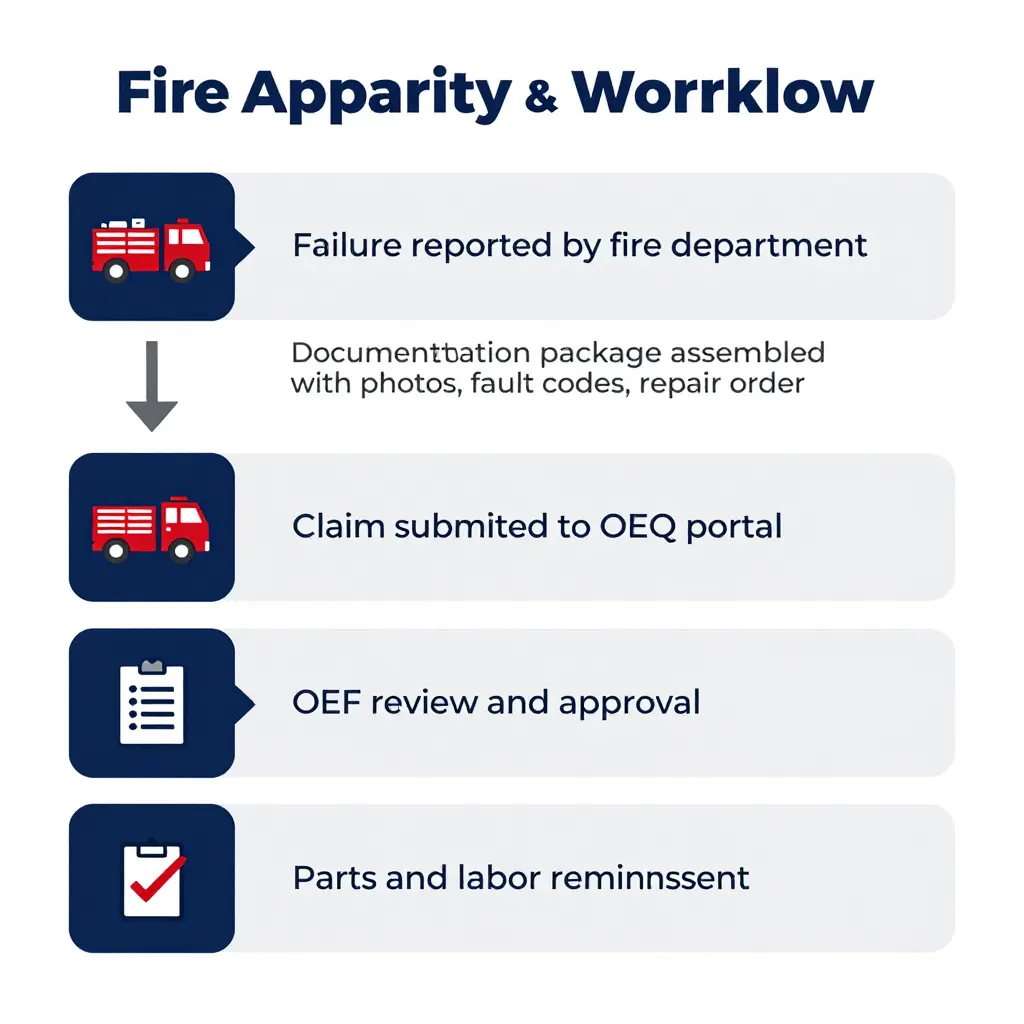
Once the package is complete, the claim follows a predictable submission and approval flow:
| Stage | Typical owner | Target time |
|---|---|---|
| Failure reported | Fire department | Day 0 |
| Documentation package assembled | Dealer service writer | 1-2 days |
| Claim submitted to OEM portal | Dealer warranty admin | Within the OEM window |
| OEM review and approval | OEM warranty team | 5-10 business days |
| Parts and labor reimbursement | OEM finance | 30-60 days |
OEM response times vary by manufacturer, but a well-prepared claim usually sees acknowledgment within 1-2 business days.
Evidence standards and the reasons claims fail
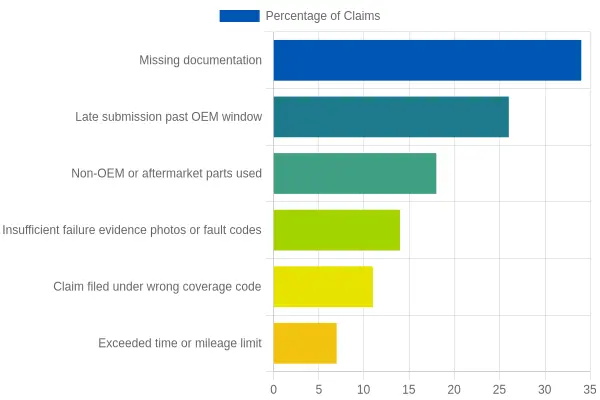
A claim is only as strong as its evidence. Photographs need to be in focus and dated. Download fault codes before they are cleared. The parts invoice has to show an OEM component was installed, because aftermarket substitutions are a leading cause of rejection. The chart below lists the most common reasons claims are delayed or refused.
How clean warranty handling cuts downtime
Every day a fire truck is out of service costs something: lost response capability, a rental replacement, overtime. Dealers who pre-authorize repairs, stock fast-moving warranty parts, and file accurate claims get trucks back on the line sooner. That predictability protects the department’s budget, which is why fleet managers weigh service and warranty terms as carefully as purchase price when budgeting a new fire truck.
For dealers who treat warranty claims as a core competency, the payoff shows up in healthier margins and fleets that stay ready more often.
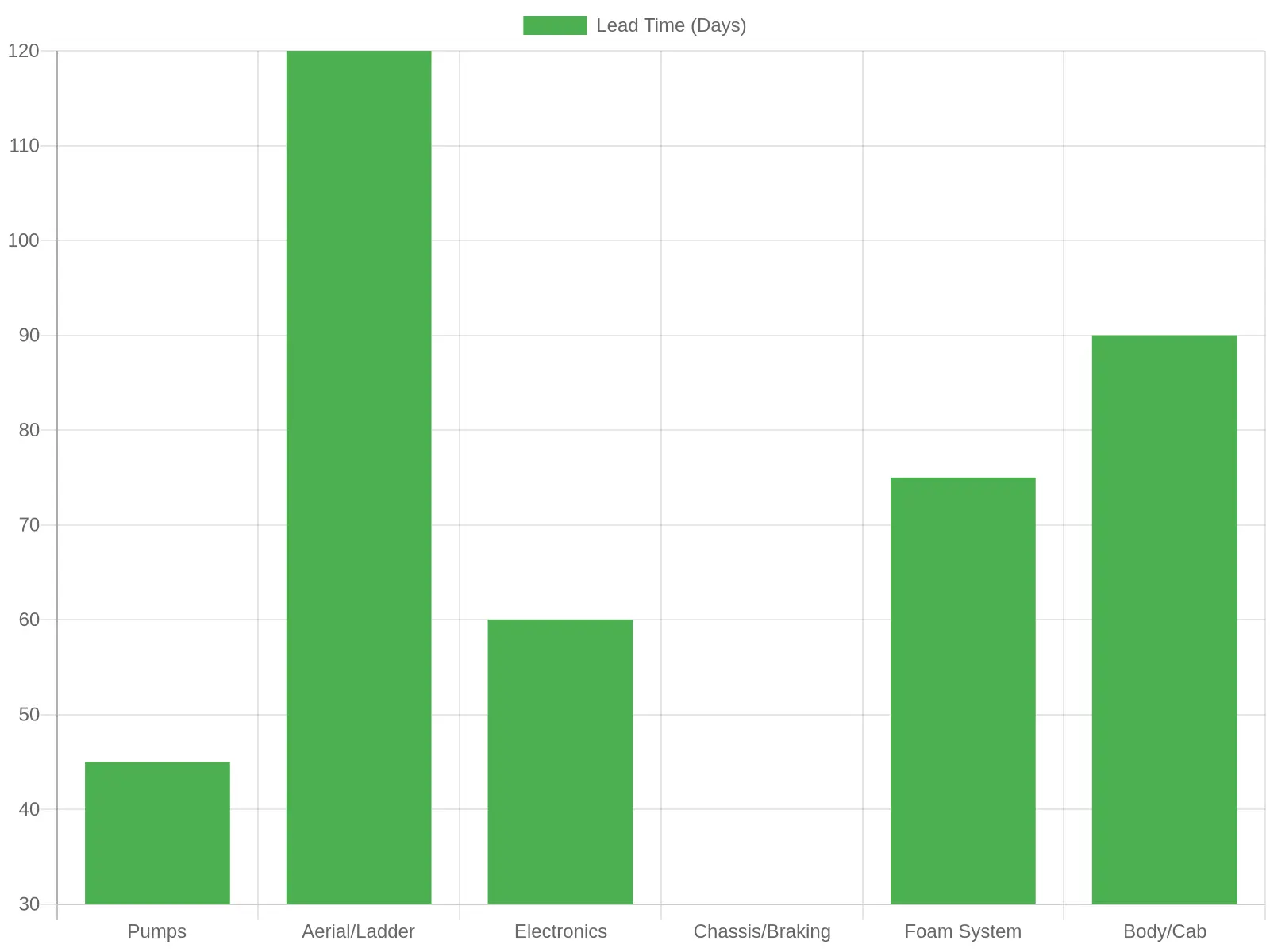
Fire Apparatus Spare Parts Lead Time by Component Category
This chart compares typical spare parts lead times across fire apparatus component categories as a quick benchmark for planning maintenance and stock.
| Component Category | Typical Lead Time (Days) |
|---|---|
| Pumps | 45 |
| Aerial/Ladder | 120 |
| Electronics | 60 |
| Chassis/Braking | 30 |
| Foam System | 75 |
| Body/Cab | 90 |
Aerial/ladder assemblies and custom body/cab components carry the greatest downtime risk, while chassis/braking parts are usually the quickest to source. Those gaps are what tell a department what to stock on-site and what to order on demand.
The Downtime Reduction Playbook: Five Practical Moves
Lead time figures and warranty trends are only useful if they change what a shop does. For fire apparatus dealers, fire department fleet managers, and municipal procurement officers, that means building uptime into daily operations instead of reacting to breakdowns. Five moves follow, each with a concrete payoff. If new purchases are on the table, understand budgeting for lead time and service cost before the spec is locked.
1. Maintain a critical spares inventory. Keep the fast-moving, long-lead components on hand – pumps, valves, control modules, seals, and discharge hoses – so a routine failure does not become a weeks-long vehicle outage. On-hand spares absorb sudden spare parts lead time spikes.
2. Establish agreed response-time SLAs with the OEM. Put diagnostic response, parts shipment, and on-site repair windows in writing. A documented SLA turns a vague promise into measurable service coverage you can hold a supplier to.
3. Pre-verify warranty documentation. Assemble VIN records, service histories, and claim forms before any work begins. Complete paperwork heads off the approval delays that stretch every repair cycle.
4. Standardize parts across the fleet. Consolidate on common platforms, fittings, and consumables wherever specifications allow. Fewer SKUs lower stocking risk and let one spare cover several trucks.
5. Apply telemetry for predictive maintenance. Use onboard data to flag fault codes and duty cycles before they turn into failures. Predictive alerts move work from emergency callouts to scheduled service.
The Playbook at a Glance
| Move | Action | Uptime Payoff |
|---|---|---|
| 1 | Critical spares inventory | Blunts spare parts lead time spikes |
| 2 | OEM response-time SLAs | Turns service coverage into measurable guarantees |
| 3 | Pre-verify warranty docs | Speeds claim approvals |
| 4 | Standardize fleet parts | Fewer SKUs, shared spares |
| 5 | Telemetry-based predictive maintenance | Converts emergencies into scheduled service |
Run the five together and downtime becomes a cost you can budget for rather than a surprise.
Warranty Claim Workflow at a Glance
The diagram runs left to right through the six stages of a warranty claim, which is the sequence a fire apparatus dealer should follow. Each box is a handoff point, and the return arrow shows closed claims feeding back into fleet records for reliability tracking.
- Part failure identification – the fault is confirmed and isolated on the apparatus.
- Documentation and evidence capture – photos, fault codes, and service notes are logged.
- Claim submission to the OEM – the packaged claim is filed with the manufacturer.
- Review and approval – the OEM validates coverage and authorizes the repair.
- Part shipment and repair – replacement components arrive and are installed.
- Claim closure and recovery – the case is reconciled and costs are recovered.
Keeping these steps tight protects uptime for fire department fleet managers and simplifies warranty administration for dealers managing critical emergency equipment. For more on parts availability and service planning, see this guide to spare parts lead times and service coverage.
Service Coverage: Where Uptime Is Won or Lost
For fire apparatus dealers, service coverage is where fleet reliability is decided. Whether a disabled fire truck returns to service in hours or in weeks depends on how broad the coverage is and how fast a technician can physically reach the vehicle. A truck that sits idle for three weeks waiting on a cross-border parts shipment has a coverage problem, not a warranty problem.
Four dimensions of service coverage can be measured:
- Geographic reach of service centers and mobile units. The distance to the nearest authorized facility or field service vehicle sets the floor for response time. Dense service-center footprints plus roaming mobile units shrink that window from days to hours.
- Technician certification and OEM diagnostics access. Only factory-trained, certified technicians running current OEM diagnostic software can read proprietary fault codes and validate repairs, which protects warranty compliance.
- Parts availability within the coverage zone. Local stocking of high-failure components and fast-moving spares decides whether a repair is finished same-day or waits on a shipment.
- After-hours and emergency response. Fires do not keep business hours. Around-the-clock dispatch and pre-staged emergency parts keep critical apparatus mission-ready.
Global manufacturers build multi-country service networks to extend these capabilities to their dealers. CIMC Tianda, for example, layers regional service hubs, mobile response teams, and centralized parts logistics that local fire apparatus dealers can plug into – so a single fire truck breakdown in a remote district still draws on a coordinated service network rather than a lone workshop.
Evaluate a service network the way you would evaluate response time itself. Coverage breadth and speed decide how quickly your fleet is back on the road, and price alone will not tell you. Dealers weighing total cost of ownership should also factor in budgeting a new fire truck’s service costs alongside customization lead time.
What the Data Shows
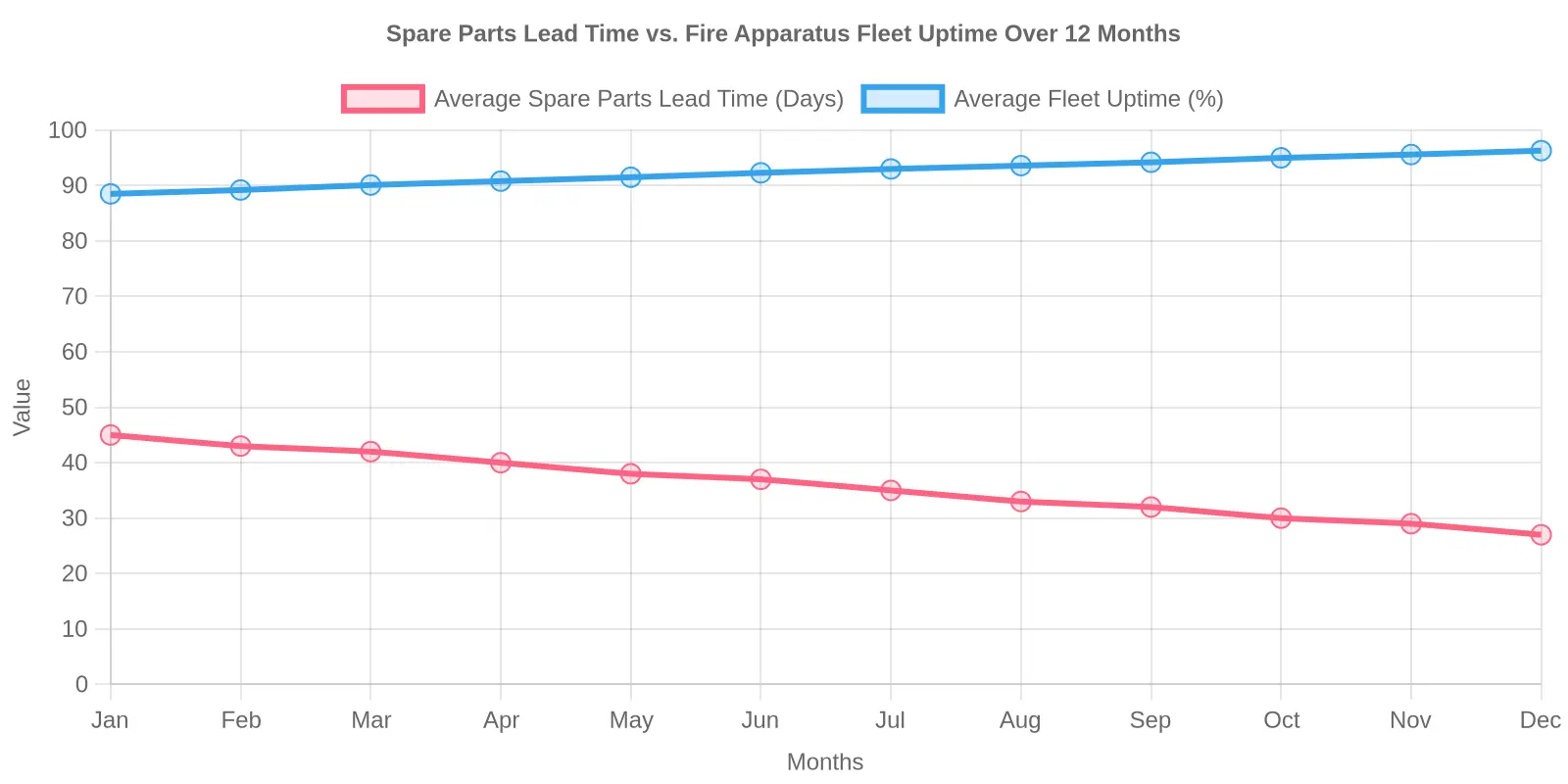
The chart plots two series across a single 12-month window. As average spare parts lead time falls from 45 days in January to 27 days in December, average fleet uptime climbs from 88.5% to 96.3%. The two lines move in almost perfect opposition, the inverse relationship every depot manager works with but rarely sees graphed.
| Metric | January | December | Net Change |
|---|---|---|---|
| Average Spare Parts Lead Time (Days) | 45 | 27 | -18 days |
| Average Fleet Uptime (%) | 88.5 | 96.3 | +7.8 pts |
Why the Lines Move Together (in Opposite Directions)
Every day a critical part sits in a warehouse or on a freight dock is a day a rig sits out of service. Compress lead time and you compress downtime. Three conclusions follow for dealers and fleet supervisors:
- Inventory placement beats expediting. Moving high-turnover parts closer to the point of need shortens the clock more reliably than emergency air freight.
- Faster fulfillment compounds uptime. An 18-day reduction translated into nearly 8 percentage points of additional availability across the year.
- Uptime is a readiness metric, not a maintenance metric. For emergency services, each recovered percentage point represents more apparatus available on the first alarm.
The trend line gives procurement officers a defensible argument for spending on parts logistics and service coverage: it moves fleet readiness, which is the point. To see how lead time factors into the broader cost picture of a new rig, it helps to understand how much a new fire truck costs and what drives customization lead time.
How to Evaluate a Fire Apparatus Dealer’s Service Coverage
When fire apparatus dealers compete for your fleet’s business, the reach of their service coverage matters far more than the warranty fine print. Use this checklist to separate genuine support networks from marketing promises:
- Distance from dealer service center to fleet location – Confirm the actual drive time, not just the number of miles, since traffic and routing directly affect how quickly a rig re-enters service.
- Guaranteed response time – Insist on a written, contractual commitment for on-site arrival windows rather than a vague “prompt service” pledge.
- Certified technician availability – Verify that EVT- or ASE-certified staff are on hand for your specific chassis, pump, and aerial platforms.
- On-site mobile service capability – Check whether the dealer deploys fully equipped field trucks so minor repairs never require towing a fire truck out of service.
- OEM parts access within the coverage zone – Ask where critical spares are warehoused locally, because regional parts inventory slashes downtime compared to ordering from a distant depot.
- Warranty claims turnaround – Clarify how fast the dealer files, adjudicates, and reimburses warranty claims so your department isn’t financing manufacturer defects up front.
- After-hours emergency support – Confirm a 24/7 dispatch line staffed by real technicians who can guide crews through failures during overnight incidents.
- Escalation and reporting cadence – Request quarterly performance reporting that tracks uptime, repeat failures, and open warranty claims against agreed benchmarks.
Pair this checklist with a clear view of total lifecycle costs. Understanding the service cost of a new fire truck helps procurement teams weigh upfront pricing against long-term support reliability.
How the Service Coverage Network Connects
The diagram below maps the architecture behind a fire apparatus dealer’s service coverage model. The OEM/distribution hub sits at the top, holding inventory depth and technical authority. From there, lines branch outward to regional dealer service centers, which stage parts and handle warranty administration. Those centers reach further out to mobile service units that roll to a department’s bay, and to the fleet locations themselves. The layered structure is what shortens downtime: the closer a certified technician and the right part sit to the apparatus, the faster the rig returns to service.
When you look at a coverage map, go past the number of dots. Ask how quickly the hub can replenish a regional center, whether mobile units carry the high-failure components, and where warranty claims actually get processed. Those cost and lead-time details belong in the decision – see how they factor into budgeting a new fire truck before you sign.
The schematic shows the hierarchy with geometric nodes and connecting lines: a central hub, regional service centers, then mobile units and fleet endpoints. (Placeholder image: a 2D network diagram of a fire apparatus dealer service coverage network.)
Fire Apparatus Dealers FAQ: Spare Parts, Warranty Claims, and Service Coverage
What is a typical spare parts lead time for fire apparatus?
Dealers typically quote a spare parts lead time of 24 to 72 hours for common consumables and fast-moving wear parts when inventory is stocked locally. Specialized components such as pumps, aerial hydraulic parts, or proprietary electronics usually take two to six weeks, and custom-built items can extend to eight to twelve weeks. The actual figure depends on whether the part is held by the OEM or must be manufactured to order, so planning for parts lead time and service costs should be part of every fleet budget.
How are warranty claims processed and approved?
The dealer submits a claim through the OEM portal with the VIN, part numbers, labor hours, and diagnostic documentation attached. The OEM warranty administrator reviews each submission against coverage terms and then approves, partially approves, or denies it within a defined window, often five to ten business days. Approved claims are credited to the dealer account or reimbursed after parts return and verification.
What causes warranty claim rejection?
Claims most often fail on missed submission deadlines, incomplete documentation, or repairs performed without prior authorization where it is required. They also fail when the failure is traced to operator error, accident damage, unauthorized modifications, or non-OEM parts installed by third parties. Clear photo and diagnostic evidence significantly lowers rejection rates and speeds reimbursement.
How is service coverage evaluated?
Map the dealer network’s mobile service radius, authorized service center locations, and local parts stock against the fleet’s operating area. Fleet managers should review response-time commitments, on-site versus depot repair capability, and after-hours availability for each region. Coverage gaps often appear on rural routes or during seasonal deployments, so periodic audits keep response plans realistic and enforceable.
How can dealers reduce fire truck downtime?
Dealers reduce downtime by maintaining a predictive spare parts inventory, operating mobile field service units, and pre-staging critical components at regional depots. Structured preventive maintenance schedules and fast diagnostic turnaround also shorten out-of-service periods. Because fire trucks are mission-critical assets, even small delays in parts availability directly affect emergency response readiness.
Conclusion: One Integrated System for Reliable Uptime
Three pillars run through this guide: spare parts lead time, warranty claims, and service coverage. Each one matters on its own, but together they decide whether a truck rolls out of the bay or sits idle. A delayed component can stall a dealer’s entire delivery schedule. An unresolved warranty dispute can erode a fleet manager’s budget and trust. Thin service coverage turns a minor repair into weeks of uptime lost.
Reliable uptime does not come from optimizing one pillar in isolation. It comes from treating parts logistics, warranty administration, and service coverage as a single operational system. Managed together, they reinforce one another and shorten downtime. Managed in silos, they work against each other.
As a global manufacturer supporting dealers across 75 countries, CIMC Tianda builds its network around that integration, pairing genuine parts availability with warranty clarity and dependable service reach. To understand how these operating realities connect to the broader economics of your rigs, explore our breakdown of what a new fire truck really costs. Disciplined management of all three pillars is what keeps apparatus ready when the alarm comes in.