What a Used Fire Chief Vehicle Is – and the Three Factors That Decide the Purchase
A used fire chief vehicle is a command vehicle, not a frontline pumper or ladder truck. Most are battalion chief SUVs or suburban utility chassis upfitted with command, communications, and incident-management systems. When a department shops for used fire chief vehicles for sale, it is buying a mobile command post: a platform that puts the incident commander, radios, mapping and accountability software, and often a light tower on scene, and keeps command running through a long incident.
Three things decide what that vehicle actually costs: chassis hours, radio interoperability, and refurbishment cost. Chassis hours measure the mechanical life left in the engine, transmission, and drivetrain; unlike odometer mileage, they capture the long idle stretches that define command duty. Radio interoperability decides whether the unit can reach VHF, UHF, 700/800 MHz, and P25 partners on a live incident. Refurbishment cost covers the upfitting, electronics, and cosmetic work needed to bring the vehicle to your specification, and it is where accurate planning around budgeting for customization, lead time, and service cost keeps a project from running over.
The three interact. A low-hour chassis with incompatible radios still needs expensive communications work, and a cheap command vehicle with undisclosed refurbishment needs can end up costing more than a clean one. Get all three right and total cost of ownership follows.
How to Read Chassis Hours on a Used Fire Chief Vehicle
Chassis Hours vs. Odometer Mileage: Two Different Clocks
An hour meter records cumulative engine run time from the moment the ignition is energized; the odometer records distance traveled. On a used fire chief vehicle the two rarely move together. A command SUV that idles for 90 minutes while a chief manages an incident adds roughly one chassis hour and almost no miles. Mileage understates the wear; the hour reading shows it.
For vehicles that idle as much as command SUVs and battalion chief rigs do, chassis hours are the more conservative wear signal. A 6,000-hour unit with 60,000 miles has absorbed far more runtime stress per mile than either number suggests on its own.
Why Hours Outweigh Mileage on Idle-Heavy Command Platforms
Fire apparatus spend much of their service life parked with the engine running, because pumps, radios, lights, and HVAC all draw on it. That idle time still circulates oil, turns the accessory drive, cycles the transmission in park, and loads the charging system, yet it adds no odometer distance. Idling accumulates engine hours at roughly one per clock hour, so the odometer systematically understates duty. When two trucks look identical, treat the hour reading as the primary wear signal and mileage as background.
How Chassis Hours Map to Component Wear
- Engine. During idle, hours track piston, valve-train, and bearing revolutions far better than mileage does. Long idling encourages cylinder glazing, fuel dilution of the oil, and turbo wear from repeated low-load heat cycles.
- Transmission. Idle hours work the torque converter, cooler circuit, and fluid. Low-speed and stationary duty often produces more thermal cycling than steady highway miles.
- Auxiliary systems. Alternators, batteries, inverters, air compressors, and radio/interoperability racks all run on engine time, so high hours point to earlier replacement – a real cost when that equipment was upfitted into the vehicle.
Acceptable Chassis Hours by Vehicle Class and Usage Profile
| Vehicle Class | Typical Odometer | Typical Chassis Hours | Assessment Notes |
|---|---|---|---|
| Command SUV / Sedan (urban) | 60,000-90,000 mi | 5,000-8,000 hr | High idle share; inspect cooling and auxiliary drives |
| Battalion Chief SUV (suburban) | 70,000-110,000 mi | 4,000-6,500 hr | Balanced duty; mid-cycle service likely due |
| Rural response unit | 80,000-130,000 mi | 3,500-5,500 hr | Higher mileage, lower idle; drivetrain wear dominates |
| Airport / standby command | 40,000-70,000 mi | 7,000-11,000 hr | Extreme idle exposure; scrutinize auxiliary systems |
Reaching the top of a range should trigger a full mechanical inspection, not automatic rejection. A documented service history can justify high hours; an undocumented one cannot.
Interpreting Hour-to-Mileage Ratios as Duty-Cycle Evidence
Divide odometer miles by chassis hours to get miles per hour of runtime. That ratio describes the duty cycle more clearly than either number on its own.
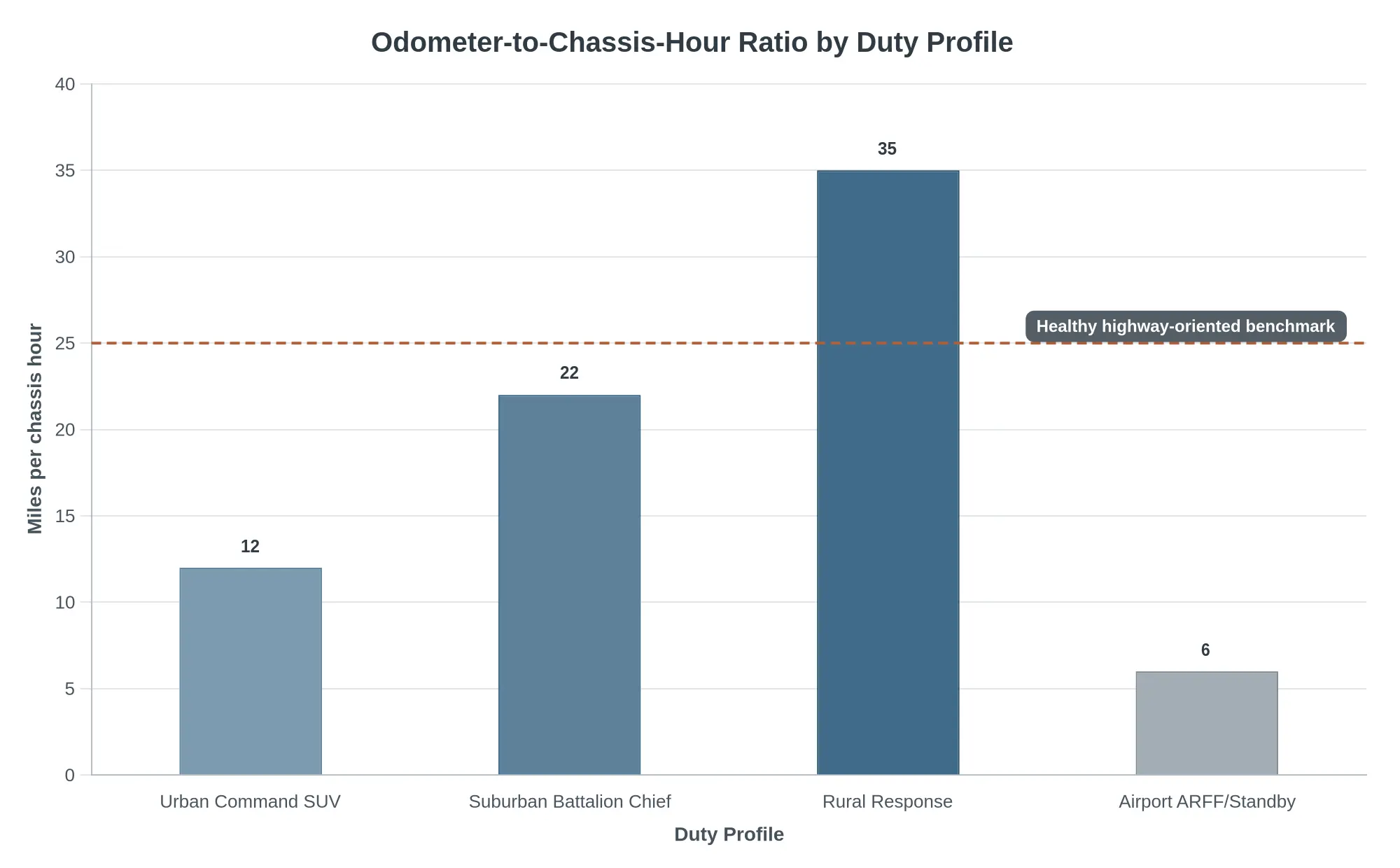
Below about 15 miles per hour, the unit has led an idle-heavy, event-driven life typical of urban command work, and auxiliary and thermal wear dominate. Above 30, it has spent long stretches on the highway, so drivetrain and tire wear matter more than stationary runtime. A ratio near 22-25 points to balanced suburban service. On used fire chief vehicles, a low ratio combined with unexpectedly high total hours signals idle stress that a mileage-focused inspection will miss.
Practical Takeaway
Ask for the hour meter reading along with the odometer before you negotiate, then calculate miles per chassis hour to classify the duty cycle. Check the reading against the class table and price auxiliary and cooling-system refurbishment accordingly. Original chassis class and pump rating also shape replacement economics; see these insights on chassis class and pump rating for that comparison. Hours, not miles, show how hard a command vehicle has worked.
The next table turns that analysis into rough screening benchmarks. Use it when a listing’s odometer looks healthy but the engine has been idling for years. Ranges differ by source and configuration, so treat any single table as a starting filter and reconcile it against your own fleet data. For the cost side of procurement, see our guidance on budgeting for a new fire truck’s customization, lead time and service cost.
| Vehicle Class | Typical Odometer Range | Typical Chassis Hours Range | Hour-to-Mileage Ratio Signal | Procurement Risk Level |
|---|---|---|---|---|
| SUV Command (Tahoe / Expedition) | 80,000 – 160,000 mi | 8,000 – 14,000 hrs | High idle ratio (above 0.08 hr/mi) | Moderate |
| Pickup Chassis (F-250 / F-350) | 60,000 – 130,000 mi | 6,000 – 12,000 hrs | Elevated idle ratio (above 0.09 hr/mi) | Moderate – High |
| Heavy Rescue-Based (walk-in body) | 40,000 – 110,000 mi | 9,000 – 16,000 hrs | High standby / idle ratio | High |
| Battalion Chief SUV (Type III) | 70,000 – 150,000 mi | 7,000 – 13,000 hrs | Moderate ratio (0.06 – 0.09 hr/mi) | Moderate |
| Incident Support / Air-Light Unit | 50,000 – 120,000 mi | 10,000 – 18,000 hrs | Very high station-idle ratio | High |
| Long-Wheelbase Command (semi-based) | 90,000 – 200,000 mi | 12,000 – 20,000 hrs | High operational-hours overload | High |
Screen every candidate against these class norms. A unit that exceeds its typical chassis-hours range, or shows an adverse hour-to-mileage ratio, is telling you it has idled for years and deserves a full mechanical and engine-life inspection before purchase.
Radio Interoperability: The Hidden Cost Driver in Used Fire Chief Vehicles
Departments evaluating used fire chief vehicles usually start with chassis hours, pump ratings, and cosmetic condition. The factor that most often decides the outcome is the one you cannot see in a photo: radio interoperability. A command vehicle that cannot reach neighboring agencies during a mutual-aid incident has failed at its main job, however few hours its engine has logged. Treat the communications suite as a primary evaluation criterion.
The Technical Fundamentals
Interoperability comes down to whether the radios on both ends match in standard and configuration.
P25 digital standards. Project 25 (P25) is the dominant public-safety digital standard in North America and defines the common air interfaces that let radios from different manufacturers talk. A used command vehicle may run P25 Phase 1 or Phase 2. A department built on Phase 2 trunking cannot fully interoperate with a Phase 1-only installation without upgrades.
Analog versus digital. Legacy analog systems remain in service in many rural jurisdictions. A command vehicle with analog-only equipment cannot directly access a partner’s digital talkgroups. Some radios support both modes; many older installations do not.
Trunked versus conventional. Conventional systems use fixed frequencies, while trunked systems assign channels dynamically through a control channel. A vehicle programmed for trunked operation is not drop-in compatible with a conventional mutual-aid network, and the reverse is equally true.
Encryption. Encrypted traffic requires matching key sets, including algorithms and key IDs. A vehicle loaded with another agency’s encryption keys may look connected yet stay silent on the buyer’s secure channels.
Why Legacy and Agency-Specific Installs Fail to Match
Radio installations are usually customized: agency-specific talkgroups, zone and channel layouts, proprietary programming software, dealer-locked codeplugs. A surplus command vehicle arrives with the previous owner’s configuration. Unless the buyer can get the original programming files and clear them with its own system administrator and radio shop, reconfiguration may mean new radios, new control heads, or a full reprogramming effort.
Interoperability Verification Points
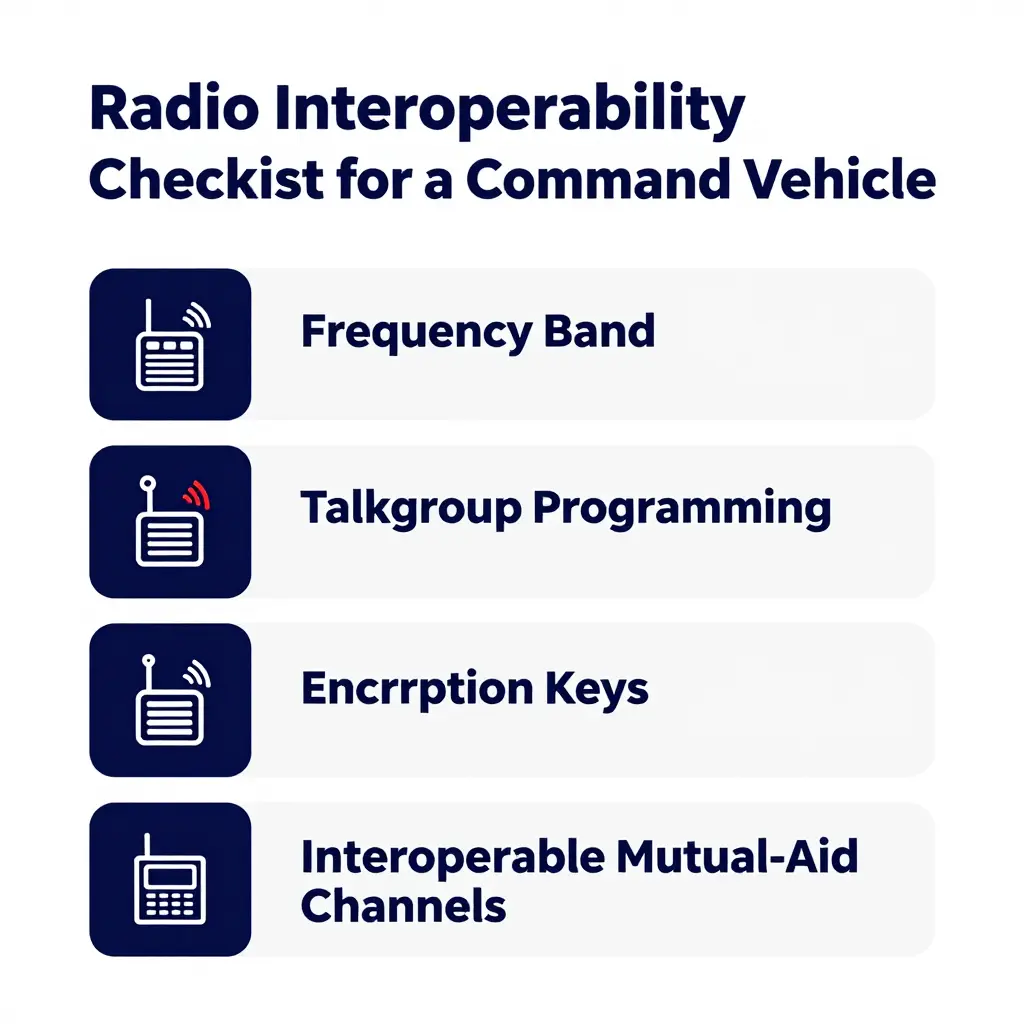
| Verification Point | What to Confirm |
|---|---|
| Frequency band | VHF, UHF, or 700/800 MHz match to your system |
| Talkgroup programming | Your talkgroups loaded and correctly assigned |
| Encryption keys | Compatible algorithm and current key sets installed |
| Mutual-aid channels | NIFOG and state interoperability channels present and tested |
Verify each point with a documented radio check, ideally live with a mutual-aid partner on the real network.
Cost and mission-readiness
Interoperability shows up in both the price and the readiness of a command vehicle. A unit quoted low but needing full radio replacement can cost more than a comparable unit with a verified, compatible installation. If a used fire chief vehicle has to coordinate multi-agency operations on day one, validate the communications before purchase and fold reconfiguration into total cost of ownership. Readiness starts with a radio that answers.
Where the Refurbishment Budget Actually Goes
Before you sign a purchase order on a used fire chief vehicle, break refurbishment into its work packages instead of a single lump sum. The chart below splits a representative budget across the six work packages that dominate most command-vehicle rebuilds, so procurement teams can benchmark quotes line by line rather than by one bottom-line figure.
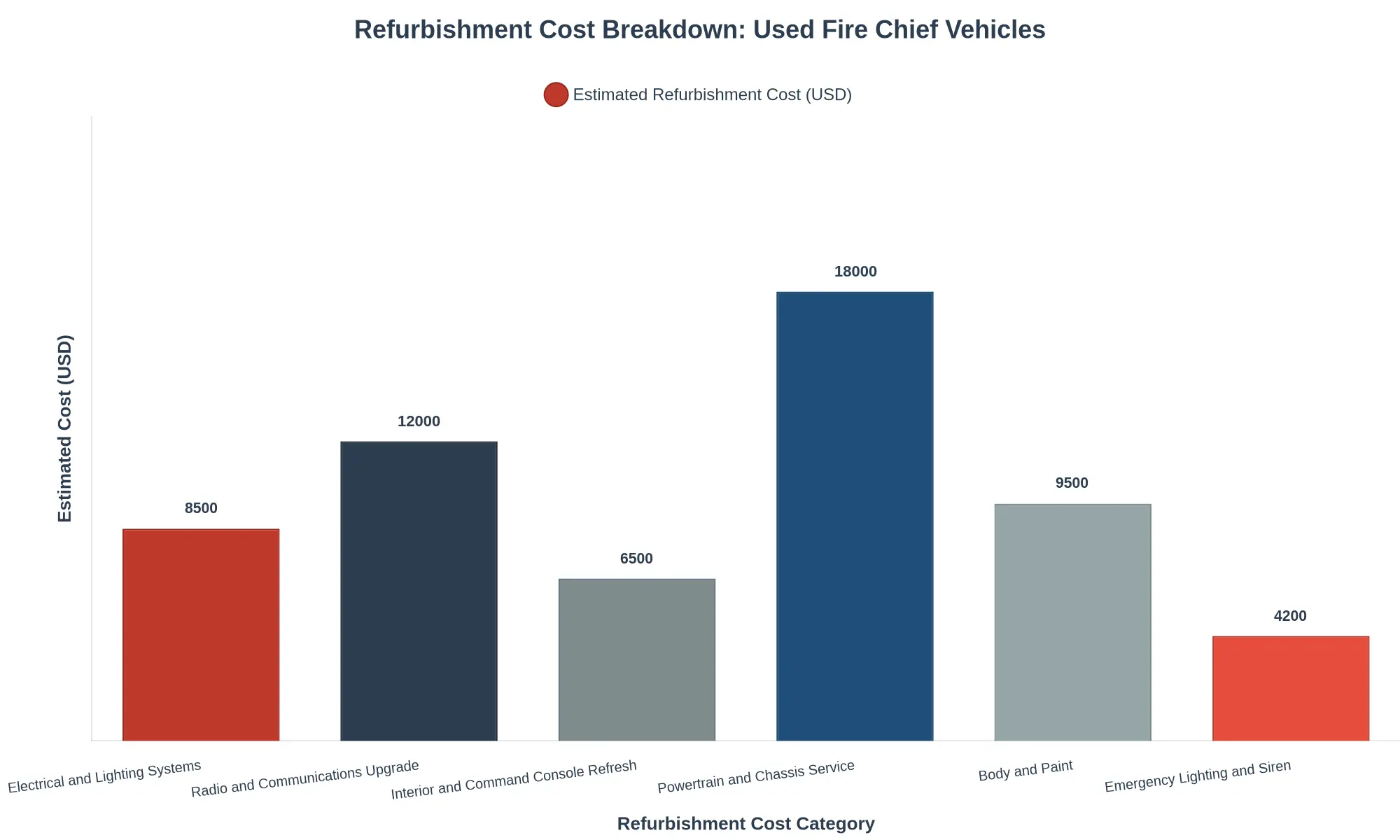
As the chart shows, powertrain and chassis service and radio and communications upgrades usually take the largest share. Mechanical condition and interoperability, not paint, should drive your inspection priorities. Electrical and lighting, body and paint, interior and console refresh, and emergency lighting and siren make up the rest. Map every vendor estimate to these categories. A quote that leaves out powertrain service or radio work is not a bargain; it is an omission worth investigating. For how these figures compare with a new build, read budgeting a new fire truck covers customization, lead time, and service cost.
Radio interoperability is seldom why a department starts shopping for a used fire chief vehicle, but it is often why a purchase disappoints after delivery. Before signing anything, confirm the candidate’s communications suite will reach your dispatch center, regional partners, and mutual-aid network on day one. The checklist below covers the confirmations that should decide go or no-go.
Radio Interoperability Verification Checklist
- Confirm the frequency band and band split (VHF, UHF, or 700/800 MHz) match your jurisdiction’s licensed channels.
- Verify P25 Phase 1 and Phase 2 capability, and whether the radio runs trunked, conventional, or dual-mode.
- Validate talkgroup assignments and zone/channel programming against your current dispatch and incident templates.
- Check encryption key availability, and confirm the former agency’s keys can be wiped and reprogrammed by your system administrator.
- Confirm cross-band interoperability with mutual-aid partners, including any required patch or gateway hardware.
- Verify antenna and cabling integrity, covering coax condition, connector corrosion, and mounting grounds.
- Confirm head-unit and control-head configuration, including remote head placement, ergonomics, and emergency button function.
- Review the installed radio inventory (mobile, portable, and any vehicular repeater) against your operational requirements.
- Test a live on-air check with dispatch and at least one partner agency before final acceptance.
This checklist is the operational core of the decision. A low-hour chassis with incompatible radios is a hidden upgrade project, not a bargain. Weigh interoperability against chassis hours and refurbishment cost before committing budget, and settle the communications first; the rest of the purchase is easier to control once that is done.
From Surplus to Service-Ready: The Refurbishment Workflow
Once a fire department acquires a used fire chief vehicle (a battalion chief SUV or command vehicle), the refurbishment and upfitting path sets both its final capability and its lifecycle cost. Reputable shops follow the five stages below, from first inspection to compliance sign-off. Each stage carries its own labor hours, parts exposure, and overrun risk, so use the sequence to vet quotes. Buyers weighing refurbishment against new-apparatus spending should also review how chassis class, pump rating, and agent capacity shape total pricing on a comparable new unit.
Minimalist 2D flow diagram showing the five-stage refurbishment and upfitting workflow for a used fire chief vehicle: inspection and assessment, mechanical and chassis service, electrical and communications upgrade, interior command console refit, and final compliance testing, connected by directional arrows.
The five stages
- Inspection and assessment. Chassis hours, drivetrain condition, and any collision or flood history come first, because this stage decides whether the vehicle is a sound platform at all.
- Mechanical / chassis service. Powertrain, brakes, suspension, and fluids are restored to meet the duty cycle of an emergency response vehicle.
- Electrical and communications upgrade. Wiring harnesses, emergency lighting, and interoperable radio systems are refreshed or replaced to current standards.
- Interior command console refit. Workstations, mounting, data displays, and ergonomics are rebuilt around the command staff who will actually ride in it.
- Final compliance testing. A last verification pass confirms the completed upfit meets regulatory, safety, and operational requirements before the vehicle returns to service.
Refurbishment Cost: What Drives Total Spend on a Used Fire Chief Vehicle
On a used fire chief vehicles for sale listing, the purchase price is usually the smallest number in your budget. Refurbishment costs decide whether a used command vehicle or battalion chief SUV becomes a dependable front-line asset or a recurring money pit. Buyers who plan around cosmetics alone tend to underestimate the final outlay by 30-50%, because the real money goes to compliance, systems integration, and mechanical restoration.
The five cost categories that define total spend
The six work packages in the chart above collapse into five budget categories. The ranges below reflect realistic conditions for a mid-size command vehicle or battalion chief SUV. They come from different projects, so they do not add up to a single 100%.
| Cost category | Typical range (USD) | Share of total |
|---|---|---|
| Electrical and lighting upgrades | $8,000 – $18,000 | 20-30% |
| Radio and communications integration | $6,000 – $20,000 | 15-25% |
| Interior command console rebuild | $5,000 – $15,000 | 10-20% |
| Powertrain and chassis service | $7,000 – $25,000 | 20-35% |
| Body and paint work | $4,000 – $12,000 | 10-20% |
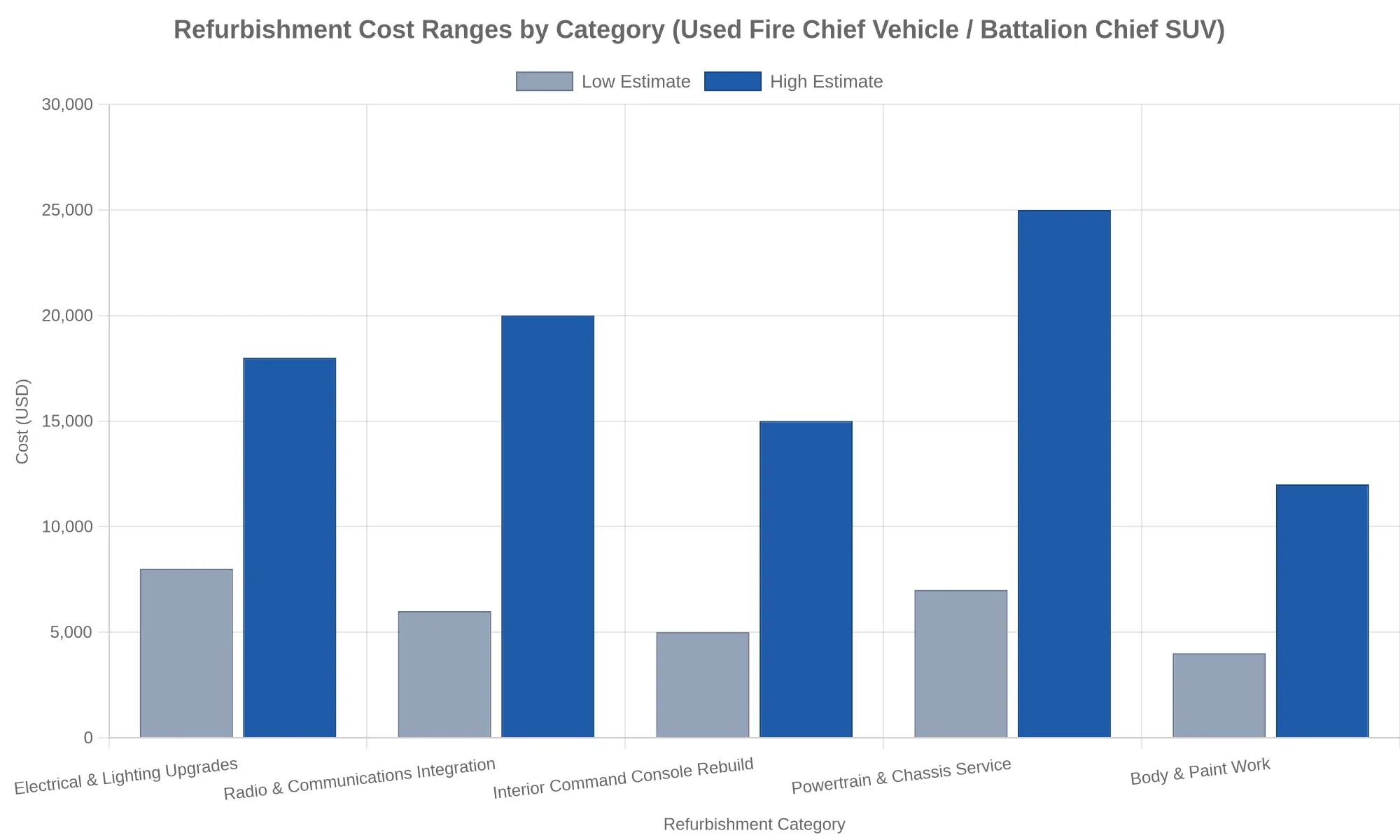
What the bar chart shows
The chart plots the low and high estimate for each category side by side, and the spread is the point. Powertrain and chassis service has the widest band: a $7,000 service-and-fluids baseline at one end, a transmission, driveline, or suspension overhaul near $25,000 at the other. Radio and communications integration spans $6,000 to $20,000, because legacy stacks rarely drop cleanly into modern interoperable systems. Body and paint, the category buyers notice first, is the narrowest at roughly $4,000 to $12,000 – which is why it should never anchor the budget.
What pushes refurbishment costs higher
Three factors repeatedly blow budgets past the midpoint of every range:
- Non-compliant legacy equipment. Warning lights, sirens, and control heads built to older NFPA and SAE standards often cannot be certified, which forces replacement instead of reuse.
- Corrosion. Salt-belt chassis hide rust in frame rails, mounting points, and electrical grounds. What looks like surface damage regularly doubles body and paint work.
- Incompatible radio systems. A pre-P25 radio stack may need new wiring harnesses, antennas, and reprogramming to reach interoperability, turning a modest line item into the costliest integration task on the vehicle.
What the total looks like
Add the five categories and a realistic refurbishment lands between roughly $30,000 and $90,000, before the purchase price. That number works only when it stays well below the cost of a new-build equivalent. Budget the mechanical and communications categories first, treat paint as the last line item, and confirm chassis hours and radio compatibility before committing; see our guidance on budgeting customization, lead time, and service cost for the benchmark. Get that math right, and a refurbished battalion chief SUV delivers front-line readiness at a fraction of new-unit spend.
Evaluating and Budgeting for a Used Fire Chief Vehicle
Treat acquisition as a three-variable decision
A command SUV, a battalion chief rig, a mobile command platform: whatever the label, a used fire chief vehicle is rarely a simple asset purchase. For procurement officers and fleet managers it is a total-cost-of-ownership (TCO) decision, and three variables decide how it turns out – chassis hours, radio interoperability, and refurbishment scope. Judge them one at a time and you either overpay up front or inherit five-figure risk later.
Engine hours, not odometer mileage, are the truest wear indicator on emergency apparatus. Command vehicles idle heavily – scene lighting, radios, climate control, mobile data terminals – so a 60,000-mile unit can carry 8,000+ hours of engine runtime, the equivalent of a much older chassis. Radio interoperability is just as decisive: a vehicle programmed to a foreign P25 talkgroup or a proprietary encryption scheme may require full codeplug re-authoring or, at worst, replacement radios that dwarf the purchase discount. Refurbishment estimates then frame the gap between “as-delivered” and “mission-ready,” and that gap has to be benchmarked against how much a new fire truck costs before any award is signed.
Documents to request before you inspect
Ask for these before the inspection. Missing documents are themselves a red flag.
| Document | What It Verifies | Red Flags |
|---|---|---|
| Service and maintenance records | PM interval compliance | Gaps over 12 months; deferred repairs |
| Hour meter logs / ECM history | True engine duty cycle | Meter resets; drift vs ECU hours |
| Radio programming documentation | Interoperability and codeplug | Missing codeplug; proprietary encryption |
| Prior upfit records and load calcs | Electrical and module integrity | Undocumented splices; overloaded circuits |
| OEM build sheet and VIN decode | Chassis spec and payload | Mismatched components; salvage history |
Inspection Procedures
Skip the walkaround and run a three-stage inspection. Start with a mechanical and hour-meter audit: cross-check the physical hour meter against ECU-stored hours and scan for stored fault codes. Then test interoperability: bring your own portable radio and confirm the unit transmits and receives on your live talkgroups, zone by zone. Finish with an upfit and electrical survey: trace aftermarket circuits, check alternator and battery capacity against current loads, and photograph every splice. Timestamp everything; the evidence file is your negotiating lever.
Modeling TCO Against Buying New
A defensible acquisition memo compares fully loaded five-year TCO, not sticker price. Build three scenarios – used as-is, used fully refurbished, and new – and hold the assumptions for radio integration, insurance, and residual value constant across all three.
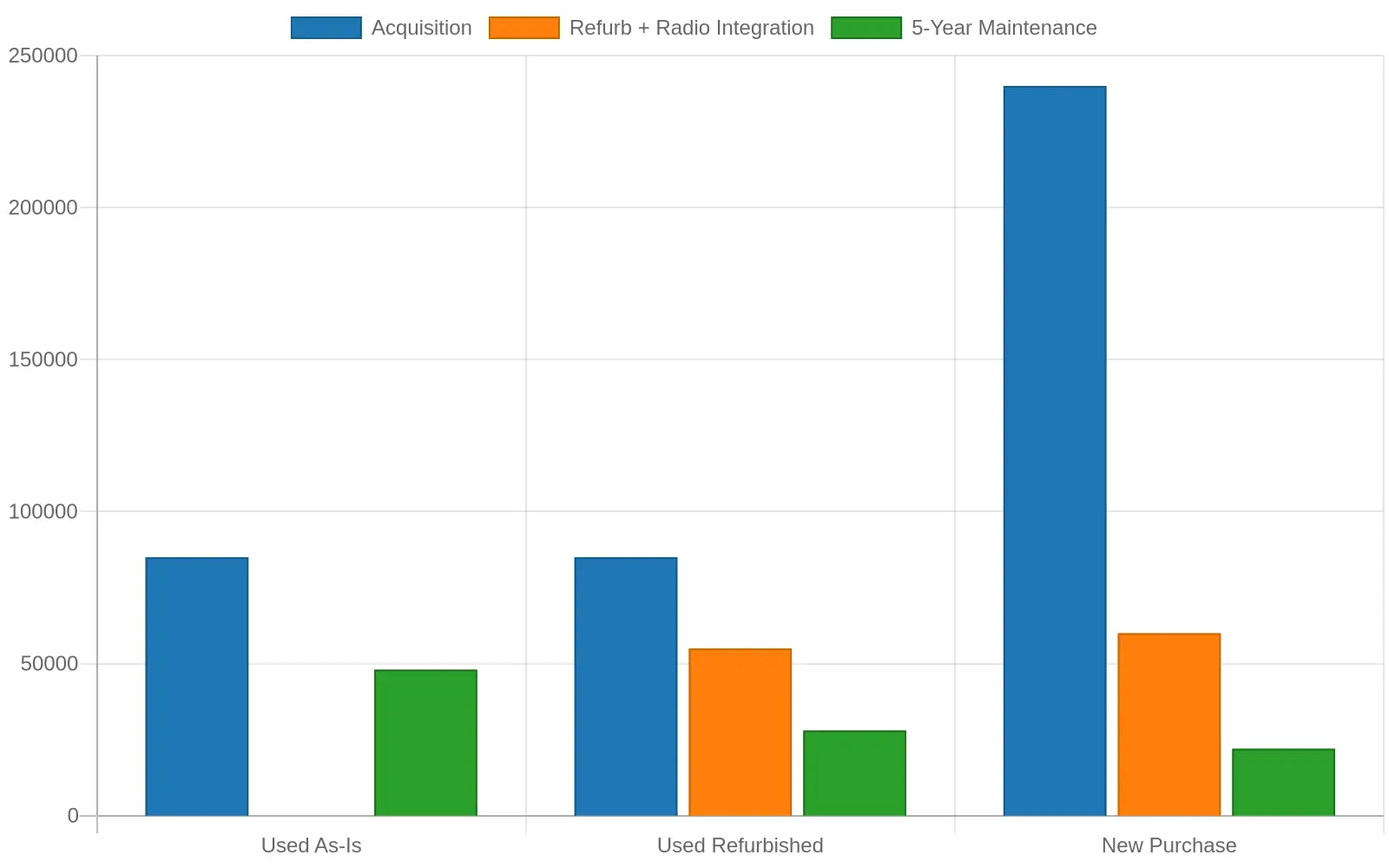
The pattern holds: over five years, a refurbished used unit typically lands 35-50% below a new purchase, while an as-is unit can give that advantage back if radios and deferred maintenance surface later. Factor in lead time as well. New-build command vehicles routinely carry 12-18 month delivery windows, and every month of downtime has an operational cost. If long-term support matters, confirm the availability of critical spares and warranty channels before you commit.
Recommendation
Use a go/no-go gate. Proceed only if (1) verified engine hours fall below your lifecycle threshold – 6,500 hours for a command chassis, for example; (2) radio interoperability is confirmed on your live network without codeplug re-authoring; and (3) refurbishment plus integration quotes keep five-year TCO below roughly 55% of the new-purchase alternative. If any one fails, walk away. When the numbers sit close, rely on real vendor quotes rather than list prices.
How the Interoperability Layers Connect
In the field, a command vehicle never talks to a single network in isolation. The diagram below traces a transmission’s path: from the chief’s local talkgroup on scene, through a cross-band gateway that bridges incompatible frequencies or systems, and out to the mutual-aid network that links neighboring departments. Knowing this flow helps procurement officers judge whether a used chief vehicle’s radio package will actually fit a regional response plan or merely look complete on the spec sheet.
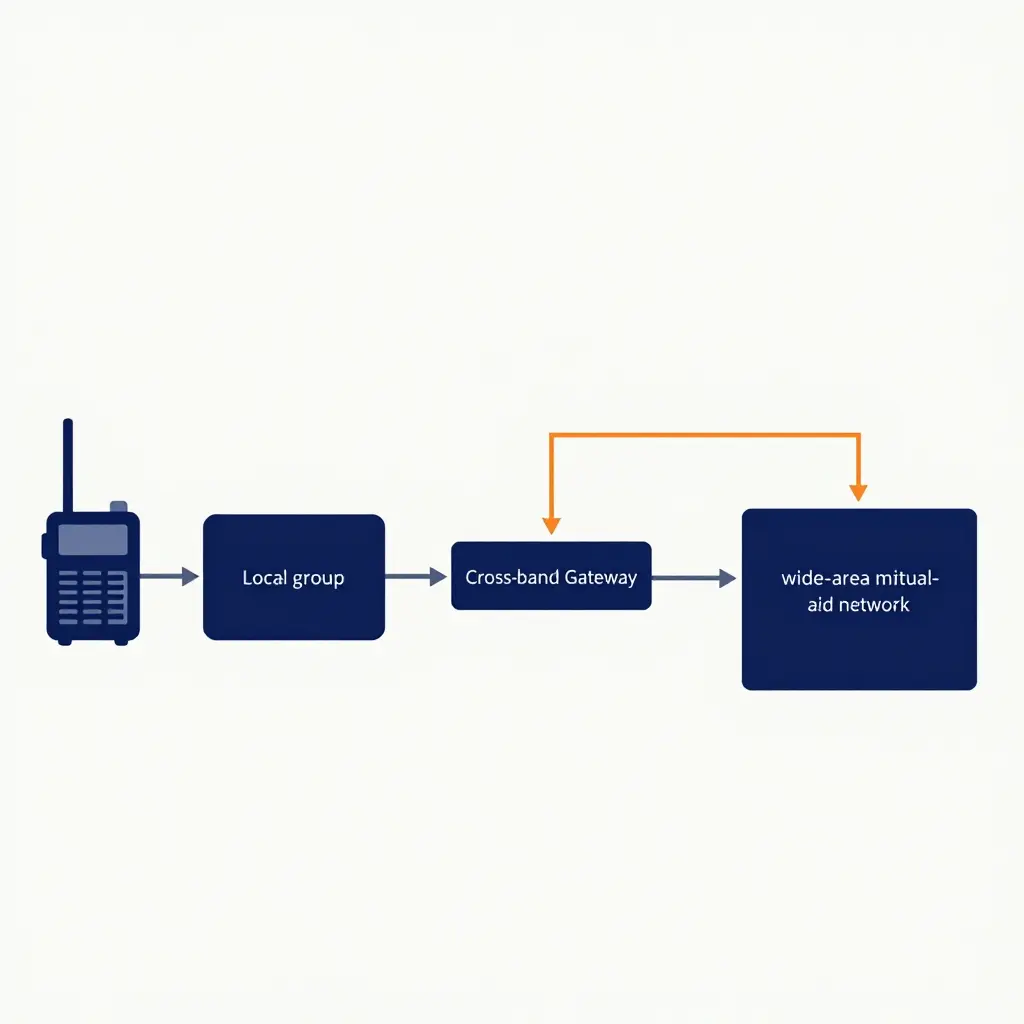
Ask where the cross-band gateway sits in the architecture: aboard as a dedicated appliance, or in a regional unit that must be patched in on arrival? A vehicle that carries its own gateway holds up far better when the regional backbone is saturated or unavailable.
Frequently Asked Questions About Used Fire Chief Vehicles
What chassis hours are acceptable on used fire chief vehicles for sale?
For command vehicles built on light- or medium-duty chassis, the idle-to-total-hour ratio matters as much as the total. Units around 5,000-8,000 chassis hours are generally considered serviceable when idle hours stay modest; rigs above 10,000 hours warrant closer review. High idle percentages wear emissions components, alternators, and cooling systems even when mileage looks low, so ask for the full hour breakdown before deciding.
Can a used command vehicle achieve radio interoperability with a new agency network?
Usually, yes. Interoperability is mostly a matter of programming and configuration, not the vehicle’s age. Most command vehicles carry standardized radio suites (such as APCO P25), so compatibility turns on the protocol, frequency band, encryption keys, and talkgroup assignments, not the chassis itself. Before purchase, confirm the onboard radio’s band and encryption capability and budget for reprogramming or a subscriber-unit swap to match your network.
What refurbishment costs should I expect?
They scale with scope. A light cosmetic refresh may run a few thousand dollars, while a full mechanical and interior overhaul can reach five figures. Typical line items include powertrain servicing, emergency lighting upgrades, console and radio replacement, and paint or vinyl wrap. Because the spread is wide, obtain a written scope of work so you can weigh the investment against the vehicle’s remaining service life.
How do chassis hours compare with odometer readings?
They measure different things and should be read together. The odometer counts road travel; hours count total engine run time, including stationary operation for scene command, idle warming, and generator support. Low mileage with unusually high hours means long idle periods, which stress engine and electrical components differently than highway driving does.
Do refurbished chief vehicles meet current standards?
Only when the rebuild is aimed at them. NFPA 1901 and related guidelines cover emergency lighting, reflective markings, warning systems, and safety equipment, and many older units fall short of newer requirements unless upgraded. Confirm which standard edition the refurbishment was built to satisfy and request documentation for lighting, braking, and occupant-protection changes.
How should I compare total cost against buying a new purchase?
Compare total cost of ownership rather than sticker price alone: acquisition, refurbishment, expected service life, and financing. A refurbished chief vehicle often delivers comparable command capability for a fraction of new-unit pricing, though higher near-term maintenance can offset part of the savings. Pricing new apparatus across chassis class and options gives you a fair baseline; see this guide to how much a new fire truck costs by chassis class and ratings before you commit budget.
What determines value
Disciplined procurement of used fire chief vehicles for sale comes down to three measurable numbers: chassis hours, radio interoperability, and refurbishment cost. Chassis hours show how much useful life is left in the drivetrain and command platform, separating a mission-ready unit from one near the end of its service window. Radio interoperability decides whether the vehicle can reach mutual-aid partners, dispatch centers, and neighboring jurisdictions during a real incident, which no cosmetic inspection can answer. Refurbishment cost turns both findings into a budget line and reveals the lifetime expense behind the sticker price. Read together, they give a clear verdict on whether the purchase is worth making.
Closing Recommendation
For procurement officers and budget decision-makers: never approve a used command vehicle on price alone. Require documented chassis hour logs, verify interoperability against your regional communication plan, and obtain itemized refurbishment quotes before committing funds. Departments that formalize this three-part review consistently reach well-planned budgeting outcomes and avoid the hidden costs of premature replacement.
CIMC Tianda builds firefighting and rescue equipment across several lines, and buyers work with a partner that treats mission readiness as something engineered rather than assumed. Apply the same discipline to used fire chief vehicles for sale, and you will secure dependable, cost-effective apparatus that serves your community for years.