Why Fire Truck Quotes Diverge: Two Measurable Reasons
No single market rate fixes what a fire truck cost will be. What a buyer receives is a defined build plus a defined verification process, and a quote that documents only one of the two is an incomplete number. Two bids for what the cover sheet calls the same apparatus routinely land far apart, and that spread is not negotiation noise. It is arithmetic on two variables you can measure and audit: what is actually being built, and how much testing, inspection and documentation comes with it.
Read a quote with those two variables in hand and price comparison turns into document interpretation. Specification gaps measure the distance between the nominal apparatus and the component-level reality underneath it: chassis rating and reserve capacity, rated pump flow at draft versus at pressure, tank material and baffling, foam proportioning architecture, cab construction, electrical load margin. Inspection scope measures the verification stacked on top of that build: factory and third-party witness testing, pump performance runs, structural and aerial load proofs, electrical and NFPA compliance records, as-built drawings, and the documentation package a municipality is obliged to retain.
Two offers for a nominally identical fire fighting truck can differ substantially because one prices a complete, verifiable build while the other prices a platform whose real costs (components, testing, paperwork) are deferred into change orders, options or post-award negotiation.
Deferral is the mechanism behind most price divergence. A lower number is not automatically better value, and a higher number is not automatically padded; each reflects a different point on the specification and inspection spectrum. Serious evaluation therefore starts by normalizing both dimensions before anyone compares a dollar figure.
Specification Gaps: Why “the Same Truck” Never Costs the Same
Two bids for what a tender describes as “one 1,000 gpm pumper” can differ substantially without either bidder being dishonest. The variance rarely sits in the headline performance figure; it sits in everything the headline leaves open. A specification gap is the distance between a performance claim and a build sheet, and every unresolved line item is a design decision the bidder has to price defensively.
| Line item | What changes | How the price moves |
|---|---|---|
| Chassis class and GVW | Commercial cab-over versus purpose-built custom chassis; GVW, wheelbase and frame section set by tank, pump and body loads | Each class step brings heavier frame rails, larger brakes, more cooling capacity and stricter cab structural requirements. Because GVW is driven by everything mounted on it, this line item absorbs the weight of other decisions. |
| Pump rated capacity and pressure stages | Single-stage versus two-stage pump; volume mode versus pressure mode for standpipes and CAFS feed | Impeller size, pump body, suction and discharge manifolds, relief valves and cooling loop all scale with capacity. A two-stage pump adds a transfer valve and more complex acceptance testing. |
| Water and foam tank material and volume | Polypropylene versus stainless steel versus galvanized steel; baffling, sumps, fill towers and foam-compatible seals | Volume behaves almost linearly; material and baffling behave as step changes. Stainless resists many foam concentrates and aggressive water chemistry, at higher material and welding cost. |
| Foam proportioning type | Manual inductor, around-the-pump, balanced pressure, or electronic direct injection | Hardware and control logic are added at each step: venturi and metering valve, then a foam pump with ratio controller, then sensors and calibration. |
| Body construction | Aluminum versus stainless versus galvanized steel; extrusions versus formed panels; compartment and tray layout | Material cost, fabrication labor and corrosion strategy differ. Aluminum is light but needs isolation from steel; stainless is labor-intensive; galvanized sits at the low end with a defined service life. |
| Axle and suspension ratings | Front and rear GAWR, single versus tandem rear axle, spring versus air suspension | Ratings must match fully loaded weight. An under-specified axle forces a mid-build re-rate that cascades into frame, brakes, tires and driveline. |
| Aerial ladder length and rated load | Typically 50 to 75 ft articulated versus 75 to 110 ft straight ladders; tip load with and without waterway flowing | Length and rated load drive boom section count, hydraulic capacity, outrigger spread and rear frame reinforcement. Increases compound rather than add up linearly. |
| CAFS versus conventional delivery | Midship or PTO-driven compressor, air plumbing, air-to-water ratio control versus standard pump-and-hose delivery | A compressed air foam package is a subsystem, not an accessory: compressor, air lines, ratio control and a foam tank sized for air-injected foam. It also reshapes pump and hose selection. |
Why the gaps compound
Line items do not price independently. A larger water tank raises GVW; higher GVW pushes the chassis into a heavier class; a heavier chassis demands higher axle and suspension ratings, larger brakes and more cooling capacity. Aerial length adds weight at the worst possible location, the rear overhang, which changes outrigger spread and the front axle rating needed to keep steering within limits. This cascade is why two trucks with similar-looking spec sheets can land in different weight and price classes, and why the heavy-duty fire truck class is defined by the whole package rather than by one component.
Pump specification tends to be reduced to a single capacity number, while pressure stages decide the plumbing underneath it. A single-stage pump covers most structural firefighting; a two-stage unit adds a transfer valve, additional controls and a second performance point to verify at acceptance. A tender that names capacity but omits stages hands that decision, and its cost, to the bidder.
Tank specification is where omissions are most expensive to recover. Baffling, sumps, fill towers, venting and foam-compatible seals are frequently left out of the draft and then quoted as extras, so the same nominal capacity can hide meaningfully different construction.
Foam proportioning is the clearest type-driven cost. Manual induction and around-the-pump systems are inexpensive and depend on operator judgment; balanced pressure adds a foam pump and ratio controller to hold percentage across changing flows; electronic direct injection adds sensing and calibration. Each step buys repeatability. When a tender says only “foam capable,” the bidder is free to choose the cheapest reading, and comparing foam fire truck bids without normalizing the proportioning method produces a misleading ranking.
Body construction is a materials-and-labor decision as much as a corrosion decision, and compartment count, door type and tray systems are labor-heavy yet often described in a single line.
Aerial specification punishes shorthand. Rated load at the tip with the waterway flowing determines boom section design, hydraulic capacity and stabilizer geometry, so a rescue-rated ladder and an elevated master stream platform are different machines even at identical length. Line-by-line review of aerial fire truck specifications is the practical way to expose that difference.
Three items most often under-specified
- Foam proportioning method: the phrase “foam capable” without a system type leaves the largest single percentage swing in the foam system.
- Body material and compartment configuration: aluminum, stainless or galvanized, plus door and tray layout, changes both material cost and fabrication hours.
- Tank material, baffling and mounting: nominal volume gets quoted while the construction that makes it durable and safe under dynamic load is left to interpretation.
Every one of these relationships can be described with confidence, but none can be reduced to a fixed multiplier. The magnitude depends on the tender: vehicle size, the standards invoked, required acceptance testing, and whether the specification is written as a performance target or a build description. Closing those gaps before bids are opened is what makes quotes genuinely comparable.
Specification-Gap Comparison: Where Two Fire Truck Quotes Actually Diverge
The fastest way to explain a six-figure spread between two apparatus bids is to lay the under-specified items side by side. Buyers reviewing heavy-duty fire truck platforms should treat every incomplete cell as a question to send back to the bidder, because silence in a quote is not a saving, it is an unresolved requirement.
Table 1. Specification-gap comparison of under-specified line items across two fire truck quotes.
| Line Item | Typical Low-Quote Specification | Typical High-Quote Specification | Why It Moves Fire Truck Price |
|---|---|---|---|
| Chassis and GVW | Commercial chassis, catalog GVW, no reserve capacity stated | Custom chassis, verified GVW with rated payload margin | Chassis class sets axle, brake and body size limits |
| Pump rated capacity and stages | Single-stage, rated at draft, test point not defined | Two-stage, rated at 10 ft lift and 150 psi | Stage count and rating conditions change pump and plumbing cost |
| Tank material and volume | Poly tank, nominal volume, baffling not specified | Welded stainless steel, usable volume, baffled per standard | Material, thickness and baffle geometry drive fabrication hours |
| Foam proportioning system | Manual eductor, single class B ratio | Around-the-pump or direct injection, multi-ratio, calibrated | Injection accuracy adds controls, plumbing and calibration testing |
| Body material | Galvanneal steel, painted, standard compartment layout | Aluminum or stainless, extruded body, custom layout | Corrosion resistance and custom fabrication raise labor content |
| Axle and brake ratings | Catalog axles, no stopping distance data | Up-rated axles, ABS and ESC, documented stopping distance | Higher ratings add cost, weight and certification work |
| Electrical and lighting configuration | Base 12V loom, minimum warning lights | Multiplexed system, LED scene lighting, redundant circuits | Multiplexing and LED packages are large standalone line items |
| Documentation and testing package | Delivery checklist only, no witnessed tests | Certification file, witnessed pump and acceptance tests | Third-party testing and documentation carry real labor and liability |
Treat the table as a negotiation script: every blank specification is a priced option waiting to be discovered later as a change order.
Inspection Scope: The Line Item That Quietly Moves the Bottom Line
Inspection scope is the set of verification activities a manufacturer contractually commits to perform and prove before an apparatus is accepted: tests, witness points, hold points, and the documentary evidence each produces. It is not a formality bolted onto the end of a build. Every layer of it carries labor hours, equipment time, facility availability and third-party fees.
Quotes diverge most sharply here, because inspection scope is layered and vendors routinely include different numbers of layers.
The Layers a Quote May or May Not Include
- In-process factory inspection: staged checks at chassis prep, body mounting, plumbing and electrical rough-in, while defects are still cheap to correct.
- Pre-delivery inspection (PDI): the final operational checkout of pump engagement, valve operation, lighting and road-worthiness before release.
- Third-party inspection and witnessing: an independent agency retained by the buyer to witness tests, audit build records and sign off on conformity.
- Factory acceptance testing (FAT): measured pump performance against rated flow and pressure curves, plus foam proportioning accuracy verified across multiple flow rates and ratios rather than at a single nominal point.
- Aerial device structural and load testing: non-destructive examination, static and dynamic load tests and stability verification on ladders, platforms and booms.
- Weigh-in and axle load verification: individual axle and gross weight certification against the chassis rating, with load distribution documented.
- Documentation package: test reports, material certificates, calibration records and warranty terms, assembled and traceable to serial numbers.
| Verification Layer | What Is Verified | Primary Cost Drivers |
|---|---|---|
| In-process inspection | Workmanship and assembly conformity | Inspector labor hours, production hold time |
| Pre-delivery inspection | Full operational function | Technician time, facility bay occupancy |
| Third-party witnessing | Independent conformity evidence | Agency fees, travel, schedule delays |
| Factory acceptance testing | Pump curve and foam ratio accuracy | Test water, instrumentation, calibration labor |
| Aerial structural and load testing | Structural integrity and stability | Load weights, NDT crews, engineering sign-off |
| Weigh-in and axle verification | Legal weight compliance | Scale time, ballast adjustment, re-work |
| Documentation package | Traceability and warranty evidence | Engineering hours, certification, record management |
Why the Lower Quote Is Usually a Narrower Scope
Each of these layers consumes real resources. A witnessed FAT with instrumentation and a signed report can represent days of facility time. Third-party witnessing adds agency fees and typically extends the delivery schedule, which carries its own financing cost. Aerial load testing requires certified crews, calibrated weights and engineering review.
When one quote comes in materially below another on a comparable specification, the difference is frequently not a cheaper product but a thinner evidence trail. The apparatus may arrive with a single pass/fail sheet instead of a documented pump curve, a verbal assurance instead of a certified weight ticket, and a warranty statement that is silent on the components most likely to fail.
Buyers should require every bidder to enumerate inspection scope line by line, then compare like with like. Where documentation, certification and component traceability are central to your acceptance criteria, review the fire truck parts catalog to see how spare-part identification and record-keeping are structured in practice. Scope written into the contract is scope you can enforce; scope left to assumption is scope you will fund later, at emergency rates.
Cost Contribution by Specification Tier: Where the Money Actually Sits
Comparing two quotes side by side only becomes useful when you can see which cost categories are driving the gap. The grouped chart below breaks the same six cost categories across three specification tiers, so procurement teams can benchmark a bid against the class of apparatus it actually belongs to rather than against a single headline price.
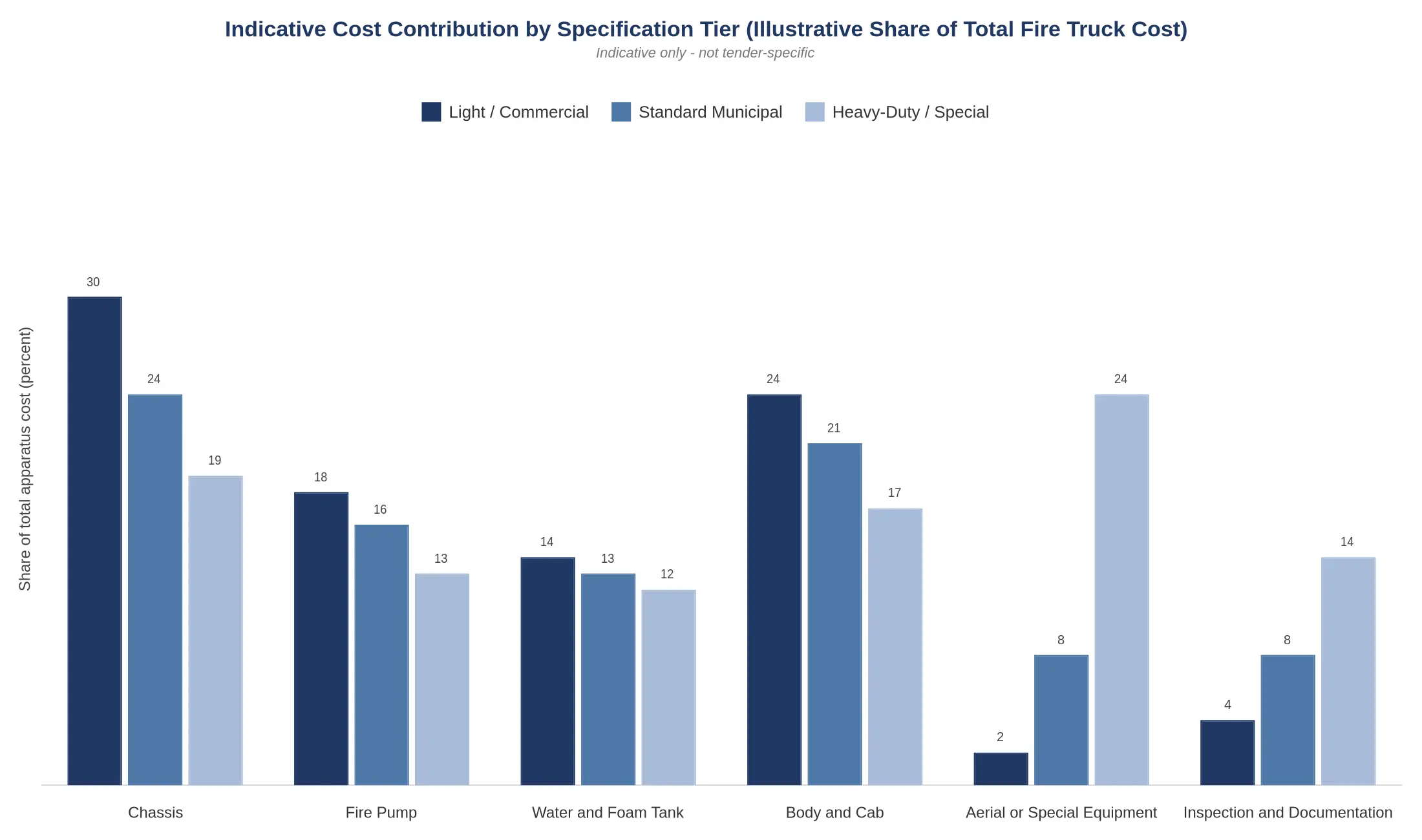
Indicative relative values only – illustrative shares for discussion, not derived from any specific tender, quote, or manufacturer price list.
Chassis, pump, tank and body shares compress as you move up the tiers, because the base vehicle and fabrication work do not scale as steeply as the systems layered on top of them. Aerial and special equipment is where the tiers truly separate, moving from a marginal line item on a commercial build to the single largest contributor on heavy-duty and special apparatus, which is why a side-by-side comparison of heavy-duty and special apparatus specifications rarely produces like-for-like numbers.
Inspection and documentation grows steadily as a share of fire truck cost as apparatus complexity rises, from roughly 4 percent on a light commercial build to about 8 percent at the standard municipal tier and around 14 percent on heavy-duty or special apparatus. That growth is not administrative overhead: every added system, certification path and third-party witness point introduces verification labor, test documentation and sign-off cycles that scale faster than the hardware they certify.
Comparing fire truck quotes line by line is the fastest way to strip out marketing language and expose what a bidder is actually pricing. The questions below convert vague offers into comparable line items, so every bidder answers the same verifiable points in the same terms.
- Pump performance: What is the rated pump capacity at a defined discharge pressure (NFPA ratings are stated at 150 psi, roughly 10 bar), and will that rating be demonstrated on a factory test stand with the pump curve supplied? A flow figure with no stated pressure is not a specification.
- Tank volume and material: What material is the water tank built from (polypropylene, stainless steel or coated mild steel), and what is the nominal versus usable volume once baffling, foam tank and plumbing displacement are deducted?
- Foam proportioning: Which proportioning method is offered (around-the-pump, balanced pressure or direct injection), and what is the stated accuracy across the full flow range, evidenced by a calibration report rather than a brochure claim?
- Chassis ratings: What are the chassis GVW and individual front and rear axle ratings, and do the completed axle loads with full water, foam and crew stay inside those ratings on a certified weigh ticket?
- Body build and warranty: What body material and construction method are used, and what warranty period, with which exclusions, applies separately to the body structure, the tank and the paint finish?
- Inspection and testing scope: Which tests are included (hydrostatic, pump performance, foam system, electrical, apparatus road test), and does the buying department hold documented witness rights at each stage?
- Documentation: Which deliverables ship with the vehicle: as-built drawings, test certificates, pump curves, operator and maintenance manuals, and training records?
- Delivery assumptions: What assumptions underpin the quoted lead time, including chassis allocation, deposit date and approval milestones, and what happens to the schedule if any of them slip?
- Spare parts and training: What is included in the recommended first-year fire truck parts list, the onboard tool kit, and the operator and pump-operator training hours?
Issue this list with the tender documents and require written responses in the same order from every bidder. When fire truck quotes are normalized this way, price differences finally map to real specification and scope differences instead of presentation quality.
Standards, Certification, and Compliance Scope: Where Cost Accumulates
Two trucks can look identical on a spec sheet and still land $80,000 apart, and the gap often lives in this section. Standards define the floor, not the finish line. How far a supplier goes in proving that floor has been met is a commercial decision, and it shows up in price.
The reference frameworks
NFPA 1901 is the usual benchmark for structural fire apparatus, covering chassis and cab integrity, water pump performance, tank and hose bed capacity, warning devices and stability expectations. NFPA 1906 applies to wildland apparatus, where payload, off-road handling and pump-and-roll capability shape the design differently. Buyers should confirm which edition a quote references, since requirements evolve between revisions and older editions may not satisfy a current procurement specification.
EN 1846 takes a different structure. EN 1846-1 sets classification and designation conventions, EN 1846-2 addresses common safety and performance requirements, and EN 1846-3 covers permanently installed equipment. In practice, EN 1846 classification language is often used to describe category, drive configuration and crew capacity rather than to certify an entire vehicle.
On top of these sit national rules that vary by market: type approval or individual vehicle approval, chassis emission standards such as Euro or EPA tiers, braking and stability requirements, lighting and marking rules, and registration or roadworthiness inspection. None of these are uniform, so a truck accepted in one country may need re-engineering for another.
Design compliance, test evidence, certification documentation
These three are frequently blurred in a quotation, and they are not interchangeable.
| Layer | What it demonstrates | Typical cost effect |
|---|---|---|
| Design compliance | Drawings, calculations and component selection aligned to a cited standard edition | Mostly absorbed in the engineering baseline; limited visible variance |
| Test evidence | Reports from pump performance, aerial structural and stability, foam proportioning or braking tests, whether in-house, witnessed or third-party | Moderate to high; rises with the number and independence of tests |
| Certification documentation | Formal certificates, declarations of conformity, type approvals, data plates and labels issued by a recognized body | High where new certification, re-testing, or translation and legal review is required |
A quote can say “compliant with NFPA 1901” or “EN 1846 compliant” while supplying only the first layer. That statement may be accurate as a design claim, yet it says nothing about which tests were performed, who witnessed them, or which certificates travel with the vehicle. When a specification is written around design intent alone, a supplier can meet it without commissioning a single independent test.
Inspection scope and price converge here. Test evidence and certification documentation are the two layers procurement teams can verify, and they are also the two that carry real external cost. Narrow the scope and the number falls; broaden it and the same truck becomes a different line item. That is a legitimate difference in offering, not necessarily a defect, but it has to be visible in the award comparison.
Practical checks for evaluators
- Ask each bidder to list the exact standard edition cited, per system, not as a single blanket clause.
- Request a test evidence matrix: test name, standard reference, performing party, witness, date and report number.
- Separate certificates that ship with the vehicle from those that exist only at the manufacturer level.
- Confirm who pays for re-testing if a witness or authority rejects a result at delivery.
- Document any accepted exclusions in writing, so the compliance position is not reconstructed after delivery.
Treat every claim as design-level until paperwork proves otherwise. A clear, itemized statement of compliance scope protects both sides: the buyer knows what has been verified, and the seller is not later asked to fund tests that were never quoted. For highly customized builds, such as configuration-driven compliance on special fire trucks, agree the evidence package before the chassis order, because retrofitting certifications onto a finished vehicle is where the most avoidable fire truck cost appears.
Reading the Inspection Scope Layers
Each additional layer in this diagram represents another category of verifiable, documentable work that a supplier has explicitly included in the quoted price.

A quote that stops at the inner ring describes a truck you inspect only while it is being built. One that reaches the outer ring describes a truck whose quality was witnessed, tested, certified and handed over with a complete evidence trail. Two bids can look nearly identical on the specification sheet and still sit three layers apart on this diagram, which is often the largest single reason their totals diverge.
When comparing submissions, ask each bidder to state in writing which layers are included, who performs the inspection at each layer, and what records are delivered at handover. That short conversation converts a vague price difference into a measurable scope difference.
Total Cost of Ownership: Where the Real Fire Truck Price Is Decided
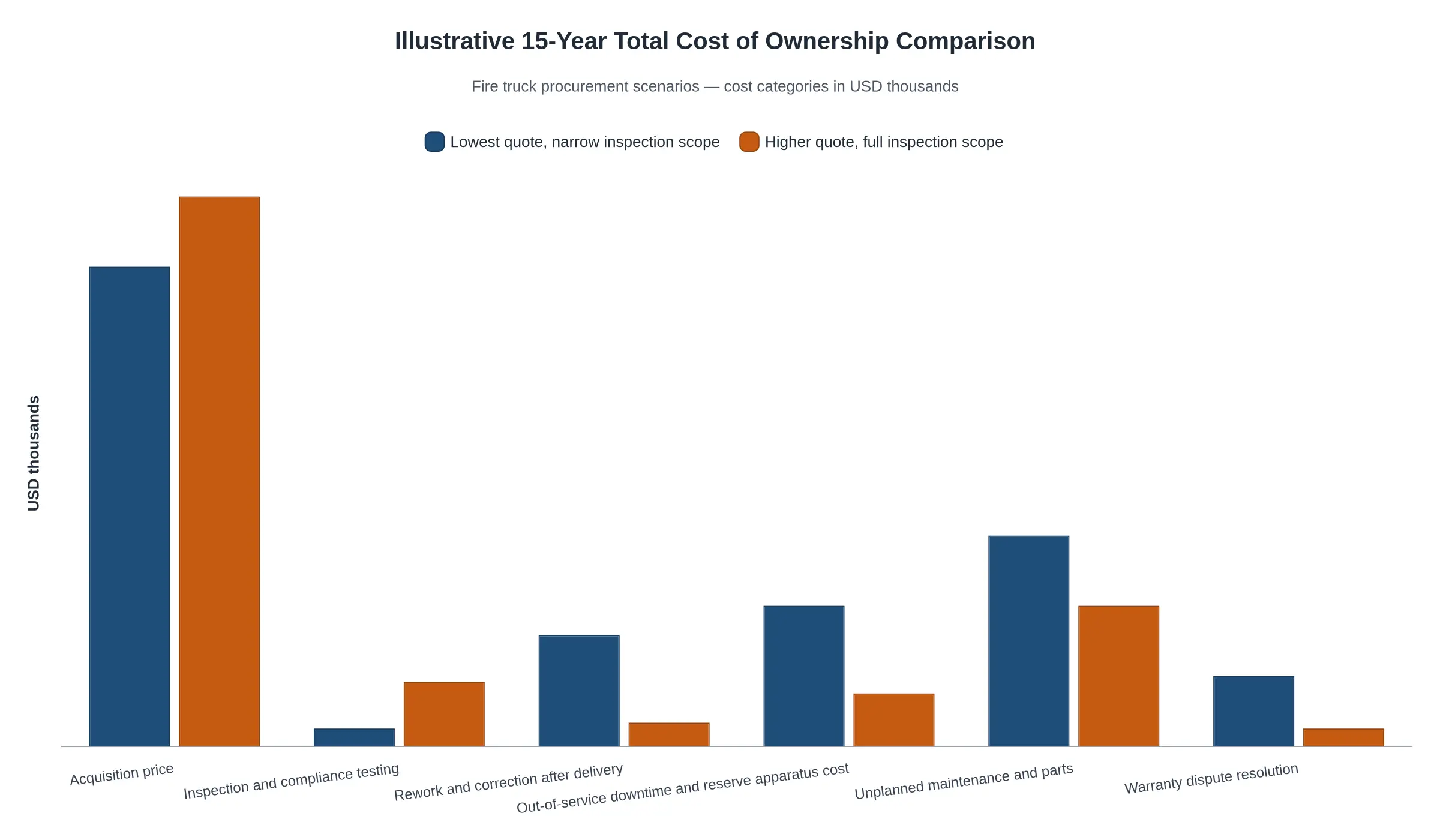
A fire truck price is a single number on a single page. That number tells you what the apparatus costs on the day the purchase order is signed, not what it costs while you own it. Procurement officers who treat the line item as the whole story are buying an unhedged risk position, and the invoice for that risk arrives later, in maintenance bays, in reserve apparatus calls and in warranty correspondence.
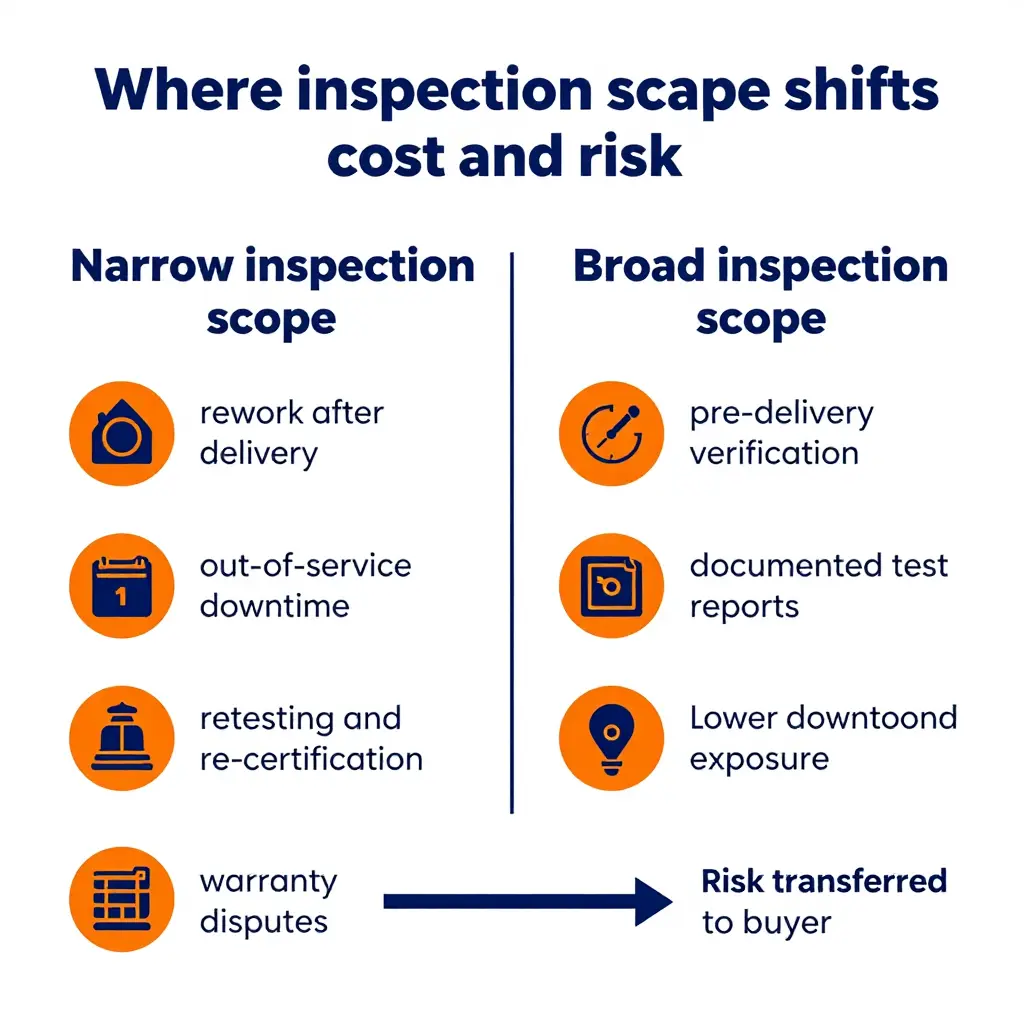
A Narrow Inspection Scope Does Not Remove Cost – It Relocates It
Inspection scope describes what is verified before the truck is accepted: pump performance curves, aerial load testing, electrical and body integrity checks, documentation of component conformance, and compliance with the specification item by item. A quote that skips this work is cheaper because the verification is simply not being paid for – by anyone at the factory.
What happens next is predictable. Defects surface during the first acceptance test or the first live fire, and correction becomes the buyer’s project to manage. Rework is billed against a delivered asset. Out-of-service time accrues against a unit that was supposed to be in the station. Re-testing and re-certification get scheduled twice instead of once. And when responsibility is contested, the discussion moves from engineering to contract language, where warranty disputes can consume months and a great deal of goodwill.
The lowest bid carries a built-in asymmetry: the seller’s savings are certain and immediate, while the buyer’s costs are probabilistic, delayed and often larger than the discount.
A Broader Scope Front-Loads Cost and Reduces Downstream Exposure
A thorough pre-delivery inspection program costs real money up front: factory witness testing, third-party verification, documented test reports, and the engineering time to trace every nonconformance to closure. That expense is visible and easy to criticize in a bid comparison.
It is also the cheapest insurance available. Acceptance becomes a formality rather than a negotiation. The apparatus enters service with known performance data. The manufacturer bears correction cost while the asset is still in its own facility, where labor and access are least expensive. In practical terms, a broader scope converts unpredictable, escalated downstream costs into a predictable line item you can budget and defend.
Four Factors That Break the Bid-Comparison Illusion
| Factor | What It Does to Total Cost of Ownership |
|---|---|
| Utilization | Low-utilization apparatus suffers from inactivity-related failures; high-utilization apparatus exposes weak components within months. Both make build quality financially decisive. |
| Service life | A ten-year fleet cycle amplifies early defects across a decade of operations; a twenty-year cycle rewards engineering depth far more than a discount. |
| Resale and residual value | Documented inspection history and OEM-supported components protect resale position. Unverified builds and orphaned configurations depress residual value and widen the disposal loss. |
| Parts availability | Shared, current-production components keep unplanned repairs short. Proprietary or discontinued parts convert routine fixes into extended outages at premium prices. |
Parts availability compounds over time. A truck with common, readily sourced components can be returned to service in hours; one with obsolete or single-source assemblies may wait weeks. Buyers evaluating long-term exposure should confirm component standardization and fire truck parts availability before comparing final prices, because the cheapest quote is rarely the cheapest asset to keep in service.
Add these forces together and the arithmetic is blunt: a five percent acquisition premium is trivial next to a lost apparatus week, a failed aerial test, or a warranty claim that stalls while lawyers exchange letters. The lowest quote is a valid data point. It is simply not a total cost of ownership figure.
Where the Two Dimensions Meet
Specification gaps determine what the buyer must eventually discover and pay for, while inspection scope determines when and by whom that discovery is funded. They have to be evaluated together, as one risk equation, because pricing that is low only in the absence of verification is not a saving. It is a transfer.
Where the Money Actually Sits in a Fire Truck Quote
When two quotes for ostensibly similar apparatus differ by six figures, buyers often look for a single expensive line item to blame. The reality is more structural. A fire truck quote is a stack of cost blocks, and each block moves independently depending on chassis class, pump rating, tank material, body construction and, critically, how much inspection and documentation work the supplier has priced in.
The doughnut chart below shows an indicative share of a fire truck quote across seven cost blocks for a commercial-chassis build. Treat the percentages as a planning benchmark rather than a rule. Chassis and driveline take about a third of the total at this tier and give up share as you move to a heavy-duty fire truck platform, where the systems layered on the base vehicle, aerial and special equipment in particular, absorb much of the difference.
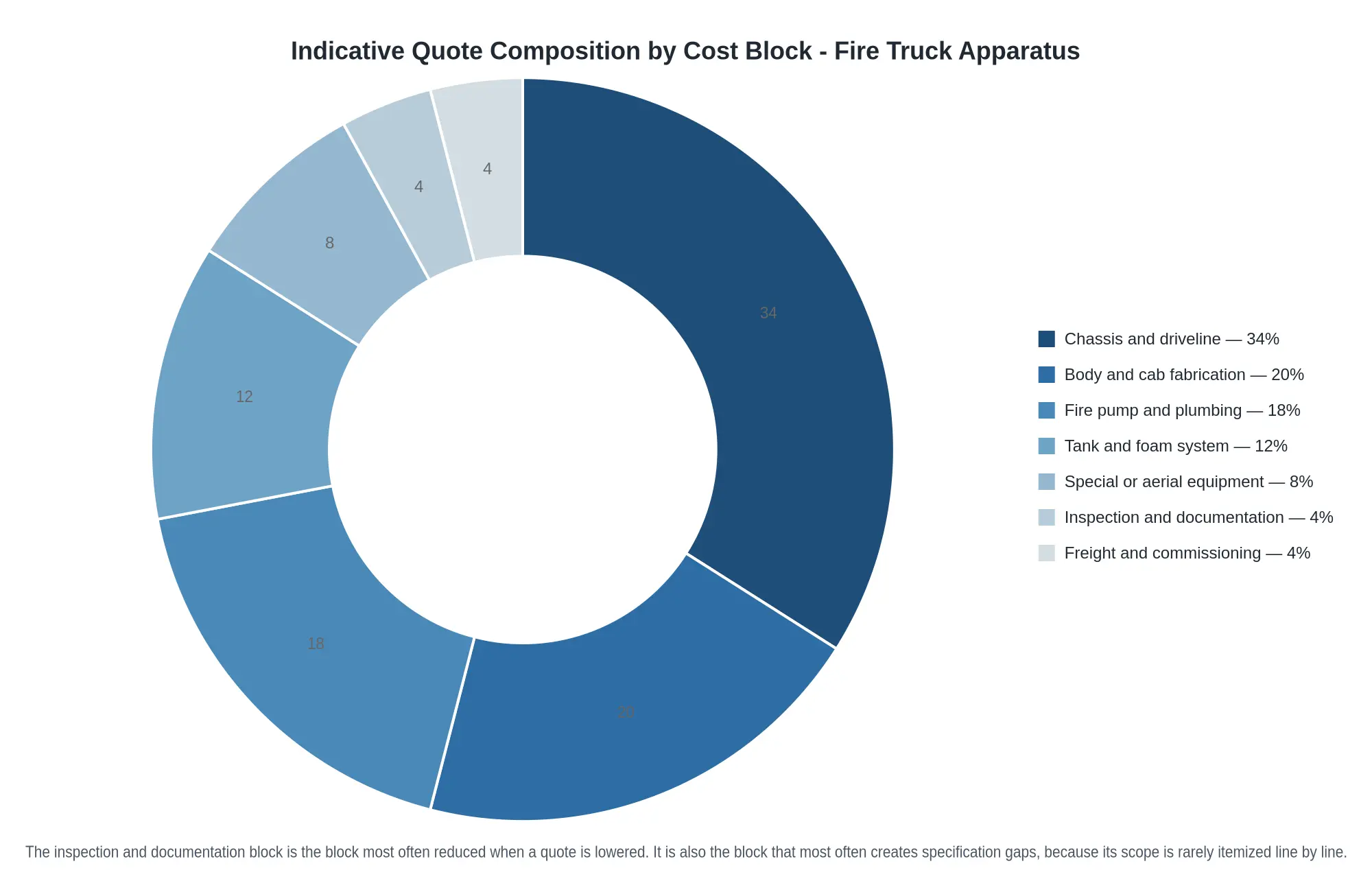
Note: the inspection and documentation block is the one most often reduced when a quote is lowered. It is also the block that most often creates specification gaps, because its scope is rarely itemized line by line.
At roughly 4% of indicative value, cutting the inspection block in half looks like a rounding error on the purchase order, yet it is the block that determines whether pump performance, foam proportioning accuracy, electrical integration and aerial load testing are verified against the specification or simply assumed. On certified special apparatus the same block is a considerably larger share, closer to the 8 to 14 percent range shown in the tier comparison above. Two quotes that look a few percent apart can therefore differ far more in verifiable scope than the spread suggests. That difference surfaces after delivery, when remediation is expensive and schedules are already committed.
A practical response is to request a line-item breakdown of each cost block before comparing totals, with inspection and documentation split into discrete tasks: factory acceptance testing, third-party witness points, pump and foam system certification, weight and stability verification, as-built drawings and operator training records. Once those items are visible, a lower total becomes a specific trade-off you can accept or reject rather than an unexplained discount.
Frequently Asked Questions: Why Fire Truck Quotes Diverge
Procurement teams reviewing competing bids for the same nominal apparatus are often surprised by the spread between the lowest and highest number. The questions below address the most common points of confusion around fire truck cost, specification gaps and inspection scope.
Why do two fire truck quotes for the same apparatus differ?
Two quotes for the “same” apparatus usually price two different vehicles. Commercial-chassis builds and purpose-built custom chassis carry materially different costs because of frame ratings, cab construction, axle capacity and certification testing. Pump capacity, tank material, foam systems and warranty terms further separate the numbers. Beyond hardware, each supplier interprets the same brief differently, so specification gaps in your request are filled by each bidder’s own assumptions. The divergence is therefore a documentation problem as much as a price problem.
Is a higher quote always better equipped?
No, a higher quote is not automatically the better-equipped apparatus. A premium number can reflect a heavier chassis, longer warranty, extended training package or broader inspection scope rather than superior firefighting capability. It can also reflect a conservative vendor building in contingency for ambiguous requirements, or simple margin. The reliable method is a line-by-line comparison that puts every submission on the same baseline: pump rating at the same pressure, tank capacity in the same material, identical warranty exclusions. Only after normalizing those items can you judge whether the extra cost buys capability or padding.
What should an inspection scope include?
Inspection scope should be defined in writing before bids are opened, not negotiated afterward. At minimum it should cover pre-construction drawing review, in-process inspections at chassis, body and pump installation stages, and a final acceptance test. That final test should document pump performance at rated flow and pressure, foam proportioning accuracy where applicable, aerial device load and stability testing, electrical and lighting verification, and a road test at loaded weight. Third-party or owner-witnessed inspections should be named in the document, along with who bears the cost of rework and reinspection. A scope that omits any of these stages invites disputes at delivery.
How do specification gaps affect resale value?
Specification gaps depress resale value because buyers in the secondary market price documentation, not promises. An apparatus without a clear build record, certified pump test results and a documented inspection history is harder to certify, and therefore harder to finance and insure. Ambiguity at purchase also tends to produce non-standard components, which narrows the pool of future buyers and raises their maintenance risk. Over a fifteen-year service life, a truck that can be resold with complete records typically recovers a meaningful share of its original cost. Gaps written into the contract at award become discounts demanded at resale.
Can inspection scope be added after contract award?
Yes, but it is more expensive and less effective than specifying it upfront. Post-award additions arrive as change orders, and vendors reasonably price them with contingency because the production schedule has already been set. Access to the factory floor may also be limited once the chassis is in build, and rework discovered late costs far more than rework caught at the frame stage. When time is the constraint, negotiate a defined acceptance test and a documentation package as the minimum add-on. Buyers comparing quotes should treat inspection terms as a scored evaluation criterion, not a post-award negotiation.
Who should pay for third-party inspection?
Third-party inspection is normally funded by the purchaser and built into the budget as a percentage of fire truck cost. Expect roughly one to two percent of contract value for a full witness program on a custom apparatus, with owner-witnessed inspections costing less but demanding staff time. Some suppliers bundle a documented inspection package into their bid; that option should be compared on scope, not on price alone. Clarify in the contract who pays for reinspection after a failed test. Ownership of that cost is the strongest single incentive for the builder to get it right the first time. Buyers reviewing fire apparatus product categories can use category-level specifications as a starting baseline for these comparisons.
Closing Advisory: Put the Cost Differences to Work in Your Evaluation Matrix
When two quotes for what looks like the same fire truck diverge, the gap is almost never arbitrary pricing. It traces to two documented dimensions: specification gaps and inspection scope. Pumps, tanks, foam systems, chassis ratings, cab materials and electrical architecture vary line by line, while the depth of factory testing, third-party witness inspection and documentation deliverables varies just as widely but far less visibly. Both dimensions belong in the evaluation matrix as explicit, priced line items, not as assumptions buried inside a headline number. A quote that looks 12% cheaper on page one often closes at parity or above once specification and inspection scope are normalized.
Four Steps Before You Award
- Normalize every offer to a common line-item template. Break each bid into identical equipment, testing and documentation lines so that missing scope becomes visible rather than inferred.
- Require a written inspection and testing plan. Demand the specific test procedures, witness points, hold points and acceptance criteria, then confirm they are priced.
- Price the documentation package explicitly. Manuals, as-built drawings, training records, warranty terms and compliance certificates carry real cost and real value; make them a separate, comparable line.
- Score total cost of ownership, not headline price. Weigh delivery, spare parts availability, service intervals, expected service life, and resale or redeployment value alongside the purchase figure.
When you write specifications for that template, keep them category-aligned rather than generic: a structural pumper, an ARFF unit and a plant-protection vehicle share a chassis, not a mission. Draw the baseline from your fire fighting truck requirements, benchmark runway-response criteria against airport fire trucks, and set self-protection and foam-capacity targets from industrial fire truck duty cycles. Category-specific specifications are what make the first step of the matrix workable.
Divergent quotes are a measurement problem before they are a budget problem. Normalize the template, document the inspection scope, price the paperwork, and score the full lifecycle, and the lowest responsible offer becomes evident from the numbers rather than argued over in committee.