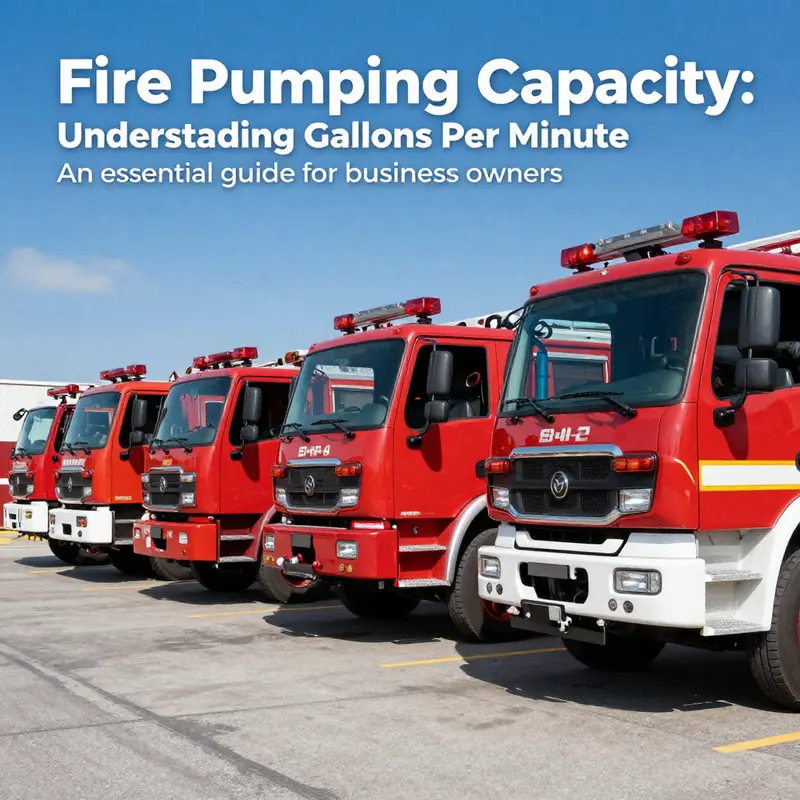
Fire tenders are sold with one of two pump drive layouts, and the one you choose decides how much water reaches the nozzle, what the truck costs to run and how the crew works around it. A PTO pump drive takes power from the chassis transmission or transfer case through a power take-off, so the engine that turns the wheels also turns the pump. No second power unit is added.
An engine-driven pump works differently. A dedicated engine and pump set are mounted on the apparatus as a self-contained unit, independent of the chassis drivetrain. Because the two engines are separate, each can be sized, governed and serviced for its own workload. Most of what follows comes out of that separation.
The comparison below covers pump performance, cost of ownership, maintenance and duty-cycle fit, and it is written for buyers of commercial fire trucks and industrial apparatus who need equipment that holds up under sustained demand rather than occasional use. Each factor is taken on its own terms, so the trade-offs are clear before a specification is signed.
How a PTO pump drive works and how an engine-driven pump works
The two layouts on a fire fighting truck answer one question: which engine turns the pump? One borrows the chassis engine, the other brings its own. That answer sets where the pump sits, how much body space is left and how much weight remains for water.
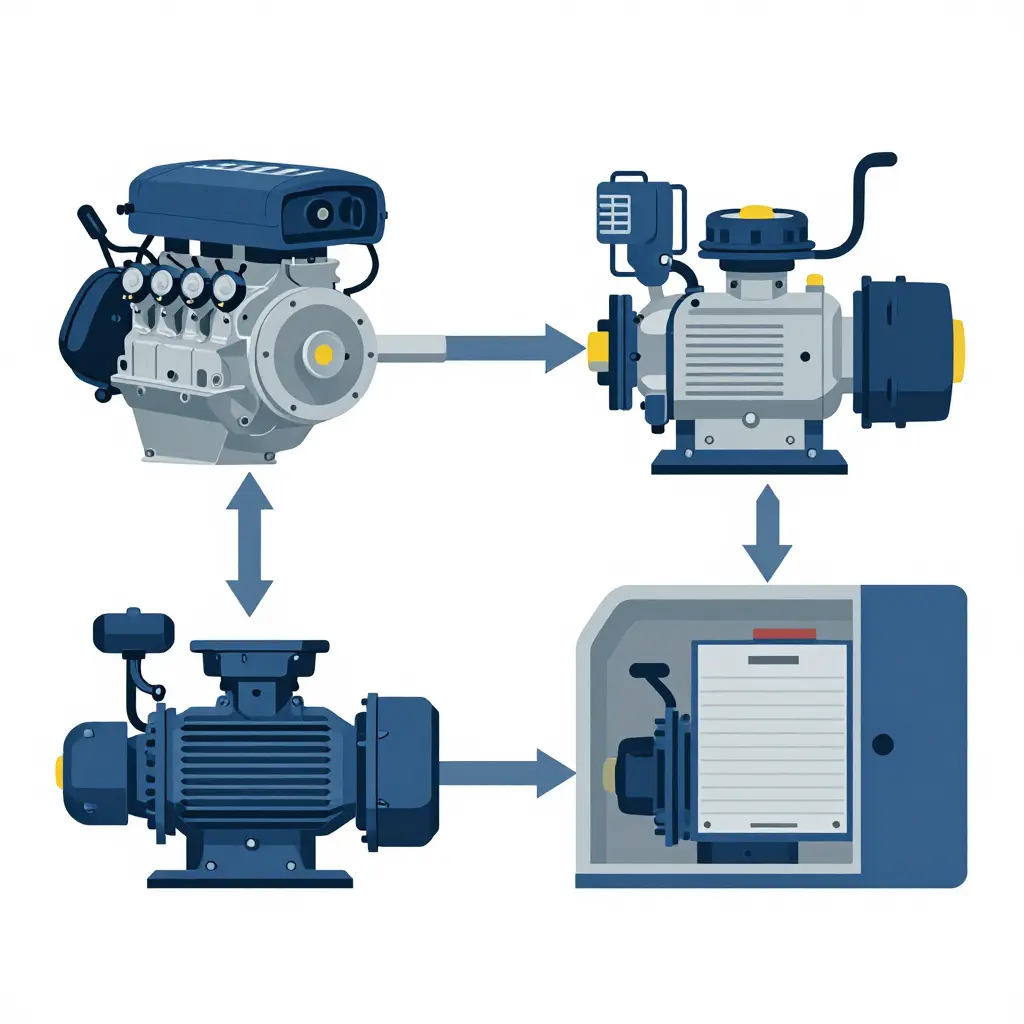
PTO pump drive: power borrowed from the chassis engine
With a PTO pump drive, the chassis engine does double duty. Power leaves the engine, runs through the transmission to a power take-off (PTO) gearbox, then along a driveshaft to the pump. The driver engages it from the cab: neutral, parking brake on, then an air or electric switch that meshes the PTO.
Mounting is usually mid-ship, between the axles, or at the rear on a rear-mounted pump. A mid-ship position keeps the fire truck pump low and the weight balanced, but it uses frame space under the body; a rear pump leaves that middle section for the tank and locker compartments.
With no second engine, the layout saves weight and cost, and the saved weight goes into water or foam. Pump output tracks chassis engine speed instead, so the operator holds a set rpm and gear while pumping. One engine also means one service routine, and PTO parts are stocked by the transmission and chassis suppliers behind most fire fighting truck ranges.
Engine-driven pump: power from a dedicated engine
An engine-driven pump has its own diesel engine, mounted in the rear body compartment and bolted directly to the pump. The chassis engine drives the wheels and nothing else: no PTO, no long driveshaft, no shared load between driving and pumping.
Engagement is separate. The operator starts the dedicated engine with its own key or switch, in the cab or at the pump panel, and sets pump speed on that engine’s throttle. Nothing about the pump depends on the transmission, which is why ARFF trucks and some industrial units built for pump-and-roll can keep water flowing while the vehicle creeps forward. A standard rear-mount module is normally operated from a standstill.
The trade-offs land in space and payload. The extra engine, cooling pack, fuel lines and exhaust take a block of the rear body, so tank size or equipment storage shrinks. Payload drops by the weight of that engine and its support systems, and there is a second engine to maintain.
Side-by-side comparison
| What it affects | PTO pump drive | Engine-driven pump |
|---|---|---|
| Power source | Chassis engine via PTO | Dedicated pump engine |
| Pump location | Mid-ship or rear | Rear body compartment |
| Engagement | In-cab PTO switch | Separate engine start |
| Body space | More free space | Less free space |
| Payload | Higher | Lower |
| Pumping while moving | Only with a pump-and-roll PTO arrangement | Not tied to the driveline; used on ARFF and industrial pump-and-roll builds |
| Maintenance | One engine | Two engines |
For the same chassis, the PTO layout leaves more tank volume and payload, which is why most municipal and light industrial buyers specify it. The dedicated engine trades space, weight and a second service schedule for a pump that no longer depends on the driveline.
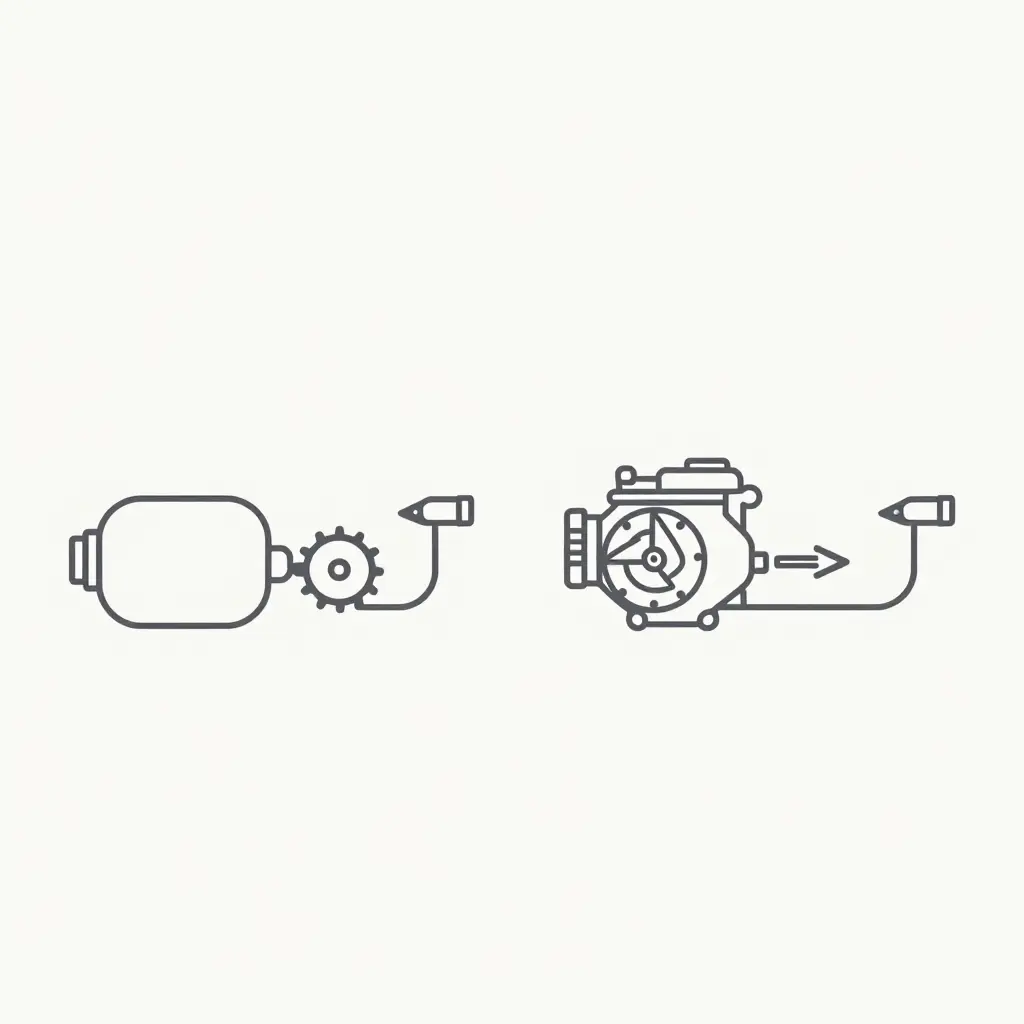
Side-by-side schematic of the two drive layouts: power take-off (left) versus dedicated engine (right).
The left panel follows the power path from the chassis engine, through the power take-off on the transmission, to the pump: one engine moves the truck and spins the impeller. The right panel puts a second engine beside the pump and drives it directly.
Nearly everything else buyers ask about traces back to that routing: whether water can flow while the truck rolls, how much of the rated flow survives the hose run, and how the body has to be laid out in the factory. Keep the diagram beside the spec sheet when a dealer quotes pump performance against engine ratings for a new water tanker or heavy-duty fire truck.
Performance and Operational Trade-offs Between PTO and Engine-Driven Pumps
In service, the difference between the two layouts shows up in routine rather than on the spec sheet. These are the points owners raise first.
A PTO engages through the transmission, so the truck has to be stopped, in neutral and on the parking brake before the pump comes online. An engine-driven pump starts on its own engine and can usually be pumping within a minute of arrival, whatever the transmission is doing. The gap is seconds, but it decides the order in which a crew does things on arrival.
A dedicated engine is not limited by gearbox ratios, so it can be specified with a large impeller and hold high flow at high pressure for hours. A PTO is bounded by the chassis engine’s speed and the gearing behind it: mid-range duty is easy, the top end of a single large stream less so. On either drive, delivered flow depends on the pump curve meeting the nozzle requirement, not on the drive type alone.
Pump-and-roll is a build decision rather than a property of the drive type. A standard split-shaft PTO turns the pump only once the driveline to the wheels is disengaged, so the truck stands still; a pump-and-roll arrangement keeps drive to the wheels while the PTO turns the pump. Engine-driven modules are mechanically free of the wheels, which is why ARFF and many industrial trucks pump while creeping. Decide whether that mobility is part of your operating pattern, then pick the layout that delivers it.
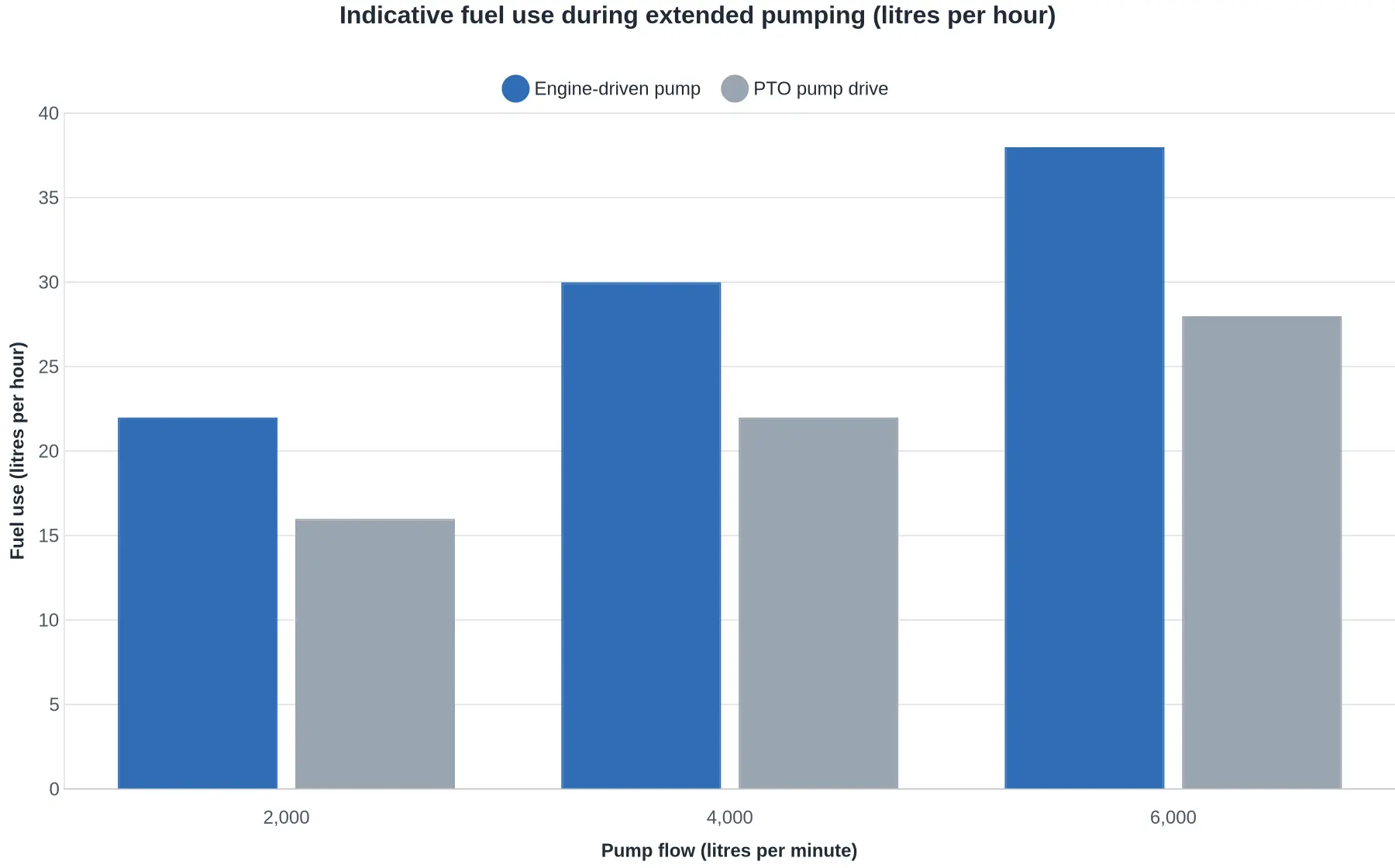
Extended pumping is where fuel shows up on the running cost. A PTO drive draws on the chassis engine, which may be turning at elevated speed for hours, while a dedicated pump engine can be sized and governed for its load. The indicative chart below gives figures at three flow rates.
An engine-driven pump adds a second combustion source at the rear of the truck, so its noise and exhaust originate there rather than at the front. A PTO concentrates both at the main engine. On a long stationary deployment the total acoustic footprint is often comparable; what changes is where it lands, which matters on sites with boundary limits.
The dedicated engine, its cooling pack, fuel tank and controls take body volume and weight straight out of the water or equipment allowance. A PTO leaves that space and mass for tank capacity, lockers or foam systems. On a heavy-duty fire truck the extra mass is usually absorbable; on a compact build it is not.
An engine-driven panel asks the operator to watch a second set of gauges, temperatures and fuel levels, but the pumping task no longer depends on chassis gear and engine speed. A PTO panel has fewer instruments, while the driver holds the engine at the right speed and gear, and drift there shows at the nozzle.
PTO Pump Drive vs Engine-Driven Pump: Side-by-Side
If you are comparing fire tenders for sale, the table below lines up a PTO pump drive against an engine-driven pump on the criteria that decide both purchase price and lifetime cost. It applies across fire fighting truck models built on commercial or custom chassis.
| Criteria | PTO pump drive | Engine-driven pump |
|---|---|---|
| Pump engagement method | Split-shaft PTO driven off the transmission | Dedicated engine coupled directly to the pump |
| Typical flow and pressure capability | 1,000-2,500 L/min at 10 bar | 2,000-6,000 L/min at 10-16 bar |
| Pumping while driving | Only in a pump-and-roll build; a split-shaft PTO disengages the wheels | Independent of the wheels; used for pump-and-roll on ARFF and similar builds |
| Fuel consumption during extended pumping | 4-8 L/h added to the chassis engine’s existing burn | 10-20 L/h for the pump engine at working load |
| Payload and body-space impact | No second engine, more room for the water tank | Extra engine and fuel tank reduce body space |
| Maintenance complexity | One engine, one oil and coolant schedule | Two engines, two separate service intervals |
| Service access | Pump set behind cab or mid-ship, access is tight | Standalone pump module with open side access |
| Upfront acquisition cost | Lower, fewer components and no second engine | Higher, second engine adds roughly 15-25% |
| Cold-start and idle behaviour | Relies on chassis engine condition | Pump engine starts independently of chassis |
| Best-fitting duty cycle | Short attacks, municipal response, tight budgets | Long relay pumping, industrial and airport standby |
The PTO column wins on price, body space and simplicity. The engine-driven column wins on flow, pressure and continuous duty. Weigh the rows against your call volume and water supply plan, then shortlist the chassis that satisfies the rows you cannot trade away.
One row is worth checking against your own market: if you work to NFPA 1901, the smallest rated pumper is 750 gpm, about 2,800 L/min, at 150 psi, and the lower end of the PTO range in that table sits below it.
PTO Pump Drive vs Engine-Driven Pump: A Performance Scorecard
Datasheets are hard to compare: one quotes litres per minute, another horsepower, a third service intervals. The four indicators below decide whether a drive pays for itself, so they are plotted on one chart, three of them scored from 1 to 10 and maintenance left as hours per year.
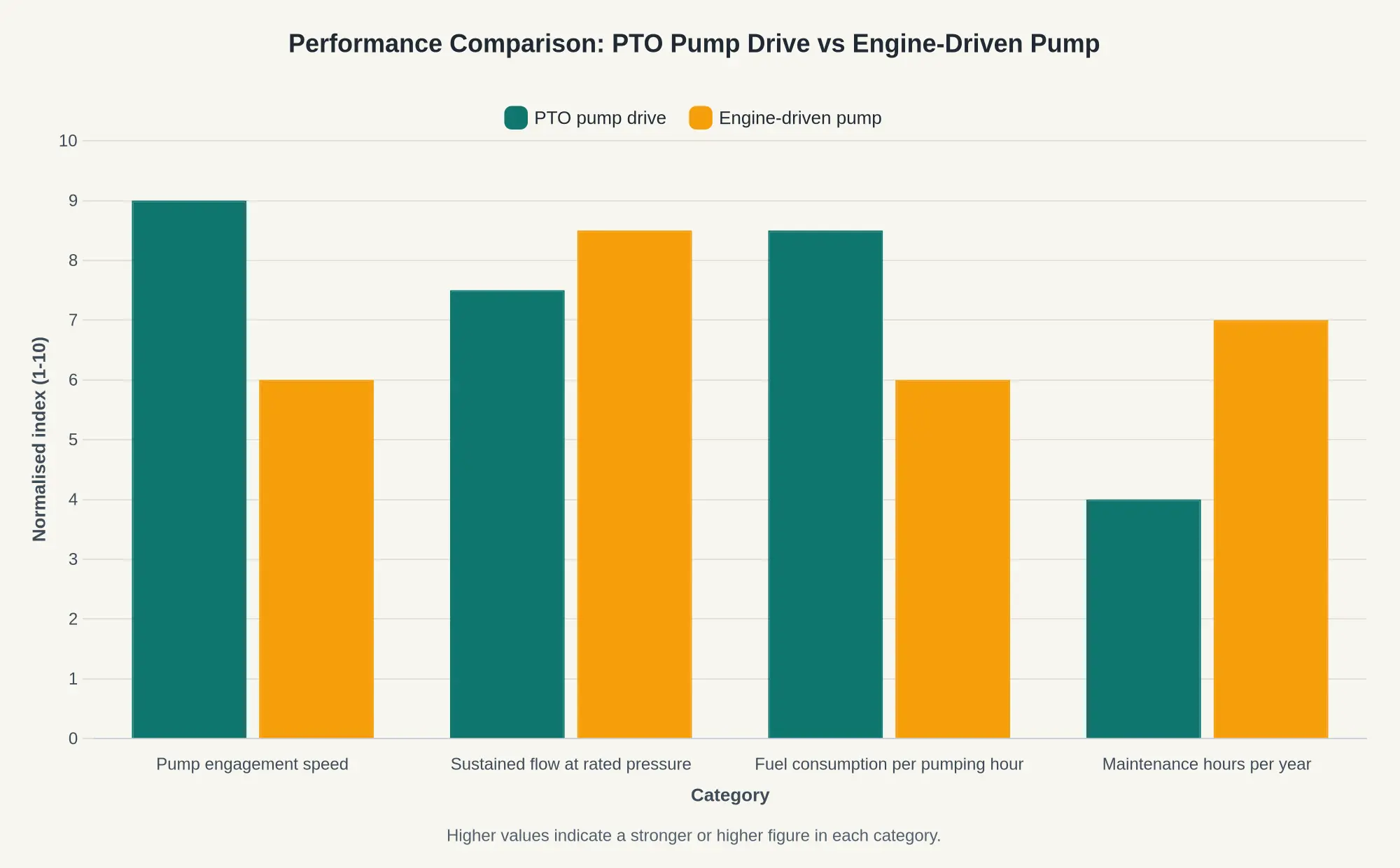
Scores run from 1 to 10, and for engagement speed, flow and fuel a higher score is better. Maintenance is shown as hours per year, so fewer hours is better.
What the scores say
No drive wins every row. The engine-driven pump takes engagement speed (9 against 6), because it starts on its own engine with no neutral-and-parking-brake sequence, and it takes sustained flow at rated pressure (8.5 against 7.5), because nothing in the driveline caps it.
The PTO takes fuel per pumping hour (8.5 against 6), since one engine runs instead of two, though the chassis engine spends that time off its efficient band while it drives the pump. On maintenance it records 4 hours a year against 7: one engine, one oil interval, one cooling system. The shorter bar is the better result in that row.
Reading the numbers in context
An index helps up to a point. A municipal pumper working short structural calls is usually served better by the PTO, where fuel and upkeep weigh more than a large, continuous flow. A unit that may hold pressure for eight hours at an industrial tank fire needs the self-contained output of a dedicated engine, and the extra maintenance belongs in the operating budget from the start.
| Category | PTO pump drive | Engine-driven pump | Practical meaning |
|---|---|---|---|
| Pump engagement speed | 6 | 9 | Time from arrival to water |
| Sustained flow at rated pressure | 7.5 | 8.5 | Long-duration pumping stability |
| Fuel consumption per pumping hour | 8.5 | 6 | Higher score means less fuel burned |
| Maintenance hours per year | 4 | 7 | Hours, not a score: lower is better |
Apparatus that routinely pumps for hours should be specified on a chassis that can carry either layout, such as a heavy-duty fire truck, before the drive is fixed. The index is only useful when it is read against your own hours at the pump.
A Verification Checklist Before You Order Fire Tenders for Sale
Work through this as a sequence rather than a menu, and apply the same tests whether the fire truck pump is PTO-driven or engine-driven.
- Confirm that the hazard and risk profile of your site — flammable liquids, storage height, occupancy type — matches the agent and vehicle class you are ordering.
- Verify flow and pressure at the nozzle rather than the pump nameplate, because pressure losses through hose runs can swallow a nominal rating.
- Check the expected pumping duty cycle; incidents lasting hours need a drive rated for sustained output, not short bursts.
- Measure the distance to your water source and map the refill, including tanker shuttle time, hydrant access and suction lift limits.
- Compare chassis and axle rating limits against the fully loaded weight of water, foam, equipment and crew.
- Confirm compliance with the fire service standards that apply to you, such as NFPA 1901, EN 1846 or your national code, and ask for the test documentation.
- Review local service and spare-parts coverage, including dealer distance, technician availability and typical lead times on pumps, valves and seals.
- Establish driver licensing and crew training requirements, since heavier vehicles and more complex pump controls can demand additional certification.
- Calculate total cost of ownership over the planned service life, covering fuel, maintenance intervals, tyre and brake wear, insurance and resale value.
- Match onboard water and foam tank capacity to the realistic first-response window before backup arrives.
If time is short, start with the hazard profile, nozzle flow and pressure, and total cost of ownership. Those three decide most of the remaining specification, including which of our commercial fire trucks fits the operation.
Total Cost of Ownership: PTO Pump Drive vs. Engine-Driven Pump
The invoice is the easiest number to compare and the least reliable guide to what a truck will cost. Integration labour, fuel burned at the pump and service hours lost to repairs move the total more than the purchase order does, which is why a PTO pump drive and an engine-driven pump have to be read as two cost curves rather than two prices.
On acquisition, a PTO pump drive usually costs less, because the chassis engine already supplies the power and no second power unit has to be bought, mounted or certified. An engine-driven pump adds a dedicated engine, its controls and the mounting hardware that goes with them.
Installation and body integration follow the same pattern. A PTO take-off is mechanically straightforward but has to match the chassis driveline and transmission, which limits how freely the body can be moved to another chassis later. A separate pump engine needs its own cooling, exhaust and fuel routing inside the body, so it takes more body volume and more engineering hours. Where sustained pump duty and generous body space matter more than a low entry price, it is worth reviewing heavy-duty fire trucks built for continuous pumping.
Fuel and consumables during pumping favour the PTO arrangement in most duty cycles, since one engine does the work instead of two running in parallel, though the chassis engine spends that time well below its efficient band. An engine-driven pump is economical when it runs in its own efficient band and the chassis engine is not left idling to feed it.
Scheduled maintenance splits along the same line: a PTO setup keeps one engine, one oil change interval and one service bay booking, while a dedicated pump engine doubles the schedule. Downtime cuts the other way. Engine work on a PTO truck can take the whole vehicle out of service, whereas a separate pump engine can sometimes be serviced without immobilising the chassis.
| Cost factor | PTO pump drive | Engine-driven pump |
|---|---|---|
| Acquisition price | Lower – no second power unit | Higher – dedicated engine and controls |
| Integration complexity | Simple driveline take-off, chassis-bound | More packaging, cooling, exhaust routing |
| Fuel while pumping | Lower per hour, single engine | Depends on load band of the pump engine |
| Maintenance schedule | One engine to service | Two engines, two intervals |
| Downtime exposure | Whole vehicle off road for engine work | Pump engine can be isolated in some designs |
| Residual value | Familiar, broad buyer base | Specialist appeal, stronger in industrial fleets |
Residual value tends to reward whichever configuration the local market understands. PTO trucks resell easily among general municipal and rural buyers, while engine-driven trucks hold the interest of industrial and airport operators who want independent pump power. A complete service history and reliable fire truck parts and pump service kits protect that resale figure more than either drive type does on its own.
Take the PTO pump drive when entry cost, a one-engine service routine and predictable fuel use matter most and the truck pumps intermittently. Take the engine-driven pump when independent pump power and servicing that can be isolated from the chassis justify the higher acquisition and integration spend. Judge both on the hours you actually pump.
Where the Money Actually Goes: Lifecycle Cost of a Pump System
The purchase price is one slice of the cost. Over ten to fifteen years, fuel, scheduled servicing, breakdowns and resale all pull on the same budget.
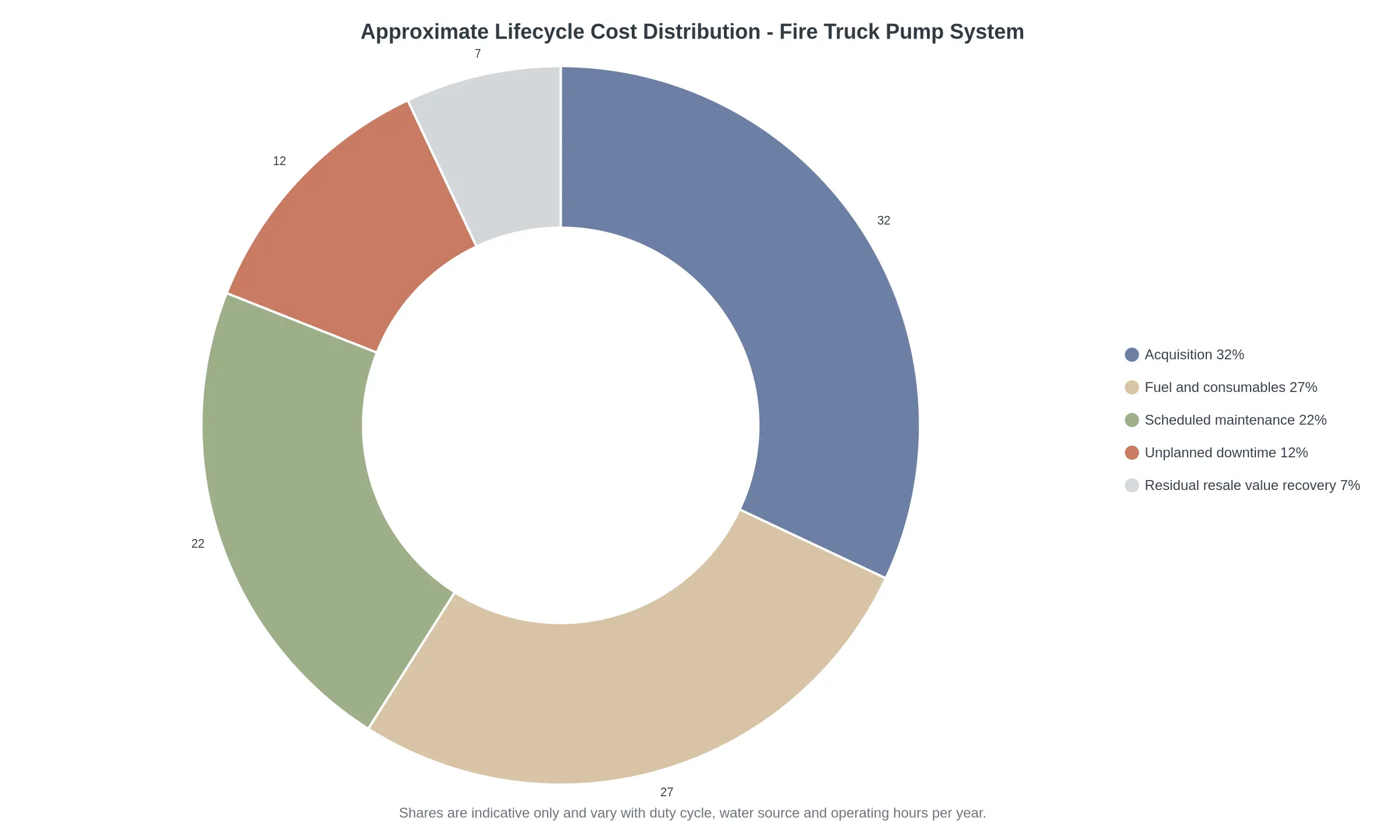
Shares are indicative only and vary with duty cycle, water source and operating hours per year.
- Acquisition is the largest slice, not the whole story. Roughly a third of the total sits in the initial purchase, which is why the drive chosen at order stage has to be judged against the other two-thirds.
- Fuel and consumables accumulate quietly. A pump driven by the main engine and one with its own engine burn fuel at different rates per pumping hour, and over ten to fifteen years those hours add up.
- Unplanned downtime never appears on an invoice. The slice looks modest on paper, but lost response capability during peak season is not a billable line.
- Resale gives something back. A well-maintained unit with documented service history recovers a meaningful share of its original price, so keep the records tidy and stock the right service items from fire truck parts when replacements fall due.
Adjust the shares to your own call volume, terrain and water sources before you commit to a drive type.
Matching Drive Architecture to Vehicle Categories and Duty Patterns
Drive architecture decides how the pump receives power, and that follows from vehicle size, run profile and the volume of water or foam that has to move. The mapping below is a guide, not a rule. For aircraft response work, ARFF aircraft rescue fire fighting vehicles generally use dedicated engine-driven pumps, because output has to be available instantly and independently of road speed.
Pump-Driven Chassis for Light and Fast-Response Units
In a chassis-driven layout, the main engine powers the pump through the driveline, so water can flow with the truck parked or, in a pump-and-roll build, while it moves. This suits compact bodies where weight and space are tight and the crew needs a first attack delivered within seconds of arrival. Small fire trucks built this way keep pump, tank and hose bed on one short wheelbase with minimal mechanical complexity. The fit is short travel distances, modest tank volumes and a duty pattern built around rapid first attack.
PTO-Driven Configurations for Volume and Foam Delivery Builds
A power take-off draws torque from the transmission, so pump output is tied to engine rpm rather than road speed. Larger tanks, proportioning systems and multiple discharge outlets sit comfortably on this layout, which is why volume and foam builds are usually PTO-driven. Foam fire trucks need stable, sustained flow to hold a proportioning ratio, and a PTO delivers that from a standstill. The fit is high delivered volume per incident, foam proportioning and long pump-and-transfer periods.
Dedicated-Engine Pumps for High-Flow Industrial and Rescue Roles
A separate pump engine decouples pump performance from the chassis, which allows very high flow rates, independent throttle control and pumping with the truck engine shut down. Industrial fire trucks serving process facilities and tank farms use this arrangement to feed monitors and fixed deluge systems at rates chassis-driven pumps cannot sustain. The fit is high-flow monitor demand, long-duration pumping and redundancy in the power path.
Maintenance and Serviceability: PTO vs Engine-Driven Pumps
The service picture differs mainly in how many systems the technician has to own. On a PTO setup, the fire pump drive borrows the chassis engine, so routine work stays within one powerplant. Engine-driven units add a second engine with its own fuel, cooling, exhaust and starting circuits, and the pump gets more breathing room on the frame in exchange.
- PTO drives mean one engine to service, one oil change cycle, and no separate fuel or cooling system to track.
- Engine-driven pumps are quicker to reach, because the pump head, its engine and the skid sit behind removable panels.
- Both types need a weekly pump run, quarterly seal and packing checks, and an annual flow test.
- PTO spares centre on the PTO unit, driveline and transfer case; engine-driven spares follow the pump engine’s own parts list.
- Warranty coverage usually splits along component lines, so chassis and pump may be covered by different parties.
Access to pump and drive components
Engine-driven trucks win on plain accessibility. The pump sits exposed with removable panels and clear space around the impeller housing, so a seal swap can be a one-person job. PTO installations tuck the pump behind the cab or under the body, which is fine for routine checks but slower when a driveline joint or PTO clutch needs attention.
Scheduled inspection intervals
| Interval | What to check |
|---|---|
| Weekly | Pump run, pressure gauge accuracy, visible leaks |
| Quarterly | Packing or mechanical seal condition, drive shaft play |
| Annually | Flow test, relief valve setting, gearbox oil |
These intervals apply to both designs and do not help you choose between them.
Wear parts and seal replacement
Seals, gaskets, impellers, wear rings and valve seats fail on both configurations at similar rates, and both need a stocked set of consumables. Keeping a shelf of fire truck pump seals and wear parts shortens downtime considerably. Hoses, nozzles and suction strainers belong in the same store, and a small reserve of portable fire fighting equipment covers crews when a section is pulled for repair.
Technician skill requirements
PTO systems suit general chassis mechanics, since there is no independent pump engine to diagnose. Engine-driven units need someone comfortable with diesel diagnostics, governor settings and fuel system troubleshooting, which often means a call-out.
Spare parts and warranty
PTO components are widely available from transmission and chassis suppliers, so lead times are short. Engine-driven pumps tie owners to that specific engine maker’s network. On warranty, confirm in writing which party covers the pump, which covers the driveline, and how a shared failure is apportioned.
PTO drives keep routine servicing cheaper and simpler. Engine-driven pumps reward fleets that value stand-alone pump access and can support a second engine in-house.
Frequently Asked Questions: PTO Pump Drive vs Engine-Driven Pump
Choosing a fire tender usually comes down to one decision: PTO pump drive or engine-driven pump. These are the questions business owners ask most when reviewing fire fighting trucks for sale.
Which drive suits long-duration pumping?
For several hours of sustained pumping, an engine-driven pump holds up best. Its dedicated engine runs independently of the chassis, avoids transmission heat build-up, and delivers stable pressure at a fixed throttle without putting hours on the truck’s drivetrain.
Can a PTO pump drive pump while the vehicle is moving?
Only in specific builds. A standard split-shaft PTO disengages the drive to the wheels, so the truck has to stand still while the pump runs. Pump-and-roll needs either a PTO and transmission arrangement designed to keep the wheels driven, or an engine-driven pump that has no mechanical link to the driveline.
How does fuel consumption compare?
During fireground pumping, an engine-driven pump burns more fuel because it runs a second engine. A PTO pump drive uses the chassis engine, which is often already idling, so it usually consumes less fuel per hour of stationary pumping.
Which option costs less over the service life?
A PTO pump drive usually costs less over its service life. It carries a lower purchase price and only one engine to service, though it limits simultaneous pumping and driving. An engine-driven pump costs more up front and more in maintenance.
Can an engine-driven pump be retrofitted?
Retrofitting an engine-driven pump onto an existing chassis is possible but rarely practical. It requires dedicated mounting space, a separate fuel system, cooling and controls. Most buyers replace the apparatus instead, with a factory-built engine-driven configuration.
What specifications should I request when comparing fire tenders for sale?
Ask for rated flow and pressure at a stated engine speed, drive type, PTO pump drive rating and torque limits, tank capacity, pump curves and warranty terms. Say whether the engine-driven pump is mid-ship or rear-mounted before you compare prices.
A Practical Decision Framework: Choosing Between PTO and Engine-Driven Pump Drives
The two drive types answer different operating conditions rather than competing on the same ground. Work through these checks in order.
- Match the drive type to the duty cycle. A vehicle that responds, pumps briefly at the scene and returns to service suits a PTO drive. A unit expected to run its pump for extended periods is generally better matched to an engine-driven pump.
- Verify flow and pressure at the required nozzle. Rated figures at the pump outlet can differ noticeably from what reaches the nozzle once hose runs, elevation and fittings are counted. Confirm performance against the actual nozzle requirement rather than the nameplate.
- Confirm payload and body-space limits. Pump, drive and tank arrangements all consume weight and volume. Check the chassis rating and body layout before committing, since a drive option that fits mechanically may not fit inside the payload envelope.
- Compare lifecycle cost rather than purchase price alone. Include fuel during pumping, maintenance intervals, wear on the driveline or auxiliary engine, and expected service life. The lower sticker price is not automatically the lower cost of ownership.
| Check | What to confirm |
|---|---|
| Duty cycle | Duration and frequency of pumping relative to road operation |
| Flow and pressure | Delivered performance at the nozzle, not just at the pump |
| Payload and space | Chassis rating, tank size, and body layout |
| Lifecycle cost | Fuel, maintenance intervals, and service life |
Assessed together, these four points turn the choice between a PTO drive and an engine-driven pump into a documented decision rather than a preference.
Buyers reviewing commercial fire truck configurations can use the same framework when shortlisting any fire tenders for sale.
CIMC Tianda is a global equipment supplier with more than 20 years of experience in firefighting vehicles, operating across 75 countries through 30+ subsidiaries. Its product coverage spans firefighting and rescue equipment for municipal, industrial, airport, and specialty applications.
To discuss drive options, flow requirements and body layout for your own specification, request a configuration and quotation from the CIMC Tianda team.