Emergency Vehicles for Sale: Building a Plant Standby Fleet That Holds Up
Specifying a standby fleet usually starts with a spreadsheet of unit counts and pump capacities, then turns harder somewhere around the second site visit, when somebody asks who is going to pump the thing at 3 a.m. and how long water takes to reach the far bund. Three things decide whether the fleet works: how many units you keep, who is certified to run them, and how much of the site and the clock you actually cover. Each pushes on the other two. Oversize any of them and you buy capacity nobody can operate; underdo any of them and the response arrives late.
Unit count is how many vehicles sit on site, sized to footprint, process risk and the incidents you expect rather than to a single worst case. Crew certification covers the qualifications your own staff or contracted responders must hold before a standby unit can be dispatched legally and safely. Coverage gaps are the minutes between an alarm and an adequate response, measured against what your permits, your insurer and the regulator require.
Much of the pricing and comparison work goes into chassis and pump capacity on industrial fire trucks built for on-site standby duty; crew and response time get whatever attention is left over, which is how fleet plans end up complete on paper and thin in practice. The sections below take the three in order: sizing the count, documenting certification, closing gaps without overbuying. The reasoning holds for industrial plants, logistics hubs and airport-adjacent sites, where access and travel time differ but the decision structure doesn’t.
How Many Units a Plant Standby Fleet Actually Needs
There is no universal number, and a supplier who quotes one before asking about your site is guessing. Unit count is an output. It comes out of a chain that runs from what the site must protect, through the capability that protection demands, to the number of vehicles that must be on the pad at the same moment. Break the chain and you either overbuy capital equipment or underwrite a gap you will discover on the worst night of the year.
Demand side: what the site asks the fleet to do
The chain starts with geometry. A larger protected area stretches hose lays, adds travel time inside the fence line and splits responders into sectors, and every sector needs its streams open at once. The hazard class of the stored materials then sets the application rate, the foam type, and whether suppression must be backed by cooling streams on adjacent exposures. A tank fire and a polar-solvent spill commit very different numbers of appliances at the same moment.
Next comes the design event: the simultaneous-demand assumption behind your worst credible case, such as a primary fire plus exposure protection plus a pump or seal fire elsewhere in the process. Flow rate per position, multiplied by the duration the response must sustain it, gives a volume – flow times time equals water and foam concentrate. Where hydrants are thin or absent, resupply distance turns that volume into shuttle cycles, and cycle time decides how many tenders have to rotate to keep flow continuous. A bigger area, a harsher hazard, a longer duration, a farther fill point: each one raises required capability, and required capability raises the count.
Supply side: what your site can actually field
Capability only exists when someone can drive it. Driver and pump-operator availability per shift caps the useful fleet, because a vehicle with no trained operator at three in the morning is a parked asset, not coverage. Round-the-clock operations need certified crews for every shift plus a factor for leave and training. Maintenance rotation takes another slice of the fleet out of service at any given time, so reserve margin has to be counted rather than hoped for. The dedicated-versus-shared decision across a site cluster moves the arithmetic too: sharing cuts capital spend and adds travel time to every response, and that travel time is charged against the same clock, so shared units deliver fractional availability.
Unit count is therefore a function of required simultaneous output, not of budget. Budget decides which industrial fire truck configurations you can afford per seat; the scenario decides how many seats you need. Buy fewer seats than the calculation calls for and the requirement does not shrink – it moves into your emergency response plan as accepted risk. Work in this order: define the design event, compute flow and duration, convert that into simultaneous positions, then test the result against crew rosters and workshop schedules. Fleets sized this way hold up in an audit and on the ground.
The grid below is a first-pass check on that reasoning: each risk profile against the units needed at once, a typical mix, a reserve ratio and a crew size.
Unit Count Planning Reference for Plant Standby Fleets
Minimum counts and reserve margins still have to survive your local fire code, the authority having jurisdiction and your insurer’s terms, so treat the grid as a first pass beside a real risk assessment, not a substitute for one.
| Plant Risk Profile | Minimum Simultaneous Response Units | Typical Unit Mix | Recommended Reserve Ratio | Crew on Shift |
|---|---|---|---|---|
| Low-hazard warehouse and logistics | 1-2 | Light or industrial fire truck, water tanker fire truck | 1.2:1 | 2-4 |
| Medium-hazard manufacturing | 2-3 | Industrial fire truck, foam fire truck, emergency rescue vehicle | 1.3:1 | 4-6 |
| High-hazard chemical or fuel storage | 3-4 | Foam fire truck, water tanker fire truck, industrial fire truck, emergency rescue vehicle | 1.5:1 | 6-8 |
| Airport and airfield standby | 2-3 | ARFF vehicle, water tanker fire truck, emergency rescue vehicle | 1.5:1 | 4-6 |
| Remote or long-resupply sites | 2 plus water logistics | Industrial fire truck, water tanker fire truck, remote water supply unit, fire fighting ATV | 1.5-2:1 | 4-6 |
Where foam appears in the mix, confirm agent type and proportioning capacity against a specialist foam fire truck range before you lock the count.
Crew Certification: The Hidden Multiplier on Fleet Size
Crew certification is not one ticket bought once and filed away. It is a stack of overlapping permissions, each with its own expiry date. The first layer is driver licensing for heavy and aerial apparatus: weight classes, air brake endorsement, the handling characteristics of a long-wheelbase rig. On top of that sits pump operator qualification, where the skill that matters is reading hydraulic demand, drafting and relay work under pressure, not turning a valve. Then come foam and CAFS competence – proportioning, expansion ratios, application technique – and ARFF-specific training wherever an airfield falls inside the coverage boundary. Every layer expires quietly, and no spec sheet tells you who is permitted to put the unit into service on a Tuesday night shift.
Certification depth changes the effective size of the fleet. An uncertified unit is an unavailable unit: a well-maintained aerial fire truck with nobody signed off on ladder operation is, in practical terms, a shed on wheels. A single-certified operator is worse, because the unit looks available right up until that person takes leave, falls ill or resigns, and one resignation becomes a single point of failure for the whole standby posture. The arithmetic is unforgiving: certified operators per unit per shift, multiplied across shifts and roster patterns, plus a relief factor. Round-the-clock coverage of one seat typically takes three to four trained people to absorb rest days and absence, so two qualified operators per unit per shift is a sensible floor rather than a luxury. Plan certification alongside procurement, not after the first alarm.
Three Pillars of Plant Standby Readiness
Readiness stands on three columns: the units you can actually field, crews certified to operate them, and the coverage gaps that sit on the map and across the clock. Each carries weight on its own; all three rest on the fleet.
Owners who treat the purchase as the whole job are usually the ones a gap surprises later. Chassis and pump configuration feed straight into the first column, and the industrial fire truck lineup shows what is available for fixed-plant duty.
Finding and Closing Coverage Gaps
A coverage gap is any point in your response chain where delivered performance falls below the threshold your risk profile requires. It is not a count of vehicles. A plant can own five trucks and still carry serious gaps if those trucks cannot reach the hazard, arrive late, or lack the agent the fire demands.
Four measurements reveal most of them:
- Reach distance – the horizontal and vertical distance from where a vehicle can physically park to the farthest seat of risk, whether that is a bunded tank area, a rack structure or an upper process deck. Reach is measured from the parking position, not from the gate.
- Response time beyond acceptable thresholds – the minutes between alarm and first effective agent on the fire, including the time a truck spends off-site refilling or repositioning.
- Capability gaps – no foam for a hydrocarbon fire, no aerial reach above the tallest structure, no compressed air foam for deep-seated Class A fuel, no rescue or gas-supply function.
- Resupply intervals – the cycle time for water tanker round trips, foam concentrate restocking, SCBA cylinder recharge and fuel, which caps how long an attack can be sustained.
Two further gaps stay invisible on a fleet schedule. Shift-change gaps appear in the handover window, when the certified pump operator or aerial operator is between shifts and no qualified replacement is on site. Maintenance gaps appear when the foam truck is in the workshop and the rest of the fleet has no proportioning capability. In both cases the asset exists; the coverage does not.
Gaps also compound when the count is adequate but certification or reach is not. Three trucks with two certified operators behave like two trucks. A group of pumpers with no aerial appliance cannot attack a fire above ground level however many nozzles are on the pad, and the crews pushed into closer positions then need rescue capability you may also lack. Counting units produces false confidence.
This is where specification matters more than volume. CIMC Tianda’s portfolio spans the aerial ladder fire truck, water tower fire truck, foam fire truck, CAFS fire truck, remote water supply system fire truck, fire fighting drone and fire extinguishing robot, each one an option for closing a specific gap type rather than adding general capacity. When you evaluate emergency vehicles for sale, the question is which gap a unit closes and whether your crew can certify to use it. The broader fire fighting truck range lets you match vehicle type to gap instead of defaulting to another pumper that duplicates what you already own.
| Gap type | Operational symptom | Closing option |
|---|---|---|
| Short reach, low height | long hose lays, pressure loss | water tower fire truck, aerial ladder fire truck |
| Short reach, remote water | tanker cycle limits attack | remote water supply system fire truck |
| Missing foam capability | hydrocarbon fire cannot be attacked | foam fire truck, CAFS fire truck |
| Late first size-up | delayed tactical decision | fire fighting drone |
| Restricted access or confined hazard | crews cannot enter safely | small fire truck, fire extinguishing robot |
| Latent gap at shift change or downtime | no certified operator, no agent | crew certification planning plus redundancy in vehicle type |
For plant standby fleets, closing a gap is a mapping exercise: name the symptom, name the missing capability, then add the smallest unit that removes it. The audit below walks each gap type so you can find where your fleet stops performing before the alarm sounds.
Crew Training Hours by Role: The Number Most Fleet Plans Forget
Fleet conversations usually stop at unit count and pump capacity. The roster behind the trucks is what decides whether your plant standby fleet can respond at 3 a.m. on a Sunday, and training hours decide how many people you need on shift and how many on call.
The chart below gives indicative annual training and certification hours per role in a typical plant standby fleet. The spread is the useful part: one ARFF-qualified crew member consumes about four times the training hours of an apparatus driver/operator.
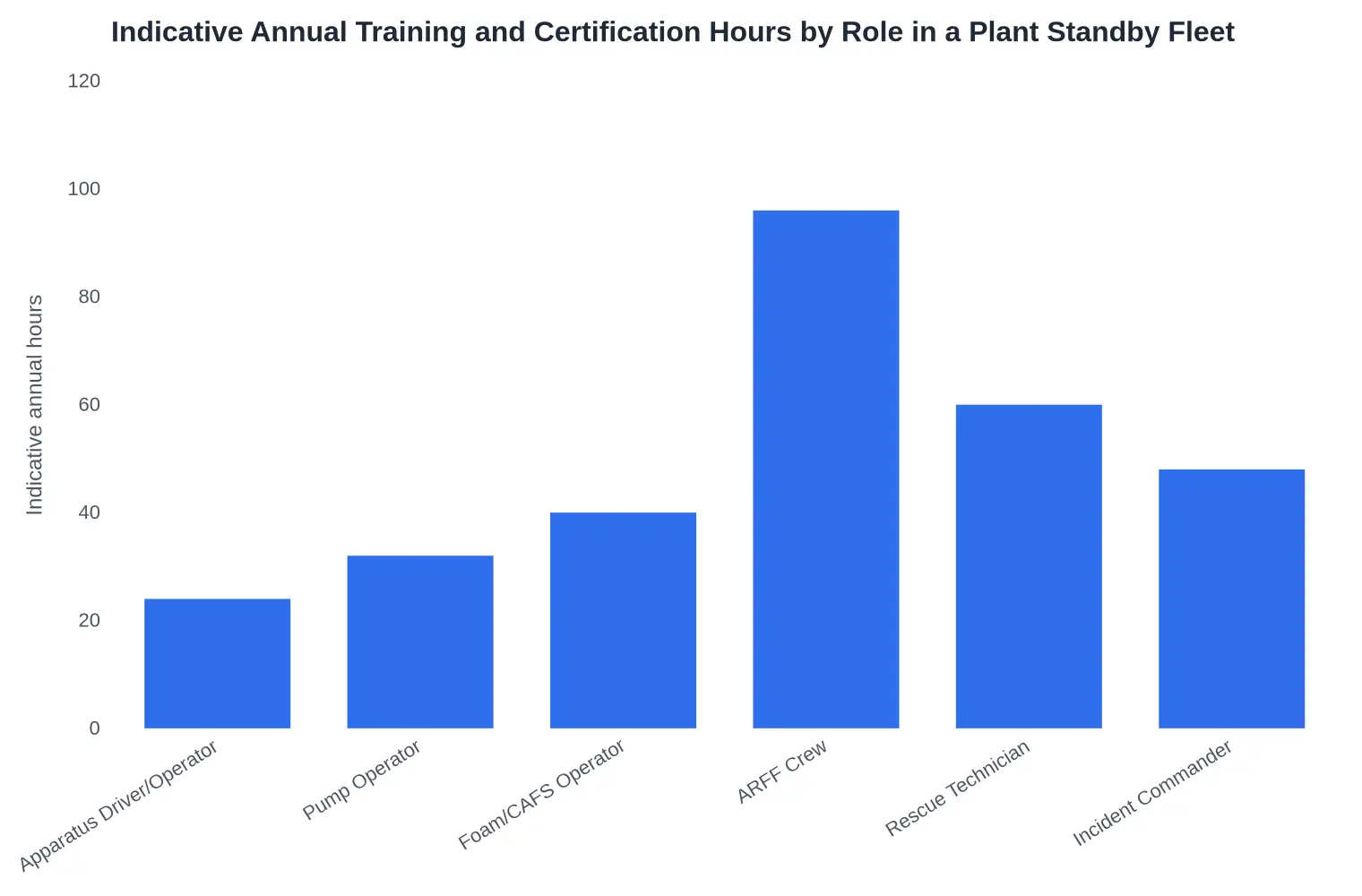
Planning estimates for crew scheduling and roster design, not regulatory minimums. Hours vary with site risk profile, equipment fit-out and local training arrangements.
Reading the Chart as a Staffing Tool
- Apparatus driver/operator – ~24 hours. The entry-level baseline. Enough to keep a truck moving safely and correctly, not enough to run an incident.
- Pump operator – ~32 hours. Adds hydraulic competence: setting pressures, managing relay and supply, protecting the pump in low-water conditions.
- Foam/CAFS operator – ~40 hours. Proportioning, expansion ratios and agent selection. If your site stores flammable liquids, this role sits on the critical path, and it pairs with dedicated foam and CAFS fire trucks.
- ARFF crew – ~96 hours. The heavy end. Aircraft and large fuel loads demand recurrent live-fire practice, vehicle familiarisation and joint drills, which is why ARFF coverage is the hardest roster to keep full.
- Rescue technician – ~60 hours. Confined space, extrication and technical rescue, skills that decay fast without hands-on repetition.
- Incident commander – ~48 hours. Command, communication and scene size-up. Often the scarcest skill on a plant site, because it needs experience as well as a certificate.
What This Means for Your Unit Count
Add the hours for the roles you intend to staff, then divide by the training each person can realistically absorb in a year alongside their day job. That calculation, not the spec sheet, tells you whether a two-person crew is a plan or a wish. Folding roles into fewer people – a driver who is also the pump operator and the incident commander – looks efficient on paper, and the training load stacks while certification currency slips first.
A practical approach: map the credible scenarios, assign the roles each one requires, then buy apparatus that matches that role structure rather than capability you cannot crew. Revisit the numbers every time you add a unit, because a new foam tender or rescue vehicle adds training hours before it adds response capability.
Coverage Gap Audit: Steps for Owners
A coverage gap audit is the fastest way to justify, or challenge, a capital request for standby fleet vehicles. Work the steps in order; each one feeds the next. Where a step shows a shortfall, record it rather than fixing it on the spot, because you want the full picture before you spend anything.
-
Map every protected asset and hazard zone. Walk the site and mark structures, tank farms, loading bays, control rooms and high-hazard process areas on a scaled plan. Output: a single asset-and-hazard map with each zone assigned a risk tier.
-
Plot every current apparatus position on that map. Note each bay, hardstand and remote standby point your fleet can respond from today. Output: a reach map showing which zones each position can physically serve.
-
Measure reach and response time from each position. Drive the actual routes in shift-change traffic and time them instead of estimating from a site plan. Output: a response-time record per apparatus position, zone by zone.
-
Test simultaneous-demand capacity. Model the worst realistic multi-front event and count how many calls compete for the same truck in the same minute. Output: a demand profile naming the calls that collide, which is where most coverage gaps first become visible.
-
Verify crew certification shift by shift. Build a grid of every shift against the certifications each role requires, ARFF, foam and pump operator tickets included. Output: a certification matrix with unfilled seats and expired tickets flagged per shift.
-
Check resupply and water/foam replenishment. Time a full refill cycle from hydrant, tanker or remote water supply and calculate how long suppression lasts before the first truck runs dry. Output: a replenishment cycle time and a written shortfall in minutes and gallons.
-
Chart maintenance rotation downtime. List scheduled services, inspection intervals and realistic repair turnarounds, then compare them with your minimum availability target. Output: an availability calendar showing exactly which weeks your coverage narrows.
-
Match each gap to a vehicle or equipment category. Convert every recorded shortfall into a requirement – reach, flow rate, crew seats, foam capacity – and assign it to a category, for example browsing proven industrial fire truck configurations for fixed-plant duty. Output: a prioritised procurement list with the specification each unit must meet.
Date the audit and file it with your fleet records. Re-run it whenever storage volumes, site layout or shift staffing change, since any of those moves the arithmetic and can quietly reopen a gap you had closed.
The chart that answers the coverage question
Distance is the one variable every plant operator can measure before signing a purchase order. The model below compares three fleet configurations across a 25 km radius. The shape of the curves matters more than the exact numbers; watch how the gap between a single standby unit and municipal-only response widens with every kilometre.
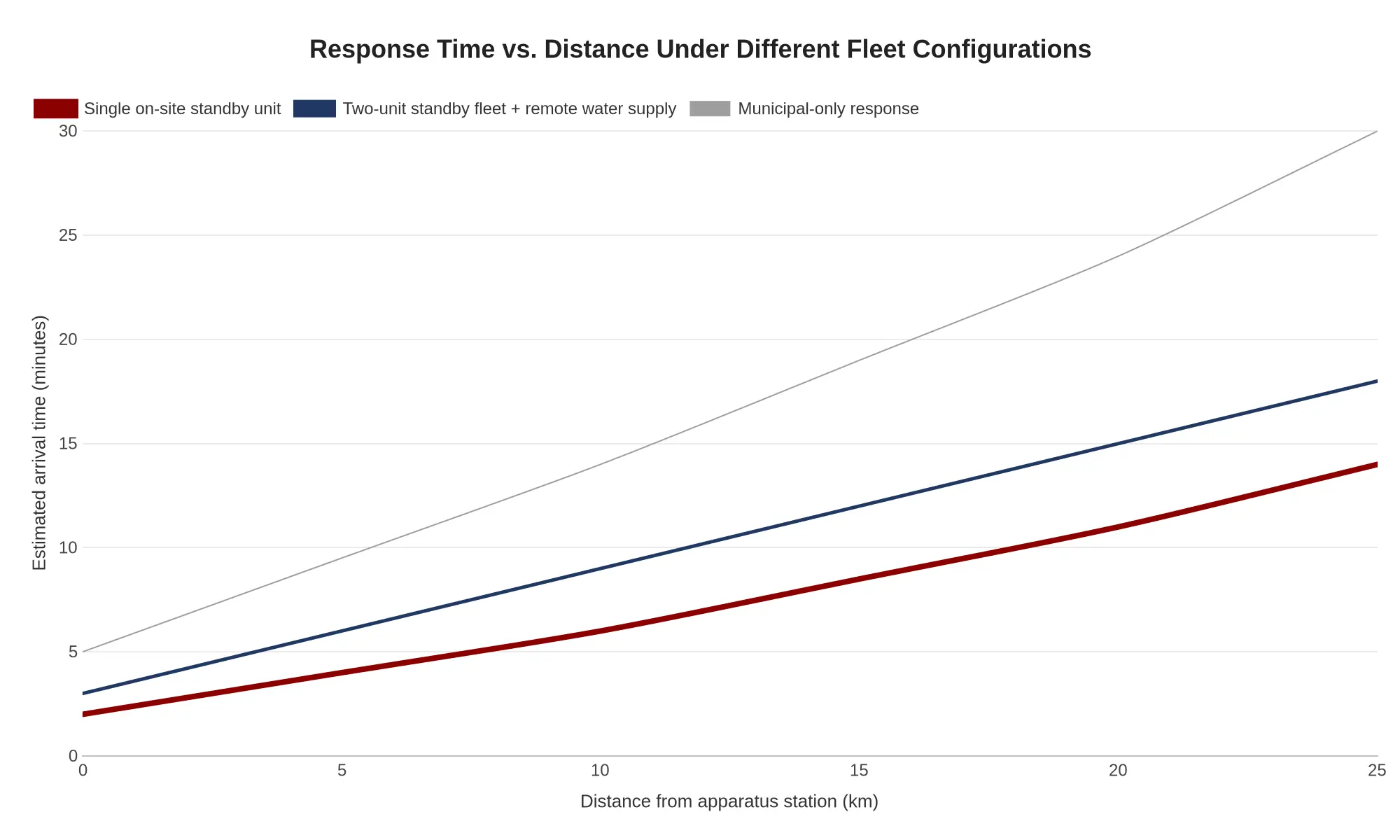
Caption: Model assumes average access conditions, unobstructed site roads and dry-weather travel. For planning comparison only, not for compliance or insurance certification.
What the lines are telling you
- Single on-site standby unit (dark red, thickest): flat and fast close to the station, but arrival time roughly doubles once you pass 12 to 15 km. One truck on site buys speed, not depth.
- Two-unit standby fleet with remote water supply support (blue, medium): slightly slower over the first kilometre, then pulls away from the single-unit option because the second unit stages, relays water and keeps the first crew working instead of waiting on a hydrant. Adding remote water supply system trucks to the fleet is what keeps that curve sustainable past the ten-minute mark.
- Municipal-only response (grey, thinnest): fine near town, punishing at the far edge of a large site, where a 25 km run pushes estimated arrival to around half an hour.
If your highest-risk asset sits within about 8 km of the station, a single standby unit carries most of the load. Beyond that, the second unit stops being optional; it is the difference between containing a fire and managing a loss.
Rebuild this curve with your own travel times, gate access times and crew mobilisation figures. Real roads rarely match a straight line.
Turning Audit Findings into a Configuration Shortlist
An audit is only useful if it ends in a list you can defend to a board. Sort the findings by gap type, then map each gap to the vehicle or equipment category that closes it. Skipping that step is how plants end up buying a bigger pump truck when what they lacked was access to a congested process area.
Here is the grouping most plant operators end up with after a first-pass audit:
- Suppression reach gaps (large tank fires, flammable liquid storage) > an industrial fire truck sized to the hazard, or a heavy-duty fire truck where foam capacity and pump endurance drive the spec.
- Access and manoeuvrability gaps (narrow pipe racks, tank farm alleys) > small chassis units and portable appliances a two-person crew can deploy without a driver.
- Vertical and high-reach gaps (warehouse roofs, silos, elevated loading arms) > an aerial fire truck matched to the tallest credible rescue height on site, not the tallest structure.
- Sustainment gaps (consumables, spares, nozzles, hose) > a parts and consumables line item, treated as part of the vehicle decision rather than a post-purchase detail.
Parts and consumables availability belongs in configuration planning, not in the afterthought column. A fire truck that sits idle because a pump seal or foam proportioner component is unavailable is a coverage gap wearing a budget line. When you shortlist a chassis, shortlist its fire truck parts stream alongside it: filter cartridges, foam concentrate, nozzles, hose couplings, and the small wearable items that decide whether the appliance is genuinely ready at shift change.
Supply continuity is where manufacturer scale matters. CIMC Tianda has been developing airport logistics, firefighting and rescue equipment for more than 30 years; its fire and rescue businesses include Shenyang Jietong, Shanghai Jindun, Ziegler, Cuilian and Sichuan Chuanxiao. Group-wide it counts more than 20 member companies, 5,000-plus employees and products distributed in nearly 130 countries and regions. For a buyer, that translates into catalogue breadth, consistent documentation and a parts channel that does not depend on a single distributor relationship.
Write the shortlist as a table with three columns: gap type, equipment category, and the crew or certification requirement that arrives with it. Then review the total as a fleet rather than a set of one-off purchases, because worst-case simultaneous demand is what a fleet is judged on. Buyers comparing emergency vehicles for sale across several categories should confirm that every candidate fire truck can be supported by the same parts and service logic. Four or five categories is usually enough, and the audit findings, not the brochure, should set the priority order.
Frequently Asked Questions
How many emergency vehicles does a plant standby fleet typically need?
There is no universal figure, because unit count should follow a documented risk assessment rather than a template copied from another site. A common starting point is one primary response unit and one backup, with specialised vehicles added such as an industrial fire truck as footprint, process hazards and distance to water grow. Testing emergency vehicles for sale against that assessment usually settles the minimum defensible number quickly.
Can crew certification be outsourced to a third-party provider?
Yes, and many plants do, contracting accredited training providers for initial and refresher development of drivers, pump operators and rescue team members. Outsourcing works best when the contract specifies practical assessments, skills verification and records your own team can audit between courses.
How do we identify and prioritise coverage gaps when budget is limited?
Map every credible scenario against response time, extinguishing capacity and reach, then score each shortfall by consequence and likelihood so the picture rests on evidence rather than opinion. Fund the highest-consequence gaps first, even when they are not the most visible. A single multi-role vehicle often closes two or three gaps at once, which is the cheapest way to move the needle.
Does buying used instead of new change the certification or maintenance plan?
The readiness expectations stay the same; the starting point shifts, because a used unit needs a full condition and performance baseline before it enters service. Build the maintenance plan around that baseline, covering pump testing, hose and appliance inspection, and a parts strategy for older components. Many buyers shortlist emergency vehicles for sale only after reviewing service history and long-term parts availability.
The logic runs in a fixed order. Unit count sets capacity: how much water, foam or rescue capability a plant can put on a fire, and how many simultaneous incidents it can absorb. Crew certification sets availability, because a pumper with no trained driver, or an ARFF unit with no qualified operator, is capacity on paper only; licensing, refresher training and shift rostering decide what is genuinely usable. Gap analysis then tests whether that capacity sits in the right place, against the real hazard map rather than a generic benchmark.
All three move over time, so review them together at each procurement cycle and again after any operational change: a new process unit, an expanded tank farm, a revised shift pattern. CIMC Tianda supplies configurations for plant standby fleets across emergency rescue vehicles and the wider firefighting equipment range. Whatever the order of purchase, the fleet that performs is the one where unit count, certification and coverage were measured against the same site conditions.