Fire Truck Dealer Selection: The Three Factors That Matter
Your apparatus is only as available as the dealer standing behind it. Three things separate a fire apparatus dealer who supports a fleet from a reseller who takes orders: demo units your crew can actually run, technicians trained on the equipment they sold you, and spare parts stocked within reach of your station. Price tells you what the truck costs on delivery day. These three decide what it costs over the fifteen to twenty years that follow.
A demo unit lets your crew run the pump, climb the ladder and test the foam system before you sign. Technician training decides whether warranty work happens in your own bay or three time zones away. Regional spares stock sets downtime after a breakdown, and a truck waiting on a valve is a truck off the line. Dealers who carry deep local fire truck parts inventory keep crews ready instead of waiting on freight.
Three Capabilities That Define a Fire Truck Dealer
Every dealer promises support after the sale. These three claims leave a paper trail you can check before the contract:
- Demo unit access – a working vehicle your team can inspect, drive, and test-pump.
- Technician training – factory-certified people who can service exactly what they sell.
- Regional spares stock – parts held near your station, not on another continent.
Pillar 1: Demo Unit Access
A demonstrator turns the brochure into evidence. Operators can judge pump output, hose layout and cab ergonomics on a working vehicle, and a dealer who keeps a demonstration fire fighting truck on hand usually expects repeat business rather than a single transaction. Hands-on inspection also surfaces the specification problems that come back later as change orders.
Pillar 2: Technician Training
Certified technicians shorten every repair cycle, because diagnostic time falls when the person holding the wrench knows the chassis, pump and control logic. That training shows up directly in uptime: a truck back in service in hours instead of weeks, with no outside contractor to schedule. For a budget owner, it also turns unpredictable emergency labor rates into a maintenance line item you can forecast.
Pillar 3: Regional Spares Stock
Local stock decides whether a failed seal is an inconvenience or a grounded apparatus. When wear items, seals, valves and pump components sit in a nearby depot, downtime is measured in shifts rather than shipping seasons. Predictable parts pricing and lead times also let you build a spares allowance that survives a finance review.
The Resourcing Benchmark
CIMC Tianda builds fire and rescue vehicles through subsidiaries that include Sichuan Chuanxiao, Ziegler, Shenyang Jietong and Shanghai Jindun, and its equipment is distributed in nearly 130 countries and regions through more than 20 member companies. That footprint is one reference point for what a properly resourced dealer network looks like; measured against it, demo access, trained crews and regional parts become things you can request in writing rather than sales talk.
Weighting follows from service life. A fire truck earns its keep over fifteen to twenty years, so the criteria that protect uptime (regional spares fill rate, technician training coverage, first-response service time) should carry more of the score than a one-time price concession or a shorter delivery window.
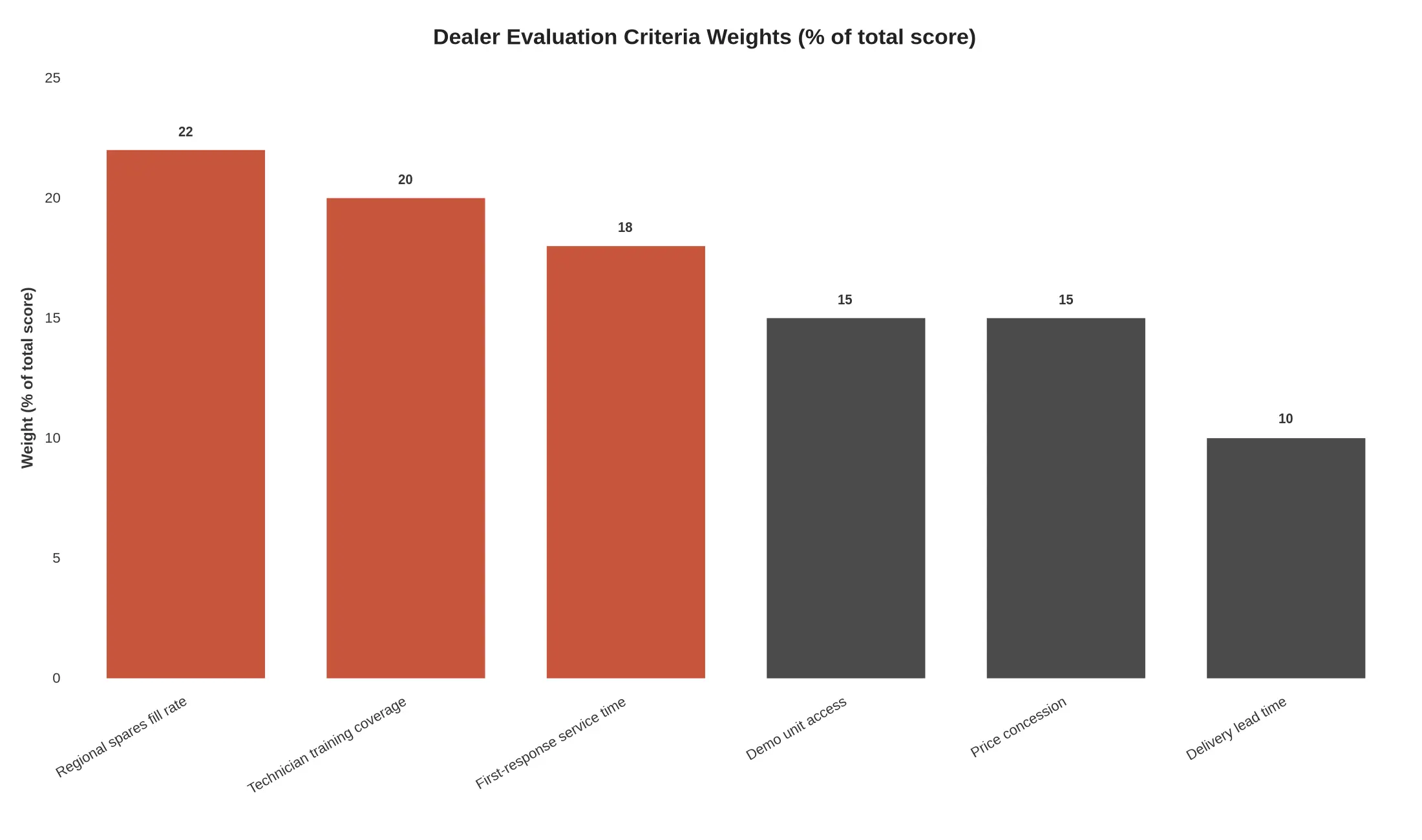
Those three service criteria carry about 60 percent of the weight in the chart, and the order is deliberate: a rig waiting four weeks for a pump seal or a valve body misses calls. Before scoring any bidder, ask for the numbers behind each bar. What share of your fast-moving fire truck parts do they hold regionally, how many of your technicians will they train on site, and what first-response window will they accept for a Sunday night call? If those figures are not in writing, score zero on that line.
Demo Unit Access: What to Verify Before You Commit
Ask for the demo program in writing and hold the purchase order until each item below is confirmed. A demonstrator that stays for an afternoon flatters any vehicle; the useful information comes from your own crew operating it under your conditions.
Configuration Match to the Ordered Specification
The demonstrator should mirror your build sheet as closely as the dealer can manage: same chassis class, pump rating, tank capacity, foam proportioning method, body layout and monitor position. Differences are acceptable when the dealer explains them in advance and shows what they change in daily operation. A generic demonstrator with a different pump and tank tells you almost nothing about the truck you are buying.
Demonstration Duration and On-Site Operation
Insist on a demo that stays at your station long enough for your own crew to work a normal shift – typically two to five days for pumpers, longer for specialized apparatus. Your operators, not the dealer’s technician, should handle the pump panel, the deck gun and the scene lighting. You are buying usability, so let the people who will use it at 3 a.m. be the ones who test it.
Testing Pump, Aerial and Foam Systems Under Load
Static displays prove nothing about flow. Require a draft test, a pressurized hydrant test and a foam proportioning check at rated capacity, with gauges read against the spec sheet. Some apparatus families need a longer list:
- Aerial platforms and ladders: cycle the boom through full extension and stow, verify stabilizer deployment on uneven ground, and confirm rated tip load with the monitor flowing. Reach and outrigger footprint are easier to judge in person, so review the aerial fire truck range before scheduling the visit.
- Aircraft rescue vehicles: ask for acceleration and braking demonstrations, turret reach and dry chemical burst performance. Compare the available ARFF aircraft rescue fire fighting configurations against your airfield response category.
- Compressed air foam systems: run the compressor long enough to confirm consistent wet or dry foam quality, and watch how the system behaves as the tank runs low. CAFS fire trucks live or die on repeatability, not on a single show-and-tell.
- Quick-attack units: turning radius, single-operator pump-and-roll and hosebed access matter more than top speed, so drive small fire truck models through your narrowest alleys and steepest yards.
Written Confirmation That the Demo Is Representative
Close the loop with a signed statement: the delivered truck will match the demo configuration, or the dealer will document every variance and its price effect. That single page prevents most post-delivery disputes and gives your maintenance team a baseline to service against.
Demo access also tests dealer depth. A supplier who cannot put a representative machine under load is unlikely to hold regional spares or field-trained technicians once the apparatus is in service.
Fire Truck Dealer Selection Scorecard
Score each candidate independently on a 1-5 scale before you sit down to compare them side by side – scoring first, discussing second, keeps the loudest sales pitch from setting the agenda. The weighting here differs from the pillar chart above because this scorecard adds warranty and parts pricing and treats service response as its own line.
| Evaluation Area | What to Verify | Evidence to Request | Suggested Weight | Red Flag |
|---|---|---|---|---|
| Demo unit access | Unit available for hands-on pump and drive test | Written demo schedule and unit specs | 10% | Demo “on request” with no date |
| Technician training and certification | Factory-trained techs for chassis and pump | Certificates, training logs, headcount per depot | 15% | No named certified technicians |
| Regional spares stock and fill rate | Local stock depth and same-week fill rate | Stock list plus 12 months of fill-rate data | 20% | Parts ordered per truck, no local stock |
| Service response commitment | Response and on-site arrival hours, 24/7 cover | Contractual SLA with penalties stated | 15% | Verbal promises only, no SLA |
| Parts pricing transparency | Published, discountable price list and lead times | Current price list and lead-time table | 10% | Quotes only, prices “on application” |
| Multi-product coverage (aerial, ARFF, industrial, tanker) | Range breadth and OEM authorizations held | Authorization letters and product catalogue | 10% | Single-line dealer with no cross-support |
| Warranty and escalation path | Warranty terms plus named escalation contact | Warranty document and escalation chart | 20% | No named escalation owner |
Walk the parts warehouse during the evaluation visit. Consumables and wear items you can see on the shelf – pumps, nozzles, hoses and seals – usually shorten downtime more than a discount on the chassis, and the fire truck parts a dealer actually stocks tell you what they expect to replace.
Total weight: 100%. Tally the weighted scores, then use the widest gaps as the agenda for the final negotiation round.
Technician Training: The Capability Behind Every Response
Ask a dealership what happens at 2 a.m. when a pump fails mid-incident, and the answer is in its training records. Either the truck returns to service in hours, or it idles for weeks waiting for a factory specialist to fly in. That difference is technician depth.
OEM-certified training levels
Factory certification is built as a ladder, not a single course. Level 1 covers chassis systems, including electrical multiplexing (a networked wiring architecture that replaces individual circuits with a shared data bus), braking, cooling and driveline diagnostics. Level 2 moves into body and pump systems: plumbing, valves, transfer cases, pressure relief and pump performance testing against rated flow. Level 3 handles aerial hydraulic and structural inspection, which means torque checks on turntable fasteners, cylinder seal integrity, weld and crack inspection, and load testing on an aerial ladder fire truck platform before it carries a crew again.
| Certification track | Core content | What it protects |
|---|---|---|
| Level 1 | Chassis, electrical, braking, driveline | Roadside diagnosis speed |
| Level 2 | Body, pump, plumbing and valve work | Rated pump output |
| Level 3 | Aerial hydraulics, welds, load testing | Aerial structural safety |
| Foam / CAFS | Proportioner calibration, air-to-solution ratio | Foam blanket performance |
Foam and CAFS proportioning is a discipline of its own. A CAFS (compressed air foam system) technician verifies proportioner accuracy across the full flow range, calibrates air-to-solution ratios and confirms that the air compressor and water pump stay synchronized. Small errors here produce either a foam blanket that breaks down or a stream that over-aerates and falls short.
Diagnostic software access separates real capability from guesswork. Certified dealers hold OEM licenses for the same diagnostic suites the factory uses, so fault codes, engine control logs and pump controller histories can be read rather than guessed at.
Recertification keeps all of it current, since controllers, emissions hardware and aerial designs change faster than most service intervals. Reputable dealers commit a fixed number of training seats per year, commonly 12 to 20 across chassis, pump, aerial and foam tracks, plus recertification slots. Those seats belong in the budget, not in the goodwill column.
When certification is missing, the buyer absorbs the risk
A dealer without certified technicians hands repair risk straight back to you. Warranty claims stall without documented OEM procedures, third-party shops improvise with non-OEM fire truck parts that may not meet pressure or load ratings, and every extra day of downtime is a day your district runs short. A fire apparatus dealer that publishes its certification levels and seat count is offering cheap insurance.
Put the Training Conversation in Writing
“Full support” costs a dealer nothing to say on a sales visit and disappears the first time your pump fails before a structure fire. Hand over these questions and ask for typed answers attached to the contract; the quality of the response tells you as much as the truck does.
- Confirm the certification levels your technicians actually hold, whether factory-certified, ASE-accredited, or trained to a model-specific tier.
- Name the trainer qualifications, including who delivers each course and whether the instructors keep current factory credentials.
- Specify the recertification interval, and explain how refreshers are scheduled when new pump, foam, or multiplex technology arrives.
- Guarantee diagnostic tool access, covering laptop software licenses, fault-code readers, and software updates for the life of the vehicle.
- State the number of training seats per year bundled into the purchase, plus the per-seat cost once that allowance runs out.
- Cover aerial and foam systems explicitly, since aerial fire trucks and CAFS proportioning rigs demand specialized training beyond chassis repair.
- Commit to a response time for a trained technician on site, written in hours and tied to a defined service radius.
- Document every completed training session, with signed certificates, service records, and a log you can hand to insurers and inspectors.
- Publish an after-hours escalation path, showing who answers the call and how the fire truck parts shipment is dispatched.
- Clarify where training happens – your station, the dealer’s facility, or online – and who absorbs travel and overtime costs.
Specific answers to those ten questions can be enforced later. Adjectives cannot.
Why Technician Depth Should Shape Your Dealer Choice
Price and delivery dates usually start the conversation about fire truck dealers, but neither is what keeps a fleet available eight years later. What keeps it available is whether the dealer can fix what they sold you, and whether their people are trained on the equipment you own.
So ask how a technician moves from one skill level to the next. A serious dealer has a defined path with sign-offs, not a claim about “factory-trained staff.” The diagram below shows what that path looks like when it is built deliberately.

Three-tier training progression: foundation systems at the base, advanced systems in the middle, aerial and specialist certification at the top. Solid arrows show upward progression, while the dotted loop represents the recertification cycle that returns every technician to the foundation level.
Tier 1: Foundation Systems
Every technician starts here, regardless of experience. Foundation training covers the mechanical and electrical basics that sit under nearly every fire fighting truck: chassis and driveline inspection, brake and air systems, 12 and 24 volt electrical diagnostics, pump priming circuits, valve operation, hose and nozzle compatibility, and the preventive maintenance schedule that keeps a rig insurable.
This tier is where a dealer either builds real capability or quietly outsources it. If the foundation layer is thin, everything above it turns into guesswork. Ask how many technicians hold current foundation certification and how often they rotate through refresher sessions.
Tier 2: Advanced Systems
Advanced training moves into the systems that are expensive to misdiagnose: foam proportioning, compressed air foam, CAFS, water tank and remote water supply controls, onboard electronics, telematics, and the pump-to-engine interlocks that protect both. Parts knowledge compounds here too, because a technician who understands the system can tell you which component actually failed instead of replacing modules until the fault disappears.
Mixed-fleet owners tend to settle the choice at this tier. Where fire truck parts sit locally and the technician understands the system, downtime usually falls from weeks to days, because diagnosis is faster and the right component is already on the shelf.
Tier 3: Aerial and Specialist Certification
At the top of the ladder sits certification for aerials, platforms and specialist bodies. This work is regulated, documented and non-negotiable: structural inspection, hydraulic and leveling systems, load testing, interlock verification, and the annual certification records a fire department or insurer will ask for by name.
Not every dealer needs in-house aerial capability, but they do need to be honest about whether they have it. If aerial work is subcontracted, find out who performs it, how far away they are, and what that does to your response time during a busy season. For departments adding an aerial fire truck to the fleet, the question belongs before the purchase order, not after.
The Recertification Loop
Certifications expire, standards get revised, and new component generations arrive. A dealer whose training path only flows upward will eventually have technicians holding credentials that no longer match the trucks on your lot.
A sound program loops back: annual foundation refreshers for everyone, advanced recertification on a two to three year cycle, and aerial recertification on whatever interval the standard and the manufacturer require. When you tour a dealership, ask to see the training calendar rather than the certificates on the wall.
A Short Checklist Before You Sign
| What to ask | What a strong answer sounds like |
|---|---|
| How are technicians leveled? | Named tiers with written requirements and documented sign-off |
| Who delivers training? | Factory programs plus in-house mentorship, not video-only |
| How is recertification tracked? | A calendar or system with expiry alerts per technician |
| What happens after hours? | Defined on-call rotation with tier coverage, not a single name |
| How does training connect to parts? | Stocking decisions driven by what technicians actually replace |
The truck is a single transaction. The training system behind it runs for as long as you own the vehicle, so weight it that way when you score bidders.
Regional Spares Stock: Measuring Depth, Not Promises
Line-item counts by category, last year’s emergency fill rate and the longest backorder currently open say more than any claim about carrying parts. Real regional spares stock means part numbers sitting on a shelf within a defined delivery radius, not brochure language.
Start with the items that stop a truck cold. Pumps and valves should be scored on model coverage, seal and bearing kits on hand, and whether complete pump bodies or only wear components are stored locally. For foam proportioning components, ask about proportioner valves, flowmeters and foam-compatible seals, because a failed proportioner sidelines a pumper as fast as a dead pump; the fire truck parts catalog gives you a sense of the component families a depth-focused dealer should source quickly.
Aerial structural and hydraulic parts need their own scrutiny: cylinder seal kits, hydraulic hose assemblies rated to the platform’s working pressure, and structural pins or bushings held in the hub warehouse. If those parts are three weeks away at the factory, your ladder truck is out of service for three weeks.
Wear items are where fill rate is won or lost. Brake pads, drums, rotors, slack adjusters, U-bolts and chassis bushings should be stocked to a predictable replacement rhythm rather than ordered after a failure. Electrical and control modules are the exception, so ask which modules are stocked, which run on an exchange program, and how firmware updates are handled.
Consumables complete the picture. Hoses, nozzles, gaskets, adapters and spares for portable fire fighting equipment should be replenished against actual call volume, not annual guesswork.
What Good Numbers Look Like
Set measurable targets before you sign anything. A reasonable benchmark is 90 to 95 percent immediate fill rate on critical wear items and 80 percent or better on long-lead assemblies, reviewed monthly rather than annually.
| Category | Stocked where | Target fill rate | Typical restock lead time |
|---|---|---|---|
| Pumps and valves (seal and bearing kits) | Hub | 90% | 2-5 days |
| Foam proportioning components | Hub | 85% | 3-7 days |
| Aerial structural and hydraulic parts | Regional hub | 80% | 5-10 days |
| Brake and chassis wear items | Hub and spoke | 95% | 24-48 hours |
| Electrical and control modules | Hub | 85% | 2-5 days |
| Hoses, nozzles, consumables | Spoke | 95% | Same day to 24 hours |
Consignment and vendor-managed inventory arrangements shift the carrying cost off your balance sheet. Under consignment, parts sit in your building but stay on the dealer’s books until they are used, which suits items you rarely replace and cannot afford to wait for. VMI goes a step further: the vendor tracks your consumption and replenishes automatically, so nobody is guessing at reorder points.
Downtime settles the argument. Every day a truck is down costs crew hours, mutual-aid exposure and possibly rated availability with your insurer. Stock held regionally turns a week-long factory order into an afternoon repair.
What a Well-Balanced Regional Spares Stock Actually Looks Like
The total value on a dealer’s shelf tells you very little about their spares holding. What matters is the mix – whether the money sitting in that warehouse points at the parts that stop a truck from going out the door. A depot loaded with chrome fittings and short of brake chambers fails you on a Monday morning just as reliably as an empty shelf.
The chart below sets out a reference mix for a regional spares holding, expressed as share of stock value. Use it as a sanity check when a dealer walks you through their inventory, or as a starting point if you are building your own buffer stock alongside your fire truck parts supply agreement.
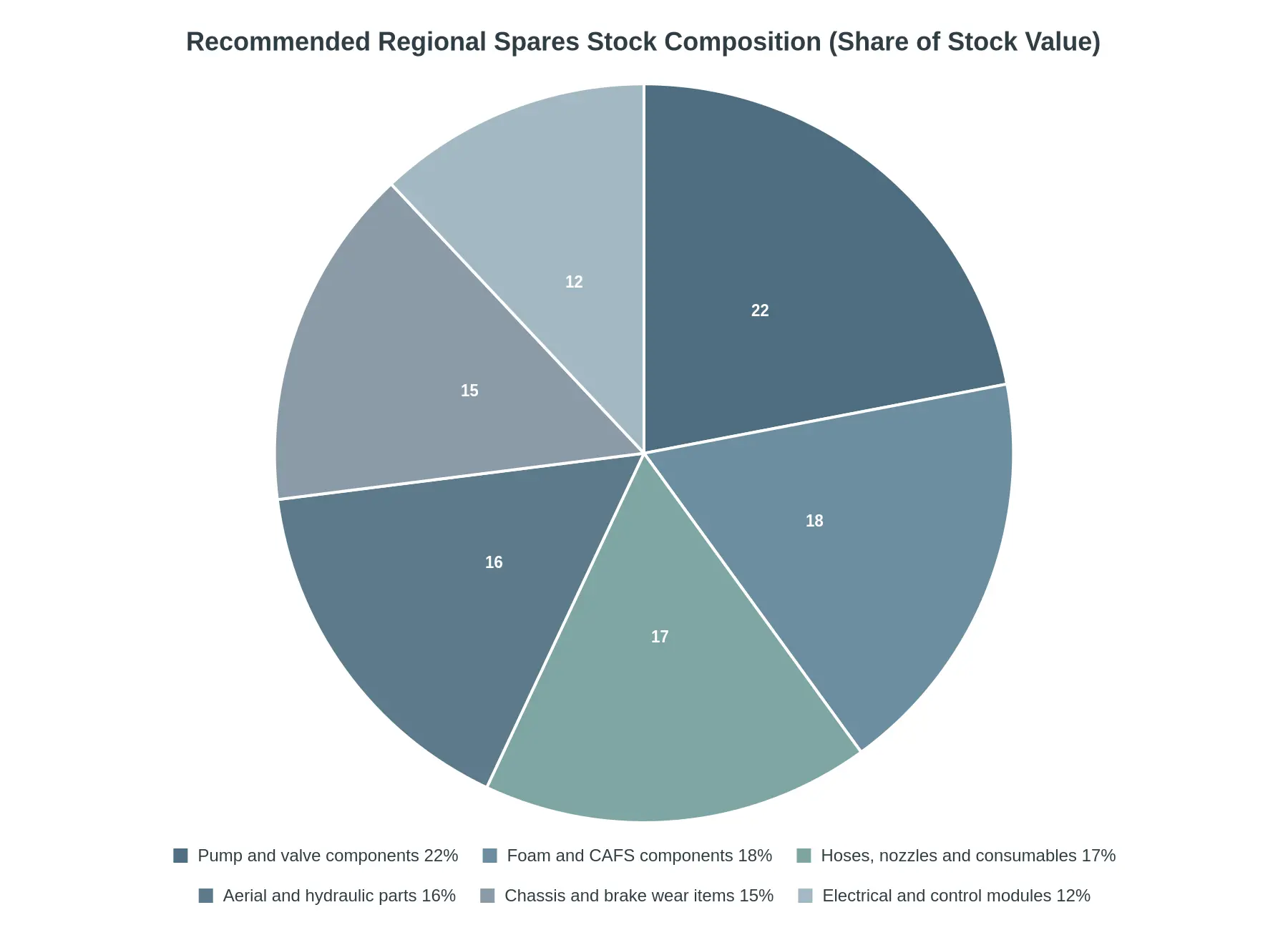
Recommended composition of a regional spares stock holding, expressed as share of stock value rather than unit count – a single aerial hydraulic cylinder can outweigh hundreds of nozzle gaskets on the balance sheet.
Reading the mix in practice
- Pump and valve components (22%) carry the largest share because a failed pump or stuck valve takes the appliance out of service immediately, and these assemblies are rarely available off the shelf locally.
- Foam and CAFS components (18%) reflect how heavily modern fleets lean on compressed air foam systems – proportioning valves and compressor seals are high-value, slow-moving items that still need to be on hand.
- Hoses, nozzles and consumables (17%) are cheap per unit but move constantly, so they earn a meaningful slice of value through sheer turnover.
- Aerial and hydraulic parts (16%) only matter if your fleet includes ladders or platforms, but where it does, a single seal kit or burst hose can ground the truck for weeks.
- Chassis and brake wear items (15%) are predictable – brake chambers, pads and air valves wear at a known rate and should never become a surprise order.
- Electrical and control modules (12%) round out the mix: a smaller share of value, but the hardest to substitute and the most likely to trigger a diagnostic headache.
If a dealer’s holding is skewed heavily toward one or two of these buckets, ask why. A depot with 40% of its value in consumables is a well-stocked shop, not a regional spares hub.
Contract Verification and Service Agreement
Assurances have a short life once a purchase order is signed. The clauses below are written to sit inside the dealer agreement itself: each one measurable, each one auditable, each one a commitment your business can enforce rather than a favor you hope to receive. Treat them as a checklist during fire truck dealer selection so that what a dealer promises across the demo bay is exactly what they sign on paper.
Clause 1 – Fill-Rate Commitment
The dealer guarantees a 92% or higher fill rate on stocked fast-moving parts (filters, brake components, pump seals, hose couplings), measured monthly against the order lines you submit. Any month below 92% triggers a written corrective plan within 10 working days and a 5% credit applied to the shortfall lines. Backorder notifications must reach you within 24 hours of order acknowledgement, not at the point of dispatch.
Clause 2 – On-Site Response Window
For a vehicle-down condition affecting operational readiness, the dealer dispatches a certified technician within 8 hours for sites inside the primary service region and 24 hours outside it. The clock starts at your logged service call. If the window is missed twice in a rolling quarter, the dealer absorbs the next two callout fees.
Clause 3 – Training Seats Allocated Annually
Minimum 6 technician training seats per year per purchased vehicle, at no charge, of which at least 4 are hands-on pump, aerial and electrical diagnostics rather than classroom slides. Certification records must be issued within 15 days of course completion, and seat balances carry over a maximum of one year.
Clause 4 – Warranty Recovery Process
Claims are acknowledged within 2 business days, approved or rejected with written cause within 7, and parts shipped within 10 days of approval. Labor reimbursement follows a rate schedule attached to the agreement. Any rejection must cite the specific exclusion clause – no verbal refusals, no drifting claims.
Clause 5 – Escalation Contacts
Named individuals, not departments: service desk (4 business hours), regional service manager (24 hours), factory technical director (48 hours if still unresolved), each with mobile, email and title listed. The contact sheet is refreshed in writing every quarter.
Clause 6 – Parts Pricing Schedule
A firm price list at handover, indexed annually but capped at 5% or CPI, whichever is lower, plus a fixed trade discount off list (commonly 15-20% on genuine parts) and 90-day price protection on quoted repair jobs.
Clause 7 – Right to Audit Stock Levels
Two stock audits per year on 5 business days’ notice, with access to inventory reports for the parts list in Annex A. If the committed regional stock value drops below the agreed floor, the dealer replenishes within 30 days.
| Clause | Measurable Standard | How You Verify It |
|---|---|---|
| Fill rate | 92% quarterly minimum | Monthly order-line report |
| Response | 8 h / 24 h dispatch | Service call log stamps |
| Training | 6 seats per vehicle per year | Signed certification records |
| Warranty | 2 / 7 / 10 day milestones | Claim tracker reference |
| Escalation | 4 h / 24 h / 48 h tiers | Quarterly contact sheet |
| Pricing | 5% or CPI cap | Annual price list comparison |
| Audit | 2 audits per year | Inventory reports review |
Where Complexity Earns Stricter Terms
Custom platforms demand the most explicit wording. Specialized builds such as special fire trucks and heavy industrial fire truck units carry bespoke hydraulics, one-off electronics and low-volume components, and vague goodwill language becomes a future outage. For these, name the exact part numbers held in regional stock, extend the response clause to cover auxiliary systems, and tie training seats to the specific chassis configuration.
Regional Spares Stock: Why the Shape of a Dealer’s Network Matters
Ask a fleet manager what keeps a fire truck in service and horsepower rarely comes up. A $40 seal, a brake chamber, or a pump valve nobody had on the shelf does. The measure of a dealer is how fast a part reaches your bay, and the best-run dealers solve it with a hub-and-spoke structure.

How to read the diagram: the large central hexagon is the regional spares hub, holding deep inventory and the fast-moving critical parts. Each smaller circle is a satellite stock point placed closer to your operating area. The straight arrows fanning outward show replenishment flow: parts move from the hub down to the satellites on scheduled and emergency runs. The curved dashed loop running back toward the center represents the service and training feedback path, where technician findings, failure reports, training updates and recurring part requests travel back up so the hub can adjust what it stocks.
What the two flows actually deliver
Replenishment is the flow you feel first. In a well-designed network, your nearest stock point carries consumables, filters, seals, lamps, hoses and the parts that fail on a predictable cycle. When something unusual breaks, the hub ships it overnight instead of the factory shipping it in six weeks. That gap is often a truck back on the run versus a truck parked through a wildfire season.
The feedback loop is the one that quietly improves your service. Every repeat failure a technician diagnoses should travel back to the hub and change the stocking profile. Dealers whose satellites feed data upward get sharper each year; dealers whose satellites only consume stock stay frozen in whatever assumptions were made when the network was built.
Questions that reveal the real network
Before you sign, ask the dealer to draw their structure on paper, then work through this list:
| What to ask | Why it matters |
|---|---|
| How many satellite stock points serve my area? | One distant warehouse means long waits, whatever the brochure says |
| What is the guaranteed delivery window to my station? | Vague answers usually mean no committed logistics |
| Which parts live at the satellite, and which at the hub? | Critical wear items should be local, not regional |
| How do technician findings reach the hub? | No feedback loop means the stocking profile never improves |
| Can I see stock levels before I order? | Transparency signals a mature system |
Where the model breaks down
Hub-and-spoke is efficient, but it is not magic. A network thins out when a dealer adds satellites faster than it can staff them, or when the hub carries only high-turnover items and drops the slow-moving parts that are still mission-critical. Aircraft rescue and industrial pump components are the usual examples: they rarely fail, so they look like dead stock on a spreadsheet, yet a single failure can ground a unit for weeks. A dealer who understands your duty cycle holds them anyway. If your operation leans on specialized apparatus, ask which fire truck parts categories they stock locally instead of assuming coverage.
Distance is not the only variable either. A satellite fifteen miles away that ships twice a week is slower than a hub two hundred miles away with daily dispatch, so ask about dispatch frequency as well as geography.
Tying it back to your decision
Draw the diagram for each dealer on your shortlist and mark where your station sits on it. Demo access gets your crew behind the wheel and technician training keeps them capable, but the parts network is what decides whether that capability holds up when a fitting breaks. Short arrows and a live feedback loop are the ones worth signing with.
Total Cost of Ownership: Where Dealer Capability Shows Up on the Balance Sheet
The sticker price is usually the smallest number in the conversation. Over fifteen to twenty years of service, repairs, downtime, training and resale value decide whether a fire truck was a good buy or an expensive lesson. Dealer capability touches almost every one of those lines, and the effect is directional: the right partner pulls lifecycle costs down, the wrong one lets them creep up.
Start with specification risk. Access to a demo unit lets your crew run the pump, work the aerial and load hose on a truck configured like the one you plan to order, under your own conditions. When the vehicle you receive matches the work it has to do, the expensive cost lines fall: change orders during build, first-year retrofits, and the slow bleed of a truck that is either oversized for the job or short on capacity. Hands-on demonstrations also shorten the driver learning curve, which reduces early wear and minor body damage.
Technician training follows the same logic. Crews trained on your specific chassis, pump and electronics fix more faults correctly the first time, which lifts first-time-fix rates and pulls down repair labor hours, repeat visits and rework on parts that were swapped on a guess. Warranty claims get cleaner too, because faults are documented correctly instead of chased.
Parts availability closes the loop. Regional spares held close to your station turn downtime from a procurement project into a same-day errand, and every hour a truck is out of service is an hour of lost readiness, borrowed coverage or standby revenue you never recover. Keeping the right fire truck parts on the shelf is cheap compared with the cost of waiting for them. A dealer who demonstrates, trains and stocks is a dealer who keeps your fleet available, and availability protects every other line item.
Downtime vs. Parts Proximity
The gap widens with fleet size and specialized apparatus, because every factory-order part can keep more vehicles out of service for longer.
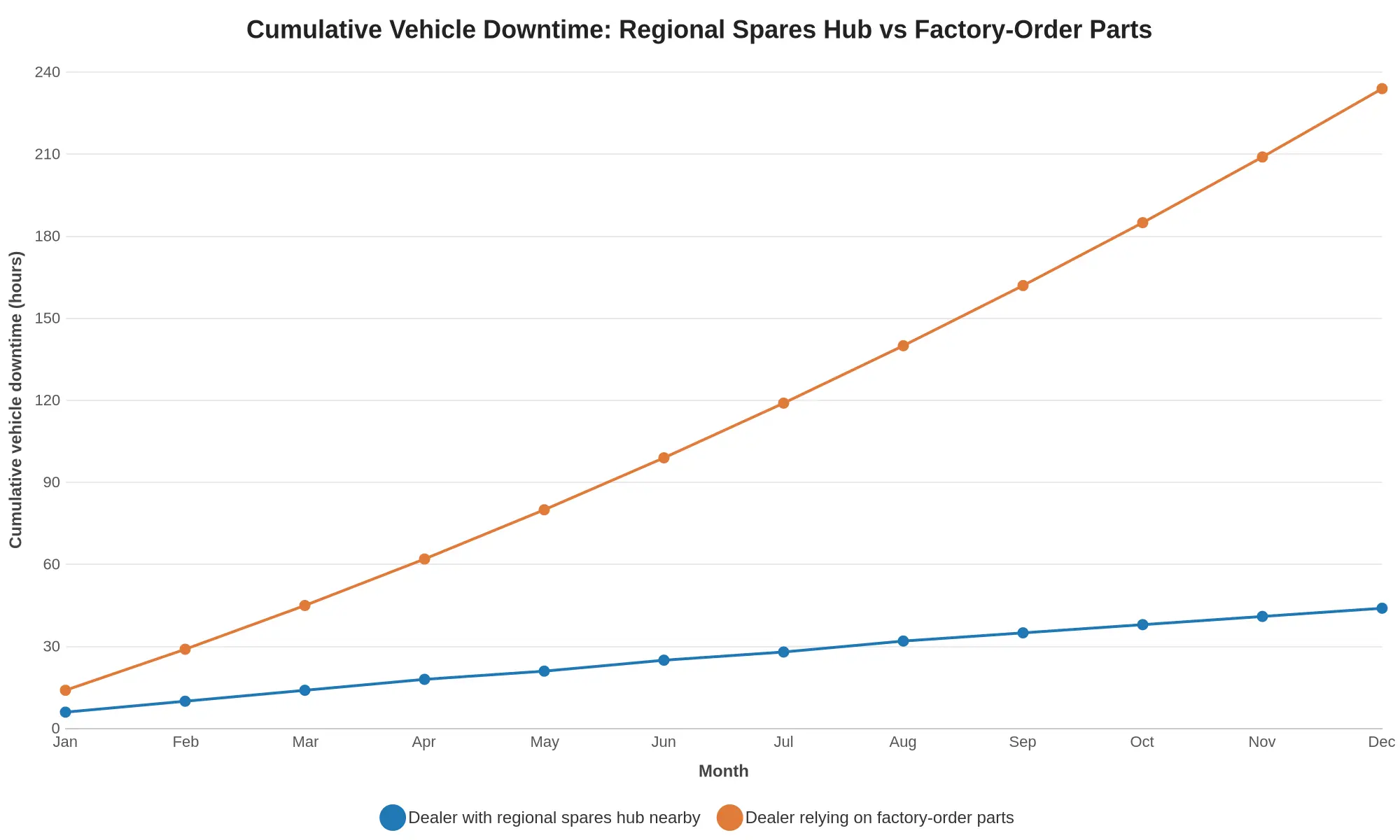
The chart assumes both dealers start the year with comparable fleet availability, then accumulate downtime month by month. Verify which critical fire truck parts the nearby hub actually stocks, particularly for specialized apparatus that cannot absorb a long factory-order wait.
Frequently Asked Questions
How many demo units should a fire truck dealer make available before purchase?
At least one fully operational demo unit per category under consideration, and two when the purchase involves aerial or ARFF apparatus. Demo access should include a scheduled pump test, a road drive, and an aerial or monitor operation where applicable. Without a matching demo, the validation risk stays with you.
Is OEM-certified technician training mandatory or optional?
Write it into the dealer agreement rather than treating it as optional: named technicians, recertification intervals, and on-site commissioning support. Keep training records auditable, because untrained staff can void warranty coverage and stretch repair time. Two trained technicians on every service shift is a workable floor.
What parts fill rate is reasonable to require in a dealer agreement?
Require 90% on pump and valve components and 95% on brake and chassis wear items, with 80% or better on long-lead assemblies such as aerial hydraulics. Measure fill rate from the dealer’s own regional inventory, not from an OEM warehouse, and review it monthly. Add 24-hour emergency replenishment for the cases where a stocked line still runs out.
How far can a regional spares stock point be from the fleet before downtime rises?
Keep regional spares within four hours of ground delivery, which puts most fleets within roughly 150 miles of the stock point. Beyond that radius, downtime rises as soon as a repair needs a second trip. Set the stock point inside the distance that still delivers critical spares within four hours.
Can one fire apparatus dealer support aerial, ARFF, industrial and small fire trucks at the same service level?
Yes, when the dealer assigns category-specific technicians, tooling and parts to each apparatus class. Separating service bays and holding OEM certifications for every class is what makes that support credible. Confirm demo access for the exact class, technician training by category, and regional spares sized to the fleet mix, and review the dealer’s commercial fire trucks service scope before signing the agreement.
Closing: The Evaluation Sequence in Plain Terms
The sequence in this guide can be restated plainly: request demo access, verify technician training records, inspect regional spares stock, then lock the commitments into the agreement. Working through the steps in that order keeps the decision on evidence a business owner can examine.
- Request demo access. Ask for a demonstration unit and operate it under the conditions your crew faces, including pump engagement, hose deployment and apparatus handling on the ground where it will serve.
- Verify technician training records. Review certificates, manufacturer authorization and service history for the technicians who would maintain your vehicles, not just for the sales staff.
- Inspect regional spares stock. Visit the warehouse or request a current inventory list of wear parts, pumps, valves and body components held locally, and confirm stated delivery times.
- Lock the commitments into the agreement. Write demo availability, training obligations, stockholding levels and response times into the contract, with named responsibilities and review dates.
CIMC Tianda builds fire and rescue vehicles across pumpers, tankers, aerials and specialty units, and its published product families give buyers something concrete to compare against these service requirements; the fire fighting truck range is one starting point. Dealer capability should match fleet complexity, because the support structure that sustains a single pumper differs from the one a mixed fleet of aerials, tankers and rescue units requires.