Wildland Fire Truck for Sale: Choosing Between 4×4 and 6×4 on Steep Terrain and Refill Cycle
Most buyers open the wildland fire truck purchase by comparing manufacturers. That order is backwards. Two trucks from the same builder behave very differently on the same hillside, because what decides the outcome is the configuration, not the badge on the grille.
Configuration shows up in two numbers you can measure before anyone signs: the gradient the truck climbs with a full tank, and how long one refill cycle takes from leaving the fire line to getting back onto it. Those two numbers decide whether the unit holds a line or spends the afternoon shuttling. The wider fire fighting truck range is a useful reference for what is actually available.
Why Drivetrain Configuration Drives Wildland Purchasing Decisions
Axle count sets the operating envelope. A 4×4 carries its mass over two axles, both driven, so a large share of the weight sits on driven rubber — that is where its climbing ability comes from. A 6×4 spreads a heavier class of load across three axles, with the tandem pair doing the driving. Wheelbase decides whether the frame clears crests and drainage cuts; a longer frame grounds out sooner. Gross axle weight ratings cap how much water and foam you can add, and every extra litre of tank eats into the margin you were counting on.
On sustained gradients these effects stack. Grade resistance adds to rolling resistance, drivetrain losses rise, and load transfer pushes weight rearward as the nose lifts. So buyers end up matching Heavy duty fire truck specifications to the routes the truck will really serve, not to the ideal route in the brochure.
In practice the choice comes down to two questions: how steep is the worst access road, and how far away is the nearest place to refill? The table lines up the figures that matter on grade-heavy wildland duty.
| Specification | 4×4 Configuration | 6×4 Configuration |
|---|---|---|
| Driven axles | 2 of 2 (both axles driven) | 2 of 3 (tandem rear pair driven) |
| Typical GVW class | 10 – 15 t | 18 – 26 t |
| Usable water tank range | 1,500 – 4,500 L (400 – 1,200 US gal) | 3,000 – 9,500 L (800 – 2,500 US gal) |
| Gradeability, loaded | ~45% (~24 degrees) | ~30% (~17 degrees) |
| Turning radius | 7.0 – 8.0 m | 9.5 – 11.0 m |
| Breakover angle | 25 – 30 degrees | 18 – 22 degrees |
| Departure angle | 30 – 35 degrees | 20 – 25 degrees |
| Payload headroom for foam / CAFS | 600 – 1,000 kg | 1,500 – 3,000 kg |
| Water refill cycle per tank | 6 – 10 min | 12 – 20 min |
Read it as a trade. The 4×4 wins on angles and turning circle; the 6×4 wins on water and payload. Spec the chassis against your steepest access road and your slowest refill run and neither column will mislead you. If foam or compressed air is part of your mix, look at proven CAFS fire truck configurations before you fix the axle count.
Where a 4×4 Wildland Fire Truck Wins
Chassis geometry. The 4×4 runs a 3.6-4.2 m wheelbase where the 6×4 needs 4.8-6.0 m. Turning radius drops from roughly 9.5 m to 7 m, which is often the difference between clearing a switchback and reversing through it. Laden weight lands around 7,000-9,000 kg against 14,000-18,000 kg, and less mass per tyre means less sinkage on loose, unconsolidated ground. Breakover angle improves to about 25-30 degrees versus 18-22. With both axles driven, torque stays live at the front of the frame when the rear unloads over a crest.
Water logistics. A 1,500 L tank fills in roughly two minutes at normal tender flow; a 4,500 L tank takes six or more. Per trip the cycle is shorter, not longer, and the truck leaves the source with less mass to haul uphill — paid for in two to four times as many trips. For anyone weighing a small fire truck against a 6×4, the trade is cycle count against cycle time. Where a fire fighting ATV takes the last 200 m, the 4×4 covers everything before it.
Reading the schematic: where the weight goes on a slope
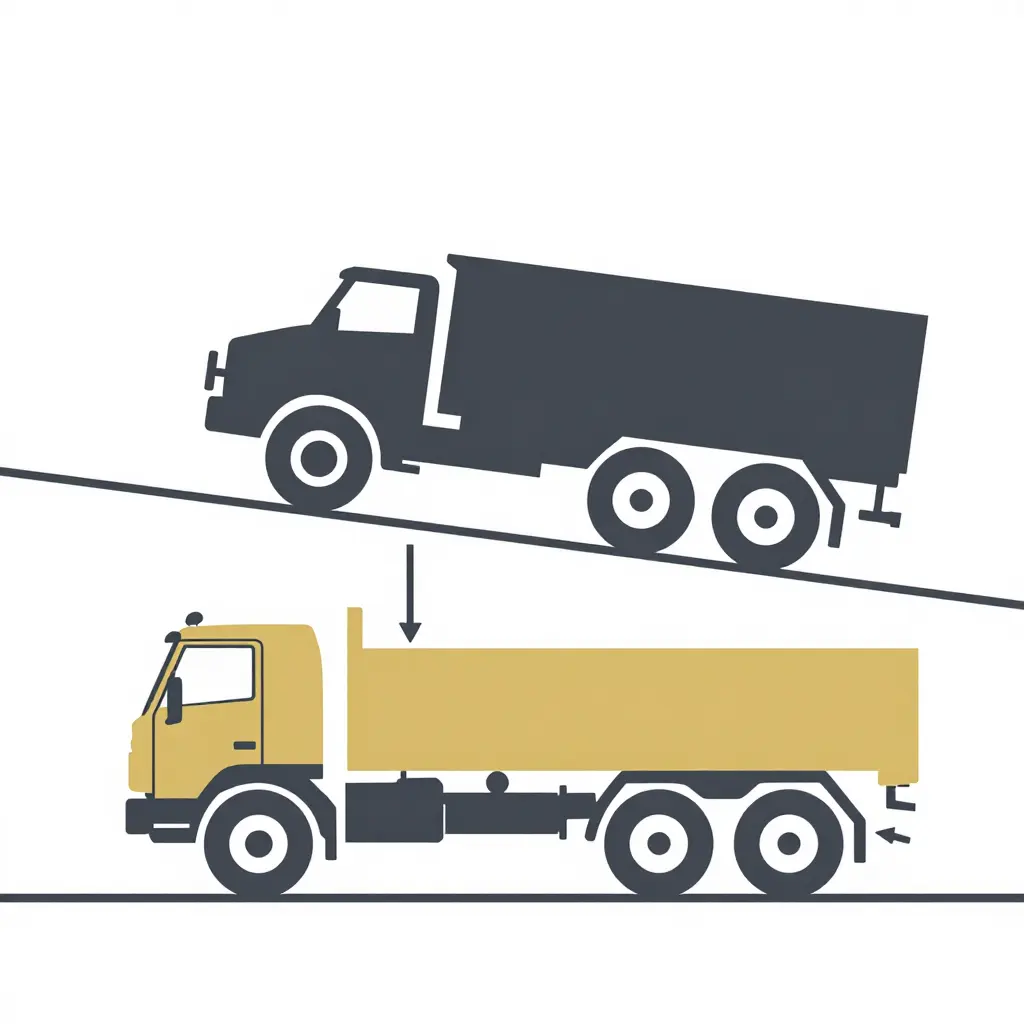
The 4×4 is drawn on top: two axles, both driven, short wheelbase holding the centre of gravity inboard. The 6×4 below it has three axles and a tandem rear group, so the same slope reads differently. The load arrows lengthen and lean rearward, and the traction arrows fan out across four rear tyres instead of two.
That contrast is the purchase in miniature. More of the 4×4’s mass sits over the steering axle, and it stays nimble on narrow climbs. The 6×4 buys grip and stability on loose grades by shifting weight aft, and pays with a longer footprint and a wider turning circle. If your routes are wide gravel roads carrying heavy water loads, the tandem options in our heavy-duty fire truck platforms will fit better than a light chassis.
Where a 6×4 Wildland Fire Truck Wins
Volume comes first. A three-axle rig typically carries 2,000 to 2,500 US gal (7,600-9,500 L) against 1,000 to 1,200 gal (3,800-4,500 L) on a comparable 4×4, plus a much larger foam concentrate tank. That payload converts straight into discharge time: at 150 gpm a 1,200-gal 4×4 runs dry in about eight minutes, while a 2,400-gal 6×4 holds the line for roughly sixteen — long enough to finish anchoring a hose lay instead of breaking off for water. Buyers comparing water tanker fire truck configurations usually find that payload, not pump pressure, sets the pace of a shift.
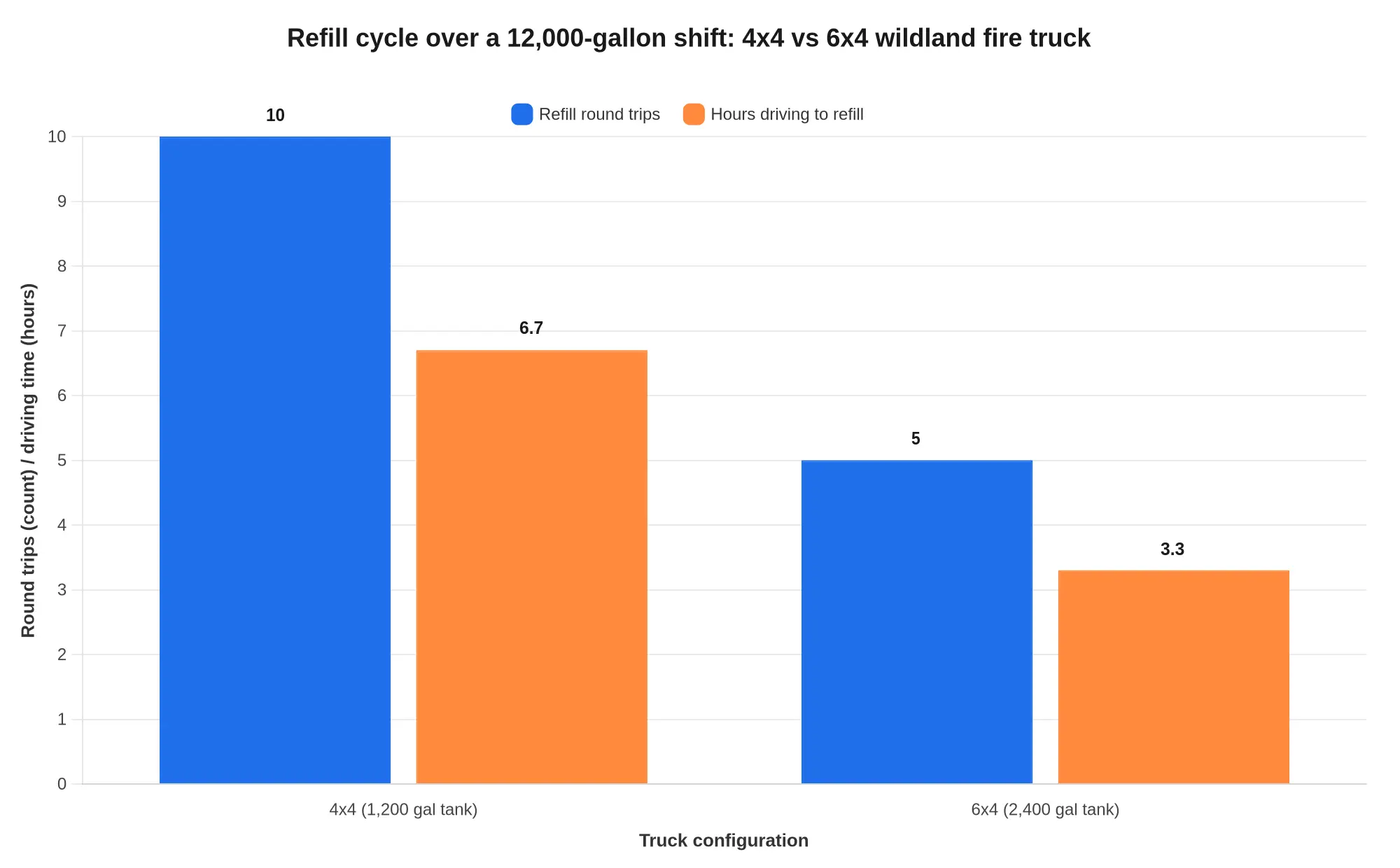
The same payload rewrites the refill arithmetic. Twelve thousand gallons across a shift is ten round trips for a 1,200-gal 4×4 and five for a 2,400-gal 6×4. At forty minutes a round trip on the longer hauls, five fewer trips hands back more than three hours of fireline time. Three axles also spread axle load and drop the centre of gravity, so the truck tracks predictably on sustained gradients. What you give up is wheelbase: wider turning circles, and less appetite for tight switchbacks and narrow trails. The chart below turns those trip counts into hours behind the wheel.
4×4 vs 6×4 Wildland Fire Truck: The Trade-off in One Chart
Axle configuration decides how a crew works all season. One truck climbs harder and gets back to water faster; the other carries far more water and keeps discharging long after it arrives. The grouped chart puts both against the five metrics that shape a shift on steep terrain.
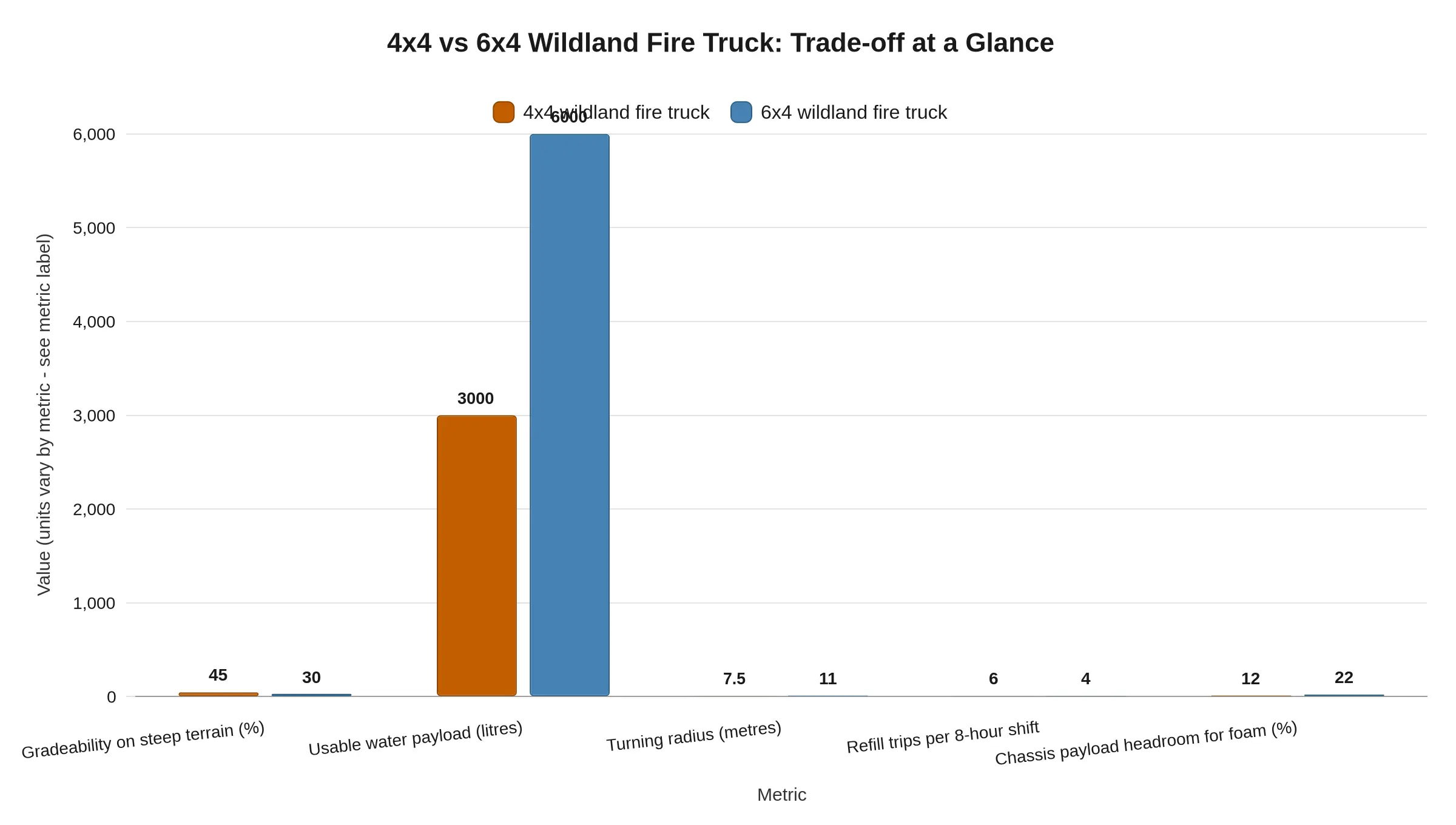
Legend: orange bars = 4×4 wildland fire truck, blue bars = 6×4 wildland fire truck. X-axis: metric (units shown in each label: % grade, litres, metres, trips per 8-hour shift, % payload headroom). Y-axis: measured value, with units varying by metric.
Caption: The 4×4 leads on manoeuvrability and trip frequency, climbing steeper grades, turning in a tighter radius and completing more refill cycles per shift. The 6×4 leads on usable water payload and foam headroom, which translates into longer sustained discharge before the next refill.
Reading the Numbers
The chart figures use a representative pair: a 3,000 L 4×4 and a 6,000 L 6×4.
| Metric | 4×4 wildland fire truck | 6×4 wildland fire truck | Who wins |
|---|---|---|---|
| Gradeability on steep terrain (%) | 45 | 30 | 4×4 |
| Usable water payload (litres) | 3,000 | 6,000 | 6×4 |
| Turning radius (metres) | 7.5 | 11.0 | 4×4 |
| Refill trips per 8-hour shift | 6 | 4 | 4×4 |
| Chassis payload headroom for foam (%) | 12 | 22 | 6×4 |
What the Gap Means on the Ground
Fifteen percentage points of gradeability is not a spec-sheet boast. It is the difference between reaching a ridge-line hotspot with a full tank and staging at the bottom while the fire walks away. Add a turning radius about 3.5 m tighter, and the 4×4 gets through timber tracks, switchbacks and ranch gates that force a longer wheelbase into reverse.
Trip count reads differently once each trip is weighted by tank size. Six cycles a shift against four is 50% more trips, but each 4×4 trip carries half the water, so over eight hours the 4×4 delivers roughly 18,000 L against 24,000 L from the 6×4. Its advantage is not volume. It is putting water on ground the bigger truck cannot reach, 20 minutes’ climb from the nearest draft site, without spending the shift at the bottom.
Turn the chart around and the arithmetic flips. Doubling usable water from 3,000 to 6,000 L keeps a 6×4 at rated flow far longer, and an extra 10 points of payload headroom let you run a richer foam proportion without spending your safety margin. On wide, graded fire roads where access is not the bottleneck, that sustained output covers more line per fill. The heavy-duty fire truck configurations page shows how that payload class is usually built out.
A Quick Way to Choose
- Pick 4×4 when terrain, gate widths and tank spacing set the pace of your shift, and quick turnaround matters more than long discharge time.
- Pick 6×4 when roads are passable, draft sites are far apart, and your crew needs to hold a line for 30 minutes or more without breaking for water.
- Mixed fleet? Many owners run 4×4 units as the first-in climb-and-attack trucks and 6×4 units as the sustained-supply anchor behind them.
Either way, ask your supplier for gradeability and turning radius measured with a full tank. Payload changes both, and a chart is only honest when it reflects loaded performance. Walking the spec sheet against your own terrain turns glossy claims into facts you can check:
- Gradeability measured on your steepest surveyed route, tank full.
- Usable tank volume rather than nominal volume on the water tanker fire truck you are pricing.
- Refill time at the source you will actually use, with the pump you are actually buying.
- Turning radius against the tightest gate or switchback on the route.
- Drivetrain matched to surface type, not to habit.
- Pump flow at rated pressure, not peak.
- Payload left over for foam concentrate or a CAFS installation.
- Empty weight and axle loads against local road and bridge limits.
- Parts and service coverage within reach of your district.
The Refill Cycle at a Glance
Whatever the chassis, the loop your crew drives has the same five stages. The tank draws down as you work the line, you travel to the water source, position and connect the hose, fill, and return to the fire line. Then it starts again.
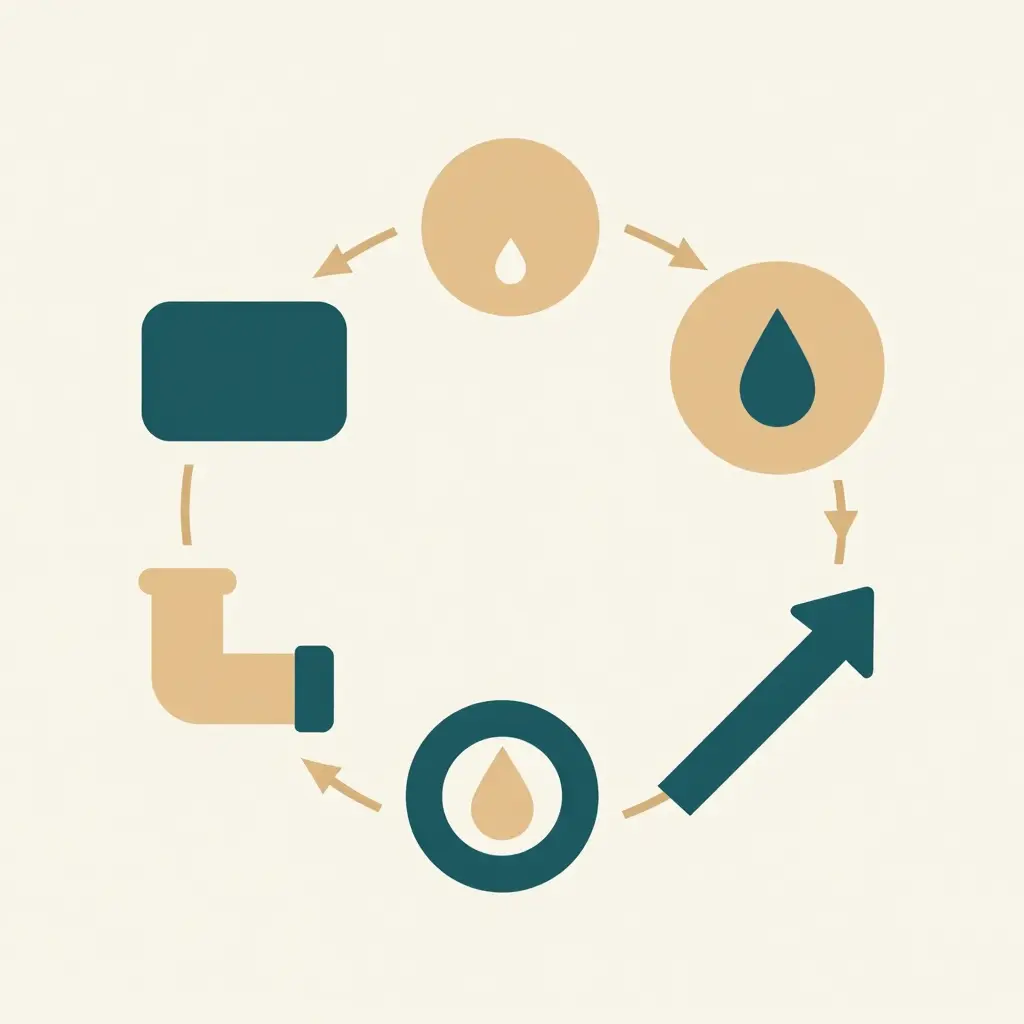
Once that loop is instinctive, the buying questions sharpen. How much of the circle goes to climbing a grade? How many minutes does the fill itself take? How fast can the truck be back in position? Those numbers decide whether a smaller tank with better traction beats a bigger tank that never quite reaches the line. Operations that haul volume over distance should compare water tanker fire trucks built for exactly this kind of shuttle work.
The Water Refill Cycle Decides Your Real Output
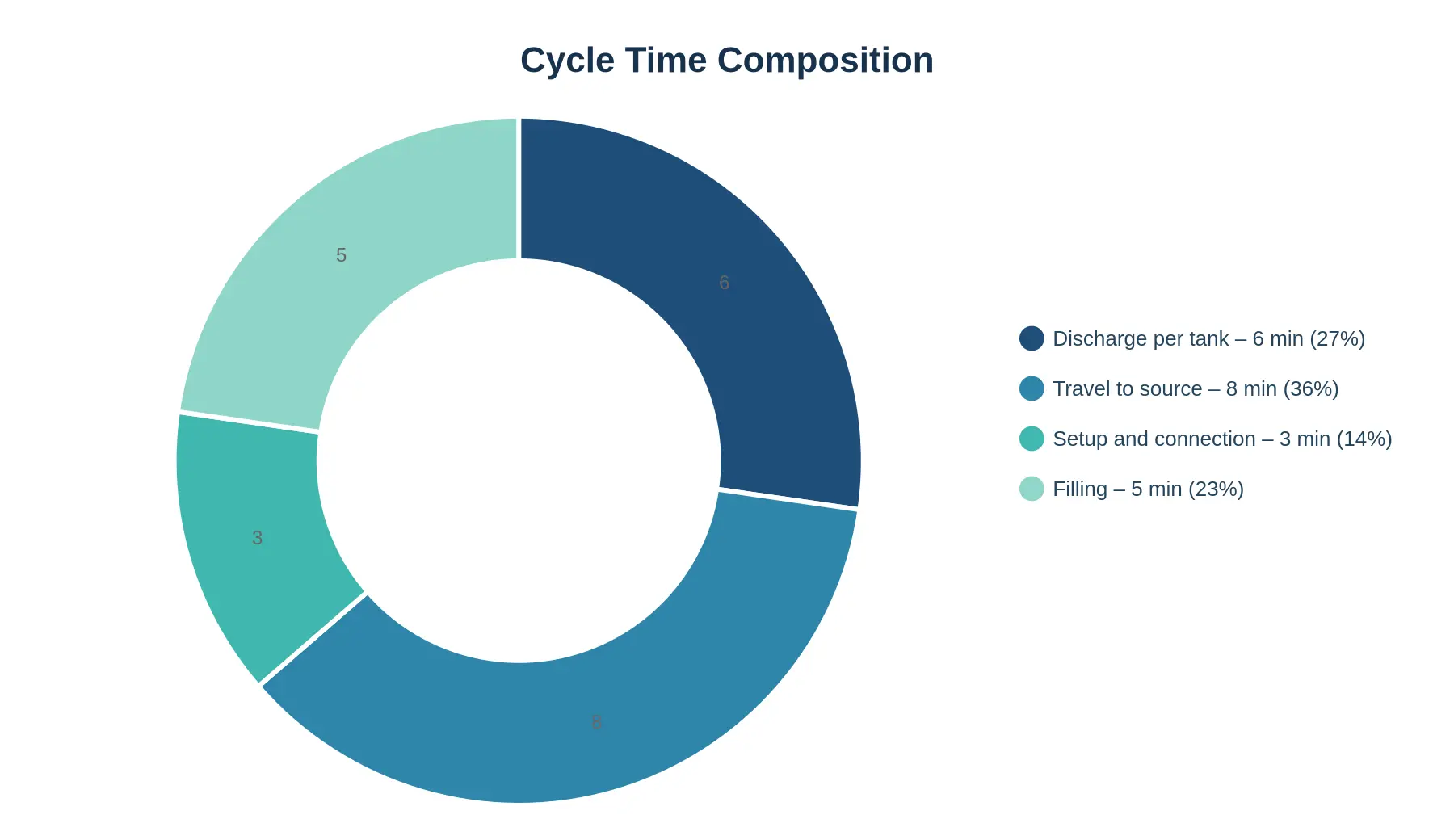
Real output is water delivered per hour, not the tank size on the sheet, and the loop governs it: discharge time + travel time to the source + setup and connection time + filling time.
Discharge time = tank volume ÷ pump flow rate. A 4,000 L tank empties in four minutes at 1,000 L/min; a 6,000 L tank takes six. Filling runs the other way, capped by what the source can give, so extra capacity buys minutes at the fill point rather than saving them. Tank size and pump flow simply trade against each other; neither shortens the loop on its own.
Wheelbase pays where travel and positioning take real time. On steep terrain those minutes fall noticeably, and the saving can offset a smaller tank across a working shift. That is why a compact remote water supply system fire truck sometimes logs more minutes at the nozzle per hour than a heavier unit with more water aboard.
The chart splits one cycle into its four components.
Where the Minutes Actually Go: The Refill Cycle Broken Down
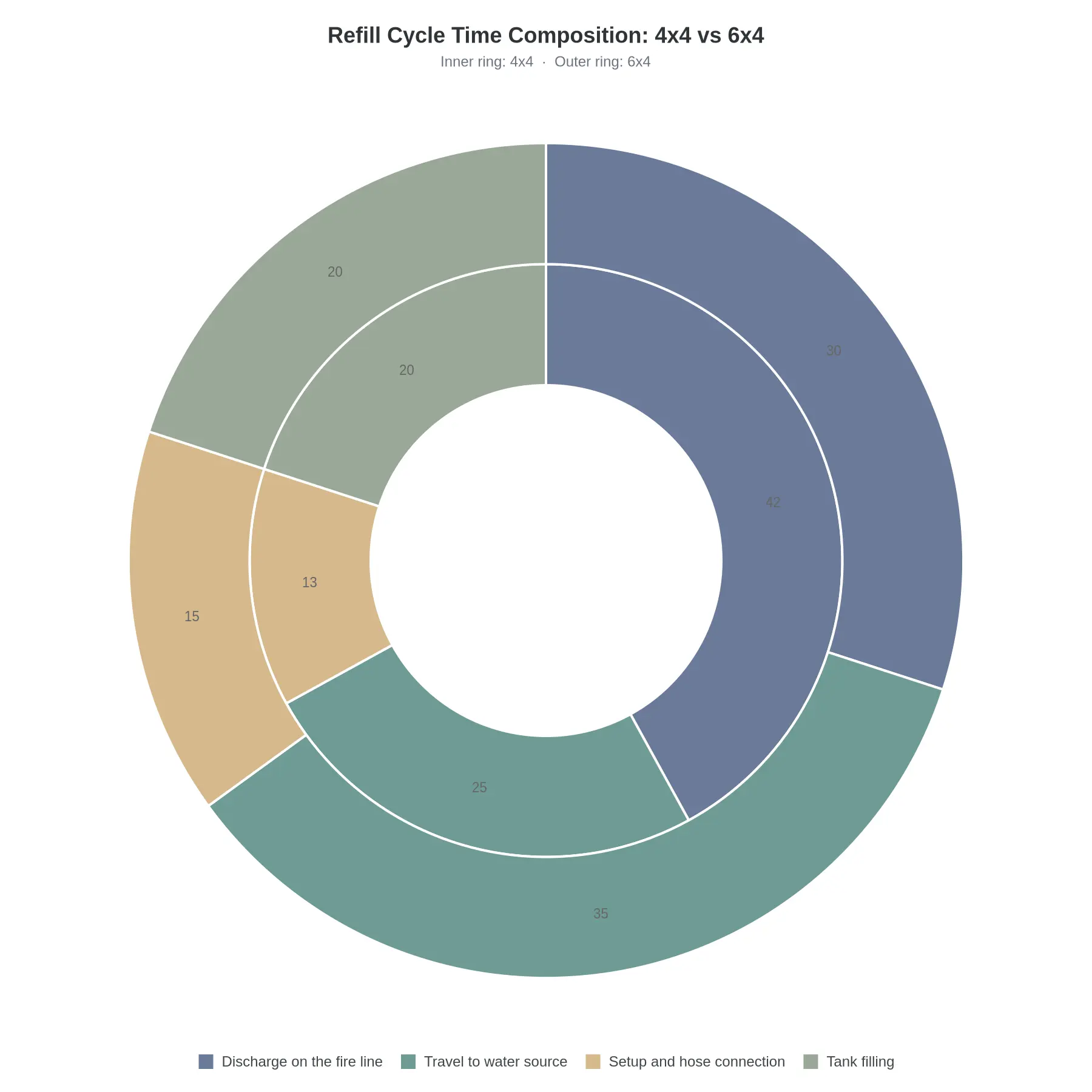
No refill cycle is just “fill and spray.” Every round trip is four jobs, and the way a truck divides its time across them decides how much water reaches the fire line. The two rings below compare a representative cycle for each chassis: inner ring for the 4×4, outer ring for the 6×4, percentages in the legend.
The Numbers Behind the Rings
| Cycle segment | 4×4 share | 6×4 share |
|---|---|---|
| Discharge on the fire line | 30% | 42% |
| Travel to the water source | 35% | 25% |
| Setup and hose connection | 15% | 13% |
| Tank filling | 20% | 20% |
Filling holds near a fifth of the cycle in both cases, but not because the minutes are equal — the 6,000 L tank takes roughly twice as long to fill. Discharge time doubles along with it, so the volume-linked segments scale together while travel and setup do not.
That is why the interesting movement sits in the other three segments. Travel takes about the same four or five minutes either way, yet it eats 35% of the 4×4’s shorter cycle against 25% of the 6×4’s. Setup drops a couple of points on the larger chassis, where pre-connected lines and a higher-capacity pump shorten the hookup. The 6×4 then spends 42% of each cycle discharging, against 30% for the 4×4.
If long shuttles over steep ground are your normal working day, match the chassis to the cycle rather than to the brochure. Browsing water tanker fire trucks by tank size and drivetrain shows quickly how the shares shift.
Caption: The 6×4 puts a larger share of each cycle into discharge and a smaller share into travel; on the 4×4, the drive to water dominates a shorter cycle. That is the clearest single signal of how each chassis earns its keep on steep ground.
Configuration Decision and Cost
Treat the purchase as a matching exercise, not a price comparison. Match driven axles to the route profile: 4×4 where tight access and lighter payloads define the shift, 6×4 where the roads are wide enough to use three axles and the water demand is heavy. Then match tank size to the refill cycle your sources can actually support, because a large tank on a slow-fill route is weight you carry all day.
Costs diverge after delivery. Two-axle chassis usually cost less to acquire and consume fewer tyres, while three-axle units burn more fuel per kilometre but take less drivetrain punishment on steep terrain. Confirm dealer and parts coverage in your region before signing, and weigh residual value: 4×4 models hold strongly in mixed fleets, 6×4 models in heavy-haul work.
A mismatched configuration raises operating cost whatever you paid for it. Compare total cost per delivered litre when you shortlist a wildland fire truck for sale, and review the commercial fire trucks built around your actual route.
FAQ: Choosing Between a 4×4 and 6×4 Wildland Fire Truck
Does a 4×4 or 6×4 wildland fire truck handle steep terrain better?
The 4×4 usually does, on steep, loose or uneven grades. Its shorter wheelbase and single rear axle concentrate weight over the driven tires, which cuts wheelspin on gradients where a longer 6×4 chassis can ground out or lose grip.
How does tank size change the water refill cycle?
Capacity sets how long a crew can work before resupply. A larger tank lengthens the water refill cycle and cuts trips to a hydrant or drafting point; a smaller tank shortens both. Match capacity to the real distance between water sources on your terrain.
Can a 6×4 chassis operate on narrow access tracks?
Often yes, but with limits. A 6×4 wildland fire truck carries a longer wheelbase and wider turning circle, so it suits maintained roads and firebreaks better than tight single-track trails. Check bridge ratings, track widths and turning radii on your actual routes before selecting this configuration.
Which configuration suits a mixed municipal and wildland duty cycle?
A 4×4 with a moderate tank is the usual compromise: it handles paved response, tight residential streets and off-road access. Move to a 6×4 wildland fire truck for sale only if most calls involve long highway runs and sustained water delivery. Our special fire truck range covers chassis and body options for both roles.
Closing Requirements Summary
Two pairings decide the specification. Drivetrain to route profile: 4×4 for tight, steep, low-traction grades, 6×4 for payload and stability where the roads are wide enough to use them. Tank size to the refill cycle your primary source can deliver, not to the capacity printed in the brochure. Judge any wildland fire truck for sale on those pairings rather than on peak figures.
Three checks before you commit:
- Survey the steepest route with a loaded vehicle.
- Time a refill at the primary water source.
- Confirm service coverage for the chassis you choose.
They apply whether you are replacing a single industrial fire truck or adding to an existing fleet.