ARFF Trucks for Sale: A Capacity and Readiness Decision
ARFF trucks are aircraft rescue and fire fighting vehicles: chassis built to carry large water and foam loads, a high-reach turret and rescue tools, and to reach any point of the movement area inside the response time the airfield is certified to. Buyers comparing airport fire trucks are shopping for a standby asset rather than a routine work vehicle, and that asset has to answer at 3 a.m. in February as readily as at noon in July.
What separates one offer from another is not the sticker price. It is the coverage obligation the truck has to meet, the number of times it will actually roll, and whether rebuilding an older unit beats buying new.
- Standby coverage. Response-time rules cover the movement area, not just the main runway, for as long as the field is open. Coverage hours, crew size and agent capacity set the floor for any vehicle specification.
- Dispatch demand. Annual call volume, mutual-aid requests and training runs show how hard the truck will work. A rig that rolls twice a month is a different purchase from one that rolls twice a day.
- Rebuild or buy new. A refurbished unit costs less up front and carries remaining service life and parts-availability limits. A new build costs more and restarts the lifecycle clock.
What follows takes those three in order: the coverage rules that set minimum specifications, the call data that shows whether a second rig earns its place, and the arithmetic of refurbishment. Current aircraft rescue fire fighting vehicle listings are a quick reference for how far specifications and prices spread across the category.
Standby Coverage Requirements: Sizing the Fleet to the Site
Standby coverage is a commitment written into an airport’s certification, its insurance and often a fire authority permit: a stated firefighting capability held on station, ready to leave a designated position within a stated time. It answers a different question from dispatch demand. Call volume over a year tells you how much work the fleet does. Standby coverage tells you what has to be available at the worst moment, at one fixed location.
In the United States the floor is the ARFF index under 14 CFR 139.315. The index, A through E, is set by two inputs: the length of the air carrier aircraft the airport serves and the average daily departures of those aircraft. The index then fixes agent quantities, discharge rates and response times. The operational rule is blunt. Within three minutes of the alarm, at least one required vehicle must reach the midpoint of the farthest runway serving air carriers and begin applying agent; every other required vehicle has four minutes.
Those figures, not the price list, decide the vehicle. A high index with a short response window and a fully staffed crew points to a large heavy-duty fire truck with a big water tank, proportioning system and roof monitor. A lower index with a longer allowance and cross-staffed crews can often be served by a light fire truck or a commercial chassis unit, which cuts acquisition and running cost without breaching the obligation. Coverage planning is what settles the heavy-duty versus light question, and getting it wrong in either direction costs money. A shortfall is rarely an internal matter: an under-equipped or unavailable unit can put certificate conditions at risk, void insurer warranties and leave a loss uninsured.
- Response time – minutes from alarm to agent on the hazard, measured from the designated standby position, not from a station across the field.
- Water and foam capacity – on-board water, foam concentrate and finished-foam volumes, scaled to the hazard and to the reserve a sustained incident needs.
- Foam delivery rate – gallons per minute at the monitor or handline, because knockdown tracks application rate more closely than tank size.
- Vehicles per coverage category, with crews – each category requires a set number of responding vehicles, and each of them needs a trained, equipped crew aboard. A parked truck with nobody in it satisfies nothing. Compare heavy-duty fire truck options against your coverage figures before settling on a chassis class.
New ARFF Truck vs. Refurbished ARFF Truck vs. Contracted Standby Coverage
Airport fleet purchases usually take one of three shapes: order a new build, buy a used unit and refurbish it, or contract standby coverage from an operator who supplies the truck and the crew. The factors that decide between them are below.
| Comparison factor | New build ARFF trucks for sale | Refurbished ARFF trucks for sale | Contracted or leased standby coverage |
|---|---|---|---|
| Capital outlay | Highest upfront spend; full warranty included | Lower purchase price; budget for refurbishment extras | No asset purchase; recurring monthly or annual fee |
| Lead time to in-service date | Roughly 12 to 24 months, build slot dependent | Roughly 3 to 9 months, scope dependent | Weeks to a few months under an agreed contract |
| Coverage compliance fit | Built to the current standard and your category requirement | Compliant only if rebuilt to current standard; paperwork must verify it | Tied to the provider’s fleet and response commitment |
| Maintenance burden | Scheduled OEM service; little corrective work in early years | More frequent inspection of aging pumps, foam systems, and drivelines | Provider carries maintenance under the agreement |
| Operator training requirement | Full OEM familiarization plus airport driver and operator certification | Familiarization on legacy controls and any modified systems | Minimal in-house training; provider supplies crew |
| Resale or residual value | Holds value; active secondary market | Already depreciated; narrower buyer pool | None; no asset retained at contract end |
| Best fit | Long-horizon fleets with the highest index requirements | Operators bridging a gap or serving lower category fields | Seasonal, temporary, or low-frequency standby needs |
Read the table as a filter, not a ranking. A refurbished unit that arrives next quarter can meet a compliance deadline a new build cannot touch, and a lease keeps capital free for terminal or runway work. Whatever the shortlist, check each option against your index requirement first, then against the dispatch numbers below.
If chassis, tank and foam configuration are still open, the airport fire trucks range shows how build specs map to airport categories.
Dispatch Demand Analysis: Sizing the Fleet to the Work It Actually Sees
Dispatch demand is where a fleet plan meets the runway, because it converts assumptions about coverage into a figure you can count. Call frequency sets the baseline: a station handling a handful of runs a month rarely needs a second heavy apparatus, while steady daily volume may already be stretching response times. The mix matters as much as the total. Emergencies need instant, fully crewed readiness; scheduled and non-emergency work can often be absorbed by one multi-role unit. Mutual aid commitments reserve capacity that stays committed even when local calls are light, and peaks follow the operation’s own rhythm – shift changes, seasonal traffic, industrial throughput.
Errors in either direction are expensive. An over-specified fleet carries apparatus, water, foam and pump capacity it never uses, while capital sits idle and maintenance and training budgets keep draining. An under-specified fleet looks thrifty until two calls land at once and the coverage window opens with nothing to send. Demand data also drives the specification itself: sustained water volume and reach point toward a water tower configuration, flammable liquid risk and foam logistics toward a dedicated foam unit, and runway or airside obligations toward aircraft rescue fire fighting vehicles built for rapid intervention. Set airport fire truck configurations, water tower and foam options against your own demand history and the comparison stays grounded in evidence rather than preference.
Three measures carry most of the argument:
- Rolling call volume by incident type – the true baseline, and an indication of which capability actually gets used.
- Concurrency rate – how often two or more calls overlap. This is the clearest single signal that one apparatus is no longer enough.
- Peak distribution and mutual aid activations – the hours and seasons when committed capacity is thinnest.
Share of Dispatch Demand by ARFF Vehicle Category
Before you can judge whether a used rig is worth refurbishing, you need to know what your station rolls out of the bay for. The chart below is a working example of a demand profile sorted by vehicle type: heavy-duty aircraft rescue fire fighting vehicles carrying most structural and aircraft responses, with foam, water tower, rapid intervention and aerial units splitting the remainder in declining order. Feed your own twelve months of run data into the same format and the fleet conversation shifts from “what should we buy?” to “what do we keep, and what do we add?”
If runway and aircraft response carry your heaviest call volume, the range of aircraft rescue fire fighting vehicles shows how the category breaks down by configuration.
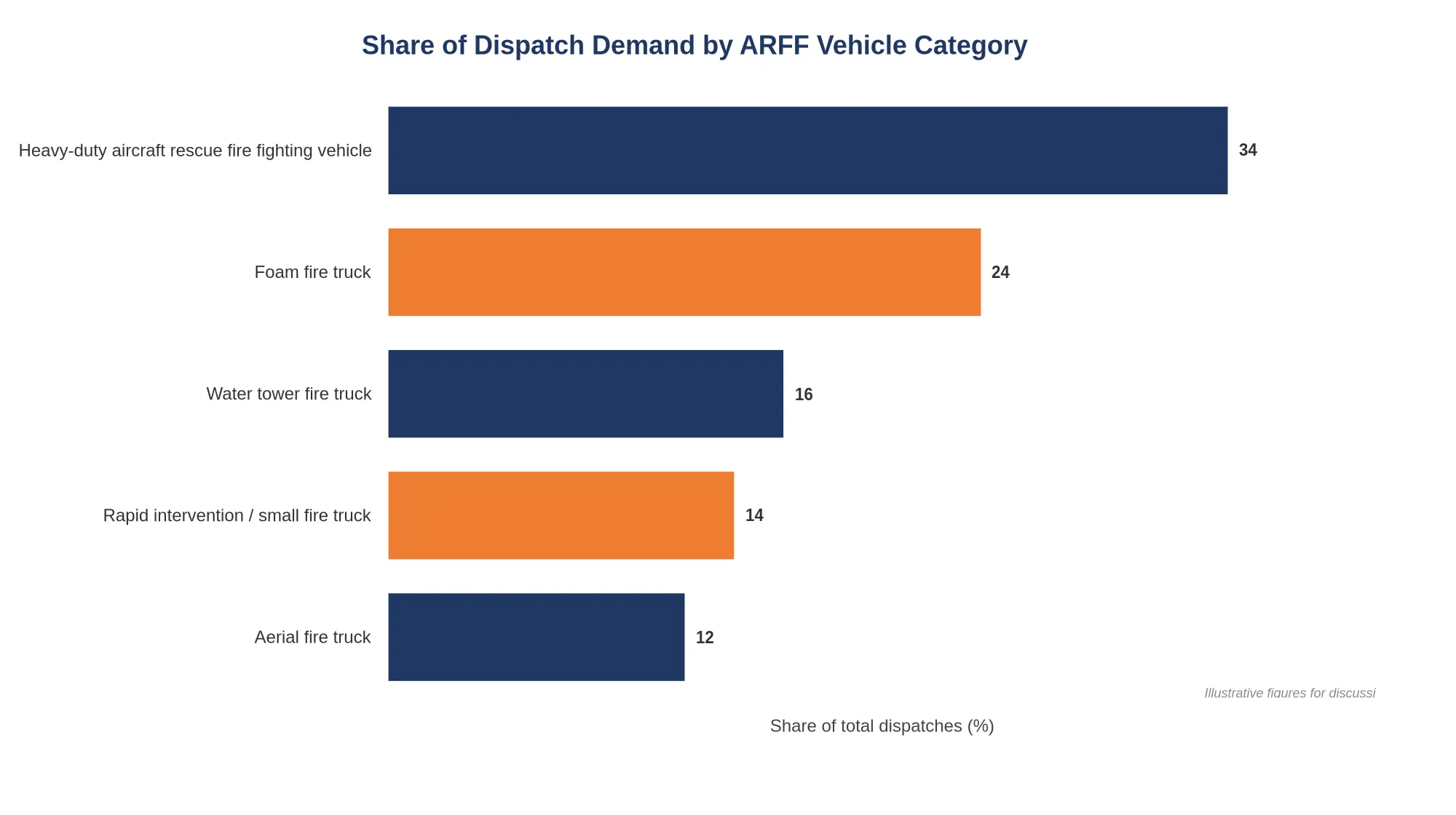
Chart data note (illustrative figures, not verified statistics): The percentages below are hypothetical examples for discussion and planning purposes only. They are not industry benchmarks, and they should not be quoted as verified data. Replace them with your own dispatch logs.
| Vehicle category | Illustrative share of dispatches |
|---|---|
| Heavy-duty aircraft rescue fire fighting vehicle | 34% (illustrative) |
| Foam fire truck | 24% (illustrative) |
| Water tower fire truck | 16% (illustrative) |
| Rapid intervention / small fire truck | 14% (illustrative) |
| Aerial fire truck | 12% (illustrative) |
Caption: Mapping dispatch demand by vehicle category turns a fleet plan into a priority list, showing which rigs earn their keep every week and which sit idle while still consuming maintenance budget.
Reading the chart before you spend
Use the bars to test necessity, not to settle any single category. A category that shows up often needs reliability, parts availability and fast turnaround, which is what refurbishment usually delivers well. A category with a thin but critical share – aerial access for tall structures, rapid intervention in tight industrial space – is often better served by a lower-hour used unit than by stretching the primary apparatus. Either way, the numbers give you something concrete to put in front of a budget committee, and they set up the refurbishment question that follows.
Refurbishment vs. New-Build: Weighing the Real Tradeoffs
When you compare new-build units against refurbished ARFF trucks for sale, the real question is how much structure you are getting for the money. A credible rebuild starts with a structural and chassis inspection that looks past the paint: frame straightness, corrosion at body and boom mounts, spring hangers, stress cracking around the pump house. Pump and foam proportioning systems need to be restored to rated performance rather than resealed, with flow testing across the full operating range and verified proportioning accuracy at low injection rates, where foam ratios go wrong most easily. Tank and plumbing deserve the same treatment, because baffle welds, tank liners and valve seats are where age shows first. Cab and crew safety work (seating, restraints, roll protection, egress) and electronics retrofits (radio interoperability, apparatus data, cameras) are usually the most flexible line items in a rebuild, and the easiest to under-specify when nobody writes them into the scope of work. Comparing the wider field of airport fire trucks before the specification is locked is the cheapest diligence available.
A new build delivers a full service life, a current warranty position and predictable parts support from the OEM. Refurbishment shortens lead time and lowers capital outlay, which matters when standby coverage has to be in service within the year, and a documented rebuild can still deliver years of dependable response. What it raises is inspection diligence. You are buying an engineer’s judgment about remaining service life, and a thin inspection can hide fatigue, undersized repairs or obsolete components with long lead times that surface in your first busy season. On a fixed budget, treat the refurbishment route as a diligence exercise rather than a discount, and get scope of work, warranty terms and parts support confirmed in writing before signing.
The checklist below covers the inspection points to verify on any candidate unit, in the order that matters most.
Refurbishment Inspection Checklist Before You Buy
Work through these in order and record every finding, reading and photo. A refurbishment only pays off when the metal, the paperwork and your standby obligations all line up.
- Chassis and frame corrosion. Walk the full length of the longitudinal rails, cross members and welds, and probe any flaking paint, bubbling or pitting around battery boxes, wheel arches and mounting brackets. Hidden rust-through is the most expensive defect to reverse.
- Pump performance at rated capacity. Run the pump at nameplate pressure and flow with a calibrated flowmeter, and record output, vibration and seal weeping across a full 30-minute load test, not a two-minute idle check.
- Foam proportioning calibration. Draw concentrate through every proportioner setting and confirm the induction ratio lands inside the manufacturer’s tolerance. A drifting system can under-foam a fire without setting off a single alarm.
- Tank and plumbing leak test. Fill the tank to capacity, let it stand under load, and inspect seams, baffles and tank-to-pump piping for weeping, soft spots or stress cracks that signal delamination in a composite shell.
- Electrics and lighting, end to end. Check battery condition, alternator output, emergency and warning lights, scene lighting, siren and intercom, then trace any spliced, chafed or corroded wiring in the harness.
- Brakes and tires. Measure pad and drum wear, test the air system for pressure loss and compressor recovery time, and read the DOT date code on every tire. Cracked tires or anything past the seven-year mark should be replaced, not negotiated.
- Cab safety and crew protection. Confirm that seat belts, seat mountings, grab handles and restraint anchors are intact and uncracked, and that the cab structure shows no deformation from a prior impact.
- Documentation and service history. Match engine hours, pump hours and mileage against the maintenance log, and pull pump test certificates, boom or aerial inspections and accident records so the paper trail matches the metal.
- Compliance with today’s coverage terms. Check that foam capacity, pump rating and response time meet what your airport authority enforces now, not the standard in force when the rig was built, and benchmark the unit against aircraft rescue fire fighting trucks currently on the market.
Any item you cannot verify with a reading, a certificate or a photo should be priced into the deal as a repair, not carried as a maybe.
Total Cost of Ownership and Residual Value: Refurbished vs. New ARFF Trucks
Purchase price is the first line in a longer ledger. A new ARFF truck carries the highest capital outlay and arrives with a full design life, warranty coverage and a factory service network. A refurbished unit costs meaningfully less at acquisition, but part of that saving goes straight back into the refurbishment scope: powertrain rebuilds, pump and foam proportioning overhaul, tank and body repair, electrical and corrosion work, plus recertification of the foam system and any inspections the authority requires. Done properly, a documented refurbishment can add roughly 8 to 12 years of service, which is the figure that actually competes with a new-build timeline. Buyers get into trouble when they buy refurbished ARFF trucks on price alone and only discover afterwards that the scope was written before anyone inspected the corrosion and the wiring.
The recurring lines decide the rest. Annual maintenance and parts spend tends to run higher on an older chassis in the first year after refurbishment, then settles into a predictable band; ageing components rarely fail on a convenient schedule. Downtime is the least modelled cost of all. A truck in the shop during a coverage obligation can force a mutual-aid arrangement, a short-term rental or a contractual penalty, and any of those can dwarf a season of parts spending. Training differs too, since a refurbished truck with a familiar layout often needs less retraining than a new platform with new controls, while insurance depends on agreed value, certification status and how the refurbishment was documented. At disposal, a new truck returns more in absolute resale value; a refurbished truck returns less, but less capital was ever at risk. The lowest purchase price is rarely the lowest total cost of ownership. A cheap truck can give back on downtime, parts and resale what it won on the invoice, particularly when the firefighting and rescue equipment package was rebuilt to a lower standard than the chassis.
To compare fairly, build a multi-year cash flow over 10 and 15 years, stacking capital cost, refurbishment scope, maintenance and parts, downtime exposure, training, insurance and resale into one column per option. Then divide by the years of coverage each option actually delivers, not the years it sits in the yard.
| Cost line | New ARFF truck | Refurbished ARFF truck |
|---|---|---|
| Purchase price | Full OEM pricing | Lower upfront capital |
| Refurbishment scope | Not applicable | Powertrain, pump, foam system, tank, body, wiring |
| Service life added | Full design life, often 20+ years | Typically 8 to 12 years |
| Annual maintenance and parts | Warranty-backed early, rising later | Higher first year, then predictable |
| Downtime exposure | Long delivery lead time | Refurbishment window plus standby gaps |
| Training | New controls, full course | Familiar layout, shorter retraining |
| Insurance | Higher agreed value | Lower insured value, verify certification |
| Residual value | Higher absolute resale | Lower absolute resale, less capital at risk |
Three cost lines that most often surprise buyers:
- Scope creep found after the inspection. Corrosion in the tank cradle, harness damage or a foam system that cannot be recertified turns a defined refurbishment into an open-ended project.
- Downtime during a coverage gap. Renting, borrowing or breaching a coverage obligation while the truck is out of service frequently costs more than the repair invoice.
- Insurance and resale haircuts from thin documentation. Without a clear refurbishment record, insurers price the risk up and buyers at disposal price the truck down.
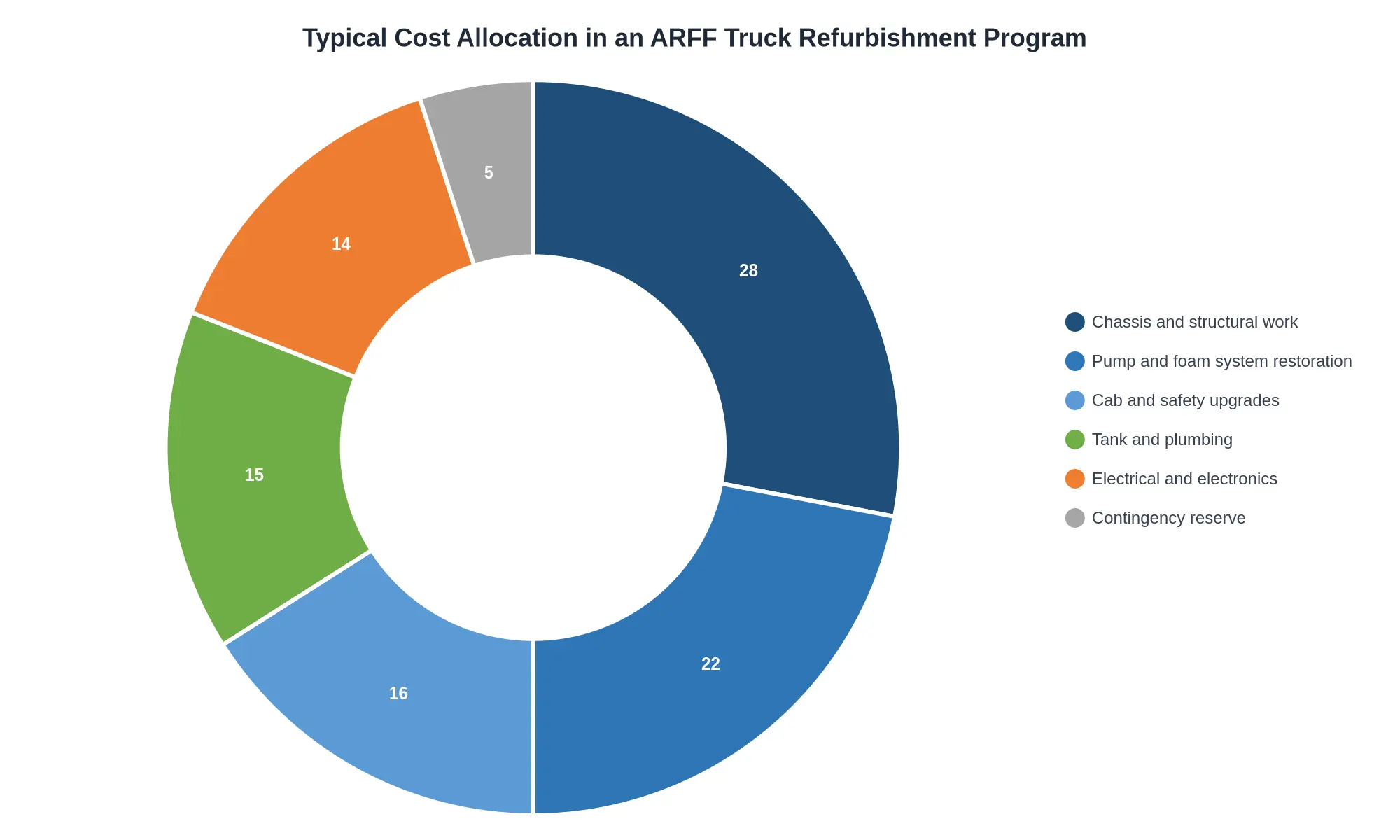
Typical Cost Allocation in an ARFF Truck Refurbishment Program
Budget a refurbishment the way you would budget a new build and the numbers behave far more predictably. The chart below shows how a typical ARFF (aircraft rescue and fire fighting) refurbishment program spreads its money across six work packages.
| Cost category | Illustrative share |
|---|---|
| Chassis and structural work | 28% |
| Pump and foam system restoration | 22% |
| Cab and safety upgrades | 16% |
| Tank and plumbing | 15% |
| Electrical and electronics | 14% |
| Contingency reserve | 5% |
Caption: Charting these six work packages side by side shows where refurbishment spending lands in the wider total cost of ownership picture, alongside standby readiness and dispatch demand.
Data note: these are indicative planning allocations for early-stage budgeting, not quoted prices. Actual shares shift with vehicle age, inspection findings and the scope you agree with your rebuilder. Owners weighing a rebuild against a replacement should also review the range of airport fire trucks available before committing capital.
Matching Coverage and Dispatch Demand to Equipment Categories
Two questions get an operator further than any specification sheet: what coverage gap exists in your response district, and what dispatch pattern will the vehicle actually run? A single-station operator with a mixed incident load needs different attributes from an airport or industrial site with fixed hazard zones and strict response-time commitments. The specification work is a mapping exercise between a stated operational requirement and the equipment category built for it, which is why it helps to review the wider fire truck product range before narrowing the field. CIMC Tianda builds firefighting and rescue equipment alongside airport and logistics systems, and the company reports equipment distribution in nearly 130 countries and regions, so category boundaries, chassis availability and configuration conventions are established in its catalogue rather than invented per order.
- Structural and first-response coverage in built-up areas: a standard pump-and-tank configuration covers routine call volume, while a small fire truck suits narrow streets, tight access yards and low-call-volume sites where a full-size chassis would slow the crew down.
- Airside standby and fixed response-time commitments: an aircraft rescue fire fighting vehicle is specified around acceleration, off-road mobility and agent discharge rate rather than tank size alone, because the requirement is reaching a runway incident inside a stated time window.
- Fuel and flammable liquid risk: an industrial fire truck is configured for plant layouts and process-area access, and where the hazard is a spill or tank fire, a foam fire truck brings the smothering agent and proportioning system the scenario demands.
- Sustained supply and high flow at distance: a heavy-duty fire truck carries the pump capacity and payload for long-duration incidents, while a water tower fire truck adds elevated delivery where the fire is above ground-level reach.
- Non-fire incidents and rescue support: an emergency rescue vehicle covers the call types that arrive alongside fire dispatch, including technical rescue and casualty support, so those incidents do not pull a pumper off coverage.
Frequently Asked Questions
What standby coverage obligations should I confirm before buying an ARFF truck?
Standby coverage rules come from your airport certification, your insurer and your local fire authority. Confirm the required response times and staffing levels, and whether a dedicated aircraft rescue fire fighting vehicles unit has to stay on site during scheduled air carrier operations.
How much dispatch demand justifies adding another vehicle?
Review twelve months of call logs. If mutual-aid requests, second-alarm responses or simultaneous incidents delay your primary unit more than once a month, a second vehicle is usually justified and it closes a standby coverage gap at the same time.
Can refurbished ARFF trucks for sale meet current compliance requirements?
Yes, when the rebuild brings the unit up to current NFPA 414 and FAA guidance for ARFF vehicles. Ask for proof of the engine, pump, foam system and cab upgrades, and have an independent inspector verify the completed work before delivery.
What are typical lead times for new versus refurbished units?
New aircraft rescue fire fighting vehicles typically take 12 to 24 months from order to delivery, depending on chassis availability. Refurbishment is quicker but not instant: workshop time commonly runs 60 to 120 days once a build slot opens, and the in-service date falls inside the 3 to 9 month window depending on scope and parts.
What documentation should I request before purchase?
Ask for the title, service records, pump and foam test results, the NFPA compliance report, axle weight certificates and the latest inspection sheet. Missing documents usually mean deferred maintenance, and they complicate insurance and coverage approvals later.
How should I plan residual value at replacement?
Depreciate the truck over ten to fifteen years and track resale prices for comparable aircraft rescue fire fighting vehicles. Budget a 15 to 25 percent salvage credit toward replacement, then adjust it yearly as dispatch demand changes.
Pulling the Decision Together
Weigh the three questions in order and the specification usually writes itself. Coverage comes first: how many apparatus must be ready at any moment, how fast they must respond, and what protects the site during servicing or a crew change. Demand comes second: the frequency, severity and type of incidents your operation handles, which decides whether you need high-volume foam delivery, rapid intervention or a general-purpose platform. Cost structure comes last, and only then does refurbishment versus new build become answerable. An older chassis with a refreshed body and updated foam system serves a low-dispatch site well; a high-demand operation usually recovers the added cost of new equipment through uptime.
A Simple Three-Step Framework
-
Define standby coverage first. Map how many vehicles must be mission-ready, over what shift pattern, and with what acceptable gap during servicing. That sets the minimum fleet size before any specification discussion starts.
-
Size the fleet to the dispatch demand profile. Match pump capacity, foam tank volume and agent type to incident history and to the risk profile of the site you protect. Under-specifying creates recurring operational strain; over-specifying inflates capital and training costs.
-
Test refurbishment against new-build. Compare total cost of ownership, remaining structural life, parts availability and expected years of service. Refurbishment wins on low-hour, low-dispatch assets; new-build wins where response demand is constant and downtime is expensive.
Worked through in that order, the three steps leave you with a specification brief rather than a feature list. From there, review the fire fighting truck product categories and compare configurations across ARFF trucks for sale, then ask the team for a specification assessment against your own coverage figures.