Brand New Fire Truck Quote vs Delivered Cost: The Core Difference
A manufacturer’s quote for a brand new fire truck is a starting figure. The delivered cost is what the business owner actually pays by the time the vehicle is standing on site.
The quote prices the truck at the factory gate: chassis, pump, tank, bodywork, and the equipment named in the specification. Everything after the truck leaves the plant – inland haulage to the port, the ocean leg, the move to your site – is invoiced separately, usually by someone other than the manufacturer.
Delivered cost adds freight, insurance, import duties and taxes, customs clearance, inland transport and commissioning to that quote. Buyers comparing fire fighting truck models across suppliers should budget against the delivered figure, because capital approval built on the quote alone tends to fall short at payment time.
What a Brand New Fire Truck Quote Usually Covers
A quote is a factory-level price for building the vehicle, not a door-to-door delivered cost.
On the included side, the figure normally bundles the chassis and cab, with the axle ratings and commercial chassis configurations you select, plus the fire pump, water or foam tank and associated plumbing, which is where tank and pump specifications get locked down. Body fabrication and compartment layout, standard lighting and equipment mounts, factory testing before shipment, and handover on ex-works or FOB terms sit inside the same figure. In short, the supplier is quoting a finished, tested truck standing at the factory gate.
Left out are international freight, cargo insurance, import duties, local taxes, delivery-port handling, and the labor to commission the truck once it lands. Those costs fall to you or your nominated importer.
The split matters at budget time. The ex-works price is one line in the total cost of ownership, so the logistics and compliance layer has to be added before suppliers can be compared side by side.
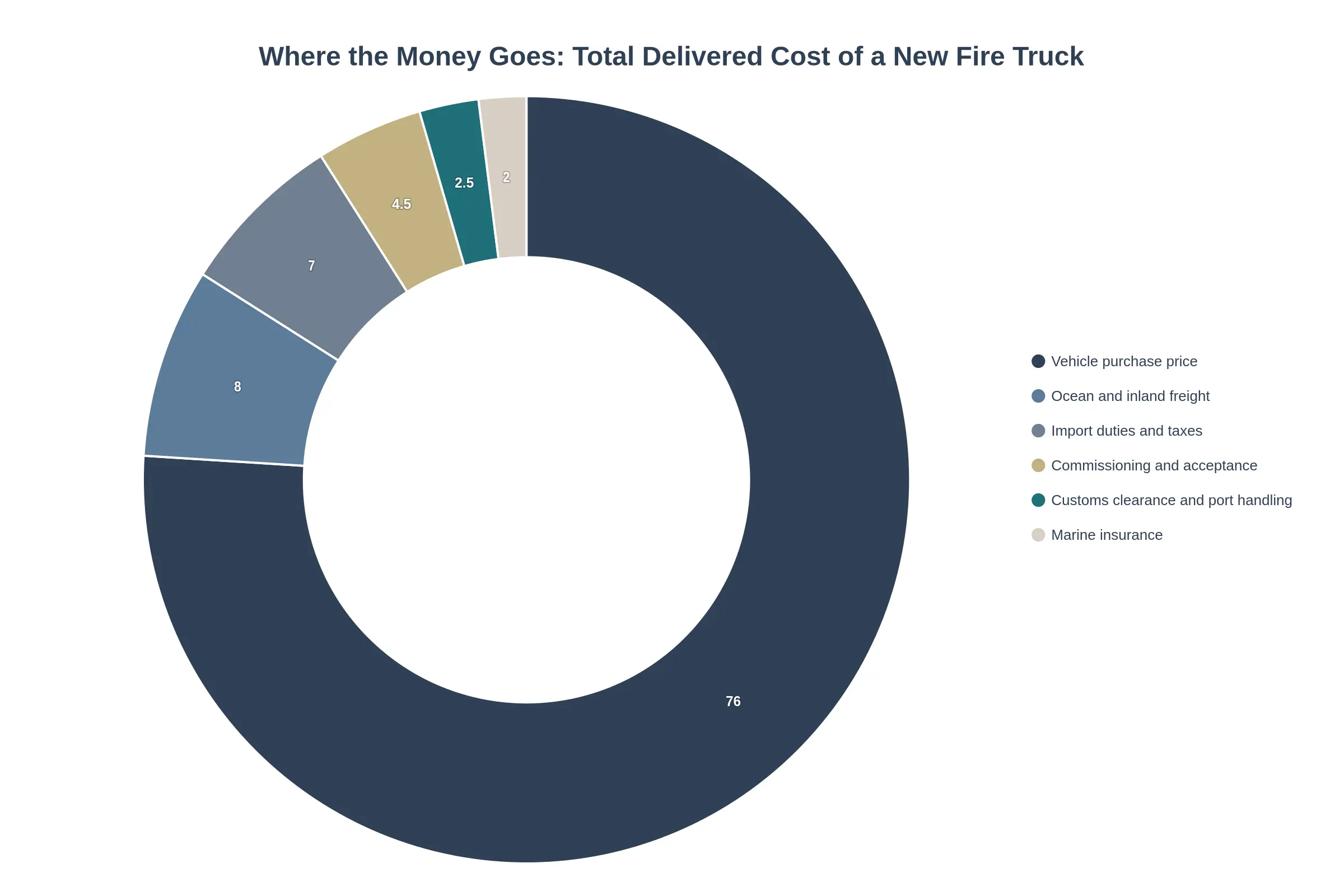
Figure 1 – Share of total delivered cost for a new fire truck, modelled on a USD 400,000 quoted unit price landing at roughly USD 526,000 delivered.
The Quoted Price Is Only the Largest Slice
In the worked example above, the figure on the quotation – the vehicle purchase price – accounts for about 76% of what you actually hand over. The remaining 24% is spread across freight, insurance, duties, port formalities and the commissioning work that turns a shipped machine into a truck your crew can roll out of the bay.
On a USD 400,000 purchase that is roughly USD 126,000 sitting outside the headline number, and much of it is easy to miss until the invoice stage.
Reading the segments
- Ocean and inland freight (8.0%) depends on vehicle dimensions, weight, and whether the unit ships as a complete vehicle or in sections; long-wheelbase trucks with large water tanks occupy more deck space.
- Import duties and taxes (7.0%) are set by your country’s tariff code and local VAT/GST treatment, not by the supplier.
- Commissioning and acceptance (4.5%) covers pump testing, foam system calibration, operator training and the paperwork that proves the unit meets specification.
- Customs clearance and port handling (2.5%) is brokerage, terminal charges, and storage when documents lag.
- Marine insurance (2.0%) is small as a percentage, but it is not a line to skip on a high-value unit.
Use these proportions as a planning benchmark rather than a fixed rule. Duty rates and freight lanes vary by destination, and a smaller light fire truck will shift the freight and clearance shares downward, while a large aerial appliance pushes them up.
Freight Costs: Moving a Fire Truck Across Borders
Freight is frequently the largest single line item between a quoted price and your landed cost, and most of its drivers are visible before you sign.
Shipping mode drives the rest. Compact apparatus often travels inside a standard container, but taller or heavier units need a flat rack or a roll-on/roll-off (RoRo) vessel, and that one choice can shift fire truck freight cost by several thousand dollars. Length, height and gross weight then decide how you are priced – a container slot, linear meters on a flat rack, or cubic measure – and a few extra centimeters of height can push a shipment into a pricier bracket.
Route matters too: longer ocean legs, transshipment through a hub, and congested destination terminals all add bunker, handling and waiting charges that scale with distance. Chassis class follows the same logic, since a light skid-mounted body and a triple-axle platform have very different chassis size and shipping footprint, and the heavier platform needs more lifting gear, lashing and road permits. Booking several units together spreads fixed port, documentation and handling fees across the batch, so per-truck freight usually drops as order volume rises.
Rates also move with the calendar. Peak pre-year-end capacity crunches and the quieter weeks that follow can change a quote by double-digit percentages depending on when you book. Marine insurance rounds out the calculation: a small percentage of declared value, but it belongs in every landed cost sheet, and coverage should reflect the replacement value of a brand-new apparatus.
What lands on the invoice after the truck leaves the factory is set out below. Read it as a checklist rather than a price list: the manufacturer’s quote fixes some of these lines and leaves others to move.
Quoted price vs delivered cost: which items sit outside the manufacturer quote
| Cost Line | Where It Comes From, and Whether It Moves |
|---|---|
| Chassis and cab | Core quoted item; engine, drive and cab options stay negotiable, so the figure is variable. |
| Fire pump and tank | Pump rating and tank capacity are priced separately; upgrades move the total, so variable. |
| Body and equipment | Lockers, ladders and tools may sit outside the base quote; specification drives a variable cost. |
| Factory testing | Pre-delivery inspection and pump tests are sometimes bundled, sometimes billed; confirm which. |
| Ocean freight | Charged per unit or container and driven by route and fuel, so it is variable. |
| Marine insurance | A percentage of cargo value for the voyage; variable and often overlooked. |
| Import duties and taxes | Set by local tariff codes and vehicle value; fixed by law but different across markets. |
| Customs clearance, port handling and inland transport | Terminal fees, brokerage and trucking add up; each leg is variable and destination-specific. |
| Commissioning and acceptance testing | On-site setup, crew training and acceptance tests are usually billed separately as variable service costs. |
Confirm in writing which of the nine lines above sit inside the manufacturer quote and which arrive later from freight forwarders, customs brokers and service teams. Buyers comparing a fire fighting truck range across suppliers should ask for every line to be stated as fixed or variable before signing.
Duties, Import Taxes and Customs Clearance
Customs classification comes first. The tariff code assigned to your vehicle – often driven by chassis type, gross vehicle weight, pump capacity and whether the unit is purpose-built for firefighting – sets the duty rate. Specialized platforms such as ARFF and aircraft rescue fire fighting vehicles may be classified differently from a conventional pumper, so it pays to confirm the heading your build actually falls into before comparing quotes.
Duty is then typically assessed on a CIF basis: invoice value plus international freight plus marine insurance. A deceptively low ex-works price can produce a much larger duty bill once transport is folded into the dutiable base. Value-added tax or sales tax usually applies after duty, calculated on the CIF value plus the duty amount, so the tax compounds on top of the duty rather than running alongside it.
Paperwork is where timelines slip. A missing certificate of origin, an inconsistent bill of lading, vague technical specification sheets or an absent conformity certificate will trigger queries, inspections or re-submission, and every extra day the unit sits at the terminal racks up demurrage and storage charges. Clearance is also sequential, so one document gap stalls the whole chain: classification review, duty assessment, tax payment and physical release all wait on the same file. Building a document checklist at the quotation stage, and validating it with your freight forwarder before shipment, is far cheaper than solving it after the vessel arrives.
Before signing any purchase agreement, confirm every duty assumption with a local customs broker, because rates, valuation rules and documentation requirements vary by jurisdiction and are revised regularly.
Where the Money Piles Up: A Five-Stage Map
Every brand new fire truck travels through five cost layers between the moment you receive a quotation and the moment the keys are handed over: the quotation stage, the transport stage, the customs stage, the delivery stage, and the commissioning stage.
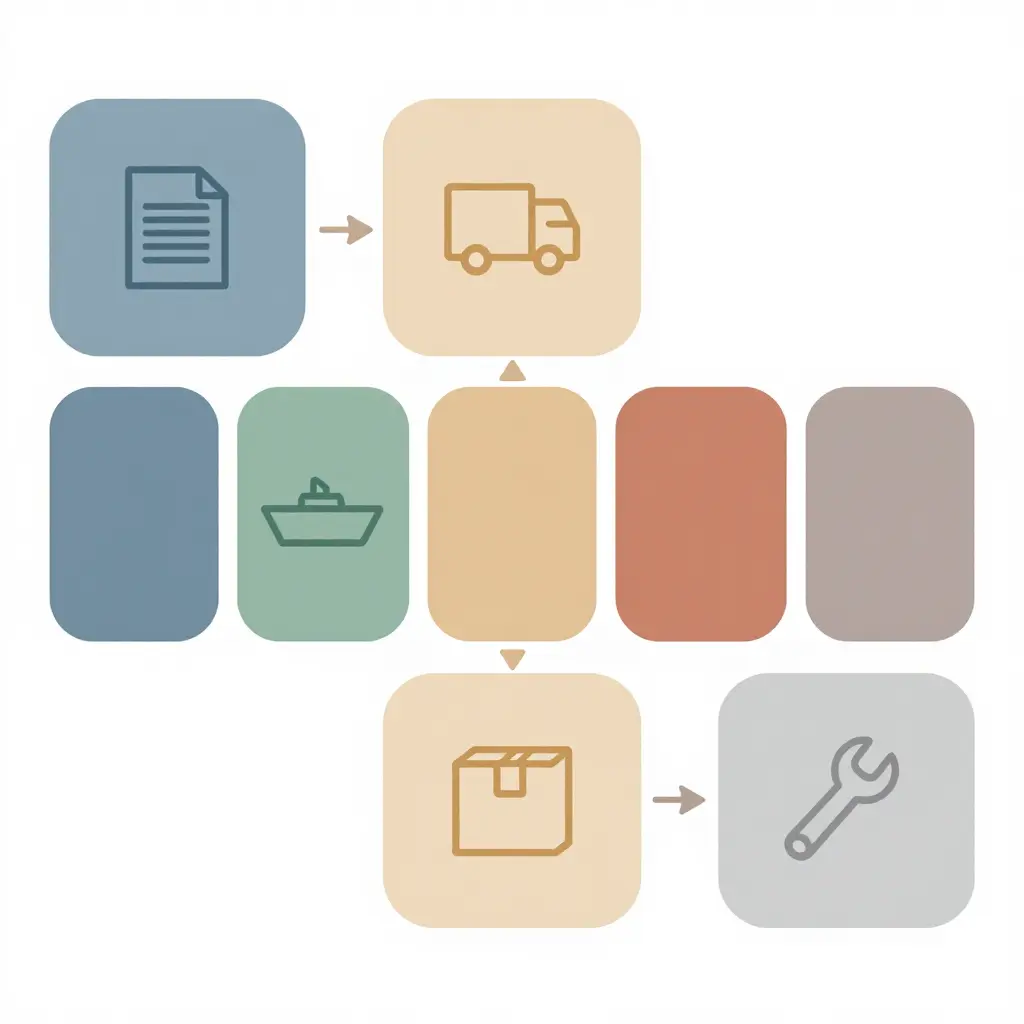
Each block is a place where a line item appears on your final invoice, and none of them sits inside the FOB figure on the quote.
Commissioning and Acceptance: The Cost Item Buyers Forget
Commissioning is where a factory product becomes a working emergency vehicle, and it is where budgets most often slip.
It typically begins with a pre-delivery inspection at the factory, followed by fluid checks and pump performance testing against the rated flow and pressure curves. Foam-capable units need foam proportioning calibration – a separate skill set – confirming that the injector or balance-pressure system delivers the correct percentage across the full range of flows, not only at the rated point. Where an aerial device is fitted, function testing of the boom, ladder and outriggers must be documented, including load and stability checks; typical configurations are listed under aerial ladder fire truck platforms. After the hardware checks come the human ones: operator and crew familiarization covering pump operation, foam use and aerial controls, then handover of manuals, test certificates, as-built drawings and training records. Warranty registration closes the loop, and it is surprisingly easy to forget until a claim is rejected months later.
Most manufacturers bundle the factory-side work into the quoted price – pre-delivery inspection, pump and foam testing, aerial function testing, handover documentation, and a set number of familiarization hours. What tends to be invoiced separately is everything that happens on your site: local labor for unloading and setup, crane or lifting equipment hire, water supply for flow testing, travel and accommodation for factory technicians, and any extended warranty or service contract. That gap is why commissioning frequently lands 3 to 8 percent above the ex-works figure, and why two quotes that look identical on paper can differ by tens of thousands once these items surface.
Put every commissioning line item in writing before the purchase order goes out, including who supplies what and who pays for it.
Where the Quote Stops and the Real Bill Begins
Index the quoted price of each vehicle class at 100, then plot what the same truck costs once freight, duties, port handling and commissioning are paid. The result is not a single markup but a sliding scale that widens with the size of the machine.
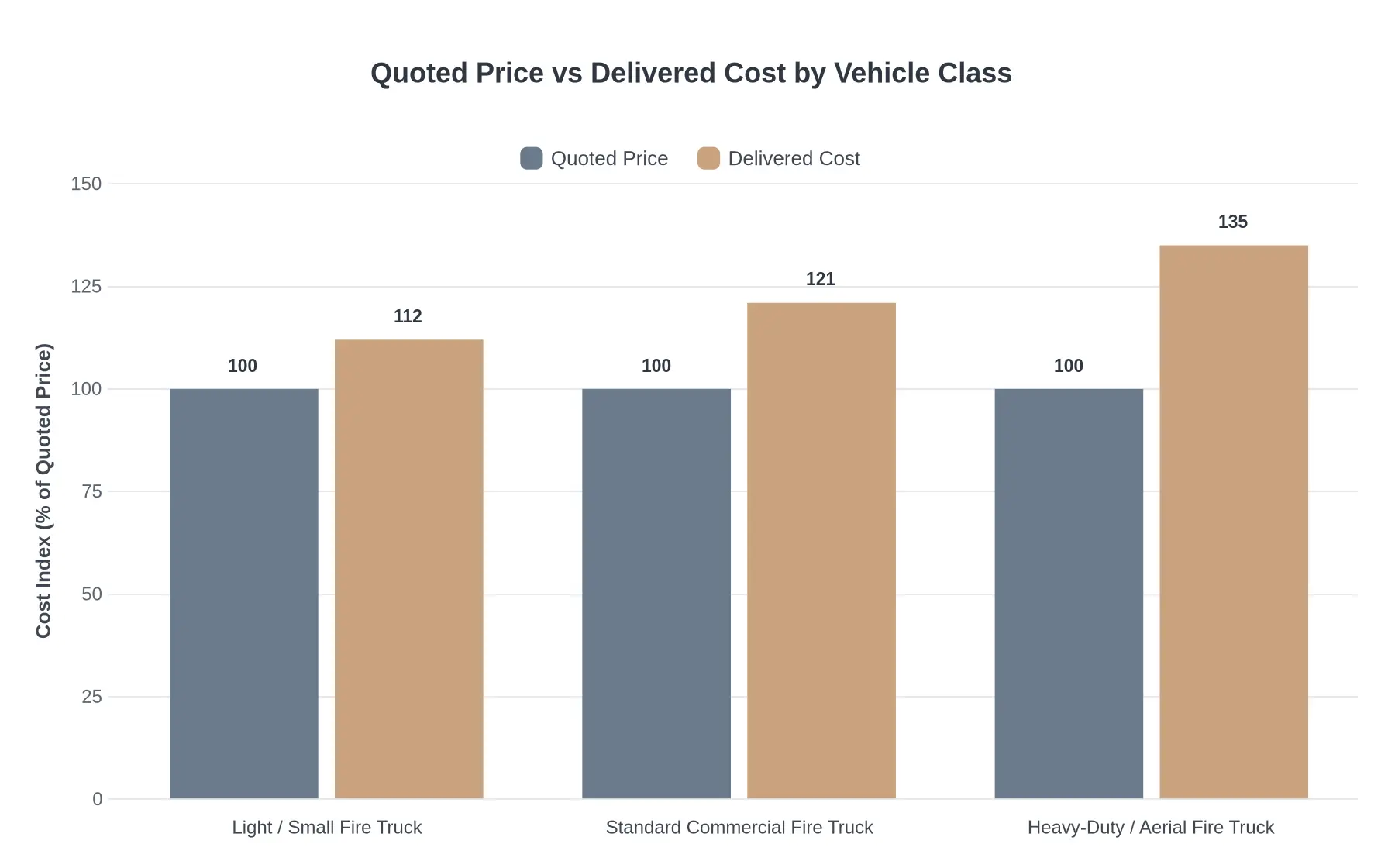
A light truck finished at 112, about a 12% uplift, because it rides on a compact chassis and often shares a container or a consolidated load. A standard commercial unit landed at 121, roughly a fifth more than the invoice. The heavy-duty and aerial class hit 135, driven by over-length permits, multi-axle escorts, cranes at both ends and far longer commissioning. If you are still choosing a platform, start with the lightest class that meets your response requirement, because that is where the delivered-cost surprise is smallest.
Budget the freight multiplier from day one, not after the PO is signed.
Practical Levers to Control Delivered Cost
Whether you are comparing a single pumper or a fleet of commercial fire trucks, the quote you sign is rarely the number you pay. The controls that keep the final invoice close to the approved budget sit on the buyer’s side:
- Request an itemized quote with named exclusions – ask what is explicitly not covered, so freight, duties, and commissioning never arrive as surprises.
- Confirm the Incoterms before signing – DAP, FOB, or CIF decides who carries freight risk, insurance, and port charges.
- Consolidate multiple units into one shipment – combining trucks and spare parts in a single container trims per-unit freight and handling fees.
- Verify tariff classification early – lock the HS code with your customs broker to prevent reclassification and unexpected duty rates.
- Pre-clear documentation ahead of arrival – prepare invoices, certificates of origin, and permits early to avoid demurrage and storage penalties.
- Budget local inland transport explicitly – include port-to-station haulage, road permits, and escort costs in your delivered cost calculation.
- Negotiate a commissioning package into the purchase price – bundle pre-delivery inspection, operator training, and warranty activation into one fixed figure.
- Reserve a contingency percentage – set aside 5-10% for currency movement, inspection delays, and minor retrofit work on arrival.
Work through that list once per supplier, and the gap between sticker price and what lands at your station becomes visible before you commit.
Building a Delivered-Cost Budget Before You Sign
A delivered-cost budget converts a headline sticker price into the figure you will pay by the time the truck is parked in your bay and ready to respond.
Start with an itemized quote that separates chassis, body, pump, tank, foam system and electronics, because bundled pricing conceals the options that drive shipping weight and volume. Then obtain written freight and marine insurance estimates to your final destination, noting whether the vehicle ships roll-on/roll-off or in a container, since a water tanker configuration changes weight and freight class long before it changes performance on scene. Confirm duties, taxes and clearance fees with a licensed customs broker, as tariff treatment varies with vehicle classification and country of origin.
Price commissioning and training separately, covering pre-delivery inspection, pump and foam testing, radio integration and the operator training days your crew will need, and allow for the longer site-access schedules that typically accompany industrial units delivered into a live plant. Add a contingency allowance, commonly five to ten percent, before you compare suppliers, so that currency movement or a late scope change does not undo the plan. Keep the total cost of ownership in view as well: first-year fuel, maintenance and service coverage sit outside the delivered cost but belong in the same budget.
A complete delivered-cost figure protects capital planning by showing the full commitment before the order is placed, which is the practical difference between a budget that holds and one that needs revisiting.
Frequently Asked Questions
These are the questions that come up most often when a supplier’s price sheet meets the real cost of getting a truck onto a station floor.
What does a brand new fire truck quote typically exclude?
A fire truck quote normally covers the chassis, body, pump, tank and standard equipment at ex-works or FOB terms, which means the truck is priced before it moves. It usually leaves out freight, marine insurance, duties, import taxes, port handling, customs brokerage and commissioning. Optional items such as spare parts kits, extra hose, foam systems and crew training are quoted separately too, so check whether these appear as line items or are simply absent. You can compare typical configurations in the range of commercial fire trucks before requesting pricing.
Are duties calculated on the quoted price or on a CIF value?
In most importing countries, duties and import taxes are assessed on the CIF value, which is the goods price plus freight and insurance up to the port of entry. That means the fire truck quote on its own is rarely the dutiable base, and the landed figure customs uses will be higher. Ask your customs broker to confirm the valuation method and the tariff code applied to your vehicle type before you place a deposit.
How much does commissioning usually add relative to the vehicle price?
Commissioning commonly adds about 3% to 8% of the vehicle price once site work, testing, dealer preparation, registration support and operator handover are counted. Aerials, aircraft rescue units and other technically complex builds tend to sit at the upper end because setup and testing take longer. Treat it as a distinct budget line rather than an unexpected extra.
Who arranges marine insurance and inland transport?
Unless the supplier quotes a delivered, CIF or DAP price, the buyer arranges marine insurance and inland trucking, including port storage, crane lifts and last-mile haulage. Write it into the contract who books the vessel, who files an insurance claim if cargo is damaged, and who pays demurrage if clearance slips. Clear allocation avoids disputes once the truck arrives.
Can delivered cost be reduced by consolidating shipments?
Yes. Shipping a fire truck together with spare parts, hose, nozzles or a second unit in one container or on one vessel spreads freight and port charges across more cargo, which lowers the per-unit figure. Consolidation does not change the duties owed on the vehicle itself, but it does cut handling, documentation and insurance overhead. The delivered cost saving is usually modest for a single large truck and more noticeable on fleet orders with dense accessory loads.