For aircraft rescue and firefighting (ARFF) vehicles, three things decide whether a China airport fire truck wholesale order closes on schedule and on budget: batch inspection, spares kit planning, and port handover timing. None of them appears as a line item on the quotation, which is why all three tend to be under-planned. Each carries its own procedure, paperwork, and cost exposure.
ARFF chassis and airport-grade apparatus come from two very different kinds of supplier: dedicated airside manufacturers and general heavy-truck builders that adapt a commercial platform. Buyers can compare body types, foam systems and drivetrain options in our airport fire truck product range before building a shortlist. After that, the specification matters less than how the order is executed. Pre-shipment inspection checks that the delivered unit matches the technical agreement; batch inspection checks that units in a multi-unit order are consistent with each other; and a properly planned spares kit determines whether the vehicle stays in service after commissioning. Port handover timing, which follows from the FOB or CIF terms you sign, decides demurrage, insurance, and what the vehicle finally costs landed at your airfield.
What follows is the procedure, not a product pitch: how to define and verify inspection lots, what a serviceable spares kit should contain, and how to sequence delivery and handover so that risk and cost stay under your control from contract signature to commissioning.
Table 1. Batch inspection criteria for airport fire trucks (ARFF), mapped across the export manufacturing cycle.
| Inspection Stage | What Is Verified | Reference Standard / Document | Pass Criteria | Buyer Action on Failure |
|---|---|---|---|---|
| Pre-production material check | Chassis VIN and build sheet, steel plate and tank material certs (stainless / GRP), pump and foam-proportioner nameplates, hose and foam concentrate batch numbers, full component traceability against the approved BOM | Approved BOM and spec sheet, supplier mill certs (EN 10204 3.1), ISO 9001 QMS records | All materials match the approved BOM; certs are present, legible and authentic; no unapproved substitutions | Raise an NCR; quarantine the non-conforming lot; require alternative sourcing or written deviation approval before work continues |
| In-process chassis and pump assembly check | Subframe welds, chassis mounting, PTO and driveline, pump alignment, plumbing and valve routing, foam tank baffles, electrical and CAN-bus integration, torque logging | Build drawing set, welding procedure (WPS), NFPA 1901 / 414 or EN 1846 assembly specs | Weld NDT pass; pump aligned within OEM tolerance; no leaks at pressure test; torque values recorded | Halt the line; rework or re-weld to procedure and re-inspect; escalate to a full lot hold on repeat defects |
| Pre-shipment functional test (pump flow, foam proportioning, monitor reach) | Pump flow and pressure at rated RPM, foam proportioning accuracy (%), monitor / water cannon reach and elevation, tank fill and dump rates, dry vacuum primer, emergency shutdown | NFPA 414 / 1901, EN 1846-3, factory FAT procedure, buyer’s ITP | Rated flow within +/-5% and rated pressure achieved; foam ratio within +/-10% of set point; monitor reach meets spec; all functions pass | Withhold final payment or release certificate; require repair plus full re-test; appoint a third-party pre-shipment inspection witness |
| Dimensional and weight verification against HS code / shipping spec | Overall L x W x H, wheelbase, GVW and axle loads, ground clearance, turning radius, container / Ro-Ro suitability, HS code classification (e.g. 8705.30) | HS nomenclature (8705.30), shipping spec and packing list, port and road regulations, drawing dimensions | Dimensions and weights within declared tolerances and shipping-mode limits; HS code consistent with the built configuration | Reclassify the HS code; revise the packing and shipping plan; adjust the freight booking; correct documents before export |
| Documentation review (CO, test reports, inspection certificate) | Certificate of Origin (CO), FAT / SAT test reports, third-party inspection certificate, CE / ISO conformity, warranty statement, spare-parts list, operating and maintenance manuals | Contract documents, Incoterms (FOB / CIF), chamber-of-commerce CO, ISO / CE conformity, buyer’s inspection agency (SGS / BV / TUV) | Complete, consistent and legible documents; names, quantities and HS codes match the goods; certificates endorsed by the issuing authority | Block shipment; request corrections and reissue; verify authenticity; release only when documents match the physical goods |
Batch Inspection: Sequencing, Sampling, and Deviation Control
Order the quality gates before the first unit ships. A factory acceptance test (FAT) is the deepest technical checkpoint, because it happens at the manufacturer’s plant with the engineers still on site: pumps, foam proportioning, monitor flow rates, boom reach and electronics are run under load, and defects can be corrected there rather than after shipping. A pre-shipment inspection then confirms that the finished, packed unit still matches the approved configuration after final assembly, painting and road testing. On multi-unit China airport fire truck wholesale orders, apply the FAT to each chassis rather than the first one only. Assembly discipline tends to drift after the pilot build, and treating that first unit as proof for the rest of the batch is how buyers end up finding problems at their own airfield.
Sampling matters most on fleet orders. Inspect 100% of units for safety-critical systems – brakes, foam tanks, boom integrity – and use AQL-based sampling for cosmetic items such as decals and seating. On follow-on units, random sampling of 20-30% of the batch is workable, provided that a single failure triggers re-inspection of the entire batch inspection lot.
Log every deviation on a numbered non-conformance report (NCR) with photo evidence, serial numbers, and a defined corrective-action window. Without that record, withholding a retention payment or recovering rework and freight costs is hard to justify; with it, the claim is straightforward.
A supplier-issued certificate of conformity (CoC) shows that the paperwork was completed, not that the hardware matches it. An independent third-party inspector removes that conflict of interest. Verify critical assemblies directly: inspect the foam proportioning skid and monitor package against the specified foam fire truck build, and confirm that the accompanying fire truck spare parts kit is complete before release.
Takeaway: match the inspection to the equipment class. A fast-attack ARFF vehicle, a foam tender, and a logistics truck fail in different ways and with different consequences, so scale the test depth, sampling rate, and documentation to the risk each class presents.

The schematic maps the five stages a wholesale airport fire truck order passes through before release: order confirmation, material check, in-process check, pre-shipment functional test, and documentation release. Because the gates run in sequence, a defect caught at the material check does not travel downstream into a finished ARFF chassis. When you audit a supplier’s quality assurance discipline, this is the flow to ask them to walk you through stage by stage.
What a Standard Airport Fire Truck Spares Kit Should Include
How quickly an ARFF vehicle returns to service after a fault depends on what is sitting on the shelf, so treat the spares kit as a readiness asset rather than an accessory. Specify each line against the truck BOM and the OEM service schedule, and map it to a verified part number before shipment. Buyers sourcing the wider airport fire truck parts range can use the categories below as a starting list.
- Consumable wear parts – seals, gaskets, and filter elements wear on predictable service intervals. Stock enough to cover the first 12 months of scheduled maintenance so you are not air-freighting replacements.
- Pump and foam-proportioning spares – impeller wear rings, proportioner diaphragms, and check valves. Foam-system faults are one of the most common causes of an ARFF vehicle sitting out of service.
- Monitor and nozzle assemblies – a spare deck monitor, bumper turret nozzle, and O-ring kits. These are high-cycle components exposed to debris and thermal stress.
- Braking and tyre components – brake pads, air-dryer cartridges, and axle-matched tyre sets, ordered to the vehicle specification so braking stays within the manufacturer’s tolerances.
- Electrical and sensor spares – fuses, relays, control modules, and level and pressure sensors. Most are supplier-specific, and local sourcing is unreliable in most importing markets.
- Hydraulic hose and fittings – pre-crimped hose assemblies and adapters. A hydraulic leak on a boom or pump circuit cannot be repaired in the field without correctly matched fittings.
- Fasteners and mounting hardware – grade-matched bolts, clamps, and vibration mounts. These preserve torque integrity on pump, monitor, and boom installations.
- Quick-reference spares inventory sheet – map every part number to the truck BOM so procurement can reconcile stock against the build documentation at pre-shipment inspection and after port handover.
A practical kit usually runs 30 to 60 line items. Stocking slow-moving assemblies ties up capital and risks shelf-life expiry on elastomers; running short on a critical sensor extends downtime. Start from the OEM recommended quantities and adjust for local lead times.
Port Handover Timing: How Early Coordination Controls Cost
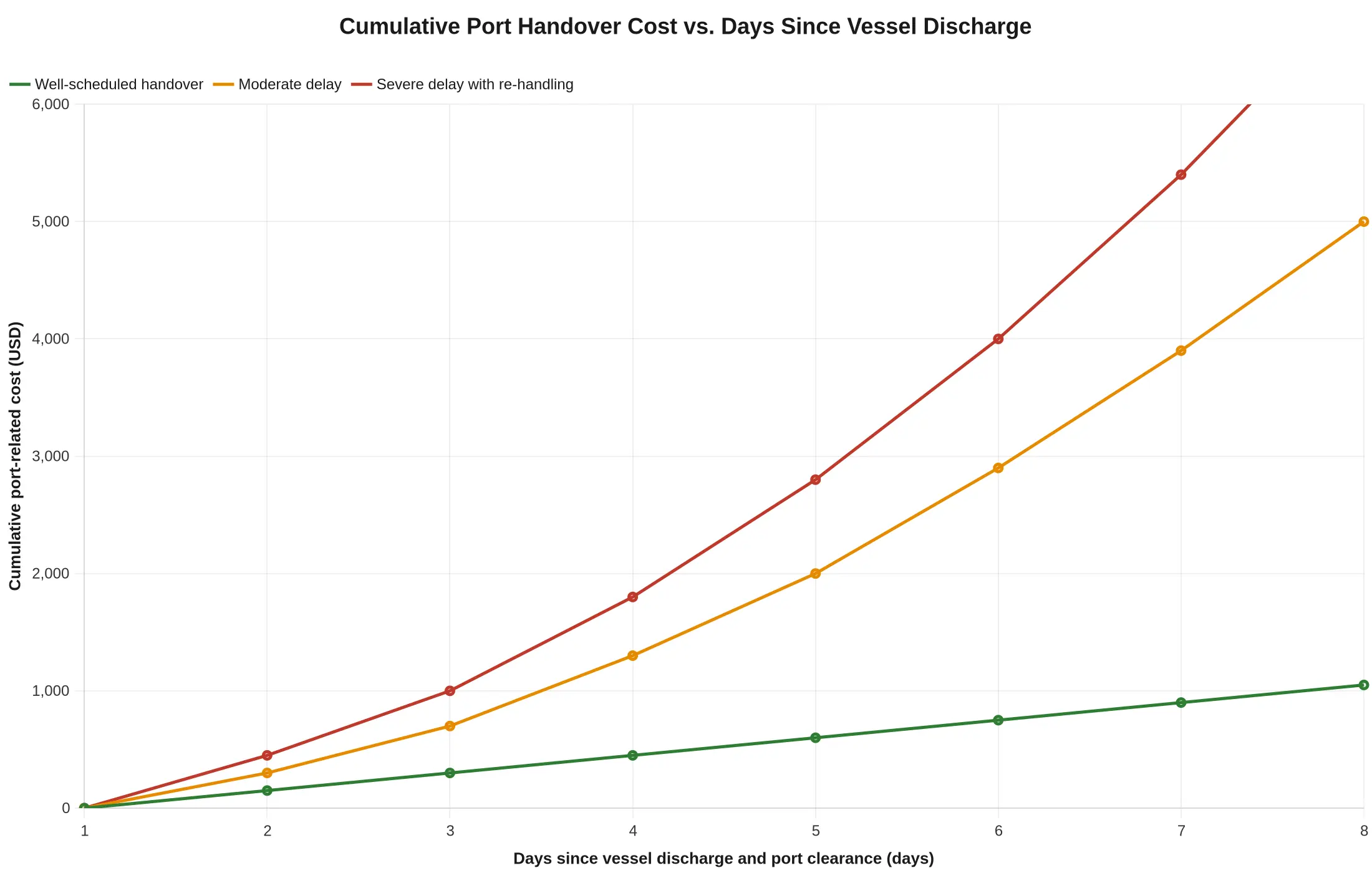
The cost clock starts when the vessel berths and your ARFF unit is craned onto the quay. Demurrage, terminal storage, and re-handling charges do not arrive as a single invoice; they add up day by day until the vehicle is cleared, released, and driven out of the port. The chart below models three handover scenarios over a standard discharge-and-clearance window.
Reading the Curves
The x-axis is days elapsed since discharge; the y-axis is cumulative port-related cost in USD.
- Well-scheduled handover – documents are pre-cleared, the bonded truck is pre-booked, and the port release is lodged before the ship berths. Cost stays almost flat because the unit exits within free time and never enters storage.
- Moderate delay – a missing inspection certificate or a late HS-code ruling pushes the unit past free time. Demurrage starts, and storage accrues daily.
- Severe delay with re-handling – the unit is moved to a secondary yard and repositioned later. That extra handling roughly doubles the slope of the curve, compounding every day of delay.
Why the Gap Widens So Fast
Port costs are not linear. A well-orchestrated handover of one heavy unit can close out near USD 1,000 for the whole window. A five-day overrun on the same vehicle can reach USD 5,000 to USD 7,000 once demurrage tiers, nightly storage, and yard-to-yard transfers stack up. The slope steepens once free time expires, so each additional day costs more than the one before it.
| Scenario | Day 4 cumulative | Day 8 cumulative | Cost driver |
|---|---|---|---|
| Well-scheduled handover | 450 | 1,050 | Light handling only |
| Moderate delay | 1,300 | 5,000 | Demurrage + storage |
| Severe delay with re-handling | 1,800 | 7,000 | Re-handling + extended storage |
Practical Coordination Steps
For imported airport fire trucks, most of this cost is avoidable through work done before the vessel sails:
- Confirm the pre-shipment inspection report and HS classification are locked before departure, so customs clearance is a formality rather than a negotiation.
- Pre-arrange the onward bonded transport and confirm the port release authorisation in writing at least 72 hours before ETA.
- Align the port-handover milestone with your inspection window, so the released chassis goes straight to the acceptance team instead of sitting in a holding yard.
Every day saved between berthing and release is a day of demurrage and storage that never gets charged.
Aligning FOB/CIF Terms with the Port Clearance Window
Getting a batch of ARFF vehicles off the quay starts well before the vessel berths. Under FOB, the buyer books the freight and risk passes when the cargo is loaded on board at the load port, so the nominated forwarder has to be locked in weeks ahead. Under CIF, the supplier arranges carriage and insurance, but the buyer still owns the clearance clock at the destination port. Either way, the term you sign decides who pays demurrage and who carries the exposure if documents arrive a day late. On multi-unit airport fire truck wholesale programs, that one clause sets the whole downstream logistics schedule.
Pre-Shipment Documentation and HS Code Classification
Most clearance failures trace back to documents rather than trucks. Every unit in a China airport fire truck wholesale order needs its HS codes confirmed before the container is sealed, because firefighting chassis, pumps, foam proportioning systems, and aerial booms can fall under different classifications and attract different duty rates. Schedule pre-shipment inspection so the certificate reaches your broker rather than trailing the vessel. A mismatched invoice description, a missing certificate of origin, or an unresolved HS code will hold the release and start storage charges.
Inspection Certificates, Inland Booking and the Cost Mechanics of Delay
The inspection certificate has to be dated so it is still valid when the vessel arrives: run it too early on a delayed shipment and it can expire, run it too late and the cargo sits. Book inland transport before discharge, not after, because hauliers and low-bed trailers for oversized ARFF units are in short supply. This is where the schedule turns into money. Demurrage and terminal storage compound daily past free time, and they climb much faster than the daily value of a single truck. Whether you route standard bodies through special fire truck configurations or custom airside rigs, that accumulation curve is the real penalty for poor scheduling.
Timing Is Risk Transfer
Timing and risk transfer are the same question. Risk passes to the buyer when the cargo is loaded on board at the load port, under both FOB and CIF; what differs is who arranges and pays for the main carriage and insurance. From that point, liability, insurance responsibility, and cost exposure are yours. Treat the clearance window, the pre-shipment inspection, the HS codes, and the inland booking as one plan, and the handover stays on your terms. Miss one link and you absorb demurrage, storage, and damage risk that was never priced into the deal.
Frequently Asked Questions for Procurement Teams Sourcing ARFF Trucks
What should batch inspection verify on an ARFF order?
Batch inspection confirms that every unit matches the approved specification before it leaves the factory: chassis and engine serial numbers, pump and foam-proportioner performance, monitor reach and flow, tank capacity and material, and compliance with NFPA 414 or whichever standard the contract names. It also ties each vehicle to one pre-shipment inspection report, so serial numbers, test data and packing lists stay consistent across the order.
What should a spares kit contain, and how is it sized?
A spares kit should cover fast-moving wear parts and mission-critical components: filters, belts, hoses, seals and O-rings, foam-proportioner parts, pump valves, monitor nozzles, lamps, fuses and relays, plus a gasket and fastener set. Size it by fleet count, duty cycle and replenishment lead time. A common rule is one kit per three to five vehicles for a two-year operating window, with proportioner parts and similar critical items held at one spare per truck. Buyers can build wider coverage from a fire truck parts catalog.
How does port handover timing affect landed cost?
Port handover timing drives demurrage, storage and detention charges. If the container or RoRo unit arrives before the buyer’s customs broker is ready, the terminal’s free-time clock runs and daily fees start once it expires. Line up a cleared customs entry, ready inland trucking and a confirmed berth, and the unit stays inside its free period instead of accruing avoidable storage cost. Late port handover also pushes the delivery date and can trigger demurrage on the vessel side.
Which HS codes and documents matter for clearance?
ARFF and airport fire trucks are normally classified under HS heading 8705.30 for fire-fighting vehicles. Clearance typically requires the commercial invoice, packing list, bill of lading or CMR, certificate of origin, and the pre-shipment inspection certificate. Some markets also ask for product conformity certificates. Always confirm the exact HS codes with your customs broker, because a wrong classification can change duty rates and slow release.
How do FOB and CIF change risk transfer?
Under FOB, risk transfers when the goods are loaded on board at the Chinese port, and the buyer arranges and insures the main carriage. Under CIF, the seller arranges freight and insurance to the destination port, but risk still transfers at the loading port, not at delivery. In both cases, confirm that insurance covers the full transit and that acceptance testing or pre-shipment inspection at origin is settled before risk passes.
| Term | Who arranges freight | Who insures | Risk transfers |
|---|---|---|---|
| FOB | Buyer | Buyer | On board at load port |
| CIF | Seller | Seller | On board at load port |
Bottom line: lock down batch inspection and pre-shipment inspection before payment, plan the spares kit around real duty cycles, and sequence port handover against your customs and trucking schedule to keep landed cost predictable.
Closing Summary: Three Controls That Protect Every Wholesale Order
Sourcing through China airport fire truck wholesale channels comes down to three things you can control before the vehicle leaves the factory.
Batch inspection. A structured pre-shipment inspection confirms every unit matches the agreed build spec before it leaves the factory: pumps, foam proportioning systems, chassis tolerances and documentation. A deviation caught at the plant costs far less to fix than one found after arrival, and it keeps your ARFF certification timeline intact.
Spares kit planning. Ordering a genuine spares kit alongside the vehicles avoids the scramble that follows a first-year component failure. Bundling consumables, wear parts and critical spares into the original shipment often improves unit pricing and removes a second freight cycle.
Port handover timing. Aligning FOB/CIF terms with realistic production and inspection dates keeps demurrage, storage and schedule penalties out of your landed cost. Clear handover milestones make the risk-transfer point unambiguous for both parties.
Write all three into the supply contract as measurable clauses – inspection criteria, spares list, handover dates – so accountability is documented rather than assumed. Explore our ARFF aircraft rescue and firefighting vehicles and airport fire trucks to see how a vetted China airport fire truck wholesale partner supports each control from purchase order to final delivery.