A chassis spec that misses the body it will carry is an expensive mistake to find at the upfit bay. When a fire truck chassis for sale is ordered without matching GVWR, cab-to-axle (CA), and pump module fit to the intended body and equipment, the finished truck ends up with overloaded axles, weight sitting in the wrong place, and rework that pushes delivery back by weeks.
The three specs are interdependent. GVWR caps the legal operating weight and sets how it divides between steer and drive axles. Cab-to-axle fixes the clear frame space behind the cab, which limits body length and where components can sit. Pump module fit is the check that the pump, plumbing, and mounting hardware actually bolt to the frame without eating into load capacity or service access.
Dealers and upfitters, emergency vehicle builders, and municipal procurement officers can work from the same numbers here to read a spec sheet, ask suppliers better questions, and catch a mismatch before the order goes in — whether the build is a standard pumper or a heavy-duty fire truck chassis with a larger apparatus package.
What GVWR Means on a Fire Truck Chassis
GVWR (Gross Vehicle Weight Rating) is the heaviest the completed apparatus may legally weigh, as certified by the chassis manufacturer. It covers the chassis, cab, body, water, foam, equipment, and crew together. Frame rails, springs, axles, brakes, and tires are all sized for that one number. Anything bolted or pumped onto the rig counts against it.
GVWR vs. GAWR, Curb Weight, and Payload Capacity
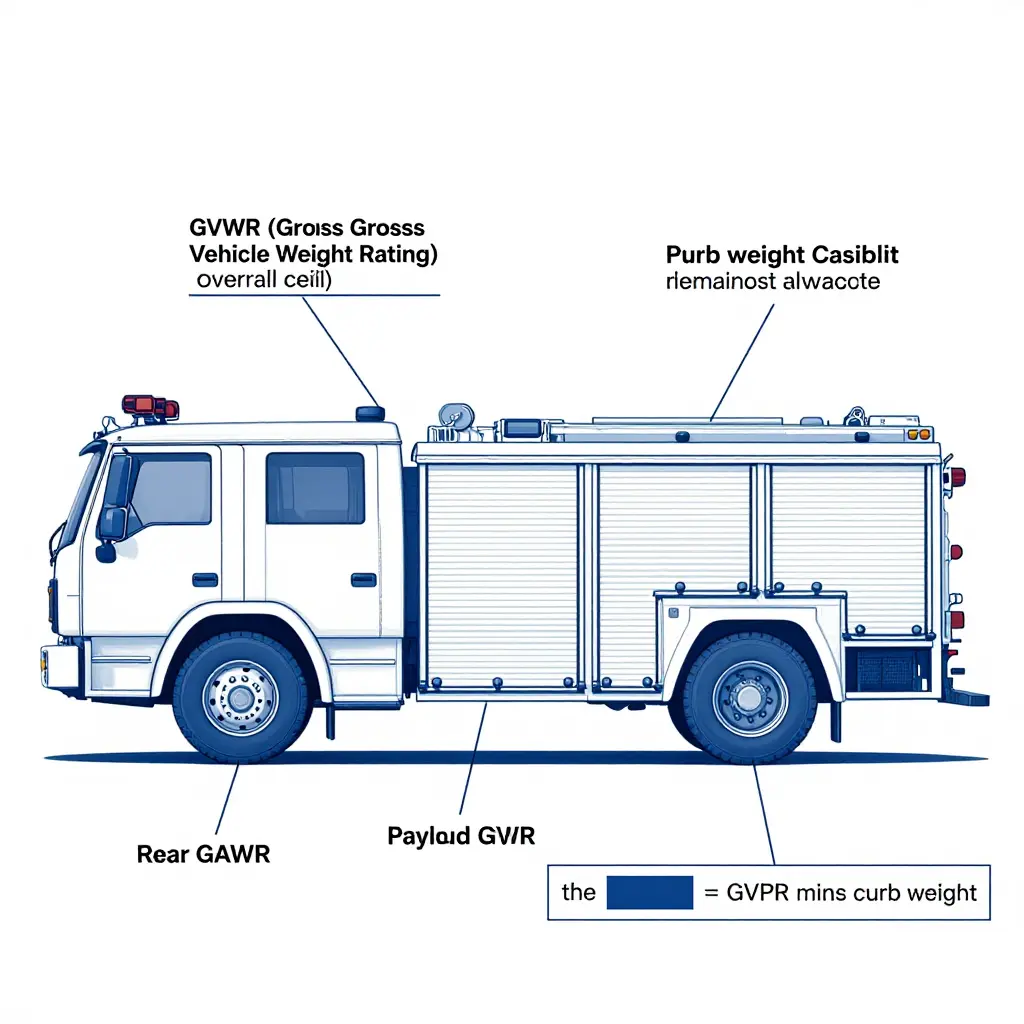
GVWR is the ceiling; the ratings underneath it are what hold the truck up. GAWR (Gross Axle Weight Rating) is the most one axle system may carry, and a truck’s GVWR cannot exceed the sum of its front and rear GAWRs. Curb weight is the apparatus as delivered — fuel, fluids, and standard equipment included. Subtract curb weight from GVWR and you get payload capacity: the allowance left for water, tools, and people. Settle these figures before the first build sheet, not after.
Who Sets the Limit
The chassis manufacturer sets GVWR, not the upfitter. It is fixed during design — frame section modulus, suspension capacity, axle rating, braking performance, tire load index — and printed on the vehicle certification label. A heavier body or a bigger tank will not raise it. That is why specifiers pick the apparatus class first: heavy-duty tandem-axle chassis for high-GVWR pumpers and aerials through heavy-duty fire truck, and lighter frames for tankers and rescues via commercial fire trucks.
How GVWR Scales Across the Lineup
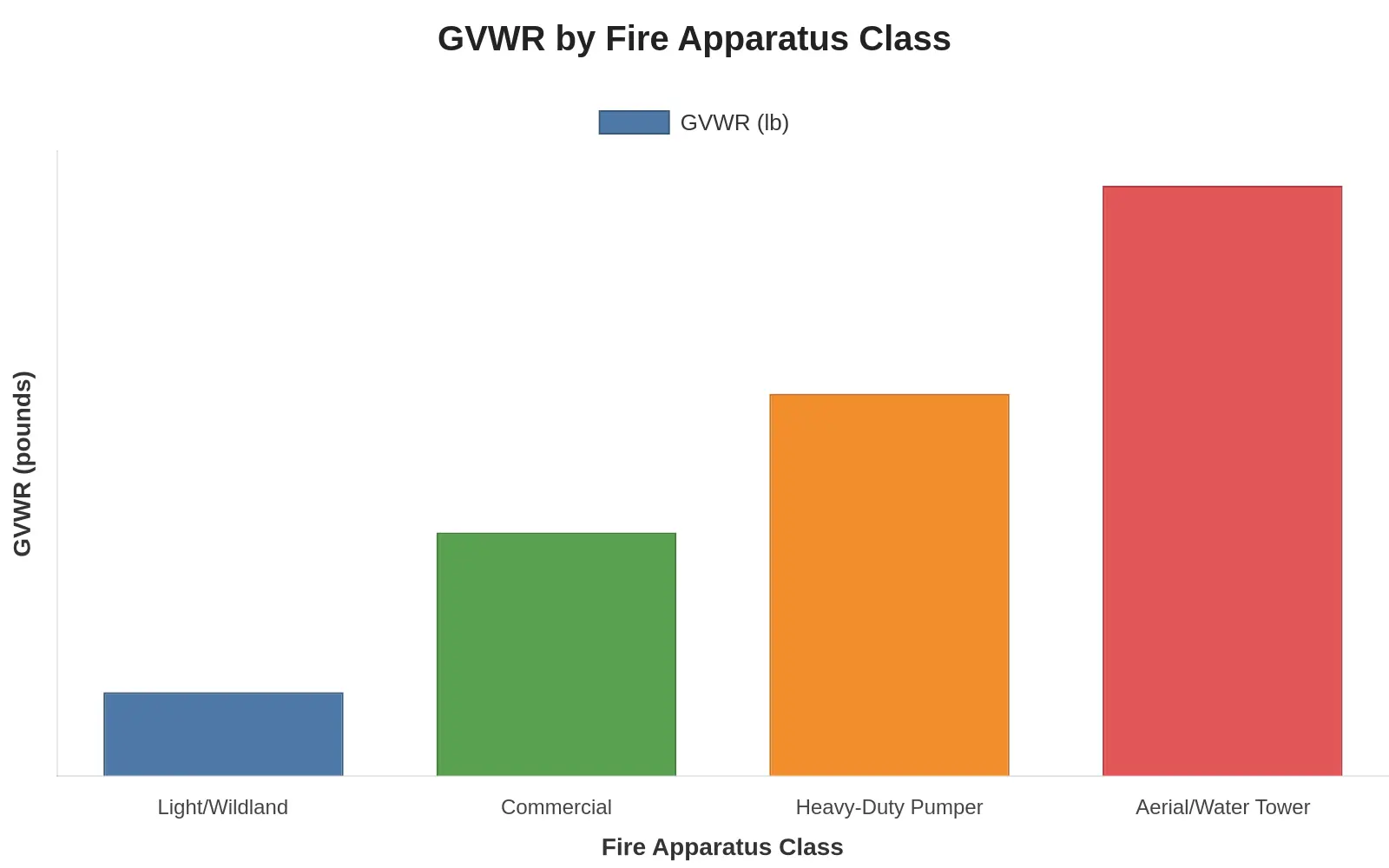
GVWR climbs with apparatus class. Light/wildland chassis run near 12,000 lb, commercial chassis around 35,000 lb, heavy-duty pumpers near 55,000 lb, and aerial or water tower apparatus up to roughly 85,000 lb. Choose a platform whose rating sits comfortably above the completed weight you calculated; that margin is what keeps the truck serviceable over its life.
Consequences of Exceeding GVWR
Overload the truck and every system works past its design limit. The failures show up as:
- Brake fade and longer stopping distances – overloaded brakes overheat and lose friction, especially on long downgrades.
- Premature tire failure – tires running above their load index can suffer sidewall separation and blowouts.
- Voided chassis warranty – manufacturers may deny claims when the completed apparatus exceeds the certified rating.
- Regulatory penalties and out-of-service orders – operating above GVWR violates federal and state weight laws, risking fines and DOT violations.
- Reduced stability and handling – a top-heavy, overweight rig raises rollover risk and degrades steering response.
- Accelerated component wear – springs, frame rails, and driveline parts fatigue early, driving up maintenance costs.
- Altered weight distribution – overloading can exceed an individual GAWR even when total weight looks acceptable.
Check your completed weight against curb weight plus payload, verify each GAWR, and leave margin in the class you choose. GVWR is a boundary, not a target.
The table below maps typical GVWR and axle ratings to common apparatus types. Use it to shortlist chassis, then confirm every figure against the OEM build sheet for the individual chassis before you lock the spec.
Note: GVWR, front GAWR (gross axle weight rating), and rear GAWR are illustrative typical ranges. Final ratings must always be confirmed against the OEM data plate on the individual chassis, as ratings vary by wheelbase, suspension, tires, springs, and optional equipment.
| Chassis Class | Typical GVWR (lb / kg) | Front GAWR | Rear GAWR | Typical Apparatus Application | Recommended Pump Module Size |
|---|---|---|---|---|---|
| Light Commercial | 17,500 – 19,500 lb (7,938 – 8,845 kg) | 6,500 – 7,500 lb | 12,000 – 13,660 lb | Quick-attack, mini-pumper, brush/CAFS, fast-response | 100 – 250 gpm |
| Medium-Duty | 26,000 – 37,000 lb (11,793 – 16,783 kg) | 9,000 – 14,000 lb | 17,500 – 23,000 lb | Commercial pumper, tanker, rescue, command | 750 – 1,250 gpm |
| Heavy-Duty | 42,000 – 50,000 lb (19,051 – 22,680 kg) | 14,600 – 18,000 lb | 27,000 – 31,000 lb | Custom pumper, industrial, foam, equipment truck | 1,250 – 1,500 gpm |
| Aerial-Support | 58,000 – 72,000 lb (26,308 – 32,659 kg) | 18,000 – 20,000 lb | 40,000 – 52,000 lb | Aerial ladder, platform, quint, water tower | 1,250 – 2,000 gpm |
| Airport Rescue (ARFF) | 65,000 – 90,000 lb (29,484 – 40,823 kg) | 24,000 – 28,000 lb | 41,000 – 62,000 lb | ARFF, high-reach extendable turret, foam attack | 1,500 – 3,000+ gpm |
These ranges are broad on purpose. To match axle ratings to ladder weight, water load, and body configuration, browse our heavy-duty fire truck chassis selection.
Cab-to-Axle (CA): The Dimension That Determines Body Length
Get CA right and the pump module drops onto the frame, the body balances over the axles, and nothing fights you later. Get it wrong and you inherit frame flex, weight sitting in the wrong place, and clearance conflicts that no amount of field adjustment fixes.
What CA Actually Measures
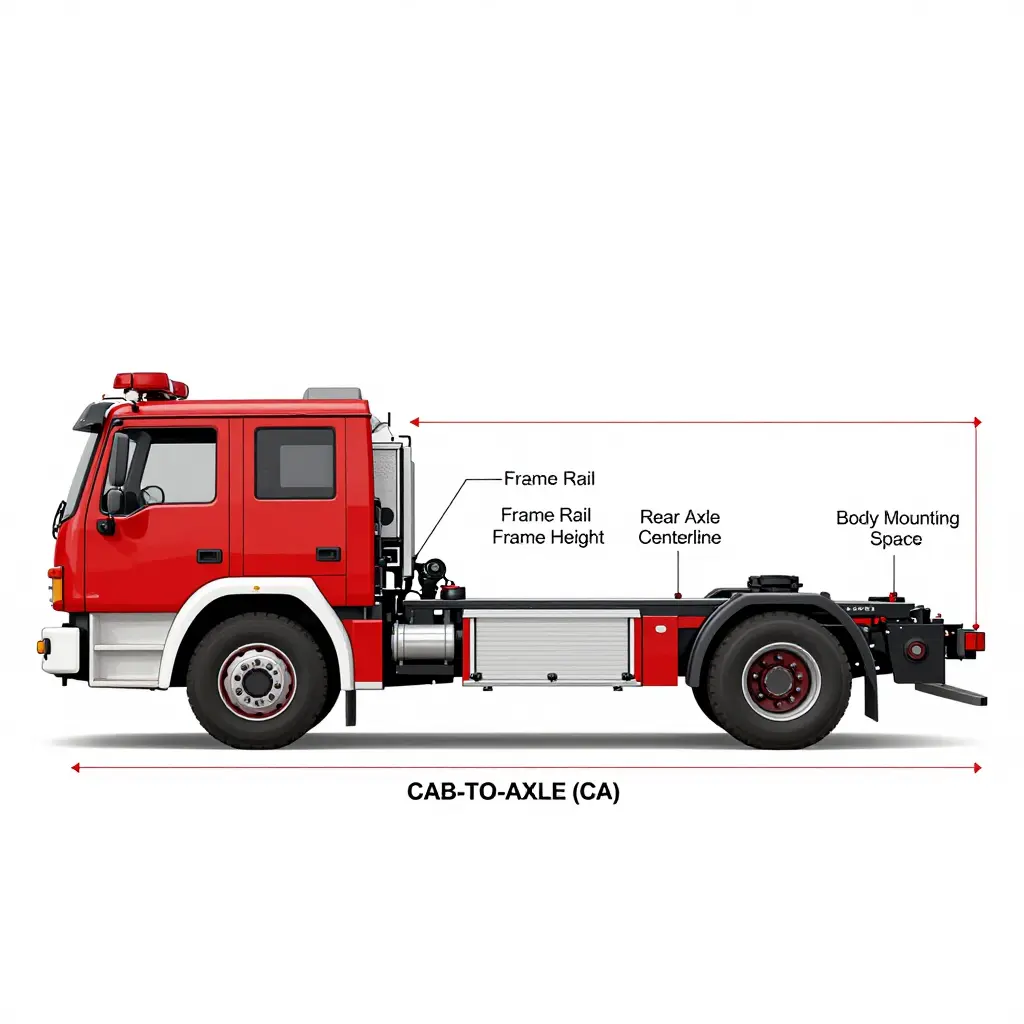
The cab-to-axle (CA) dimension is the horizontal distance from the back of the cab to the centerline of the rear axle, or the center of the tandem axle pair. Measure it along the top of the frame rail, not along the ground; it is given in inches. With GVWR and wheelbase, CA is one of the three numbers in fire truck chassis dimensions that decide whether a given body, tank, and pump package will fit the chassis you are buying.
How CA Determines Body and Pump Module Mounting Space
The pump module, water tank, hose bed, and rear body all sit on the frame rail behind the cab, so CA sets how much length they have to share. A short CA forces a compact module; a long CA allows a bigger tank and a deeper hose bed. These parts bolt to specific mounting points, so even a few inches of CA variance can separate a drop-in install from a costly custom rebuild using fabricated fire truck parts.
Frame Rails: Length, Height, and Cross-Section
CA only works if the frame under it can take the load. Three frame measurements interact with it:
- Frame rail length – must extend far enough rearward to support the full body, with adequate overhang for the rear compartment.
- Frame height – drives the mounting elevation of the pump module and the resulting center of gravity.
- Frame rail cross-section – a 10-inch rail versus a 12-inch rail changes stiffness dramatically. A 12-inch rail resists bending far better, making it the right choice for long CA values with heavy tanks; pairing a long CA with a thin 10-inch rail invites flex and fatigue.
Single-Axle vs. Tandem-Axle: How CA Requirements Shift
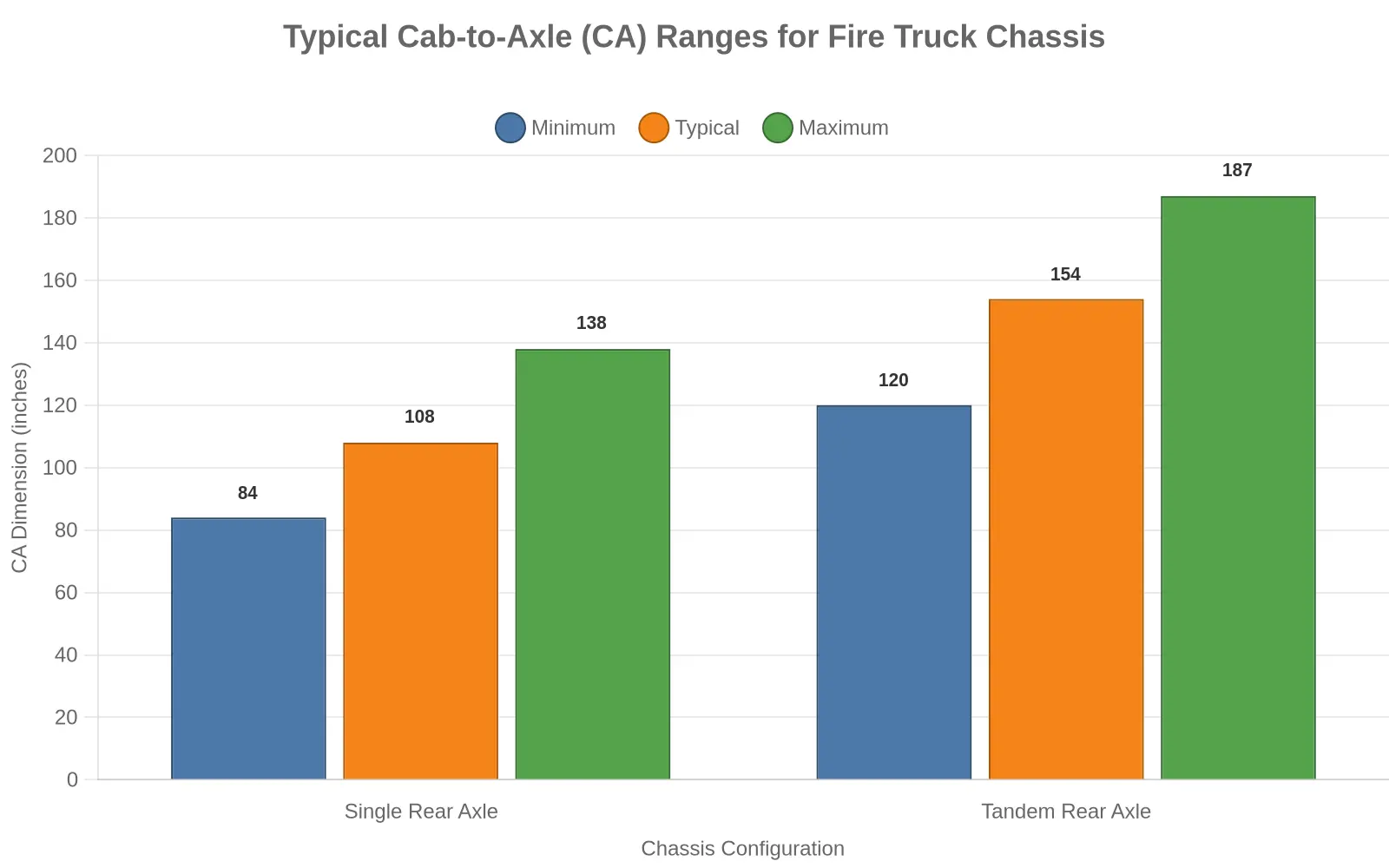
Axle configuration changes what CA you can use. A single rear axle keeps CA short and carries less weight on the rear, which suits compact bodies, light rescues, and nimble urban apparatus such as a small fire truck. A tandem axle supports a longer CA and spreads load across four rear tires, so it can take a larger pump module, a bigger water tank, and a heavier aerial or specialty body. Body length follows from that: spec the axle first, set the CA envelope, then choose a body that fits inside it.
| Chassis Configuration | Typical CA Range | Body-Length Implication |
|---|---|---|
| Single rear axle | 84 to 138 in | Compact body, light pump |
| Tandem rear axle | 120 to 187 in | Large tank, heavy body |
When CA Is Wrong: Three Predictable Failures
A wrong CA rarely fails gracefully. It shows up in three ways:
- Frame stress – a body mounted where the frame expects a different load creates concentrated bending, cracking rails and loosening mounts.
- Poor weight distribution – overlength CA shifts mass rearward, overloading the rear axle and lightening the steering axle, which harms braking and handling.
- Clearance conflicts – too-short CA pushes the pump module into the cab or leaves no room for the driveline and suspension travel.
Measure CA precisely, tie it to frame rail length, height, and cross-section, and check it against the axle configuration long before anyone welds a bracket.
 dimension defines how much body length sits behind the cab. A short CA pushes the module rearward and limits compartment depth. A long CA allows a larger body but lengthens the wheelbase, which changes maneuverability and weight distribution.
Plumbing follows the frame. Crossmembers, fuel tanks, battery boxes, and exhaust all compete for the same corridor, so keep suction and discharge runs short, straight, and shielded from road debris. Map those runs before you lock the body design on a fire truck chassis for sale.
Pump drive type shapes everything else:
| Drive type | Mounting | Best for | Key trade-off |
|---|---|---|---|
| Midship split-shaft | Transfer case in the driveline | High-capacity pumps, short suction runs, low Cg | Uses valuable frame space; adds driveline complexity |
| Front-mount | PTO or engine-driven at the front | Simple bodies, pump-and-roll work | Affects cooling and steering; longer suction runs |
| Transmission PTO | Off the transmission | Light, simple rear-mount pumps | Lower flow capacity |
A midship split-shaft pump sits low in the frame with short suction lines and keeps full engine power available, which is why it handles the largest flows. A front-mount pump suits simple bodies but changes cooling and steering geometry. A PTO-driven pump is lighter and simpler, with lower flow capacity. Foam proportioning adds a tank and pump skid to the same frame space, so builders often start from a dedicated foam fire truck platform.
Balancing capacity inside the payload envelope
GVWR headroom is the hard ceiling. Pump capacity, water and foam tank volume, and compartment layout all draw on the same weight budget. More water means more axle load and a stiffer frame; more compartments mean more body weight and less tank volume.
Keep the front and rear axles under their ratings and the center of gravity low. A heavier pump can force a larger frame section or a tandem rear axle.
Compatibility checks before you order
Before you commit, confirm:
- Engine PTO availability – confirm the transmission offers the required PTO ports and torque ratings.
- Cooling system capacity – verify the radiator and fan can handle sustained pump duty at high ambient temperatures.
- Wiring and air routing – check harness and air-line clearance around the pump, tank, and driveline.
- Frame drilling limits – respect the frame’s no-drill zones near stress points.
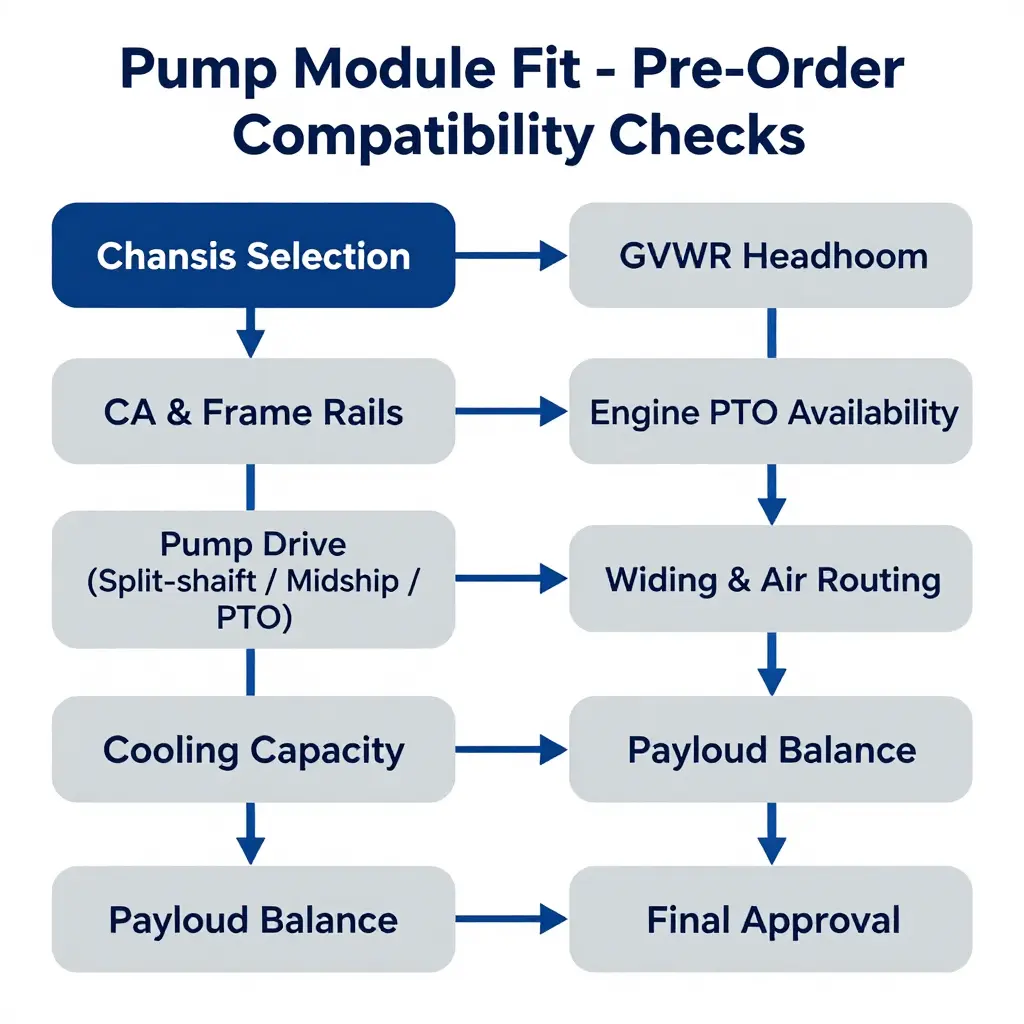
The diagram above gives the order: chassis selection, then CA and frame, then GVWR headroom, then pump drive and PTO, then cooling, wiring, and payload balance. Work through it in that sequence and the pump module should fit the first time.
How Weight Stacks Up Across a Typical Fire Truck Chassis
It helps to see where the mass actually lands before you spec a chassis. The chart below breaks a representative single-axle / tandem commercial build down by component, so spec writers, upfitters, and municipal fleet managers can see how quickly the gross vehicle weight rating (GVWR) envelope fills once the tank and pump module go on.
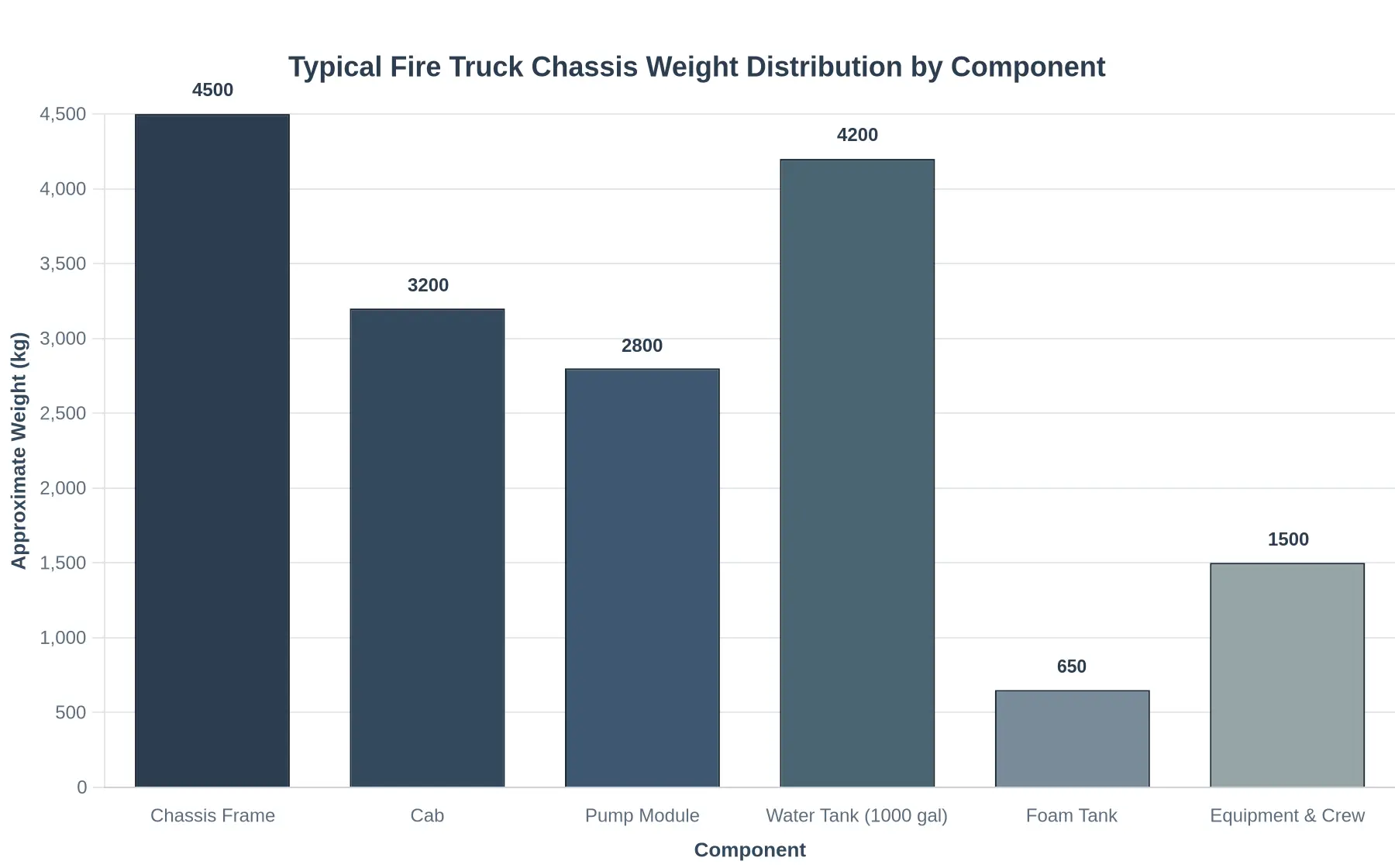
Figure: Component weights in kg on a representative 1,000-gallon pump-and-roll configuration.
Once the water tank and pump module are on, payload headroom drops fast – those two components alone can take roughly half of a mid-range chassis GVWR. Add crew, hose, and foam and there is little margin left for extra equipment or water beyond the tank rating.
Reading the Numbers
The values below are approximate and move with tank material (poly vs. steel), pump capacity, and cab configuration, but the proportions hold across most commercial and custom builds. The frame and cab figures are the unladen baseline before any upfit begins.
| Component | Approx. Weight (kg) | Share of Payload Concern |
|---|---|---|
| Chassis Frame | 4,500 | Baseline – always present |
| Cab | 3,200 | Fixed structure |
| Pump Module | 2,800 | Heavy – drives CA needs |
| Water Tank (1,000 gal) | 4,200 | Largest single load |
| Foam Tank | 650 | Deceptively light until filled |
| Equipment & Crew | 1,500 | Grows with staffing |
The point for procurement officers: every kilogram the pump module and water tank take up is a kilogram unavailable for hose beds, ladders, or larger water volumes. Available payload – not the headline GVWR – is what constrains the spec. If high-volume water delivery is the job, a dedicated tanker-style platform will balance tank size against chassis capacity better than overloading a general-purpose chassis.
Procurement Spec Checklist: Specifying a Fire Truck Chassis
A chassis spec is a negotiation between what the mission demands and what the frame, axles, and drivetrain can safely carry. Buyers who rush the fundamentals usually find the mismatch at the upfit bay. The checklist below follows the order that keeps a build on budget and on schedule.
Define the mission profile. Every chassis decision flows from the duty cycle. Short urban response, long-haul water-tanker routes, and off-road industrial fire truck work load a frame very differently, so document call volume, terrain, response distance, and the equipment the rig must carry before you compare any spec sheet.
Calculate the required GVWR. GVWR (gross vehicle weight rating) is the ceiling you cannot exceed, so add the empty chassis weight, the body and pump module, water or foam payload, personnel, and tools, then build in a realistic safety margin. Underspecifying GVWR is the most expensive error in chassis procurement.
Determine the needed cab-to-axle (CA). CA, the distance from the back of the cab to the centerline of the rear axle, caps how much body and pump module you can mount. Measure the intended body layout instead of guessing, and remember that long ladders and heavy equipment usually demand a longer CA and a stiffer frame.
Choose the frame and axle configuration. Match frame rail thickness, section modulus, and axle ratings to the GVWR and duty cycle you calculated. An aerial fire truck platform and a light rescue have little in common, so do not force one spec across the fleet.
Select the pump drive type. Flow requirement, the space behind the cab, and whether the pump must run while the truck is moving decide between a midship split-shaft, a PTO-driven pump, or a front-mount. The pump drive choice feeds straight back into CA and frame length.
Confirm pump module fit. With the drive chosen, verify the physical envelope of the pump module against the CA, frame height, and mounting points. Check hosebed, tank, and plumbing clearances so the module drops in without cutting or welding surprises.
Verify OEM compliance. The finished configuration has to stay within the original equipment manufacturer’s body-builder guidelines, including weight distribution, driveline angles, and warranty conditions. A non-compliant build can void coverage and leave your department exposed.
Before you buy, ask the seller to confirm load distribution and ride-height data in writing, so every fire truck chassis for sale you evaluate is measured against the same verified numbers.
Dealer, Upfitter, and Global Supply Considerations
For fire apparatus dealers, upfitters, and emergency vehicle builders, the chassis is only the starting point. The real work is securing, documenting, and integrating that chassis with a body, pump module, and specialized equipment. Chassis availability and lead times shape every downstream commitment, from bid deadlines to delivery schedules promised to municipal customers.
When a platform is in short supply or stuck behind a long production queue, upfit schedules slip. Dealers reserve allocations months in advance; upfitters need firm build slots to keep fabrication lines productive. A late chassis pushes body fabrication, pump installation, and final inspection back with it.
OEM body-builder documentation matters just as much. Accurate chassis drawings, cab-to-axle dimensions, frame rail specifications, mounting points, and electrical interface data let upfitters engineer bodies that fit correctly the first time. Incomplete or late documentation forces rework, raises cost, and introduces safety and compliance risk.
A supplier with a broad chassis and apparatus portfolio takes some of that pressure off. One source can match a platform to each mission and provide consistent documentation, dimensional data, and engineering support. It matters most on specialized programs such as ARFF aircraft rescue and fire fighting and airport fire trucks, where integration tolerances and delivery windows are tight.
CIMC Tianda brings more than 20 years of experience and a presence across 75 countries supported by 30+ subsidiaries, giving dealers, upfitters, and builders a dependable supply and engineering partner. That scale helps stabilize chassis allocation, shorten lead times, and get documentation to upfit teams in time to plan.
Frequently Asked Questions: Buying a Fire Truck Chassis
The questions below come up most often when procurement officers and fleet managers source a new chassis.
What is a safe GVWR margin for a new chassis?
Most specifiers leave roughly 10 to 20 percent of the gross vehicle weight rating unused once the apparatus is fully loaded with water, foam, tools, and crew. The reserve absorbs later equipment additions and keeps brakes, springs, and driveline components off their design limit. Work out a realistic dry weight plus fluids and payload before ordering so you know you are inside it.
How do I calculate the cab-to-axle I need?
Cab-to-axle (CA) is the horizontal distance from the back of the cab to the centerline of the rear axle. Start with the length of your body or pump module, add the frame rail length required behind the cab, and subtract any overhang the body permits. Then check that the resulting wheelbase and axle placement support correct weight distribution. A properly specced heavy-duty fire truck chassis lists CA and wheelbase options that match a body plan.
Can a pump module be added to any chassis?
No. Pump module fit depends on frame rail strength, available CA, PTO or engine-driven pump provisions, and reserve payload. A commercial chassis with a light frame or short CA often cannot accept a midship pump without reinforcement. Confirm the chassis is rated for the module’s weight and torque loads before purchase.
What is the difference between GAWR and GVWR?
GAWR (gross axle weight rating) is the maximum load a single axle is designed to carry, stated separately for the front and rear. GVWR is the maximum total weight of the fully loaded vehicle, including chassis, body, fluids, and payload. Stay under both: an axle can exceed its GAWR even when total weight is below GVWR.
How does pump drive type affect chassis choice?
Midship split-shaft, PTO, and front-mount drives each impose different frame, cooling, and driveline requirements. A midship split-shaft pump needs adequate CA and frame strength, while a front-mount pump changes cooling and steering geometry. Settle the drive type early and you avoid costly rework later.
What documentation should I request from the chassis supplier?
Request the build sheet; GAWR and GVWR ratings; wheelbase and CA dimensions; frame section modulus; and the incomplete vehicle document (IVD). The IVD is required when an upfitter completes the apparatus and helps maintain compliance. Also ask for axle, brake, and electrical schematics so your builder can validate the installation.
Comparing these specifications side by side is the fastest way to confirm a fire truck chassis for sale will meet your operational and regulatory needs.
Conclusion: Selecting the Right Chassis Starts with the Spec
Selecting a fire truck chassis for sale comes down to matching a vehicle to a mission. No single specification stands alone: GVWR, cab-to-axle length, and pump module fit have to agree.
GVWR sets the ceiling for every load the apparatus will ever carry, from water and foam to crew, tools, and rescue equipment. Cab-to-axle distance defines the body length available behind the cab, and therefore how much pump, tank, and compartment space can be mounted. Pump module fit confirms that the pump, driveline, and body integrate without compromise on plumbing, torque, or cooling.
| Specification Pillar | What It Governs | Why It Matters |
|---|---|---|
| GVWR | Total loaded weight capacity | Keeps axles, suspension, brakes, and frame within safe limits |
| Cab-to-axle (CA) | Body length behind the cab | Determines mounting space for pump, tank, and compartments |
| Pump module fit | Pump, PTO/driveline, and body interface | Confirms plumbing, torque, and cooling align correctly |
Get the chassis right by holding to three things: a clearly defined mission profile, weight discipline throughout the build, and fitment validated before the order is placed. Skip one and the apparatus pays for it across its entire service life.
To review the complete range of configurations, explore the full fire fighting truck chassis range on cimcfiretruck.com, then contact the team for help specifying a chassis for your department’s operational requirements.