Why Fire Truck Certification Cost Belongs in Your Operating Budget
A fire truck is certified for a set period, then re-verified on a schedule for as long as it stays in service. That makes the certification bill a recurring operating expense rather than part of the purchase price. Budget it as a fixed line and fire truck maintenance cost stops producing surprises in month nine.
Four activities keep a truck certified: pump performance testing, tire age compliance, inspection documentation and record retention. Each one takes labor, shop capacity or desk time every year, whether or not the truck runs a single call this year.
Pump tests and tire age are the two largest recurring drivers. Pump verification comes back on a fixed cycle and costs apparatus downtime, a qualified technician and flow-testing equipment. Tire rules go by date of manufacture, so a truck that has barely left the bay can still need a full set on a calendar deadline instead of a wear deadline.
The rest of this article takes those costs in order: the individual components, the pump test intervals that set the maintenance calendar, the tire timelines that force replacement dates, and a budgeting method that funds both without draining reserves. Fleets that plan tire and pump work together, and buy components from a reliable fire truck parts supplier, tend to flatten the biggest spikes in annual certification spend.
Where the Recurring Money Goes
The shape of the spend says more than the total does. Below, a typical year of compliance cost for a mid-size pumper is split into five categories and sorted by size rather than by how often someone complains about them.
Chart specification
- Chart type: Horizontal bar chart (bars sorted from largest to smallest so magnitudes are read instantly)
- X-axis label: Annual cost (USD)
- Y-axis label: Cost category
- Scale: $0 to $2,000, gridlines every $500
- Palette: Muted slate blue and soft gray, single accent tone, no shadows or gradients
- Data labels: Dollar value printed at the end of each bar
- Do not use: Photography, icons, or decorative background imagery
Data table
| Cost category | Annual cost (USD) | Share of total |
|---|---|---|
| Pump performance testing (labor + water supply) | 1,850 | 32.6% |
| Tire replacement reserve (amortized per year) | 1,600 | 28.2% |
| Operator refresher training | 950 | 16.8% |
| Third-party inspection fees | 850 | 15.0% |
| Documentation and record-keeping | 420 | 7.4% |
| Total | 5,670 | 100% |
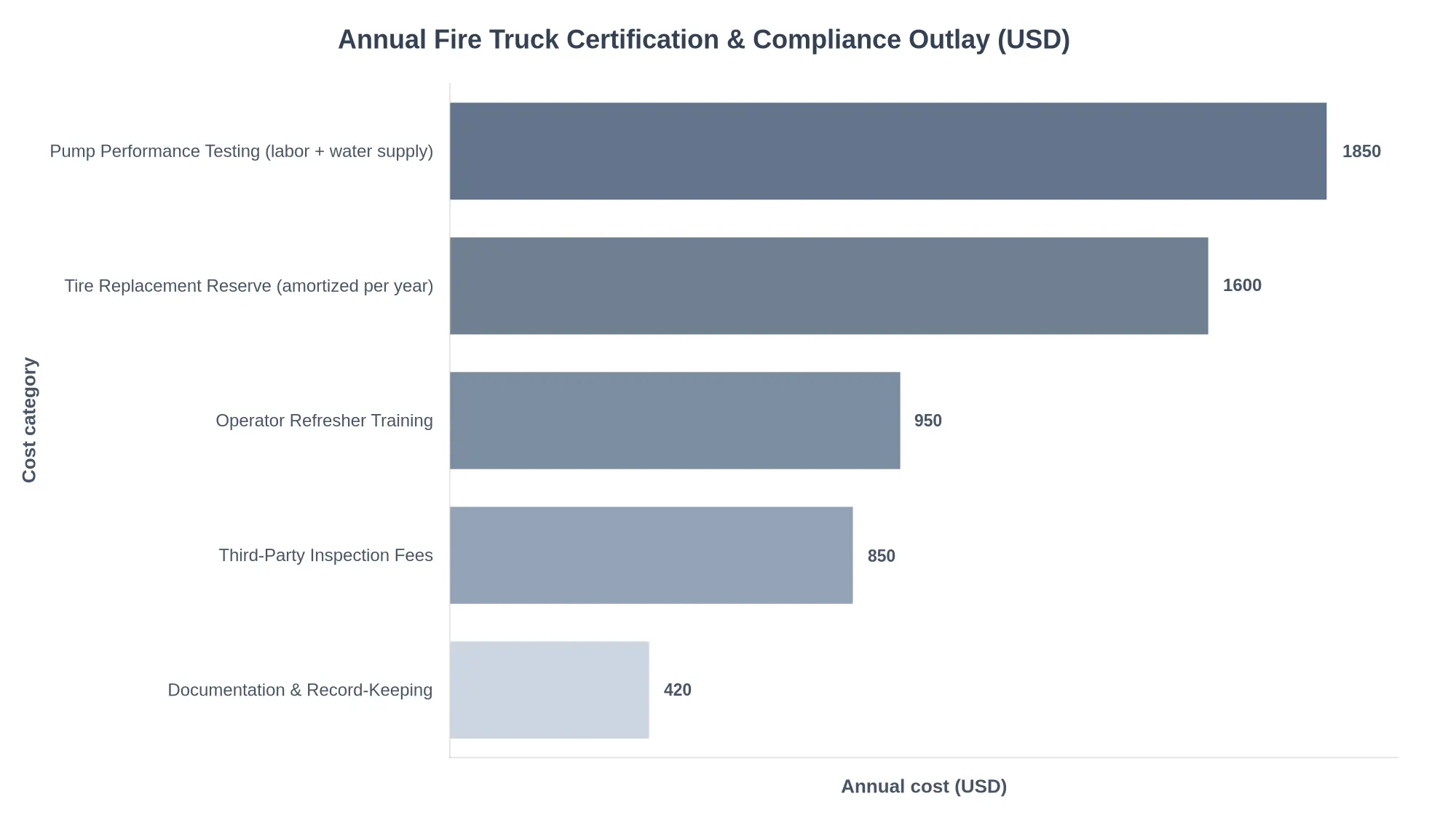
Caption: Pump performance testing and tire reserves typically dominate the recurring certification total – together they account for roughly three in every five dollars.
What the bars tell you
The two largest bars are the two you cannot avoid. An annual pump test needs water and labor, and time-based replacement rules pull a truck once its tires reach their date, tread or no tread. The two smallest bars, inspection fees and paperwork, are usually the first ones owners budget for, because they are the easiest to estimate. Across a fleet, price tires and pump testing per vehicle and carry the rest as fixed overhead; when replacement time comes, a dependable stock of fire truck parts keeps a planned job from turning into a month out of service.
Pump Test Intervals: What the Standards Actually Require
Pump test intervals are not one event on the calendar. They are three layers, each with its own interval, its own paperwork and its own cost, and a working apparatus has to satisfy all three.
Layer 1: Weekly and monthly operational checks (not certified tests)
These are in-house inspections, not performance tests. The weekly walk-around at the pump panel covers leaks at the packing and flanges, gauges sitting at zero with the glass intact, suction and discharge valves cycled through their travel, primer fluid and relief valve settings, and a brief bump from the onboard tank to confirm the pump engages. The monthly check goes further: engage the PTO, pump from the tank for a sustained period while watching that discharge pressures hold, exercise the transfer valve, verify the cooling loop, then drain and inspect the panel. Allow one to two labor hours and the occasional cheap part for worn gauges, packing, and valve components.
Layer 2: The annual pump test (NFPA 1911)
NFPA 1911, the standard for testing in-service fire apparatus, is the benchmark most departments and insurers point to. The annual pump test measures performance rather than appearance. Water comes from a static source or a hydrant, flows through pitot- or meter-equipped discharges, and the pump has to hold rated capacity at the specified net pressures, commonly 100% capacity at 150 psi, 70% at 200 psi and 50% at 250 psi on a single-stage pump, followed by a vacuum test and checks of the relief valve and engine cooling. Every reading goes onto a test form, and that form becomes your evidence of fire pump certification for the authority having jurisdiction, your underwriter and any future resale file.
Layer 3: Acceptance and overhaul milestones (age- and event-driven)
| Trigger | Test performed | Typical duration | Main cost components |
|---|---|---|---|
| New apparatus delivery | NFPA 1901 acceptance test, usually witnessed | Full day | Delivery scheduling, witness fee |
| Pump overhaul or impeller, seal, or packing rebuild | Full performance retest | Same as annual | Same as annual, plus shop hours |
| Transmission, PTO, or drive line repair | Performance retest to confirm pump curve | Half day to full day | Labor, water supply |
| Older apparatus or stricter AHJ policy | Extra witnessed testing or shorter cycles | Varies | Frequency multiplication |
Your authority having jurisdiction can always shorten these intervals or add documentation requirements, so confirm local rules before you lock in a maintenance contract.
Why frequency drives the bill
A certified test is expensive per event for four reasons: labor hours (typically two to four people for part or all of a duty day), water supply logistics (hydrant flow or a tanker shuttle, dump tank, hose lays), third-party witness fees (usually a flat fee per test, so it multiplies straight through with frequency) and downtime (standby coverage, rental replacement apparatus or deferred calls). Routine checks cost little because they consume labor and nothing else.
For a cost-per-year view, multiply per-test cost by tests per year. A witnessed annual test that eats a full crew day, plus water supply and a witness fee, doubles in the labor and witness lines if the AHJ moves you to semi-annual testing, while water supply stays roughly flat per event. Add a monthly pump operation check on top and you have bought twelve smaller events, each modest, collectively real.
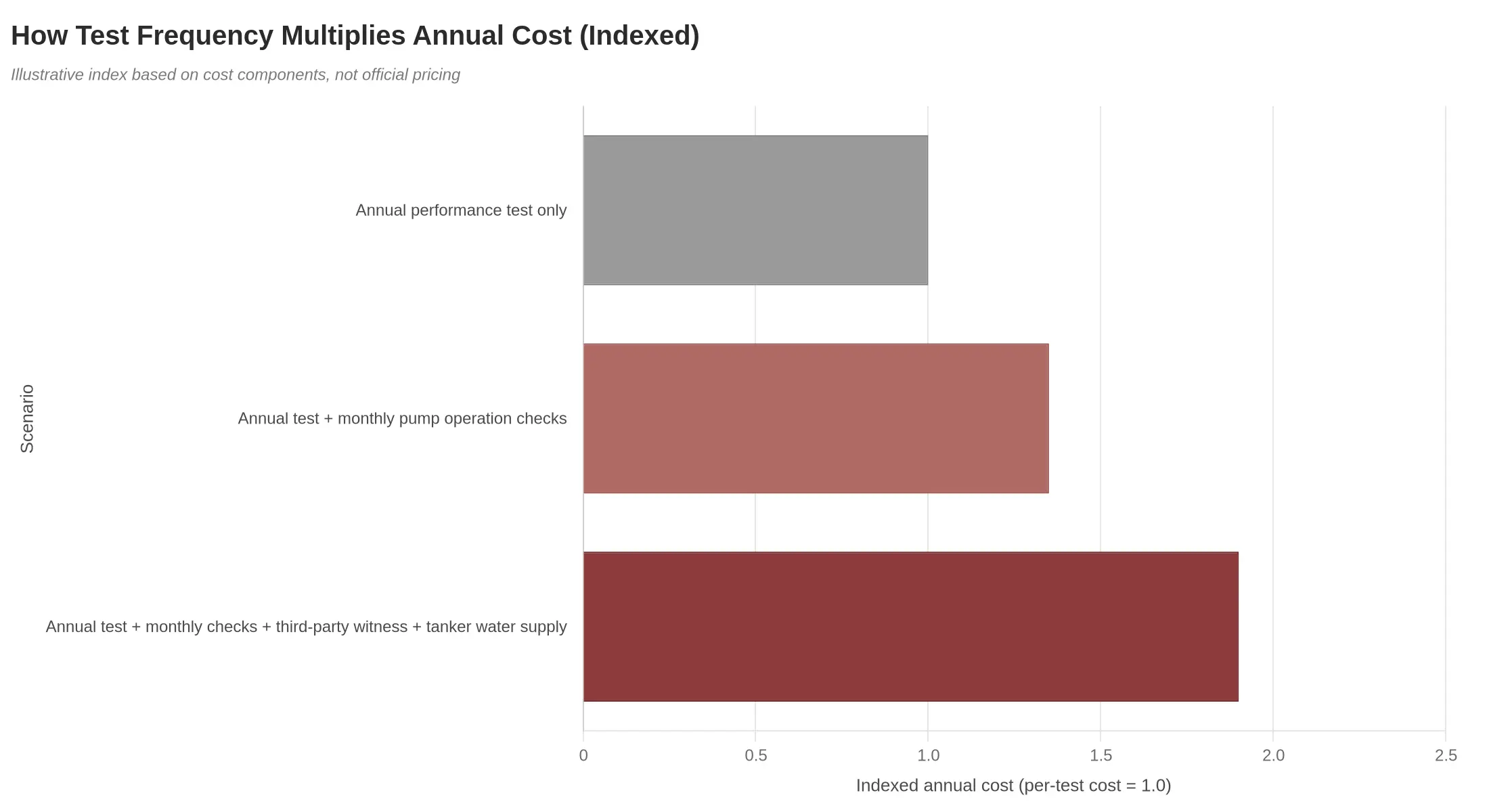
An indexed view, not official pricing: same per-test cost, three different compliance programs.
The practical takeaway
Cutting the annual pump test to save money is a bad trade, and so is skipping routine checks to protect the test line. A neglected packing gland or a stuck relief valve turns a modest test bill into a pump overhaul, and the overhaul lands wherever the truck happens to be standing that week. Better levers: a multi-year test agreement, witness fees bundled across several apparatus, and the annual test scheduled alongside other maintenance so the downtime line is not paid twice. Price the schedule per year rather than per event and nobody at the budget meeting gets surprised.
Standards Comparison: Test Intervals and Age Limits
Before you sign a service contract or set a budget line, put the requirements side by side. The table compares pump testing, service milestones, tire age limits and recordkeeping, and it makes the split between costs that are fixed and costs that scale with apparatus size, usage and duty cycle a good deal easier to see.
| Requirement | What It Covers | Typical Interval or Limit | Cost Driver | Who Usually Performs It |
|---|---|---|---|---|
| Annual pump performance test | Verified flow and pressure at rated capacity, vacuum and priming check, gauge accuracy, relief valve and plumbing inspection | Annually (12 months is the most common cycle; some jurisdictions run a full test every 3-5 years with annual service tests in between) | Rated GPM and pump stages, apparatus class, travel or mobile-lab fees, hose and nozzle setup time | Third-party testing contractor or a certified in-house shop, with the AHJ witnessing |
| Routine pump operation check | Short operating (churn) test, packing glands, valves and drains, primer, water level, visible leaks, unusual noise or vibration | Weekly, and after every use; daily apparatus check before shift | Labor hours, water supply, minor parts and seals | Driver/operator and company officer |
| Pump overhaul or major service milestone | Teardown, impeller and wear ring replacement, bearings and seals, gearbox and driveline inspection, full re-certification | Commonly every 5-10 years or roughly 1,000-2,000 operating hours, or sooner if flow drops below the rated spec | Parts kits, skilled labor hours, downtime, rental or loaner coverage | OEM service center or authorized pump rebuilder |
| Tire age limit | Replacing tires based on date of manufacture rather than tread depth, since rubber ages from the inside out | A 7-year replacement practice is common for critical-service tires; some fleets allow 6-10 years, and several cite a hard maximum around 10 years | Tire size and load rating, number of tires, single versus dual, mounting, balancing and disposal | Fleet maintenance shop or tire dealer using DOT date codes |
| Tire tread and sidewall inspection | Tread depth, cuts and bulges, ozone cracking, bead condition, inflation pressure, lug nut torque | Monthly plus pre-trip checks; common tread thresholds are 4/32 in on steer axles and 2/32 in elsewhere | Labor hours, replacement rate, alignment and suspension wear | Driver/operator daily, shop technician monthly |
| Documentation and record retention | Test reports, repair orders, certification labels, tire date codes, inspection logs, audit file | Retained for the life of the vehicle plus a set period, commonly 3-7 years depending on jurisdiction and insurer | Admin time, records software, audit preparation | Department administrator, fleet manager or the testing vendor |
Use the table as a planning tool rather than a rulebook. Actual pump test intervals and age limits vary by jurisdiction, insurer and apparatus class, and a busy industrial or ARFF unit may need shorter cycles than a reserve engine that runs a few hundred hours a year. Confirm the governing standard with your AHJ and your carrier, then budget against the strictest rule that applies to that fire truck category before committing to a purchase or a multi-year service contract.
How Apparatus Type Changes Your Certification Burden
Two apparatus can carry similar nameplates and still sit at opposite ends of the certification cost curve. Scope explains it: every added system is another component that must be inspected, flowed, loaded or witnessed on a schedule, and each of those steps consumes technician hours, water, fuel and downtime. Buyers comparing quotes for fire fighting trucks tend to compare purchase price alone, when the more useful figure is purchase price plus the certification load the specification locks in for the next decade.
Pump capacity class sets the baseline test load
Rated pump capacity drives annual test effort more than any other single choice. A rated capacity test flows the pump at or near its rating, so water supply scales with the number: a 750 gpm unit can often be tested from a hydrant or a modest draft site, while a 2,000 gpm unit typically needs a large static source, longer hose lays and more people on the nozzle bank. The interval between tests may be identical; the hours per event are not. Higher-capacity pumps also carry more pressure-relief, priming and gauge calibration work, and any failure buys a re-test.
Foam systems add a proportioning verification layer
Foam fire trucks carry a second system that has to be proven, not just inspected. Proportioning accuracy is checked across the flow range, which means multiple test points per event, plus verification of tank-to-proportioner plumbing, flush procedures and compatibility with the concentrate actually carried. The concentrate is consumed during testing, so the medium is a genuine recurring cost and not something that ends at delivery.
Aerial devices carry the heaviest per-event burden
Ladders and platforms need periodic structural and operational verification covering the boom, hydraulics, safety interlocks and load handling. That work generally requires qualified third-party personnel and specialized equipment, and it is usually scheduled as its own event rather than folded into a routine service visit. Of all the apparatus classes, aerials tend to produce the largest single certification invoice per cycle, before the annual maintenance that the elevating structure itself requires.
Water tanks and tank-to-pump performance
The tank itself is simple. Capacity still shapes the cost. Tank-to-pump flow verification, baffle and vent inspection and mounting checks are routine, but filling a 3,000-gallon tank for a test takes more water and more time than a 1,000-gallon tank. Larger tankers also spend more of the test day traveling to and from a fill site, which is where the hidden labor sits.
Industrial and airport specifications stack requirements
Industrial units frequently combine monitors, foam proportioning and fixed suppression, and airport fire trucks built to airport standards may carry foam, dry chemical or dual-agent systems alongside rapid-intervention performance requirements. Each additional agent system adds inspection points, calibration steps and records to maintain, and each one is a candidate for a deficiency finding at the next audit.
Why this belongs in the purchase decision
Matching apparatus class to actual duty cycle is the most reliable way to avoid paying for certifications you will never use. A department running mostly medical calls and light vegetation work rarely benefits from the highest-capacity pump, the largest tank or a full foam system, yet each of those choices adds cost on every certification cycle for the life of the vehicle. Under-specifying cuts the other way: a tanker or aerial that is too small for the job shifts the burden onto mutual aid and water shuttle arrangements. Compare ten-year totals instead of sticker prices, and include purchase price, finance cost and the certification, testing and maintenance events the specification makes unavoidable.
Certification is a running cost, not a date
Most owners treat fire truck certification as a single calendar event: book the test, pass the test, file the paperwork. The clock behaves differently. The moment an apparatus goes back in service, the countdown to the next pump performance test, the next tire age review and the next documentation update is already running.
The money does not leave your account in one lump sum on test day either. It leaks out across the whole cycle: a worn gauge here, a marginal hose test there, a set of tires that ages out while the tread still looks fine. Following the sequence shows where the annual certification spend actually comes from, and how much of it could be planned rather than absorbed.
The loop below draws that sequence as a closed circuit.
The six-stage certification cycle at a glance

Figure 1. The recurring certification cycle. Six stages sit on a single closed loop with no start and no end: in-service duty, routine pump operation check, scheduled pump performance test, tire age and condition review, documentation update, and back to in-service duty. Every arrow is a handoff, and every handoff is where cost can either be controlled or discovered too late.
Node sequence and arrow flow (clockwise):
| Step | Stage | Arrow flow | What it costs you |
|---|---|---|---|
| 1 | In-service duty | Arrow leads to Step 2 | Normal wear, fuel, crew hours |
| 2 | Routine pump operation check | Arrow leads to Step 3 | Minor servicing, seals, gauges |
| 3 | Scheduled pump performance test | Arrow leads to Step 4 | Test fees plus any repair to pass |
| 4 | Tire age and condition review | Arrow leads to Step 5 | Replacement even when tread is good |
| 5 | Documentation update | Arrow leads to Step 6 | Admin labour, records, filing |
| 6 | Return to in-service | Arrow loops back to Step 1 | Downtime exposure, standby cover |
The diagram has no beginning on purpose. The loop closes on itself because an apparatus is never really “finished” being certified; it simply re-enters the cycle a year older, with a little more wear on the parts that decide whether it passes.
Reading the loop as a spending map
The two halves of the circle behave very differently, and that difference is where the planning value sits.
Steps 1 to 3 are reactive. Pump checks and performance tests surface problems at the moment they are measured. When a pump fails to hold pressure you pay for diagnosis, parts and a re-test, often on a compressed timeline, which is the most expensive way to buy anything. Owners who log gauge readings and seal condition between tests turn most of those surprises into scheduled work.
Steps 4 and 5 are calendar-driven. Tire age limits are the classic case of a cost with nothing to do with how the truck looks: a tire can pass a visual inspection and still be out of date by the manufacturer’s own guidance, so a budget that only funds “replace when worn” will come up short every time. Documentation runs the same story in slow motion. It is small, recurring and easy to defer until a compliance review makes it urgent.
Added up end to end, the annual number is rarely driven by the test fee. It is driven by how many stages you discover late. A modest maintenance allowance spread across all six steps, instead of saved for the test, is what keeps a certified fleet predictable.
A practical way to use this diagram
- Walk the loop once a quarter and mark the stage you are actually in, not the one the calendar says.
- Log pump pressure and flow readings between tests so Step 3 becomes confirmation rather than investigation.
- Record tire manufacture dates, not just tread depth, so Step 4 never lands as a surprise.
- Assign one person to Step 5, so paperwork is not the stage that stalls the loop.
If part of your plan involves refurbishing rather than replacing, it helps to know which components decide certification outcomes. Our fire truck parts range covers the pump, valve and wheel-end items that most often decide whether an apparatus passes or goes back into the shop.
The certification cycle is not an interruption to operations. It is the operating rhythm of a compliant fleet, and once it is drawn as a single loop the annual spend reads as a schedule instead of a bill.
Tire Age Limits: The Cost Clock You Cannot Reset
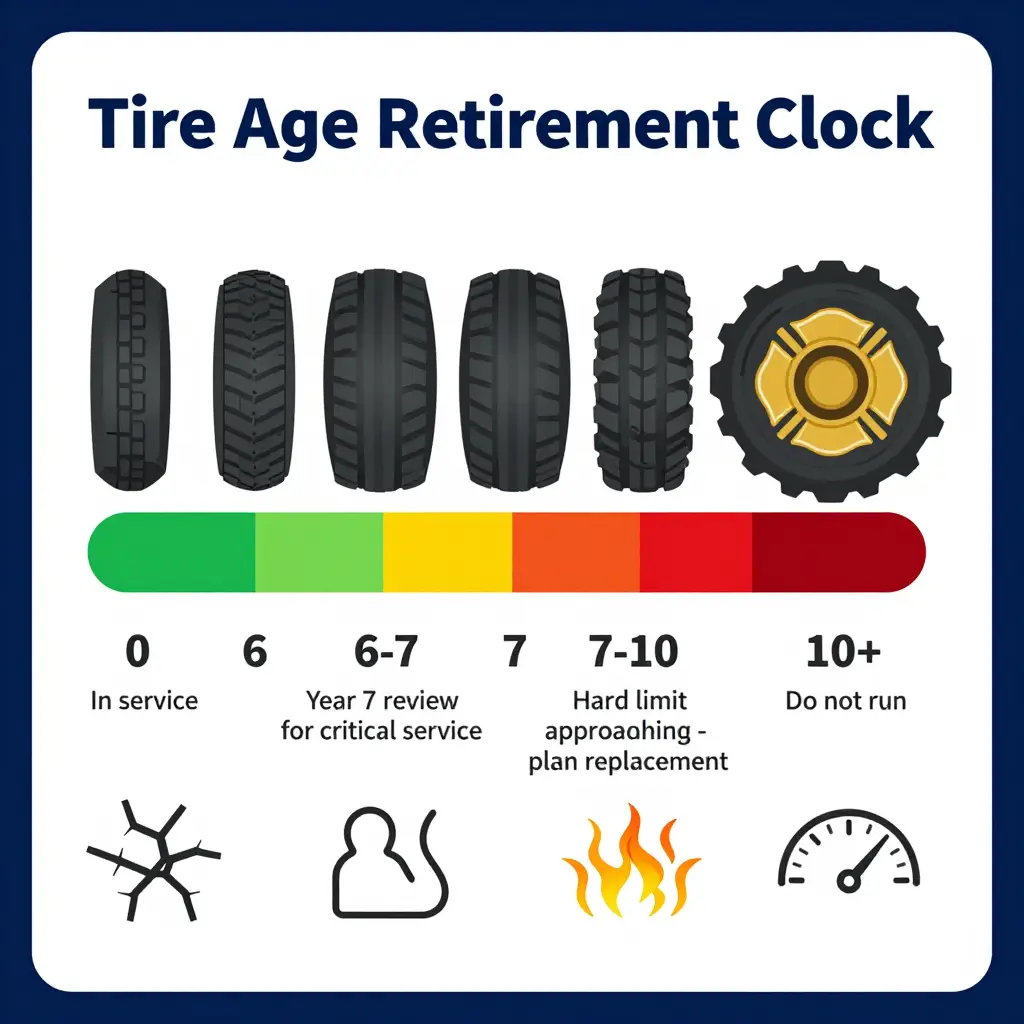
Fire apparatus tires rarely wear out. On a pumper or rescue that logs a couple thousand miles a year, the rubber usually looks serviceable right up until someone crouches down and reads the date code molded into the sidewall. Every tire on the fleet ages whether the truck moves or not, and driving less does not reset the clock. That is what tire age limits come down to.
Why rubber retires on the calendar, not the odometer
- Rubber degradation. Oxidation, ozone, UV exposure and long idle stretches harden the compound and dry out the sidewall. Cracks start small, sit in the shade and grow quietly.
- Sidewall and casing fatigue. The casing carries load whether the truck is rolling or parked. Load cycles, flexing and static flat-spotting weaken the structure from the inside, exactly where nobody looks during a walkaround.
- Heat exposure. Underinflation, brake heat, hot pavement and direct sun all accelerate aging. Heat damage is cumulative and does not reverse.
- Low annual mileage masks aging. A reserve pumper covering 2,000 miles a year can still show 80 percent tread at year eight. The tread says “go.” The calendar says otherwise.
Where the industry lands: seven and ten
Common industry practice retires critical-service tires around the seven-year mark, with hard limits at roughly ten years of service life regardless of tread depth or mileage. The reasoning holds up: by year seven a tire has absorbed enough calendar time, heat history and load cycling that its margin for a full-load, emergency-response run is no longer something to assume.
One caveat matters here. Exact limits have to be verified against the adopted standard, insurer requirements and local regulation. Those three sources can and do diverge, and your written replacement policy should cite whichever one governs your jurisdiction and your apparatus class.
Why odometer math understates risk
Fleet budgets built on mileage assume wear is proportional to use. On low-mileage fire apparatus that assumption fails quietly.
| Ownership year | Odometer-based view | Age-limit view |
|---|---|---|
| 1 to 3 | Tires “like new” | Reserve accruing annually |
| 4 to 6 | Tread still well above minimum | Begin planning the replacement cycle |
| 7 | No trigger seen | Seven-year critical-service review |
| 8 to 10 | Still no trigger seen | Approaching the hard limit, replacement scheduled |
The cost mechanics: a schedule, not a surprise
An age rule fires on the calendar rather than on utilization, which turns an unpredictable failure into a known, plannable event. That predictability is the whole budgeting argument: the replacement date is not a matter of luck, so the money should not be either. Amortize the cost of a full tire set across its service life and fund it annually.
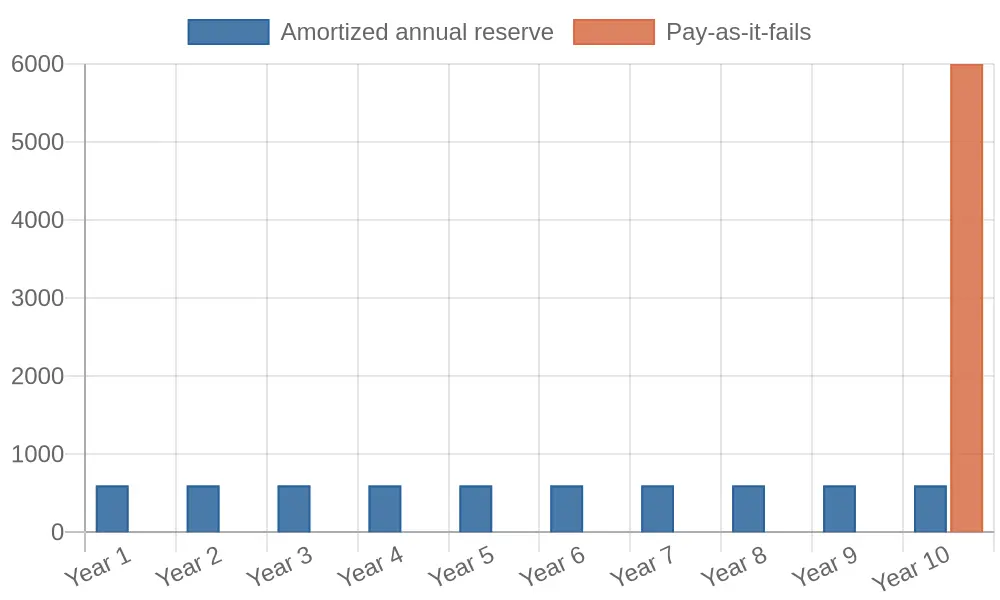
A few related items belong in that reserve, because they rarely arrive alone:
- Load range and size availability. Heavy-duty apparatus sizes and load ranges are not always sitting on a shelf. Availability and lead time drive price, so confirm sourcing well before the deadline and keep an eye on fire truck parts options for your chassis.
- Matching duals or axle pairs. Replacing a single tire on a dual set or an axle pair usually is not best practice. Budget in sets, not units.
- Downtime. Out-of-service days while a truck waits on tires still cost coverage, and often a rental or a mutual-aid arrangement.
Handled this way, tire replacement stops ambushing the budget. Handled badly, a ten-year-old tire becomes the most expensive item in your fire truck maintenance cost profile, at the least convenient moment. A calendar-driven reserve is the cheapest insurance you will ever buy for a truck that has to start on the first crank.
What Ten Years of Certification Costs
Annual pump tests get budgeted one invoice at a time, and that is how the real number sneaks up. Each test looks small and forgettable. Stacked over a full ownership cycle they become a serious capital commitment, and when tire replacement lands on top the total jumps in visible steps instead of drifting gently upward.
The chart below models three ownership profiles over ten years: a low-utilization unit that mostly sits ready, a typical urban-duty engine running routine call volume, and a heavy-duty industrial or airport unit that works hard and eats tires fast.
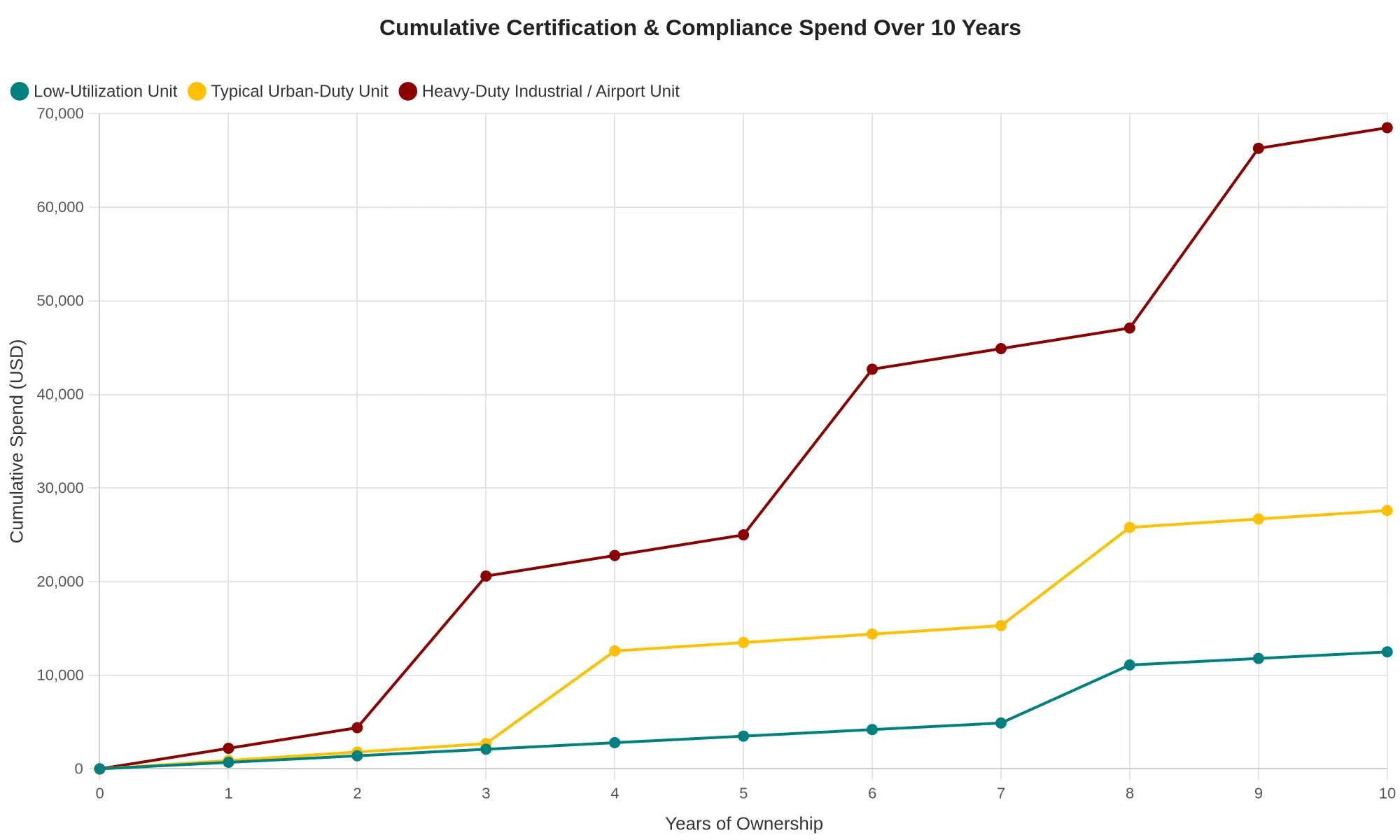
Figure 2 – Cumulative certification and compliance spend over a ten-year ownership horizon. Assumed annual pump test fees of $700, $900, and $2,200 respectively, with tire sets replaced at year 8, years 4 and 8, and years 3, 6, and 9. Figures are illustrative planning estimates in USD, not quotations; tire-set prices in the model escalate slightly with each cycle.
Legend: teal = low-utilization unit; amber = typical urban-duty unit; dark red = heavy-duty industrial / airport unit. X-axis: years of ownership (0-10). Y-axis: cumulative spend in USD.
Reading the Curve
The gentle slopes are pump tests compounding. The vertical steps are tire replacements. Read the shape, not just the endpoint, because the shape is what breaks budgets.
| Year | Low-Utilization (USD) | Typical Urban-Duty (USD) | Heavy-Duty Industrial / Airport (USD) |
|---|---|---|---|
| 0 | 0 | 0 | 0 |
| 1 | 700 | 900 | 2,200 |
| 2 | 1,400 | 1,800 | 4,400 |
| 3 | 2,100 | 2,700 | 20,600 |
| 4 | 2,800 | 12,600 | 22,800 |
| 5 | 3,500 | 13,500 | 25,000 |
| 6 | 4,200 | 14,400 | 42,700 |
| 7 | 4,900 | 15,300 | 44,900 |
| 8 | 11,100 | 25,800 | 47,100 |
| 9 | 11,800 | 26,700 | 66,300 |
| 10 | 12,500 | 27,600 | 68,500 |
Three things stand out. Annual pump tests are relentless: on the heavy-duty curve they add roughly $2,200 every year whether the truck turns a wheel or not, which is why the baseline climbs even between tire events. The steps dwarf the slope, because a single $14,000 tire set on the heavy-duty unit equals about six years of testing, and the $9,000 set on the typical urban unit equals ten years of testing. And tire age limits mean even a low-utilization unit pays: its curve bends upward around year 8 on rubber age alone, not on wear.
Turning the Curve Into a Budget Line
Budgeting follows from that shape. Set the annual test figure aside as a fixed, non-negotiable line, then run a separate sinking fund for tires sized to your replacement cycle: roughly one-tenth of a tire set per year for a low-utilization unit, closer to one-third per year for equipment like airport fire trucks that burns through tread quickly. Matching your duty cycle to these curves tells you whether you are on the teal, amber or dark red path, and that one answer moves a ten-year compliance reserve by tens of thousands of dollars.
Budget the slope monthly. Plan the steps years in advance.
Six Factors That Push Certification Cost Past the Estimate
Most owners budget the visible line items, the annual inspection, the sticker and the paperwork, and then find the real fire truck certification cost landing well above the quote. The gap almost always comes from six drivers that never appear on an estimate.
- Test frequency driven by duty cycle or insurer terms. A busy pumper, or one protecting a high-hazard site, can be pushed onto shorter pump test intervals than the once-a-year baseline. Some insurers also contractually require additional performance tests, and every extra test drags in more labor, more water and more documentation.
- Water supply logistics for pump testing. Pump tests need a lot of water at a controlled flow, plus a safe place to dump it. If your site cannot supply that, you pay for tankers, hydrant fees, hoses and an operator to stand by.
- Third-party witness and paperwork fees. Many authorities require an independent witness on site during testing, which means scheduling fees, travel charges and a stack of certified reports that can each carry their own price tag.
- Low-utilization aging of tires and seals. Idle apparatus still ages. Tires reach their calendar limit long before the tread wears out, and pump and valve seals dry and crack, so low mileage often means earlier replacement.
- Undocumented modifications or missing service records. A missing logbook or an unrecorded modification turns a routine inspection into an investigation, with re-inspection fees and corrective work on top.
- Parts availability for older or imported apparatus. Obsolete or imported components can mean long lead times, premium pricing and expedited shipping. Keeping a source for replacement fire truck parts on hand makes those surprises far cheaper to absorb.
Run all six against your own fleet before you set next year’s annual reserve. They are the difference between a realistic budget and a hopeful one.
FAQ
Certification costs hinge on two things: how often the pump gets tested and how old the tires are allowed to get. These five answers cover what owners ask most often, and each one is worth confirming with your local authority before you build a budget around it.
How often does a fire truck pump need to be tested?
Most authorities require annual pump testing, though some permit longer intervals for certain apparatus. NFPA 1911 is the common benchmark. Because pump test intervals vary by jurisdiction, confirm the schedule with your local fire marshal before booking a fire truck certification appointment.
What is the maximum tire age for a fire truck?
Many departments retire fire truck tires at seven years from the manufacturing date, regardless of tread depth, while some jurisdictions allow up to ten years with documented annual inspections. Tire age limits are usually set by the authority having jurisdiction, so confirm locally.
Does low mileage exempt a fire truck from tire age limits?
No. Tire aging is driven by oxidation and time, not distance traveled, so a low-mileage apparatus can still be pulled from service. Most standards include no mileage exemption, and fire truck certification generally requires replacement once the age threshold passes, even on seldom-used vehicles.
What records must be kept to stay certified?
Operators typically retain pump test reports, tire serial numbers and installation dates, maintenance logs, inspection certificates and manufacturer documentation. Records should be current and retrievable during audits, since incomplete paperwork can fail fire truck certification even when the apparatus itself is mechanically sound.
Can certification cost be reduced by choosing a different apparatus class?
It can, though not always. Smaller chassis units, such as those in the light fire truck category, often carry lower testing fees and fewer specialty inspections than heavy-duty or aerial apparatus. Fee structures vary, so compare fire truck certification requirements before purchase rather than assuming one class is automatically cheaper.
Building a Certification Reserve Into Your Fleet Budget
The cost logic behind fire apparatus certification is more predictable than it first looks. Pump test intervals set a recurring labor and inspection baseline, whether those tests run annually or on another required cycle. Tire age limits create a replacement schedule that can be amortized across each tire’s service life instead of absorbed as a sudden expense. Documentation discipline prevents avoidable re-testing by keeping inspection records, repair histories and test results where people can find them. For a business operating heavy-duty fire trucks, those three inputs turn certification from a vague worry into a line item.
A five-step budgeting framework
- Estimate test events per year. Count the apparatus in each pump-test category and multiply by the number of required events. Include backup units and any specialized equipment that needs separate inspection.
- Assign a per-event cost range. Build a low-to-high range from vendor quotes, internal labor rates, travel charges and anticipated repair work. A range beats a single number because test outcomes vary.
- Divide tire replacement cost by the retirement interval. If a set of tires costs a known amount and must be retired at a set age, reserve that cost divided by the years in service. Count replacement fire truck parts and installation labor in the same calculation.
- Add a documentation and training allowance. Budget recordkeeping time, compliance software if you use it, staff training and refresher updates, so paperwork does not become a last-minute bottleneck.
- Review the reserve annually. Compare actual test, tire and documentation spending against the reserve, then adjust next year’s contribution for fleet changes, new apparatus or updated requirements.
Track pump-test intervals and tire age limits as fixed calendar events and certification spend settles into a predictable operating cost instead of a recurring surprise.