How to Buy a Fire Truck: Station Bay Fit and Acceptance Testing
Two engineering checks should happen before a fire truck purchase order is issued: whether the apparatus fits the station, and whether it performs as contracted. For a fire department, airport or industrial operator, station bay fit usually comes first. The truck has to clear the doors, apron, turning radius and overhead obstructions at the building where it will be parked for the next fifteen to twenty years. Once the chassis and body are built, overall length, travel height, wheelbase and rear overhang are fixed, and they vary widely across fire fighting truck categories. Measuring the bay before you specify the truck is cheaper than modifying a door header or rerouting a drain after delivery.
Acceptance testing is the second check. Before final payment, the buyer and manufacturer run documented tests on pump performance, aerial operation, electrical systems, braking and water flow against values written into the contract. A signed acceptance record shows what was delivered and gives the buyer a baseline for warranty claims and maintenance. A buyer who treats the test as a formality gives up the strongest leverage in the purchase.
What each checkpoint covers:
- Station bay fit – confirming door clearances, floor loading, apron approach and turning space before the chassis and body are specified.
- Fire truck acceptance testing – verifying documented performance against contract specifications, and recording the results, before final payment is released.
Station Bay Fit: The Constraints to Confirm Before You Order
Bay fit is settled by the building, not the specification sheet. A truck that is 200 mm too tall or 1 m too long will not fit, whatever the purchase order says. Measure the building and compare the numbers with the manufacturer’s drawing for the exact build; do not leave the conflict for the approval form.
Length and travel height come first
Overall length determines whether the driver can enter, park and reverse out without clipping door frames or blocking circulation behind the truck. Travel height is the distance from the ground to the tallest fixed point on the finished vehicle, with the aerial stowed and roof equipment fitted. Aerial ladders fold down but still add height and length, so check the aerial ladder fire truck range against your measured clear dimensions before you shortlist a model.
Width, doors, and everything that hangs off the body
Body width is rarely the problem; mirrors, ladders, hose trays and light bars are. Measure the full operating envelope, including anything that folds out, swings or overhangs. Door clear height and width need enough margin for driver error, worn suspension and a fully loaded apparatus.
Ceiling, floor, and water
Exhaust extraction rails, light fixtures, sprinkler piping and door tracks reduce usable height and can be struck by raised equipment or roof-mounted monitors. Check the slab for concentrated wheel and outrigger loads as well as distributed load; a pounds-per-square-foot rating by itself does not show whether a loaded axle will crack the floor. Drainage has to handle washdown water and whatever drips off the apparatus overnight. Vehicle class changes the constraints, so compare heavy-duty fire truck build details with the building before assuming a larger chassis will fit.
Confirm against drawings, not brochures
Brochure fire truck dimensions describe a base configuration and usually leave out options, ladders and extra equipment. Ask for a drawing of the exact build showing overall length, travel height, width over mirrors, wheelbase and axle loadings, then compare those figures with measured site conditions. Record your own measurements, allow a working tolerance and have the manufacturer confirm fit in writing.
Bay Fit Measurement Checklist
Measure the building yourself before you sign.
- Door clear opening height and width, measured at the narrowest point and including trim, weatherstripping or hardware that reduces the opening.
- Bay interior length, from the rear wall to the inside face of the door threshold at floor level.
- Bay interior width, between finished side walls, noting pilasters, columns and wall-mounted equipment that intrude into the clear space.
- Floor load rating, documented as point load and distributed load and checked against the loaded axle and outrigger loads of the models you are considering.
- Driveway grade and apron turning space, measured as a percentage of slope plus the sweep area available for the apparatus to swing in and out.
- Overhead and side obstructions, including light fixtures, sprinkler piping, door tracks, heaters and anything else hanging below the ceiling line.
- Exhaust extraction and ventilation provisions, including hose connection points, fan capacity and clearance for the system to attach to the vehicle.
- Manufacturer dimension drawing with a stated tolerance, so published dimensions and site measurements can be compared with the build variance in view.
Write down every value you measure; estimates, memory and old building plans are not reliable.
| Measurement | Where to Measure | Value to Record |
|---|---|---|
| Door clear opening | Narrowest point, floor to header | Height and width |
| Interior length | Rear wall to door threshold | Feet and inches |
| Interior width | Finished wall to finished wall | Feet and inches |
| Floor load rating | Slab or structural drawing | Pounds per square foot and point load |
| Driveway grade | Steepest section of approach | Percentage of slope |
| Apron turning space | Swept area at the door face | Square feet |
Comparing vehicles class by class shortens the shortlist quickly, because bay length, door clear height, floor loading and site access tend to follow truck class more than brand. Scan the class that matches your call types and site layout first, and you can rule whole families of vehicles in or out before you request a quotation.
Table 1: Indicative Station Bay and Access Requirements by Fire Truck Class
| Truck class | Typical body length range | Recommended bay length including clearance | Minimum door clear height | Floor load consideration | Access note |
|---|---|---|---|---|---|
| Small / light fire truck | 4.5-6.5 m | 6.5-8.5 m | 3.0-3.5 m | Light; single rear axle, roughly 7-10 t GVW class | Fits narrow urban lanes and a single 3.5-4 m door in most cases |
| Commercial fire truck | 7-9 m | 9-11 m | 3.5-4.0 m | Medium; two-axle chassis, roughly 12-16 t GVW class | Standard driveway width and turning radius are usually adequate |
| Heavy-duty pumper | 8.5-11 m | 11-13 m | 3.8-4.2 m | Heavy; tandem rear axle, roughly 16-26 t GVW class | Drive-through bays or a long straight apron simplify reversing |
| Water tanker fire truck | 8-11 m | 11-13.5 m | 3.8-4.2 m | Laden weight varies strongly with tank fill; check laden rear axle load | Allow hardstanding and hose reach at the fill point, plus rear outlet clearance |
| Aerial ladder or aerial platform truck | 10-14 m body, plus aerial overhang | 14-17 m, plus turntable and boom clearance | 4.0-4.5 m | Very heavy; concentrated outrigger point loads on the slab | Outrigger footprint roughly 5-7 m across and 7-9 m along the truck; level hardstanding required |
| Aircraft rescue and fire fighting truck | 9-13 m | 12-15 m | 4.0-4.5 m | Very heavy; roughly 20-40 t GVW class with high axle loads | Needs a direct response route to the runway, wide aprons and monitor headroom |
All figures above are indicative only and must be confirmed against the manufacturer drawing for the specific model you select before you fix bay dimensions, door heights or slab design.
Site Survey and Access Route Review
Walk the route the truck will drive before you sign, not just the bay. Measure gate and driveway clear width, apron depth and the turning envelope, and get pavement and bridge load limits from the owner or a structural engineer. Check grade and breakover transitions; a steep apron can scrape a bumper or hang the chassis. Measure overhead lines and canopy heights against the tallest point of the truck with light bars and monitors fitted. A truck that clears the door but cannot turn into the apron still does not fit.
Water and environmental details matter too. Measure the distance to a usable water source and the time it takes to fill, then compare that with tank capacity and fire truck dimensions so the first call does not expose a fill problem. Review water tanker and fill logistics options while site changes are still inexpensive. Decide where foam concentrate will be stored, how it stays within its temperature range, and where test water will drain without pooling or reaching storm drains.
Ask for these before finalizing a layout:
- Dimensioned drawings and turning templates from the supplier, showing swept paths with the vehicle at full load
- Pavement, apron and bridge load ratings from a civil or structural engineer
- A site plan noting water source capacity and refill rate, foam storage area, and drainage paths for test water
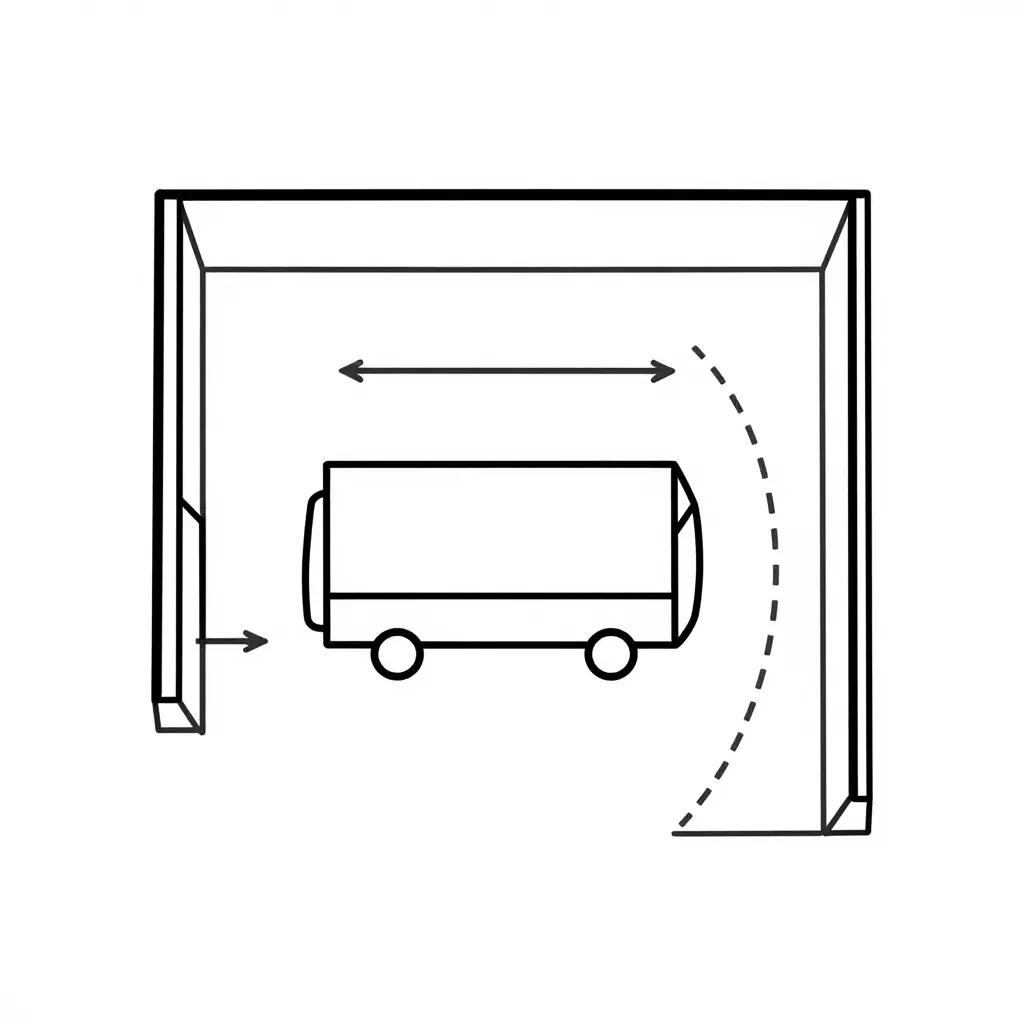
The plan view below shows the geometry that decides fit: the bay outline, door opening, truck footprint, side and front/rear clearance arrows, and the turning arc across the apron. Measure the same margins on site before you sign, then check them again during acceptance testing with the real vehicle in the doorway.
Acceptance Testing: Define the Test Before Delivery
Fire truck acceptance testing usually has two stages, and both should be defined before the contract is signed. The factory acceptance test (FAT) takes place at the manufacturer’s facility before shipment and checks the build against the approved specification: pump flow and pressure at rated conditions, foam proportioning accuracy, tank capacity, aerial device function and interlocks, electrical and warning systems, and control response. The site acceptance test (SAT) takes place at the buyer’s station after delivery and checks the same systems in the real environment: drafting from local water sources, aerial deployment clearances around buildings and overhead lines, radio integration and transit damage. Use the same checklist for both stages so the results can be compared, whether the unit comes from a standard fire-fighting truck line or a custom build.
A written test plan lists each item, the acceptance value or referenced standard, the instrument used, the responsible party and the order of testing. The witness protocol says who observes each item, which signatures close it, and how attendance is recorded if a nominated witness cannot be there. Record measured values on the plan, not checkmarks. Any reading outside tolerance becomes a numbered defect with a description, severity, owner and target correction date. Keep open defects on a tracked log until they are corrected and re-tested; a critical open item means the acceptance test is not finished.
The test passes when every item meets its acceptance value, every defect is closed or formally deferred in writing with the buyer’s agreement, and both parties countersign the results. Tie payment retention to those milestones: hold a defined portion until the FAT documentation is complete and accepted, and release the balance only after SAT completion and signed delivery. Two documents belong with the purchase contract from the start:
- The approved test plan, including acceptance values, instrument list, and test sequence
- The witness protocol together with blank results and defect-log forms
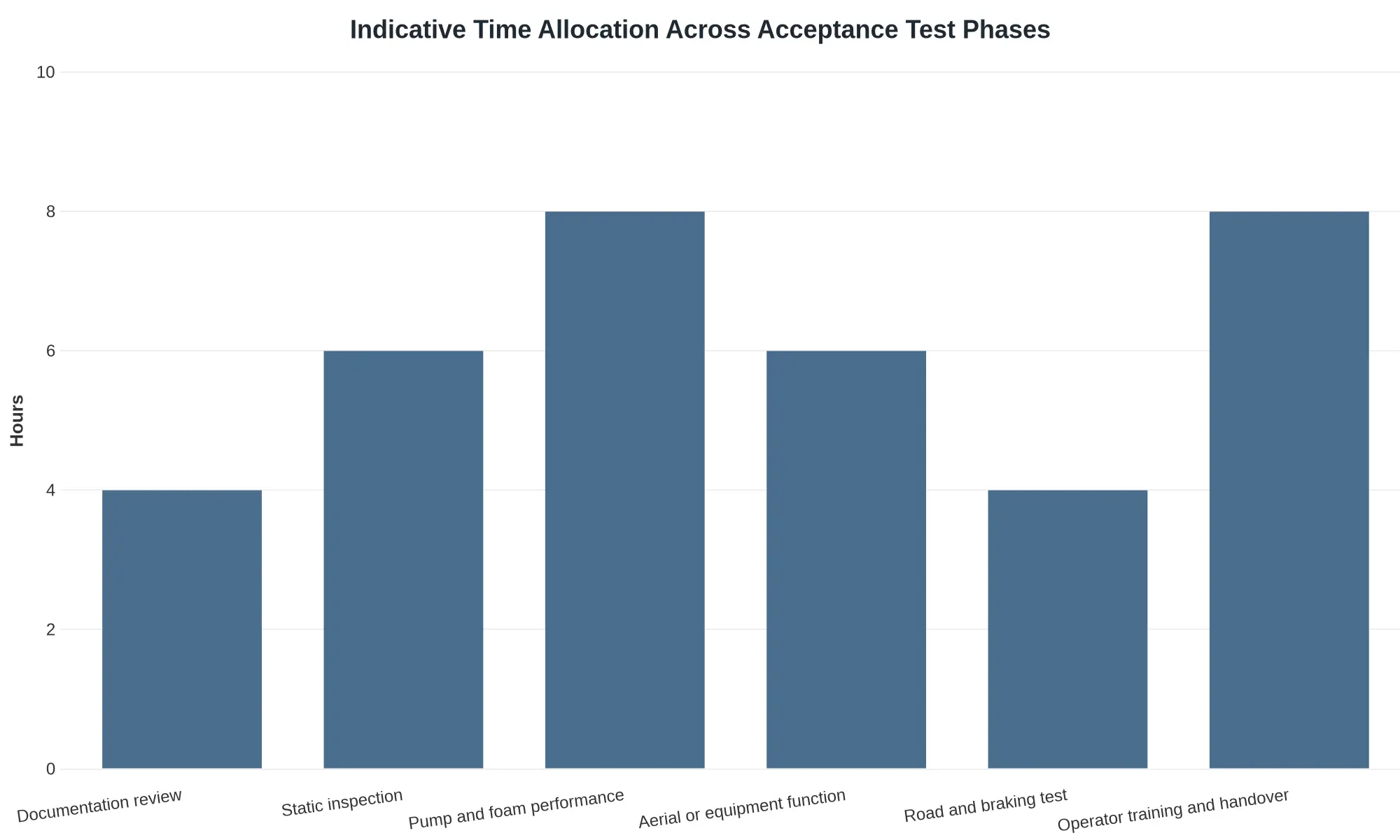
The hourly allocations in the chart are indicative. Adjust them to the vehicle class and the scope in your contract; used that way, the chart helps buyers schedule their own witnesses and book site access in advance.
Verifying Pump, Foam, and Aerial Performance
Pump and foam tests should reproduce the numbers in the contract, not the numbers in a brochure. Hold the pump at rated flow and rated pressure and confirm the stream matches the fire truck specifications you signed. Cross-check each gauge against a calibrated master gauge at low, mid and high points of its range; a gauge that reads low misleads every operator who uses it. For foam, draw concentrate across the full flow range and confirm the proportioning percentage holds at each step, whether the rig is a compact foam fire truck or a full-size pumper with several discharges.
On a water tower fire truck, deploy the boom and outriggers on the surface specified by the manufacturer, set them according to the level indicators, and confirm the interlocks prevent operation outside the permitted slope or outreach. Run the monitor through its range and watch for drift or settling. An aerial ladder follows the same pattern: cycle the ladder, check rated load at rated reach, and confirm the interlocks. Where a compressed air foam system is fitted, test it separately. Verify wet and dry foam quality, expansion behavior and proportioning at the nozzle on a CAFS fire truck; the air-to-solution ratio has to be measured, not inferred from how the foam looks.
Write pass or fail criteria, tolerances and test conditions into the contract before testing starts, and log every result against its own criterion. The sign-off sheet should read as evidence, not opinion.
Measurements to record:
- Rated pump flow and pressure (gpm or L/min at rated pressure) against the contracted figure, with engine rpm and intake conditions noted.
- Gauge reading versus calibrated reference at low, mid and high range, with the deviation in psi or bar for each gauge.
- Foam proportioning percentage at several flow steps, calculated from concentrate consumed against water volume, compared with the target percentage and tolerance.
- Aerial or tower data: stabilizer deployment time, outrigger loading, maximum reach, monitor flow at height, and any drift or settlement observed at rated load.
The acceptance sequence has six stages: contract test plan, factory witness test, delivery and site inspection, performance tests, defect close-out, and final sign-off and handover. Each stage is a gate; the order is the same whether you are commissioning a single pumper or a fleet of heavy-duty fire trucks. Put the list in your project pack with dates and owners against each stage.
Documentation, Training, Spare Parts, and Warranty Handover
Delivery is not complete when the truck arrives. Before sign-off, get a handover package that includes operator and maintenance manuals in a language the crew reads, as-built drawings that match the vehicle as built rather than the original design concept, a spare parts list with manufacturer part numbers for wear items, and a training agenda that states how many hours operators and technicians will receive. Do not sign off while the package is incomplete. For consumables and add-on gear, check the portable fire fighting equipment range so the first stock order matches the truck’s actual configuration.
Training needs its own hours and its own line in the contract. Operators usually need several hours on pump engagement, monitor operation and daily checks; technicians need more on diagnostics, valve service and electrical fault-finding. Get the hours in writing, not in conversation. Warranty terms should list the coverage period for each major component, what voids coverage, and the claim process: who to call, what photographic evidence to send and how long approval takes. Ask for lead times on high-wear fire truck spare parts, and keep a small buffer of filters, seals and nozzles on the shelf. Use the fire truck parts catalogue when you build the stock list so the part numbers are right from the first order.
Confirm the following in writing before final payment:
- The signed manual and as-built drawing register, including revision numbers and delivery dates.
- The dated training agenda with named trainers and agreed hours for operators and technicians.
- The warranty certificate, claim procedure, and a spare parts list showing part numbers and quoted lead times.
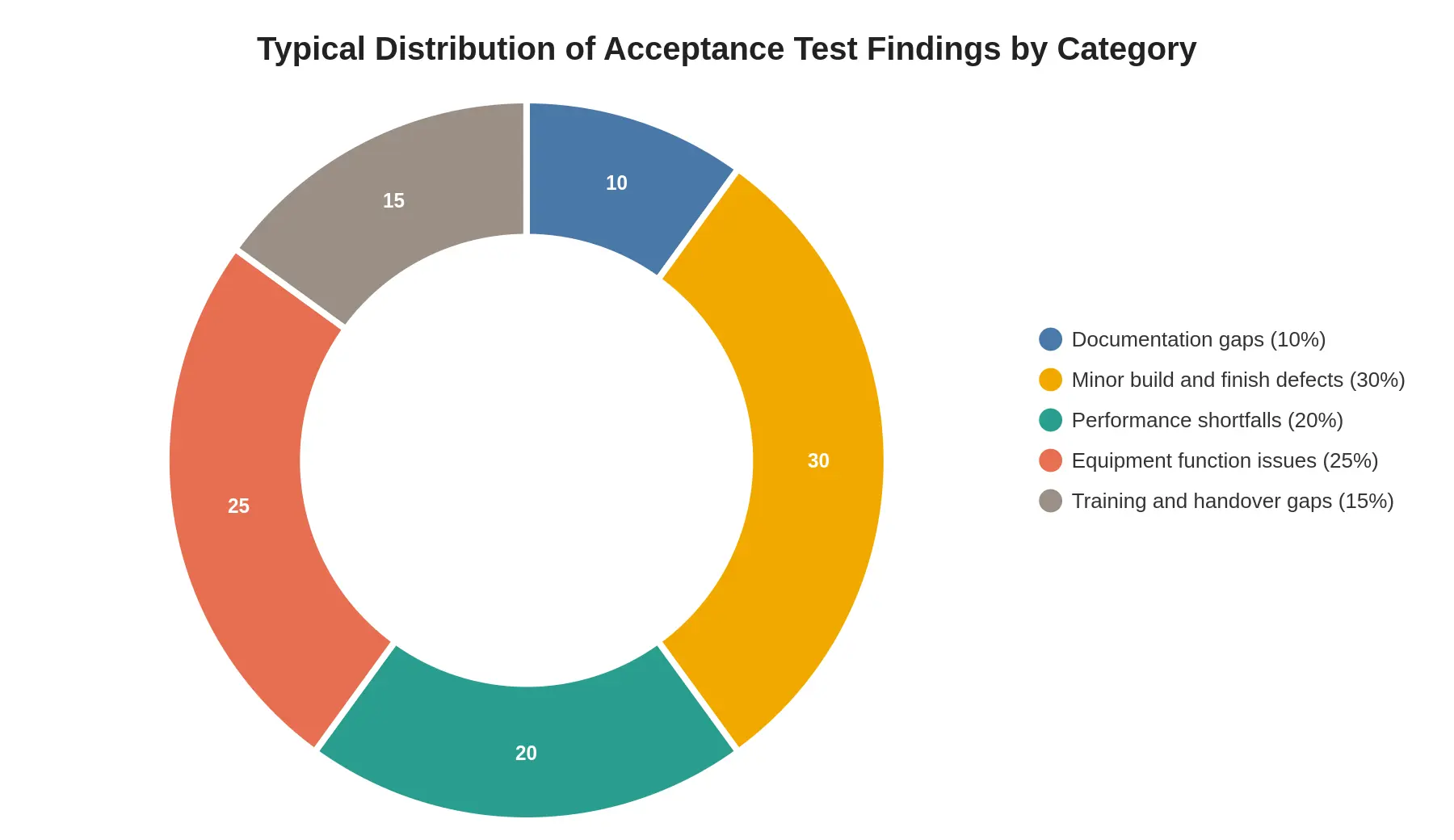
The chart is illustrative; the percentages are not a forecast. Use it to decide where to spend witness time and to prepare a defect log before inspection day; actual proportions vary with vehicle class and contract scope.
Frequently Asked Questions
How much clearance should a station bay allow around a fire truck?
A common starting point is 4 feet (1.2 meters) of clearance on both sides and at the front and rear. Check local codes, which may differ. Confirm station bay fit with the dealer using the truck’s exact dimensions, including mirrors, ladders and open compartment doors.
Can a fire truck be delivered before the bay is completed?
Yes. A manufacturer can deliver a completed commercial fire truck before the station bay is finished if the buyer has secure, weather-protected storage and a suitable receiving area. Put delivery timing, insurance coverage and pre-delivery inspection responsibilities in the purchase contract.
What should a fire truck acceptance test include?
A fire truck acceptance test should cover chassis operation, pump performance, foam system function, aerial device movement, emergency lighting, braking and specified equipment. Record results against the purchase specification and list every deficiency in writing before signing final acceptance.
How long does acceptance testing usually take?
Budget one to three days for a standard pumper and three to five days for aerial or specialized apparatus. The range depends on the specification, test scope and whether the manufacturer performs a preliminary factory test before delivery.
What happens if a fire truck fails acceptance testing?
The buyer should withhold final acceptance and issue a written deficiency list. The manufacturer corrects the issues and repeats the failed tests. Payment release and delivery follow the contract’s acceptance and remedy terms.
Sequence Bay Fit and Acceptance Testing to Protect the Purchase
A fire truck purchase involves several decisions that have to be made in order. Confirm bay fit against the manufacturer’s drawings before you commit, survey the access route the apparatus will actually travel, write measurable acceptance criteria into the contract, witness and record every test, and close defects before final sign-off. Missed steps tend to surface as costs after delivery.
Final checkpoints before you sign:
- Bay fit verified against drawings – turning circle, door swing, overhead clearance and hose bed access confirmed in writing.
- Access route surveyed end to end – bridge weight limits, gate widths and turning radii checked along the real path.
- Acceptance criteria measurable and contractual – pump pressure, flow rate, foam proportioning and tank capacity stated as numbers with tolerances.
- Every test witnessed and recorded – results documented on the day, with defects corrected and re-tested before final sign-off.
CIMC Tianda’s product range covers firefighting and rescue equipment and special fire trucks. The company reports more than 30 years of development and a distribution network covering nearly 130 countries and regions.