Rescue Truck Orders: Layout, Payload, and Delivery
A rescue truck order is a specification exercise, not a purchase. Every line on the build sheet carries mass, volume, electrical load, and cost, and those numbers pull on each other. Three of them settle most of the outcome: compartment layout, payload margin, and delivery delays. Move one and the other two move with it. Chassis selection, body configuration, and total cost of ownership all trace back to decisions made on paper, before anyone cuts steel. Treated as a controlled set of engineering constraints you can model, verify, and defend, rescue truck specifications keep a project predictable.
Who This Guide Is For
This is written for the people who sign off on new apparatus: fleet managers, fire and rescue departments, EMS agencies, rescue squad chiefs, municipal procurement officers, and emergency services fleet administrators. You are not shopping for a vehicle so much as acquiring a platform that has to pass every operational test you throw at it, including the ones on its worst day. The aim here is practical and specification-focused: a framework for comparing proposals, choosing a platform such as a purpose-built emergency rescue vehicle, and holding a supplier to commitments you can measure.
How the Three Variables Interlock
Compartment layout sets where equipment lives and how fast a crew can reach it. Payload margin sets how much you can carry before braking, handling, and axle ratings suffer. Delivery delays set when the truck enters service and how long the existing fleet has to cover the gap. Consider any one of the three on its own and you will overpay, under-spec, or wait past the date written in the contract. The sections below take each in turn and show where they collide.
Compartment Layout: How Body Zoning Drives Operational Readiness
Of everything in a new order, compartment layout is the hardest to undo. It fixes what the crew can reach, how fast they reach it, and how much the emergency rescue vehicle weighs on each axle. Resolve and freeze it before the chassis is finalized. Cutting compartments into a finished truck costs a great deal and rarely gives the crew what it actually needed.
Compartment Zoning
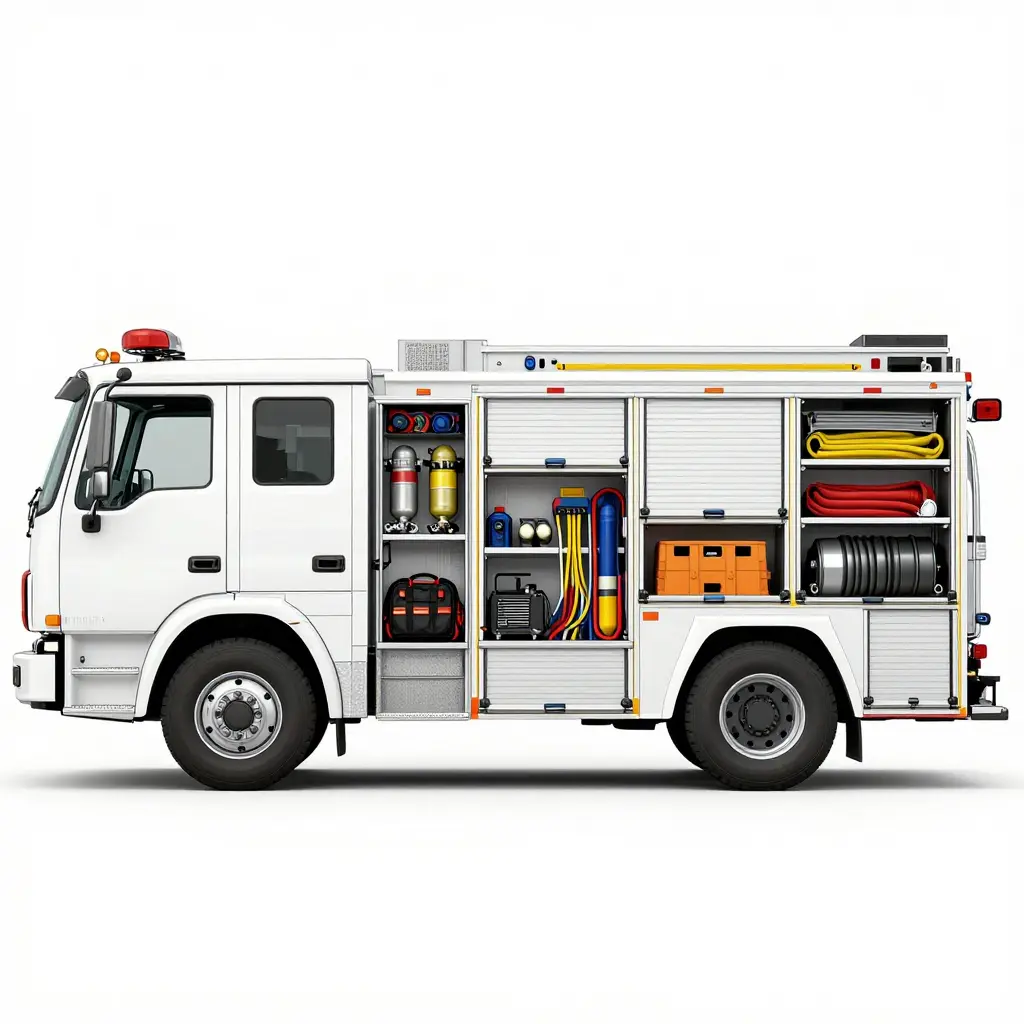
Rescue bodies are normally split into three zones. Front compartments take the equipment a crew grabs first: hand tools, SCBA, medical bags, small hydraulic accessories. The mid-body carries the heaviest payload, because that is where the structure is strongest and the mass sits closest to the center of gravity. Rear compartments hold bulk items such as cribbing, extra hose, and large extrication rams. Put a tool in the wrong zone and the crew ends up reaching across the body or carrying the load into the middle of an incident.
Body and Storage Configuration
A walk-in body gives you standing room inside and keeps equipment out of the weather, at the cost of added weight, height, and wheelbase. A non-walk-in body gives you more usable payload and a lower roof line, though everything has to be reached from outside. In either style, transverse storage lays long tools crosswise so they can be pulled from both sides. Longitudinal storage runs gear front to back, which keeps the walkway clear and the weight closer to the middle.
Layout Variables to Lock Early
- Zone assignment for every tool and sub-system
- Walk-in versus non-walk-in body selection
- Transverse versus longitudinal storage orientation
- Adjustable shelving type, pitch, and load rating
- Roll-up versus hinged door choice per compartment
- Routing path for hydraulic, pneumatic, and electrical runs
Roll-up doors save swing clearance at a tight scene, but they need a hidden track and a clean header. Hinged doors seal better and cost less, but they need room to swing. Adjustable shelving lets a department repurpose compartments as the truck ages, as long as the anchors and structural backing are engineered in from the start.
Interaction with Wheelbase, GVWR, and Center of Gravity
Every layout choice moves weight somewhere. Load the mid compartments heavily and the center of gravity shifts rearward along with the rear-axle load, so wheelbase and GVWR have to follow that distribution rather than be assumed. Utility routing competes for the same frame space: hydraulic lines, air lines, and electrical harnesses all need protected, serviceable paths that clear the compartments as they move. On specialty configurations such as special fire truck bodies, the squeeze is tighter because auxiliary systems occupy the mid-body.
The frame, wheelbase, and subframe are cut and welded to a fixed compartment geometry, so the layout has to be locked before the chassis is finalized. Change it late and you buy wheelbase adjustments, weight re-certification, and schedule slips. Looking at proven emergency rescue vehicle configurations early gives a department a reference point for balancing ergonomics against payload margin.
Compartment Layout Configuration Comparison
The table below compares the three layout configurations most often specified on new emergency rescue vehicles.
| Layout Type | Body Style | Typical Compartment Count | Storage Volume (cu ft) | Access Type | Center-of-Gravity Impact | Best-Fit Application |
|---|---|---|---|---|---|---|
| Non-walk-in side-access | Non-walk-in body, low-profile to full-height exterior compartments | 6-10 | 300-450 | Roll-up (hinged optional) | Low; mass kept at low vertical positions, minimal rollover influence | High-call-volume equipment trucks limited by station bay height |
| Walk-in body | Full-height walk-in rescue body with interior standing height | 8-14 | 450-700 | Combination roll-up and hinged | Moderate to high; raised floor and roof line increase vertical CoG | Long-duration technical rescue, command, and rehab operations |
| Walk-around transverse | Walk-around body with transverse (cross-body) compartments | 10-16 | 550-850 | Roll-up primary with hinged transverse | Moderate; mass distributed across axles, monitor rear overhang | Heavy rescue carrying long tools and ladders stored transversely |
Body style refers to the structural shell and whether the crew can walk inside; storage volume is usable compartment space in cubic feet. Higher volumes generally push payload and wheelbase requirements up, so match both figures to chassis GVWR and axle ratings.
Compartment layout optimization checklist
Before releasing rescue truck orders, run this validation sequence against the proposed platform specification. Work through it in order; each step depends on geometry and mass data confirmed upstream.
- Check total stowed equipment volume, including cases, brackets, and air gaps, against the net cubic capacity of each zone, and hold a minimum 15% reserve for future additions.
- Confirm door swing arcs and roll-up clearance against the body skin, with full articulation and no contact to adjacent panels, steps, or ground-mounted equipment.
- Map hydraulic hose and electrical cable routes through each compartment, maintaining bend-radius limits and separating high-current runs from fluid lines to prevent chafe and thermal coupling.
- Check axle-load distribution by compartment against the chassis GAWR, with full water, foam, and tool loads carried into the final center-of-gravity calculation.
- Validate ladder and tool mounting points against structural backing, confirming brackets tie into reinforced frame members rather than interior liner.
- Confirm service accessibility for routine maintenance, so filters, valves, and battery terminals stay reachable without demounting shelving.
- Cross-reference these findings with the rescue truck platform specifications to lock the configuration before order release.
Payload Margin Analysis for Rescue Truck Orders
Payload capacity drives almost every decision in a rescue truck specification, and it is usually the last thing anyone checks. Three numbers matter, and mixing them up is behind most overweight deliveries.
GVWR is the gross vehicle weight rating: the most a chassis is engineered to carry on all axles together, as certified by the manufacturer. Curb weight is the finished vehicle as delivered, chassis, body, full fuel, and fluids included, but no crew, water, or loose equipment. Subtract curb weight from GVWR and you get available payload. Subtract the operating loads from that and what is left is the payload margin.
The numbers close in fast. Take a Class 8 chassis rated at 44,000 lb GVWR. A fully outfitted rescue body can push curb weight to roughly 24,500 lb, which leaves about 19,500 lb of usable payload. That looks generous until the loads show up. A 1,000-gallon water tank adds roughly 8,340 lb on its own. Foam concentrate and its tank add several hundred more. Extrication tools, cribbing, generators, winches, and hydraulic rescue systems routinely take another 8,000 to 10,000 lb. A six-person crew adds about 1,500 lb. Equipment added late in the project only deepens the deficit.
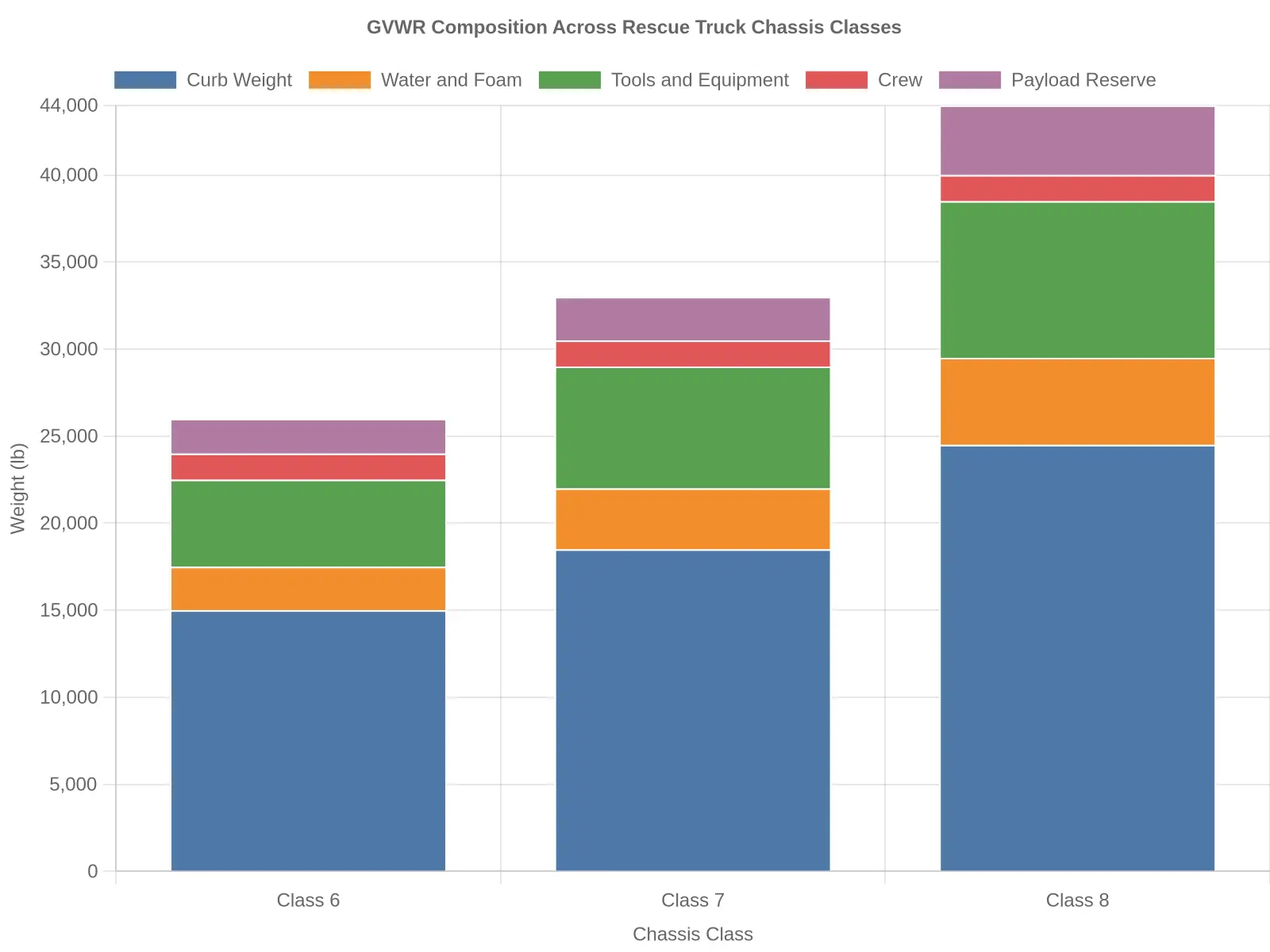
You need a positive payload margin because axle ratings are legally enforceable on their own, apart from GVWR. A front axle rated at 16,000 lb and a rear tandem rated at 28,000 lb can each go over while the total stays under gross. Distribution matters as much as total weight, particularly on an emergency rescue vehicle where the heavy components cluster along the frame. Tanks, generators, and cascade systems mounted too far forward overload the steering axle and degrade handling. Packed at the rear, they overload the tandem and reduce steering authority. Work out the front-to-rear balance early, while compartment layout and equipment placement are still movable.
Good practice is to hold back a target payload reserve, often 10 to 15 percent of remaining capacity, as a design buffer. That reserve absorbs the additions that always turn up late: a bigger extrication tool, a replacement generator, a heavier winch. Underestimate it and you lose performance, schedule, and money together. The fixes are unappealing: redesign compartment storage and rework the body, uprate springs or axles, or fail the delivery inspection at final acceptance when the truck is weighed and comes in over its own rescue truck specifications.
Specify the platform for the load you intend to carry. A heavy-duty fire truck chassis rated for that load, or an industrial fire truck with reinforced axles for severe duty cycles, costs far less than correcting an overweight build after the fact. Define the complete operating loads before design, not after.
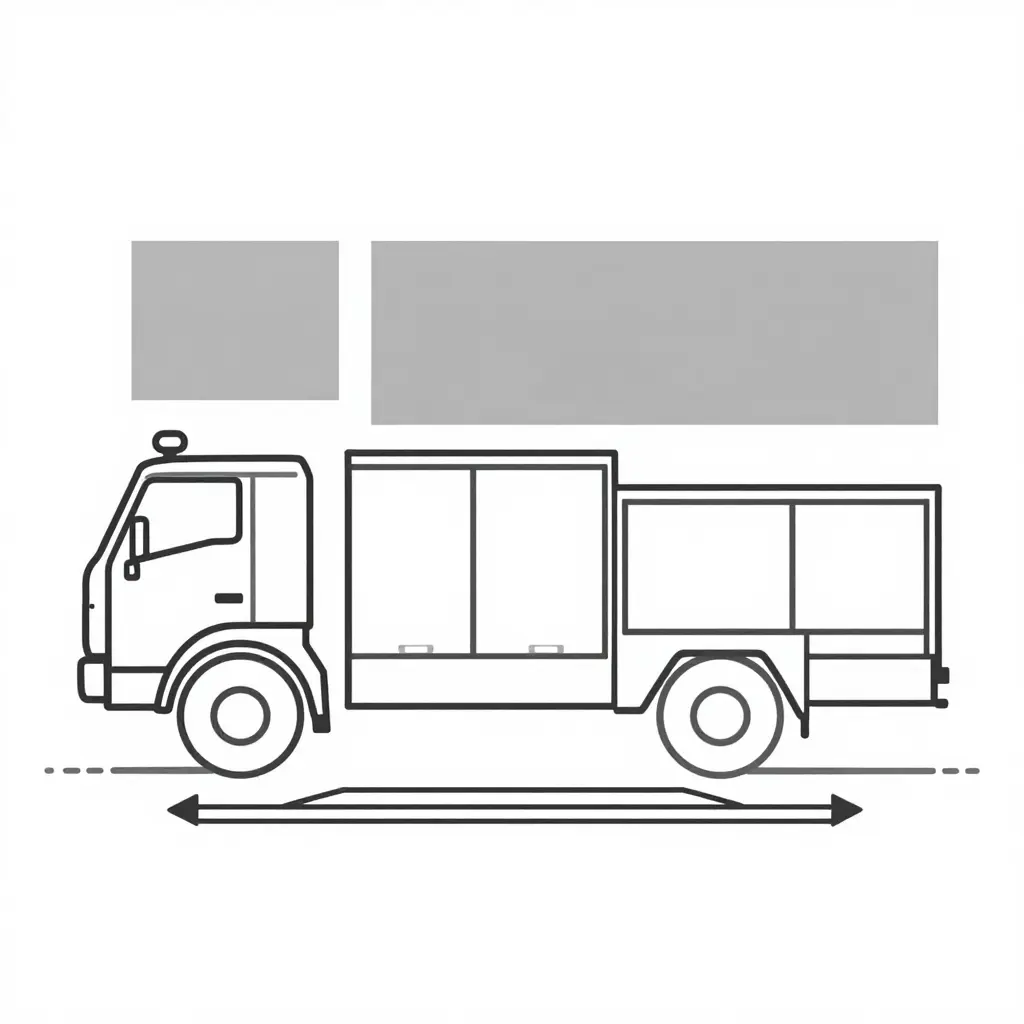
Schematic payload distribution across a rescue truck chassis: shaded blocks represent compartment loads (cab, body, water tank, equipment), while the lever concept below the axle line illustrates how the front- and rear-axle load split shifts as mass moves fore and aft.
Delivery Delays in New Rescue Truck Orders: Drivers and Controls
Delivery delays on new rescue truck orders rarely come from a single failure. They build out of overlapping dependencies that start well before fabrication. Naming the drivers is what lets a fleet manager set a timeline that holds and write a contract that can be enforced.
Common Drivers of Schedule Risk
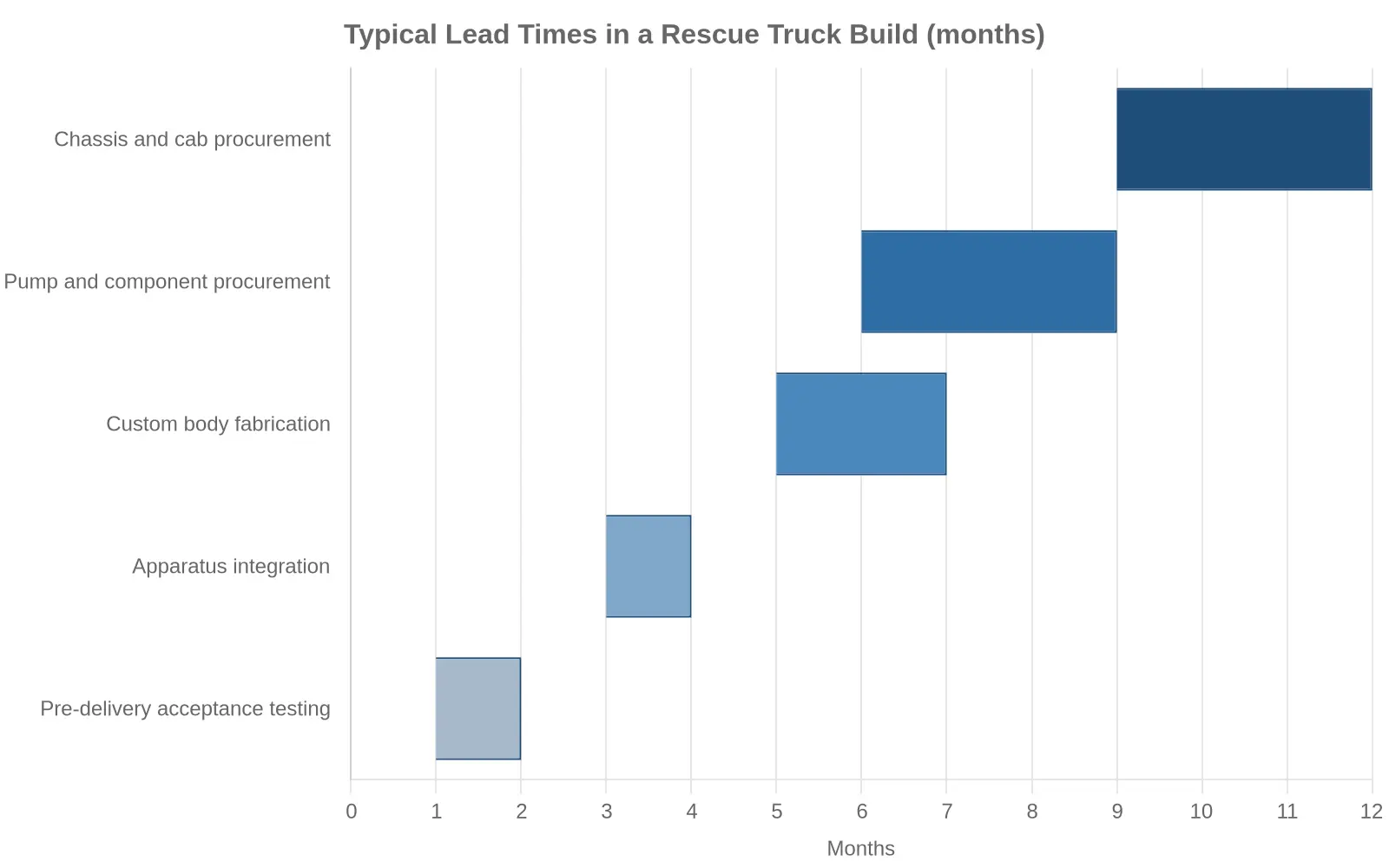
Chassis lead times. Commercial chassis slots commonly run 9 to 12 months. Specialized or heavy-duty cabs can run longer when OEM production peaks.
Cab and chassis availability. An order does not guarantee allocation. Limited trim packages, axle ratings, or emissions configurations can push a promised build date out by a full quarter.
Custom body fabrication. Rescue bodies are built to order, and shop capacity is finite. A late engineering release eats a build slot that does not come back once the line is scheduled.
Component and pump supplier backlogs. Pumps, foam proportioners, generators, and specialty hardware carry their own lead times. Check subcomponent availability early and source proven fire truck parts from stable supply chains; that is how you avoid quiet slippage at integration.
Specialized apparatus integration. Light towers, winches, and rescue tool systems have to be coordinated across several vendors. On non-standard platforms, special vehicles engineering often becomes the item that sets the pace.
Pre-delivery acceptance testing. Testing follows a fixed sequence: pump certification, electrical load verification, compartment door alignment, and road trials. Compress any of it and you risk a failed inspection and a trip back to the shop.
How Post-Order Specification Changes Extend Build Slots
Any change after the order is placed triggers a new engineering release, another round of approvals, and re-sequencing. Revise compartment layout late and the damage spreads: drawer slides, shelving, electrical runs, and mounting points all have to be redesigned before the body shell is closed. That routinely adds weeks, and it can cost the builder a reserved slot altogether, pushing delivery delays well past whatever the original change was worth.
Tracking Phased Milestones Against Contractual Dates
Each milestone should carry its own contractual date and payment trigger, not a single end date.
| Milestone | Typical Contractual Trigger |
|---|---|
| Design freeze | Signed engineering release |
| Chassis receipt | OEM delivery confirmation |
| Body mount | Body placed on chassis |
| Systems install | Pump, electrical, plumbing complete |
| Paint | Finish approval |
| Final inspection | Pre-delivery acceptance test passed |
Buffer Scheduling, Milestone Payments, and Delay Clauses
Build in a 10 to 15 percent schedule buffer instead of quoting the earliest theoretical date. Tie payments to verified milestones so the money tracks real progress. Define liquidated damages for late delivery, and keep the right to cancel if a milestone slips past an agreed grace period.
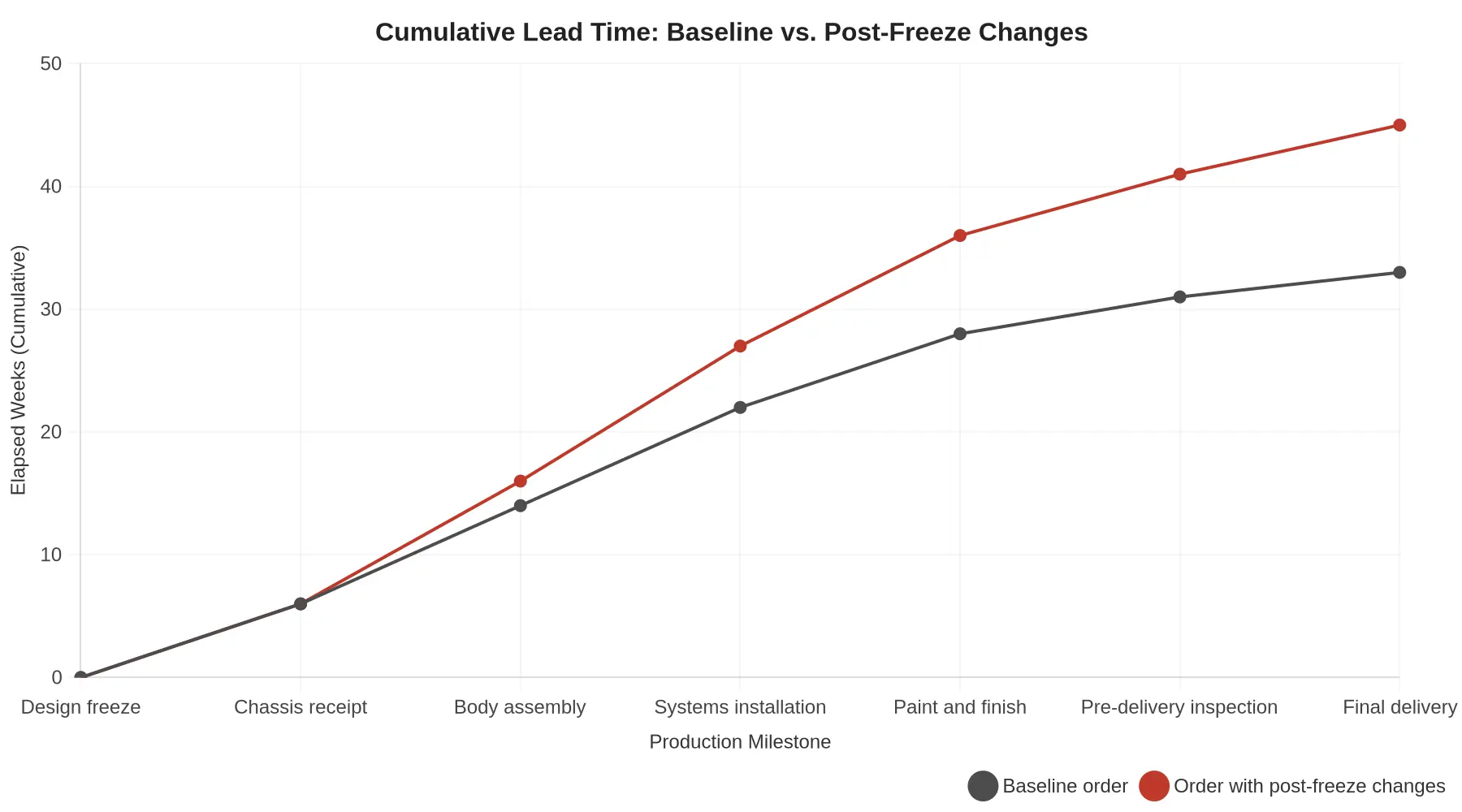
Cumulative Lead Time: Baseline vs. Post-Freeze Changes
The chart above tracks cumulative weeks from design freeze through each production milestone, for two orders: a clean baseline and one that absorbed specification changes after the freeze point. The baseline rises steadily to roughly 33 weeks at final delivery. The second line stays with it through chassis receipt, then separates sharply from body assembly onward and reaches about 45 weeks at handoff.
The gap between the two lines is the point. Both orders clear design freeze together and receive the chassis on the same schedule, so the entire difference comes from the late changes. The second line does not run parallel to the first; it steepens, because rework compounds at every downstream stage instead of being absorbed once.
For a procurement team, the lesson is that specification discipline before design freeze does more to protect a delivery date than anything else available. A change approved after that gate propagates through compartment layout revisions, harness rerouting, and re-inspection, and it multiplies the weeks lost at each milestone it touches. Ask a manufacturer where its freeze point sits, how change orders are priced, and how they are scheduled. Those answers usually decide whether the date holds. Buyers evaluating emergency rescue vehicle platforms should confirm all three before signing.
Frequently Asked Questions: Rescue Truck Orders
What payload margin should a rescue department target?
Hold a payload reserve of 10 to 15 percent of available payload, where available payload is GVWR (gross vehicle weight rating) minus curb weight. That reserve absorbs the tools, extrication equipment, water, and personnel that accumulate over a rig’s service life. Running at or above 90 percent of GVWR costs you braking distance, tire life, and axle compliance. Weigh the finished truck on a certified scale before you accept it; a calculated estimate is not good enough.
Can the compartment layout be modified after the order is placed?
Only minor changes are practical once the body enters fabrication. Adding, relocating, or resizing a compartment after the frame is welded and the body is skinned means re-engineering the substructure, rerunning electrical and plumbing chases, and repainting. The purchaser normally pays for all of it. Set a compartment layout freeze point at the design-approval milestone, and put agreed unit pricing and a defined schedule impact for post-approval change orders into the contract. If you want a benchmark first, look at factory-configured fire fighting truck platforms and compare their standard layouts.
How long do typical delivery lead times run, and what causes delivery delays?
For a custom rescue body on a commercial chassis, plan on 10 to 16 months from contract execution to delivery. Chassis allocation from the OEM is the largest single variable and can account for 6 to 9 months by itself. Pump and aerial component backlogs, custom paint and graphics, third-party subsystem integration, and DOT or state inspection scheduling all add to delivery delays. Lock a chassis delivery date into the contract and review the build schedule on a regular cadence.
What specifications most affect axle loading?
Front and rear axle ratings, wheelbase, and the placement of heavy fixed equipment affect axle loading more than overall body length. Water and foam tanks, the pump, generator, and hydraulic rescue tool systems should sit within the wheelbase so the weight is shared between the axles. A poor front-to-rear balance can put a single axle over its rating even when the total looks compliant with GVWR.
How should we compare quotes when compartment layouts differ?
Normalize every proposal to the same basis before comparing price. Itemize body dimensions, usable compartment volume, net payload, water and foam capacity, electrical load, and what is standard versus optional. The comparison below converts differing compartment layouts into cost per usable cubic foot and cost per pound of payload.
| Metric | Quote A | Quote B |
|---|---|---|
| Body height (in) | 90 | 96 |
| Usable compartment volume (cu ft) | 410 | 455 |
| Net payload (lb) | 3,200 | 3,050 |
| Base price (USD) | 495,000 | 512,000 |
| Cost per cu ft | 1,207 | 1,125 |
| Cost per lb payload | 155 | 168 |
What should we verify at pre-delivery inspection?
Put the truck on a certified scale and check actual axle weights against the spec sheet, then confirm tire inflation and load-range ratings match the measured loads. Check that compartment doors latch, seals seat, and louvered vents drain. Run the warning, scene lighting, and emergency systems under load. Make sure the wiring is labeled, the schematics are handed over, and the manufacturer’s weight and NFPA 1901 compliance documentation is complete before you sign acceptance.
Conclusion and Procurement Recommendations
Most rescue truck orders are decided long before the chassis reaches the station. Compartment layout, payload margin, and delivery delays are not separate line items. A layout that keeps moving consumes payload, and a payload problem almost always pushes the schedule. Departments that see the three as one system get a truck that ages well instead of one that needs rework in its first year. Buyers comparing platforms can review the full range of emergency rescue vehicles alongside specialized special vehicles to see how configuration choices carry downstream.
Why Layout Lock-In Protects Payload
Freezing the compartment layout early is the most direct way to protect payload margin. Once dimensions, mounting points, and equipment placement are fixed and the build slot is allocated, axle load calculations can be finished against a known configuration. Every late change adds weight, moves the center of gravity, and eats into the reserve the truck needs to stay compliant and durable. A deliberately defined payload margin, meaning weight held back from the rated gross vehicle weight, leaves room to add equipment later without re-specifying the chassis or suspension.
Mitigating Delivery Delays
Delivery delays answer to the same discipline. Replace an optimistic promise with staged milestones tied to production events, and slippage shows up while there is still time to react. Milestone tracking turns a vague lead time into checkpoints a procurement officer can verify and act on.
Concrete Pre-Order and Post-Order Actions
| Stage | Action | Purpose |
|---|---|---|
| Pre-order | Validate axle load calculations against the final layout | Confirm compliance before commitment |
| Pre-order | Define a payload reserve as a percentage of GVWR | Absorb future equipment additions |
| Pre-order | Freeze specifications before build slot allocation | Prevent late, weight-adding changes |
| Post-order | Track milestones from chassis PO to final inspection | Surface slippage early |
| Post-order | Hold a pre-delivery inspection checklist | Verify as-built weight and fit |
| Post-order | Document change orders and their weight impact | Keep the payload margin accountable |
Specification Discipline as a Lifecycle Cost Decision
Specification discipline is a lifecycle cost decision, not paperwork. A truck specified correctly once spends less time in the shop, keeps its payload capacity longer, and holds resale value better than one amended after the build slot was assigned. Freeze the layout, reserve payload margin, and track delivery through milestones, and you get a vehicle that stays mission-ready for its full service life, at a total cost of ownership that reflects planning rather than correction.