Introduction: The Real Cost Behind a Used Pump Truck
The asking price on a used pump truck for sale is only the entry fee. What the machine will actually cost you is set by its residual structural and hydraulic condition, the rebuild liability you take on when the keys change hands. Judge the truck on that condition, not on the windshield sign.
For concrete pumping contractors and fleet managers, two factors decide a used pump truck’s real value: hydraulic pump wear and boom fatigue. Both worsen with every hour, both are expensive to reverse, and both are easy to hide behind fresh paint and a warm engine at the point of sale.
Hydraulic Pump Wear and Boom Fatigue
Hydraulic pump wear develops through pressure loss, internal leakage, and rising fluid temperature. By the time output drops noticeably during a pour, the pump, valves, and cylinders may all be near the end of their service interval. The same principle governs hydraulic truck crane systems: once pressure control degrades, the problem spans the whole circuit rather than one component.
Boom fatigue carries the same weight. Cyclic loading stresses the boom’s welds, pins, and structural steel, and the cracking it causes is often invisible without non-destructive testing. A clean visual inspection on its own proves little.
Why Rebuild Budget Planning Comes First
Set your rebuild budget before the inspection, not after it. Inspection findings only mean something when you measure them against a ceiling you have already chosen. Once you know your rebuild tolerance, the most you can spend on hydraulic and boom repairs before the truck stops making sense, you can sort every defect into a deal-breaker, a negotiation lever, or a risk you can live with.
Buyers who inspect first and budget later tend to overpay. Buyers who set the budget first walk away from the machines that will lose money and negotiate hard on the rest. On thin margins, the order in which you do those two things often decides whether the truck is an asset or a liability.
Hydraulic Pump Wear Analysis: Where a Used Pump Truck Hides Its Real Condition
The hour meter, the fresh paint, and a spotless engine bay say almost nothing about the component that actually decides your repair budget. That component is the hydraulic pump, and its condition shows up in wear patterns you cannot see from the outside.
The Four Wear Mechanisms
Hydraulic pump wear rarely comes from a single dramatic failure. It is cumulative, and four mechanisms overlap to drive it:
- Cavitation. When inlet flow is restricted or the oil is aerated, vapor bubbles form and then collapse violently against internal surfaces, eroding metal and widening clearances.
- Contamination from abrasive concrete slurry. Concrete dust, sand, and cement fines get past filtration eventually. Once they do, they grind like paste against gears, vanes, and pistons.
- Seal degradation. Heat and chemical exposure harden seals over time; worn seals leak internally and let contaminants travel deeper into the circuit.
- Loss of volumetric efficiency. As clearances widen, the pump recirculates oil instead of moving it, so real output drops even though the shaft keeps spinning.
Symptoms You Can Actually Measure
A worn pump shows symptoms long before it fails outright: reduced pumping pressure, slower boom cycle times, elevated oil temperature, and metal particles in the hydraulic fluid. Oil analysis usually confirms the metal long before an operator notices anything unusual.
How Wear Accumulates Over Operating Hours
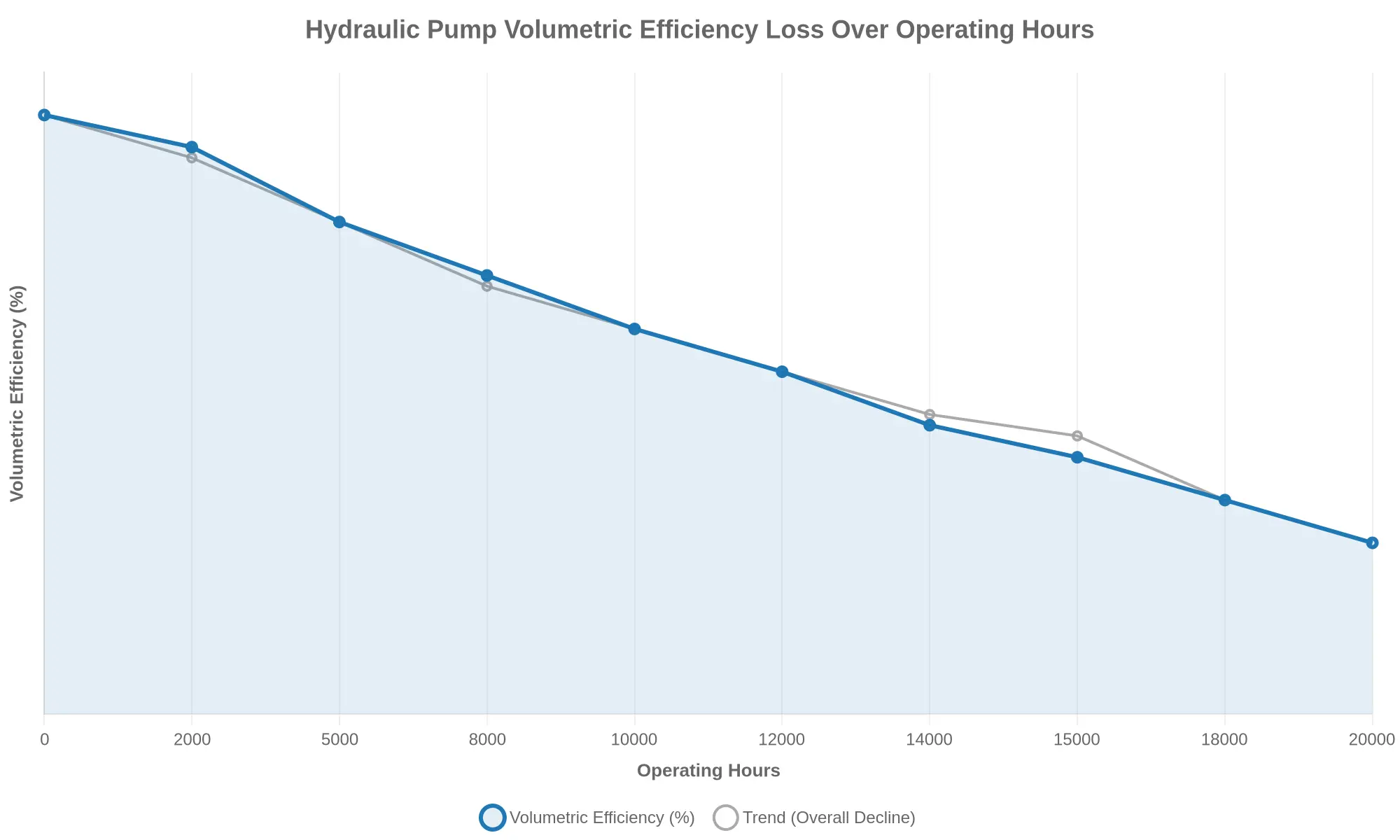
Hydraulic pump wear does not progress in a straight line. Between roughly 5,000 and 10,000 operating hours, clearances grow slowly and output loss stays modest. Past about 12,000 to 15,000 hours the curve steepens and small contamination events compound quickly. That is why a used pump truck with 16,000 hours can behave very differently from one with 9,000 hours, even when the maintenance records look identical.
Why Testing Beats Looking
A pump can lose a third of its volumetric efficiency while still holding acceptable pressure at idle, so visual inspection is never enough. Only pressure and flow testing under load reveals the real condition. Because hydraulic system components such as the pump and its control valves absorb most of a rebuild budget, verify flow output against the OEM spec before you commit to buy.
Where Hydraulic Pump Wear Actually Happens
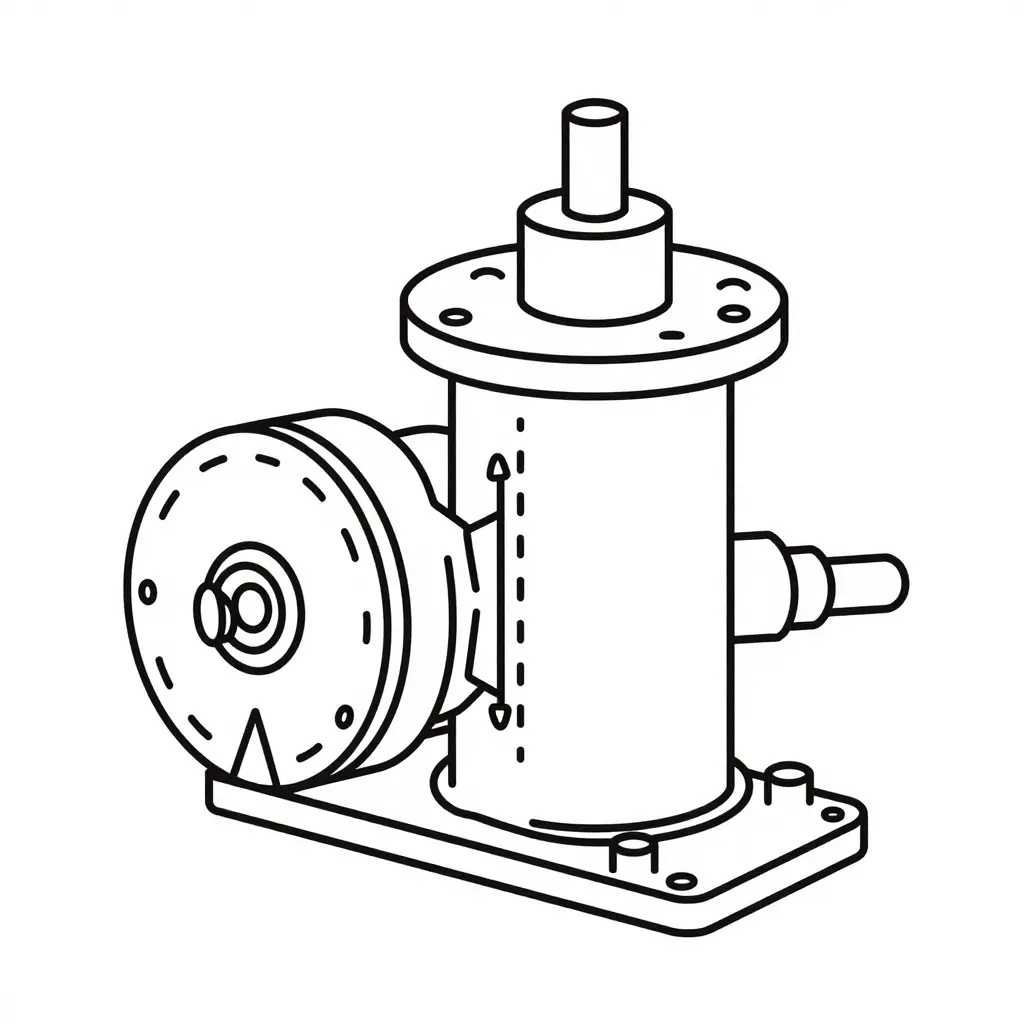
On a used pump truck for sale, the hydraulic pump is the most expensive component to replace and the easiest to overlook. The schematic above shows the four internal wear points that cost a pump pressure and flow long before it fails outright:
- Wear plate – the flat sealing face that controls internal leakage at the valve port. Scoring here lets high-pressure fluid bypass back to the low-pressure side.
- Swash plate – its angled surface sets piston stroke and output volume. Slipper pad wear here reduces displacement and adds metallic debris to the oil.
- Cylinder bore – runs in the barrel where pistons reciprocate. Wall scoring from contaminated oil increases blow-by and uneven pressure.
- Shaft seal – the external barrier at the input shaft. A weeping seal shows up as oil on the pump housing and signals bearing or shaft wear.
The dashed arrows in the diagram mark the leak paths that open as these faces wear. In a healthy pump, clearances stay tight enough to contain fluid. As surfaces degrade, internal leakage rises, oil temperature climbs, and the boom and placing cylinders lose the controlled delivery a pour requires.
Three cheap checks tell you more about a pump than any hour meter: pull an oil sample, ask for a recent flow-and-pressure test, and look at the shaft seal and pump housing for weeping.
Boom Fatigue Assessment: The Safety-Critical Factor That Decides a Rebuild
Every concrete boom lives a hard life: each pour flexes it, each swing loads it, each outrigger extension twists it. Over thousands of cycles that fatigue builds in the steel, the welds, and the pins. When you evaluate a used pump truck for sale, it is the one issue that can turn a bargain into scrap.
How Cyclic Loading Breeds Cracks
Fatigue does not come from one overload event. It comes from the ordinary, repetitive stress of normal operation. As the boom articulates, its sections flex under the weight of the pipe and wet concrete, and peak stress concentrates at weld toes, plate transitions, and sharp corners. A microscopic crack starts there and grows a fraction of a millimeter per cycle until the remaining section can no longer carry the load.
Weld Stress, Torsion, and Hinge Wear
Three mechanisms accelerate this decline:
- Weld stress concentrations at box-section seams and stiffener junctions are the most common initiation sites.
- Outrigger-induced torsion twists the base of the boom whenever the machine is supported unevenly, adding shear stresses the original design did not intend to see continuously.
- Repeated flexing and pin wear at hinge points open clearances, which raises impact loading and drives cracks into pin bosses.
Surface Corrosion vs. Load-Bearing Cracks
Buyers often confuse the two, and the mistake is expensive.
- Surface corrosion is mostly cosmetic. Rust scale, paint loss, and pitting on the outer skin affect appearance rather than capacity, provided wall thickness stays within tolerance.
- Load-bearing fatigue cracks are critical. A crack in a tension flange, weld toe, or pin boss can propagate until a section fails and the boom drops. No paint or cosmetic repair fixes one.
A cosmetic defect almost never takes a machine out of service; a single missed structural crack can. That asymmetry is why visual inspection alone is not enough on a used unit.
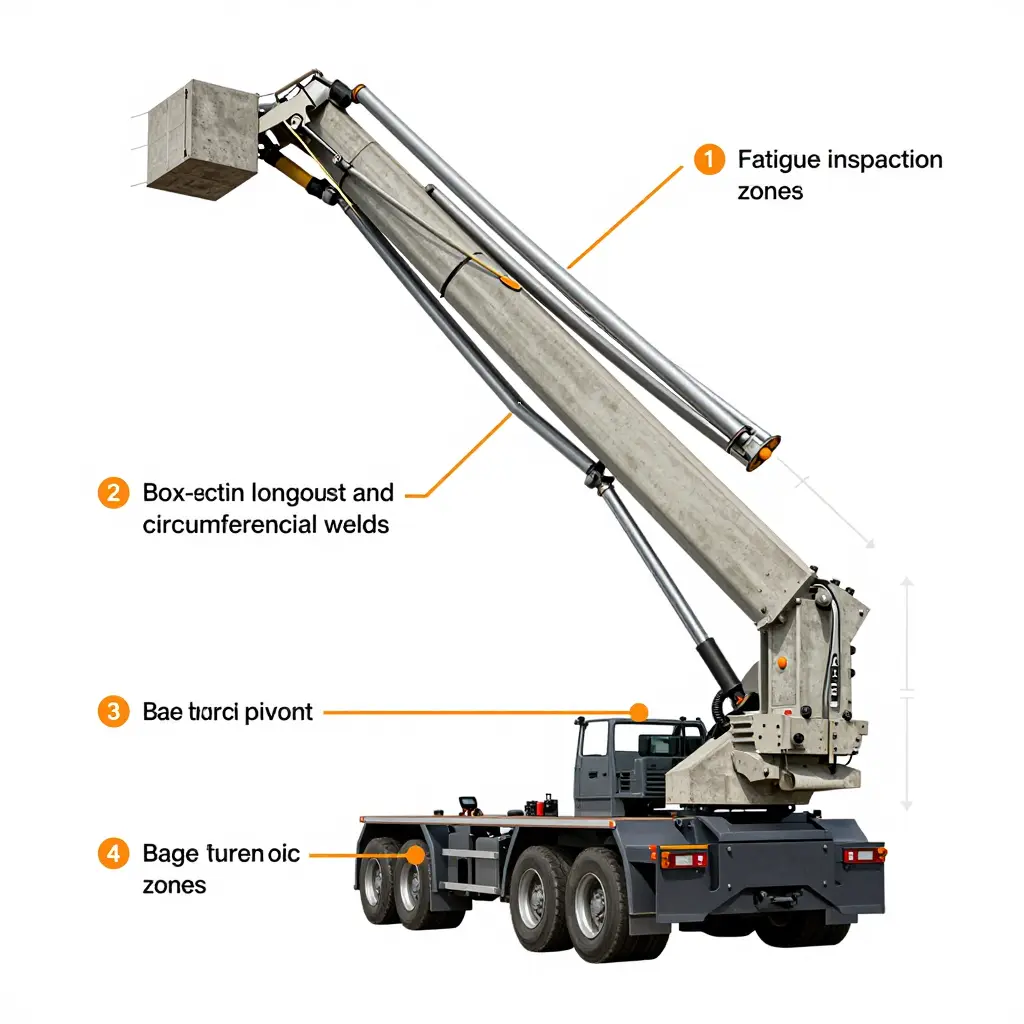
Where to Look: The Priority Inspection Zones
Point your non-destructive testing and visual inspection at these areas:
| Inspection Zone | Typical Defect | Risk Level |
|---|---|---|
| Box-section welds | Toe cracks, undercut | Critical |
| Pin bosses at hinges | Cracking, ovalized bores | Critical |
| Base turret pivot | Cracks, worn slew joint | Critical |
| Boom-to-turret plate | Weld separation | Critical |
| Outer skin surfaces | Cosmetic corrosion | Low / cosmetic |
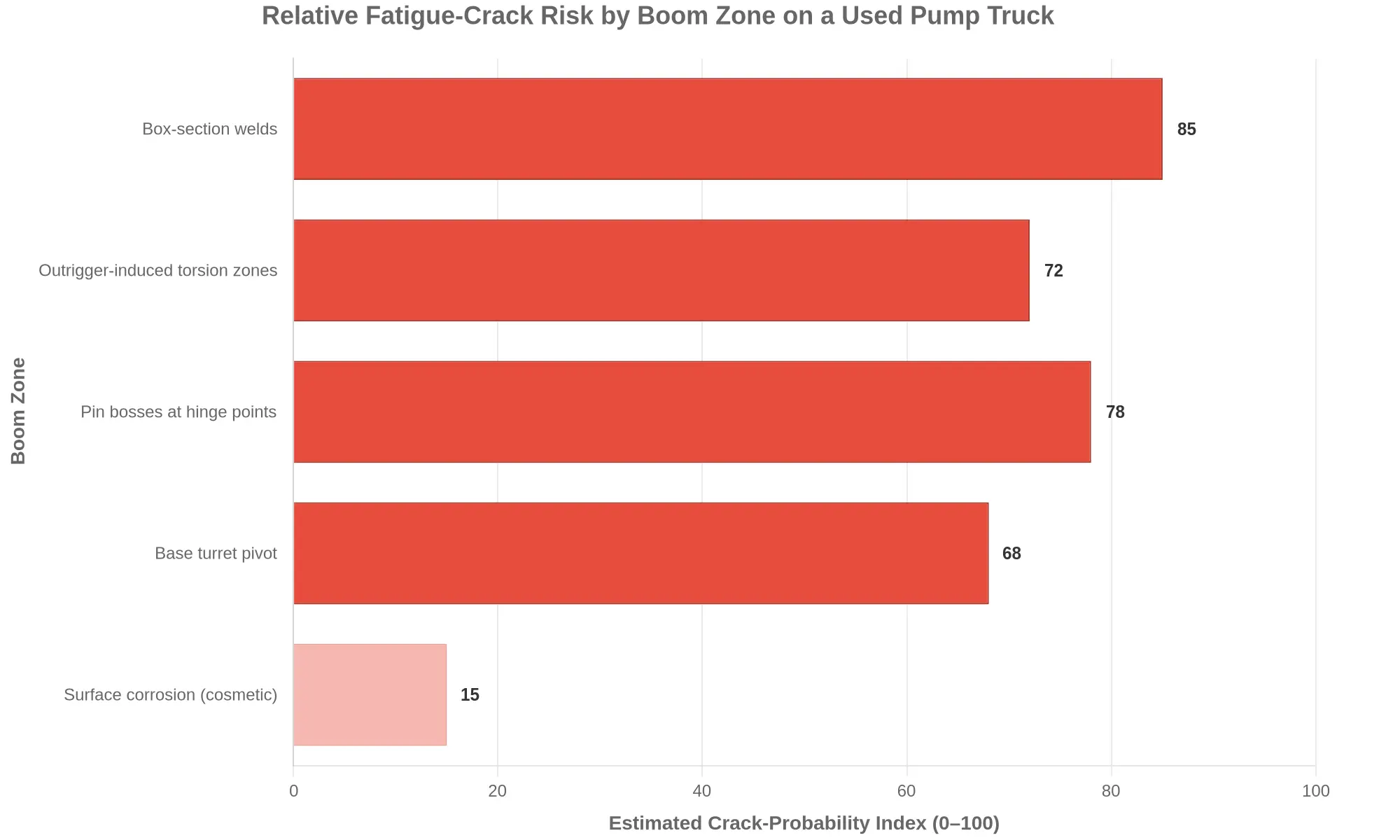
Box-section welds and pin bosses carry most of the risk; surface corrosion sits at the bottom.
Why This Governs Rebuild Economics
Boom condition sets the ceiling on what a rebuild can be worth. If inspection confirms sound welds and clean pin bores, a rebuild can pay for itself. If ultrasonic testing reveals propagating cracks in primary members, the repair cost can exceed the value of the truck. Some structural repairs, like replacing a boom section or a turret casting, are simply not economical at used-market prices.
The same load-path logic applies across lifting equipment, so it helps to understand how heavy-duty hydraulic boom structures are built and stressed.
The Bottom Line for Buyers
Do not sign off on a used pump truck for sale until an independent inspection has cleared the boom’s primary welds, pins, and turret. Cosmetic rust is a negotiating chip; fatigue cracking is a deal-breaker. Treat the boom as the deciding structural question, and your fleet spends its money on machines that work instead of machines waiting for a weld to fail.
A disciplined pre-purchase inspection separates a sound machine from a costly mistake before any deposit changes hands.
Hydraulic System Checks
- Pull a hydraulic fluid sample and send it for lab analysis to detect metal particles, water ingress, and oxidation.
- Review recent pressure test results to confirm the main pump reaches rated output at both low and high flow settings.
- Assess hydraulic pump wear by measuring case drain flow, since excessive leakage points to internal component fatigue.
- Trace all hoses, cylinders, and fittings for weeping seals, chafing, and heat-damaged lines.
- Verify the hydraulic cooler and filtration system perform within spec and show no bypass contamination.
- Cross-check fluid change intervals and filter part numbers against the hydraulic truck crane service record to catch skipped maintenance.
Boom and Structure Checks
- Inspect every weld along the boom sections for cracks, porosity, or repaired zones that hint at boom fatigue.
- Measure pin and bushing wear at each boom joint with a micrometer and compare results against OEM tolerances.
- Examine the outrigger beams, pads, and hydraulic locks for bending, corrosion, or field repair work.
- Check the slewing ring and boom pedestal for play, abnormal noise, and adequate lubrication.
- Review the structural inspection history, including any NDT reports or previous crack repairs performed on the boom.
If pressure tests fall short of rated output, case drain flow is excessive, or weld and pin inspections reveal cracking or play beyond tolerance, budget for a full technical teardown before purchase.
Hydraulic Wear vs. Boom Fatigue: A Side-by-Side Comparison
Two condition factors dominate a rebuild budget on a used pump truck for sale: hydraulic pump wear and boom fatigue. Both sit inside the same hydraulic system you would find on a hydraulic truck crane, but they call for different inspection and spending strategies. The table below compares them, along with two auxiliary items worth checking.
| Condition Factor | Common Symptoms | Inspection Method | Typical Repair Cost Share | Impact on Purchase Decision |
|---|---|---|---|---|
| Hydraulic pump wear | Weak output pressure, slow boom and ram cycles, whining, hot oil, metal particles in fluid | Pressure-flow test, oil analysis for wear metals, filter-magnet check, case-drain flow measurement | 15-30% of rebuild budget | High but predictable – pump can be rebuilt or replaced for a known cost |
| Boom fatigue | Cracks near welds and hinge points, rust streaks, flaking paint, sectional sag, jerky movement | Dye-penetrant or magnetic-particle testing of welds, visual inspection with a magnifier, pin/clearance measurement, ultrasonic thickness of box sections | 20-40% of rebuild budget | Critical – a safety issue that may be non-repairable and can void certification |
| Hydraulic cylinders | Leaking seals, drift under load, scored or pitted rods | Visual seal and rod check, pressure-hold test, extend-and-hold leak observation | 5-15% of rebuild budget | Moderate – usually repairable with reseal kits or replacement |
| Turret bearing (slewing ring) | Play or rocking at the boom base, grinding during rotation, uneven slew, grease loss | Dial-indicator check of axial and radial play, grease sampling, mounting-bolt torque verification | 10-20% of rebuild budget | High – replacement is costly but the failure point is predictable |
Weigh hydraulic wear and boom fatigue together rather than in isolation: a tired pump is a predictable and usually repairable cost, while boom fatigue is a safety-critical, sometimes deal-breaking risk. Fund hydraulic refurbishment first, then hold a contingency for structural inspection and certified repair before you commit to the rebuild budget.
Building a Realistic Rebuild Budget
A used pump truck only becomes a bargain once you know what the rebuild will cost. The purchase price is the easy number; the rebuild budget decides whether the deal works. Build your figure around five cost buckets, then size the job to the duty cycle the truck will actually face.
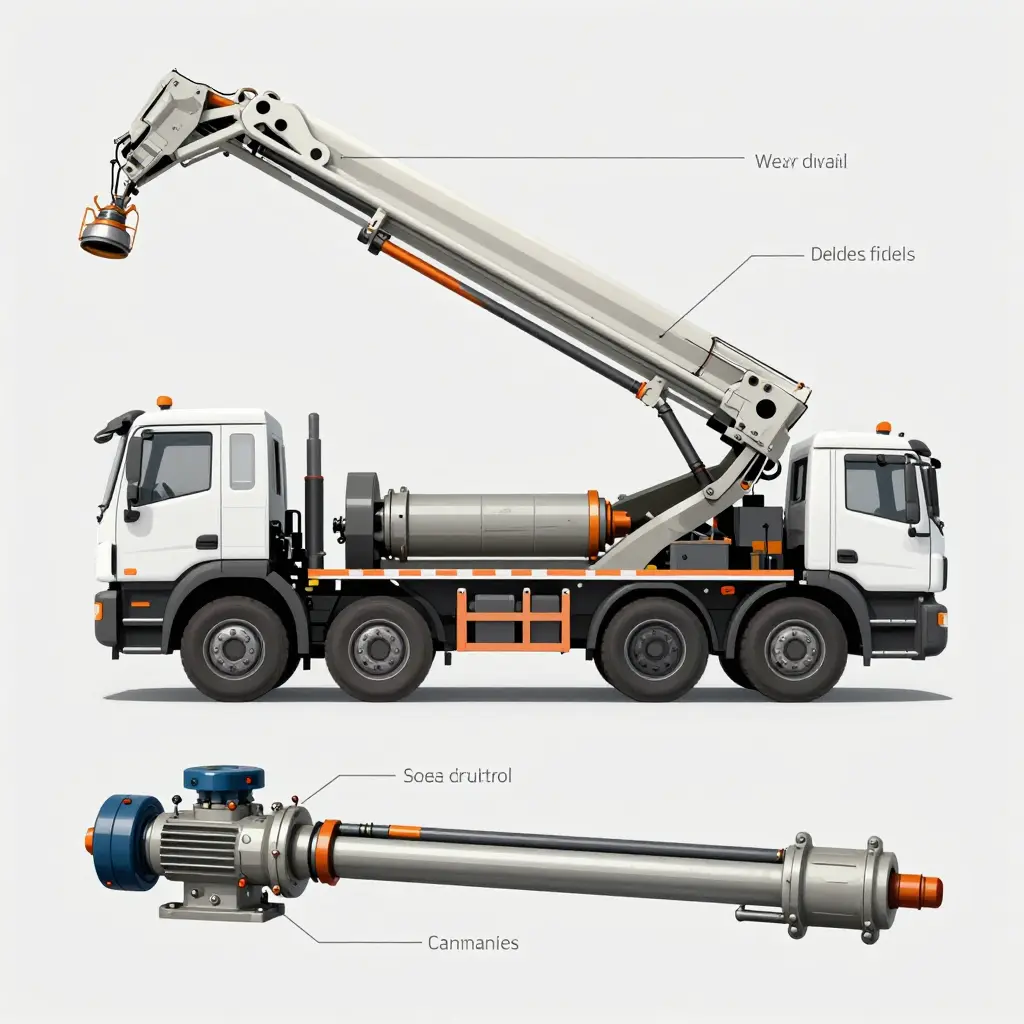
The five cost buckets that define the total
Treat the rebuild as five separate invoices rather than one. Lumping them together hides the line items that grow fastest. If you are also comparing hydraulic-heavy machinery, reviewing hydraulic systems and lifting equipment is a useful sanity check on what a proper overhaul involves.
| Cost component | What drives the spend | Typical range (USD) |
|---|---|---|
| Hydraulic pump overhaul or replacement | Hydraulic pump wear measured at teardown; new vs. reman vs. rebore | $6,000 – $35,000 |
| Boom crack repair and structural reinforcement | Weld prep, certified re-welding, plate reinforcement, NDT re-inspection | $5,000 – $30,000 |
| Hydraulic cylinder resealing | Cylinder count, rod condition, barrel scoring | $2,500 – $12,000 |
| Control system upgrades | Proportional valves, joystick or remote, wiring, radio control | $3,000 – $18,000 |
| Labour and downtime overhead | Shop hours, crane and lifting, lost production days | $4,000 – $25,000 |
Light refresh, partial rebuild, or full rebuild?
A rebuild budget only makes sense when it matches the truck’s intended duty cycle. Over-rebuilding a low-hour machine wastes capital; under-rebuilding a truck headed for continuous pours invites a mid-project failure.
- Light refresh suits a machine running light, sporadic duty – a few days a month, shorter booms, lower pressures. You address hydraulic pump wear at the margin, reseal weeping cylinders, and refresh controls, but leave structure and major hydraulics largely untouched.
- A partial rebuild fits a truck heading into regular commercial work – steady weekly pours on mid-size jobs. Here you overhaul the pump, repair known boom cracks, and reseal all cylinders, accepting that some assemblies will carry more hours than others.
- A full rebuild is for high-cycle, high-pressure duty: continuous pours, tall booms, heavy utilisation. Every wear surface is renewed, the structure is reinforced and re-certified, and controls are modernised – because downtime in the field costs far more than the parts.
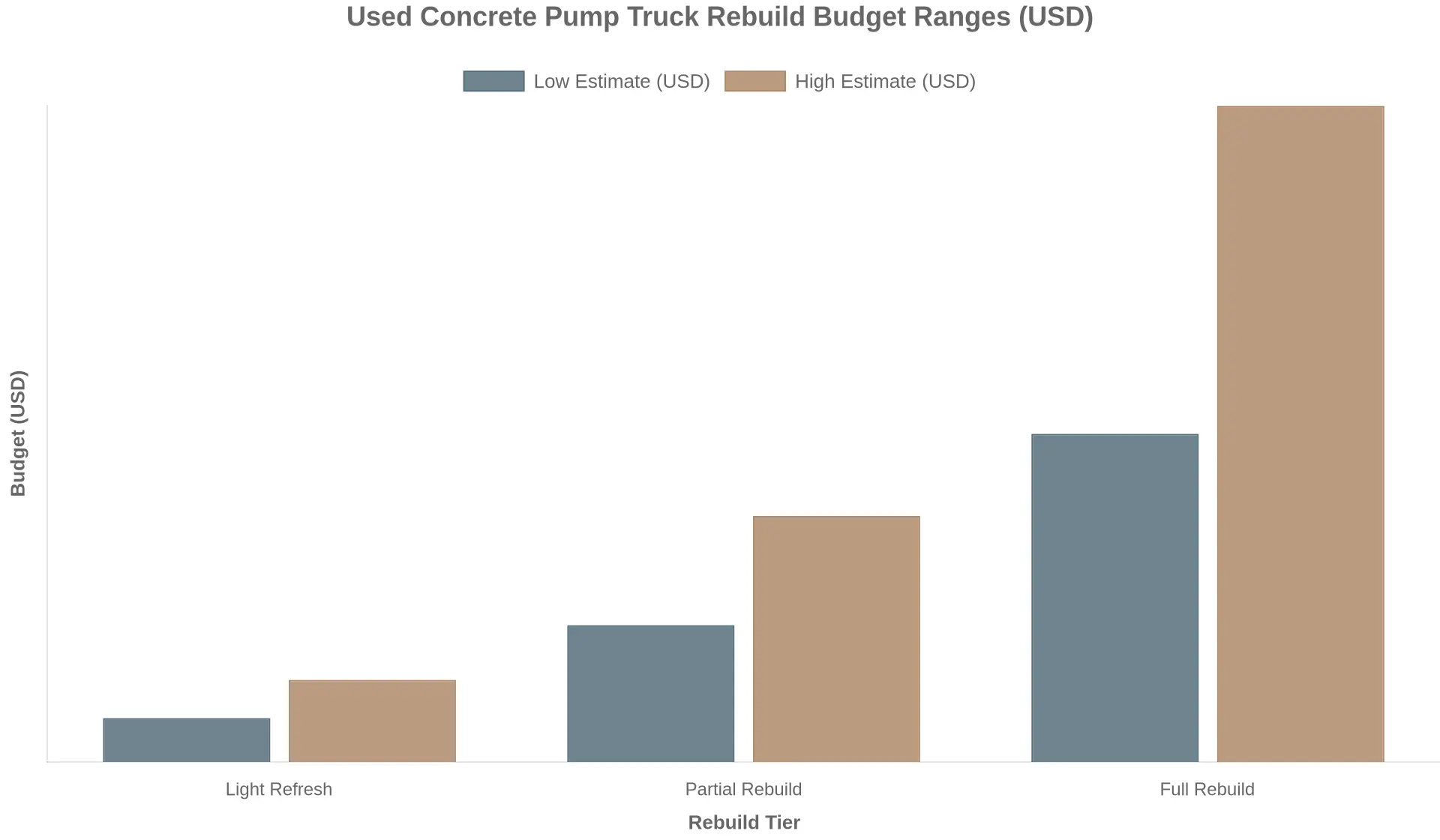
Reserving room for the damage teardown reveals
The most common budgeting mistake is treating the first inspection as the final scope. Teardown usually turns up hidden damage – a scored cylinder barrel found only after resealing starts, or boom cracks that spread once paint is stripped. Hold back a contingency of 15-25% of the core rebuild budget, then set a hard decision point: if hidden damage pushes the scope past your contingency, pause and re-price instead of absorbing the overrun. Scale the contingency to the depth of the teardown – small for a refresh, larger for a full rebuild.
Where Your Rebuild Budget Actually Goes
Most rebuild budgets come down to the same five buckets, with the hydraulic pump and boom taking the largest share.
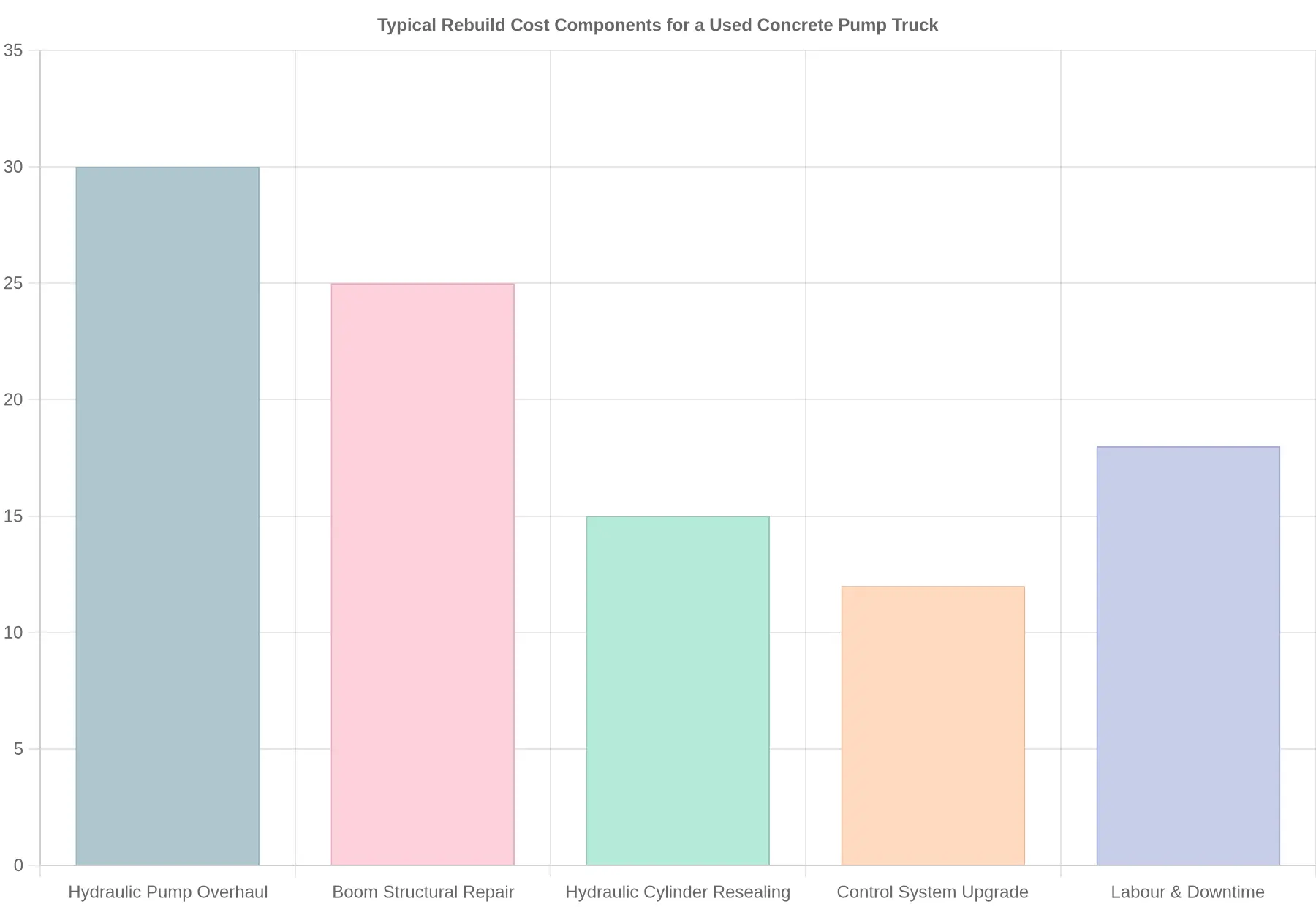
Cost shares vary with operating hours and inspection findings.
Negotiation Red Flags and the Rebuild-versus-Replace Decision
Every used pump truck carries a second number beyond the asking price: what it will cost to make the machine trustworthy again. Find that number before you negotiate, then use it as leverage. The seller names a price; you price the risk.
Three Red Flags That Move Money
Undocumented hydraulic service history. A pump truck lives and dies by its hydraulic system. If the seller cannot produce service records for the main pump, valves, cylinders, and cooler, assume worst-case wear. Missing paperwork is not neutral; it is a price cut you should ask for. A documented service trail is worth real money, and its absence is worth a discount.
Active boom crack repairs without engineering sign-off. Fresh welds, doubler plates, or grinder marks near the boom pivot or box section, with no stamped engineering repair procedure, mean the boom should be treated as compromised. Field-welded cracks are a structural liability that can void certification and endanger operators. Walk away, or make the seller fund a certified repair with NDT verification.
Fluid analysis showing heavy contamination. Always request a lab report on the hydraulic oil. High particle counts, water ingress, or metal fines mean the pumps, motors, and valves are already wearing from the inside. A dirty sample means the rebuild clock is running faster than the hour meter suggests, so budget accordingly.
Turning Findings into a Real Number
The sticker price is not what you pay. The working formula is:
Real Acquisition Cost = Asking Price + Projected Rebuild Budget + Downtime and Recertification Costs.
If a unit lists at $180,000 and a competent shop quotes $65,000 for pumps, seals, hoses, and boom inspection, your real number is roughly $245,000 before it ever pours concrete. Negotiate against that figure, never the listing price. A modest sticker price turns into a heavy real cost, which is why the “cheap” truck rarely is.
| Inspection Finding | Typical Negotiation Position | Recommended Action |
|---|---|---|
| No hydraulic service records | Reduce price 5-10% | Budget a full hydraulic inspection |
| Boom crack repair, no engineering sign-off | Walk away or demand certified repair quote | Require NDT and a stamped procedure |
| Heavy fluid contamination | Subtract full flush and pump rebuild | Lab-test the oil before any offer |
| Minor leaks, documented service | Small reduction only | Proceed with confidence |
When a Rebuild Stops Making Sense
A rebuild is worth doing when the chassis, boom structure, and drivetrain are sound and only wear parts are tired. It stops making sense once the rebuild budget exceeds roughly 50-60% of the price of a comparable refurbished or new unit – at that point you are paying new money for old steel.
Three additional walk-away signals: structural boom fatigue that needs section replacement, a bent or twisted boom that cannot be re-straightened within spec, and hydraulic contamination so severe the entire circuit must be flushed and rebuilt. If any of these apply, replacement wins on total cost of ownership every time. For contractors comparing mixed fleets, the same rebuild math applies to the arm and lifting assemblies on aerial and hydraulic crane units, where hydraulic truck cranes share near-identical pump and cylinder economics.
Bottom line: inspect hard, quantify the repair, subtract it from the asking price, and only sign when the real acquisition cost beats replacement.
In front of a used pump truck with a tired hydraulic system and a boom that has seen a decade of pours, the question is usually not whether it is broken but whether rebuilding it is worth it. The diagram below maps that decision as a sequence you can walk through before you sign a purchase order.
The Rebuild vs. Replace Evaluation Path
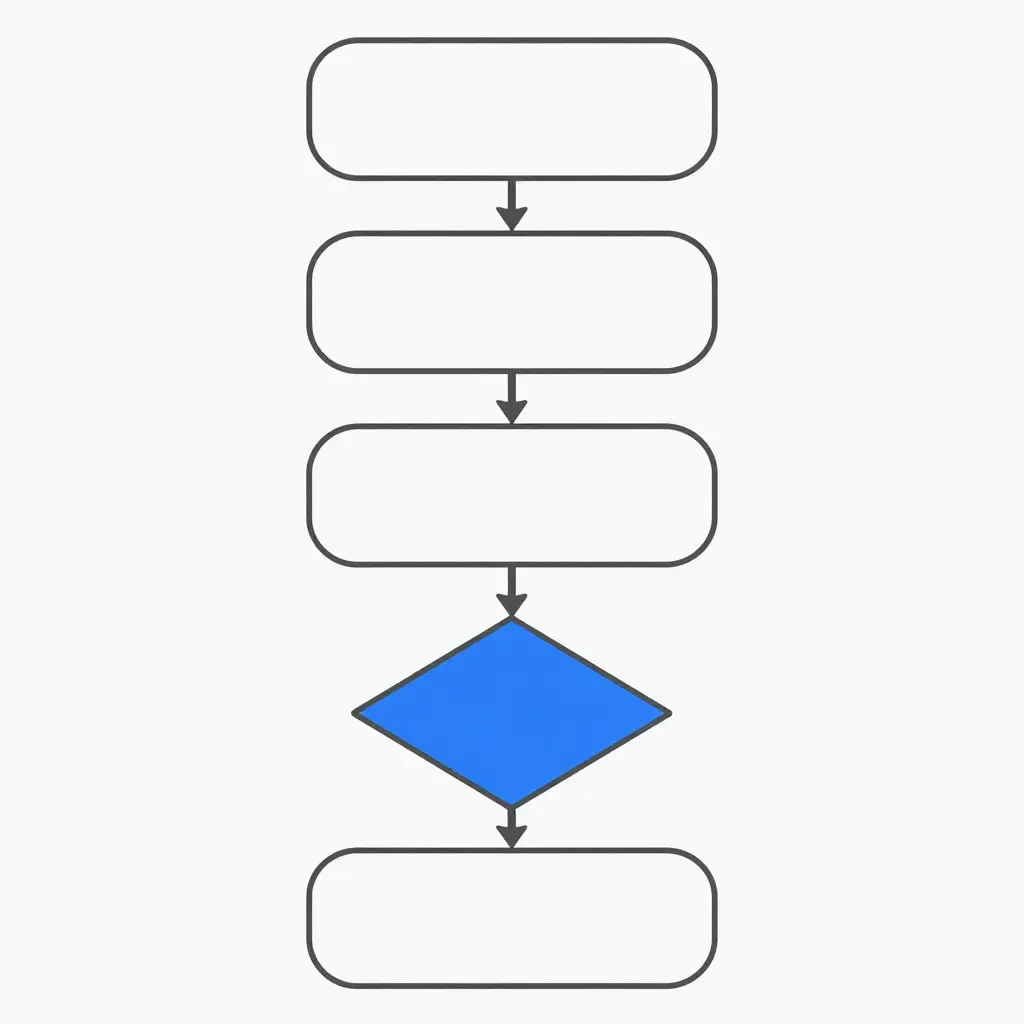
Work the flow from top to bottom. Each box is a checkpoint, and you move to the next only once you have real numbers rather than a seller’s assurances. Each stage settles one question:
- Inspect the hydraulic system. Check pump wear, cylinder scoring, hose condition, and whether pressure holds under load. Hydraulic failures are the single most expensive surprise on a used unit.
- Assess the boom structure. Look for fatigue cracks, weld repairs, and out-of-tolerance deflection. Structural fatigue is the hardest defect to reverse economically.
- Estimate the rebuild budget. Add up parts, labor, downtime, and re-certification to arrive at a realistic all-in figure – not a best-case guess.
- Compare against replacement cost. Weigh your rebuild number against the delivered cost of a comparable used or new machine, factoring in remaining service life.
- Decide. If the rebuild budget sits comfortably below replacement and the structure is sound, rebuild. If fatigue is deep or the math is thin, replace.
Why the sequence matters
The order is deliberate. Hydraulics and boom structure are where a “cheap” truck turns expensive fastest, so they come first. A budget estimate only means something once you know how much steel and fluid you have to rescue.
| Checkpoint | What Kills the Deal | Typical Cost Driver |
|---|---|---|
| Hydraulic system | Failing main pump, scored cylinders | Pump and cylinder replacement |
| Boom structure | Fatigue cracks, past field welds | Steel repair and re-certification |
| Rebuild budget | Parts, labor, downtime | Total project hours |
| Replacement cost | Thin remaining service life | New or used machine price |
Run every number through the flow before you commit. A truck that clears all five boxes is a rebuild candidate; one that fails on structure or math is a replacement.
If you are comparing whole-fleet options, it helps to see how similarly spec’d working vehicles are priced and configured. Comparable aerial and hydraulic equipment categories, such as hydraulic truck cranes and working units, give you a benchmark before you finalize the rebuild call.
A quick rule of thumb
If the rebuild budget lands above roughly half the cost of a comparable replacement, and the boom has already been welded once, lean toward replacement. Sound iron with a tired but serviceable hydraulic package is where rebuilding pays off.
Frequently Asked Questions About Buying a Used Pump Truck
How can I tell if hydraulic pump wear is too severe to keep running?
Start with a pressure and flow test at full operating temperature, because a pump that looks fine when cold often reveals real trouble once the oil thins out. Warning signs of advanced hydraulic pump wear include sluggish boom response, drift under load, oil temperature that climbs faster than normal, and dark fluid with visible metal glitter. Pull the return filter and check the magnet for iron paste, then send an oil sample for particle analysis. If the pump cannot hold rated pressure, or flow drops more than roughly 10 to 15 percent below spec, plan for replacement rather than a top-up. Contractors often compare these readings against the hydraulic equipment specs on comparable machines before committing.
Can boom fatigue cracks be safely repaired, or does the boom section need replacing?
It depends on where the crack sits and how it is treated. A single, short crack in a non-critical plate can be repaired safely by grinding it out completely, welding to the manufacturer’s procedure, and adding a reinforcement plate. Structural boom fatigue at hinge points, box-section corners, or areas with multiple branching cracks usually means the affected section should be replaced instead of welded. Always require ultrasonic or magnetic particle testing before and after the repair, and never accept a weld that simply caps the crack.
What should I expect a full rebuild to cost?
Cost varies widely with boom length and vehicle class, so use ranges rather than single figures. A hydraulic-only rebuild typically runs $8,000 to $25,000, while a full rebuild covering hydraulics, boom repairs, and engine work commonly lands between $60,000 and $150,000. Boom section replacement alone can add $30,000 to $80,000 depending on size and availability. Set your rebuild budget against the residual value of the chassis so you never spend more than the finished truck is worth.
Is a rebuilt pump truck worth buying versus a new one?
For most contractors, yes, provided the rebuild is documented. A properly rebuilt unit usually sells for 40 to 60 percent of new price and can deliver comparable output for years when the chassis is sound and parts are still available. New machines win on warranty coverage, latest boom technology, and predictable uptime. The deciding factor is the quality of the rebuild file: pressure test records, weld certifications, and parts invoices should all be present.
How many operating hours are acceptable on a used pump truck for sale?
Boom and pump hours matter far more than engine mileage, because the placing circuit does the hardest work. On a well-maintained unit, 3,000 to 6,000 boom hours is generally acceptable, and 6,000 to 8,000 hours is workable if a rebuild has been completed and documented. Anything above 8,000 hours without a rebuild should be priced as a project truck, not a working asset. Always verify the hour meter against service records and wear patterns on the outriggers, boom pins, and slew ring.