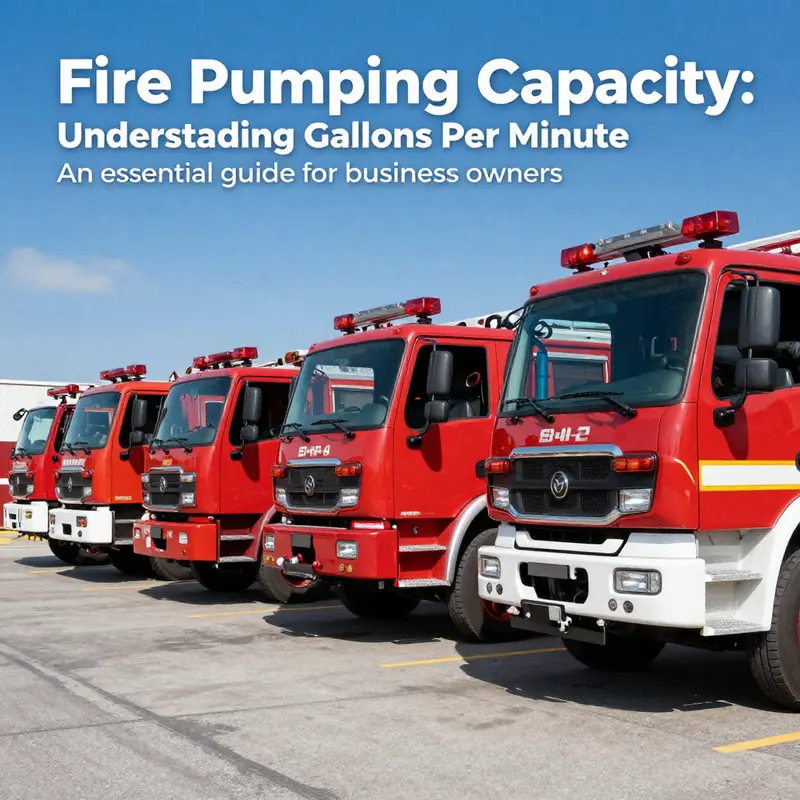
Steel vs Aluminum Fire Truck Bodies: Where the Money Actually Goes
Buyers comparing steel and aluminum fire truck bodies usually compare one line item: the invoice. That number is real, but it isn’t the cost of the apparatus. The purchase price is the first entry in a ten-year ledger, and what the truck costs to keep in service is settled by corrosion repair and service life.
Start with the price gap between the two bodies, including the material, fabrication and coating work behind it. Then add what rust and galvanic damage cost in repairs, repainting and lost availability. The two figures only mean something added together, with service life and resale in the same column.
A lower purchase price looks like a clear advantage until corrosion repair and a shorter service life are priced in. A department that keeps apparatus a decade or more needs the whole comparison, not the invoice.
To see how those trade-offs land on real builds, compare fire fighting truck configurations across weight classes and body styles.
Why a Steel Fire Truck Body Carries a Lower Purchase Price
Steel is still the least expensive way to put a durable, load-bearing body on a chassis. The gap starts at the mill: plate and structural sections cost a fraction of aluminum per ton, and that difference carries through every fabrication step. A steel body comes in noticeably below an equivalent aluminum build before a single option is added.
The figures below are order-of-magnitude planning estimates for budgeting conversations, not audited data or quotations.
| Cost item | Steel body planning estimate | Aluminum body planning estimate |
|---|---|---|
| Body plate material, per ton | USD 700 – 1,100 | USD 2,400 – 3,400 |
| Fabricated body, mid-size pumper | USD 18,000 – 28,000 | USD 30,000 – 46,000 |
| Typical welding and labor share | Lower, forgiving process | Higher, more setup and skill |
Where the savings actually come from
Lower raw material cost per ton. Steel is a commodity with deep, liquid supply, so buyers aren’t competing for a narrow pool of marine-grade aluminum sheet. Price swings are easier to absorb and lead times easier to plan around.
Simpler fabrication and welding. Mild steel welds predictably with common MIG and stick processes. Fabricators need less fixturing, less preheat planning and fewer rework cycles than aluminum demands, and those hours show up in the invoice.
Wider supplier availability. Far more shops can cut, bend and weld steel than can work aluminum to fire apparatus standards. More bidders means more competitive pricing and shorter lead times, which matters when a replacement body is needed quickly.
Easier repair in general workshops. A dented or cracked steel panel can usually be straightened or patched locally. Straightening aluminum is fussier, and heat-sensitive alloys can lose strength during the repair. Keeping common fire truck body parts in stock is also simpler and cheaper for steel structures.
The mechanical trade-offs behind the lower price
The savings get paid for in other currencies. Steel is roughly three times denser than aluminum, so a steel body adds real weight to the chassis, and that weight comes straight out of the payload margin — the margin that carries water and foam. A body that saved money at purchase can end up forcing a smaller tank or a heavier chassis specification.
Corrosion is the second cost. Steel depends on coatings and paint for protection. Wherever a coating is breached, whether by a stone chip, a mounting bolt or a scratched compartment floor, rust starts and spreads behind the paint film. Aluminum oxidizes too, but it doesn’t perforate the same way, which changes long-term repair budgets.
So measure a steel body’s advantage against payload and corrosion exposure rather than against sticker price alone. Compare the delivered cost per kilogram of usable payload, then weigh it against the salt, humidity and washdown cycle the truck will actually face. For departments on short, dry-duty cycles, steel often wins on total cost. On coastal or heavy-washdown duty, the savings get spent on coating quality or lost to panel replacement.
Why an Aluminum Fire Truck Body Commands a Higher Purchase Price
The aluminum premium reflects how the material behaves in fabrication, how much design work surrounds it, and how few shops are genuinely equipped to build with it. A price comparison that skips those drivers ends up comparing a commodity steel fabrication with a more demanding engineered assembly.
Higher material cost
Aluminum sheet and extrusion in the alloys and thicknesses used for apparatus bodies generally cost more per pound than structural carbon steel, and the premium widens once cut-off waste, tighter handling requirements and mill lead times on specific tempers are counted. Because the material is lighter, more of the structure has to be designed around stiffness rather than mass, which can add section depth and forming complexity. Builders’ indicative ranges put the material line well above steel on a like-for-like body; the exact figure depends on alloy selection, panel thickness and supplier contracts.
Specialized welding and fastening processes
Aluminum pulls heat out of the weld zone quickly, so fabricators have to hold heat input in a narrow band to avoid distortion and strength loss in the heat-affected zone. That means dedicated welding equipment, separate wire and consumables, clean dry shop conditions, and strict separation from steel tooling to prevent contamination. Many body assemblies also use riveted or bonded joints alongside welding, which brings fixturing, controlled clamp pressure, surface preparation and sealant work that has to repeat exactly. It runs slower per linear foot than plain steel welding, and the hours go into the price.
Extra engineering for dissimilar-metal joints
The most underestimated cost sits at the interfaces. Body mounts, hinge points, pump and tank brackets, subframe connections and step hardware often join aluminum to steel. Those joints create galvanic couples, so engineers have to specify isolation barriers, coated or stainless fasteners, compatible sealants and drainage paths that keep water from pooling at the connection. Each decision needs drawing time, prototype checks and validation before it reaches production. On a steel body, most of that work is settled by habit.
A smaller pool of qualified builders
Fewer fabricators have real aluminum apparatus experience, and fewer still will bid on a custom body. That leaves a thinner competitive field, longer lead times and labor priced accordingly. Expect fewer options on the aluminum side, and weigh build quality and process discipline rather than bid count. Typical commercial fire truck builds show how body specification shapes the configuration choices that follow.
What the premium buys
Lower body weight and more payload for water and agent. Water runs about 8.3 pounds per gallon, so every pound taken out of the body structure is a pound available for tank capacity, foam concentrate or equipment. On a chassis with a fixed axle rating, an aluminum body can support a larger tank or a fuller equipment load without going over the limit.
Corrosion resistance that does not depend on paint integrity. Steel depends on coating continuity; a deep scratch, a stone chip or a scored panel edge becomes a rust initiation site, especially with road de-icing salt. Aluminum forms its own passive oxide layer, so minor surface damage doesn’t start the same progressive deterioration, and the structure doesn’t rely on a repaint schedule to survive.
Stronger resale value. Second owners and trade-in appraisers look at structural condition first. An aluminum body that has spent a decade in service without section loss or patch repairs tends to hold residual value better than a steel body of the same age, which narrows the net cost gap over the ownership cycle.
Where the aluminum premium is recovered
- More water, foam or equipment carried per legal axle load, which cuts trips and mutual-aid calls.
- Less spent on corrosion repair and repainting over the service life of the body.
- Higher residual value at trade-in or resale, offsetting part of the initial outlay.
Figures in this section are indicative estimates; actual costs vary by builder, specification, chassis and region.
The comparison below sets the two bodies side by side as a quick screen, and the cost breakdowns that follow carry the detail. To see how each body style is specced, browse commercial fire truck platforms.
| Factor | Steel Body | Aluminum Body | What It Means for the Buyer |
|---|---|---|---|
| Purchase price premium | Baseline, lowest upfront cost | Typically 10-20% higher on a completed apparatus | Budget more upfront for aluminum, less later |
| Body weight | Heavier shell, lower payload headroom | Roughly 30-40% lighter body structure | Haul more water or equipment per trip |
| Corrosion resistance | Requires painting and regular inspection | Naturally oxide-protected, holds up in salt | Fewer paint cycles and less rust chasing |
| Typical corrosion repair approach | Cut out rust, weld patches, repaint | Replace panels, re-rivet, specialist welding | Aluminum repairs need certified shops, not any garage |
| Repair turnaround | Short, common welding skills available | Longer, fewer qualified fabricators | Plan spare coverage, downtime costs more with aluminum |
| Resale value | Depreciates faster in wet, salty climates | Holds value better in corrosive service areas | Stronger resale where roads are salted |
| Expected service life | 15-20 years with diligent maintenance | 20-25 years with basic care | Aluminum’s longer life often offsets the price gap |
| Best-fit use case | Budget-limited, dry inland, high-turnover fleets | Coastal, industrial, long-hold frontline fleets | Match body material to climate and ownership horizon |
What Drives Corrosion Repair Cost on a Fire Truck Body
Corrosion repair cost behaves less like a one-time invoice and more like a line item that comes back every budget cycle. A body sits outdoors, gets sprayed with road salt and cycles between wet and dry, so the damage never truly stops. Owners who plan for it as a recurring operating expense make better equipment decisions than those who treat it as a surprise.
- Coating failure and repaint cycles. Once paint chips or seam sealant cracks, moisture reaches bare metal and the damage spreads. Repainting a whole compartment section costs far more than the spot touch-up that was skipped the year before.
- Panel replacement versus patch repair. A patch saves money today and often traps corrosion behind the new plate. Full panel replacement restores the structure and resets the corrosion clock, which is why it dominates the larger bills; sourcing the correct fire truck body parts and panels adds to the total.
- Galvanic corrosion at body-to-chassis and body-to-subframe joints. Where a steel bracket meets aluminum skin, moisture and salt make a small battery, and the aluminum — the anode in that couple — loses material. Isolating those joints costs labor, and sometimes means replacing hardware on both sides of the connection.
- Hidden corrosion in compartments and wheel arches. Wheel spray and standing water collect where nobody inspects, so the damage is already advanced by the time it shows. Access, disassembly and refinishing hidden areas inflate every estimate.
- Downtime and lost readiness. A truck in the shop cannot answer a call, and departments may need a rental unit or mutual-aid cover. That lost availability is a real operating cost even when no invoice records it.
- Labor rates for aluminum welding versus steel welding. Aluminum demands cleaner prep, a different filler metal and more skilled hands, so hourly rates and rework risk run higher. A repair costs more per hour than patching steel, and the gap compounds across the vehicle’s service life.
On routine, low-speed corrosion, a painted steel body usually absorbs less cost per event, because patching is cheap and widely available. On coastal, industrial or heavy-salt routes, aluminum tends to come out ahead: fewer corrosion events, and each one rarely escalates into structural replacement. Budgeting the work as an annual expense line rather than a rare emergency keeps both sets of numbers honest.
Cumulative Purchase Plus Corrosion Repair Cost, Steel vs Aluminum Body
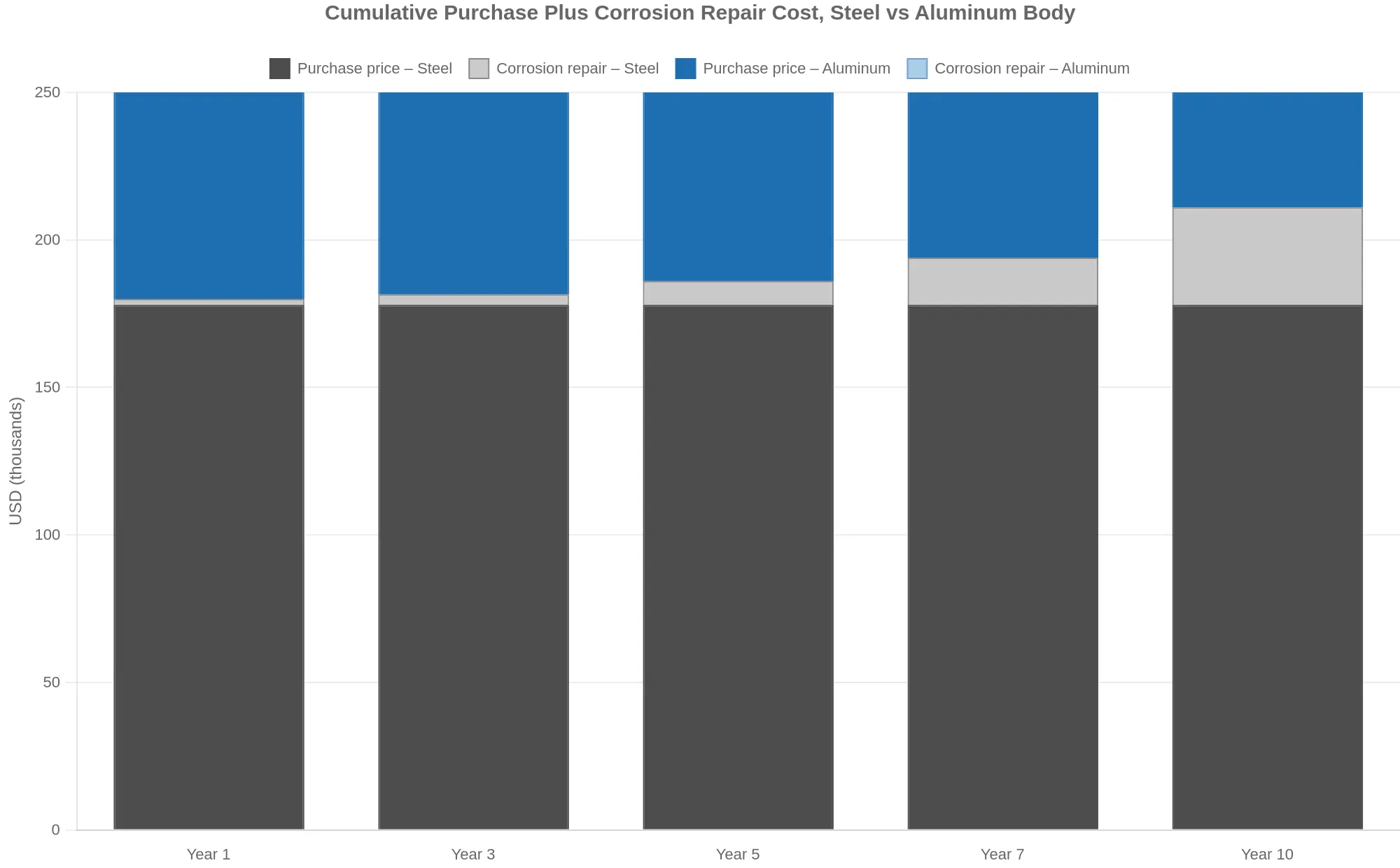
Note: The values shown are indicative planning estimates used to illustrate the crossover point, not quoted prices.
The useful question is which body costs less by the time the rig is paid off, not which costs less on delivery day. Grouped bars make that shift visible year by year.
| Ownership year | Steel body (USD) | Aluminum body (USD) | Aluminum premium remaining |
|---|---|---|---|
| Year 1 | 180,000 | 205,000 | 25,000 |
| Year 3 | 181,500 | 205,300 | 23,800 |
| Year 5 | 186,000 | 206,200 | 20,200 |
| Year 7 | 194,000 | 207,800 | 13,800 |
| Year 10 | 211,000 | 211,500 | 500 |
Reading the chart: the aluminum premium is essentially gone by year 10, when both totals land near $211K on these assumptions. Past that point the gap keeps shrinking, and the next round of steel corrosion repairs, often quoted on replacement fire truck parts, pushes the steel body above aluminum for good.
Total Cost of Ownership: Finding the Break-Even Point
The purchase price gap is one line in the budget. A real comparison uses total cost of ownership, which folds the price difference and the expected corrosion repair cost into a single lifecycle number and shows which body costs less across the years you plan to keep the truck.
Divide each purchase price by the years you expect to keep the truck, add average annual corrosion repair, add annual downtime cost, and the result is a cost per service year for each option. Two cost-per-year figures compare better than two sticker prices, because upfront savings and long-term repairs end up on the same scale.
Four inputs drive the calculation, and the buyer supplies all four:
| Variable | What it reflects |
|---|---|
| Local labor rates | Body shop and welder hourly cost in your area |
| Climate and de-icing salt exposure | How aggressive the corrosion environment is |
| Wash-down frequency | How often the chassis and body are rinsed |
| Expected service life | Planned hold period in years |
Build the comparison in four steps:
- Set the expected service life in years.
- Divide each purchase price by that figure to get an annual cost.
- Estimate average annual corrosion repair from local labor rates, salt exposure and wash-down frequency.
- Add annual downtime cost to each figure and compare the two per-year results.
A short hold period favors the lower purchase price, because there are too few years of repair savings to offset the upfront gap. A long hold favors the body with the lower corrosion repair cost, since annual savings accumulate over more years and can exceed the original premium. The same four steps work on any specification, including heavy-duty fire truck builds.
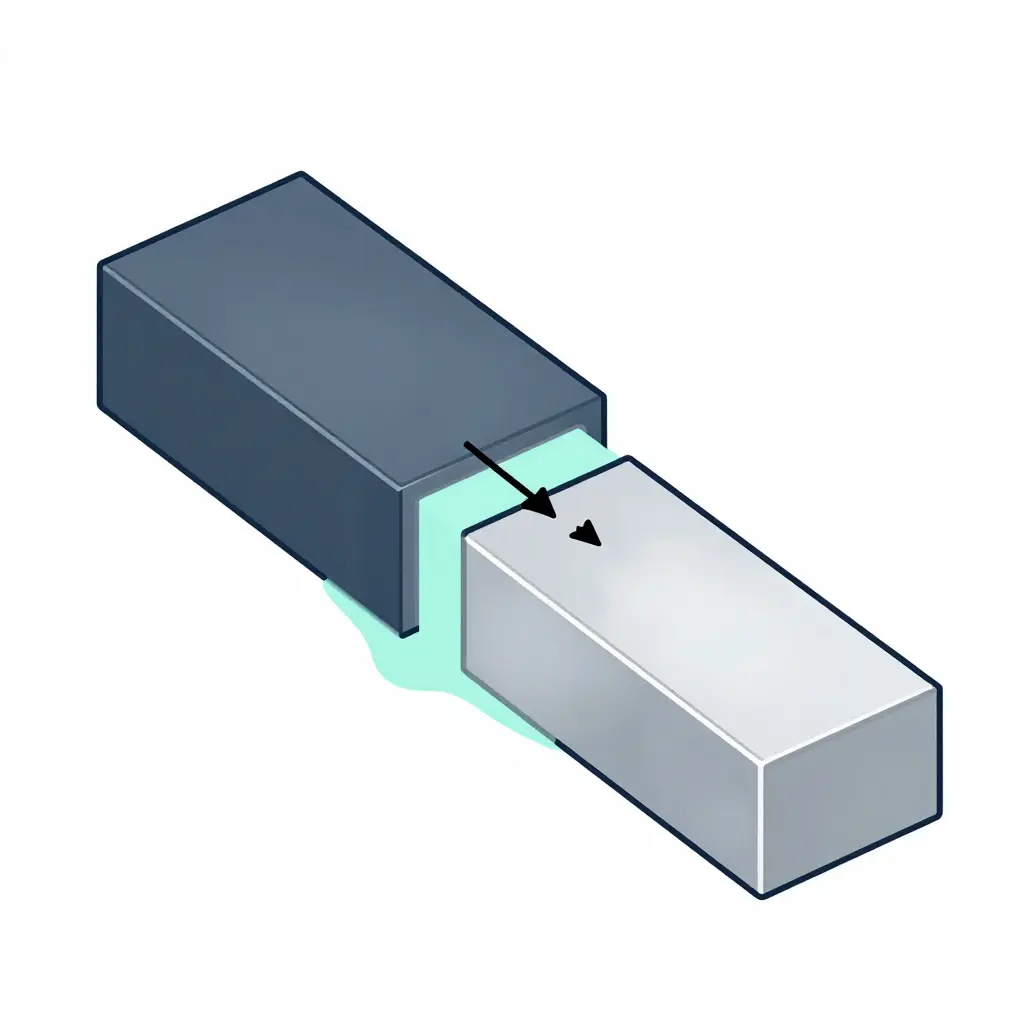
Caption: Steel and aluminum sit far apart on the galvanic series, so any moisture bridging the joint turns that contact point into a tiny battery. That is why isolation between dissimilar metals — insulating washers, sealant, barrier tape — is the most important preventive measure, and why the extra assembly step and labor it demands show up in corrosion repair bills and long-term ownership costs on commercial fire trucks.
Specification and Maintenance Choices That Protect Either Body
Whichever metal a buyer picks, the long-term corrosion outcome depends less on the base metal than on how the body is specified at the order stage and how consistently it is maintained afterward. A few specification decisions and a scheduled upkeep routine keep repair exposure broadly similar across both materials, so the purchase price gap doesn’t get compounded by avoidable body work.
Specify the interfaces before the panels
Dissimilar metals should never touch directly. Where aluminum panels meet a steel subframe or mounting bracket, specify an isolation layer such as barrier tape or a non-metallic gasket, and use barrier washers under fasteners so a bolt never becomes the corrosion bridge between the two. Stainless fasteners fitted with isolating sleeves add little to the build cost and prevent the localized pitting that is expensive to cut out later. Compartment floors, wheel arches and pump areas also benefit from continuous seam seal rather than spot sealing. Isolating hardware is far cheaper to include up front than to retrofit after the first blisters appear, so it belongs in the specification rather than in a later service bulletin: a complete fire fighting truck configuration can be reviewed with these details written in.
Build a routine that fits the duty cycle
- Joint isolation and barrier washers: confirm during pre-delivery inspection that isolating washers, gaskets and sleeves are present at every dissimilar-metal joint, and replace any that are compressed, cracked or missing during service work.
- Undercoating and cavity wax cycles: refresh underbody coating every 24 to 36 months in coastal or de-icing-salt regions, and re-apply cavity wax inside frame rails, door pillars and pump compartment voids where spray cannot reach.
- Drainage and ventilation: keep compartment drain holes clear, fit bug screens rather than sealing vents, and check that hose beds and equipment lockers dry out between calls so standing water never becomes a permanent resident.
- Wash-down schedules: rinse the underbody and chassis after every exposure to road salt, brine or firefighting foam, and wash weekly during heavy foam or chemical use, paying attention to the top of the frame and the inner fender wells.
Inspect coating integrity on a fixed interval
Coating inspection should follow a calendar, not a hunch. Walk the body every quarter, checking seams, fastener heads, panel edges and the underside of compartments for chalking, blistering or exposed base metal. Any break in the coating should be cleaned and recoated within the same service window, since a small touch-up costs a fraction of section replacement. When damage does reach structural panels, sourcing replacement body panels and repair parts early keeps a localized repair from becoming a full-body job and preserves resale value on either material.
Frequently Asked Questions
How large is the purchase price gap between steel and aluminum fire truck bodies?
On a completed apparatus, aluminum typically runs 10% to 20% more than a comparable steel build; the year-1 totals in the table above differ by USD 25,000, or just under 14% of the steel figure. The gap is smallest on simple bodies and widens on heavily compartmented rescue-style builds, where more panel, extrusion and mounting hardware goes into the premium.
| Item | Steel body | Aluminum body |
|---|---|---|
| Body purchase price (mid-size pumper) | Baseline | +10% to +20% |
| Cost per individual corrosion repair | Lower | Higher |
| Typical first corrosion repairs | Year 8 to 12 | Year 12 to 18 |
All figures in this table are indicative estimates and vary by builder, chassis and region.
Does aluminum really eliminate corrosion repair cost?
No. Aluminum does not rust, but it still suffers galvanic corrosion where it contacts steel fasteners, brackets or wet dissimilar metals, and road salt attacks unprotected edges. Most owners carry a lower corrosion repair cost rather than zero, and aluminum fixes usually require certified welding or full panel replacement instead of a patch.
Can a steel body be repaired more cheaply after corrosion damage?
Yes, in most cases. Steel is straightforward to weld, patch and repaint at a local shop, so an isolated corrosion spot usually costs less to fix than equivalent aluminum damage. The catch is frequency. Steel tends to need those repairs sooner and more often, so total lifetime corrosion repair cost can still come out higher even when each job is cheaper.
Which body material suits long-hold fleets versus short-hold fleets?
Fleets that keep apparatus 15 years or longer generally come out ahead with aluminum, because the higher purchase price is spread over many years and resale value holds up better. Fleets that cycle trucks every 7 to 10 years often do better with steel, since the corrosion exposure window is shorter and the upfront savings stay on the books.
How does body weight affect payload and pump performance?
A lighter aluminum body frees up gross vehicle weight for water, foam and equipment, and slightly improves acceleration and braking. Pump output depends on the pump and plumbing rather than on body material, though a lighter body may allow a larger tank within the same chassis rating. Steel bodies carry less payload for the same rating but cost less per pound of structure.
Does climate change the cost comparison?
Yes, considerably. Coastal salt air, heavy road-salt use and year-round humidity accelerate steel corrosion, so aluminum’s repair cost advantage grows in those regions. Dry inland climates with limited winter salting narrow the difference, and steel often remains the more economical choice there.
Inspecting a Corroded Panel: A Simple Decision Path
A corroded body panel almost never calls for a yes-or-no answer. It calls for a scope. Before anyone quotes a number, walk the vehicle and look at two things: how much of the protective coating has failed, and how much base metal has actually disappeared. Blistered coating and light surface staining are cosmetic problems with a limited repair window. Pitting, perforation along seams or rust creeping out from behind a mounted bracket means the metal itself has thinned, and the job has moved into a different budget bracket.
That is why the three-step flow below runs the same way on every truck. It keeps the decision honest and keeps quotes comparable between a steel-bodied heavy-duty fire truck and an aluminum one.

Caption: The flow is the same on every truck; the scope it lands on is what actually moves the invoice. A coating touch-up plus a patch is a small line item, while full panel replacement drags in labor, downtime and repainting. Aluminum also prices that same scope differently from steel, because it needs its own surface prep, filler metal and isolation practice before anything gets sealed and recoated.
Why the Same Three Steps Produce Very Different Invoices
Step one is the cheap one, and it is the step most owners skip. A proper inspection measures remaining metal thickness at the low spots, not just at the visible rust. Two panels that look equally tired can be twenty minutes apart in repair hours once that measurement is on paper.
Step two is where budgets split. A patch is a local repair: cut back to sound metal, splice a formed insert, finish the edges. Panel replacement is a full teardown of trim, wiring, insulation and sometimes the compartment interior. On steel, welding is forgiving and shops are plentiful. On aluminum, heat input, filler alloy and oxide removal are fussier, and any steel fastener left in contact invites galvanic corrosion back within a season.
Step three is the quiet cost driver. Resealing and recoating a repaired steel panel is routine. Doing it correctly on aluminum means restoring the barrier system properly, or the repair area becomes the next failure point.
Questions worth asking any shop before you sign:
- Was metal thickness measured, or only eyeballed?
- Does the quote separate patch labor from full panel replacement?
- Are the sealant and coating systems rated for the metal actually on the truck?
- What warranty applies specifically to the repaired area?
Get those answers in writing, and a quote tells you what you are actually buying.
Matching Body Material to Your Operating Profile
Steel carries the lower purchase price at the point of order. Aluminum costs more on the invoice and gives the premium back through lower corrosion repair spending across the service life, especially where road salt, coastal air and daily wash-down cycles are routine. Which of those matters more depends on your operating profile, not on the spec sheet.
Choose steel when the hold period is short and corrosion exposure is low. A unit that runs limited hours in a dry climate and gets replaced inside a normal budget cycle rarely accumulates enough corrosion damage to erase the upfront saving.
Pay for aluminum when the hold period is long, payload matters and corrosion exposure is high. In that combination, the high-mileage heavy-duty chassis configurations that carry the most body weight and log the most running hours are exactly where the premium earns itself back: weight saved on the body is weight available for water, foam and equipment, and the corrosion repair differential compounds every year the truck stays in service.
Both metals will do the job. How long you keep the truck and what it drives through decide which one costs less, and that answer is rarely the same for two neighboring departments.
Tank size and compartment layout shift both weight and price, so settle those alongside the material choice rather than after it.
Structure the purchase around total cost of ownership rather than invoice price. The invoice is a single number on a single day, while the corrosion repair differential, payload capacity and resale position accumulate over every year the apparatus stays on your roster.