Introduction: Why Foam System Integrity Decides ARFF Performance
Airport fire truck foam system faults rarely announce themselves. They accumulate inside the proportioning hardware, the water and foam tanks and the discharge plumbing, and nobody notices until a rated flow of finished foam is actually needed. ARFF crews get one attempt at an aircraft fire on the apron.
Three faults erode real capability more than any others: proportioning drift, refill time and the response window. Each gets treated as a separate maintenance item, but they interact. A slow drift in the foam concentrate ratio changes the finished foam. A sluggish refill stretches the gap between passes. The response window is what decides whether the truck can close that gap in time.
A capable ARFF platform is defined less by its peak specification sheet than by how well its foam delivery holds up under stress. The vehicles in this review of leading ARFF fire trucks earn their rating through stable proportioning, defensible refill rates and a response window that holds across a full incident.
Understanding how the three variables drive each other lets maintenance teams set inspection priorities and intercept degradation before it reaches the fireground.
Proportioning Drift: The Silent Fault in ARFF Foam Systems
Foam proportioning drift is the slow movement of the foam concentrate-to-water mixing ratio away from its design set point. A nozzle expects 3% AFFF; months later the same system may be delivering 2.5% or 3.6%. Nothing breaks, no alarm sounds and the truck still produces foam, which is what makes drift hard to catch in an ARFF foam system.
Why the Ratio Is Everything
- The mixing percentage decides whether foam blankets a fuel fire or breaks up on contact.
- Too little concentrate means weak, fast-draining bubbles and poor vapor sealing.
- Too much concentrate wastes agent and money and still underperforms.
How Each Proportioner Type Drifts
Induction (venturi) proportioners
- A pressure drop pulls concentrate into the water stream.
- Water flow, back-pressure and nozzle choice all move the suction point.
- Worn or clogged metering orifices cut suction and lower the ratio.
Balance-pressure proportioners
- A diaphragm and control valve match concentrate and water pressure.
- A worn diaphragm or fouled sensing line throws the balance off by a few percent.
- The ratio drifts whenever one side sees a pressure change the other does not.
Around-the-pump proportioners
- Part of the pump output is diverted to drive concentrate into the discharge.
- They need steady pump output; when flow varies, so does the diverted share.
- Pump behavior and proportioning stability are linked as a result – see how fire truck pump capacity shapes reliable foam delivery.
What Acceptable Foam Proportioner Accuracy Looks Like
| Proportioner type | Main drift risk | Typical acceptance band |
|---|---|---|
| Induction | Suction loss, orifice wear | about +/-10% of set ratio |
| Balance-pressure | Diaphragm and sensing drift | about +/-10% of set ratio |
| Around-the-pump | Pump-output variation | about +/-10% of set ratio |
Most field standards accept roughly +/-10% relative to the design percentage across the expected flow range. Tighter tolerances apply where a specific hazard demands it.
Why Small Drift Compounds Into Failure
- Foam quality falls off non-linearly, so a small ratio loss costs more than it looks.
- Below design, drainage time and expansion ratio drop sharply.
- A 15-20% shortfall can push a marginal fire outside suppression limits.
- Drift stacks on other losses: hose friction, elevation and worn nozzles.
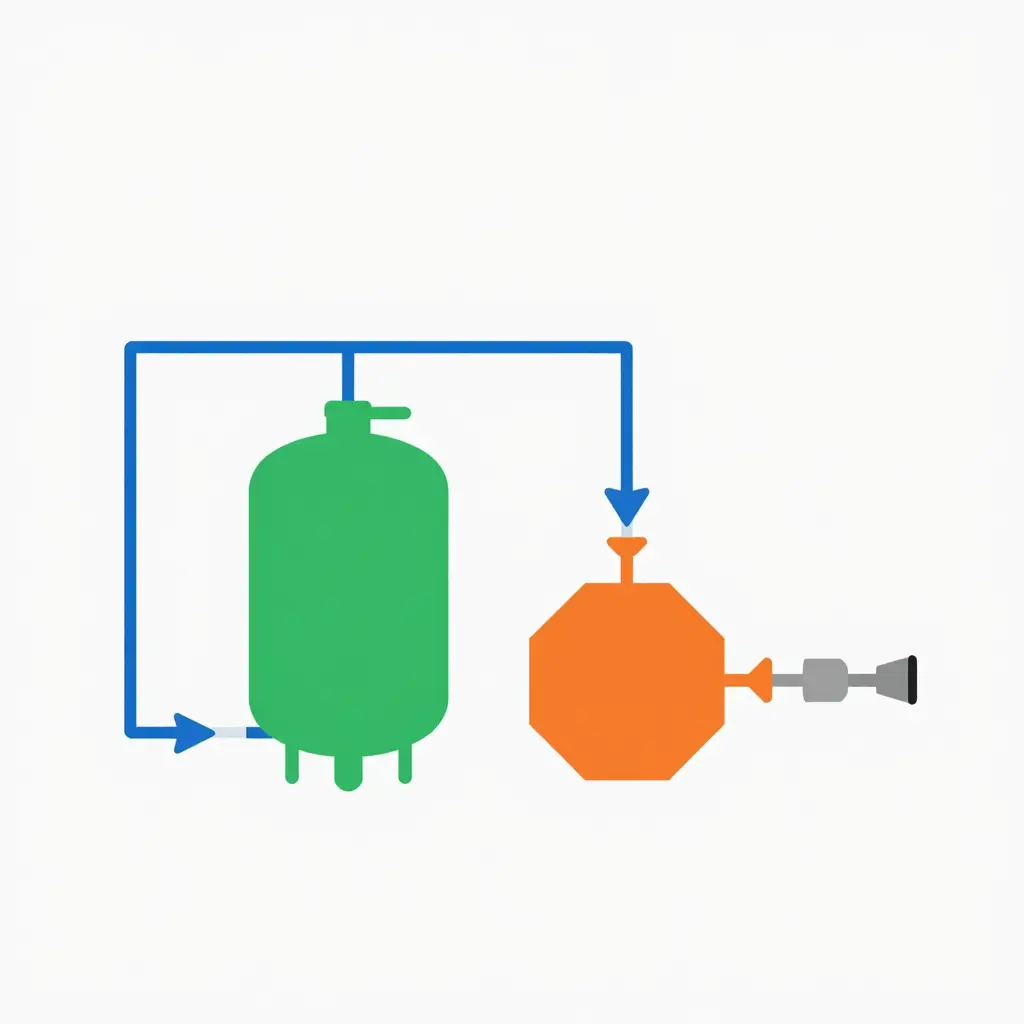
The schematic shows the core flow path of an ARFF proportioning circuit: water in, concentrate drawn from the tank through a proportioning device that meters it into the stream, and a mixing point just upstream of the discharge nozzle. That induction device and mixing junction are where proportioning drift and refill bottlenecks usually start, not at the nozzle itself. How much throughput the water supply line can sustain depends on the pump capacity behind it, which sets the ceiling for consistent foam ratios under load.
Root Causes of Proportioning Drift in ARFF Foam Systems
Proportioning drift is a foam system delivering a concentrate-to-water ratio that slowly leaves its design setpoint. The most common causes of proportioning drift are mechanical, hydraulic or chemical rather than electronic.
Worn or scaled metering orifices. Metering orifices control how much concentrate is drawn into the water stream. Mineral scaling, dried foam residue and abrasive erosion change the effective orifice diameter, so the same pressure differential no longer yields the intended ratio.
Degraded seals and diaphragms. Elastomer seals and balance diaphragms stiffen, crack or swell with age and chemical exposure. Leakage across a compromised diaphragm distorts the reference pressure the proportioner depends on, and the mix carries a persistent bias.
Pump pressure fluctuations. Most proportioners are pressure-referenced, so unstable supply or discharge pressure shifts the concentrate draw. Worn impellers, air ingress and a fluctuating water supply all translate into ratio error.
Foam concentrate viscosity changes. As concentrate ages or sits through temperature extremes, foam concentrate viscosity rises. Flow through fixed orifices changes, and the effective ratio shifts without any hardware fault.
Incorrect calibration after service. Reassembly with wrong spring tensions, swapped jets or unverified flow settings can leave a unit biased from the moment it goes back into service.
Debris in the induction line. Particulate contamination, gelled concentrate or sediment in the induction line restricts flow and starves the proportioner of concentrate.
Regular ARFF proportioner maintenance built on documented flush cycles and traceable service records is the most effective defense. The same fleet discipline applies to vehicle identification: clear, standardized livery, like the reasoning behind high-visibility ARFF vehicle livery, keeps units and their service histories easy to track.
Proportioning Drift: Symptom-to-Correction Quick Reference
Foam proportioning drift rarely sets off an alarm. It shows up as weak blankets, wasted concentrate or a nozzle that suddenly feels wrong. The table pairs common field indicators with the likely root cause, the fastest reliable detection method and the correction a crew can make on the apron. Use it as a first-response checklist on high-capacity ARFF foam trucks before escalating to a full system recalibration; keeping the proportioning system in tolerance protects both response time and agent inventory.
| Fault Indicator | Likely Root Cause | Detection Method | Field Correction Action |
|---|---|---|---|
| Low foam expansion | Blocked air-induction venturi; low compressed-air output | Compare measured expansion ratio against spec; inspect venturi and air lines | Clear venturi debris; verify compressor pressure and air-valve travel |
| Watery foam blanket | Under-proportioning (ratio below set point); weak concentrate pickup | Refractometer or conductivity test at each discharge outlet | Recalibrate proportioner; inspect concentrate pump and check valve |
| Over-concentrated discharge | Stuck metering valve; incorrect viscosity or set point | Draw sample; measure refractive index or Brix against target | Reset metering valve; confirm concentrate batch and ambient temperature |
| Fluctuating ratio | Air entrainment in concentrate line; worn proportioner seals | Continuous flow and ratio monitoring during discharge | Purge air from line; replace seals and diaphragm; bleed fittings |
| Pressure loss at nozzle | Clogged strainer or nozzle screen; partially closed valve | Compare nozzle inlet and outlet pressures with calibrated gauge | Clean or replace strainer; open valve fully; inspect nozzle orifices |
| Foam fails to cling; rapid drain | Degraded concentrate; over-aeration; incorrect expansion class | Drain-time test on fuel pan; check concentrate age and batch | Replace aged concentrate; adjust aeration; confirm correct foam class |
| Slow proportioner response | Sluggish actuator; control-signal lag; low pump RPM | Time the ratio change after each setpoint adjustment | Service actuator; recalibrate controller; check pump drive speed |
How to Use This Table on the Apron
- Start with the indicator, not the theory. Match the visible symptom to the left column, then work right through detection and correction.
- Verify before you adjust. Confirm with a measurement – refractometer, gauge or drain-time test – rather than guessing at the ratio.
- Log every correction. Tracking recurring rows over time shows whether drift is a one-off fault or a systemic wear pattern.
- Escalate early. If two correction attempts fail, the problem is likely calibration or control logic rather than the field-fixable items listed here.
For crews supporting a full fleet, pairing this table with accurate fire truck pump capacity data ensures the proportioner, pump and discharge lines are all sized to the same performance envelope.
Refill Time: The Clock That Defines Your Foam Endurance
Refill time is the total elapsed duration required to return an airport fire truck’s foam concentrate tank to its full operational level after it has been partially or fully drawn down during an incident. In practice it is the interval between “we’re out of foam” and “we’re ready to attack again.” For ARFF operators, it sets a hard limit on the effective suppression window.
Foam tank capacity sets the baseline
Every calculation starts with foam tank capacity. ARFF trucks carry a finite reservoir of concentrate, and once it is depleted, suppression stops until replenishment is complete. A larger tank delays the first refill but never eliminates it. It also leaves more volume to move later, so capacity and refill time stay tied together.
Transfer rate and pump performance
How fast concentrate goes back into the tank depends on the transfer pump and its rated flow. A dedicated transfer pump moves concentrate far faster than a small portable unit, and that difference translates directly into minutes of restored coverage. Slow transfer is a common hidden weakness inside an airport fire truck foam system.
Refill point accessibility
A fast pump is only as good as its reach. If the refill point is distant, congested or blocked, the truck spends minutes maneuvering instead of recharging. Clear, well-mapped access to concentrate supplies matters as much as the pump itself.
Bulk vs. portable refill methods
| Method | Speed | Trade-off |
|---|---|---|
| Bulk refill (tanker or pressurized line) | Fast | Needs infrastructure and clear access |
| Portable refill (drums and pumps) | Slower | Flexible and independent of fixed supplies |
Why refill duration shrinks the suppression window
The effective foam suppression window is the time a truck can actually apply foam, not the time it spends on scene. Every minute spent refilling is a minute not spent suppressing. Friction losses and hose routing stretch transfer time further, so real endurance can fall far short of what nameplate capacity suggests. Planners who want to understand hose length and layout can budget refill realistically and track ARFF foam refill time against the response window they promise.
ARFF Foam Refill Time vs. Post-Refill Readiness Benchmark
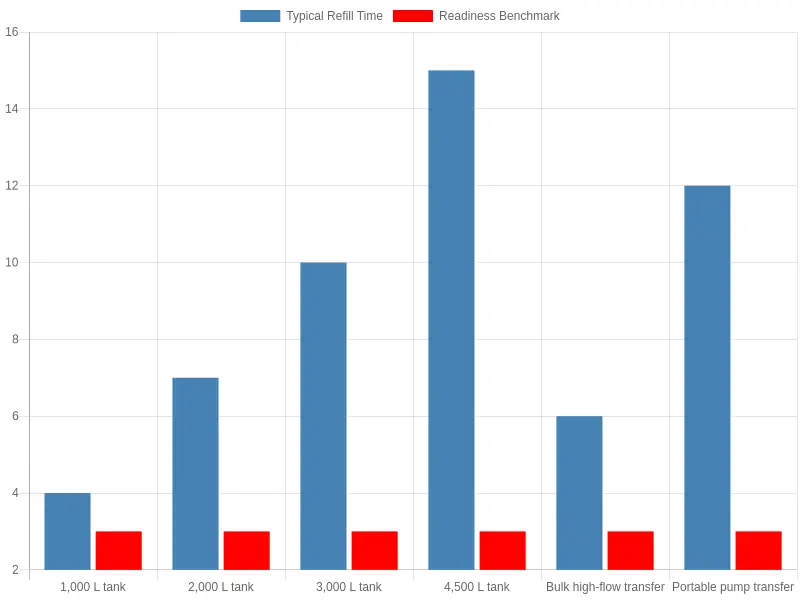
Refill time runs against every ARFF crew. Once a truck empties its foam tank on a running fuel fire, that apparatus is out of the fight until it is back to full strength. The table below gives representative refill times across several tank capacities and transfer methods, measured against a 3-minute post-refill readiness benchmark – the kind of operational window airport safety planners want to see maintained during a sustained incident.
| Tank Capacity / Refill Method | Typical Refill Time (min) | Gap vs. 3-min Benchmark |
|---|---|---|
| 1,000 L tank | 4 | +1 |
| 2,000 L tank | 7 | +4 |
| 3,000 L tank | 10 | +7 |
| 4,500 L tank | 15 | +12 |
| Bulk high-flow transfer | 6 | +3 |
| Portable pump transfer | 12 | +9 |
The pattern is simple. The bigger the foam tank, the wider the gap between actual refill time and the moment the rig is expected to be mission-ready again. A 1,000 L top-up runs one minute over the benchmark; a 4,500 L tank runs twelve minutes past it. Bulk high-flow transfer recovers time by feeding large volumes at once. Portable pump transfer is the slowest method for a given tank because flow is capped by the transfer pump rather than the tank itself. Flow rates drive these numbers, so it helps to understand the relationship between fire truck pump capacity and refill throughput.
Why the gap matters
A minute spent refilling is a minute not delivering foam to a running fuel fire, where temperatures can exceed 1,000 degrees Celsius and the wreckage of a wide-body jet can span over 60 metres. Once the refill gap reaches double digits, a single ARFF vehicle can miss an entire re-attack cycle, leaving crews to lean on mutual aid or hold the line with water alone. Refill time and proportioning drift get treated as twin reliability faults for that reason: a truck that refills slowly is nearly as limited as one that proportions foam incorrectly.
Key takeaways
- Typical refill times range from roughly 4 minutes for a 1,000 L tank to about 15 minutes for a 4,500 L unit.
- Bulk high-flow transfer (about 6 minutes) is the fastest practical method once the tank size grows.
- Portable pump transfer (about 12 minutes) is the slowest method because flow is capped by the transfer pump.
- Only the smallest tanks come close to the 3-minute readiness benchmark; larger rigs routinely overshoot it.
Closing that gap means matching transfer equipment, hose diameter and staging discipline to the tank volume you actually carry. Airport safety teams that map their refill times against the operational window can see where an extra high-flow coupling or a pre-staged bulk tender buys back the minutes that count.
How Foam System Faults Shrink the ARFF Response Window
The ARFF response window is the measurable interval between alarm activation and the moment suppressant actually reaches the fire. It covers the whole chain: alarm, dispatch, travel, positioning, proportioning and discharge. Time lost anywhere along that chain comes out of the margin for knocking down a fuel fire before it escalates.
Between the alarm and foam on the fire, the truck has to accelerate, cross the airfield, reach the incident and establish a foam blanket at its rated flow. The suppression clock stops only once a stable foam layer separates fuel from vapor. Anything that delays that final step, mechanical or procedural, compresses the window.
Proportioning drift eats into the window with no obvious sign. When an inductor or balance-pressure pump drifts from its set percentage, the delivered foam can fall below effective concentration, and crews compensate by extending discharge time and flowing more water and concentrate to reach the same blanketing effect. Slow refill between sorties, driven by tank capacity and pump throughput, adds to the problem by forcing trucks to pause before a second pass.
Because runway and apron coverage depend on achieving rated delivery, foam system reliability is inseparable from the response window itself. A system that under-delivers cannot protect the same area. Operators focused on response speed factors, including how quickly apparatus can reach the scene, must treat proportioning accuracy and refill time as equally critical.
Preventing airport fire truck foam system faults is what preserves the size and dependability of the ARFF response window.
Foam System Maintenance and Inspection Checklist
A disciplined inspection routine is the fastest way to catch proportioning drift and slow refills before they shrink your response window. Use this checklist for every shift handover, post-service validation and pre-flight readiness check.
- Verify the proportioning ratio at multiple flow rates (low, rated and maximum), never a single point check.
- Test induction and balance-pressure valves for correct opening, seating and full-load response.
- Inspect diaphragm and seal condition for cracking, swelling or hardening before every shift.
- Confirm foam concentrate viscosity and age match the manufacturer’s current specification.
- Validate proportioner calibration after any service, repair or component replacement.
- Inspect strainers and lines for debris, sediment and clogging that could restrict flow.
- Time refill operations from empty to full and compare against the response window benchmark.
- Log every test result with date, flow rate and pass/fail status for trend analysis.
- Check pressure gauges and flow meters against a calibrated reference instrument.
- Verify tank level sensors and low-level alarms trigger correctly under static and flowing conditions.
For teams specifying new apparatus, understanding how top ARFF truck manufacturers approach airport safety helps you set realistic baseline tolerances before signing off a purchase.
Standards and Testing Evidence: Proving Foam Systems Actually Work
An airport fire truck’s foam system is only as reliable as the last time someone verified it. Datasheets and factory acceptance tests set the baseline; periodic, documented testing is what turns a claim into evidence. This is where ARFF testing standards, calibration discipline and maintenance culture converge, and where subtle airport fire truck foam system faults first reveal themselves.
Why ratio verification anchors everything
The centerpiece check is the foam proportioning test, which confirms the system injects the intended concentration of concentrate into the water stream across the full operating range. A system that proportions correctly at one flow rate can drift at another, so evidence-based programs verify the ratio at low, mid and high flows instead of a single point. That is the fastest way to catch proportioning drift before it erodes extinguishing performance.
Expansion and drainage benchmarks
Beyond ratio, foam quality is judged by expansion ratio and drainage time – how much finished foam the solution yields and how long it holds water. Together these metrics predict whether a blanket will seal a fuel fire long enough to protect the response window crews depend on.
| Test parameter | What it verifies | Typical schedule |
|---|---|---|
| Proportioning ratio | Correct concentrate-to-water mix across flow range | Acceptance and periodic |
| Expansion ratio | Foam blanket volume per unit of solution | Acceptance and periodic |
| 25% drainage time | Water retention and blanket durability | Acceptance and periodic |
| Calibration checks | Sensor, pump, and valve accuracy | Annual, or per authority |
| Full-flow discharge | Simultaneous monitor and nozzle operation | Per standards cycle |
Annual calibration and the reliability curve
Annual calibration cycles reset the drift that builds up from pump wear, valve seating and sensor aging. When calibration slips, reliability does not fail all at once; it decays until a live response exposes it. Schedules tied to recognized ARFF testing standards keep that decay predictable and measurable.
Designing for testability
The best evidence is the easiest evidence to collect. Many of the leading ARFF truck manufacturers design for testability with accessible test ports, built-in flow meters and diagnostics that log data, so verification stays fast and repeatable rather than an occasional event.
Standards define what good looks like; testing proves you are still there.
FAQ: Airport Fire Truck Foam System Faults
The questions below are the ones firefighting crews, airport safety teams and maintenance staff ask us most often. Small errors in the foam mixture can eat into the response window, so they matter.
What causes proportioning drift?
Proportioning drift happens when the foam proportioner delivers a concentrate ratio that slowly moves away from its set percentage, usually 3% or 6%. Common causes include worn or contaminated flow meters, clogged eductor orifices, air leaks on the suction side, and temperature swings that change foam viscosity. Water with high mineral content can also coat internal surfaces and skew the measured flow over time.
How often should foam proportioners be calibrated?
Manufacturers typically call for calibration checks every 6 to 12 months, plus verification after any repair or nozzle change. High-use ARFF units at busy airports often benefit from quarterly checks, since vibration and heat stress accelerate wear. Always recalibrate after switching foam concentrate brands, because different formulations behave very differently.
What is a typical ARFF foam refill time?
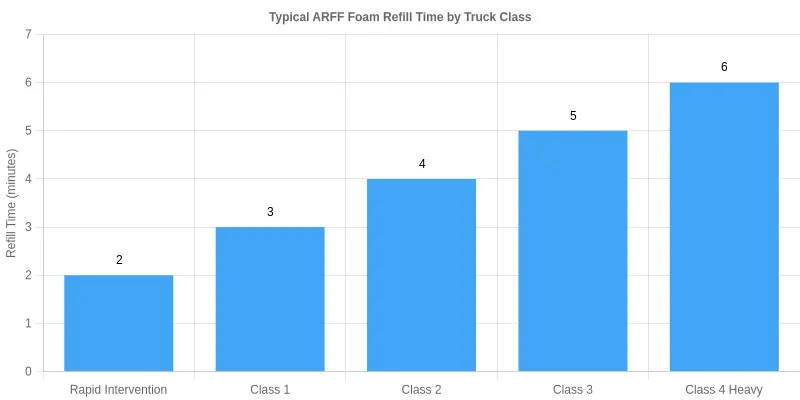
Foam refill time depends on tank size, truck class and pump capacity. On a dedicated high-flow foam supply, most ARFF trucks are back to full in roughly 2 to 6 minutes; rapid intervention vehicles sit at the fast end, while heavy Class 4 trucks take longer simply because of the volume involved. Figures measured by tank volume run higher, up to about 15 minutes for a 4,500 L unit, so it is worth comparing specifications across leading top ARFF fire truck platforms before you buy.
How does proportioning drift affect the response window?
The response window – the critical time from alarm to effective foam application – shrinks when the mixture drifts. A low concentration produces weaker, slower-spreading foam that may fail to blanket a fuel spill, forcing crews to apply more agent and extend the operation. A high concentration wastes concentrate, shortens coverage and can empty the tank before the fire is controlled.
What are the early warning signs of a failing foam system?
Watch for inconsistent foam expansion, a visible change in foam texture or drain time, and pressure fluctuations at the nozzle. Frequent low-concentration alarms, harder-to-draw concentrate and any unexplained rise in agent consumption are reliable red flags. Creeping drift on the ratio display, even by a small percentage, is often the earliest clue that service is due.
Can proportioning drift be corrected in the field?
Yes, minor drift can sometimes be adjusted in the field, but only when you can verify the ratio with an accurate test kit. If readings stay unstable after adjustment, the unit should go out of service for bench testing and parts replacement. A quick tweak does not restore the full response window on its own – confirm it with a measured discharge test.
Conclusion: Where Calibration, Logistics, and the Window Converge
Across this series, three forces have shaped every failure we examined: proportioning drift, refill time and the response window. They are not isolated concerns. They form a single chain, and the strength of a foam system equals its weakest link. Drift undermines the concentration that lets foam extinguish fuel fires; slow refill logistics strand a truck without a sustained second attack; and both compress the window in which an airport incident must be controlled. That is why airport fire truck foam system faults so often stay hidden until real pressure exposes them.
Reliable foam performance rests on three things: disciplined calibration, fast refill logistics and respect for the operational window. No amount of good equipment compensates for the absence of any one of them.
From Reaction to Anticipation
The clearest gains for the industry lie in shifting from reactive repair to anticipation.
- Predictive diagnostics – onboard monitoring that flags proportioning drift before concentration falls out of tolerance.
- Automated proportioning verification – self-checking routines that confirm mix accuracy after every refill and shift change.
- Standardized refill protocols – documented, timed procedures that turn refill from an improvisation into a predictable step.
Each stakeholder owns a distinct part of this agenda:
| Stakeholder | Core Priority | Forward-Looking Action |
|---|---|---|
| Firefighting professionals | Proportioning accuracy | Verify concentration at the start of every shift |
| Airport safety personnel | Refill logistics | Adopt standardized, tracked refill protocols |
| Manufacturers | Early fault detection | Build predictive diagnostics into new apparatus |
| Maintenance crews | Window discipline | Align calibration schedules to response windows |
A Closing Standard
For ARFF truck manufacturers and the crews who operate their machines, the message is the same: reliability is bought once and maintained continuously through verification, preparation and discipline. When calibration is trusted, refill is routine and the response window is respected, foam systems perform as designed each time they are called.