Airport fire truck manufacturers build their product lines around two numbers that tender evaluations weigh above almost everything else: ARFF chassis payload and agent capacity in tenders. An Aircraft Rescue and Firefighting (ARFF) truck has to reach a runway accident within minutes and put water, foam, and dry chemical onto burning aviation fuel. Rapid acceleration and large onboard agent tanks pull in opposite directions. A bigger tank calls for a heavier chassis, larger axles, and a longer wheelbase; a lighter chassis caps how much extinguishing agent the truck can bring to the scene.
That tension shapes how manufacturers position their platforms and how airport authorities write procurement documents. A tender that specifies an agent volume without a supporting chassis payload tends to attract bids that comply on paper while giving up mobility, braking distance, or traction on soft ground beside a runway. Push payload the other way and cost and maintenance climb without a matching gain in reach. Comparing manufacturers really means comparing how each one resolves the conflict.
Procurement teams shortlisting platforms can start with how established builders handle these constraints in practice, as laid out in this overview of leading ARFF truck manufacturers serving airport safety.
Why Chassis Payload and Agent Capacity Decide Tenders
Two figures usually settle a bid comparison before anyone opens the price sheet: the ARFF chassis payload a vehicle can legally and safely carry, and the total agent capacity in tenders that actually reaches the incident.
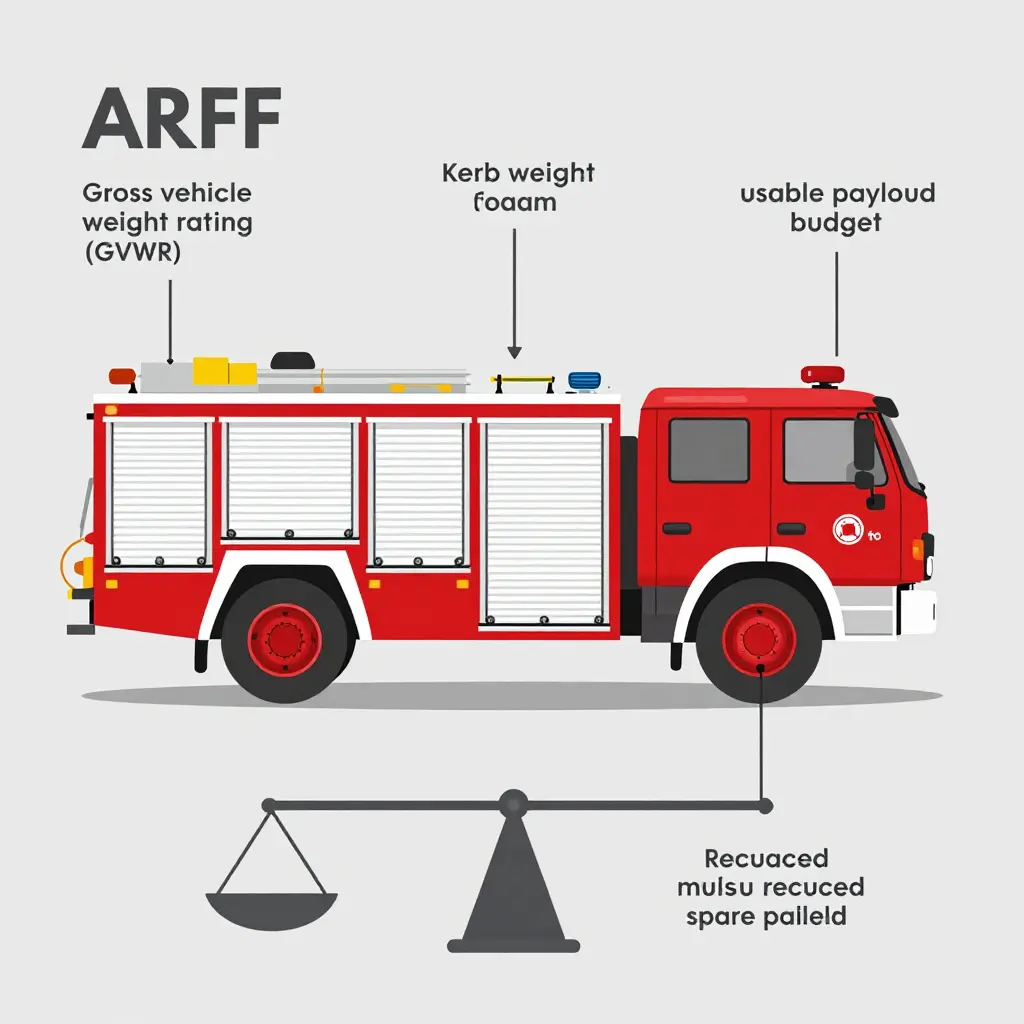
Every ARFF truck has a gross vehicle weight rating (GVWR): the maximum mass its axles, frame, brakes, suspension and tyres are certified to handle. Subtract the kerb weight – the finished truck, pump, plumbing and fuel – and what remains is the payload budget. Water, foam concentrate and dry chemical all draw on it. One litre of water weighs about one kilogram, so a 12,000-litre water tank alone adds roughly 12 tonnes before a single litre of foam is loaded. Go over the GVWR and the truck cannot be registered, or its braking distance and axle life degrade quietly in service.
Category rules then set the floor. The largest aircraft an airport serves fixes its fire category, and that category dictates minimum agent quantities and discharge rates. Larger aircraft need far more water, foam and dry chemical, so the payload ceiling on a given chassis becomes the binding constraint very quickly.
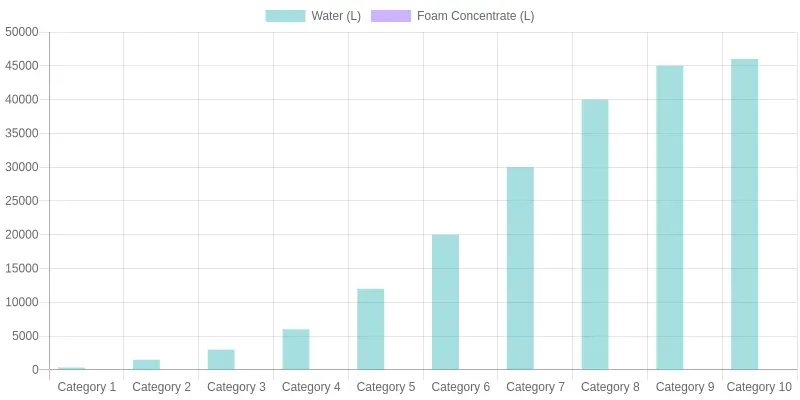
A payload shortfall shows up in two places:
- A smaller tank means more refill cycles, which stretches the window between attack passes and leaves the crash site under-protected.
- Trimming foam concentrate or dry chemical can drop the truck below the mandated category minimum and disqualify it from the tender outright, however attractive the price.
That is why leading airport fire truck manufacturers put so much engineering into chassis layout: extra axles, lighter composite tanks and re-routed plumbing all buy back payload that gets spent on water, foam and dry powder. A bid that ignores the balance rarely survives technical evaluation.
The table below compares leading global ARFF manufacturers on the specifications tenders actually ask about – chassis class, agent capacity and payload strategy – as a neutral screening reference (see our overview of top ARFF truck manufacturers).
| Manufacturer | Typical Chassis Class (GVW range) | Water Capacity (liters) | Foam Concentrate (liters) | Dry Chemical (kg) | Notes on chassis payload strategy |
|---|---|---|---|---|---|
| Rosenbauer | 6×6 ARFF, approx. 30,000-52,000 kg | 12,000-14,000 | 1,500-2,000 | 250 (typical) | Purpose-built ARFF chassis with high-strength alloy body; maximizes agent load within a 6×6 GVW envelope |
| Oshkosh | 6×6 ARFF, approx. 30,000-49,000 kg | 12,000-15,000 | 1,600-2,000 | 250-500 | Integrated chassis-and-body architecture; balances large water volume with acceleration and gradeability |
| E-One | 4×4 to 6×6, approx. 27,000-45,000 kg | 10,000-14,000 | 1,300-1,900 | 250 (typical) | Modular body on commercial or custom chassis; configurable payload for varied mission profiles |
| Magirus | 4×4 to 6×6, approx. 28,000-42,000 kg | 10,000-14,000 | 1,000-1,900 | 250 (typical) | Chassis-integrated body; tuned for European axle-load and road-registration limits |
| Morita | 4×4 to 6×6, approx. 25,000-40,000 kg | 8,000-12,000 | 1,000-1,500 | 200-250 | Lightweight construction to suit Asia-Pacific operating conditions and tighter GVW constraints |
| CIMC Tianda | 4×4 to 6×6, approx. 26,000-42,000 kg | 10,000-14,000 | 1,200-1,900 | 250-500 | Customizable body-and-chassis pairing; payload tailored to individual tender and airport requirements |
All figures are indicative ranges that vary with configuration, axle layout, and local registration limits; confirm exact specifications against each manufacturer’s current tender documentation.
Reading the Payload-to-Agent Ratio
An ARFF fire truck’s gross vehicle weight (GVW) is a fixed budget, and the payload-to-agent ratio shows where the money goes. Every kilogram falls into one of three buckets: the agent load (water plus foam), the hard systems (chassis, drivetrain, pump and boom), and the margin left for crew, tools and reserve capacity. That last bucket is what keeps an ARFF chassis payload legal and stable in service.
The agent share is agent mass divided by GVW, not agent litres on their own. Read the table above one row at a time: a model can advertise an enormous tank and still be the weaker tender if its margin column is thin.
| Model | GVW (kg) | Agent capacity (L) | Agent mass (kg) | Chassis + pump + boom (kg) | Crew & equipment margin (kg) | Agent share of GVW |
|---|---|---|---|---|---|---|
| Rosenbauer Panther 6×6 | 39,000 | 13,000 | 13,650 | 22,800 | 2,550 | 35.0% |
| Oshkosh Striker 6×6 | 37,500 | 11,500 | 12,075 | 23,100 | 2,325 | 32.2% |
| Ziegler Z8 | 40,000 | 14,000 | 14,700 | 22,500 | 2,800 | 36.8% |
| E-ONE Titan Force | 36,000 | 10,500 | 11,025 | 22,475 | 2,500 | 30.6% |
| Morita MAC-8 | 30,000 | 9,000 | 9,450 | 18,500 | 2,050 | 31.5% |
Figures are representative estimates for comparison only.
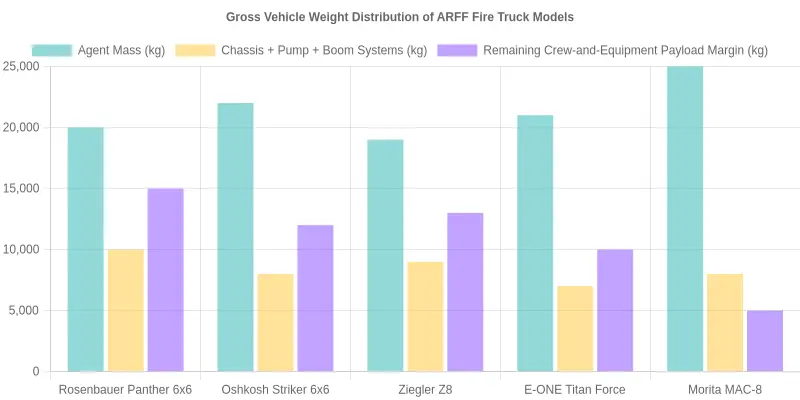
Read the table closely, though. Ziegler Z8 carries the most agent at 14,000 L, but its heavy chassis leaves only 2,800 kg of margin – barely more than the much smaller Morita. E-ONE Titan Force sits at just 30.6% agent share yet keeps a proportionally larger cushion for equipment. The biggest tank is not automatically the better bid.
A higher agent capacity in tenders only helps if the chassis has payload left to carry it. Once the tank consumes the margin, there is nowhere to mount rescue tools, hose or a full crew. Bidders either breach axle limits or quietly strip equipment, and the delivered airport fire truck no longer matches the promise.
When airport authorities review agent capacity in tenders, read the margin column before the tank size, and compare each row against the mission the vehicle actually has to perform. To see how builders resolve the trade-off, look at what distinguishes leading ARFF truck manufacturers.
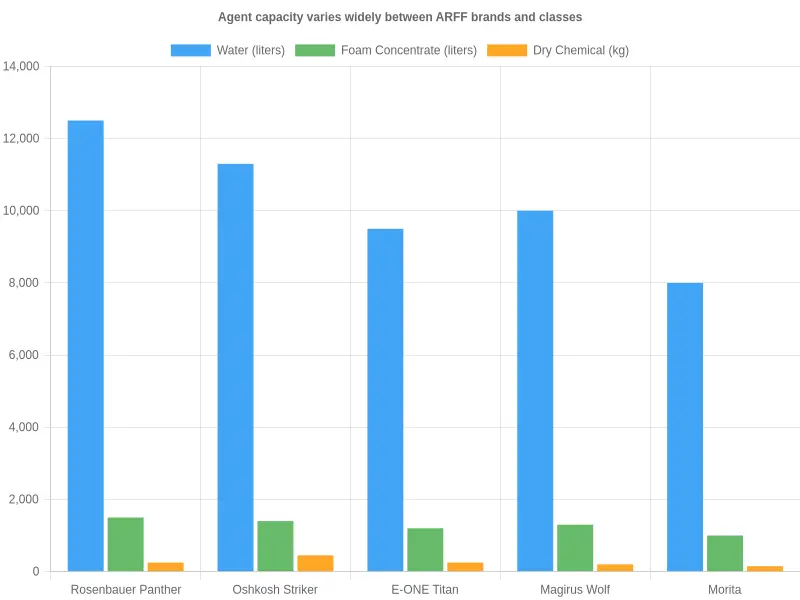
Agent capacity varies widely between ARFF fire truck brands and classes, from around 8,000 liters of water in lighter models to more than 12,500 liters in top-tier platforms.
Manufacturer Deep-Dive: Chassis Payload and Agent Capacity Strategies
Airport fire truck manufacturers compete on a narrow technical margin: how much firefighting agent they can deliver per axle load. ARFF vehicles have to stay stable, accelerate quickly and cross unpaved terrain, so every structural choice about the chassis frames how much water, foam and dry powder a tender can legally and safely carry. The market splits accordingly between purpose-built and converted platforms, each tuned to a different balance of ARFF chassis payload and cost.
Across the sector, leading airport fire truck manufacturers take one of four approaches:
- Dedicated ARFF platforms: purpose-built frames, cabs and drivelines allow a low center of gravity, wide wheel arches and high gross vehicle weight. That frees more mass for agent capacity and generally produces the strongest payload headroom.
- Commercial chassis conversions: reusing established heavy-truck cabs and frames shares parts with road fleets, simplifies service and lowers purchase price, but the donor chassis caps frame stiffness and axle ratings, which limits agent volume.
- High-mobility axle lines: an 8×8 configuration spreads weight across more axles, lowering ground pressure and permitting larger tanks. It suits sand, gravel and cross-country response, where traction and footprint matter most.
- Standard tandem and tri-drive layouts: 4×4 and 6×6 designs remain the majority. They balance maneuverability with payload, and because they are lighter and cheaper they often win tenders where runways are short and airport categories are lower.
How Axle Count Shapes Payload and Tender Competitiveness
Axle arrangement is the clearest predictor of a tender’s specification envelope.
| Configuration | Typical role | Payload headroom | Tender competitiveness |
|---|---|---|---|
| 4×4 | Small airports, cat 4-6 | Moderate | Strong on price and agility |
| 6×6 | Mid-size, cat 6-8 | High | Balanced |
| 8×8 | Large hubs, cat 9-10 | Very high | Wins on agent volume |
Among the top ARFF fire trucks now in service, 6×6 and 8×8 chassis dominate high-category tenders. A manufacturer that reserves payload margin on the chassis can add extra foam concentrate, a larger water tank or a dry chemical system without exceeding axle limits, which makes its bid more competitive where specifications are scored. Builders working from conversions have to trade agent capacity against equipment, so their edge usually rests on lifecycle cost and parts commonality rather than raw volume.
How a Modern ARFF Truck Splits Its Agent Payload
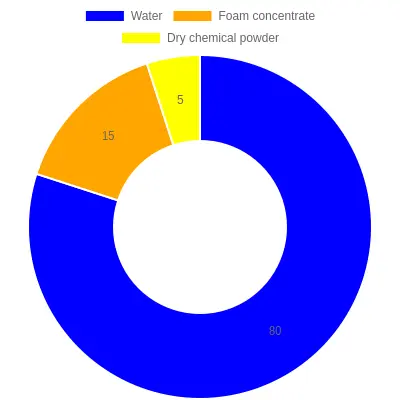
Aircraft rescue and firefighting (ARFF) trucks rarely carry a single extinguishing medium. They blend three so crews can match the agent to the moment: a dominant water reservoir, a smaller tank of foam concentrate that gets proportioned into that water, and a compact charge of dry chemical powder for knock-down punch where foam alone struggles.
Reading the Mix
- Water (80%) – the bulk carrier that absorbs heat and generates steam; most airport tenders chase category compliance by growing this tank first.
- Foam concentrate (15%) – the AFFF or fluorine-free concentrate that, once proportioned, blankets a fuel spill and suppresses vapor.
- Dry chemical powder (5%) – a fast sidelining agent prized for cutting a three-dimensional fuel fire before the foam blanket is fully established.
Why Category Shifts the Slice Sizes
Under ICAO categories 1 through 10, the required discharge rate and total agent volume scale up with the largest aircraft the airfield must serve. That is why the foam concentrate slice expands more than proportionally on higher-category rigs: a Category 9 or 10 truck has to sustain a proportioned foam blanket far longer than a small regional tender. Dry chemical typically stays a thin sliver, because it supplements the foam rather than replacing it.
The chart is a representative blend, not a fixed rule. Real-world splits differ between 6×6 and 8×8 chassis, and operators often trade water for extra foam to shorten agent refill windows during a response. For a closer look at how these trade-offs shape real tenders, see this breakdown of the top ARFF trucks on the market.
How the three agents are proportioned is a direct function of the ARFF chassis payload budget, since every extra litre of water or foam must be bought back by adding axle capacity.
Where CIMC Tianda Fits in the Airport Fire Truck Manufacturing Landscape
CIMC Tianda comes to ARFF from a wider airport equipment business. Its portfolio spans airport ground support and logistics systems, and the company says it is a world leader in passenger boarding bridges. That background is relevant because an airport fire truck does not work in isolation: it responds on aprons, taxiways and around terminals, and a supplier already familiar with gate-side infrastructure and airport logistics brings useful context to ARFF design.
The company says its firefighting and rescue equipment operates across 75 countries through a network of more than 30 subsidiaries, backed by over 20 years of experience in airport and logistics systems. That footprint is the basis for its claims about local service responsiveness, spare parts availability and consistent engineering standards across regions with different regulatory expectations.
How Payload and Agent Requirements Are Addressed in Tendering
In tender settings, the company treats ARFF chassis payload and agent capacity in tenders as linked engineering variables rather than isolated specifications. The chassis has to carry the combined weight of water, foam concentrate, dry powder and monitor systems while preserving the acceleration and gradability that response-time standards demand. Agent capacity is then evaluated against the specific aircraft categories, runway codes and refill assumptions an airport actually faces. Because foam delivery degrades over time, a related technical reference on foam proportioning drift and refill timing helps operators line up tender requirements with realistic performance.
The goal is straightforward: match payload to mission, keep agent volumes credible, and keep equipment serviceable through its life cycle.
Frequently Asked Questions: ARFF Tenders and Specifications
How are agent capacity requirements set by airport category?
The airport’s ICAO or NFPA category sets them. The category follows the size of the largest aircraft in regular service and how often it operates – low movement counts can allow a lower category. Higher categories raise both the minimum discharge rate and the total water, foam concentrate and dry chemical that must be carried on a single vehicle. Match the specification to the published category table, not to a competitor’s truck.
What do GVW limits mean for ARFF chassis payload?
Gross vehicle weight (GVW) is the maximum legal or design mass carried across all axles, so it caps how much equipment a vehicle can haul. ARFF chassis payload is the GVW minus the finished vehicle weight, and everything left over must cover water, foam, dry chemical, crew and tools. When agent loads grow, designers have to trade off fuel, accessory weight or axle ratings to stay compliant.
Does a 6×6 or an 8×8 chassis carry more agent?
An 8×8 chassis generally supports a higher GVW and spreads that mass over four axles, so it can carry more water and foam than a comparable 6×6 in the same category. The extra weight and turning radius can reduce acceleration and apron maneuverability, though, which matters for response-time targets. Compare usable agent volume after accounting for foam system hardware rather than chassis size alone; a well-configured 6×6 can still meet many requirements, as shown in this breakdown of the Rosenbauer Panther 6×6.
How is foam proportioning accuracy verified in tenders?
Usually through witnessed acceptance tests that compare the set proportioning percentage against measured concentrate draw at multiple flow rates. Evaluators often use conductivity meters, refractometers or mass-flow measurements to confirm the delivered ratio stays within a tolerance band such as plus or minus 10 percent. Tender documents should specify the test flow range, the reference method and the permitted drift over a full discharge.
How do manufacturers demonstrate payload margin during evaluation?
Credible airport fire truck manufacturers provide axle-weight tickets and corner-scale readings that show the payload margin remaining under the rated GVW. They may also supply loaded road tests, gradeability data and center-of-gravity reports so evaluators can confirm stability and braking performance. Asking for these documents up front separates suppliers who understand agent capacity in tenders from those quoting optimistic paper specifications.
Why does payload margin matter when comparing bids?
A truck quoted close to its GVW ceiling has little room for added equipment, retrofit foam systems or heavier dry chemical loads later. Comparing payload margin alongside agent volume shows which offer will stay upgradable and safe over a fifteen-year service life. Treat margin as a scored criterion, not a footnote.
Can agent capacity in tenders be met with a smaller vehicle?
Yes, within limits: foam and dry chemical concentrates are lighter than water, so a proportioning-heavy specification can sometimes fit on a smaller chassis. The practical constraint is the required discharge duration at the specified rate, which sets the water volume floor. Where space is tight, a 6×6 with optimized tank geometry may satisfy the category while staying under axle limits.
Conclusion
Comparing airport fire truck manufacturers comes down to how each brand balances ARFF chassis payload against agent capacity in tenders. A vehicle that carries more water, foam and dry chemical still has to respect the axle limits, braking performance and stability thresholds set by the airport category it serves. Buyers who chase maximum agent volume risk oversizing the chassis and eroding the payload margin needed for future upgrades; those who under-specify may fall short of ICAO rescue-and-firefighting response requirements.
Manufacturers separate themselves mainly on chassis philosophy. Some favor a low center of gravity and tight turning circles for apron work; others push modular bodies, fast agent refill and easy maintenance access. Tenders are likely to weigh lifecycle support, component reliability and long-term parts availability more heavily alongside raw performance. Judging airport fire truck manufacturers on that balance helps authorities buy vehicles that meet today’s standards and can still adapt as operations change.